2027 Generative AI in College Degree Programs

Co-Founder and Chief Data Scientist
Many prospective students face challenges transitioning into the Artificial Intelligence field due to limited prior experience and the fast pace of technological advancements. Traditional degree programs often lack flexibility and tailored curricula for those shifting careers. This gap causes uncertainty about which programs best prepare learners for AI roles while accommodating their existing commitments.
Understanding how colleges incorporate generative AI into their degree offerings can clarify this path. This article explores how generative AI is integrated into college programs, highlighting flexible options and accreditation to help readers make informed decisions about entering the Artificial Intelligence industry.
Key Things You Should Know
- By 2026, over 65% of U.S. colleges offer generative artificial intelligence courses integrated into computer science, engineering, and digital arts degree programs, reflecting rapid curriculum expansion.
- Generative artificial intelligence skills are in high demand, with graduates reporting a 20% higher employment rate within six months compared to peers without such training.
- Recent surveys show 58% of college students prefer programs emphasizing ethical use and creativity in generative artificial intelligence, underscoring its interdisciplinary importance.
What is generative AI and how is it integrated into college degree programs?
Generative AI refers to systems that produce content such as text, images, code, or audio by learning patterns from vast data sets. Its growing role in higher education reflects the increasing need for students to develop, apply, and critically assess these technologies.
Colleges integrate generative AI applications in college degree programs through courses in computer science, data science, and digital arts, pairing theory with practical projects featuring GPT-based models and generative adversarial networks (GANs). Different approaches to incorporating generative AI technology in higher education include:
- Specialized classes on neural networks, machine learning algorithms, and ethical challenges linked to AI content creation.
- Interdisciplinary courses merging AI with disciplines like journalism, marketing, or design to foster AI-enhanced media skills.
- Capstone projects and research labs focused on real-world AI tasks such as model tuning, bias identification, and deployment.
- Workshops providing hands-on experience with AI tools that improve writing, coding, and multimedia production.
Demand for generative AI education is significant: 93% of students in 2025 expressed that training in this field should be part of their degree programs, underscoring the importance of AI literacy. To address concerns about ethical use, job displacement, and creativity limits, programs often balance technical training with lessons on transparency, data privacy, and responsible innovation.
For those interested in advancing their knowledge, an accelerated computer science degree offers a pathway to build in-depth expertise and career readiness with a focus on emerging AI technologies.
Which types of artificial intelligence degrees focus specifically on generative AI skills?
Degrees that target generative AI skills are typically found within computer science, data science, and artificial intelligence departments. These specialized programs include tracks such as Generative AI Engineering, Natural Language Processing (NLP), and Machine Learning with generative modeling. Students learn to build and refine models like language models, GANs (Generative Adversarial Networks), and diffusion models that enable text, image, and audio generation.
Undergraduate degrees focused on generative AI skills often cover essential topics like neural networks, unsupervised learning, probabilistic modeling, and ethics in AI development. Many universities offer minors or certificates in generative AI, which complement broader AI or computer science degrees. These programs provide practical experience with key architectures such as transformers and variational autoencoders to design responsible content generators.
Programs emphasizing generative AI combine technical knowledge with applied coursework in creative AI, computational linguistics, and synthetic data generation. For example, an NLP-centered program prepares students to work extensively with language models, reflecting the higher occupational exposure of text-related careers to generative AI technologies. A Federal Reserve analysis reports occupational exposure of 0.76 for language-model-focused roles versus 0.56 for image generation, highlighting greater disruption potential in text-heavy fields.
Students assessing generative AI degree programs in colleges should prioritize curriculum depth in generative techniques, model deployment, and interdisciplinary studies. Hands-on, project-based learning and industry partnerships are key for gaining relevant experience. Prospective students seeking affordable options may consider exploring the cheapest engineering colleges that offer foundational AI programs.
How do online generative AI programs compare to campus-based options in flexibility and outcomes?
Online generative AI college programs offer significant flexibility through asynchronous coursework and self-paced learning, catering well to working professionals and nontraditional students seeking adaptable schedules. In contrast, campus-based generative AI degree outcomes comparison shows structured environments provide face-to-face interaction, immediate feedback, and collaborative projects that foster deeper understanding.
Despite differing delivery modes, skill acquisition and job readiness tend to align when hands-on experiences and practical applications are present. Federal Reserve research highlights Mathematics, Computer Science, Political Science and Government, and Accounting majors as most impacted by generative AI, underscoring the importance of programs integrating AI-related tools.
Online courses typically use cutting-edge AI software and real datasets, while campus programs leverage lab access and faculty workshops for immersive experiences. Prospective students should assess if programs incorporate relevant AI applications, access to updated tools, and strong mentorship irrespective of format.
Recommendations include:
- Evaluating project-based learning focused on generative AI in key majors.
- Considering flexible pacing available in online formats or networking advantages offered on campus.
- Reviewing graduation outcomes and employer partnerships tied to both formats.
Students aiming for AI-centric careers might also explore cybersecurity masters online for complementary skill development aligned with evolving industry demands in generative AI and related fields.
What courses and technical skills are typically taught in generative AI-focused curricula?
Generative AI courses and technical skills in college programs focus on foundational and advanced competencies needed to design, train, and deploy generative models. Core subjects often cover machine learning principles along with deep learning architectures such as generative adversarial networks (GANs) and variational autoencoders (VAEs). Students typically learn essential programming languages and tools for generative AI curricula like Python, TensorFlow, and PyTorch for practical model implementation.
Data preprocessing and management play a crucial role, covering techniques to curate high-quality datasets essential for training effective systems. Natural language processing (NLP) methodologies are also emphasized, enabling the creation of AI systems capable of generating text, dialogue, or code. Many programs expand into specialized areas such as image generation, video synthesis, and music creation using neural networks, while teaching algorithm optimization and evaluation metrics for performance and fairness.
Ethics and bias mitigation are integrated into coursework to prepare students for addressing social impacts and safety concerns linked to generative AI. Capstone projects typically require building practical applications such as chatbots, content generators, or AI art tools, reinforcing real-world problem-solving skills.
The 2026 Lumina Foundation-Gallup State of Higher Education study reports 57% of U.S. college students use AI in their coursework at least weekly, with about 20% using it daily, highlighting widespread adoption in academic settings. For those interested in a fast-paced education pathway, a cyber security fast track program can complement skills in AI and technology fields.
What admission requirements and prior experience do generative AI degree programs expect?
Generative AI degree programs typically require applicants to have a solid foundation in computer science, mathematics, or related technical fields. Most programs expect undergraduate coursework in programming languages like Python or Java, data structures, algorithms, and linear algebra. Experience with machine learning, deep learning frameworks, or AI projects is highly valued and may be required for competitive admission.
Applicants often need to submit portfolios that include research, coding samples, or contributions to open-source AI projects. Graduate programs commonly require a bachelor's degree in STEM disciplines with a minimum GPA of 3.0.
Though standardized tests such as the GRE may still be requested, many institutions have made them optional. Practical experience in AI-focused internships or jobs can strengthen applications, sometimes compensating for lower academic metrics. International candidates usually must demonstrate English proficiency through TOEFL or IELTS exams.
Programs targeting working professionals or lifelong learners often offer part-time or certificate tracks with fewer prerequisites, concentrating on foundational AI concepts and beginner programming skills. A 2026 survey shows 69% of faculty believe AI tools have improved teaching methods, highlighting the expectation that students be ready for AI-enhanced learning and collaboration.
How long do generative AI degree and certificate programs take, and what do they cost?
Generative AI education offers a variety of degree and certificate options that differ in duration and cost based on the level and institution type. Bachelor's degrees usually take about four years full-time, combining core computer science with AI-focused subjects to prepare students for entry-level AI development and research roles.
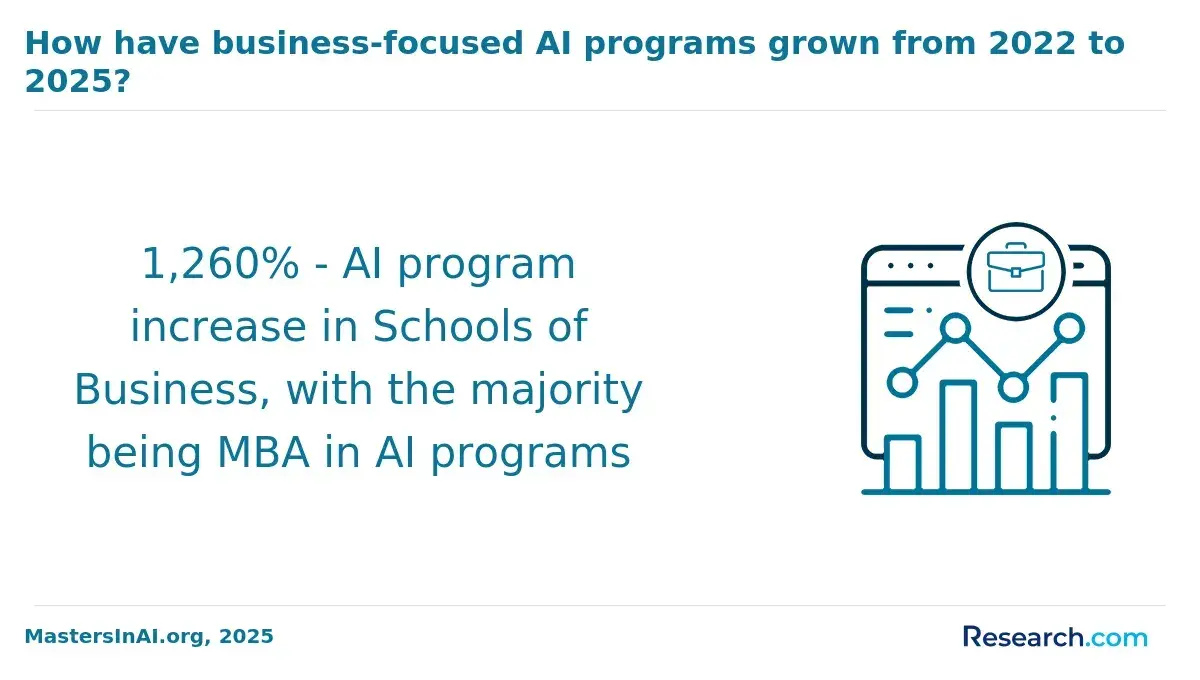
Master's degrees, which have nearly doubled to 310 programs recently, typically require one to two years and delve deeper into generative AI techniques such as natural language processing, computer vision, and machine learning model development.
Certificate programs provide more flexible, shorter-term pathways, usually ranging from a few months to a year. These programs suit working professionals seeking to upskill or transition into AI without committing to multi-year degrees.
Public bachelor's programs often cost between $10,000 and $30,000 per year for in-state students, with private institutions charging more. Master's degrees generally range from $20,000 to $50,000 total. Certificates are more affordable, typically $1,000 to $8,000 depending on program length and prestige.
When selecting a program, consider factors like curriculum relevance, faculty expertise, and research opportunities. With 193 bachelor's and 310 master's AI degrees nationwide, students can find diverse options tailored to their career goals. Researching these programs can help clarify choices and provide detailed information on offerings.
What careers can graduates pursue with training in generative AI, and what do they do?
Graduates trained in generative AI have diverse career opportunities, including AI research scientists, machine learning engineers, data scientists, AI product managers, and natural language processing specialists. AI research scientists develop new generative models and optimize algorithms for applications like creative content generation and autonomous systems. Machine learning engineers focus on designing, building, and deploying scalable AI systems, while data scientists use generative AI to analyze data, generate insights, and create predictive models that influence business strategies.
AI product managers coordinate the integration of generative AI technologies across teams and project phases. Natural language processing specialists develop systems that produce human-like language for chatbots and virtual assistants. Additional roles include AI ethicists who promote responsible AI usage and AI trainers who curate datasets to refine models.
Key industries recruiting these graduates include technology, healthcare, finance, entertainment, and education. For example, healthcare leverages generative AI for drug discovery and medical imaging, while entertainment uses it for video game content and film production. The AI in education sector alone is projected to grow from $7.05 billion in 2025 to $136.79 billion by 2035, reflecting a strong job market and salary potential.
Essential skills include proficiency in Python, frameworks like TensorFlow and PyTorch, and adept data handling. Problem-solving abilities to address AI biases and evaluate model results are vital. This well-rounded expertise equips graduates to innovate and excel in AI-driven fields.
What salary ranges and earning potential can generative AI specialists expect over time?
Generative AI specialists typically start with salaries ranging from $85,000 to $120,000 annually, varying by region and employer. Those with three to five years of experience often earn between $130,000 and $180,000. Senior professionals in leadership or research roles can command salaries above $200,000, reflecting strong demand across sectors like technology, healthcare, finance, and entertainment.
Salary growth is closely linked to skills in model development, deployment, and ethical governance. Specialists familiar with deploying large language models or leading AI policy efforts within organizations tend to reach higher compensation tiers.
Students and professionals should recognize that generative AI is not solely technical. According to Coursera data summarized by Engageli in 2026, only 20% of universities have formal AI policies, while 56% of students and educators feel unprepared to manage AI challenges. This indicates a rising need for experts in ethical and governance issues, which may boost earning potential for those blending technical skill with policy knowledge.
Typical salary ranges include:
- Entry-level roles at startups or mid-sized companies: $85,000-$110,000.
- Experienced professionals at larger firms or with niche skills: $150,000-$200,000.
- Leadership roles combining ethics, policy, and AI tech: $200,000+, often with bonuses or equity.
To maximize long-term earnings, job seekers should cultivate both technical mastery and expertise in AI's ethical implications.
How is accreditation handled for online and campus generative AI programs, and why does it matter?
Accreditation for generative AI programs, whether online or on campus, is governed by regional and national bodies recognized by the U.S. Department of Education. These agencies ensure institutions maintain high academic standards, including curriculum relevance, faculty expertise, and student outcomes. For AI-focused courses, accreditation verifies incorporation of current AI technologies, ethical issues, and practical applications.
This process is crucial because accredited degrees have recognized value in the job market and qualify students for federal financial aid. Rapid advances in generative AI require accreditors to continuously update evaluation standards. For instance, programs must show effective use of AI tools that enhance learning, like adaptive tutors or AI-driven coding assistants.
According to Coursera's 2026 AI in Higher Education report, students in AI-enhanced environments achieve 54% higher test scores, 30% better learning outcomes, and 10× more engagement than peers. Without proper accreditation, students risk attending programs that employers or other schools do not recognize, which can impact credit transfer, certification, and graduate admissions.
It is advised to verify an institution's accreditation status using the Council for Higher Education Accreditation (CHEA) or the Department of Education's database. Maintaining consistent curriculum and assessments across online and in-person AI programs protects students' academic investments and ensures equitable learning experiences regardless of delivery format.
Are there industry certifications or professional standards for working with generative AI tools?
Industry certifications and professional standards for working with generative AI tools are rapidly evolving. Organizations like the AI Certifications Institute and the Global AI Council offer credentials such as the Certified Generative AI Professional (CGAP), which emphasize technical skills, model understanding, and compliance with data privacy laws. These certifications can significantly enhance career prospects by validating practical expertise.
Major tech companies also provide focused training. Microsoft's Azure AI Certification and IBM's AI Engineering Professional Certificate prioritize hands-on experience with generative AI platforms and responsible AI principles, making them valuable for students and professionals aiming for roles in AI development or AI-enabled product design.
Professional standards from organizations like IEEE and ISO increasingly emphasize ethics, bias mitigation, and transparency in AI. Their frameworks recommend best practices for governance to ensure responsible use of generative models. Familiarity with these standards is becoming important as employers expect adherence to ethical AI guidelines.
With a 2026 synthesis showing 86-95% of university students use AI in their studies and usage growing 20-30 percentage points annually, formal certification and alignment with industry standards are critical for career readiness. Prospective students should seek programs integrating these certifications and ethics frameworks to strengthen their credentials within the competitive AI job market.
Other Things You Should Know About Artificial Intelligence
Generative AI can assist in creating content and suggesting ideas, but it does not replace the unique creativity and critical thinking skills of students. It serves as a powerful tool for augmenting human creativity rather than substituting it. Educators emphasize the ethical use of AI to support original thought and learning outcomes.
A strong foundation in mathematics, particularly in areas like linear algebra, calculus, probability, and statistics, is highly beneficial for AI degree programs. These skills are critical for understanding algorithms and model development. However, some programs provide preparatory courses to help students without extensive math backgrounds catch up.
Many AI degree programs incorporate internships and hands-on projects as core components to bridge theory and practice. These opportunities allow students to apply classroom knowledge in real-world settings, collaborate with industry professionals, and enhance employability. Practical experience is often considered essential by both educators and employers in the AI field.
Generative AI is diversifying job roles for AI graduates in 2027, opening opportunities in fields like content creation, healthcare, and finance. Students are increasingly pursuing specializations, such as an artificial intelligence in finance master’s, to capitalize on these emerging roles across various industries.
References
- Generative AI Professional Certification: Your Gateway to the Future https://certiprof.com/blogs/news/generative-ai-professional-certification
- Certified Generative AI Professional | My iACN https://www.iacnetwork.org/certified-generative-ai-professional
- Best AI Courses Online: Free and Paid Options Compared https://hakia.com/news/best-ai-courses-online/
- Board of Governors of the Federal Reserve System https://www.federalreserve.gov/econres/notes/feds-notes/educational-exposure-to-generative-artificial-intelligence-20250226.html
- AI Certification Guide for Companies — 2026 https://www.pertamapartners.com/insights/ai-certification-guide-companies
- How Students Use Generative AI in College: Insights for Faculty - Every Learner Everywhere® https://www.everylearnereverywhere.org/blog/how-students-use-generative-ai-in-college-insights-for-faculty/
- Future of AI in College Education | University of Phoenix https://www.phoenix.edu/articles/online-college/ai-in-online-college-education.html
- Generative AI and Its Transformative Role in Higher Education | Tiffin University https://go.tiffin.edu/blog/generative-ai-and-its-transformative-role-in-higher-education/
- AI Governance in Higher Education: Policies That Enable Innovation https://feedbackfruits.com/blog/ai-governance-higher-education
- Best Generative AI Courses and Certifications in 2026 https://ryantronier.com/resources/generative-ai-courses/