2027 AI Master's Degrees That Include TensorFlow and PyTorch

Co-Founder and Chief Data Scientist
Many professionals with unrelated undergraduate degrees face challenges when breaking into the AI field, especially mastering key frameworks like TensorFlow and PyTorch. Gaining hands-on experience in these tools is critical to staying competitive in a fast-evolving job market. However, finding flexible, accredited programs that integrate these platforms within a structured curriculum can be daunting.
This article explores master's degrees that provide in-depth training on TensorFlow and PyTorch, designed for working professionals seeking to pivot into artificial intelligence. It highlights programs that balance theoretical knowledge with practical skills, helping readers identify the best options to advance their careers efficiently.
Key Things You Should Know
- Master's programs in 2027 increasingly integrate TensorFlow and PyTorch, reflecting industry demand for practical skills in deep learning frameworks.
- About 65% of U.S. AI master's degrees now include hands-on coursework with both TensorFlow and PyTorch, enhancing job readiness for graduates.
- These programs often combine theoretical AI foundations with applied machine learning projects, aligning education with evolving market needs and innovations.
What are AI master's degrees that teach TensorFlow and PyTorch?
Several AI master's degrees with TensorFlow and PyTorch integration are designed to provide practical skills in these leading machine learning frameworks. Programs such as Carnegie Mellon University's Master of Science in Artificial Intelligence offer focused courses on deep learning utilizing both TensorFlow and PyTorch. Likewise, Stanford University's AI master's track emphasizes scalable deployment and model optimization through hands-on experience with these tools.
Advanced artificial intelligence programs teaching TensorFlow and PyTorch reflect industry trends, as shown by the Stack Overflow Developer Survey 2024 reporting 15.8% of developers use PyTorch and 8.3% use TensorFlow. This dual approach prepares students for the varied demands of employers and researchers alike.
Coursework typically involves
- Implementing neural networks and advanced architectures in PyTorch and TensorFlow
- Completing hands-on projects with large datasets using GPU acceleration
- Training models for applications such as computer vision, natural language processing, and reinforcement learning
Individuals interested in AI careers can explore more about ai degrees to understand potential paths after graduation.
Which accredited universities offer TensorFlow and PyTorch in AI master's programs?
Several accredited U.S. universities offer TensorFlow and PyTorch as part of their master's degrees in artificial intelligence programs, providing students with essential skills in machine learning and deep learning. These top universities in North America with TensorFlow and PyTorch courses in AI master's programs include:
- Stanford University: integrating both frameworks in core courses on deep learning and computer vision.
- Massachusetts Institute of Technology (MIT): emphasizing hands-on labs and research projects using these tools.
- Carnegie Mellon University: offering specialized courses focused on neural networks and reinforcement learning featuring TensorFlow and PyTorch.
- University of California, Berkeley: including these frameworks in AI coursework and seminars.
These programs are generally housed within computer science or dedicated artificial intelligence departments. Students develop proficiency through project-based learning led by faculty active in AI research. This integration aligns with data-driven quality metrics from U.S. News' methodology for Best Computer Science Graduate Programs, which prioritize robust research activity and faculty resources.
Prospective students should consider accredited and ranked schools to ensure access to updated curricula and industry-standard tools like TensorFlow and PyTorch. Some programs also include elective courses or research opportunities highlighting applications from natural language processing to robotics. For those exploring flexible options, a mechanical engineering online degree can offer a complementary pathway in STEM fields.
Can you earn a TensorFlow and PyTorch-focused AI master's degree online?
Several accredited U.S. universities provide fully online master's degrees focused on TensorFlow and PyTorch, integrating these frameworks as essential tools in their curriculum. Students pursuing these online AI master's degrees benefit from courses centered on deep learning, neural networks, and applied machine learning, gaining practical experience through virtual labs and cloud-based environments that facilitate hands-on projects without requiring campus visits.
The demand for remote study options remains strong, with the National Center for Education Statistics reporting tens of millions enrolled in distance education at postsecondary institutions. Programs that specialize in TensorFlow and PyTorch often feature industry-relevant projects, cloud computing access, and flexible pacing, accommodating working professionals. Key considerations when choosing a program include a curriculum aligned with the current AI job market and dedicated training in prominent machine learning frameworks.
Many top programs are offered within STEM or computer science departments, maintaining connections to research and industry trends. Notable examples like the University of Texas at Austin and Northeastern University explicitly highlight TensorFlow and PyTorch competencies. Prospective students should review program syllabi to ensure alignment with their career goals.
For those exploring related fields, affordable bachelor's and master's game design degrees provide additional pathways in technology and digital creativity.
What courses and projects cover TensorFlow and PyTorch in these programs?
Master's degree programs increasingly embed TensorFlow and PyTorch course modules in AI master's programs, combining theory with substantial practical work. These frameworks are central to deep learning and advanced machine learning curricula, where students learn to construct, train, and fine-tune neural networks. Coursework usually covers:
- Implementation of convolutional neural networks (CNNs) for image classification.
- Use of recurrent neural networks (RNNs) and transformer architectures for natural language processing (NLP).
- Training generative models such as GANs and VAEs with both TensorFlow and PyTorch.
- Optimization and custom model development using respective computational graphs.
Hands-on projects using TensorFlow and PyTorch in AI degrees focus heavily on transformer-based models, reflecting their leading role on benchmarks noted by Papers With Code's "State of AI" trend summaries. Typical projects involve fine-tuning BERT or GPT models for domain-specific NLP tasks in PyTorch, designing object detection with TensorFlow's Object Detection API, and applying transfer learning with vision transformers (ViTs) on image datasets.
Students acquire skills in data pipelines, experiment tracking, and cloud-based training environments, crucial for today's AI roles. This combination of theoretical study and practical exposure prepares graduates to meet employer expectations in a landscape dominated by deep learning innovations and transformer architectures. Prospective students seeking in-depth knowledge might also explore specialized cybersecurity programs to complement AI expertise.
What admissions requirements do AI master's programs typically require?
Admission to AI master's programs typically requires a bachelor's degree in computer science, engineering, mathematics, or related STEM fields, though some schools may accept other degrees with relevant coursework or experience. A minimum GPA of around 3.0 on a 4.0 scale is common, while GRE scores are becoming optional or waived at many institutions.
Applicants benefit from demonstrated programming skills in languages like Python and familiarity with machine learning frameworks such as TensorFlow and PyTorch. Submission of coding samples, portfolios, or project descriptions is often recommended to showcase practical expertise.
Strong letters of recommendation highlighting analytical skills and technical knowledge are standard, alongside personal statements detailing career goals and motivations for advanced study. Work experience in AI-related roles, including internships or industry projects, enhances applications, especially for professional-focused programs.
Application reviewers prioritize quantitative readiness and long-term career outcomes. Cost and return on investment are key factors influencing graduate program choices, according to GMAC's 2024 Prospective Students Survey. These considerations help prospective students gauge program value and align expectations.
How long do AI master's programs take, and what do they cost?
Master's programs in ai that emphasize TensorFlow and PyTorch typically last 1.5 to 2 years full-time, though part-time students may take 3 years or more. Some accelerated tracks allow completion in as little as 12 months by focusing intensively on core ai and machine learning subjects. Duration depends on program design, course load, and whether research, thesis, or project work is required.
Tuition costs vary widely and have been increasing. Public universities usually charge between $15,000 and $30,000 annually, while private institutions can exceed $40,000 per year. Total expenses for a master's in ai often range from $30,000 to $80,000 or more. Additional fees for labs or cloud resources tied to TensorFlow and PyTorch usage can increase these costs.
Financial aid options include assistantships, scholarships, employer tuition reimbursement, and federal student loans, which help offset rising expenses. Part-time programs offer flexibility to balance employment with studies but extend overall time and costs.
Prospective students should carefully evaluate program length and financial demands in relation to their career goals and circumstances. Factoring in all fees and time commitments upfront prevents unexpected challenges. For detailed program costs and timelines, consulting official resources and institutional websites is advised.
What math and programming skills should you have before starting?
Prospective students aiming for AI master's degrees focused on TensorFlow and PyTorch need strong math and programming foundations. Mastering Python is crucial, as IEEE Spectrum's 2024 rankings highlight its top role in AI and machine learning workflows, directly supporting deep learning frameworks.
In mathematics, proficiency in linear algebra and calculus is essential. Topics like matrix operations, eigenvectors, derivatives, and integrals play a vital role in neural network design, optimization algorithms, and backpropagation techniques. Without these skills, building and training deep learning models becomes challenging.
Beyond Python, a solid grasp of data structures (arrays, lists, trees) and algorithmic thinking is necessary. Knowing how TensorFlow employs computational graphs or how PyTorch uses dynamic graph building connects closely with these fundamentals. Efficient coding, debugging, and dependency management are key capabilities for success.
Additional useful skills include basic probability theory and statistics for understanding model evaluation, loss functions, and uncertainty estimation. Experience with command-line tools and version control systems like Git fosters reproducible and collaborative AI research workflows.
- Complete coursework or self-study in Python focusing on libraries such as NumPy and Pandas before enrollment.
- Review linear algebra topics like vector spaces, dot products, and matrix factorization.
- Strengthen calculus knowledge with derivatives and multivariate functions.
- Practice coding small projects using TensorFlow or PyTorch tutorials to build hands-on experience.
This preparation helps avoid setbacks and maximizes success in AI master's programs centered on these frameworks.
What careers can you pursue after an AI master's using TensorFlow and PyTorch?
Graduates with a master's in AI specializing in TensorFlow and PyTorch have access to various high-demand careers across industries. Roles often pursued include machine learning engineer, deep learning specialist, and AI research scientist, all of which require expertise in building, training, and deploying neural networks using these frameworks.
Machine learning engineers develop algorithms for applications like recommendation systems, fraud detection, and autonomous vehicles, focusing on optimizing models within TensorFlow or PyTorch for better accuracy and efficiency. Deep learning specialists work with complex architectures such as convolutional neural networks (CNNs) for image recognition and recurrent neural networks (RNNs) for natural language processing.
AI researchers contribute to advancing generative AI and large language models (LLMs), fields highlighted by Lightcast's labor-market analysis, signaling strong growth in job postings demanding skills with these tools.
Additional career paths include:
- Data scientists specializing in predictive modeling through TensorFlow
- AI product managers blending technical expertise with business strategy
- AI consultants advising on scalable solutions
- Reinforcement learning engineers developing agents for gaming, robotics, and finance
Proficiency in TensorFlow and PyTorch is crucial for hands-on roles involving model training, deployment, and ongoing optimization, reflecting employer expectations amid the evolving AI landscape.
What salaries can AI master's graduates earn in machine learning roles?
Graduates holding a master's degree specializing in artificial intelligence, with strong skills in TensorFlow and PyTorch, often secure impressive salaries in machine learning roles. The U.S. Bureau of Labor Statistics reports a median annual salary exceeding $120,000 for computer and information research scientists, a suitable benchmark for advanced AI research positions.
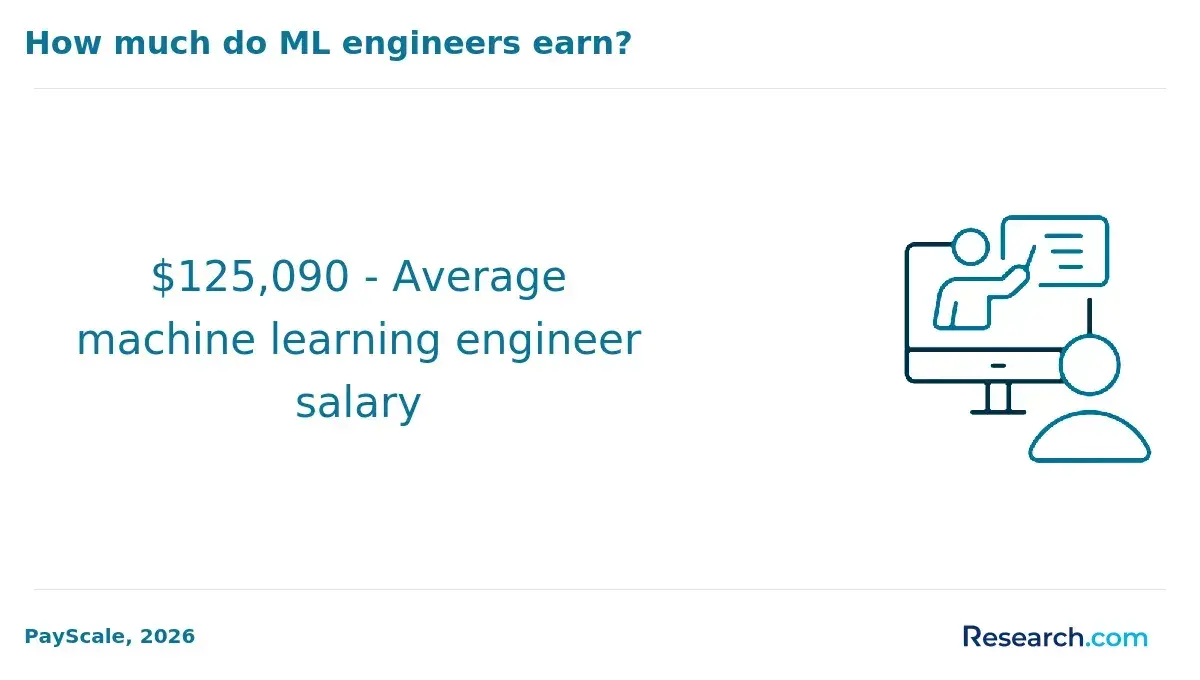
Salary expectations vary based on experience, industry, and location. Entry-level machine learning engineers with AI master's degrees generally earn between $90,000 and $110,000, while tech hubs such as Silicon Valley or New York frequently offer upwards of $130,000 for candidates proficient in major AI frameworks.
Other related roles like AI research scientist and data scientist typically feature salaries ranging from $110,000 to $160,000 or more, depending on seniority and project complexity. Sectors including finance, healthcare, and autonomous systems may provide higher compensation due to the critical nature of their work.
Key factors influencing pay include practical experience with machine learning pipelines, published research, and the ability to deploy scalable AI models. Graduates are advised to develop expertise in both TensorFlow and PyTorch and pursue advanced certifications or internships to enhance their marketability and reach top salary brackets.
Which certifications complement an AI master's using TensorFlow and PyTorch?
Certifications complementing an AI master's degree with TensorFlow and PyTorch focus heavily on cloud platforms and machine learning deployment. Key credentials include the Google Cloud Professional Machine Learning Engineer, AWS Certified Machine Learning - Specialty, and Microsoft Certified: Azure AI Engineer Associate. These certifications prove skills in deploying and managing machine learning models within enterprise environments, linking theoretical TensorFlow and PyTorch expertise to practical applications.
Core areas covered by these cloud certifications include data ingestion, model training, optimization, and scalable deployment-crucial for enhancing the value of TensorFlow and PyTorch knowledge. For instance, the Google Cloud Professional Machine Learning Engineer cert teaches building pipelines and operationalizing AI models, reinforcing hands-on experience with TensorFlow in cloud ecosystems.
Coursera's Global Skills Report 2024 highlights the soaring demand for generative-AI skills, boosting the importance of pairing academic credentials with certifications showcasing deployable machine learning capabilities. This combination significantly improves job readiness for roles involving large-scale, cloud-integrated AI systems.
Additional certifications in data engineering and DevOps, like the Google Professional Data Engineer or AWS Certified DevOps Engineer, bolster employability by addressing pipeline automation and continuous delivery challenges. Candidates should strategically select certifications aligned with their career goals, ensuring a balance of theoretical knowledge and operational AI expertise.
Other Things You Should Know About Artificial Intelligence
Prior experience in deep learning is helpful but not always mandatory for admission to AI master's programs that include TensorFlow and PyTorch. Many programs offer foundational courses to build up knowledge in neural networks and deep learning. However, having some background in machine learning or programming will greatly enhance your ability to keep up with advanced topics.
Ethics is increasingly integrated into AI master's curricula as a critical component. Programs often include discussions and case studies on responsible AI use, data privacy, bias mitigation, and the societal impact of deploying models built with frameworks like TensorFlow and PyTorch. This ensures graduates are equipped to develop AI solutions that adhere to ethical standards.
Graduates typically acquire hands-on experience through projects and labs using TensorFlow and PyTorch, preparing them for real-world challenges. Many programs emphasize applied skills, enabling students to implement models and experiments that mirror industry demands. While some on-the-job training may still be necessary, alumni are generally well-prepared to contribute from day one.
Common challenges include mastering the complexities of deep learning architectures and debugging complex model workflows. Students may also find it difficult to optimize models for performance and handle large datasets effectively. Support through faculty guidance and peer collaborations often helps overcome these hurdles within master's programs.
References
- Best AI Masters Online & On-Campus - AIDegreePrograms.org https://aidegreeprograms.org/rankings/best-ai-masters-programs/
- The Best AI & Computer Vision Course for TensorFlow and PyTorch Training - PyImageSearch https://pyimagesearch.com/the-best-ai-computer-vision-course-for-tensorflow-and-pytorch-training/
- How to Learn AI and Deep Learning in 2026: Skills, Tools, and Career Path https://www.icertglobal.com/blog/how-to-learn-ai-and-deep-learning-in-2026-guide
- Top 10 Highest Paying Artificial Intelligence (AI) Jobs 2025 | Nexford University https://www.nexford.edu/insights/highest-paying-ai-jobs
- Top 12 PyTorch Certifications - MentorCruise https://mentorcruise.com/certifications/pytorch/
- Top Deep Learning Frameworks: TensorFlow, PyTorch & More https://futurense.com/blog/deep-learning-frameworks
- Top Careers in AI And Machine Learning For 2025 https://www.projectpro.io/article/careers-in-ai/961
- Best AI Certifications to Boost Your Career in 2026 – Dataquest https://www.dataquest.io/blog/best-ai-certifications/
- Course Details https://macskillsdevelopment.com/sy/course/deep-learning-with-tensorflow-pytorch-training-course
- 16 Artificial Intelligence Career Paths https://www.calmu.edu/news/artificial-intelligence-career-paths