2027 AI Bachelor's Degree Programs for Students Weak in Math

Co-Founder and Chief Data Scientist
Students aiming to enter the field of artificial intelligence often face a significant hurdle: strong math skills are typically seen as essential for success. This challenge can discourage many from pursuing AI bachelor's degrees, particularly those whose backgrounds are rooted in less quantitative disciplines.
As demand grows for AI professionals, accessible educational paths that accommodate varying math proficiency levels become crucial. This article explores AI bachelor's degree programs designed for students weaker in math, highlighting flexible, accredited options that focus on practical skills and foundational knowledge to help bridge the gap and support career transitions into the AI industry.
Key Things You Should Know
- Many AI bachelor's programs in 2026 offer curricula designed for students weak in math, focusing on practical skills, ethics, and AI applications rather than advanced calculus or linear algebra.
- Approximately 40% of U.S. AI degree programs now provide alternative pathways, including foundational math support or integrated boot camps to foster competency without prior strong math backgrounds.
- Graduates from these math-light AI programs report 15-20% faster employment rates in tech roles emphasizing AI product management, ethics, and human-centered design compared to traditional AI graduates.
What is an AI bachelor's degree, and how much math does it require?
An AI bachelor's degree involves a strong foundation in mathematics, which is essential for grasping artificial intelligence algorithms and systems. Core math topics usually include linear algebra, probability and statistics, and optimization methods, according to ACM/IEEE-CS/AAAI's "Computing Curricula." These areas support understanding neural networks, modeling uncertainty, and enhancing AI model performance.
Students preparing for an ai bachelor's degree math requirements for students should be ready for coursework at least at the level of multi-variable calculus and discrete math. Typically, programs demand between 15 and 30 credit hours of math, often completed within the first two years. Those who find math challenging can sometimes find applied AI tracks or programs offering extra support to better accommodate different skill levels.
Understanding artificial intelligence degree math content is crucial for success in both academic and professional AI fields. Strong math foundations align with industry standards and emerging AI research needs. Students are advised to pick programs with clear math curricula and academic advising to meet these demands effectively.
For students interested in accelerating their education, exploring the fastest way to get a computer science degree may offer valuable pathways to enter the AI field more quickly.
Which AI bachelor's programs are best for students weak in math?
Best AI bachelor's programs for students with limited math skills focus on practical skills, programming, and applying AI tools rather than advanced math theory. These degrees often include hands-on projects and real-world AI applications, making them suitable for individuals who find complex math challenging.
Popular paths include interdisciplinary computer science programs with AI concentrations designed to minimize rigorous math. For instance, courses emphasizing machine learning engineering or AI product development tend to cover essential math like linear algebra and probability, but avoid intensive proofs or abstract formulas.
Demand for generative AI skills has surged dramatically, as noted by Coursera's 2024 Global Skills Report, highlighting the value of degrees centered on applied AI, software frameworks, and project-driven learning over purely theoretical math. This surge supports students pursuing the best AI degrees for students struggling in math by focusing on industry-relevant skills.
Core coursework to consider includes:
- Programming in Python or R for AI development
- Data handling and preprocessing techniques
- Applied machine learning workflows
- AI ethics and applications
Some universities offer AI minors or certificates tailored for students with weaker math backgrounds, which enhance career-relevant expertise in sectors like marketing, healthcare, and business analytics. When researching options, carefully review math prerequisites and prefer programs with flexible requirements or remedial support.
Many also provide cooperative education opportunities, fostering experience without excessive math demands. For alternative STEM options that maintain accessibility, consider an online mechanical engineering degree as a complementary career path.
Can you study AI online without heavy calculus or advanced math prerequisites?
Yes, you can study ai online without advanced math, especially in bachelor's programs designed for students weak in calculus. Many institutions tailor curricula to suit those with varied math backgrounds, focusing on applied ai, data analysis, or machine learning fundamentals that require only foundational statistics and basic linear algebra rather than intensive calculus.
Programs supporting students less confident in math often:
- Offer preparatory or bridge courses covering essential math concepts.
- Use hands-on, programming-based approaches to explain algorithms and models.
- Emphasize practical applications in areas such as natural language processing and computer vision, which rely more on conceptual understanding.
Online ai bachelor's programs for students weak in calculus frequently include interactive labs and visual tools that reduce dependence on abstract math concepts. This flexible design helps aspiring learners prioritize programming languages like Python and applied skills over deep theoretical math, preparing them for roles in ai implementation, product management, and ai ethics.
According to the National Center for Education Statistics (NCES), millions of U.S. undergraduates engage in distance education annually, highlighting broad acceptance of online learning in technical fields. Applicants should verify prerequisites carefully; some programs allow calculus substitution with statistics or discrete math and provide extensive math support or remedial classes online.
For those interested in related fields, exploring game design online programs offers another creative technology pathway that often blends programming skills with lower math emphasis.
What admission requirements matter most for low-math AI bachelor's applicants?
Admission committees are shifting focus for low-math applicants aiming for AI bachelor's programs in 2026. With over 2,000 U.S. four-year colleges adopting test-optional or test-blind policies, standardized math scores carry less weight. Instead, schools emphasize strong performance in related subjects like computer science, logic, and statistics. This approach aligns with the best admission requirements for low-math AI bachelor applicants.
Applicants should demonstrate readiness through high grades in programming, coding boot camps, or extracurriculars such as robotics clubs and software internships. Letters of recommendation that emphasize an analytical mindset and persistence in technical challenges improve an application. Portfolios and personal statements showcasing applied skills in AI-related areas are also highly valued.
Admissions committees often look for demonstrated interest in AI through online courses, competitions like Kaggle, or community AI projects, compensating for weaker math backgrounds. Each program's admissions nuances matter. Some require math placement tests or conditional admission contingent on completing foundational math courses.
Seeking programs with flexible curricula or bridge courses supports low-math students effectively. Applicants should build a holistic profile combining solid STEM grades, coding aptitude, logical reasoning, and clear motivation for AI studies since math scores alone no longer dominate decisions. For those exploring pathways in related fields, consider exploring data science degrees as another flexible option.
Which AI bachelor's specializations rely less on math-heavy coursework?
Specializations in artificial intelligence bachelor's programs that require less math focus on practical and interdisciplinary skills. These include prompt engineering, AI product management, human-centered AI design, and AI policy and ethics. Such tracks emphasize creativity, usability, and societal impacts rather than heavy coursework in calculus or linear algebra.
Prompt engineering centers on designing inputs for large language models (LLMs) and demands strong language skills and a deep understanding of AI workflows without needing advanced math. Lightcast's 2024 labor market data reveals significant growth in prompt engineering job postings, highlighting industry demand for applied LLM expertise.
AI product management combines AI knowledge with business strategy, user experience, and project management, preparing students to bring AI solutions to market without deep mathematical modeling. Human-centered AI design focuses on ethical AI use, usability, and psychological principles, relying on social sciences rather than pure mathematics.
Students less confident in math can pursue these non-math-intensive programs or minors that align with careers in AI application, strategy, and interaction design. Selecting specialized curricula helps ensure education matches the evolving job market.
What courses will you take, and how can you succeed in required math?
Students pursuing a bachelor's degree in artificial intelligence typically study programming, machine learning, data structures, algorithms, statistics, linear algebra, and calculus. These math disciplines form the foundation for understanding models, optimization, and data analysis. Coursework often expands into specialized subjects such as natural language processing, computer vision, and ethical AI.
Hands-on labs and projects using frameworks like TensorFlow or PyTorch enhance practical skills. For those struggling with math, gradual concept mastery combined with practical tools is essential. Strategies include:
- Using visual aids and software such as Wolfram Alpha and GeoGebra to deepen understanding of mathematical functions.
- Taking remedial or preparatory math classes before or alongside AI courses.
- Participating in study groups to collaborate on problem-solving.
- Integrating math lessons directly into coding projects for better comprehension.
- Leveraging AI-driven tutoring platforms to support math learning.
Data from the 2024 Stack Overflow Developer Survey reveals that 83% of developers use or plan to use AI tools, emphasizing practical AI application over theory alone. This trend suggests that strong familiarity with AI development environments like TensorFlow can offset some math difficulties by focusing on coding and experimentation.
Students should seek courses balancing theory with application, use resources that offer intuitive math insights, and build competence through consistent practice. Mentorship and internships help contextualize math within real AI projects, enriching overall learning experiences.
How do you verify accreditation for AI bachelor's programs in the U.S.?
Students interested in AI bachelor's programs in the U.S. should verify the accrediting status of their institutions through reliable sources such as the Council for Higher Education Accreditation (CHEA) or the U.S. Department of Education (ED) database. These platforms list recognized institutional accreditors that ensure program quality and legitimacy.
CHEA's extensive directory includes more than 60 recognized accreditors, covering both regional and national bodies. Regional accreditors like the Middle States Commission on Higher Education and the Western Association of Schools and Colleges are examples of widely respected agencies.
Confirming that a school's AI program is part of an institution accredited by these bodies helps safeguard educational standards. When evaluating an AI program, students should:
- Check if the school provides accreditation information on its official website and verify it through CHEA or ED databases.
- Determine whether the accreditation applies specifically to the ai bachelor's degree or is a general accreditation for the institution.
- Ensure the accrediting agency is recognized by CHEA or the U.S. Department of Education.
Beware of entities claiming accreditation from unrecognized agencies, as these may not guarantee academic quality or eligibility for federal financial aid. Some programs also hold programmatic accreditation in related fields like computer science or engineering, which complements but does not replace institutional accreditation.
For students with challenges in math, verifying accreditation is especially important for transferring credits, qualifying for certifications, and gaining employer trust. Using official databases for transparent verification protects your education investment and future career opportunities.
How long do AI bachelor's programs take, and what do they cost?
AI bachelor's degree programs generally take four years of full-time study, matching the typical undergraduate timeline in the United States. Some universities offer accelerated three-year tracks, while part-time or online programs may extend beyond four years to suit working students or those needing more flexibility. This adaptability benefits students who are weaker in math by allowing extra time to develop essential skills alongside AI coursework.
Tuition costs vary widely based on the type of institution and residency. Public four-year colleges charge an average of about $11,260 for in-state tuition and fees, according to the College Board's 2024 Trends in College Pricing. Private universities often charge two to three times that amount, sometimes surpassing $30,000 annually. Additional expenses for AI-specific resources can add several hundred to a few thousand dollars each year.
Students with weaker math backgrounds may need remedial or prerequisite courses. Many public schools offer AI or data science pathways through computer science departments, typically requiring 120 to 130 credit hours for graduation. Prospective students should explore institutions with tutoring, bridge programs, or other support services designed to improve math proficiency and overall success rates.
What entry-level jobs can you get with an AI bachelor's degree?
Graduates with a bachelor's degree in AI can enter roles that emphasize programming, data analysis, and machine learning fundamentals. Common entry-level positions include AI analyst, data scientist assistant, machine learning engineer trainee, and software developer focused on AI. These roles typically involve building predictive models, working with large datasets, and enhancing automated systems.
Other practical positions like AI support specialist, junior data engineer, AI operations coordinator, and automation specialist offer hands-on experience with managing AI workflows and deploying AI tools without requiring deep theoretical math knowledge.
The National Association of Colleges and Employers (NACE) Winter 2024 Salary Survey reports an average starting salary of $76,000 for graduates in Computer and Information Sciences, a useful benchmark for many AI-adjacent jobs. Industries such as healthcare, finance, marketing, and tech startups value candidates proficient in programming languages like Python and TensorFlow or PyTorch.
Internships and certification courses focused on applied AI roles can boost employability for those concerned about math difficulties. Emphasizing data preprocessing, practical coding, and AI tool deployment remains key to securing entry-level positions in this expanding field.
What salaries and job outlook can AI bachelor's graduates expect?
Bachelor's degree graduates in artificial intelligence can look forward to strong job growth and competitive salaries. The U.S. Bureau of Labor Statistics projects employment for data scientists, a closely related occupation, will grow 35% through 2032, much faster than the average for all fields. This indicates high demand for professionals in AI, machine learning, and analytics roles.
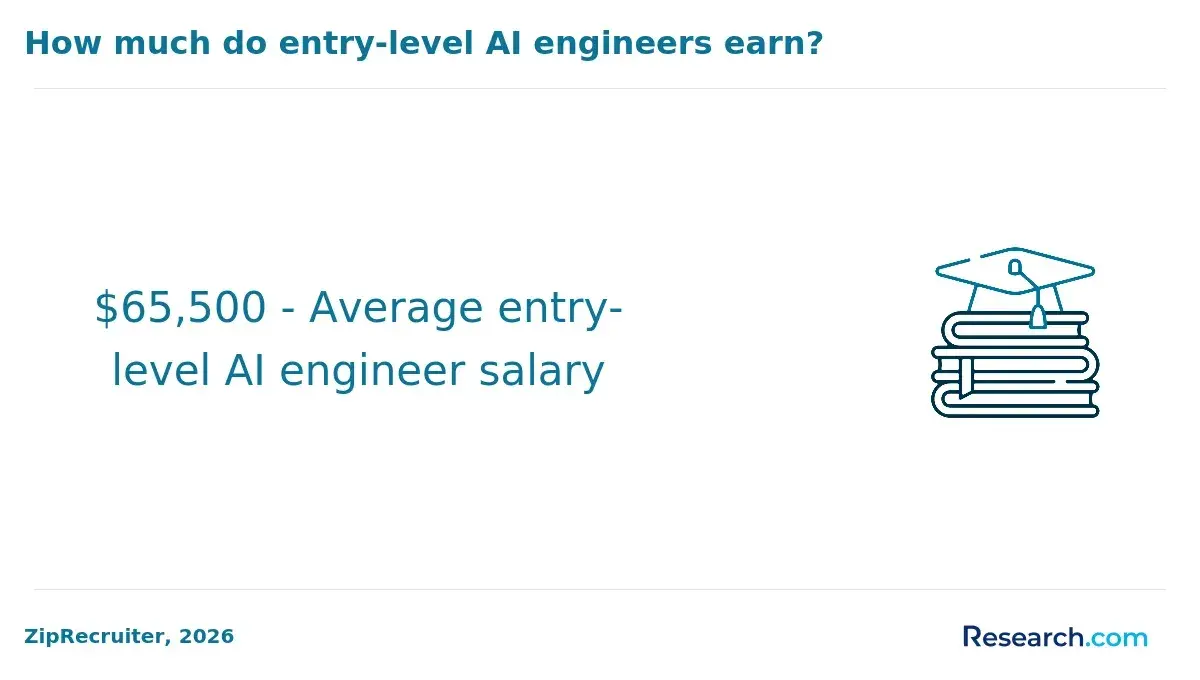
Entry-level salaries for AI bachelor's graduates generally range from $70,000 to $90,000 annually, varying by industry and location. Common starting roles include AI analyst, data analyst, and machine learning technician. With experience and advanced skills, salaries for mid-level positions often reach $100,000 to $130,000 or higher.
Typical job titles include AI developer, machine learning engineer, data engineer, and AI research assistant. Sectors such as healthcare, finance, and technology tend to offer higher pay due to specialized applications and strong demand. Employers favor strong programming and problem-solving skills over advanced math, making AI careers accessible to a broader group of students.
Career growth depends on hands-on experience with AI tools, cloud platforms, and domain-specific software. Completing internships, earning certifications, and working on applied projects enhance employability. Ongoing learning is essential as AI evolves rapidly.
Other Things You Should Know About Artificial Intelligence
Yes, students with limited programming experience can succeed in an AI bachelor's degree with dedication and support. Most programs start with introductory computer science courses designed to build foundational coding skills. Additionally, tutorials, peer study groups, and tutoring services help students overcome initial challenges in learning programming languages commonly used in AI.
Many programs require placement into college algebra or pre-calculus before students take calculus or linear algebra. Students who score below the cutoff may need one or two remedial math courses first, usually worth 3 credits each and not counted toward the AI major.
In 2027, AI bachelor's programs offer math labs, tutoring centers, and tailored courses with a focus on applied math skills to support students weak in math. These resources aim to build foundational skills crucial for AI, ensuring students can progress alongside their peers.
Students can access resources like math tutoring centers, online platforms with adaptive learning tools, and study groups to strengthen their math skills. Some might explore specialized courses or consider pursuing the best master’s programs in AI in healthcare that may cater to diverse academic backgrounds.
References
- What Math do you need to be Good at AI https://www.artificialintelligencemadesimple.com/p/what-math-do-you-need-to-be-good
- Cost to Study Artificial Intelligence in 2026 https://checkmateittech.com/cost-to-study-artificial-intelligence-usa/
- Computer Engineering: Artificial Intelligence https://apply.wseiz.pl/en_GB/courses/course/62-bsc-computer-engineering-artificial-intelligence
- Bachelor in Management and Artificial Intelligence https://www.kozminski.edu.pl/en/programs/undergraduate-programs-bachelor/bachelor-management-and-artificial-intelligence
- What Are the Top AI Degree Programs for Undergraduate Students? https://tetr.com/blog/what-are-the-top-ai-degree-programs-for-undergraduate-students
- Learn AI Without Math? Yes, Here's How https://agentiveaiq.com/blog/can-i-learn-ai-without-being-good-at-math
- Should I Take AI/ML Course With Weak Math? - Rediff Gurus https://gurus.rediff.com/question/qdtl/career/go-ai-ml-course-btech-because-math-039-s-portion/5158274
- Who Accredits Artificial Intelligence (AI) Degree Programs? - AI Degrees Online https://aidegreesonline.com/accreditation/who-accredits-ai-degree-programs/
- Verify Your Accreditation | American Board for International Accreditation https://abia.us/verify-your-accreditation/
- All the Math You Need to Know in Artificial Intelligence https://www.freecodecamp.org/news/all-the-math-you-need-in-artificial-intelligence/