2027 FAFSA vs Private Loans for AI Master's Students

Co-Founder and Chief Data Scientist
Many prospective graduate students aiming for a master's in Artificial Intelligence face a critical funding dilemma. Federal financial aid through FAFSA often offers lower interest rates and flexible repayment, but loan limits and eligibility criteria can restrict access. Conversely, private loans provide higher borrowing caps and faster approval but come with variable rates and less borrower protection.
This contrast creates a challenging decision for those needing to finance advanced degrees while managing future debt responsibly. This article analyzes 2027 FAFSA options versus private loans for AI master's students, helping readers navigate financial choices for a strategic, affordable education investment.
Key Things You Should Know
- In 2026, FAFSA offers low-interest federal loans with income-driven repayment plans, making them generally safer and more affordable for AI master's students than private loans.
- Private loans often require credit checks and may have variable interest rates, increasing total debt burden risks for students without cosigners or strong credit histories.
- Nearly 60% of AI master's students rely on FAFSA aid due to flexible deferment options, while private loans lack standardized forgiveness programs, impacting financial planning.
What is the difference between federal FAFSA funding and private student loans for AI master's degree programs?
Federal FAFSA funding for master's programs in AI differs significantly from private student loans in cost, eligibility, and borrower protections. For instance, federal student loans have a fixed interest rate of 8.05% for the 2024-2025 period, while private loans often charge variable or fixed rates between 10.5% and 12.5%, as noted by LendingTree's 2025 Private Student Loan Report. This variation affects the total repayment amount substantially for AI students.
When comparing federal FAFSA vs private loans for AI master's students, federal loans do not require credit checks or cosigners and offer flexible repayment options like income-driven plans and deferment. Private lenders, in contrast, typically require a credit-worthy cosigner and provide limited repayment alternatives, which can pose challenges for students with fluctuating incomes.
Federal aid also includes subsidized loans, where the government pays interest during enrollment, reducing overall debt. Private loans accrue interest immediately, increasing costs during and after study periods. For example, an AI student borrowing $30,000 federally would save on interest compared to private borrowing.
Additional federal protections such as loan forgiveness and postponements during economic hardship are unavailable with private loans. Prospective students seeking an AI master's degree should prioritize FAFSA applications and understand the differences between federal financial aid and private student loans for AI master's degree programs. Those interested in career paths after their education may explore options through an applied artificial intelligence degree.
How much does a master's degree in artificial intelligence cost, and what are the typical tuition ranges across accredited programs?
The cost of a master's degree in artificial intelligence programs varies significantly across accredited U.S. institutions, generally ranging from $40,000 to $120,000 in total tuition. Top-tier schools such as Carnegie Mellon University charge around $68,000 per year, pushing the total tuition beyond $130,000 for a two-year program. Mid-tier universities offer tuition between $50,000 and $80,000, while some newer or less research-intensive schools present more affordable degrees closer to $40,000.
Tuition differences reflect factors such as program reputation, faculty expertise, research opportunities, and available resources. Programs with strong industry connections often command higher fees but may provide enhanced job placement and internship opportunities. Alongside tuition, students should budget for additional costs including fees, materials, and living expenses, which can range from $15,000 to $25,000 annually depending on the location.
Federal loans through FAFSA provide standardized interest rates and deferment options, yet they might not cover full costs at higher-priced programs. Private loans can supplement funding but tend to have higher interest and less flexible repayment. Prospective students are encouraged to compare total expenses and potential returns when choosing a path in artificial intelligence education.
For those exploring affordable options in engineering-related fields, the option of an online degree in mechanical engineering might also be worth considering alongside AI studies. Evaluating tuition ranges for accredited artificial intelligence master's degrees in the US helps clarify the financial commitments needed for this advanced education.
What are the admission requirements and prerequisites for entering an accredited AI master's program in 2027?
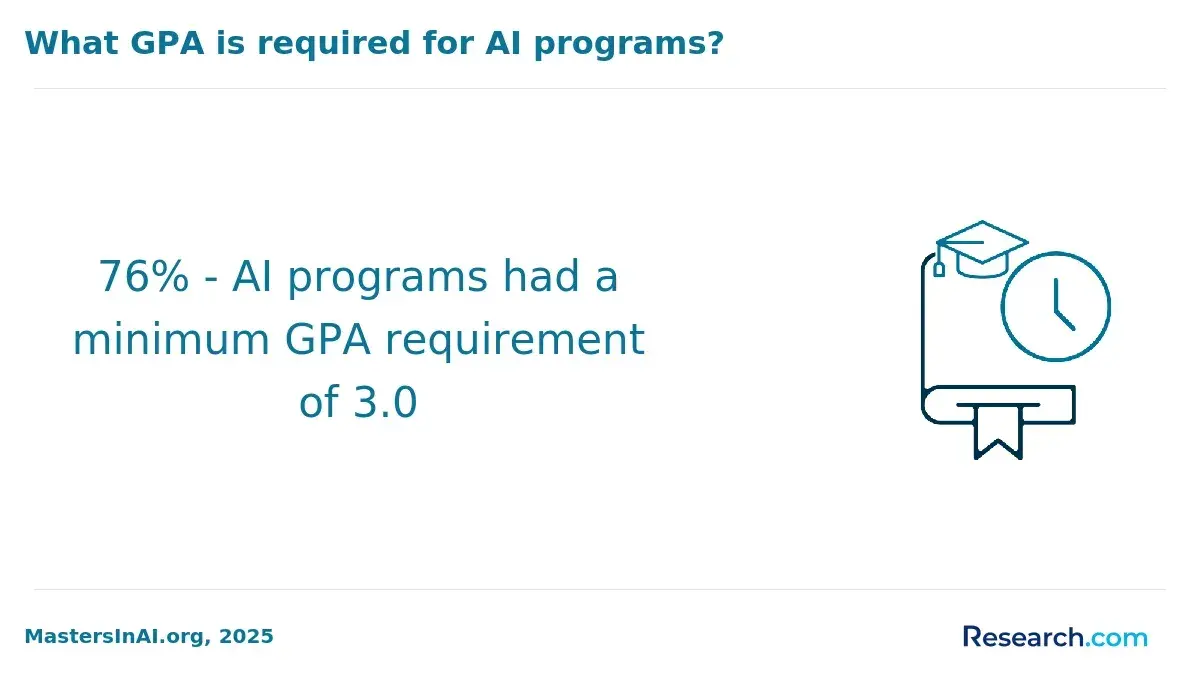
Admission requirements for accredited AI master's programs in the US prioritize a robust academic background in quantitative and technical fields such as computer science, engineering, mathematics, or related STEM areas. Many programs also welcome candidates with significant work experience in AI or data science if they demonstrate strong programming skills in languages like Python, Java, or C++, alongside foundational knowledge of machine learning, statistics, and algorithms. Prerequisites for entering US-based AI master's degree programs typically include academic transcripts showing relevant coursework in calculus, linear algebra, probability, and computer science.
Standardized tests remain important; about 73% of admitted students score 160 or higher in the GRE quantitative section. Though some schools have adopted test-optional policies, a strong GRE quant score still enhances an applicant's chances. Letters of recommendation often come from academic or professional references familiar with the applicant's technical and quantitative abilities. Personal statements should clearly convey research interests, career objectives, and reasons for pursuing an AI master's degree.
International applicants may be required to prove English proficiency through TOEFL or IELTS, unless their degree is from an English-speaking institution. Many programs offer foundation or bridge courses to address gaps in prerequisites. Prospective students searching for affordable options may also consider institutions offering the cheapest online mechanical engineering degree, which can be closely related to AI.
Which career paths and job roles are available to graduates with an AI master's degree, and what employers are hiring?
Graduates with an AI master's degree most commonly pursue roles as AI/ML engineers and data scientists, which together make up 62% of AI-related job openings. AI/ML engineers, who represent 34%, focus on designing and optimizing machine learning models used in various products or services. Data scientists, accounting for 28%, analyze complex datasets to extract insights by combining statistical methods and machine learning techniques. Other roles include AI research scientists, AI product managers, AI software developers, and AI consultants, each with unique contributions ranging from advancing algorithms to managing AI-driven initiatives.
Top employers hiring AI master's degree holders are mainly found in technology, financial services, and healthcare sectors, which together offer 67% of relevant opportunities. Tech companies spearhead innovation and development, financial firms emphasize algorithmic trading and fraud detection, while healthcare organizations leverage AI for diagnostics and personalized medicine. Considering geographic trends is essential; tech hubs like Silicon Valley, Boston, and Seattle offer numerous AI engineering positions, whereas financial hubs such as New York City provide roles blending AI with finance expertise.
Career opportunities for AI master's graduates improve significantly by tailoring resumes to highlight specific skills like TensorFlow or PyTorch for engineering or statistical tools for data science. Networking and involvement with professional AI associations also aid hiring prospects. Exploring education options like a master of data science online can be a strategic step toward entering this competitive field.
What is the average salary for AI master's degree holders, and how does it compare to other advanced tech degrees?
AI master's degree holders start with an average salary of $128,750, according to the 2024 PayScale Salary Report for Advanced Tech Degrees. This is 18% higher than computer science master's graduates, who earn an average starting salary of $109,000, and 42% more than general MBA graduates, whose starting pay averages $90,500. These figures highlight the strong demand and specialized expertise required in AI fields such as machine learning, data analytics, and neural networks.
The AI salary premium reflects employer value on technical specialization, while computer science graduates benefit from broader versatility but generally lower starting salaries. MBA graduates often earn less initially in tech roles due to their focus on management rather than deep technical skills. Salary progression for AI specialists tends to be faster, making it attractive for those evaluating education investments and loan repayment strategies.
Graduates working in research, autonomous systems, or natural language processing frequently report salaries at or above the AI master's average. Meanwhile, computer science graduates may begin with lower pay but access a wider range of tech roles. Aligning career goals with salary data is essential for optimizing education decisions in this competitive sector.
How do online AI master's programs compare to campus-based programs in terms of curriculum, flexibility, and employer recognition?
Online AI master's programs provide curriculum quality comparable to campus-based options, covering key areas like machine learning, natural language processing, and data analytics. Many accredited online degrees share professors and academic materials with on-campus programs, ensuring consistent educational standards. The greatest benefit of online studies is flexibility, enabling professionals and those with personal commitments to learn on their own schedule rather than attending fixed class times.
Employer acceptance of online degrees has improved significantly. The 2024 Coursera-LinkedIn Employer Survey on Online Degrees found that 79% of employers see no difference between online and on-campus AI master's credentials, while 21% prefer online graduates for their demonstrated time management skills. This trend highlights broader recognition of practical skills gained through these programs.
Campus-based programs offer in-person networking, access to labs, and face-to-face mentorship, valuable for hands-on AI model experimentation or teamwork. Still, many quality online programs include virtual labs and interactive forums to emulate these experiences effectively.
Prospective students should evaluate their needs carefully. Online programs deliver rigorous curriculum and strong employer credibility with unmatched convenience for those balancing work or family. Traditional programs remain ideal for those prioritizing immersive learning and direct campus resources.
What is the job market outlook for artificial intelligence professionals over the next five to ten years?
Positions for artificial intelligence professionals are expected to grow by 35% through 2032, a rate significantly higher than the average for most occupations. This surge reflects the rapid expansion of fields like machine learning, natural language processing, autonomous systems, and data analytics, all of which demand specialized AI skills. Industries such as healthcare, finance, automotive, and cybersecurity are increasingly integrating AI expertise, creating diverse opportunities.
Graduates holding a master's degree in artificial intelligence can pursue careers as AI research scientists, machine learning engineers, data scientists, or AI software developers. These roles typically require advanced programming knowledge, strong analytical skills, and some domain-specific experience. Entry-level salaries often start above $90,000 annually, with variations depending on location and employer.
While competition is growing, candidates with robust technical abilities and hands-on experience remain in high demand. Emerging subfields like ethical AI and explainable AI are gaining attention as employers seek professionals who not only advance technology but also address its societal impacts. Job seekers aiming to stay competitive should consider developing expertise in these areas to meet industry priorities.
How long does it take to complete a master's degree in artificial intelligence, and what are the typical program formats?
Master's degrees in artificial intelligence typically take 18 to 24 months to complete full-time, while part-time programs stretch to 3 or 4 years. This flexibility is vital for students balancing work or personal commitments. According to the 2024 National Association of Graduate Admissions Professionals (NAGAP) survey, 58% of AI master's students enroll part-time, underscoring a trend toward adaptable study options.
Full-time programs involve intensive coursework, research, and internships over three to four semesters, covering machine learning, data science, natural language processing, and robotics. These are ideal for students aiming for rapid workforce entry. Part-time formats, including evening, weekend, and online classes, allow students to continue employment while studying. Hybrid models combine online lectures with occasional in-person sessions, adding flexibility.
Some programs offer accelerated or competency-based tracks, enabling students with prior knowledge to finish earlier by completing condensed modules. Yet, most accredited degrees follow the standard timelines to maintain rigorous training. Choice between full-time and part-time depends on career goals, personal situation, and finances. Planning should consider financing options such as FAFSA or private loans to cover tuition throughout the program.
What professional certifications or credentials should AI master's graduates pursue to enhance their career competitiveness?
AI master's graduates significantly boost their career prospects by securing professional certifications in cloud computing, data science, and machine learning. Certifications such as AWS Certified Solutions Architect, Google Cloud Professional Data Engineer, and Microsoft Azure AI Engineer are highly valuable. According to the 2024 Cloud Credentials Impact Study by the Computing Technology Industry Association (CompTIA), individuals who obtain cloud certifications within 12 months of graduation earn 22% more than their non-certified peers. This salary advantage reflects employer demand for verified expertise in deploying AI solutions on cloud platforms.
Beyond cloud credentials, certifications like the TensorFlow Developer Certificate and the Certified Machine Learning Professional (CMLP) validate practical skills in AI frameworks and algorithms. These credentials demonstrate a graduate's readiness to address real-world AI challenges, essential for roles in research, development, and operations.
Data science certifications including the Certified Analytics Professional (CAP) and credentials from the Data Science Council of America (DASCA) enhance proficiency in statistical analysis and managing large-scale data pipelines, complementing AI competencies.
Graduates targeting specific industries should also consider domain-focused certifications. Healthcare IT certifications benefit those entering medical AI fields, while Financial Risk Manager (FRM) accreditation suits professionals interested in AI applications in finance.
How do you evaluate the accreditation and reputation of an AI master's program before enrolling?
Verify if an AI master's program holds ABET accreditation or an equivalent recognized standard to ensure it meets stringent quality criteria in engineering and technology education. According to the 2024 ABET Outcomes Assessment Report, ABET-accredited programs boast a 94% job placement rate within six months of graduation, substantially higher than the 76% for non-accredited programs. This reflects strong employer trust in accredited degrees.
Use official accreditation databases, including the ABET website, to confirm a program's status. Review the faculty's expertise and research output in AI-related areas like machine learning, natural language processing, or computer vision, as robust research often aligns with quality instruction and valuable industry links.
Examine alumni outcomes through university career services or LinkedIn profiles, focusing on employment rates in technology firms or AI startups. The length of time a program has been established and its industry partnerships can also influence curriculum quality and internship prospects.
Other Things You Should Know About Artificial Intelligence
Strong foundations in mathematics, especially linear algebra, calculus, and probability, are critical for understanding AI concepts. Programming skills in languages like Python and familiarity with machine learning frameworks also play key roles. Additionally, analytical thinking and problem-solving abilities help students excel in both coursework and research projects.
Yes, many graduate AI programs offer research or teaching assistantships that provide financial aid through stipends or tuition waivers. These positions allow students to gain practical experience while offsetting education costs. Availability often depends on the institution's budget and faculty research needs, so early application and inquiry are recommended.
Enrolling in an AI master's program offers structured opportunities to connect with peers, faculty, and industry professionals. Many programs facilitate internships, career fairs, and guest lectures from AI experts. These networks can be invaluable for job placement and collaborative research after graduation.
In AI master's programs, ethical considerations are often integrated into the curriculum. This includes studying the ethical implications of AI decision-making, data privacy concerns, and the responsible development and use of AI technologies. By understanding these aspects, students are better prepared to navigate the complex moral landscape they will encounter in their professional careers within AI fields.
References
- Your Roadmap to Earning the Best AI Certifications https://www.usaii.org/ai-insights/your-roadmap-to-earning-the-best-ai-certifications
- Top AI Certifications to Advance Your Career https://whitefiretechnologies.com/top-ai-certifications-to-advance-your-career/
- The Ultimate Guide to Accreditation for Master’s Students https://www.onlinemastersdegrees.org/student-resources/graduate-school-accreditation/
- Best AI Certifications to Boost Your Career in 2026 – Dataquest https://www.dataquest.io/blog/best-ai-certifications/
- University Degree vs AI Bootcamp: Which is Best Career Path? https://agilefever.com/university-degree-vs-ai-bootcamp-which-is-best/
- Federal vs. Private Student Loans: Compare Key Differences - NerdWallet https://www.nerdwallet.com/student-loans/learn/student-loans-federal-vs-private-loans
- 6 High-Paying Jobs With a Master’s in AI | University of Bridgeport https://www.bridgeport.edu/news/high-paying-jobs-with-a-masters-in-ai/
- What Questions Should an Agent Ask Before Selecting a Credential Evaluation Agency? https://www.airc-education.org/what-questions-should-an-agent-ask-before-selecting-a-credential-evaluation-agency
- 16 Artificial Intelligence Career Paths https://www.calmu.edu/news/artificial-intelligence-career-paths
- How to Check if a Graduate Program is Accredited (and Why This Matters) | ProFellow https://www.profellow.com/tips/how-to-check-if-a-graduate-program-is-accredited-and-why-this-matters/