
2027 Best Accelerated BSN to PhD Online Bridge Programs

Co-Founder and Chief Data Scientist
Registered nurses (RNs) working in the United States (US) had a median annual income ($93,600) that is much higher than that of all occupations across the country ($49,500) in May 2024 [US Bureau of Labor Statistics (BLS), 2025]. With a Bachelor of Science in Nursing (BSN), nursing professionals can already earn a significant income, and they can earn even more with a graduate degree.
In 2024, workers with a bachelor’s degree had median usual weekly earnings of $1,543, while those with a doctoral degree had higher earnings, with $2,278 (US BLS, 2025). For nurses, you can explore online BSN to Doctor of Philosophy (PhD) in Nursing bridge programs for potential pay raises and career advancement.
To help you get started, I created this in-depth guide to online BSN to PhD bridge programs. Explore degree programs, admission requirements, financial aid options, income potential, and career outlook.
What are the benefits of completing an accelerated online BSN to PhD bridge program?
- Online BSN to PhD bridge programs can help you land advanced nursing roles, including nursing instructor, nursing administrator, and charge nurse.
- In May 2023, nursing instructors and teachers at the postsecondary level in the US had a median annual wage of $80,780 (US BLS, 2024).
- An online BSN to PhD bridge program offers flexibility, enabling nurses to advance directly into research and academic roles while continuing to work and manage personal responsibilities.
What can I expect from an accelerated online BSN to PhD bridge program?
Students enrolled in online BSN to PhD bridge programs can expect a detailed yet flexible curriculum that combines advanced nursing theory, research methodology, and leadership training. These programs are designed for registered nurses (RNs) aiming to pursue careers in academia, research, or high-level policy development.
Courses usually include statistics, health policy, research design, theoretical foundations of nursing and healthcare, as well as qualitative and quantitative research methods. Students also complete a dissertation focused on original research that contributes to the nursing field.
The online format enables learners to balance professional and personal commitments while progressing through self-paced or structured coursework. Faculty support, virtual mentorship, and interactive learning platforms ensure that students remain engaged and connected throughout the program.
Where can I work with an accelerated online BSN to PhD bridge program?
In 2023, around 3.3 million registered nurses (RNs) worked in the US. The following employers had the largest shares of RN-employees this year (US BLS, 2025):
- Hospitals (State, Local, and Private): 58%
- Ambulatory Healthcare Services: 19%
- Government: 6%
- Nursing and Residential Care Facilities: 5%
- Educational Services (State, Local, and Private): 3%
How much can I make with an accelerated online BSN to PhD bridge program?
In May 2023, nursing instructors and teachers at the postsecondary level in the US had a median annual wage of $80,780 (US BLS, 2024). Meanwhile, registered nurses employed across the country had a 2024 median annual wage of $93,600 (US BLS, 2025).
Notably, advanced practice registered nurses (APRNs), such as nurse midwives, nurse practitioners, and nurse anesthetists, can earn wages that are significantly higher than RNs and nursing instructors. In May 2024, nurse midwives had a median annual wage of $128,790; nurse practitioners had $129,210; and nurse anesthetists had $223,210 (US BLS, 2025). These nursing professionals have earned a master’s degree in their specialization.
- List of Accelerated Online BSN to PhD Bridge Programs for 2027 List of Programs
- How long does it take to complete an accelerated online BSN to PhD bridge program? Completion Time
- How does an online BSN to PhD bridge program compare to an on-campus program? How does an online BSN to PhD bridge program compare to an on-campus program?
- What is the average cost of an accelerated online BSN to PhD bridge program? Program Cost
- What are the financial aid options for students enrolling in an online BSN to PhD bridge program? Financial Aid
- What are the prerequisites for enrolling in an online BSN to PhD bridge program? Prerequisites
- What courses are typically in an accelerated online BSN to PhD bridge program? What courses are typically in an accelerated online BSN to PhD bridge program?
- What types of specializations are available in online BSN to PhD bridge programs? What types of specializations are available in online BSN to PhD bridge programs?
- How do you choose the best accelerated online BSN to PhD bridge programs? How do you choose the best accelerated online BSN to PhD bridge programs?
- What career paths are available to graduates of online BSN to PhD bridge programs? What career paths are available to graduates of online BSN to PhD bridge programs?
- What is the job market like for graduates of online BSN to PhD bridge programs? Job Outlook
- How Do I Assess the Quality and Accreditation of an Online BSN to PhD Bridge Program? How Do I Assess the Quality and Accreditation of an Online BSN to PhD Bridge Program?
- How does an online BSN to PhD bridge program differ from the fastest DNP program? How does an online BSN to PhD bridge program differ from the fastest DNP program?
- How Can Online BSN to PhD Bridge Programs Enhance Interdisciplinary Clinical and Research Opportunities? How Can Online BSN to PhD Bridge Programs Enhance Interdisciplinary Clinical and Research Opportunities?
Accelerated Online BSN to PhD Bridge Programs for 2027: What to Know Before You Apply
A BSN to PhD bridge program is designed for registered nurses who already hold a Bachelor of Science in Nursing and want to move directly into doctoral-level research, teaching, policy, or high-level leadership without completing a separate MSN first. For working nurses, the online format can make doctoral study more realistic, but it also raises important questions: How long will it take? How much will it cost? Is a PhD the right doctorate, or would a DNP be a better fit?
This guide explains how online BSN to PhD bridge programs work, which programs are available in this list, what applicants usually need, how online and campus-based formats compare, and what career paths may follow. It is written for BSN-prepared RNs who are weighing doctoral nursing education and want a practical, decision-focused overview before contacting schools.
The program list below was developed using Research.com’s research methodology. We reviewed available program and institutional information using sources such as the IPEDS database, Peterson's database, the College Scorecard database, and the National Center for Education Statistics.
Quick Answer: Is an Online BSN to PhD Bridge Program Worth Considering?
An online BSN to PhD bridge program can be a strong option if you want a career centered on nursing research, university teaching, healthcare policy, evidence-based practice leadership, or academic scholarship. It is usually not the best choice if your main goal is advanced clinical practice as quickly as possible; in that case, a nurse practitioner pathway or DNP program may fit better.
| Question | Short Answer |
| Who is it best for? | BSN-prepared RNs who want to become nurse scientists, faculty members, policy researchers, or senior research-oriented leaders. |
| How long does it take? | Online BSN to PhD bridge programs commonly take 4 to 6 years, depending on full-time or part-time enrollment, dissertation progress, and program structure. |
| Is it fully online? | Some programs are mainly or fully online, while others include limited campus intensives, synchronous sessions, or in-person research expectations. |
| What is the biggest commitment? | The dissertation. Students must complete advanced research coursework, identify a research focus, work closely with faculty, and produce original scholarly work. |
| What should applicants verify first? | Accreditation, faculty research fit, total cost, required campus visits, funding availability, and whether the program supports the career outcome they want. |
Online BSN to PhD and Related Doctoral Nursing Pathways
The programs below include online BSN to PhD options and one closely related online BSN to DNP pathway. Review each school carefully because degree type matters: a PhD in Nursing is research-focused, while a DNP is practice-focused. Applicants should confirm current admissions requirements, tuition, residency expectations, and funding directly with each university before applying.
1. University of Central Florida
The University of Central Florida offers a BSN to PhD in Nursing pathway with accelerated and part-time study plans. Coursework is delivered online, and students attend two intensives each year. The curriculum covers topics such as nursing science theory, scientific writing, and nursing research. UCF also lists doctoral funding options, including UCF Graduate Fellowships and Nurse Faculty PIPELINE Funding.
- Program Length: 13 semesters (Accelerated); 16 semesters (Part-time)
- Cost per Credit: $369.65 (Resident); $1,194.05 (Non-resident)
- Required Credit to Graduate: 72 credits
- Accreditation: Southern Association of Colleges and Schools Commission on Colleges (SACSCOC)
2. Illinois State University
Illinois State University provides a fully online BSN to PhD in Nursing program that is primarily asynchronous and designed for part-time study. Students complete coursework in areas such as research design, applied research, and theoretical foundations of nursing and health care.
- Program Length: At least 4 years part-time
- Cost per Credit: $422.57
- Required Credit to Graduate: 75 credits
- Accreditation: Higher Learning Commission (HLC)
3. University of Texas at Tyler
The University of Texas at Tyler offers an online BSN to PhD in Nursing pathway. The curriculum includes healthcare informatics, advanced integrative health, advanced statistics, research design, and healthcare policy.
- Program Length: 4 years
- Program Cost: $42,050
- Required Credit to Graduate: Contact the university for information on credit requirements.
- Accreditation: SACSCOC
4. Walden University
Walden University offers an online PhD in Nursing with both BSN to PhD and MSN to PhD entry options. Students can choose from six specializations, including healthcare administration and nursing education. The program also includes a bridge option for students who already hold a Doctor in Nursing Practice (DNP) degree.
- Program Length: 4 years
- Cost per Credit: $805 per quarter credit
- Required Credit to Graduate: 106 quarter credits
- Accreditation: HLC
5. University of South Alabama
The University of South Alabama lists an online BSN to DNP pathway rather than a BSN to PhD pathway. It is included here as a related doctoral nursing option for nurses comparing research-focused and practice-focused doctorates. Available specialty areas include adult-gerontological acute care nurse practitioner, executive nurse administrator, family nurse practitioner, nursing informatics, and psychiatric mental health nurse practitioner.
- Program Length: 10 semesters (full-time); 12 semesters (part-time)
- Cost per Credit: $594
- Required Credit to Graduate: 69 to 87 credits
- Accreditation: SACSCOC
| School | Degree Pathway Listed | Best Fit | Format Notes |
| University of Central Florida | BSN to PhD in Nursing | Nurses seeking a structured PhD route with accelerated and part-time options | Online courses with two intensives per year |
| Illinois State University | BSN to PhD in Nursing | Working nurses who prefer a mainly asynchronous, part-time format | Fully online and primarily asynchronous |
| University of Texas at Tyler | BSN to PhD in Nursing | Nurses interested in research, policy, statistics, and informatics | Online pathway |
| Walden University | PhD in Nursing with BSN to PhD track | Students who want specialization choices in an online doctoral program | Online doctoral format |
| University of South Alabama | BSN to DNP | Nurses comparing a practice doctorate with a research doctorate | Online BSN to DNP pathway |
How Long Does an Accelerated Online BSN to PhD Bridge Program Take?
Most online BSN to PhD bridge programs take about 4 to 6 years. The exact timeline depends on whether you enroll full time or part time, how the school structures master’s-level and doctoral-level coursework, and how quickly you complete the dissertation. Full-time students may finish in about 4 years, while part-time students often need closer to 6 years.
Because BSN-entry students do not already hold a graduate nursing degree, these programs usually combine advanced nursing coursework, research preparation, statistics, theory, and dissertation development. The dissertation phase can be the most unpredictable part of the timeline because it depends on research design approval, data collection, analysis, writing, and faculty review.
| Stage | What Students Usually Do | Why It Affects Timeline |
| Bridge and graduate nursing coursework | Build master’s-level knowledge in theory, leadership, policy, statistics, and research methods | Students entering with a BSN must complete advanced coursework before deeper doctoral research |
| Doctoral research preparation | Develop a research focus, review literature, and refine methodology | A strong faculty match and clear research question can help students progress more smoothly |
| Dissertation phase | Write a proposal, conduct research, analyze findings, and defend the dissertation | This stage often determines whether a student finishes on the planned schedule |
Online flexibility helps many students remain employed, but flexibility does not mean lighter workload. Nurses should realistically plan for reading, writing, statistical analysis, faculty meetings, and long-term research deadlines.
Online vs. On-Campus BSN to PhD Programs: What Changes?
Online and campus-based BSN to PhD programs lead toward similar research, academic, and leadership goals, but the learning experience can be very different. The best format depends on your schedule, learning style, access to faculty, and need for research infrastructure.
| Factor | Online BSN to PhD Bridge Program | On-Campus BSN to PhD Program |
| Schedule flexibility | Often better for working nurses because courses may be asynchronous or offered with limited live sessions | Usually requires scheduled class meetings and more frequent campus attendance |
| Faculty interaction | Mentoring typically happens through video meetings, email, learning platforms, and virtual research collaboration | Students may have easier access to in-person faculty meetings, labs, seminars, and research groups |
| Peer connection | Discussion boards, virtual cohorts, and online intensives can support networking, but students must be proactive | Face-to-face interaction can make informal collaboration easier |
| Research access | Students may rely on digital libraries, remote data sources, local clinical partnerships, or faculty-approved research sites | Campus libraries, research centers, simulation labs, and faculty projects may be more immediately accessible |
| Best for | Self-directed nurses who need location flexibility and can manage independent scholarly work | Students who want frequent in-person mentorship and campus-based academic immersion |
If you are still comparing graduate nursing options, it may also help to review specialized clinical pathways such as accelerated MSN AGPCNP online programs. These are not the same as a PhD, but they may be more appropriate if your primary goal is advanced direct patient care.
How Much Does an Accelerated Online BSN to PhD Bridge Program Cost?
Tuition varies significantly by institution, residency status, credit requirements, and whether tuition is charged by semester credit or quarter credit. Among the programs in this guide, listed tuition examples include:
- University of Central Florida: $369.65 (Resident); $1,194.05 (Non-resident)
- Illinois State University: $422.57
- University of South Alabama: $594
| Cost Factor | Why It Matters | Question to Ask |
| Tuition rate | Per-credit pricing can differ sharply between public, private, resident, and non-resident tuition categories | Is the listed rate the same for online students, and does it change by residency? |
| Total credits | A lower per-credit rate may not mean lower total cost if the program requires more credits | How many credits are required from BSN entry through dissertation completion? |
| Dissertation enrollment | Students may need to remain enrolled while completing research and writing | What tuition or continuing registration fees apply during the dissertation stage? |
| Online and technology fees | Distance learning fees can add to the real cost of attendance | Are online course fees, platform fees, graduation fees, or residency fees required? |
| Travel requirements | Programs with intensives may require airfare, lodging, meals, and time away from work | How many campus visits or in-person sessions are required each year? |
Some nurses decide that a shorter clinical graduate pathway better matches their budget and timeline. For example, a shortest MSN care coordination online option may be worth comparing if the goal is advancement in care coordination rather than doctoral research.
The chart below visualizes tuition information for online BSN to PhD bridge and related doctoral nursing programs using current data from the featured institutions.
Financial Aid Options for Online BSN to PhD Students
Doctoral nursing students may be able to reduce out-of-pocket costs through scholarships, grants, assistantships, fellowships, employer tuition benefits, and university-specific funding. Funding availability can vary by enrollment status, residency, research focus, and whether the student is admitted to a PhD or DNP pathway.
| Funding Option | What It May Cover | What to Confirm |
| University fellowships and assistantships | Tuition support, stipends, research work, or teaching experience | Whether online BSN-entry PhD students are eligible and whether full-time enrollment is required |
| Employer tuition assistance | Partial reimbursement for approved graduate coursework | Work commitments, grade requirements, annual limits, and repayment rules if you leave your job |
| Nursing scholarships | Award amounts vary by sponsor and eligibility criteria | Deadlines, required essays, membership rules, and whether doctoral students qualify |
| Federal financial aid | Loans and other aid for eligible students who complete required applications | Program eligibility, enrollment status, and total borrowing implications |
Examples of scholarship resources mentioned for nursing and healthcare students include:
- Mahoney Family Foundation Scholarship: The Mahoney Family Foundation offers a scholarship program that provides up to $5,000 annually to professionals for educational assistance.
- Arizona Foundation for the Future of Nursing (AzFFN) Scholarships: The AzFFN, the nonprofit philanthropic arm of the Arizona Nurses Association (AzNA), offers scholarship opportunities such as Academic Nursing Scholarships, the Teri Wicker Leadership Scholarship, and the Professional Nursing Scholarship.
- TYLENOL Future Care Scholarship: The TYLENOL® scholarship program awards annual scholarships of $10,000 to 10 qualified students and $5,000 scholarships to 25 additional students.
Admission Requirements for Accelerated Online BSN to PhD Bridge Programs
Admission to a BSN to PhD bridge program is selective because students move into advanced graduate coursework and original research. Requirements vary by school, but applicants are commonly expected to show academic readiness, professional nursing experience, and a clear reason for pursuing doctoral research.
Some applicants reach the BSN after completing earlier nursing pathways, including programs similar to the best online CNA to RN programs. Regardless of the route, the BSN and RN license are central admissions requirements for most BSN-entry doctoral nursing programs.
| Common Requirement | Why Schools Require It | Applicant Tip |
| Bachelor of Science in Nursing (BSN) Degree | Confirms that the applicant has completed undergraduate nursing preparation | Verify that your BSN came from an accredited institution accepted by the doctoral program |
| Active Registered Nurse (RN) License | Shows that the applicant is legally authorized to practice nursing and has professional grounding | Keep your license current and check whether the school requires an unencumbered license |
| Minimum GPA, often 3.0 or higher | Helps programs assess readiness for advanced coursework and scholarly writing | If your GPA is near the minimum, strengthen your application with research experience, strong references, and a focused statement of purpose |
| Research interests | PhD programs need to match students with faculty who can supervise their scholarly work | Review faculty profiles before applying and name specific research areas that align with your goals |
| Professional references and writing materials | Doctoral study requires independent inquiry, academic writing, and persistence | Choose recommenders who can speak to your clinical judgment, leadership, writing ability, and potential as a scholar |
Typical Courses in an Online BSN to PhD Bridge Program
BSN to PhD curricula usually combine graduate-level nursing foundations with intensive research preparation. Students study theory, statistics, research methods, policy, ethics, and dissertation development. The goal is not only to understand existing evidence but also to produce new knowledge that can improve nursing education, systems, policy, or patient outcomes.
Nurses who are more interested in organizational leadership than research may also compare doctoral study with options such as the fastest online MSN nurse executive leadership programs.
| Course Area | What Students Learn | Why It Matters |
| Advanced Nursing Theory | Philosophical, conceptual, and theoretical foundations of nursing science | Provides the framework for scholarly inquiry and dissertation development |
| Research Methods in Nursing | Qualitative and quantitative designs, data collection, and critical appraisal of studies | Prepares students to design rigorous nursing research |
| Biostatistics | Statistical tools used to interpret healthcare and research data | Supports evidence evaluation, data analysis, and publication-quality scholarship |
| Healthcare Policy and Ethics | Policy influences, ethical issues, and decision-making in healthcare and research | Helps nurses connect research findings to systems, governance, and patient outcomes |
| Dissertation Seminar or Research Practicum | Proposal development, literature review, research implementation, and scholarly writing | Guides students through the most important requirement of the PhD |
Common Specializations in Online BSN to PhD Bridge Programs
Specializations allow doctoral nursing students to connect coursework and dissertation research with a long-term career direction. A nurse interested in academic leadership may choose nursing education, while a nurse focused on systems change may look for policy, leadership, or health services research. Nurses exploring administrative roles can also review guidance on how to become a nurse administrator.
| Specialization | Focus | Best For |
| Nursing Education | Curriculum development, teaching strategies, academic assessment, and educational research | Nurses who want to teach in colleges, universities, or professional nursing education settings |
| Health Policy and Leadership | Policy analysis, organizational change, healthcare systems, and health services research | Nurses who want to influence systems, regulation, population health, or institutional strategy |
| Clinical Research and Evidence-Based Practice | Study design, clinical outcomes, implementation science, and evidence translation | Nurses who want to improve care through research and evidence-based interventions |
The chart below shows employment levels for nursing occupations in the US in 2023, based on 2025 data from the US BLS.
How to Choose the Best Accelerated Online BSN to PhD Bridge Program
The best online BSN to PhD program is not simply the fastest or cheapest option. It is the program that matches your research interests, budget, learning style, career goal, and support needs. This is especially important for PhD students because faculty mentorship and dissertation fit can affect both completion and career direction.
If you are still comparing nursing specialties, review the educational expectations for roles such as surgical nursing through resources like how to become a surgical nurse. A PhD is not required for every advanced nursing goal, so clarify the job you want before committing to a doctoral research program.
Key Factors to Compare
- Institutional and nursing accreditation: Confirm institutional accreditation and check whether the nursing program holds recognized nursing accreditation, such as Commission on Collegiate Nursing Education (CCNE) or Accreditation Commission for Education in Nursing (ACEN), when applicable.
- Faculty research alignment: Look for faculty whose scholarship matches your intended dissertation area. A strong research fit is often more valuable than a broad program reputation.
- Online format: Ask whether courses are asynchronous, synchronous, hybrid, or tied to required campus intensives.
- Funding opportunities: Compare fellowships, scholarships, assistantships, tuition waivers, employer benefits, and dissertation support.
- Student support: Prioritize programs with academic advising, writing support, library access, statistical consulting, career services, and technology support for online doctoral students.
- Career fit: If you want advanced psychiatric mental health practice rather than research, a pathway such as fast track MSN in psychiatric mental health nurse practitioner online programs may be more aligned with your goal.
Questions to Ask Before Applying
- How many campus visits, intensives, or in-person research activities are required?
- What percentage of BSN-entry PhD students complete the program?
- How are dissertation advisors assigned?
- Which faculty are currently accepting doctoral students?
- Are online students eligible for the same funding as campus-based students?
- What technology, clinical site, research, or residency fees are not included in tuition?
- What jobs have recent graduates obtained?
- Can students enroll part time without losing funding eligibility?
Career Paths After an Online BSN to PhD Bridge Program
Graduates of BSN to PhD nursing programs often pursue careers in education, research, leadership, policy, and advanced practice environments. A PhD alone does not automatically grant a new clinical scope of practice; clinical roles such as nurse practitioner, nurse midwife, or nurse anesthetist require the appropriate graduate clinical preparation, certification, and licensure.
Some nurses pair doctoral research training with later clinical specialization, including options such as affordable online pediatric NP graduate certificate programs.
| Career Path | How a PhD May Be Used | Median Annual Wage |
| Nursing Instructors and Teachers | Teach nursing students, develop curricula, mentor future nurses, and contribute to academic research | In May 2024, nursing instructors and teachers in the US had a median annual wage of $80,780 (US BLS, 2025). |
| Registered Nurses (RNs) | Lead evidence-based practice initiatives, guide quality improvement, and support research-informed clinical protocols | In May 2024, RNs working in the US had a median annual wage of $93,600 (US BLS, 2025). |
| Nurse Midwives | Combine advanced clinical preparation with scholarly work in women’s health, prenatal care, and childbirth | In May 2024, nurse midwives employed across the US had a median annual wage of $128,790 (US BLS, 2025). |
| Nurse Practitioners | Use research expertise to strengthen clinical practice, policy work, outcomes research, or academic teaching | In May 2024, nurse practitioners had a median annual wage of $129,210 (US BLS, 2025). |
| Nurse Anesthetists | Apply doctoral-level scholarship to anesthesia safety, education, research, and clinical leadership | In May 2024, nurse anesthetists working in the US had a median annual wage of $223,210 (US BLS, 2025). |
Nurses interested in behavioral health careers may also compare doctoral research pathways with information on psychiatric nurse practitioner salary and career preparation.
The chart below compares median annual wages for nursing occupations in the US in May 2024, using 2025 data from the US BLS.
Job Market Outlook for BSN to PhD Nursing Graduates
The employment outlook for doctoral-prepared nurses depends on the role they pursue. PhD-prepared nurses may work in universities, healthcare systems, research centers, policy organizations, government agencies, or leadership positions. Demand is influenced by nursing workforce needs, the need for faculty, healthcare system complexity, and continued emphasis on evidence-based care.
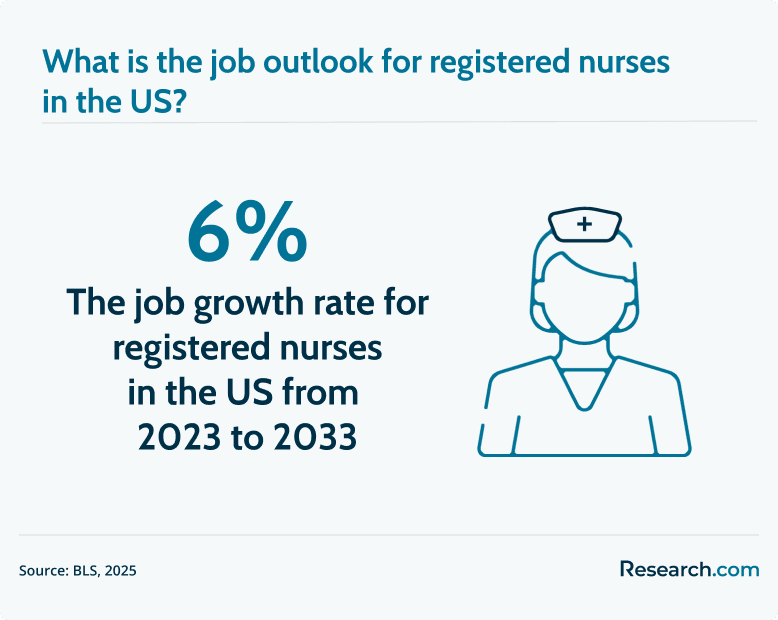
Several nursing occupations, including registered nurses (RNs), nurse practitioners, and nurse anesthetists, are projected to grow faster than the average from 2023 to 2033. Employment for RNs in the US is projected to increase by 6%, which translates to an average of about 194,500 job openings each year over the decade. Employment for nurse practitioners is projected to grow by 46% from 2023 to 2033 (US BLS, 2025).
Clinical specialty earnings and demand can also influence long-term planning. For example, nurses comparing specialty options may review information on orthopedic nurse salary while deciding whether to prioritize research, practice, education, or leadership.
Even with strong labor market indicators, students should avoid assuming that a PhD guarantees a specific salary or faculty position. Location, experience, publication record, funding history, clinical credentials, and institutional hiring needs all affect outcomes.
How to Verify Quality and Accreditation
Accreditation should be one of the first items you check. Institutional accreditation affects financial aid eligibility, credit transfer, employer recognition, and academic credibility. Nursing program accreditation can also matter for certification, licensure, and hiring, depending on the role and state requirements.
To evaluate quality, do more than read marketing pages. Ask for completion data, dissertation support details, faculty research areas, student publication opportunities, alumni roles, and online student services. Compare total cost against realistic outcomes, and review broader affordability resources such as low cost online BSN programs if you are still planning earlier stages of nursing education.
| Quality Check | Why It Matters | What to Look For |
| Institutional accreditation | Supports legitimacy, aid eligibility, and transfer recognition | Accreditation by a recognized regional or national accreditor |
| Nursing accreditation | May affect professional recognition, certification, and employer confidence | CCNE or ACEN accreditation where applicable |
| Faculty fit | Doctoral students need expert dissertation supervision | Faculty publications and active research in your area of interest |
| Online student support | Remote doctoral students need strong advising and academic infrastructure | Writing centers, library access, statistics help, advising, and technology support |
| Outcome transparency | Helps you estimate value and risk | Graduation, placement, alumni, and dissertation completion information |
BSN to PhD vs. Fast DNP: Which Doctoral Path Fits Your Goal?
The PhD and DNP are both doctoral degrees in nursing, but they are built for different outcomes. A BSN to PhD pathway emphasizes theory, research methods, scholarship, and dissertation work. A DNP pathway emphasizes advanced practice, systems leadership, quality improvement, and application of evidence in healthcare settings.
| Comparison Point | BSN to PhD | Fast DNP Pathway |
| Main purpose | Prepare nurse scientists, scholars, educators, and research leaders | Prepare advanced practice and practice-improvement leaders |
| Primary project | Dissertation based on original research | Practice-focused scholarly or quality improvement project |
| Best for | Nurses who want to teach, publish, conduct research, or shape policy through scholarship | Nurses who want to improve care delivery, lead clinical systems, or pursue advanced practice roles |
| Related option | Research-focused doctoral bridge from BSN entry | fastest DNP program options may appeal to nurses focused on accelerated practice preparation |
How Online BSN to PhD Programs Can Support Research and Interdisciplinary Work
Online BSN to PhD programs can support interdisciplinary research when students are connected with faculty, healthcare organizations, data sources, and clinical partners. A dissertation may involve nursing education, health systems, patient outcomes, informatics, policy, or population health, depending on the student’s focus and faculty expertise.
Students who want to combine research with expanded clinical authority should confirm whether they also need a separate clinical graduate credential. For example, a direct entry to nurse practitioner program may be relevant for professionals pursuing nurse practitioner preparation, but it serves a different purpose from a PhD in Nursing.
Common Mistakes to Avoid When Choosing an Online BSN to PhD Program
| Mistake | Why It Can Hurt You | Better Approach |
| Choosing the fastest program without checking research fit | A poor faculty match can slow dissertation progress or weaken your scholarly direction | Identify faculty mentors before applying and ask whether they are accepting students |
| Comparing only tuition rates | Fees, residency travel, dissertation enrollment, and credit load can change total cost | Request a full cost estimate from admission through graduation |
| Assuming online means no campus requirements | Some programs require intensives, residencies, presentations, or research meetings | Ask for a complete list of required in-person activities |
| Confusing PhD and DNP outcomes | The wrong doctorate can delay your intended career path | Choose PhD for research and scholarship; choose DNP for practice leadership and clinical application |
| Ignoring accreditation | Unrecognized accreditation can affect aid, transfer, employment, and professional credibility | Verify institutional and nursing accreditation before submitting an application |
| Assuming salary outcomes are guaranteed | Pay depends on role, location, experience, credentials, and employer type | Use wage data as a benchmark, not a promise |
Student Perspectives on Online BSN to PhD Study
- Haley: "The online BSN to PhD format made it possible for me to keep working as an RN while building serious research skills. I did not have to step away from my career to pursue doctoral study."
- Charles: "The program challenged me, but the mentoring made a difference. I wanted to move toward leadership and research, and the structure helped me understand what doctoral scholarship requires."
- Ally: "Online doctoral study let me balance work, family, and school while turning my interest in evidence-based practice into a research direction with real impact."
References
- National Center for Education Statistics. (2024, May). Graduate Degree Fields. https://nces.ed.gov/programs/coe/indicator/ctb/graduate-degree-fields
- US Bureau of Labor Statistics. (2025, April 18). Education pays. Employment Projections. https://www.bls.gov/emp/tables/unemployment-earnings-education.htm
- US Bureau of Labor Statistics. (2025, April 18). Nurse Anesthetists, Nurse Midwives, and Nurse Practitioners. Occupational Outlook Handbook. https://www.bls.gov/ooh/healthcare/nurse-anesthetists-nurse-midwives-and-nurse-practitioners.htm
- US Bureau of Labor Statistics. (2024, April 03). Occupational Employment and Wages, May 2023, 25-1072 Nursing Instructors and Teachers, Postsecondary. Occupational Employment and Wage Statistics. https://www.bls.gov/oes/2023/may/oes251072.htm
- US Bureau of Labor Statistics. (2025). Occupational Employment and Wage Statistics, Industry: Cross-industry, Private, Federal, State, and Local Government. Occupational Employment and Wage Statistics Query System. https://data.bls.gov/oes/#/industry/000000
- US Bureau of Labor Statistics. (2025, April 18). Registered Nurses. Occupational Outlook Handbook. https://www.bls.gov/ooh/healthcare/registered-nurses.htm
Key Insights
- An online BSN to PhD bridge program is best for nurses who want research, faculty, policy, or scholarly leadership roles—not simply a faster route to advanced clinical practice.
- Program timelines commonly range from 4 to 6 years, and dissertation progress is often the biggest factor affecting completion time.
- Cost comparisons should include tuition, total credits, dissertation enrollment, online fees, and travel for any required intensives.
- Faculty research fit is critical. A well-matched advisor can matter more than a program’s general reputation.
- Do not confuse PhD and DNP pathways. The PhD centers on original research; the DNP centers on practice improvement and clinical leadership.
- Before applying, verify accreditation, online format, funding eligibility, campus requirements, student support, and graduate outcomes directly with each school.
Other Things You Need to Know about Accelerated Online BSN to PhD Bridge Programs
For 2027's best accelerated BSN to PhD online bridge programs, admission requirements typically include a Bachelor of Science in Nursing (BSN) from an accredited institution, a minimum GPA (often 3.0 or higher), active RN licensure, academic transcripts, and letters of recommendation. Some programs may also require GRE scores and a statement of purpose.
Most programs require a dissertation prospectus, committee approval, original research, and a final defense. Students usually complete research-methods and statistics courses before candidacy, then enroll in dissertation credits until the project is finished. Some schools also require IRB approval before any human-subjects data collection.


