
2027 How to Become a Counseling Psychologist

Co-Founder and Chief Data Scientist
Becoming a counseling psychologist is a long professional pathway, not a quick credential. The role usually requires doctoral-level training, supervised clinical experience, a licensing exam, and ongoing continuing education. That investment matters: 2023 data from the National Science Foundation shows that students took an average of 9.1 years after earning a bachelor’s degree to complete a doctorate in counseling and applied psychology.
This guide is for students, career changers, psychology majors, and counseling professionals who want a realistic view of the education, cost, licensure, salary potential, and career options involved. You will learn what degree path to follow, how the EPPP works, how long training can take, what programs may cost, which specializations are available, and how to compare counseling psychology with related mental health careers.
Quick answer: what should you know before choosing this career?
- The U.S. Bureau of Labor Statistics projects 11% employment growth for clinical and counseling psychologists until 2032 and reports a 2023 median annual wage of $96,100 for these professionals.
- The full pathway to counseling psychology licensure may take up to 14 years when undergraduate study, graduate education, internship, post-degree supervised experience, exams, and state licensing steps are included.
- A little over a third of psychology doctorate graduates self-funded their education, so funding strategy should be part of your program search from the beginning.
- In 2023, 25,520 clinical and counseling psychologists worked in the offices of other health practitioners, making that one of the major employment settings for the field.
- Counseling psychologists generally need to renew their licenses every 2 to 3 years, typically by completing continuing education requirements set by their state licensing board.
- Steps to become a counseling psychologist
- What the EPPP is and why it matters
- Skills counseling psychologists need
- How long the training takes
- Program costs and total cost factors
- Financial aid options for counseling psychology students
- Counseling psychology specialization options
- Client groups counseling psychologists serve
- Career paths with a counseling psychology degree
- Using digital tools to improve care
- Job outlook for counseling psychologists
- Adding spiritual counseling to practiceJob outlook details
- Christian counseling master’s programs and clinical practice
- Substance abuse counseling specialization
- Average counseling psychologist salary
- Ways to improve earning potential
- Flexible and accessible counseling psychology programs
- Counseling credentials that may support advancement
- Additional career-building steps
- How to select a counseling psychology program
- Benefits of specializing in child counselingFlexible program optionsSalary considerationsAdditional considerations
What Graduates Say About Counseling Psychology Careers
What keeps me in this profession is the chance to help clients face painful transitions, relationship struggles, and emotional setbacks with more confidence. The work can be demanding, especially when caseloads are heavy, but seeing people regain stability and self-trust makes the effort meaningful. Maria
I value the range of work counseling psychology allows. Some days involve individual therapy for anxiety, while others involve group sessions, couples work, or consultation. Private practice also gives me more control over my schedule, although it requires discipline and business skills. Dan
The strongest reward is the therapeutic relationship itself. When clients begin to understand their patterns, use healthier coping strategies, or feel safe enough to be honest, the progress is powerful. This career fits people who can combine emotional presence with professional boundaries. Lisa
How do you become a counseling psychologist?
The standard route to becoming a licensed counseling psychologist is to complete a doctoral degree in psychology, gain supervised clinical experience, pass required examinations, and meet your state’s licensing rules. A bachelor’s degree is the starting point, but independent psychologist practice generally requires graduate education at the doctoral level.
Most students begin with a bachelor’s degree in psychology or a closely related field. This stage builds the academic base for later clinical training, including human development, abnormal psychology, research methods, statistics, and theories of behavior. Students who did not major in psychology may still be able to apply to graduate programs, but they may need prerequisite coursework.
A master’s degree in counseling psychology can be useful, though it is not always a required stand-alone step before doctoral study. For some students, a master’s program provides supervised counseling experience, stronger faculty recommendations, and a clearer sense of whether doctoral training is the right fit.
The doctoral stage is usually where future counseling psychologists complete the advanced preparation required for licensure. Students commonly choose between a Doctor of Philosophy and a Doctor of Psychology. PhD programs often emphasize research, teaching, and clinical science, while PsyD programs generally place more emphasis on clinical practice. Students who want practice-focused doctoral training may compare campus-based options with online PsyD programs, while confirming that the program structure supports state licensure requirements.
Related counseling roles can help you explore the field before committing to doctoral training. For example, grief counseling may appeal to students interested in bereavement, trauma, family support, or end-of-life issues. If that direction interests you, review how the pathway differs in this guide to how long it takes to become a grief counselor.
Typical pathway from student to licensed counseling psychologist
| Stage | What happens | Decision point |
| Bachelor’s degree | Students complete foundational coursework in psychology, research, statistics, and human behavior. | Choose electives, research experience, and internships that strengthen graduate applications. |
| Master’s-level study, if pursued | Students gain more exposure to counseling theories, assessment, and supervised helping skills. | Decide whether to continue to doctoral study or pursue a related counseling license where allowed. |
| Doctoral program | Students complete advanced coursework, research, practicum training, assessment preparation, and clinical supervision. | Compare PhD and PsyD formats based on research goals, clinical goals, funding, internship match, and licensure fit. |
| Internship and supervised experience | Students or graduates complete required clinical hours under qualified supervision. | Verify whether the internship and postdoctoral experience meet your state board’s rules. |
| EPPP and state licensing | Candidates complete the national examination and any state-specific requirements. | Check application deadlines, jurisprudence exams, oral exams, and documentation rules early. |
| License renewal | Licensed psychologists complete continuing education and renew according to state timelines. | Plan for ethics training, specialty training, and documentation before renewal deadlines. |
Passing the EPPP
After doctoral training and required supervised experience, candidates typically sit for the Examination for Professional Practice in Psychology. Passing this exam is one of the central steps toward independent licensure because it evaluates whether the candidate has the knowledge base expected of an entry-level psychologist.
Getting your license
Licensure is controlled by state psychology boards, so requirements are not identical nationwide. Depending on the jurisdiction, applicants may need to document supervised hours, complete a state law or ethics exam, pass an oral examination, submit official transcripts, and provide verification from supervisors. Before enrolling in a program, compare its training model with the licensing rules in the state where you intend to practice.
Maintaining your license
Licensure does not end once the first credential is issued. Counseling psychologists usually complete continuing education during each renewal cycle, which often ranges from two to three years. State boards may require specific content, such as ethics, cultural competence, telehealth, or legal updates.
Continuing education should do more than satisfy a renewal checklist. It should help psychologists keep current with evidence-based interventions, assessment practices, risk management, and technology-related ethical issues. Some professionals use advanced coursework, workshops, postdoctoral training, or accredited online PhD programs in psychology to deepen expertise over time.
Many boards require a portion of continuing education to address ethics or professional responsibility. Completing these requirements on time signals that the psychologist is committed to competent, safe, and legally responsible practice.
A 2023 National Center for Science and Engineering Statistics report on U.S. doctorates stated that 3,990 psychology doctoral degrees were awarded in 2022. The chart below presents the available psychology doctorate graduation trend data from the source period.
What is the Examination for Professional Practice in Psychology (EPPP)?
The Examination for Professional Practice in Psychology is the national licensing exam used by psychology boards across North America. It is developed by the Association of State and Provincial Psychology Boards and is designed to measure whether candidates have the core knowledge required for safe and ethical psychology practice.
The exam is computer-based and uses multiple-choice questions. Its content covers major areas of psychology that counseling psychologists are expected to understand before independent practice.
| EPPP content area | Approximate exam weighting | What it tests |
| Assessment and Diagnosis | 16% | Knowledge of psychological assessment, diagnostic tools, interpretation, and appropriate use of evaluation methods. |
| Biological Bases of Behavior | 10% | Understanding of brain-behavior relationships, biological influences, and mental health foundations. |
| Cognitive-Affective Bases of Behavior | 13% | Knowledge of emotion, cognition, learning, motivation, and how these processes affect behavior. |
| Ethical, Legal, and Professional Issues | 16% | Application of ethics codes, legal responsibilities, professional standards, confidentiality, and risk management. |
| Growth and Lifespan Development | 12% | Understanding of human development across childhood, adolescence, adulthood, and later life. |
| Research Methods and Statistics | 7% | Ability to understand research design, statistical reasoning, and evidence-based practice. |
| Social and Cultural Bases of Behavior | 11% | Knowledge of diversity, culture, social systems, identity, and contextual influences on mental health. |
| Treatment, Intervention, Prevention, and Supervision | 15% | Understanding of therapy approaches, intervention planning, prevention, consultation, and supervision. |
Because the EPPP covers broad doctoral-level knowledge, preparation should begin well before the application date. Strong coursework, supervised clinical experience, structured exam review, and practice questions can all help candidates identify weak areas before testing.
What skills are essential for counseling psychologists?
Counseling psychology requires more than academic knowledge. Effective practitioners combine clinical judgment, communication, ethics, self-awareness, and cultural responsiveness. Students looking for the fastest way to become a counselor should still recognize that speed should not come at the expense of supervised practice and skill development.
| Skill | Why it matters in practice | How to build it |
| Empathy and compassion | Clients are more likely to engage when they feel respected, understood, and emotionally safe. | Use supervised role-play, reflective practice, and feedback from practicum supervisors. |
| Active listening | Therapy depends on hearing both spoken concerns and nonverbal signals such as tone, pace, posture, and avoidance. | Practice summarizing, clarifying, and tracking themes without rushing to advice. |
| Clear communication | Psychologists must explain treatment plans, assessment results, boundaries, and complex concepts in accessible language. | Develop skills through client simulations, case presentations, and written reports. |
| Clinical problem-solving | Clients often present with overlapping symptoms, risk factors, and environmental stressors. | Learn case formulation, differential diagnosis, and evidence-based treatment planning. |
| Emotional regulation | The work can involve trauma, crisis, grief, conflict, and burnout risk. | Use supervision, consultation, personal wellness routines, and appropriate boundaries. |
| Cultural competence | Effective care must account for culture, identity, family systems, discrimination, language, and community context. | Seek diverse clinical placements, cultural humility training, and ongoing consultation. |
| Ethical judgment | Psychologists regularly make decisions involving confidentiality, consent, competence, mandated reporting, and dual relationships. | Study ethics codes, review case examples, and consult supervisors when risk is unclear. |
| Analytical thinking | Treatment should be adjusted based on progress, evidence, assessment data, and client feedback. | Build comfort with research methods, outcome monitoring, and clinical documentation. |
How long does it take to complete the training to become a counseling psychologist?
Training usually takes many years because the role requires advanced education and supervised practice. Doctoral-level graduate training commonly requires four to six years and includes coursework, practicum, research, assessment training, consultation, and a supervised internship focused on counseling and psychotherapy skills.
Before doctoral study, students usually spend about four years earning a bachelor’s degree. Some also complete a master’s degree, which may add another two to three years. Taken together, the educational portion alone can take eight to 12 years.
After the doctoral degree, candidates may still need to complete state-specific licensing steps. These can include additional supervised experience, postdoctoral hours, coursework, documentation, and examinations. Research by my team found that post-degree supervised work experience often takes one to two years.
For some students, the full pathway can extend up to 14 years. The timeline varies by program structure, full-time versus part-time enrollment, internship timing, dissertation progress, state requirements, and whether the student completes a separate master’s degree.
This is a significant commitment, but it can lead to advanced roles in clinical care, supervision, academia, assessment, and specialized practice. Students comparing long-term return on investment may also want to review the highest paid psychologist careers to understand how training level and work setting affect compensation.
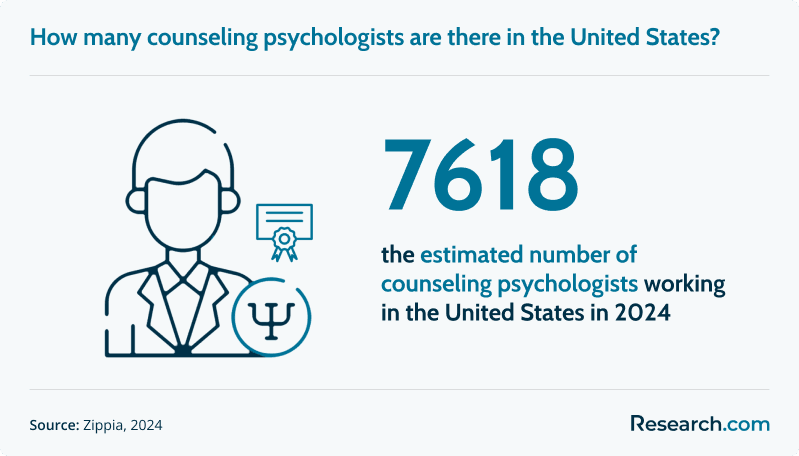
Although the pathway is demanding, many people still pursue counseling psychology. There are currently 7,618 counseling psychologists working in the US.
What are the key skills needed to be a successful counseling psychologist?
Successful counseling psychologists use a consistent set of clinical and professional abilities. These skills affect client trust, treatment quality, crisis response, documentation, collaboration, and long-term career sustainability.
- Active listening: Strong listening allows psychologists to understand what clients say directly and what they may communicate indirectly through emotion, silence, hesitation, or body language.
- Empathy: Clients need to feel that their experiences are taken seriously without being judged or minimized.
- Critical thinking: Counseling psychologists evaluate symptoms, context, risk, strengths, and treatment response before choosing an intervention.
- Cultural competence: Practitioners must understand how identity, culture, community, oppression, religion, language, and family expectations can influence mental health and treatment preferences.
- Communication skills: Clear communication is needed for therapy, informed consent, assessment feedback, crisis planning, and interdisciplinary collaboration.
- Patience and resilience: Client progress is not always linear, so psychologists must remain steady while managing the emotional demands of the work.
- Ethical decision-making: Professional integrity depends on understanding confidentiality, informed consent, boundaries, competence, documentation, and legal duties.
What is the average cost of counseling psychology programs?
Program cost varies widely by degree level, institution type, funding package, location, residency status, enrollment pace, and whether a student studies online, hybrid, or on campus. Tuition is only one part of the total cost; fees, books, commuting, health insurance, internship relocation, dissertation expenses, and lost income can also affect affordability.
Teachers College at Columbia University, which offers one of the top counseling psychology programs, listed estimated tuition of $1,970 per hour. With 95 credits in the Doctor of Philosophy program, tuition alone would total $187,150. However, the college offers fully funded doctoral fellowships that include tuition coverage and a stipend for PhD students.
Other institutions also offer fellowships, assistantships, tuition waivers, stipends, and grants. For doctoral applicants, funding can be one of the most important differences between programs. A school with high posted tuition may be more affordable than a lower-priced program if it provides substantial funding.
Cost comparison should include the full cost of attendance, not only tuition. Even the cheapest psychology degree online can become expensive once fees, technology costs, practicum travel, and time away from work are included.
The Education Data Initiative reported in 2023 that the average cost of a master’s degree is $65,134. Some online master’s in psychology programs may cost less than this, depending on the school and format. The same source reported that the average cost of a doctorate is $150,835.
| Cost factor | Why it matters | Question to ask before enrolling |
| Tuition per credit or hour | Small differences can become large across long doctoral programs. | What is the total tuition estimate for the full program, not just one term? |
| Funding package | Assistantships and fellowships can substantially reduce out-of-pocket cost. | Is funding guaranteed, competitive, renewable, or limited to certain years? |
| Clinical placement costs | Practicum and internship may require travel, relocation, background checks, or extra fees. | Does the program help students secure placements, and where are they located? |
| Program length | Longer enrollment can increase tuition, fees, and opportunity cost. | What is the typical time to completion for students in this program? |
| Online or hybrid format | Flexible formats may reduce commuting but still require in-person clinical training. | Are there campus residencies, synchronous sessions, or local practicum requirements? |
| Licensure alignment | A cheaper program is not a good value if it does not support licensure where you plan to work. | Does the program meet educational requirements for my intended state? |
What are the different types of financial aid available for counseling psychology students?
Because counseling psychology training can be expensive, students should create a funding plan before applying. The strongest strategy is usually to combine institutional funding, federal aid, scholarships, part-time work when feasible, and careful borrowing.
- Federal grants: Grants such as the Pell Grant are usually based on financial need and do not require repayment. Availability depends on eligibility and degree level.
- Scholarships: Scholarships may be offered by universities, professional psychology organizations, private foundations, community groups, or mental health associations. Awards may be based on merit, need, identity, service goals, research interests, or specialization.
- Federal Direct Loan Programs: Federal loans can help cover remaining costs, but borrowing should be tied to a realistic repayment plan. Subsidized loans do not accrue interest while eligible students are enrolled at least half time, while unsubsidized loans begin accruing interest immediately.
- Work-Study Programs: Federal Work-Study can provide part-time employment through campus or approved community employers, allowing students to earn income while enrolled.
- State Aid: Some states offer aid for students entering mental health, behavioral health, or public service fields. Students should check their state education agency and workforce development resources.
Funding questions to ask programs
- How many doctoral students receive full funding, partial funding, or no funding?
- Does funding include tuition remission, health insurance, a stipend, or teaching/research duties?
- How many years of support are guaranteed?
- Are assistantships available to master’s students, doctoral students, or both?
- What percentage of students take loans, and what support does the school provide for financial planning?
- Are there paid clinical placements, research assistantships, or community partnerships?
What types of specializations are available in counseling psychology?
Counseling psychology includes many practice areas. Specialization can help you serve a defined client population, develop deeper clinical expertise, and pursue specific psychology career paths. The right specialization should reflect your interests, training opportunities, local demand, and licensing requirements.
| Specialization | Best fit for students interested in | Common practice focus |
| Child and Adolescent Counseling | Development, school issues, family systems, and early intervention. | Behavior concerns, anxiety, trauma, identity development, peer relationships, and academic stress. |
| Substance Abuse Counseling | Addiction recovery, prevention, relapse planning, and community treatment. | Alcohol use, drug use, co-occurring mental health concerns, family support, and recovery maintenance. |
| Career Counseling | Vocational development, workplace adjustment, and life transitions. | Career decision-making, job search strategy, burnout, retirement transition, and work-life concerns. |
| Trauma Counseling | Trauma-informed care, crisis recovery, and resilience-building. | PTSD, violence exposure, grief, complex trauma, and stabilization strategies. |
| Couples and Family Counseling | Relationships, communication patterns, conflict, and family dynamics. | Couples therapy, parenting concerns, separation, family conflict, and systemic interventions. |
Specialization should not be chosen only because it sounds marketable. Look for programs with qualified supervisors, relevant practicum placements, evidence-based coursework, and opportunities to work with the population you plan to serve.
What are the different client populations that counseling psychologists work with?
Counseling psychologists work with people across age groups, identities, communities, and life circumstances. Their training prepares them to address emotional, relational, developmental, educational, vocational, and behavioral concerns.
- Adults: Adults may seek help for anxiety, depression, stress, relationship conflict, work transitions, grief, identity concerns, or major life changes.
- Children and adolescents: Younger clients may need support with school stress, social development, self-esteem, behavioral concerns, emotional regulation, family conflict, or developmental transitions.
- Couples and families: Counseling psychologists may help families and partners improve communication, reduce conflict, strengthen boundaries, and respond to major changes.
- Veterans and military personnel: This population may face trauma, PTSD, reintegration stress, service-related identity concerns, and adjustment to civilian life.
- LGBTQ+ clients: Counseling may address identity exploration, coming out, relationship concerns, discrimination, family response, minority stress, and mental health needs specific to LGBTQ+ communities.
- Clients with disabilities: Psychologists may provide support related to adjustment, self-advocacy, family systems, accessibility, independence, and quality of life.
- People with substance use concerns: Treatment may include motivation building, relapse prevention, coping skills, co-occurring mental health treatment, and recovery support.
- Clients seeking faith-related support: Some clients may compare secular counseling psychology with faith-based options. Professionals who want to understand this distinction may review how long it takes to become a Christian counselor and how training expectations differ by practitioner, institution, and credential.
What career paths are available to individuals with a degree in counseling psychology?
A counseling psychology degree can lead to several professional routes, but the scope of practice depends heavily on degree level, supervised experience, and licensure. Licensed counseling psychologists may work in private practice, hospitals, community mental health agencies, universities, integrated care clinics, correctional settings, government agencies, and research environments.
These are common directions for graduates and licensed professionals:
- Licensed counseling psychologist: Provides therapy, psychological assessment, consultation, and treatment planning for individuals, couples, families, and groups after meeting licensure requirements.
- College or university counselor: Supports students with academic stress, mental health concerns, career uncertainty, relationships, identity, and adjustment to campus life.
- Career counselor: Helps clients clarify goals, evaluate strengths, make career decisions, manage transitions, and prepare for employment changes.
- Mental health counselor: Works in settings such as community mental health centers, hospitals, and residential treatment programs, depending on license and state rules.
- Researcher or academic: Conducts studies, teaches psychology courses, supervises trainees, publishes research, and contributes to counseling theory or intervention development.
- Consultant or program evaluator: Advises organizations on mental health programs, evaluates service outcomes, develops training materials, or supports system-level improvements.
Research on psychology majors and career interests suggests that many students know about counseling but are less aware of the wider range of psychology careers. This is one reason students should explore clinical, research, academic, consulting, assessment, and organizational options before choosing a degree path.
Career opportunities vary by state, employer, license type, specialization, and experience. Before enrolling, students should identify the job titles they want and confirm which degree and license those roles require.
As of May 2022, clinical and counseling psychologists had their highest employment levels in the offices of other health practitioners. The chart below shows the industries employing the largest numbers of clinical and counseling psychologists.
How can I harness digital solutions to improve client outcomes?
Technology now affects nearly every part of mental health practice. Counseling psychologists may use secure teletherapy platforms, electronic health records, digital scheduling systems, outcome tracking tools, encrypted client communication, and online assessment workflows. These tools can improve access and organization, but they also raise important questions about privacy, documentation, informed consent, emergency planning, and cross-state practice rules.
Digital competence is becoming a practical career advantage. Psychologists who understand technology can evaluate software more carefully, protect client information, and use data to monitor progress without reducing therapy to a checklist. Professionals who want deeper technical preparation may consider an affordable technology program, such as a cheap online information technology degree, if it supports their broader career goals.
What is the job outlook for counseling psychologists?
The employment outlook is favorable compared with the overall labor market. The BLS reports that employment of psychologists, including counseling psychologists, is projected to grow 11% from 2022 to 2032, compared with the 3% average for all occupations.
Demand is shaped by several factors: broader recognition of mental health needs, integrated care models, school and campus mental health concerns, workplace stress, trauma-informed services, substance use treatment, and increased use of telehealth. At the same time, competition can vary by location, specialization, and employer requirements.
Salary is another major consideration. According to BLS data as of May 2022, the median annual wage for clinical and counseling psychologists was $90,130. Individual pay may be higher or lower depending on experience, geographic location, specialization, employer type, and whether the psychologist works in private practice, health care, education, or government.
How can spiritual counseling complement my clinical practice?
Some clients want therapy that respects spiritual meaning, values, grief rituals, moral questions, or religious identity. Counseling psychologists can address spirituality ethically when they remain within their competence, avoid imposing beliefs, and use client-centered, evidence-informed approaches.
Spiritual counseling knowledge may be especially useful when working with clients who frame healing, resilience, purpose, or community support through spiritual beliefs. Professionals interested in this area can review the pathway to become a certified spiritual counselor and compare those expectations with psychology licensure requirements.
How can Christian counseling master's programs enhance my clinical practice?
Christian counseling master’s programs may help practitioners understand faith-informed counseling models, theological language, pastoral care contexts, and ethical issues that arise when clients want religious beliefs incorporated into care. This training can be useful when serving communities where faith is central to identity and decision-making.
However, Christian counseling education is not the same as psychology licensure. Students should clarify whether a program is designed for ministry, pastoral counseling, professional counseling licensure, or another credential. To compare options, review this guide to Christian counseling master’s programs.
Should I consider a substance abuse counseling specialization?
A substance abuse counseling focus can be valuable for counseling psychologists because addiction concerns often overlap with trauma, depression, anxiety, family stress, employment instability, medical issues, and legal problems. Specialized training can strengthen skills in prevention, screening, motivation enhancement, relapse prevention, group treatment, and coordination with recovery supports.
This path may be a strong fit if you want to work in community agencies, hospitals, integrated behavioral health, correctional settings, residential treatment, or private practice with co-occurring concerns. Students who want a dedicated addiction-focused route can compare degree requirements in a substance abuse counselor degree.
What is the average salary for a counseling psychologist?
Counseling psychology can offer solid earning potential, but salary should not be treated as guaranteed. According to 2023 data, clinical and counseling psychologists combined earned an annual average salary of $106,600, while the median salary was $96,100.
Pay varies because counseling psychologists work in different settings and markets. A psychologist in private practice may have income affected by client volume, reimbursement rates, business expenses, and referral networks. A psychologist in a hospital, university, government agency, or group practice may have a more structured salary but less control over fees and scheduling.
| Salary factor | How it can affect earnings | What to evaluate |
| Experience | More experienced psychologists may qualify for senior clinical, supervisory, or administrative roles. | Look at advancement pathways, supervision opportunities, and leadership expectations. |
| Location | Pay often reflects regional cost of living, provider demand, reimbursement rates, and employer budgets. | Compare salary with local housing, insurance, taxes, and commuting costs. |
| Work setting | Private practice, hospitals, schools, universities, government agencies, and integrated care settings may pay differently. | Consider benefits, stability, autonomy, administrative burden, and caseload expectations. |
| Specialization | Some niches may support higher rates or stronger demand, especially when training is advanced and documented. | Evaluate whether the specialization has enough client demand and supervision opportunities. |
| Business skills | Private practitioners need marketing, billing, compliance, scheduling, and financial management skills. | Plan for business training if you intend to operate independently. |
How can I optimize my earning potential in counseling psychology?
Improving earnings usually requires a combination of clinical competence, strategic specialization, strong referral networks, ethical fee structures, and careful career positioning. Additional training in assessment, trauma, couples work, health psychology, substance use, supervision, or consultation may expand opportunities, depending on the market.
Private practice can increase autonomy, but it also introduces business risk and overhead. Salaried roles may offer benefits and predictability but may limit income growth. To compare income strategies across therapy roles, review this guide to what the highest paid type of therapist is.
Exploring Flexible and Accessible Counseling Psychology Programs
Because counseling psychology requires years of preparation, program format matters. Flexible options can help working students, parents, caregivers, and career changers continue their education, but flexibility should never replace supervised clinical quality or licensure alignment.
Online and hybrid programs
Online and hybrid programs may offer asynchronous coursework, live virtual classes, online advising, and reduced commuting. However, psychology and counseling programs still require supervised clinical experience. Hybrid models often combine online academic courses with in-person practicum, internship, assessment labs, or residencies.
Students seeking a less complicated entry point into counseling-related study can review the easiest counseling degree to get, while remembering that “easier” does not always mean appropriate for psychologist licensure.
Accelerated degree tracks
Accelerated programs may shorten time in school by using intensive terms, year-round scheduling, or integrated bachelor’s-to-master’s formats. These tracks can reduce time away from the workforce, but they may be demanding for students who work full time or need extensive clinical placement support.
Self-paced learning options
Self-paced courses can help students manage work and family responsibilities. They are best suited for disciplined learners who can stay on schedule without frequent deadlines. Students should verify whether self-paced formats include adequate faculty access, advising, clinical coordination, and peer interaction.
What counseling credentials can boost my professional advancement?
Counseling psychologists should distinguish psychology licensure from counseling and social work credentials. Licensed psychologists typically complete doctoral psychology training and state psychology board requirements. Other mental health professionals may pursue credentials such as LPC or LCSW, each with its own scope of practice, education requirements, and licensing board.
Additional credentials can be useful when they align with your career goals. For example, someone comparing counselor and social work pathways may benefit from understanding the difference between an LPC and LCSW. The best credential is the one that legally supports the work you want to do in the state where you plan to practice.
What additional steps can I take to enhance my career in counseling psychology?
Career growth in counseling psychology usually depends on ongoing learning, supervision, consultation, professional networking, ethical practice, and documented specialty competence. Useful steps include attending workshops, joining professional associations, pursuing specialty training, presenting research, publishing, seeking supervision in advanced modalities, and learning business skills if you plan to enter private practice.
Students who are still comparing mental health pathways may want to start with the broader process of how to become a counselor. Understanding the differences among counselor, therapist, psychologist, social worker, and psychiatric provider roles can prevent costly education mistakes.
What should I consider when selecting a counseling psychology program?
Program choice affects cost, licensure eligibility, clinical training quality, internship competitiveness, and career outcomes. Do not choose only by ranking, convenience, or tuition sticker price. A strong program should match your professional goals and meet recognized training expectations.
| Selection factor | Why it matters | What to ask |
| Accreditation and licensure fit | Licensing boards may require or prefer specific types of program recognition. | Does this program meet educational requirements in the state where I want to practice? |
| Clinical training | Practicum and internship quality shape readiness for professional work. | Where do students complete placements, and how does the school support placement matching? |
| Faculty expertise | Faculty interests influence mentorship, research opportunities, and specialty preparation. | Are there faculty members active in my area of interest? |
| Funding and debt | High debt can limit career flexibility after graduation. | What is the average funding package, and how many students receive it? |
| Graduation and completion expectations | Long delays can increase cost and postpone licensure. | What is the typical time to completion? |
| Online or campus requirements | Flexible programs may still require travel or in-person clinical work. | Are there residencies, weekend intensives, synchronous classes, or local site requirements? |
| Alternative counseling routes | Some students may be better served by counseling, social work, or marriage and family therapy programs. | Would psychology licensure or another mental health credential better match my goals? |
If you are comparing counseling licensure pathways rather than doctoral psychology programs, it may also be useful to review CACREP accredited programs. For psychology licensure specifically, always verify requirements with the state psychology board before enrolling.
Common mistakes to avoid
- Choosing a program without checking licensure rules: A program may be academically strong but still not match the state where you want to practice.
- Looking only at tuition: Total cost includes fees, living expenses, internship relocation, technology, books, insurance, and lost income.
- Assuming online programs are automatically licensure-ready: Online coursework may be acceptable, but supervised clinical training and state rules still matter.
- Ignoring funding details: A posted fellowship may be competitive, limited, or not guaranteed for every year.
- Relying only on rankings: Fit, supervision quality, faculty mentorship, internship outcomes, and licensure alignment are more important than prestige alone.
- Assuming salary outcomes are guaranteed: Earnings depend on setting, location, specialization, licensure, business model, and experience.
What are the benefits of specializing in child counseling?
Child counseling can be a meaningful specialization for counseling psychologists who want to intervene early in emotional, behavioral, developmental, and family concerns. Work with children often involves not only the child, but also parents, caregivers, schools, physicians, and other support systems.
This specialization may include treatment for anxiety, trauma, grief, behavioral challenges, learning-related stress, peer conflict, family transitions, or developmental concerns. It requires strong knowledge of child development, play-based or developmentally appropriate interventions, family systems, mandated reporting, and collaboration with schools or medical providers.
Students interested in this path should review the education and licensing expectations connected to child psychologist requirements. The best preparation includes supervised experience with children and families, coursework in development and assessment, and training in evidence-based child and adolescent interventions.
References
- Hanson, M. (July 2023). Average Cost of a Doctorate Degree. Education Data Initiative.
- Hanson, M. (August 2023). Average Cost of a Master’s Degree. Education Data Initiative.
- National Center for Science and Engineering Statistics (September 2023). Doctorate Recipients from U.S. Universities: 2022. NCSES.
- Teachers College Columbia University (n.d.). 2023-2024 Tuition & Fees. Teachers College Columbia University.
- Torpey, E. (October 2023). Careers in mental health services. BLS.
- U.S. Bureau of Labor Statistics (April 2023). Occupational Employment and Wages, May 2022, 19-3033 Clinical and Counseling Psychologists. BLS.
- Zippia (2023). COUNSELING PSYCHOLOGIST DEMOGRAPHICS AND STATISTICS IN THE US. Zippia.
Key Insights
- Becoming a counseling psychologist usually requires doctoral education, supervised clinical training, the EPPP, and state licensure; it is not the fastest mental health career route.
- The timeline can be substantial: education alone may take eight to 12 years, and the full licensure pathway may take up to 14 years depending on the student and state.
- Cost varies widely, so compare total cost of attendance, not just tuition. Funding, fellowships, assistantships, and licensure alignment can change the real value of a program.
- The EPPP covers assessment, ethics, treatment, development, research, biological bases of behavior, cultural factors, and other core psychology domains, so preparation should be built throughout doctoral training.
- Specialization can improve career fit, but it should be backed by supervised experience, qualified faculty, and clear demand in the settings where you want to work.
- Salary and job outlook are positive, with BLS projecting 11% growth from 2022 to 2032 and 2023 data showing a median annual wage of $96,100, but individual outcomes depend on location, setting, experience, and specialization.
- Before enrolling, verify accreditation, clinical placement support, state licensure compatibility, funding terms, and actual time to completion. These factors matter more than convenience or rankings alone.
Other Things You Should Know About How to Become a Counseling Psychologist in CURRENT_YEAR
Most U.S. licensing boards require a predoctoral internship of 1,500 to 2,000 supervised hours before you can qualify for licensure. APA-accredited internships are often preferred, and the exact hour total is set by the state board and doctoral program requirements.
An undergraduate degree in psychology or a related field is typically required to pursue a career in counseling psychology. This foundational education prepares candidates for advanced study and training necessary for counseling psychologist licensure.


