2027 Communications Careers: Guide to Career Paths, Options & Salary

Co-Founder and Chief Data Scientist
Choosing a communications career usually means choosing between several different kinds of work: writing, public relations, social media, marketing strategy, corporate messaging, media relations, events, crisis response, and brand storytelling. The field is broad, which is an advantage, but it can also make the first step confusing. A student may wonder whether a communications degree is enough. A working professional may be deciding whether to specialize, earn a master’s degree, or move into digital strategy.
This guide explains what communications professionals do, which roles are growing, what skills employers expect, how salaries compare, and how to decide whether this path fits your goals. It also covers practical next steps, common mistakes, alternative career options, and ways to use education, certifications, networking, and technology to build a stronger communications career in 2026.
Quick answer: Is communications a good career path?
Communications can be a strong career path for people who are good at writing, audience analysis, persuasion, storytelling, project coordination, and adapting messages across platforms. It is especially useful for careers in public relations, marketing communications, social media, corporate communications, brand strategy, content writing, media relations, and crisis communication. The best opportunities usually go to professionals who combine clear writing with digital skills, analytics, strategic thinking, and a portfolio of real work.
Key things to know before choosing a communications career
- Communications careers exist in many industries, including public relations, marketing, healthcare, government, nonprofits, technology, media, education, and corporate services.
- The field rewards both creative and strategic thinking. Strong communicators do not only produce content; they shape how audiences understand brands, issues, products, and organizations.
- Digital fluency is no longer optional. Social media, SEO, analytics, content management systems, email platforms, and AI-assisted tools are now part of many communications roles.
- Writing, editing, public speaking, interviewing, media management, and stakeholder communication remain transferable skills across many career paths.
- Pay varies widely by role, industry, location, and experience. Leadership, crisis communication, brand strategy, and digital marketing roles often offer stronger earning potential than general entry-level communications roles.
- Why consider a communications career?
- What skills do communications professionals need?
- How do you start a communications career?
- What jobs can you get with a communications degree?
- How much do communications careers pay?
- What is the job outlook for communications careers?
- Which industries hire communications professionals?
- Which communications jobs are in high demand?
- How can you move up in communications?
- How should you choose a communications master’s program?
- What steps help you prepare for communications work?
- What alternative careers use communications skills?
- Can an accelerated master’s degree help?
- Which advanced degree options may change your career path?
- How does personal branding help communicators?
- Which additional credentials can strengthen your profile?
- Why does data analytics matter in communications?
- How can you keep up with communications trends?
- How are emerging technologies changing communications work?
- Can creative writing improve communications performance?
- What challenges should you expect?
- Can technical training improve your career options?
- Can affordable education make career growth easier?
- How do mentorship and professional development help?
- Can remote work support a communications career?
- Is a doctoral degree worth considering?
- Can game design skills broaden communications work?
- Can a fast social media marketing degree improve digital strategy?
- How can graphic design training support communications?
- Can a less rigorous bachelor’s program still prepare you well?
- What common mistakes should communications students avoid?
Why consider a communications career?
Communications is worth considering if you want a career built around messages, audiences, reputation, persuasion, and trust. Organizations need people who can explain complex ideas clearly, respond to public concerns, manage brand voice, and coordinate communication across websites, social platforms, press channels, internal teams, and events.
The field also offers flexibility. A communications background can lead to public relations, digital marketing, corporate communications, nonprofit advocacy, media production, public affairs, content strategy, and brand management. Students who want a more specialized digital route may also compare communications programs with options such as the cheapest social media marketing degree online programs.
Labor market data supports continued relevance for the field, but not every communications job has the same outlook. A U.S. Bureau of Labor Statistics overview of media and communication occupations projects about 104,800 openings on average each year from 2024 to 2024 in these occupations because of employment growth and replacement needs. That broad category includes many different roles, so students should look beyond the headline number and compare specific job titles, skills, and industries.
| Choose communications if you want... | Be cautious if you prefer... |
| Work that blends writing, strategy, audiences, and media platforms | Highly predictable tasks with little deadline pressure |
| Career mobility across business, nonprofit, government, healthcare, and media settings | A career path with one fixed credential and a single licensing route |
| Opportunities to build a portfolio through campaigns, writing samples, social media, events, or messaging plans | Work where performance is rarely measured by public response, analytics, or stakeholder expectations |
| A role that may evolve with technology, platforms, and audience behavior | A field that changes slowly and requires little ongoing learning |
What skills do communications professionals need?
The strongest communications professionals combine clear expression with sound judgment. Writing and editing are foundational because most roles require press materials, web copy, emails, speeches, social posts, campaign briefs, reports, or internal announcements. Public speaking also matters, especially for professionals who brief executives, coordinate with clients, pitch stories, lead meetings, or respond during crises.
Digital skills are now central to the profession. A National Skills Coalition report on the digital skill divide notes that nearly all jobs today require digital skills. For communications professionals, that can include social media management, SEO, content marketing, basic analytics, audience segmentation, email tools, collaboration platforms, and familiarity with AI-assisted drafting or research tools.
| Skill area | Why it matters in communications | How to demonstrate it |
| Writing and editing | Clear, accurate language drives press releases, web content, internal messaging, speeches, and campaigns. | Build a portfolio with writing samples for different audiences and formats. |
| Audience strategy | Effective messaging depends on knowing what each audience needs, fears, values, and expects. | Create sample messaging plans for customers, employees, media, donors, or policymakers. |
| Digital communication | Most organizations communicate through websites, social platforms, search, email, and multimedia channels. | Show examples of social campaigns, newsletters, SEO content, or digital content calendars. |
| Analytics | Employers increasingly expect communicators to measure reach, engagement, sentiment, conversions, or campaign performance. | Include reports that explain what the data showed and how you adjusted the strategy. |
| Crisis judgment | Reputation risks move quickly, especially online. Communicators must respond accurately and calmly. | Practice scenario planning, holding statements, Q&A documents, and escalation plans. |
| Collaboration | Communicators work with executives, designers, marketers, legal teams, HR, journalists, agencies, and clients. | Highlight group projects, client work, event coordination, or cross-functional campaigns. |
What networking strategies help communications professionals get hired?
Networking matters in communications because many opportunities come through referrals, internships, freelance projects, alumni contacts, agencies, professional associations, and visible work. The goal is not to collect contacts; it is to build credibility with people who understand your skills and can point you toward relevant roles.
- Attend targeted events: Choose public relations, marketing, journalism, nonprofit, social media, or industry-specific events where employers and practitioners actually gather.
- Join professional groups: Organizations such as the Public Relations Society of America can help you meet practitioners, learn field standards, and find development opportunities.
- Use LinkedIn strategically: Share thoughtful work samples, comment on industry discussions, and connect with alumni or professionals in roles you want to understand.
- Request informational interviews: Ask professionals about their path, portfolio expectations, tools they use, and what entry-level candidates often misunderstand.
- Volunteer where your work will be visible: Nonprofits, student groups, local events, and community organizations often need help with newsletters, social media, media outreach, and event promotion.
- Follow up with purpose: After a meeting or event, send a brief message that thanks the person and references something specific from the conversation.
- Build peer relationships early: Classmates, interns, junior staff, and freelancers can become future collaborators, hiring managers, or referral sources.
How do you start a communications career?
Many people enter communications through a bachelor’s degree in communications, public relations, journalism, marketing, English, business, or a related field. A dedicated communications degree can provide a broad foundation in writing, media, persuasion, interpersonal communication, research, and strategy. Students who already know they want PR may also compare general communications programs with the cheapest online public relations degree programs.
Education alone is rarely enough. Hiring managers often want proof that you can produce usable work. Internships, student media, agency projects, campus communications roles, nonprofit volunteering, freelance writing, social media projects, and campaign case studies can all help you build that proof.
- Pick a direction: Decide whether you are more interested in public relations, social media, content writing, corporate communications, events, marketing communications, or media relations.
- Build a portfolio: Include writing samples, campaign briefs, press releases, social posts, newsletters, analytics snapshots, event materials, or brand messaging examples.
- Get practical experience: Look for internships, campus roles, freelance projects, volunteer work, or agency assistant roles.
- Learn core tools: Practice with content management systems, social scheduling tools, basic design platforms, email marketing systems, spreadsheets, and analytics dashboards.
- Ask for feedback: Have professors, supervisors, mentors, or working communicators review your writing and portfolio.
- Apply broadly but intentionally: Entry-level titles vary. Search for assistant, coordinator, associate, specialist, content, social media, communications, marketing, PR, and media relations roles.
What jobs can you get with a communications degree?
A communications degree can support many roles, but each path emphasizes different strengths. Some jobs are writing-heavy, some are analytics-focused, some require client management, and others involve high-pressure reputation work. The best choice depends on whether you prefer creating content, managing relationships, analyzing performance, planning campaigns, or leading organizational messaging.
| Career path | What the role usually involves | Best fit for people who... |
| Public Relations Specialist | Writes press releases, pitches journalists, manages media inquiries, supports reputation strategy, and helps organizations communicate with the public. | Enjoy media, writing, relationship-building, and fast-moving public issues. |
| Social Media Manager | Plans content calendars, creates posts, monitors audience response, manages engagement, and analyzes platform performance. | Understand digital culture, write quickly, think visually, and can use metrics to improve content. |
| Corporate Communications Manager | Coordinates internal and external messaging, executive announcements, employee communication, press materials, and brand consistency. | Want to work inside organizations and connect communication with business goals. A business foundation, including options such as the cheapest business degree online, can be useful for this route. |
| Marketing Communications Specialist | Creates campaign copy, website content, brochures, email messaging, product materials, and brand-aligned promotional content. | Like persuasive writing, customer messaging, and collaboration with marketing teams. |
| Event Planner | Manages event promotion, guest communication, logistics, vendor coordination, program materials, and post-event follow-up. | Are organized, calm under pressure, and comfortable coordinating many details at once. |
| Media Relations Coordinator | Builds relationships with journalists, prepares media lists, pitches stories, coordinates interviews, and tracks coverage. | Like news cycles, outreach, research, and relationship management. |
| Content Writer | Writes blogs, articles, web pages, marketing copy, guides, scripts, and SEO-informed content for defined audiences. | Prefer research, writing, editing, and developing subject-matter expertise. |
| Crisis Communication Specialist | Prepares crisis plans, holding statements, public responses, stakeholder updates, and media guidance during high-risk events. | Have strong judgment, composure, accuracy, and the ability to write under pressure. |
| Advertising Account Executive | Serves as the link between clients and creative or media teams, manages campaign needs, tracks deliverables, and maintains client relationships. | Enjoy client service, persuasion, negotiation, and project management. Related leadership preparation, such as an affordable BS in Organizational Leadership degree online, may also support this path. |
| Brand Strategist | Researches audiences and competitors, defines positioning, shapes brand voice, and develops messaging frameworks. | Like research, creative strategy, consumer insight, and long-term brand development. |
How much do communications careers pay?
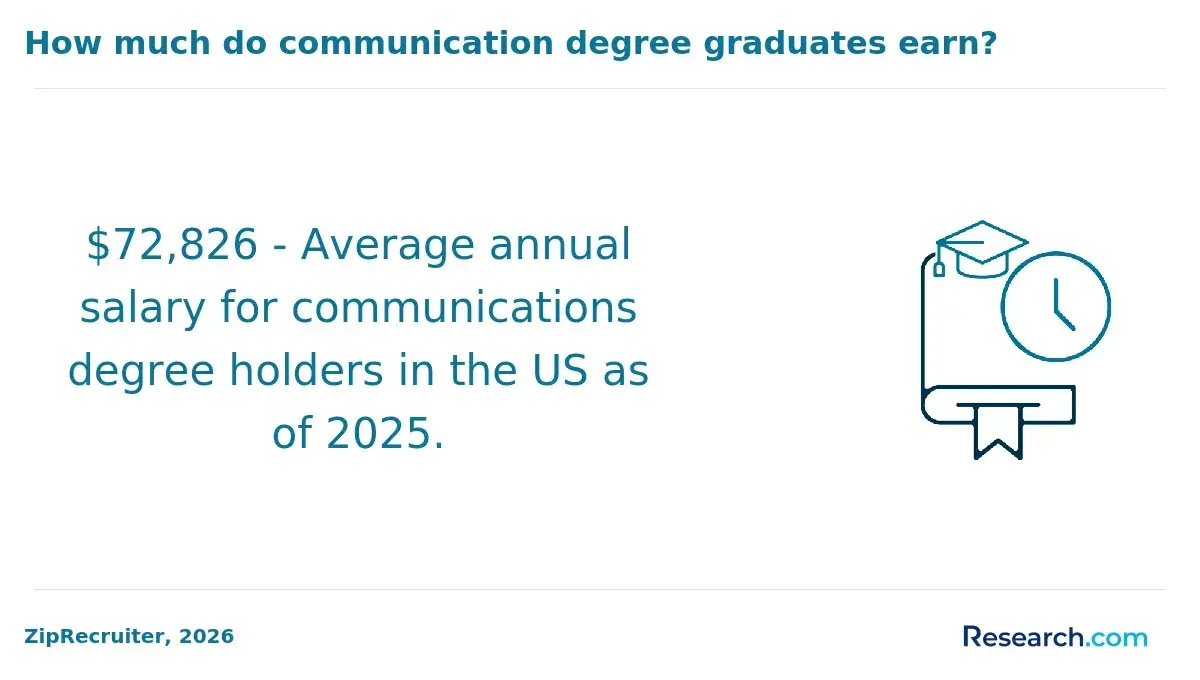
Communications salaries differ by job title, employer type, region, portfolio strength, and level of responsibility. In May 2024, the median annual wage for media and communication professionals, including public relations specialists, news analysts, and writers, was $70,300. That was higher than the national median wage of $49,500 for all occupations. Media and communication equipment workers, including broadcast technicians and film editors, earned a median annual wage of $53,850, which is in a similar range to some roles discussed in guides on associate of arts degree jobs salary.
Some entry-level communications jobs may start around $45,000 annually. Higher pay is more common in specialized or senior roles, especially in crisis communication, corporate communications leadership, brand strategy, digital strategy, and large-market agency or corporate positions. Salary outcomes are not guaranteed, so candidates should compare job postings, location, required experience, portfolio expectations, and advancement pathways before choosing a program or role.
| Factor | How it affects pay |
| Specialization | Crisis communication, analytics, digital strategy, and brand leadership may pay more than broad generalist roles. |
| Industry | Corporate, technology, healthcare, agency, government, nonprofit, and media employers may offer very different compensation structures. |
| Experience level | Portfolio depth, campaign results, supervisory experience, and strategic responsibility can raise earning potential. |
| Location and market size | Large metropolitan markets may offer more senior communications roles, though cost of living should be considered. |
| Technical fluency | Analytics, SEO, marketing automation, design tools, and multimedia skills can make candidates more competitive. |
What is the job outlook for communications careers?
The outlook depends heavily on the specific occupation. According to the BLS, employment for public relations specialists is expected to grow by 5% from 2024 to 2034, faster than the average for all occupations. Demand is connected to the continuing need for organizations to manage public image, respond to stakeholders, and communicate across digital channels.
Digital marketing, social media, content strategy, and corporate communications roles continue to matter because organizations need consistent messaging across websites, search, email, paid media, social channels, employees, investors, customers, and the press. At the same time, competition can be strong for desirable roles, especially those in major markets or well-known organizations. Candidates who can show measurable results, not just interest in media, are usually better positioned.
Which industries hire communications professionals?
Communications professionals are hired anywhere organizations need to influence, inform, persuade, educate, or maintain trust. That includes both public-facing and internal roles.
- Public relations and marketing: Agencies and in-house teams hire communications graduates for brand management, media outreach, campaigns, advertising support, and public engagement. In this sector, 36% of advertising and marketing managers are employed in advertising, public relations, and related services.
- Media and entertainment: News organizations, production companies, digital publishers, and entertainment brands need writers, editors, producers, publicists, and audience strategists.
- Healthcare: Hospitals, health systems, insurers, medical nonprofits, and public health agencies need communicators for patient education, crisis response, internal updates, and community outreach.
- Corporate sector: Large companies need internal communications, executive messaging, employee engagement, public affairs, investor-related messaging, and brand governance. These organizations do not only hire business specialists or people pursuing jobs for MBA graduates; they also need communication majors who can translate strategy into clear messages.
- Government and nonprofits: Public agencies, campaigns, advocacy groups, foundations, and nonprofits rely on communications professionals to explain policy, raise awareness, mobilize support, and maintain public trust.
Which communications jobs are in high demand?
High-demand communications roles are often tied to digital visibility, reputation risk, brand differentiation, and measurable audience engagement. The following roles are especially relevant for students and professionals planning a communications career.
| Role | Why demand exists | Skills to build |
| Social Media Manager | Organizations need platform-specific content, audience engagement, and performance tracking. Paid social media demand has seen a 116.4% increase. | Content planning, platform analytics, community management, brand voice, paid social basics, and trend judgment. |
| Crisis Communications Specialist | Online criticism, reputational risk, misinformation, and public scrutiny can escalate quickly. | Scenario planning, media relations, rapid writing, executive counsel, fact-checking, and calm decision-making. |
| Corporate Communications Manager | Growing organizations need consistent internal and external messaging aligned with business priorities. | Leadership, stakeholder management, executive communication, employee messaging, and strategic planning. |
| Brand Strategist | Companies need clearer positioning in crowded markets and more consistent audience experiences. | Market research, audience insight, messaging frameworks, competitive analysis, and creative strategy. |
| Content Writer or Copywriter | Businesses rely on high-quality content for search visibility, lead generation, customer education, and brand authority. Writers and authors have a median annual salary of $73,690. | Writing, editing, SEO, research, storytelling, conversion-focused copy, and audience adaptation. Some writers may deepen their craft through programs such as an online MFA creative writing degree. |
How can you move up in communications?
Career advancement in communications usually comes from a combination of specialization, measurable results, leadership experience, strong relationships, and continuous learning. Moving up is less about having one perfect title and more about proving that you can manage reputation, people, channels, campaigns, and outcomes.
- Specialize instead of staying too broad: Expertise in crisis communication, digital marketing, media relations, internal communication, analytics, or brand strategy can help you stand out.
- Consider graduate education carefully: A traditional or online masters in communications can support advancement if the curriculum aligns with your target role and the cost makes sense.
- Lead projects before you lead teams: Managing a launch, campaign, event, editorial calendar, or crisis simulation can prove readiness for supervisory roles.
- Build a network with depth: Mentors, former supervisors, alumni, agency contacts, journalists, and professional peers can help you identify opportunities and refine your judgment.
- Gain cross-industry perspective: Experience in healthcare, technology, nonprofits, government, or corporate settings can make you more adaptable.
- Use freelance or consulting work strategically: Side projects can expand your portfolio, but they should show results, not just activity.
- Learn analytics and reporting: Leaders need to explain what worked, what failed, and how communication supported business or mission goals.
- Develop management skills: Senior communications roles often require budgeting, vendor management, coaching, executive advising, and cross-functional leadership.
- Evaluate larger markets realistically: Larger hubs can offer more senior roles, but salary should be weighed against relocation costs, competition, and quality of life.
How should you choose a communications master’s program?
A master’s degree can be useful for communications professionals who want leadership roles, a career pivot, deeper specialization, or stronger academic grounding in strategy and research. It is not automatically necessary for every communications job, so the decision should be based on your career goal, current experience, total cost, and expected return.
| Selection factor | What to ask before enrolling |
| Program focus | Does the curriculum match your goal: corporate communications, PR, digital media, political communication, health communication, brand strategy, or research? |
| Flexibility | Can you study online, part time, or while working? Some students compare structured graduate options with easy masters degrees online, but workload should not be the only factor. |
| Accreditation and reputation | Is the institution properly accredited, and do employers in your target field recognize the program? |
| Portfolio and applied work | Will you graduate with campaigns, case studies, writing samples, analytics reports, or capstone projects? |
| Faculty and industry access | Do instructors have current field experience, and does the program connect students with alumni, agencies, employers, or internships? |
| Total cost | What will you pay after aid, fees, technology costs, and lost work time are included? |
What steps help you prepare for communications work?
Preparation should start before graduation or before applying for a career pivot. The most competitive candidates can show that they understand audiences, write clearly, use digital tools, and can produce work under real constraints.
- Study communication fundamentals: Learn persuasion, media writing, interpersonal communication, research methods, ethics, and audience analysis.
- Create a portfolio early: Include work that shows range: news-style writing, persuasive copy, social content, internal announcements, campaign plans, and analytics summaries.
- Practice editing: Many entry-level candidates can write, but fewer can revise for clarity, tone, audience, accuracy, and brand voice.
- Get experience with real stakeholders: Volunteer or intern where someone will depend on your work and give feedback.
- Learn to present ideas: Practice explaining strategy, not just showing finished content.
- Track outcomes: Even simple metrics, such as engagement, attendance, open rates, or media mentions, can help you explain impact.
- Build a professional online presence: Your LinkedIn profile, portfolio site, and public writing should reinforce the type of communications role you want.
What alternative careers use communications skills?
A communications background is useful outside traditional public relations and media roles. If you decide that agency PR, journalism, or social media management is not the right fit, you can still use communication skills in people-facing, policy-facing, training, sales, and technology-adjacent roles.
| Alternative role | How communications skills apply | When this path may make sense |
| Human Resources Specialist | HR professionals communicate policies, support employee engagement, mediate workplace issues, and help shape internal culture. Advancement may be supported by a traditional or online masters in HR. | You are interested in employee communication, training, conflict resolution, and organizational culture. |
| Corporate Trainer | Trainers design learning materials, deliver workshops, explain procedures, and evaluate whether employees understand new skills or policies. | You enjoy teaching adults, presenting, creating instructional content, and improving workplace performance. |
| Sales Representative | Sales work uses persuasion, listening, relationship-building, product messaging, and objection handling. | You are comfortable with goals, client conversations, negotiation, and performance-based expectations. |
| Public Affairs Specialist | Public affairs blends policy, stakeholder communication, government relations, and advocacy. Some professionals compare this path with traditional or online degrees in public administration. | You care about policy, government, regulation, advocacy, or community impact. |
| UX Writer | UX writers create concise language that guides users through websites, apps, forms, and digital products. | You like clear writing, user empathy, product design, and testing how words affect behavior. |
Can an accelerated master’s degree help?
An accelerated master’s program can help if you already know your goal, can handle a condensed workload, and need a faster credential for advancement or a career pivot. It may be less useful if you still need broad exploration, significant internship time, or a slower pace to build a portfolio. Professionals comparing accelerated options may want to review an online master 1 year program format and weigh speed against academic depth, cost, and support services.
Which advanced degree options may change your career path?
Advanced education can shift a communications career when it adds a capability you do not already have: leadership, research, analytics, health communication, political communication, marketing strategy, or organizational communication. Before enrolling, compare the degree’s curriculum with the job descriptions you want. If your goal is higher compensation or senior responsibility, resources on the best masters degree to get can help you think more broadly about graduate-level return on investment.
How does personal branding help communicators?
Personal branding matters because communications employers often evaluate how well you communicate about yourself before trusting you to represent an organization. A strong personal brand does not mean self-promotion without substance. It means your portfolio, LinkedIn profile, writing samples, resume, and professional conversations all tell a consistent story about your strengths.
- Define the kind of communicator you want to be known as: PR writer, content strategist, social media analyst, internal communications specialist, brand storyteller, or crisis communicator.
- Publish or showcase work that reflects that focus.
- Use your profile headline, portfolio introduction, and resume summary to describe your value clearly.
- Engage with industry conversations thoughtfully rather than posting generic content.
- Keep learning visible. Some professionals use flexible study routes, including accelerated programs online, to build credentials while working.
Which additional credentials can strengthen your profile?
Shorter credentials can be valuable when they fill a specific skill gap. For communications professionals, useful areas may include SEO, analytics, content strategy, social media advertising, crisis management, project management, email marketing, design fundamentals, or marketing automation. A broader academic route, such as a marketing degree online, may also be helpful for professionals who want to move from general communications into campaign strategy, brand management, or digital marketing.
Why does data analytics matter in communications?
Data analytics helps communicators move from “we published content” to “we know what the audience did and what we should change next.” Analytics can support content planning, media monitoring, social media reporting, email performance, website behavior, sentiment tracking, and campaign evaluation. It also helps communications teams defend budgets and explain value to leadership.
If you want to strengthen both communications and technical skills, compare programs and credentials that include analytics, digital strategy, or applied business skills. Some students also review online degree programs that pay well when evaluating whether a communications-adjacent credential might improve career mobility.
How can you keep up with communications trends?
Communications changes quickly because platforms, audience behavior, search habits, media trust, AI tools, and employer expectations keep evolving. Staying current should be part of the job, not something you do only when changing roles.
- Use continuing education strategically: Choose webinars, workshops, certificates, or degree options that address a real skill gap. Some students consider an accelerated communications degree online when they need a faster academic path.
- Follow credible industry sources: Track communications, PR, marketing, journalism, analytics, and social platform updates from sources that explain evidence and practice.
- Learn analytics tools: Understanding data helps you evaluate campaigns instead of relying only on creative instinct.
- Experiment safely: Test new tools, platforms, and formats on low-risk projects before applying them to high-stakes communication.
- Join professional associations: Groups such as the Public Relations Society of America or the American Marketing Association can provide training, events, and peer connections.
- Collaborate outside your specialty: Work with designers, marketers, product teams, HR, legal, sales, and data analysts to understand how communication decisions affect the whole organization.
How are emerging technologies changing communications work?
AI, automation, analytics platforms, augmented reality, and digital collaboration tools are reshaping communications work. These tools can help with research, drafting, monitoring, segmentation, content testing, workflow management, and performance reporting. They do not replace strategic judgment, ethical responsibility, or audience understanding. In fact, as tools become easier to use, employers may place even more value on communicators who can decide what should be said, why it matters, who needs to hear it, and what risks are involved.
Professionals who want to understand the broader path can compare role expectations in this marketing communications career path guide.
Can creative writing improve communications performance?
Creative writing can strengthen communications when it improves storytelling, clarity, voice, emotional resonance, and audience engagement. It is especially useful for brand narratives, executive speeches, campaigns, fundraising appeals, video scripts, thought leadership, and long-form content. The key is to adapt creativity to the audience and purpose; communications writing must still be accurate, strategic, and on-brand.
Professionals who want structured writing development may explore options such as the cheapest online creative writing degree, especially if their target roles involve storytelling, content strategy, or narrative-driven campaigns.
What challenges should you expect in a communications career?
Communications can be rewarding, but it is not always low-stress work. Many roles are deadline-driven and visible to clients, executives, employees, customers, or the public. Knowing the challenges helps you prepare instead of being surprised by them.
- Pressure and short deadlines: Campaign launches, media requests, crises, events, and executive announcements often require fast, accurate work.
- Rapid technology changes: Platforms, tools, algorithms, and audience behavior change often, so ongoing learning is part of the job.
- Public scrutiny: PR and corporate communications professionals may need to respond to criticism, misinformation, negative coverage, or social media backlash.
- Work-life boundaries: Social media, crisis response, events, and media relations can sometimes extend beyond standard business hours.
- Competition for desirable roles: Many people are attracted to communications, so portfolios, internships, results, and specialized skills matter.
Graduate study, such as an affordable online master's degree in communications, may help some professionals compete for advanced roles, but it should be evaluated alongside experience, cost, and career goals.
Can technical training improve your career options?
Technical training can make a communications background more marketable when it adds hands-on skills employers need. Useful areas include multimedia production, podcasting, video editing, web publishing, basic HTML, design software, marketing automation, accessibility, data visualization, and digital project management. Some professionals also review the trade school careers list to understand practical, skills-based training options that may complement communication work.
Can affordable education make career growth easier?
Cost matters because communications salaries vary and not every role requires an expensive degree. Affordable online programs, transfer-friendly schools, employer tuition assistance, scholarships, and federal-aid-eligible institutions can reduce financial risk. Students looking for lower-cost options may compare online schools that take FAFSA and evaluate accreditation, graduation support, career services, and total fees before enrolling.
How do mentorship and professional development help?
Mentorship can shorten the learning curve in communications because experienced professionals can review your portfolio, explain workplace expectations, help you avoid reputation mistakes, and give feedback on strategy. Professional development keeps your skills current as tools and channels change. For working professionals seeking a faster graduate credential, the shortest masters degree program options may be worth comparing, but speed should be balanced with academic quality and career relevance.
Can remote work support a communications career?
Remote and hybrid work can expand access to communications roles, especially in content, social media, internal communications, digital marketing, public relations support, and distributed-team coordination. It also requires stronger written communication, documentation habits, digital collaboration, meeting discipline, and self-management. Working adults who need flexible education may compare cheap online colleges that accept FAFSA while building remote-friendly skills.
Is a doctoral degree worth considering?
A doctoral degree is usually not necessary for most communications practice roles. It may be worth considering if you want to teach at the college level, conduct advanced research, move into high-level policy or organizational research, or build expertise in communication theory and methods. Professionals considering this route should compare time commitment, funding, dissertation expectations, and career goals. Accelerated options such as the shortest PhD degree may appeal to some learners, but doctoral quality, mentorship, and research fit are critical.
Can game design skills broaden communications work?
Game design may seem distant from communications, but it can support work in interactive storytelling, audience engagement, user experience, training simulations, branded experiences, educational media, and immersive content. This path is most relevant for communicators interested in digital experiences rather than traditional PR or corporate messaging. Students comparing creative technology pathways may review information on the highest salaries for game designers while considering whether game design aligns with their communication goals.
Can a fast social media marketing degree improve digital strategy?
A focused social media marketing program can help communications professionals who want stronger skills in platform strategy, content planning, paid social, analytics, audience engagement, and campaign optimization. Speed is useful only if the program still provides applied practice and credible instruction. Professionals comparing options may review the fastest online social media marketing degree and check whether it includes portfolio-building projects, current platform practices, and measurable campaign work.
How can graphic design training support communications?
Graphic design skills can make communications work more effective because many messages are visual. Communicators who understand layout, typography, branding, accessibility, and visual hierarchy can collaborate better with designers and create stronger presentations, reports, social posts, infographics, and campaign assets. A graphic design degree online accredited may be useful for professionals who want to move toward visual communication, content design, brand systems, or creative direction.
What do communications graduates say about their careers?
- Communications helped me learn how to turn ideas into messages people actually understand and act on. The work combines creativity with planning, and I like being part of how a brand earns trust. Chelsea
- The range of options surprised me. I have worked on public relations, social content, and audience campaigns in different industries, and each project required a new way of thinking about the audience. Eli
- The most meaningful part of communications is the people side. Whether I am supporting a team, responding to a difficult situation, or shaping a message, the goal is to build understanding and credibility. Vaughn
Can a less rigorous bachelor’s program still prepare you well?
A less intensive bachelor’s program can still be useful if it is accredited, affordable, practical, and aligned with your goals. The risk is choosing convenience over quality. For communications, the most important question is whether the program helps you build strong writing, presentation, research, media, digital, and portfolio skills. Students comparing accessible pathways may review What is the easiest bachelor degree?, but they should also check internship access, faculty feedback, career services, and transfer policies.
Common mistakes to avoid when planning a communications career
| Mistake | Better approach |
| Choosing a program only because it sounds broad or flexible | Identify target roles first, then choose coursework and experiences that match those roles. |
| Graduating without a portfolio | Save and organize writing samples, campaign work, analytics reports, presentations, and project summaries. |
| Focusing only on creativity | Build strategic, analytical, and business communication skills alongside creative work. |
| Ignoring digital tools | Learn social platforms, SEO basics, analytics, content systems, collaboration tools, and ethical AI use. |
| Assuming all communications jobs are the same | Compare duties across PR, corporate communications, content, events, media relations, social media, and brand strategy. |
| Looking only at tuition | Compare total cost, accreditation, financial aid, transfer credits, career support, and program outcomes. |
| Relying only on rankings | Use rankings as one input, then review curriculum, faculty, internships, alumni network, and portfolio opportunities. |
| Expecting salary outcomes to be guaranteed | Research job postings, local markets, experience requirements, and employer expectations before investing in a degree. |
Questions to ask before choosing a communications path
- Do I prefer writing, speaking, research, social media, strategy, events, media outreach, or internal communication?
- Do I want to work in an agency, corporation, nonprofit, government office, healthcare organization, media company, or as a freelancer?
- What portfolio samples will I have by graduation or by the time I apply for a new role?
- Which tools do job postings in my target role mention most often?
- Does the program I am considering offer internships, applied projects, or employer connections?
- How much debt am I willing to take on for this career path?
- Will a certificate, master’s degree, or technical credential solve a specific skill gap, or am I pursuing it because I am unsure what to do next?
- Can I show measurable results from my work, such as engagement, attendance, coverage, conversions, or audience growth?
Key Insights
- Communications is a flexible career field, but the best path depends on your preferred work: writing, PR, social media, brand strategy, corporate messaging, events, or crisis response.
- According to the U.S. Bureau of Labor Statistics, about 104,800 openings are projected annually from 2024 to 2024 for media and communication occupations.
- In May 2024, media and communication professionals had a median annual wage of $70,300, compared with $49,500 for all occupations. Pay varies significantly by role, location, experience, and specialization.
- Public relations specialists are projected to grow by 5% from 2024 to 2034, and demand is also strong in digital communications, social media, crisis response, and brand strategy.
- Paid social media demand has increased by 116.4%, making digital platform fluency especially valuable for communications professionals.
- A communications degree can help, but a portfolio, internships, measurable projects, digital skills, and professional connections are often what separate strong candidates from general applicants.
- Graduate degrees, accelerated programs, certificates, and adjacent training can be useful when they support a clear goal. They are less valuable when chosen without checking accreditation, cost, curriculum fit, and career relevance.
- The safest strategy is to build a communications profile that combines writing, strategy, analytics, technology awareness, and real examples of audience impact.
References:
- Data USA. (n.d.). Communications. Data USA. Retrieved September 16, 2024.
- Novik, V. (2024, September 6). Communications major details. Big Economics. Retrieved September 16, 2024.
- Olajumoke, F. (2024, March 17). Are social media managers still in demand in 2024? Stats & career outlook. LinkedIn. Retrieved September 18, 2024.
- U.S. BLS. (2024, August 29). Field of degree: Communications. U.S. Bureau of Labor Statistics. Retrieved September 16, 2024.
- U.S. BLS. (2024, August 29). Occupational outlook handbook: Public relations specialists. U.S. Bureau of Labor Statistics. Retrieved September 18, 2024.
- U.S. BLS. (2024, August 29). Advertising, promotions, and marketing managers: Work environment. U.S. Bureau of Labor Statistics. Retrieved September 18, 2024.
- U.S. BLS. (2024, August 29). Occupational outlook handbook: Writers and authors. U.S. Bureau of Labor Statistics. Retrieved September 18, 2024.
Other Things You Should Know About Communications Careers
In 2027, a successful communications career requires digital literacy, strategic thinking, and emotional intelligence. Proficiency in data analytics, content creation, and effective digital storytelling is crucial. Skills in crisis management and adaptability to new communication technologies are also essential to thrive in constantly evolving environments.
Communication can be a stressful job, especially when dealing with tight deadlines, crisis management, or high-stakes campaigns. Public relations specialists, for example, often need to respond quickly to media inquiries or manage unexpected reputational issues. Social media managers may also face pressure to constantly create engaging content while handling real-time customer feedback. However, for many professionals, the excitement and fast-paced nature of the work can be energizing, and effective time management helps in managing stress.