2027 How To Become A Journalist

Co-Founder and Chief Data Scientist
Choosing journalism today means weighing purpose against a tougher, more digital job market. Newsrooms still need people who can verify facts, interview sources, explain complex issues, and earn public trust, but the path is no longer limited to print newspapers or broadcast stations. Many journalists now work across websites, newsletters, podcasts, video, social platforms, data projects, and freelance assignments.
This guide explains how to become a journalist, what skills and credentials matter, where entry-level opportunities can be found, and how to decide whether journalism is the right career move for you. It also covers salary and employment outlook, education options, portfolio-building, networking, technology trends, career advancement, and alternative jobs that use the same reporting and communication strengths.
Quick Answer: How Do You Become a Journalist?
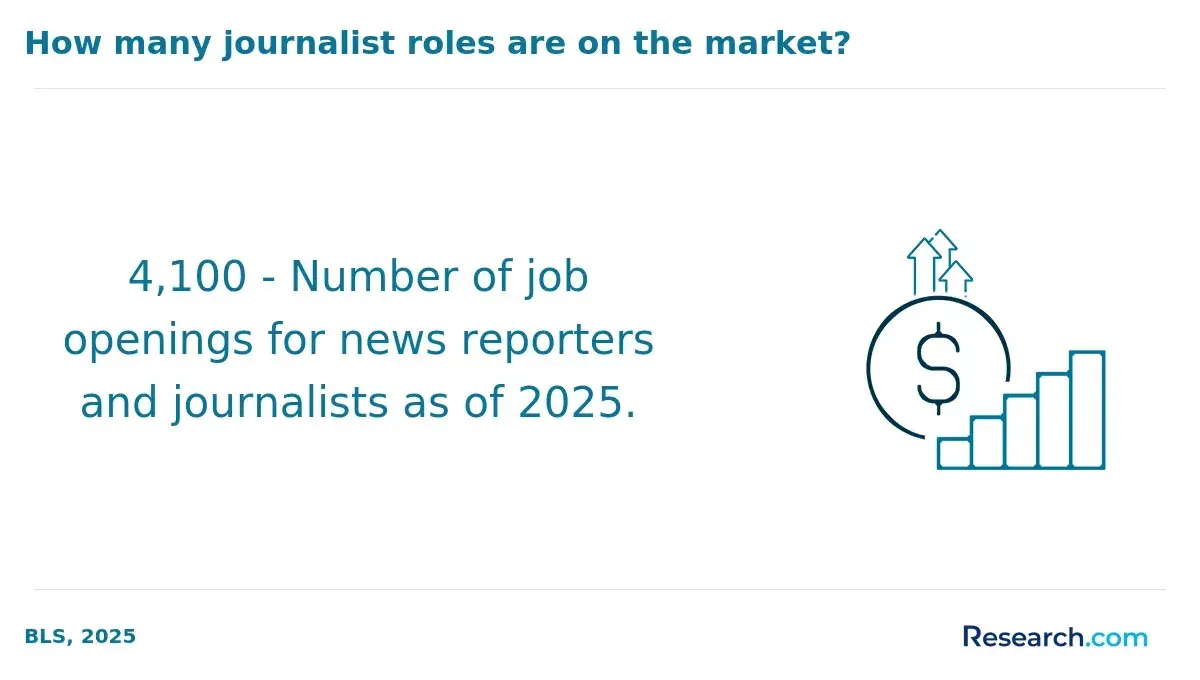
Most aspiring journalists start by earning a bachelor’s degree in journalism, communications, or a related field; building reporting experience through student media, internships, or freelance work; and creating a portfolio of published clips or multimedia samples. A degree can help, but employers also look closely at your ability to report accurately, write clearly, meet deadlines, verify information, and use digital tools. The field is competitive: employment for news analysts, reporters, and journalists is projected to decline 4% through 2034, but about 4,100 job openings are projected each year, largely because workers retire or move into other careers.
Key Things You Should Know about Becoming a Journalist
- Median salary: The median annual salary for journalists in the U.S. was $57,500.
- Job growth: Employment for news analysts, reporters, and journalists is projected to decline by 4% through 2033.
- Job openings: Around 4,500 job openings for journalists are expected each year by 2033, mainly due to retirements and career shifts.
- Job market size: There were approximately 50,000 journalism jobs.
- Education requirement: A bachelor's degree in journalism or communications is typically required for aspiring journalists.
- Why journalism may still be worth pursuing
- Journalism career outlook, salary, and job market realities
- When additional academic credentials make sense
- How to grow a useful journalism network
- How to build a credible journalist brand
- Certifications and degree options for journalists
- How graduate education can affect journalism careers
- Managing stress, deadlines, and well-being
- Challenges facing journalists today
- Whether an accelerated online bachelor’s degree can help
- Technology trends changing journalism work
- Core skills journalists need
- Steps to start a journalism career
- How to move up in journalism
- Why continuous learning matters
- Alternative careers for journalism graduates
Why Pursue a Career in Journalism?
Journalism is still a meaningful career for people who want to investigate facts, explain events, and help the public understand decisions that affect their lives. At its best, journalism exposes wrongdoing, documents community problems, questions powerful institutions, and gives readers or viewers information they can use.
The appeal is not only civic. Journalism can also be intellectually engaging. Reporters may cover public meetings, interview experts, investigate records, follow breaking news, write long-form features, produce audio stories, or create explainers for digital audiences. The work often changes from day to day, which attracts people who dislike routine and enjoy learning quickly.
However, journalism is not the right choice for everyone. It can involve irregular hours, deadline pressure, public criticism, modest starting pay in some markets, and uncertainty as media companies adjust their business models. The best candidates are usually curious, persistent, ethical, comfortable asking questions, and willing to build a career through clips, relationships, and demonstrated work rather than credentials alone.
Who Is Journalism Best For?
| Journalism may fit you if... | You may want another path if... |
| You enjoy researching, interviewing, writing, and explaining complicated topics clearly. | You want a highly predictable schedule with little deadline pressure. |
| You can handle feedback, rejection, editing, and public scrutiny. | You prefer work where your writing is not revised or challenged by editors. |
| You care about accuracy, fairness, source verification, and public service. | You are mainly looking for a communication job with a promotional or brand-advocacy focus. |
| You are open to digital formats, multimedia storytelling, and starting in smaller markets. | You only want a traditional print newsroom role in a major city immediately after graduation. |
What is the career outlook for journalism?
The journalism labor market is competitive and smaller than many other communication fields. Traditional newspapers and some legacy newsrooms have reduced staff, while digital outlets, newsletters, audio, video, and specialized media have created different kinds of reporting work. This means the career is not disappearing, but the strongest candidates usually need broader skills than previous generations of reporters did.
In the United States, employment of news analysts, reporters, and journalists is projected to decline by about 4% through 2033, while roughly 4,500 job openings are still expected each year, mostly because current workers retire or leave the occupation. Earlier in this guide, the outlook is also described as a 4% decline through 2034 with about 4,100 annual openings. Either way, the practical takeaway is the same: journalism jobs exist, but applicants should expect competition and should prepare for a digital-first hiring environment.
The job market favors candidates who can report accurately, write quickly, publish for the web, use social media responsibly, record clean audio or video, understand audience behavior, and work with data. Smaller local outlets, trade publications, nonprofit newsrooms, broadcast stations, digital startups, and freelance platforms can all be starting points.
Journalism Career Snapshot
| Factor | What it means for aspiring journalists |
| Median annual salary | The median annual salary for journalists in the U.S. was $57,500, but pay can vary by market, outlet type, experience, beat, and format. |
| Projected employment change | A projected 4% decline through 2033 signals a competitive market, especially for traditional reporting jobs. |
| Annual openings | Around 4,500 openings are expected each year by 2033, mainly because workers retire or change careers. |
| Typical education | A bachelor’s degree in journalism or communications is commonly expected, though strong clips and experience matter heavily. |
| Best preparation strategy | Build a portfolio early, complete internships, learn digital tools, and develop a reporting niche. |
For students asking how to become a journalist, the safest approach is to prepare for multiple types of media work rather than aiming at only one newsroom format. A portfolio that includes reported articles, multimedia work, data-supported stories, and audience-aware digital writing can improve your flexibility.
Should I pursue further academic credentials in journalism?
Additional education can help if it fills a specific gap, such as media law, investigative methods, data journalism, audio production, video editing, or audience analytics. It is less useful if you already have strong reporting clips and only need more professional experience. Before enrolling, compare the cost, time commitment, faculty background, internship access, alumni network, and whether the program helps you publish real work.
An online associate's degree may be useful for students who want an affordable starting credential, need transfer credits toward a bachelor’s program, or want structured training before applying for newsroom internships. Students who already hold a bachelor’s degree should usually consider targeted certificates, fellowships, workshops, or graduate programs only when they clearly support a career goal.
Degree and Training Options for Aspiring Journalists
| Option | Best for | What to check before enrolling |
| Associate degree | Students beginning college, career changers testing the field, or learners planning to transfer. | Transfer policies, writing courses, media production access, and total cost. |
| Bachelor’s degree | Most aspiring reporters seeking entry-level newsroom, broadcast, digital, or communications roles. | Internship placement, student media, faculty experience, portfolio support, and accreditation status. |
| Certificate or short course | Working professionals who need a specific skill such as data reporting, podcasting, SEO, or video editing. | Instructor credibility, practical assignments, software requirements, and portfolio outcomes. |
| Master’s degree | Career changers, specialized reporters, or journalists targeting advanced research, investigative, or leadership roles. | Return on investment, assistantships, alumni outcomes, and whether a portfolio is produced. |
How can I build a strong professional network in journalism?
Networking in journalism is not just collecting contacts. It is building relationships with editors, reporters, producers, photographers, professors, alumni, and sources who know the quality of your work. Many opportunities are shared through referrals, freelance assignments, internships, conferences, fellowships, and professional groups.
Start locally. Attend newsroom events, ask professors for introductions, join student media, follow reporters who cover beats you admire, and request short informational interviews. Online, keep your LinkedIn profile current, share published work thoughtfully, and participate in journalism communities without asking for favors before you have built trust.
Graduate study can also expand a network, especially when a program has active alumni and newsroom partnerships. If you are comparing flexible graduate routes, Research.com’s guide to fast online master’s degree options can help you understand how accelerated programs are structured, although speed should never be the only factor in choosing a journalism-related program.
How can I build a strong personal brand as a journalist?
A journalist’s personal brand should communicate credibility, not self-promotion at the expense of accuracy. Editors and audiences should be able to tell what you cover, how you report, and why your work can be trusted. Your portfolio, biography, social profiles, and published clips should present a consistent professional identity.
Build a simple portfolio with your strongest clips, a short bio, contact information, resume, and links to multimedia work. Use social platforms carefully: share your reporting, credit sources and collaborators, correct mistakes transparently, and avoid posts that undermine your perceived fairness on the topics you cover.
If cost barriers are slowing your training, you can compare schools such as online colleges with no application fee, but make sure any program you choose offers practical writing, reporting, editing, and digital media experience.
What certifications and degree options can accelerate my journalism career?
Certifications can help when they prove a concrete skill employers need. For example, a short course in data visualization, public records research, audio editing, video production, social media verification, or analytics may be more valuable than a general credential with no portfolio outcome. Journalism employers usually want evidence: clips, projects, published investigations, video samples, newsletters, podcasts, or data stories.
Accelerated programs can be useful for students who need a formal degree quickly, especially adult learners balancing work and school. If you are comparing faster credential pathways, Research.com’s overview of the fastest online degree options can provide context. For journalism, however, the key question is not only how fast the program is; it is whether the program helps you produce publishable work and secure experience.
Questions to Ask Before Choosing a Journalism Program
- Does the program require reporting, editing, media law, ethics, and digital production courses?
- Can students write for a campus publication, broadcast outlet, podcast, newsletter, or digital newsroom?
- Are internships built into the curriculum or supported by faculty relationships?
- Will you graduate with a portfolio of published or professionally edited work?
- Does the school clearly explain tuition, fees, transfer credits, and financial aid eligibility?
- Are faculty members experienced in current journalism formats, not only legacy media?
- Does the program align with your target role: reporting, broadcast, editing, data journalism, photojournalism, or multimedia production?
Can advanced degrees transform my journalism career?
A graduate degree can strengthen a journalism career when it helps you specialize or move into more advanced work. It may be valuable for investigative reporting, international reporting, science writing, data journalism, documentary work, media leadership, or academic and research-oriented roles. It can also help career changers who have subject-matter expertise but need formal reporting training.
Still, a master’s degree is not automatically required for journalism advancement. Many reporters move up through strong work, consistent clips, beat expertise, and editor recommendations. Before enrolling, compare expected debt, opportunity cost, assistantship options, internship access, and whether the program’s graduates are working in roles you want. Students exploring broader graduate paths can review master’s degrees associated with higher-paying fields, but journalism decisions should be based on fit, portfolio development, and realistic career goals.
How can I manage work-life balance and mental health challenges in journalism?
Journalism can involve breaking news, night meetings, weekend work, emotionally difficult interviews, online harassment, and pressure to publish quickly. These conditions can contribute to stress, especially for reporters covering trauma, conflict, crime, disasters, or polarizing political issues.
Protecting your well-being requires deliberate habits. Set boundaries when possible, clarify deadline expectations, debrief difficult assignments, use vacation time, keep notes organized to reduce last-minute pressure, and seek professional support if stress becomes persistent. Freelancers should also build routines around invoicing, pitching, rest, and workload limits because unstable income can add another layer of pressure.
If you are trying to move into journalism without spending many years in school, an option such as a fast associate degree may be worth comparing. Just remember that a shorter academic timeline should still include writing practice, reporting assignments, and portfolio development.
What challenges do modern journalists face?
Modern journalists work in an environment shaped by misinformation, declining trust, fast publishing cycles, online harassment, shrinking local news coverage, and intense competition for audience attention. They must verify digital content, evaluate sources, avoid amplifying false claims, and explain uncertainty clearly when facts are still developing.
Legal and ethical awareness also matters. Reporters need to understand libel, privacy, attribution, corrections, conflicts of interest, and source protection. Journalists covering sensitive stories may also need safety planning, secure communication practices, and editorial support.
For professionals who want advanced training in communication strategy, media law, or specialized reporting, one year masters programs online may be worth researching. The best choice depends on whether the curriculum directly addresses the reporting challenges you expect to face.
Can a quick bachelor's degree online fast-track my journalism career?
A faster online bachelor’s program can help if it is accredited, accepts relevant transfer credits, fits your schedule, and gives you enough opportunity to build a portfolio. It may be especially practical for working adults, military students, transfer students, and people changing careers from another field.
However, speed is not the same as career readiness. Journalism programs should teach reporting, writing, editing, media ethics, communication law, multimedia production, and digital publishing. They should also help you find internships or publish work. If you are comparing accelerated options, Research.com’s guide to a quick bachelor's degree online can help you evaluate format and timeline, but you should also review course quality and hands-on opportunities.
What emerging technologies are transforming journalism?
Technology is changing how journalists find stories, verify information, produce content, and reach audiences. Artificial intelligence tools can assist with transcription, document review, data analysis, headline testing, and workflow support. Drones, immersive media, interactive graphics, newsletters, podcasts, and video platforms have expanded the ways news can be reported and distributed.
These tools create opportunity, but they also raise ethical questions. Journalists must disclose AI use when appropriate, verify machine-generated outputs, protect confidential information, avoid synthetic media misuse, and maintain editorial judgment. Technology should support reporting, not replace verification.
Students looking for affordable digital media training may compare options such as cheap online colleges, especially if they need courses in multimedia production, data tools, or digital communication. The best programs will teach both technical skills and responsible editorial standards.
What skills are required for journalists?
Journalists need more than strong writing. They must gather reliable information, evaluate evidence, ask effective questions, work under deadline, explain context, and publish in formats audiences actually use. The most employable candidates combine traditional reporting discipline with digital production ability.
Writing and Communication
Clear writing is the foundation of journalism. Reporters must explain what happened, why it matters, who is affected, and what remains unknown. Strong grammar helps, but the deeper skill is organizing facts into a story that is accurate, readable, and fair. Journalists also need to adapt their writing for articles, scripts, newsletters, live updates, captions, headlines, and social posts.
Research and Investigation
Good reporting depends on evidence. Journalists search public records, review documents, analyze data, compare claims, follow timelines, and verify names, dates, quotes, and figures. Investigative work requires patience, skepticism, and careful documentation so that every claim can be supported.
Interviewing and Interpersonal Skills
Reporters spend much of their time talking with people. They interview officials, experts, witnesses, community members, advocates, critics, and people directly affected by events. Strong interviewers prepare well, listen closely, ask follow-up questions, and treat sources with professionalism even when conversations are difficult.
Critical Thinking and Analysis
Journalists must sort relevant facts from noise. They assess credibility, identify missing context, recognize bias, and avoid false balance when evidence clearly supports one conclusion over another. These analytical abilities are also useful outside newsrooms. If you later decide to move into management, consulting, or business communication, comparing MBA programs with high acceptance rates may help you identify accessible graduate options that build leadership and financial decision-making skills.
Ethics and Integrity
Credibility is a journalist’s most important asset. Ethical reporters verify before publishing, correct errors, avoid plagiarism, distinguish fact from opinion, disclose conflicts when required, and handle vulnerable sources carefully. Understanding media law, privacy concerns, and libel risk is also essential.
Persistence and Resilience
Reporting often involves unanswered calls, denied records requests, difficult edits, and stories that fall apart. Journalists need persistence to keep pursuing facts and resilience to improve after criticism. This is especially important in a field with high competition and fast deadlines.
Time Management
Deadlines are constant. Reporters must schedule interviews, organize notes, verify details, write drafts, respond to edits, and sometimes publish updates as new information arrives. Practical systems matter. Learning how to manage time effectively as a journalist can make the difference between controlled urgency and avoidable chaos.
Digital and Technical Skills
Modern journalists often use content management systems, audio recorders, video tools, photo editing software, spreadsheets, analytics dashboards, social platforms, and verification tools. Data literacy, search skills, SEO awareness, accessibility practices, and audience engagement are increasingly useful in digital newsrooms.
Skill Priorities by Journalism Role
| Role | Most important skills | Portfolio evidence to show |
| News reporter | Interviewing, fast writing, verification, source development, deadline judgment. | Breaking news clips, meeting coverage, community stories, and edited articles. |
| Investigative reporter | Records research, data analysis, document review, legal awareness, persistence. | Deeply reported projects, public records work, explainers, and evidence-based stories. |
| Broadcast journalist | Script writing, on-camera or audio delivery, field reporting, production coordination. | Demo reel, packages, standups, radio segments, or video reports. |
| Data journalist | Spreadsheets, data cleaning, visualization, statistical caution, public data sourcing. | Charts, data stories, methodology notes, and interactive projects. |
| Multimedia journalist | Writing, shooting, editing, audio, video, social distribution, mobile reporting. | Articles with photos, short videos, podcasts, social packages, and web-first projects. |
How to Start Your Career in Journalism
Getting into journalism is a practical process. You need training, but you also need proof that you can report. Employers and editors will look for clips, internships, references, and evidence that you understand accuracy, deadlines, and audience needs.
Step 1: Build Foundational Skills Early
- Take writing, media, public speaking, statistics, political science, economics, science, or history courses that improve your ability to understand the world you may cover.
- Read high-quality local, national, and investigative journalism to study structure, sourcing, headlines, and story framing.
- Join student media, a campus publication, a broadcast club, a podcast team, or a community newsletter to practice real reporting.
Step 2: Earn a Relevant Degree
- A bachelor’s degree in journalism or communication is typically expected for aspiring journalists.
- Six in 10 U.S. journalists with college degrees have majored in journalism or communication, with many working in television, newspapers, and online news outlets.
- If you choose another major, use electives, internships, student media, and freelance work to prove your journalism ability.
Step 3: Get Hands-On Experience
- Apply for internships with local newspapers, public radio stations, television stations, nonprofit newsrooms, trade publications, magazines, or digital outlets.
- Look for part-time production, editing, research, newsletter, or reporting roles that help you understand newsroom workflow.
- Do not dismiss smaller outlets. Local reporting can give you more responsibility and better clips than a passive role at a larger organization.
Step 4: Create a Portfolio
- Publish your strongest work online in a clean portfolio that includes your name, contact information, resume, and selected clips.
- Show range: breaking news, features, profiles, explainers, multimedia work, data-supported pieces, or investigative projects.
- For broadcast or audio roles, include a demo reel or audio samples that show reporting, writing, delivery, and production quality.
Step 5: Apply Strategically and Stay Flexible
- Search for roles such as reporter, staff writer, digital producer, assignment editor, news assistant, production assistant, researcher, or multimedia journalist.
- Consider smaller markets, local outlets, trade publications, newsletters, nonprofit newsrooms, and freelance assignments as entry points.
- Customize applications by showing that you understand the outlet’s audience, coverage priorities, and editorial style.
Common Mistakes New Journalists Should Avoid
| Mistake | Better approach |
| Choosing a program based only on speed or convenience. | Check accreditation, faculty experience, internship access, student media, and portfolio outcomes. |
| Waiting until senior year to publish work. | Start building clips through student media, internships, freelance assignments, or local reporting as early as possible. |
| Submitting applications without tailoring clips. | Match your samples to the outlet’s format, beat, and audience. |
| Assuming a degree alone will secure a job. | Combine education with internships, networking, digital skills, and a strong portfolio. |
| Ignoring accuracy under deadline pressure. | Develop verification habits, fact-checking checklists, and clear correction practices. |
How can I advance my career in journalism?
Advancement in journalism usually comes from stronger clips, deeper expertise, trusted relationships, and the ability to handle more complex work. Moving up may mean covering a larger beat, joining a bigger outlet, becoming an editor or producer, leading investigations, managing a team, or building an independent audience.
- Develop a beat: Specializing in politics, education, courts, health, science, climate, sports, business, local government, or another area can make your work more valuable. Beat reporters build source networks and context that generalists often lack.
- Produce consistently strong work: Accuracy, clean writing, deadline reliability, and smart story ideas matter. Editors remember reporters who can handle difficult assignments without creating preventable problems.
- Build industry relationships: Stay connected with editors, professors, internship supervisors, colleagues, and other reporters. Professional groups such as the Society of Professional Journalists can provide training, conferences, and networking opportunities.
- Add digital and multimedia skills: Learning video, audio, data analysis, newsletter strategy, SEO, audience analytics, or interactive storytelling can help you qualify for broader roles.
- Consider leadership: Experienced journalists may move into editing, producing, newsroom management, audience leadership, investigations editing, or news director roles.
If you eventually want to apply your communication skills outside journalism, nonprofit leadership may be one option. Research.com’s guide to the easiest online MSW program options can help career changers explore flexible routes into advocacy, community programs, and policy-related work.
Possible Journalism Career Progression
| Career stage | Common roles | How to move forward |
| Entry level | News assistant, reporter, digital producer, production assistant, staff writer. | Build clips, meet deadlines, learn newsroom systems, and ask for editing feedback. |
| Early career | Beat reporter, multimedia journalist, associate producer, newsletter writer. | Develop sources, pitch original stories, improve multimedia skills, and show audience awareness. |
| Midcareer | Senior reporter, investigative journalist, editor, producer, data journalist. | Lead projects, mentor junior staff, specialize, and produce high-impact work. |
| Advanced | Managing editor, news director, executive producer, bureau chief, independent journalist. | Manage teams, set editorial strategy, build partnerships, and maintain high ethical standards. |
How can continuous learning benefit my journalism career?
Journalism changes quickly, so ongoing learning is part of staying employable. Reporters who continue improving can adapt to new publishing tools, audience habits, verification methods, and storytelling formats. Continuous learning can also help you move into specialized reporting or leadership.
Useful options include workshops, fellowships, professional conferences, newsroom training, online courses, data bootcamps, media law refreshers, investigative reporting seminars, and editing programs. If you need a broader academic credential and want flexible study, you can compare easy degrees to get online, but make sure the program still builds the skills your target roles require.
What are some alternative career options for journalists?
Journalism skills transfer well because many organizations need people who can research, write clearly, interview stakeholders, explain complex issues, and manage information responsibly. If you decide not to stay in a newsroom, your reporting background can still support a strong communications career.
Public Relations (PR) or Corporate Communications
PR and corporate communication roles use storytelling, media judgment, writing, and message strategy. Former journalists often understand what editors need, how to write clear press materials, and how to respond quickly during public-facing situations. The key difference is purpose: journalism informs the public independently, while PR represents an organization or client.
Marketing and Content Creation
Content marketing, copywriting, brand journalism, and editorial strategy roles value clear writing and audience awareness. Journalists can write blogs, case studies, newsletters, scripts, white papers, social content, and thought leadership pieces. These roles may offer more predictable business settings while still using research and storytelling skills.
Social Media Management
Social media managers create posts, monitor trends, respond to audiences, and help organizations communicate in real time. Journalists’ deadline writing, judgment, and fact-checking habits are useful, especially during fast-moving or sensitive situations.
Editing and Publishing
Editors improve structure, clarity, accuracy, tone, and consistency. Journalism graduates may work as copy editors, assigning editors, content editors, managing editors, book editors, or freelance editors. This path suits people who enjoy shaping stories and improving other writers’ work.
Technical Writing or Grant Writing
Technical writers explain complex products, systems, or procedures in plain language. Grant writers create persuasive proposals for nonprofits, researchers, schools, and public agencies. Both careers reward precision, organization, research, and the ability to write for a specific audience.
Education, Law, Multimedia, and Other Paths
Some journalism graduates move into teaching, law, documentary production, podcasting, research, policy work, or media training. If you are interested in education careers, Research.com’s guide What Can You Do With a Masters in Education? explains options in teaching, administration, and education policy.
Accounting and finance-related communication can also be a pivot for people who like investigation and detail. A fastest accounting degree online may be worth researching if you are interested in financial reporting, forensic accounting, compliance communication, or business analysis. Before making that shift, review whether an accounting degree is worth it so you understand job prospects, salary expectations, and credential requirements.
Journalism vs. Related Communication Careers
| Career path | Primary goal | Why journalists may fit |
| Journalism | Inform the public through independent reporting and verification. | Uses interviewing, writing, investigation, ethics, and public accountability. |
| Public relations | Shape and protect an organization’s public image. | Uses media judgment, writing, pitching, and crisis communication. |
| Content marketing | Attract or educate customers through useful content. | Uses storytelling, research, audience analysis, and clear writing. |
| Technical writing | Explain complex information accurately and simply. | Uses precision, structure, research, and reader-focused communication. |
| Editing | Improve content quality, accuracy, clarity, and consistency. | Uses news judgment, language skills, fact-checking, and organization. |
References:
- Employment and Training Administration (U.S. Dept. of Labor). Career exploration resources. https://www.careeronestop.org/ExploreCareers/explore-careers.aspx
- Indeed. Journalist salary in United States. https://www.indeed.com/career/journalist/salaries
- The American Journalist. Research findings on journalism careers. https://www.theamericanjournalist.org/post/american-journalist-findings
- Bureau of Labor Statistics. News analysts, reporters, and journalists. https://www.bls.gov/ooh/media-and-communication/reporters-correspondents-and-broadcast-news-analysts.htm
- National Press Photographers Association. Professional standards and career information. https://nppa.org
- Related occupational outlook information from the Bureau of Labor Statistics. https://www.bls.gov/ooh/media-and-communication/reporters-correspondents-and-broadcast-news-analysts.htm
- National Archives and Records Administration. Federal records and media resources. https://www.archives.gov
- Bureau of Labor Statistics occupational information. https://www.bls.gov/ooh/media-and-communication/reporters-correspondents-and-broadcast-news-analysts.htm
- O*NET OnLine. 27-3023.00 News analysts, reporters, and journalists. https://www.onetonline.org/link/summary/27-3023.00
- Additional BLS occupational outlook page for reporters and journalists. https://www.bls.gov/ooh/media-and-communication/reporters-correspondents-and-broadcast-news-analysts.htm
- ProbablyGood. Career information resource. https://probablygood.org/
- Franklin University. Data journalism daily work and skills. https://www.franklin.edu/career-guide/reporters-and-journalists/what-do-data-journalists-do
- U.S. Bureau of Labor Statistics. News analysts, reporters, and journalists. https://www.bls.gov/ooh/media-and-communication/reporters-correspondents-and-broadcast-news-analysts.htm
- U.S. Government Accountability Office. Occupational and workforce resources. https://www.gao.gov
- U.S. Department of Education. Accreditation information. https://www.ed.gov/accreditation
- Additional data journalism career guide. https://www.franklin.edu/career-guide/reporters-and-journalists/what-do-data-journalists-do
Key Insights
- Journalism remains a viable career for people who value public service, verification, storytelling, and fast learning, but it is a competitive field with projected employment decline.
- The strongest applicants do not rely on a degree alone. They graduate with clips, internships, multimedia samples, source-building experience, and clear evidence of ethical reporting.
- A bachelor’s degree in journalism or communications is typically expected, but certificates, associate degrees, accelerated programs, and graduate study should be chosen only when they support a specific career goal.
- Digital skills now matter. Journalists who can write, report, edit, shoot video, work with data, understand audiences, and use technology responsibly have more flexibility.
- Before choosing a journalism program, check accreditation, cost, transfer credit rules, internship access, student media opportunities, and whether you will produce publishable work.
- If traditional journalism does not fit long term, the same skills can transfer to public relations, content marketing, editing, technical writing, social media, education, law, nonprofit work, and business communication.
Other Things You Should Know about Becoming a Journalists
To start a journalism career in 2027, having a bachelor’s degree in journalism, communications, or a related field is often essential. Practical experience from internships, strong writing skills, and proficiency with digital media tools are also crucial due to the evolving media landscape.
In 2027, journalists need strong digital skills, including proficiency in multimedia content creation, SEO strategies, and data journalism. Familiarity with social media platforms for news dissemination and audience engagement is also crucial as digital platforms dominate the media landscape.