
2027 How to Become a Marketing Analyst

Co-Founder and Chief Data Scientist
Marketing analysts help organizations decide which customers to target, which campaigns deserve more budget, which products need repositioning, and which marketing channels are producing measurable results. If you are considering this career, the key question is not only “How do I become a marketing analyst?” but also whether the role fits your strengths, education plans, salary goals, and tolerance for fast-changing tools.
This guide explains what marketing analysts do in 2027, what education and skills employers usually expect, which certifications can strengthen your resume, where analysts work, what salary and job outlook data show, and how to choose the right academic or career pathway. You will also learn how AI, privacy rules, data storytelling, and cross-functional business work are changing the profession.
Quick Answer: How do you become a marketing analyst?
To become a marketing analyst, earn a bachelor’s degree in a relevant field such as marketing, business, economics, statistics, data analytics, communications, or psychology; build practical experience with Excel, SQL, Google Analytics, CRM platforms, visualization tools, and campaign reporting; complete internships or portfolio projects; and consider certifications in analytics, digital advertising, market research, or data visualization. A master’s degree is not required for every role, but it can help with advanced analytics, leadership, or specialized positions.
Key Things You Should Know About Becoming a Marketing Analyst
- Most employers look for a bachelor’s degree in marketing, business, statistics, economics, data analytics, or another quantitative or business-focused field. Practical proof of skill often matters as much as the degree title.
- Daily work involves tracking campaign results, customer behavior, sales patterns, web activity, and market shifts. Tools such as Google Analytics, Excel, SQL, Python, Tableau, Power BI, HubSpot, and CRM systems frequently appear in analyst job descriptions.
- The job is not limited to reporting numbers. Strong analysts explain what the data means, why it matters, and what action a marketing, sales, product, or executive team should take next.
- Marketing analytics changes quickly because of AI tools, privacy regulations, search algorithm changes, paid media updates, and shifts in consumer behavior. Ongoing learning is part of the career.
- Marketing analysts work across technology, retail, finance, healthcare, consulting, agencies, nonprofits, government, education, media, and startups. With experience, they may advance into senior analyst, marketing manager, analytics manager, product analyst, business analyst, or data science-adjacent roles.
- What does a marketing analyst do in 2027?
- What education do you need to become a marketing analyst?
- Which bachelor’s degree is best for marketing analytics?
- Which certifications are useful for marketing analysts?
- What skills should marketing analysts build?
- Where do marketing analysts work?
- How much do marketing analysts earn, and what is the job outlook?
- Should you earn an online bachelor’s degree for marketing analytics?
- Can an online associate degree help you enter marketing analytics?
- Can an accelerated online master’s degree help you advance faster?
- Is becoming a marketing analyst worth it?
- How are AI and emerging technologies changing marketing analytics?
- What challenges do marketing analysts face?
- What careers can marketing analysts move into?
- How should analysts combine quantitative and qualitative insights?
- How can marketing analysts keep growing professionally?
- How can marketing analysts improve data storytelling?
- How can marketing analysts build useful professional networks?
- What ethical issues matter in marketing analysis?
- How can marketing analysts use affordable learning options?
What does a marketing analyst do in 2027?
A marketing analyst collects, cleans, studies, and explains data that helps an organization improve its marketing decisions. The role sits at the intersection of business strategy, customer research, digital marketing, statistics, and communication. Analysts examine questions such as: Which customer segment converts best? Which ad campaign is underperforming? Why did website traffic rise but revenue stay flat? Which product message resonates with buyers?
Typical responsibilities include reviewing campaign performance, building dashboards, studying customer behavior, analyzing competitors, segmenting audiences, measuring key performance indicators, and preparing recommendations for marketing leaders. Analysts may use Google Analytics, CRM systems, spreadsheet models, survey tools, statistical software, database queries, and visualization platforms to turn raw information into business guidance.
The role overlaps with business intelligence, but the focus is different. Marketing analysts concentrate on customers, markets, campaigns, pricing, positioning, and brand performance. Business intelligence analysts usually examine broader organizational data across finance, operations, sales, supply chain, and executive decision-making. If you want a wider enterprise analytics path, compare this role with how to become a business intelligence analyst.
The most effective marketing analysts do three things well: they ask the right business question, use reliable data to answer it, and communicate the answer in a way that leads to action. Their work helps companies decide how to allocate budgets, refine messaging, improve customer engagement, and measure return on investment.
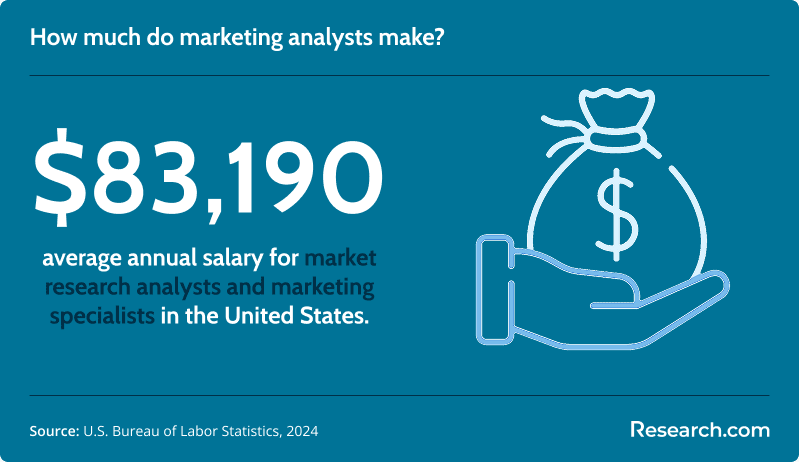
The image below shows annual earnings for marketing analysts in the United States.
What education do you need to become a marketing analyst?
Most marketing analyst roles require a bachelor’s degree, although employers may evaluate candidates based on a mix of education, technical skill, internship experience, portfolio projects, and familiarity with marketing platforms. The best preparation combines business knowledge with quantitative analysis.
- Bachelor’s degree: Common majors include marketing, business, economics, statistics, data analytics, communications, psychology, and related fields.
- Analytics coursework: Classes in statistics, market research, consumer behavior, database management, digital marketing, research methods, and business analytics are especially useful.
- Technical practice: Projects involving Excel, SQL, Python, R, dashboards, campaign reporting, or CRM data help demonstrate readiness for entry-level work.
- Internships and applied projects: Employers value candidates who can show campaign reports, survey analysis, segmentation work, dashboard samples, or A/B testing results.
- Certifications: Short credentials in analytics, paid advertising, content marketing, visualization, or research methods can support a resume, especially when paired with real projects.
- Graduate study: A master’s degree in marketing analytics, business analytics, data science, statistics, or an MBA can be useful for advanced roles. If flexibility and cost are major factors, an affordable online MBA in data analytics may be worth comparing with traditional graduate programs.
Students who want deeper quantitative preparation can also explore data analytics degrees. These programs may provide more extensive training in databases, programming, predictive modeling, and visualization than a traditional marketing major. For graduate-level specialization, the best master's degree program in data analytics can help build advanced skills in machine learning, interpretation, and predictive modeling for more technical analytics roles.
| Path | Best for | Main advantage | Possible limitation |
| Bachelor’s in marketing | Students who want a direct marketing foundation | Strong preparation in consumer behavior, branding, campaigns, and market research | May require extra technical training in SQL, Python, or advanced statistics |
| Bachelor’s in business administration | Students who want broad business flexibility | Covers marketing, finance, management, strategy, and operations | Analytics depth depends heavily on electives and concentration choices |
| Bachelor’s in statistics or data science | Students who prefer quantitative and technical work | Builds strong modeling, programming, and data interpretation skills | May require additional marketing and consumer behavior coursework |
| Bachelor’s in economics | Students interested in markets, pricing, and consumer behavior | Develops analytical thinking and understanding of market forces | Digital marketing tools may need to be learned outside the major |
| Master’s degree or MBA | Working professionals seeking advancement | Can support leadership, strategy, and advanced analytics roles | Costs more and should be evaluated against career goals and employer expectations |
Which bachelor’s degree is best for marketing analytics?
The best bachelor’s program depends on whether you want to be more marketing-focused, business-focused, or technically focused. There is no single required major for every marketing analyst job, but some programs align especially well with the role.
- Marketing: A strong fit if you want to study consumer behavior, branding, digital marketing, market research, and campaign strategy.
- Business administration: A business administration degree can prepare you for analytics work while also giving you a broader view of finance, operations, management, and strategy.
- Economics: Useful for students interested in market dynamics, pricing, forecasting, consumer demand, and data interpretation.
- Statistics or data science: A strong choice for students who want to handle complex datasets, predictive models, experimentation, and technical analysis.
- Communications or psychology: These majors can be useful when paired with analytics coursework because they help explain how people respond to messages, brands, and buying decisions. A business psychology background can be particularly relevant to consumer insights and behavioral analysis.
When comparing bachelor’s programs, look beyond the major title. Review the course catalog and ask whether the program includes market research, statistics, digital analytics, database tools, consumer behavior, data visualization, and hands-on projects. A marketing degree with strong analytics electives may be more useful than a technical degree with no business context, depending on the job you want.
If you are drawn more to data systems than campaign analysis, you may also want to review how to become a data architect. Data architects design the structures that store and organize data, while marketing analysts use data to answer customer and campaign questions.
Which certifications are useful for marketing analysts?
Certifications can help you show practical skills, especially if your degree is broad or you are trying to move into analytics from another business role. They are most valuable when they support demonstrable work, such as dashboards, campaign audits, SQL queries, or reports.
| Certification or credential | What it can demonstrate | Best fit |
| Google Analytics Certification | Ability to evaluate website behavior, traffic sources, events, conversions, and campaign performance | Digital marketing, web analytics, e-commerce, and agency roles |
| HubSpot certification | Understanding of content strategy, inbound marketing, SEO concepts, and customer engagement | Content analytics, inbound marketing, and CRM-supported marketing teams |
| Meta Blueprint Certification | Knowledge of campaign setup, social advertising, targeting, and performance evaluation on Meta platforms | Paid social, agency, and social media analytics roles |
| Google Ads certification | Understanding of paid search measurement, campaign performance, and advertising optimization | Search advertising, performance marketing, and demand generation roles |
| Microsoft Power BI or Tableau Certification | Dashboard building, visualization, reporting, and communication of data patterns | Analysts who need to present findings to marketing, sales, or executive teams |
| Certified Digital Marketing Professional (CDMP) by the Digital Marketing Institute | Broad exposure to digital marketing strategy, SEO, analytics, and campaign measurement | Career changers and marketers who want a structured digital marketing credential |
| Professional Researcher Certification (PRC) by the Insights Association | Market research knowledge, research design, and evidence-based consumer insight practices | Market research, consumer insights, and survey-heavy roles |
Certifications should not replace core analytical ability. Before paying for a credential, check whether job postings in your target market mention it, whether the credential teaches a tool you will actually use, and whether you can turn the training into a portfolio project. If you want a deeper academic route, the best online master's degree in data analytics may offer broader preparation in statistics, modeling, databases, and applied analytics.
What skills should marketing analysts build?
Marketing analysts need a mix of technical ability, marketing judgment, business communication, and ethical data handling. A degree can introduce these areas, but employers usually want evidence that you can apply them in real situations. Review marketing degree requirements to understand how academic preparation may align with the role.
| Skill area | What it means in marketing analytics | How to build evidence |
| Data analysis | Cleaning, comparing, segmenting, and interpreting campaign, customer, and sales data | Create spreadsheet analyses, SQL queries, or Python notebooks using sample datasets |
| Statistics and experimentation | Understanding averages, variation, correlation, confidence, A/B testing, and attribution limits | Analyze test results and explain what can and cannot be concluded |
| Digital marketing knowledge | Understanding SEO, paid search, paid social, email, content, landing pages, and conversion funnels | Audit a campaign or website and recommend measurable improvements |
| Visualization and reporting | Turning complex results into charts, dashboards, and summaries that decision-makers can use | Build dashboards in Tableau, Power BI, Looker Studio, or similar tools |
| Business judgment | Connecting metrics to revenue, cost, customer retention, brand goals, or strategic priorities | Write recommendations that include trade-offs, assumptions, and next steps |
| Communication | Explaining technical findings clearly to marketers, sales teams, executives, or clients | Practice presenting short analysis briefs to nontechnical audiences |
| Tool fluency | Using platforms such as Google Analytics, HubSpot, Salesforce, Excel, SQL, Python, Power BI, or Tableau | Complete hands-on projects and include screenshots, summaries, or public portfolio samples when appropriate |
| Ethical data practice | Respecting consent, privacy rules, bias risks, and responsible use of customer data | Document data sources, limitations, and privacy considerations in every project |
Where do marketing analysts work?
Marketing analysts are employed wherever organizations need to understand customers, markets, campaigns, demand, or brand performance. Some work on internal marketing teams, while others serve clients through agencies, research firms, consulting firms, or freelance arrangements.
Corporations and large enterprises
Large organizations often have dedicated analytics, marketing operations, customer insights, or growth teams. Analysts in these settings may specialize by channel, product line, region, audience segment, or customer lifecycle stage.
- Retail and e-commerce: Analysts study browsing behavior, product demand, promotions, cart abandonment, customer lifetime value, and advertising efficiency.
- Technology and software: Analysts evaluate user acquisition, subscription behavior, feature adoption, churn, and campaign performance.
- Financial services and banking: Analysts examine customer segmentation, product adoption, risk-aware targeting, and marketing return on investment.
- Healthcare and pharmaceuticals: Analysts review audience needs, campaign compliance considerations, patient or provider engagement, and product demand trends.
Marketing agencies and consulting firms
Agency and consulting roles can be a good fit if you want exposure to multiple industries and campaign types. The pace may be faster, and analysts may need to translate data for clients with different levels of technical understanding.
- Advertising and digital marketing agencies: Analysts monitor paid media, social engagement, conversion rates, SEO performance, and budget allocation. If this setting appeals to you, compare digital marketing degrees online.
- Market research firms: Analysts design or interpret surveys, focus groups, brand studies, competitor research, and consumer trend reports.
- Management consulting firms: Analysts may help clients connect marketing performance with strategy, pricing, growth, and customer experience decisions.
Media, publishing, and entertainment
Media companies rely on analysts to understand audience growth, subscriptions, content engagement, advertising revenue, and platform performance.
- Streaming services: Analysts evaluate viewing behavior, retention, engagement, and content strategy signals.
- Social media platforms: Analysts assess ad performance, engagement trends, targeting, and advertiser outcomes.
- Publishing and news organizations: Analysts study reader behavior, subscription funnels, newsletters, traffic sources, and retention patterns.
Startups and small businesses
Smaller employers may not have large marketing teams, so the analyst role can be broader. You may work on reporting, paid ads, SEO, email analytics, customer segmentation, budget recommendations, and campaign execution in the same position.
- Creating practical measurement plans for limited budgets.
- Monitoring content, email, search, social, and advertising performance.
- Using segmentation to personalize campaigns and improve retention.
Government, education, and nonprofit organizations
Public-interest organizations use marketing analytics to improve outreach, enrollment, fundraising, public awareness, and community engagement.
- Government agencies: Analysts may evaluate public information campaigns, community programs, and outreach effectiveness.
- Nonprofits and NGOs: Analysts often study donor behavior, fundraising performance, volunteer engagement, and awareness campaigns.
- Educational institutions: Analysts may examine student recruitment, enrollment trends, program marketing, and audience messaging.
Freelance and remote work
Some marketing analysts work independently or remotely, especially when their work is focused on dashboards, campaign audits, SEO reporting, paid media analysis, or consulting deliverables.
- Analyzing campaign performance for multiple clients.
- Improving digital marketing measurement and reporting systems.
- Providing part-time or project-based analytics support to companies without in-house expertise.
The table below lists top-paying industries for market research analysts and marketing specialists, according to the Bureau of Labor Statistics.
| Industry | Average Annual Salary |
| Web Search Portals, Libraries, Archives, and Other Information Services | $136,560 |
| Aerospace Product and Parts Manufacturing | $132,580 |
| Pipeline Transportation of Crude Oil | $130,840 |
| Monetary Authorities-Central Bank | $125,720 |
| Computing Infrastructure Providers, Data Processing, Web Hosting, and Related Services | $120,660 |
How much do marketing analysts earn, and what is the job outlook?
Marketing analyst compensation varies by location, industry, company size, technical skill level, experience, and whether the role is closer to market research, digital analytics, product analytics, or business intelligence. Salary data should be treated as a benchmark, not a guarantee.
Salary expectations
According to the United States Bureau of Labor Statistics (BLS), market research analysts and marketing specialists earn an average annual wage of $83,190, or an average of $40 per hour. The median wage is $74,680 per year, and the top 10 highest earners make $137,040 per year.
Total compensation may also include bonuses, commissions, or profit-sharing in some organizations, especially where marketing performance is closely tied to revenue growth. However, these forms of compensation depend on employer policies and individual role design.
Job outlook and demand
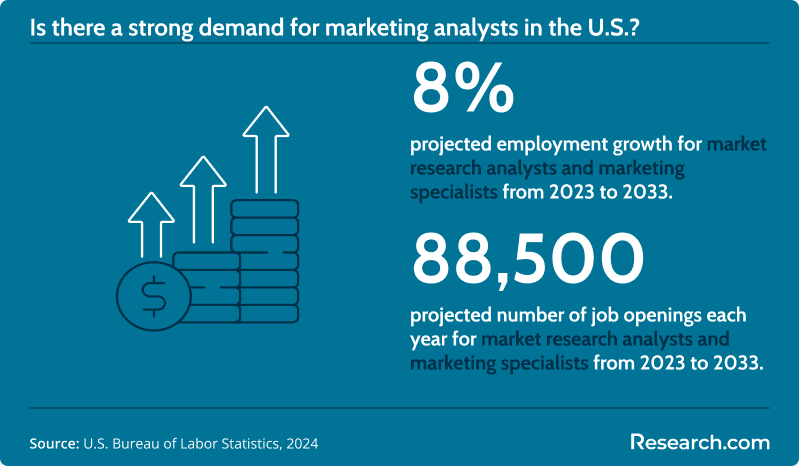
The BLS projects employment of market research analysts to grow 8% from 2023 to 2033, which is much faster than the average for all occupations. The BLS also projects an average of 88,500 openings for market research analysts each year over the same 10-year period.
Demand is supported by several long-term business needs:
- Digital marketing measurement: Companies need analysts who can interpret web, search, social, email, and advertising data.
- AI and predictive analytics: More organizations are using automated tools and machine learning-supported models, creating demand for analysts who can evaluate outputs and explain business meaning.
- Customer insight: Businesses need evidence to guide product positioning, pricing, audience targeting, and retention strategies.
- Accountability for marketing spend: Leaders increasingly expect marketers to justify budgets with measurable outcomes.
Career growth paths
With experience, marketing analysts can move into more specialized, strategic, or leadership-oriented roles.
- Senior marketing analyst: Leads deeper analysis, mentors junior analysts, and owns complex reporting or experimentation projects.
- Marketing manager or strategist: Uses analytics to shape campaigns, messaging, budgets, and growth plans.
- Director of marketing analytics: Oversees analytics strategy, measurement systems, reporting standards, and analytics teams.
- Chief marketing officer: Leads overall marketing strategy, brand direction, growth planning, and executive-level business outcomes.
The image below illustrates demand for marketing analysts and marketing specialists in the United States.
Should you earn an online bachelor’s degree for marketing analytics?
An online bachelor’s degree can be a practical route into marketing analytics if the program is accredited, offers relevant analytics coursework, and gives you enough structure to complete projects while balancing work or family responsibilities. Online study may be especially useful for adults changing careers, students who cannot relocate, or working professionals who need scheduling flexibility.
Do not choose an online program only because it appears convenient. Compare accreditation, transfer credit policies, faculty experience, analytics tools used in coursework, internship support, and career services. Some students also compare flexible options such as the easiest bachelor degree to get online, but “easy” should not be the main criterion. A program should help you build marketable skills, not just finish quickly.
| Online bachelor’s option may make sense if... | Be cautious if... |
| You need flexibility because of work, caregiving, military service, or location | The school is not properly accredited or does not clearly publish academic policies |
| The curriculum includes statistics, marketing analytics, digital marketing, databases, and applied projects | The program has little hands-on work with analytics platforms or business datasets |
| You can build a portfolio while studying | You expect the degree alone to replace internships, projects, or tool proficiency |
| The school accepts relevant transfer credits | You have not checked total cost, fees, course availability, and graduation requirements |
Can an online associate degree help you enter marketing analytics?
An associates degree online can support an entry-level path, especially if you are starting college, changing careers, or trying to reduce education costs before transferring into a bachelor’s program. It can help you build foundations in business, marketing, statistics, communication, and computer applications.
However, many marketing analyst jobs prefer or require a bachelor’s degree. For that reason, an associate degree is usually strongest when used as a stepping stone. Before enrolling, ask whether credits transfer to a four-year program, whether the curriculum includes analytics tools, and whether the school offers career support or internship connections.
Can an accelerated online master’s degree help you advance faster?
An accelerated master's degree online may help working analysts move toward advanced analytics, leadership, business strategy, or data science-adjacent roles more quickly than a traditional timeline. This option can be useful for professionals who already have a bachelor’s degree and want more formal training in data interpretation, predictive modeling, strategic planning, and analytics management.
The trade-off is intensity. Accelerated programs often require disciplined time management and may compress challenging quantitative coursework into shorter terms. Before enrolling, compare program outcomes, faculty expertise, total cost, employer tuition assistance, alumni support, and whether the degree aligns with your desired next role.
Is becoming a marketing analyst worth it?
Becoming a marketing analyst can be worth it if you enjoy working with data, asking business questions, explaining patterns, and helping teams make better decisions. The career offers a strong mix of quantitative work and strategic communication, but it is not ideal for someone who dislikes ambiguity, reporting deadlines, changing tools, or stakeholder pressure.
Benefits of the career
- Strong labor market outlook: BLS projections show continued demand for market research analysts from 2023 to 2033.
- Competitive earnings potential: BLS wage data show a median wage of $74,680 per year and an average annual wage of $83,190 for market research analysts and marketing specialists.
- Industry flexibility: Analysts can work in technology, healthcare, finance, retail, entertainment, agencies, education, nonprofits, government, and consulting.
- Career mobility: Skills in data, consumer behavior, and communication transfer into business analyst, product analyst, marketing manager, CRM analyst, and related roles.
- Balance of logic and creativity: The role combines measurement, experimentation, messaging, audience understanding, and strategic problem-solving.
Who should consider this path?
- You like finding patterns in messy information.
- You are comfortable learning new software tools.
- You can explain technical findings in plain language.
- You enjoy marketing, consumer behavior, business strategy, or digital media.
- You are willing to keep learning as platforms, privacy rules, and AI tools evolve.
Who may prefer another path?
- You want a highly predictable routine with little change in tools or metrics.
- You dislike presenting findings or defending recommendations.
- You prefer purely creative work without quantitative accountability.
- You want to avoid spreadsheets, dashboards, experimentation, and performance reporting.
- You prefer backend data infrastructure, in which case a data engineering or data architecture path may fit better.
Salary and opportunity can vary sharply by state, industry, experience, and employer. The table below shows the five states with the highest employment level for market research analysts and marketing specialists, according to the BLS.
| State | Employment | Average Annual Salary |
| California | 113,630 | $100,040 |
| New York | 83,450 | $96,200 |
| Florida | 55,760 | $80,830 |
| Texas | 52,200 | $75,350 |
| Illinois | 37,790 | $79,000 |
How are AI and emerging technologies changing marketing analytics?
AI, machine learning, automation, cloud analytics, and privacy-centered measurement are changing how marketing analysts work. Routine reporting is increasingly automated, but that does not eliminate the need for analysts. It changes the value of the role. Employers need people who can frame the right question, evaluate data quality, interpret model outputs, challenge misleading conclusions, and connect results to business strategy.
Key changes include automated campaign reporting, predictive customer segmentation, AI-assisted content and ad testing, privacy-aware attribution, real-time dashboards, and greater use of first-party data. Analysts who understand both marketing context and data limitations are better positioned than analysts who only know how to export reports.
If you are trying to build marketable skills quickly, compare short, affordable, and flexible learning routes carefully. Some learners explore options such as easy degrees to get online that pay well, but the better question is whether a program builds practical analytics, business, and communication skills that employers can recognize.
What challenges do marketing analysts face?
Marketing analytics can be rewarding, but the work comes with pressure. Analysts often operate in imperfect conditions: incomplete data, unclear campaign goals, competing stakeholder opinions, privacy constraints, and expectations for quick answers.
Data overload and data quality problems
Marketing data often comes from disconnected platforms, including websites, ad networks, CRM systems, social platforms, surveys, sales databases, and email tools. Problems occur when data is missing, duplicated, outdated, inconsistent, or measured differently by each platform.
- Reports from different platforms may not match.
- Tracking systems may break after website, cookie, or platform changes.
- Teams may make decisions from data that has not been cleaned or validated.
Turning analysis into action
Collecting data is not enough. Analysts must explain what the numbers mean and what the organization should do next. This requires judgment, not just technical skill.
- Stakeholders may want a simple answer when the evidence is mixed.
- Executives may prefer intuition over data when results challenge assumptions.
- Analysts may need to translate technical findings into practical marketing recommendations.
Fast-changing marketing platforms
Search engines, social platforms, advertising systems, privacy settings, and analytics tools change frequently. Analysts need to monitor these changes because the meaning of a metric can shift when a platform changes how it tracks, attributes, or reports activity.
Measuring ROI accurately
Attribution is one of the hardest parts of marketing analytics. A customer may see an ad, read a review, open an email, visit a store, compare competitors, and later convert through a different channel. Assigning credit to one marketing activity can be misleading.
- Some brand-building efforts do not produce immediate conversions.
- Multiple touchpoints may influence one purchase.
- Leaders may expect instant proof from campaigns that need more time to mature.
Privacy and compliance
Marketing analysts must understand privacy expectations and legal constraints. The original article identified the General Data Protection Regulation (GDPR) in Europe and the California Consumer Privacy Act (CCPA) in the U.S. as important examples, along with restrictions on third-party cookies and data tracking.
Cross-functional collaboration
Analysts often depend on marketing, sales, product, finance, IT, and leadership teams for data access and decision-making. Communication gaps can slow projects or weaken analysis.
- Departments may define metrics differently.
- Data may sit in systems analysts cannot easily access.
- Teams may disagree on campaign goals, success measures, or budget priorities.
Common mistakes to avoid
| Mistake | Why it hurts | Better approach |
| Choosing a degree program without checking accreditation | Credits, financial aid options, and employer recognition may be affected | Verify accreditation before enrolling |
| Focusing only on tuition | Fees, course materials, transfer policies, and time to completion can change the true cost | Compare total cost and graduation requirements |
| Assuming a certification guarantees a job | Employers usually want applied skill, not just certificates | Pair certifications with portfolio projects |
| Relying only on dashboards | Dashboards show what happened but may not explain why | Combine reporting with analysis, context, and recommendations |
| Ignoring privacy and consent | Misuse of customer data can damage trust and create compliance risk | Document data sources, permissions, and limitations |
| Using rankings as the only school selection factor | A highly ranked option may not fit your budget, schedule, or career goals | Compare curriculum, outcomes, support, accreditation, and cost |
What careers can marketing analysts move into?
Marketing analysts build transferable skills in data analysis, customer behavior, business strategy, reporting, experimentation, and stakeholder communication. These skills can lead to several related roles, depending on whether you want to become more technical, more strategic, more customer-focused, or more managerial.
| Alternative role | How it relates to marketing analytics | Good fit if you want... |
| Data analyst or business analyst | Uses similar analytical tools but applies them to broader business functions | Company-wide analytics beyond marketing |
| Digital marketing manager or strategist | Uses campaign insights to manage SEO, paid advertising, email, social, and content strategy | More ownership of marketing execution and strategy |
| Product analyst or product manager | Applies customer behavior data to product usage, user experience, and feature decisions | Work closer to product teams and user experience |
| Sales or revenue analyst | Analyzes sales trends, pricing, acquisition, retention, and revenue performance | A stronger connection to revenue operations and sales strategy |
| Customer insights or CRM analyst | Studies customer interactions, segmentation, loyalty, personalization, and retention | Deep customer lifecycle and relationship analysis |
| UX researcher | Combines behavior research, usability testing, interviews, and product experience analysis | A blend of research, psychology, design, and technology |
| Marketing consultant or freelancer | Provides campaign analysis, reporting, strategy, and optimization for clients | Flexibility and project variety |
| AI or machine learning-focused marketing role | Uses predictive models, automation, personalization, and advanced analytics in marketing decisions | A more technical path with modeling and automation |
The chart below shows average annual pay for selected alternative careers.
How should analysts combine quantitative and qualitative insights?
Quantitative data explains patterns at scale: conversion rates, traffic changes, customer segments, churn, revenue, click-through rates, and test results. Qualitative research explains context: why customers hesitate, what language they use, what frustrates them, and how they compare options. Strong marketing analysts use both.
A campaign report may show that a landing page has low conversion. Interviews, open-ended survey responses, heatmaps, or usability testing may reveal that visitors do not understand the offer, distrust the pricing, or cannot find the next step. Without qualitative context, the quantitative result can point to a problem without explaining the cause.
Students who want to build this combined research ability may look for programs that include both analytics and research methods. Flexible academic options such as the quickest bachelor degree online can be worth reviewing, but only if the curriculum includes enough applied coursework to support real analytics work.
What does the marketing analyst job feel like day to day?
The work often alternates between independent analysis and collaborative discussion. One day may involve cleaning campaign data and building a dashboard; another may involve presenting findings to a marketing manager, investigating why a channel’s performance changed, or designing a test to compare two campaign messages.
- Analysts who enjoy the role often like the mix of business impact, technical problem-solving, and creative strategy.
- The role can be frustrating when data is messy, stakeholders disagree, or leaders want certainty that the data cannot honestly provide.
- The best analysts are curious, skeptical, clear communicators who are comfortable saying, “Here is what we know, here is what we do not know, and here is the next test we should run.”
How can marketing analysts keep growing professionally?
Career growth in marketing analytics depends on deliberate skill-building. Analysts should regularly update their knowledge of analytics platforms, privacy rules, AI-supported tools, dashboard design, experimentation, and marketing strategy. They should also seek projects that move beyond basic reporting into recommendation, forecasting, segmentation, or business planning.
Useful growth steps include building a portfolio, joining professional groups, attending webinars or conferences, asking for cross-functional projects, learning SQL or Python if you do not already use them, and studying how your organization makes money. If you are comparing schools for future study, options such as colleges with free online application may help reduce application barriers, but accreditation and program quality should remain central.
How can marketing analysts improve data storytelling?
Data storytelling is the ability to turn analysis into a clear business narrative. A good analyst does not simply show a chart. They explain the business question, the evidence, the pattern, the limitation, the recommendation, and the next step.
- Start with the decision the audience needs to make.
- Choose a small number of metrics that answer that decision.
- Use visuals only when they make the pattern easier to understand.
- Explain uncertainty and limitations honestly.
- End with a specific recommendation, not a vague observation.
Advanced study can strengthen both technical and communication skills. For example, a one year online masters may be worth comparing if you already have experience and want a structured way to deepen analytics, strategy, and presentation ability.
How can marketing analysts build useful professional networks?
Networking helps marketing analysts learn which tools employers are using, what skills are becoming more valuable, and which roles may open before they are widely advertised. The goal is not to collect contacts. It is to build relationships with people who exchange useful insight.
- Join marketing analytics, digital marketing, data analytics, or market research associations.
- Attend webinars, conferences, product demos, and local professional events.
- Use LinkedIn to follow analysts, managers, recruiters, and analytics leaders in your target industry.
- Ask thoughtful questions about career paths, tools, hiring expectations, and project challenges.
- Use alumni networks and career services when available.
If graduate education is part of your career plan, comparing options such as what masters degree pays the most can be a starting point, but salary potential should be weighed against cost, curriculum fit, admission requirements, and your target role.
What ethical issues matter in marketing analysis?
Marketing analysts often work with customer behavior, location, demographic, purchase, survey, and digital engagement data. That creates ethical responsibilities. Analysts should protect privacy, use data only for appropriate purposes, communicate limitations clearly, and watch for bias in segmentation, targeting, models, and interpretation.
- Transparency: Be clear about where data came from, how it was collected, and what it can reasonably show.
- Privacy: Respect consent, data minimization, retention rules, and legal requirements.
- Bias awareness: Check whether samples, models, or segments exclude or misrepresent groups.
- Responsible targeting: Avoid manipulative or discriminatory use of personal information.
- Honest reporting: Do not hide weak results, overstate certainty, or present correlation as proof of causation.
Students beginning with shorter programs can still look for ethics and responsible data coursework. Options such as the fastest associates degree should be evaluated for accreditation, transferability, and whether they teach responsible analytical practices.
How can marketing analysts use affordable learning options?
You do not need to pay for every skill upgrade. Many analysts build capabilities through a combination of formal education, employer training, free tool documentation, low-cost courses, professional webinars, portfolio projects, and peer learning. The key is choosing resources that map to real job requirements.
Before investing in a program, compare the total cost, accreditation, course content, software access, career support, transfer credit rules, and whether the learning outcome is visible to employers. If cost is a major concern, resources such as cheapest online colleges can help you identify lower-cost academic options, but affordability should be balanced with quality and relevance.
Questions to ask before choosing a marketing analytics program
- Is the institution accredited, and is the program recognized by employers in my target field?
- Does the curriculum include statistics, market research, consumer behavior, digital analytics, databases, and visualization?
- Will I build portfolio projects using real or realistic datasets?
- Which tools will I practice: Excel, SQL, Python, R, Tableau, Power BI, Google Analytics, CRM software, or ad platforms?
- Are internships, capstone projects, employer partnerships, or career coaching available?
- How much will the program cost after fees, books, technology, and lost work time?
- Can I transfer credits in or out if my plans change?
- Does the program support my intended path: entry-level analyst, digital marketing, research, business analytics, product analytics, or management?
Key Insights
- The fastest route is not always the strongest route. A marketing analyst needs credible education, hands-on analytics practice, and evidence of applied work. Choose programs and certifications that help you build demonstrable skills.
- Marketing analysts are business translators. Their value comes from turning campaign, customer, and market data into decisions that teams can act on.
- BLS data show strong opportunity, but outcomes vary. Market research analysts and marketing specialists have an average annual wage of $83,190, a median wage of $74,680, and projected employment growth of 8% from 2023 to 2033, but salary depends on location, industry, experience, and skill level.
- Technical skills matter more each year. Excel is useful, but SQL, Python, visualization tools, CRM systems, Google Analytics, and campaign platforms can make candidates more competitive.
- AI is changing the job, not eliminating the need for judgment. Analysts who can question data quality, explain model outputs, and connect insights to strategy will remain valuable.
- Ethics and privacy are now core job skills. Responsible data use, bias awareness, consent, and transparent reporting are essential to maintaining trust.
- Career options are broad. Marketing analysts can move into senior analytics, digital marketing management, business analysis, product analytics, CRM, UX research, consulting, or AI-supported marketing roles.
References:
- Glassdoor. (2024, June 6). How much does a CRM Analyst make? Glassdoor.
- Glassdoor. (2024, June 6). How much does a Data Analyst make? Glassdoor.
- Glassdoor. (2024, June 6). How much does a Digital Marketing Manager make? Glassdoor.
- Glassdoor. (2024, June 6). How much does a Product Manager make? Glassdoor.
- Glassdoor. (2024, June 6). How much does a Sales Analyst make? Glassdoor.
- United States Bureau of Labor Statistics. (2024, April 3). Occupational Employment and Wage Statistics: 13-1161 Market Research Analysts and Marketing Specialists. BLS.
- United States Bureau of Labor Statistics. (2024, August 29). Occupational Outlook Handbook: Market Research Analysts. BLS.
Other Things You Should Know About Becoming a Marketing Analyst
In 2027, aspiring marketing analysts typically need at least a bachelor's degree in marketing, business, statistics, or a related field. Advanced skills in data analysis software and familiarity with digital marketing tools are increasingly important. Many professionals also pursue certifications in data analytics to stay competitive.
Marketing analysts should know Excel, SQL, and at least one data visualization tool such as Tableau or Power BI. Many employers also expect experience with Google Analytics 4, CRM platforms, and basic A/B testing tools to track campaign performance and customer behavior.





