2027 Fastest Online MBA Programs in Entrepreneurship

Co-Founder and Chief Data Scientist
An accelerated online MBA in entrepreneurship is designed for people who want graduate-level business training without stepping away from work, a startup, or family obligations for two years. The decision is not simply “Which program is fastest?” A better question is: which fast program gives you enough finance, strategy, innovation, leadership, and venture-building experience to justify the cost and workload?
This guide is for aspiring founders, small business owners, family business successors, corporate innovators, consultants, and professionals who want an entrepreneurship-focused MBA they can complete quickly. You will learn how the fastest online MBA programs in entrepreneurship compare, what they cost, how long they take, what courses and admissions requirements to expect, and how to judge whether an accelerated format is the right move for your goals.
Quick answer: What is the fastest online MBA in entrepreneurship?
The fastest online MBA programs in entrepreneurship can be completed in as little as 10 to 12 months, although many strong options take 15 to 24 months depending on credits, course load, start dates, and whether the program uses accelerated terms. The shortest programs are best for students who can handle intensive weekly coursework and already have a clear business or career goal. If you need more time for work, caregiving, or startup responsibilities, a flexible 18- to 24-month program may provide a better learning experience.
Why earn an online MBA in entrepreneurship?
- Entrepreneurs earn a median annual salary of approximately $70,849 in the U.S., though income varies widely by business model, industry, funding, and company performance.
- The entrepreneurial sector is projected to grow by 6% from 2018 to 2028, adding about 189,200 new jobs.
- Graduates may use the degree to start a company, expand an existing business, advise organizations, manage products, lead innovation teams, or move into venture-related roles.
What can I expect from an online MBA program in entrepreneurship?
An online MBA in entrepreneurship usually combines the standard MBA foundation with courses focused on opportunity recognition, venture financing, innovation, growth strategy, product development, and business model design. Most programs still require core classes in accounting, finance, marketing, leadership, operations, economics, and strategic management because entrepreneurs need to understand the full business system, not only startup ideation.
Many entrepreneurship MBA programs use applied assignments rather than purely theoretical exams. Students may build investor pitches, write business plans, analyze startup funding options, test product-market fit, study failed ventures, or work through simulations. Some programs also include capstones, consulting projects, incubator access, or virtual teamwork with classmates from different industries.
The online format is a major advantage for working adults. However, “online” does not always mean self-paced. Some programs use asynchronous courses that allow weekly flexibility, while others require scheduled live sessions, group meetings, presentations, or short residencies. Before enrolling, confirm how often you must be online at fixed times and how much weekly work is expected.
Where can I work with an online MBA program in entrepreneurship?
An entrepreneurship MBA is not limited to people who want to launch a startup immediately. The degree can also support roles in established companies that need innovation, growth, market expansion, product strategy, digital transformation, and internal venture development. Graduates may work for their own companies, small businesses, corporations, consulting firms, nonprofits, family enterprises, investment organizations, or fast-growing technology firms.
Industries where entrepreneurship MBA skills are commonly useful
- Technology and Software Development
- Healthcare and Biotech
- Financial Services and Fintech
- Retail and E-commerce
- Manufacturing and Supply Chain Management
States with large business ecosystems for entrepreneurship-focused graduates
- California
- Texas
- New York
- Florida
- Illinois
How much can I make with an online MBA program in entrepreneurship?
Entrepreneur income is difficult to measure because many founders do not earn a predictable salary, especially in the early stages of a venture. Some owners reinvest profits, take irregular draws, or earn nothing while building the company. For comparison, the U.S. Bureau of Labor Statistics reports that business and financial occupations have a median annual wage of $80,920 as of May 2024.
Salary sites report different figures because they use different data sources, job titles, and user-submitted information. These numbers should be treated as broad reference points rather than guarantees:
- Zippia: Reports an average entrepreneur salary of $70,849 per year.
- Salary.com: Lists an entrepreneur salary range between $58,000 and $113,000 annually.
- ZipRecruiter: Reports the average entrepreneur salary at $68,000 per year.
- Indeed: Shows entrepreneurs earning an average of $66,000 annually.
- PayScale: Reports a median income of $51,816 for self-employed owners of incorporated small businesses.
- Glassdoor: Shows entrepreneur salaries ranging from $60,000 to $120,000 per year.
An MBA can improve business judgment, credibility, financial literacy, and strategic thinking, but it does not guarantee a specific income. Your earnings will depend on the venture’s economics, your role, your industry, your location, and your ability to execute.
- Fastest online MBA programs in entrepreneurship for 2027
- Program length and accelerated timelines
- Online MBA in entrepreneurship vs. campus MBA
- Average cost of an online entrepreneurship MBA
- Financial aid options for online MBA students
- Admissions requirements and prerequisites
- Common entrepreneurship MBA courses
- Specialization options in entrepreneurship MBA programs
- Accreditation and employer recognition
- Practical learning in online entrepreneurship MBAs
- Trends shaping entrepreneurship MBA programs
- How to choose among the fastest programs
- Career paths after an online MBA in entrepreneurship
- Job market outlook for entrepreneurship MBA graduatesKey insights
Fastest Online MBA Programs in Entrepreneurship for 2027
Accelerated entrepreneurship MBAs appeal to students who want to move quickly from learning to execution. The fastest online MBA degree programs can be useful for founders who are already testing a business idea, managers preparing to lead innovation projects, and professionals who need a graduate credential without pausing their careers for a traditional two-year program.
Speed should not be the only selection factor. A 10-month MBA may be attractive, but it can also require a demanding pace. The strongest choice is a program that balances completion time, accreditation, cost, course relevance, faculty quality, networking opportunities, and applied venture-building work.
How do we rank schools?
Research.com uses a data-focused ranking methodology that considers program availability, institutional quality, completion speed, accreditation, and other school-level indicators.
Information is drawn from established education data sources, including the National Center for Education Statistics’ IPEDS database, program and distance learning information from the Peterson’s database, and outcomes-related information reviewed through the U.S. Department of Education’s College Scorecard database.
The result is a practical list of online MBA programs that emphasize entrepreneurship while giving students a faster route to graduation than many traditional MBA formats.
| Rank | School and program | Cost | Duration | Credits | Accreditation |
| 1 | Louisiana State University Shreveport – Online MBA, Entrepreneurship & Family Enterprise Concentration | $484/credit | 10 months | 30 credits | AACSB; SACSCOC |
| 2 | William Paterson University – MBA with Concentration in Entrepreneurship | $596/credit | 12 months | 30 credits | AACSB; MSCHE |
| 3 | University of North Carolina Wilmington – Online MBA, Entrepreneurship & Business Development | ~$536/credit (in-state) | 12 months | 36 credits | AACSB; SACSCOC |
| 4 | University of Texas Rio Grande Valley – MBA with Specialization in Entrepreneurship | $472/credit | 12 months | 36 credits | AACSB; SACSCOC |
| 5 | Southeastern Oklahoma State University – MBA with Concentration in Entrepreneurship | $380/credit | 12 months | 30 credits | AACSB; HLC |
| 6 | Fayetteville State University – MBA with Entrepreneurship Concentration | $224/credit (in-state) | 12 months | 36 credits | AACSB; SACSCOC |
| 7 | University of the Cumberlands – MBA with Entrepreneurship Concentration | $355/credit | ~18 months (flexible) | 37 credits | IACBE; SACSCOC |
| 8 | Campbellsville University – MBA in Entrepreneurial Leadership | $529/credit | ~18 months (self-paced) | 36 credits | IACBE; SACSCOC |
| 9 | American University – Online MBA (Entrepreneurship Focus) | $1,922/credit | 15 months | 48 credits | AACSB |
| 10 | Nova Southeastern University – MBA with Major in Entrepreneurship | $1,057/credit | ~21 months (accelerated pace) | 37 credits | AACSB; SACSCOC |
1. Louisiana State University Shreveport – Online MBA, Entrepreneurship & Family Enterprise Concentration
Louisiana State University Shreveport offers an accelerated online MBA built for students who want broad management training with added focus on entrepreneurship and family enterprise. The 100% online structure and 10-month timeline make it one of the quickest options on this list, especially for working professionals who can manage an intensive schedule.
- Program cost: $484/credit
- Program duration: 10 months
- Total credits: 30 credits
- Program/School Accreditation: AACSB; SACSCOC
2. William Paterson University – MBA with Concentration in Entrepreneurship
William Paterson University delivers its entrepreneurship-focused MBA through accelerated 7-week sessions. Students complete core MBA coursework while studying topics such as venture financing, innovation, and product development. The format is well suited to professionals who want a one-year timeline without leaving the workforce.
- Program cost: $596/credit
- Program duration: 12 months
- Total credits: 30 credits
- Program/School Accreditation: AACSB; MSCHE
3. University of North Carolina Wilmington – Online MBA, Entrepreneurship & Business Development
The University of North Carolina Wilmington offers an online MBA specialization in Entrepreneurship and Business Development through the Cameron School of Business. Students study venture planning, valuation, scalable growth, and core business disciplines in 7-week courses. The program can be completed in approximately 12 months on a full-time schedule.
- Program cost: ~$536/credit (in-state)
- Program duration: 12 months
- Total credits: 36 credits
- Program/School Accreditation: AACSB; SACSCOC
4. University of Texas Rio Grande Valley – MBA with Specialization in Entrepreneurship
The University of Texas Rio Grande Valley offers a fully online MBA specialization in Entrepreneurship through the Robert C. Vackar College of Business & Entrepreneurship. The curriculum emphasizes evaluating opportunities, building business plans, and understanding funding for new ventures. Seven-week courses and multiple start dates support faster completion.
- Program cost: $472/credit
- Program duration: 12 months
- Total credits: 36 credits
- Program/School Accreditation: AACSB; SACSCOC
5. Southeastern Oklahoma State University – MBA with Concentration in Entrepreneurship
Southeastern Oklahoma State University offers an affordable online MBA concentration in Entrepreneurship through the John Massey School of Business. Students complete core MBA courses along with entrepreneurship work in business plan development, venture financing, and product innovation. The 8-week term structure can support completion in about 12 months for students who take a heavy course load.
- Program cost: $380/credit
- Program duration: 12 months
- Total credits: 30 credits
- Program/School Accreditation: AACSB; HLC
6. Fayetteville State University – MBA with Entrepreneurship Concentration
Fayetteville State University, an HBCU and member of the UNC system, offers an online MBA concentration in Entrepreneurship through the Broadwell College of Business & Economics. The program combines management and finance coursework with classes in entrepreneurial finance and new venture creation. Motivated students may finish in just one year.
- Program cost: $224/credit (in-state)
- Program duration: 12 months
- Total credits: 36 credits
- Program/School Accreditation: AACSB; SACSCOC
7. University of the Cumberlands – MBA with Entrepreneurship Concentration
The University of the Cumberlands offers an online MBA that can be customized with an Entrepreneurship concentration. The program covers standard MBA subjects such as managerial accounting, economics, and strategy, then adds coursework in venture creation, innovation, and small business leadership. Its flexible pace may work well for students who want acceleration but not the pressure of a 10- or 12-month schedule.
- Program cost: $355/credit
- Program duration: ~18 months (flexible)
- Total credits: 37 credits
- Program/School Accreditation: IACBE; SACSCOC
8. Campbellsville University – MBA in Entrepreneurial Leadership
Campbellsville University offers an online MBA in Entrepreneurial Leadership that blends general business education with leadership, ethics, innovation, and venture-focused coursework. The asynchronous design can help working adults study around professional responsibilities. Students who enroll continuously can complete the program in approximately 18 months.
- Program cost: $529/credit
- Program duration: ~18 months (self-paced)
- Total credits: 36 credits
- Program/School Accreditation: IACBE; SACSCOC
9. American University – Online MBA (Entrepreneurship Focus)
American University offers an Online MBA through the Kogod School of Business with an Entrepreneurship focus. The 48-credit program is designed for professionals who want rigorous business training, exposure to venture capital and innovation, and applied experience. Two brief in-person immersions add consulting and networking components to the online format.
- Program cost: $1,922/credit
- Program duration: 15 months
- Total credits: 48 credits
- Program/School Accreditation: AACSB
10. Nova Southeastern University – MBA with Major in Entrepreneurship
Nova Southeastern University offers an MBA with a Major in Entrepreneurship through the H. Wayne Huizenga College of Business. The program includes specialized courses such as New Venture Creation, Innovation Management, and Entrepreneurial Finance. NSU recently achieved AACSB International accreditation in 2024, and students can complete the program in about 18–21 months with year-round study.
- Program cost: $1,057/credit
- Program duration: ~21 months (accelerated pace)
- Total credits: 37 credits
- Program/School Accreditation: AACSB; SACSCOC
How long does it take to complete an online MBA program in entrepreneurship?
Most online MBA programs in entrepreneurship take 12 to 24 months, but the most accelerated options can be finished in as little as 10 months. Program length depends on total credits, term length, course sequencing, start dates, transfer policies, and whether you study full time or part time.
Some schools also market highly accelerated options, including a 6 month MBA program, but students should examine the academic expectations carefully. A shorter timeline usually means fewer breaks, heavier weekly assignments, and less time to absorb complex material.
| Program pace | Typical fit | Potential advantages | Possible trade-offs |
| 10 to 12 months | Highly organized students with strong availability | Fast credential, quicker career pivot, less time in school | Heavy workload, limited recovery time, less flexibility |
| 15 to 18 months | Working professionals who want speed with more breathing room | Balanced pace, manageable sequencing, continued employment | Longer commitment than the fastest tracks |
| 21 to 24 months | Students with demanding jobs, family responsibilities, or active businesses | More time for networking, projects, and applied learning | Delayed completion and potentially more time paying fees |
Before choosing the shortest program, ask yourself whether you can realistically complete readings, discussions, group projects, exams, and venture assignments every week. An accelerated MBA is valuable only if you can learn the material deeply enough to apply it.
The following chart compares program lengths across selected institutions and can help you identify which timelines match your work schedule, startup plans, and preferred study pace.
How does an online MBA program in entrepreneurship compare to an on-campus program?
An online entrepreneurship MBA can offer the same academic content as an on-campus MBA, but the learning experience is different. Online programs prioritize flexibility, digital collaboration, and access for students who cannot relocate or attend weekday campus classes. Campus programs may provide more spontaneous networking, in-person events, and direct access to local incubators or faculty.
For cost-conscious students, an online MBA may reduce expenses tied to commuting, relocation, parking, or campus housing. Still, tuition varies widely, and some online private programs cost more than public campus options.
| Factor | Online MBA in entrepreneurship | On-campus MBA in entrepreneurship |
| Flexibility | Often better for working adults and students outside the school’s region | Less flexible if classes meet at fixed campus times |
| Networking | Depends on live sessions, cohort design, alumni access, and virtual events | Can be stronger for local networking, clubs, and informal interaction |
| Applied projects | May include virtual consulting, simulations, pitch decks, and capstones | May include in-person incubators, competitions, and local venture events |
| Cost considerations | May reduce relocation and commuting costs | May add travel, housing, and campus-related costs |
| Best for | Students who need location flexibility and career continuity | Students who want face-to-face immersion and campus-based networking |
Neither format is automatically better. Choose based on how you learn, how much networking you need, whether the program is accredited, and whether the school has real support for entrepreneurs.
What is the average cost of an online MBA program in entrepreneurship?
Tuition for online MBA programs in entrepreneurship varies substantially. Reported tuition ranges from $9,824 to $154,339, with an average total tuition cost of $39,508. For comparison, College Tuition Compare lists other graduate entrepreneurship programs at $13,000 to $24,000.
Public universities often charge lower rates, especially for in-state students, while private universities may have higher tuition. However, the listed tuition is not always the final cost. You should also calculate application fees, technology fees, books, software, residency travel, graduation fees, and the opportunity cost of time spent studying.
Cost should be evaluated alongside completion time and outcomes. For example, a lower-priced program that lacks entrepreneurship projects, career support, or relevant electives may not be the best investment. The same logic applies when comparing specialized accelerated programs such as the shortest environmental management online MBA, where speed and affordability must be weighed against curriculum quality.
The chart below compares average costs for in-state and out-of-state graduate entrepreneurship programs and shows why residency status can matter when selecting a public university.
What are the financial aid options for students enrolling in an online MBA program in entrepreneurship?
Financing an online entrepreneurship MBA usually requires combining several resources. The options are similar to those used by students in other accelerated graduate programs, including an accelerated online master's degree in homeland security, but MBA students should verify aid eligibility directly with each school.
- Federal student aid: Graduate students may qualify for federal loans by completing the FAFSA, subject to eligibility rules.
- Institutional scholarships: Some business schools offer merit-based, need-based, or program-specific scholarships for MBA students.
- Employer tuition assistance: Some employers reimburse part of tuition for employees pursuing business-related graduate education. Employers like Deloitte, Bank of America, and Wells Fargo provide such benefits.
- Private scholarships: Professional associations, nonprofits, business groups, and local organizations may provide awards for graduate business students or aspiring entrepreneurs.
- Private loans: Banks and lenders may cover costs not met by federal aid or scholarships, but students should compare interest rates and repayment terms carefully.
- Payment plans: Some universities allow students to spread tuition across installments rather than paying each term upfront.
Financial aid can reduce immediate out-of-pocket costs, but loans still affect long-term ROI. Compare the total amount borrowed against realistic post-graduation income expectations, not best-case startup outcomes.
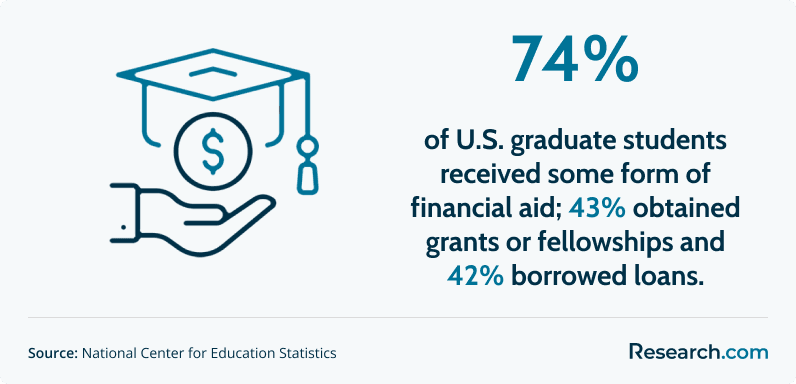
The image below shows how commonly graduate students use aid: 74% of U.S. graduate students receive some form of financial aid, 43% receive grants or fellowships, and 42% rely on loans.
What are the prerequisites for enrolling in an online MBA program in entrepreneurship?
Admissions requirements vary, but most online MBA programs in entrepreneurship expect applicants to show academic readiness, professional maturity, and a clear reason for pursuing graduate business study. Some programs are test-optional or offer GMAT/GRE waivers, while others still require standardized scores.
- Bachelor’s degree: Most programs require an undergraduate degree from an accredited institution.
- Minimum GPA: Many schools expect a minimum undergraduate GPA, often around 2.75 or higher.
- Professional experience: Some programs prefer or require work experience, usually ranging from 2 to 5 years.
- GMAT or GRE scores: Scores may be required, although waivers are often available for applicants with strong academic records or relevant work history.
- Recommendations: Schools may ask for letters from supervisors, professors, clients, or other people who can speak to your leadership and readiness.
- Personal statement: Applicants typically explain their career goals, entrepreneurial interests, and reasons for choosing the program.
- Resume: A current resume helps admissions teams evaluate leadership, business exposure, and professional progression.
If you need a more flexible admissions path, compare MBA admissions policies carefully rather than assuming all accelerated programs are easier to enter. Students who want business-related training at the undergraduate level may also explore options such as the shortest real estate degree programs if their goals are industry-specific.
What courses are typically in an online MBA program in entrepreneurship?
An online MBA in entrepreneurship should teach more than how to write a business plan. A useful curriculum helps students assess markets, model cash flow, lead teams, manage risk, build operations, attract customers, and make decisions under uncertainty. These skills can also benefit leaders in mission-driven settings, including those pursuing an accelerated master's degree in nonprofit management.
- Entrepreneurial finance: Covers funding options, startup financial planning, valuation basics, cash management, and investor expectations.
- Innovation and product development: Examines how ideas become market-ready products or services through research, testing, iteration, and launch planning.
- Business strategy: Focuses on competitive positioning, growth planning, market entry, and long-term decision-making.
- Marketing for entrepreneurs: Teaches customer discovery, branding, digital marketing, go-to-market strategy, and demand generation.
- Operations management: Explores process design, supply chains, resource allocation, and operational efficiency. Students who want deeper logistics preparation can consider an accelerated graduate certificate in supply chain and logistics management online.
- Leadership and organizational behavior: Develops skills for managing teams, shaping culture, resolving conflict, and leading change.
- Capstone project: Often requires students to create a business plan, pitch a venture, consult for an organization, or solve a real business problem.
The chart below connects coursework to entrepreneurial skills commonly shown on resumes in 2025, including product development, business planning, financial management, and innovation.
What types of specializations are available in online MBA programs in entrepreneurship?
Some MBA programs offer entrepreneurship as the concentration itself, while others let students combine entrepreneurship with a narrower focus. Professionals already in senior roles may also compare entrepreneurship MBAs with an executive MBA online if they want a program designed around leadership experience.
| Specialization | Best for students interested in | What to look for |
| Innovation and Product Development | Building new products, services, or internal ventures | Design thinking, market testing, product strategy, and launch projects |
| Venture Capital and Private Equity | Startup funding, investment analysis, or investor relations | Valuation, due diligence, financial modeling, and fundraising coursework |
| Social Entrepreneurship | Companies or nonprofits that combine revenue with social impact | Impact measurement, sustainable models, ethics, and community partnerships |
| Technology Entrepreneurship | Software, digital platforms, fintech, biotech, or tech-enabled services | Technology commercialization, digital strategy, and innovation labs |
| Family Business Management | Running, scaling, or transitioning a family-owned enterprise | Succession planning, governance, family dynamics, and growth strategy |
| Global Entrepreneurship | International markets and cross-border business models | Global strategy, cross-cultural management, trade, and market entry |
Choose a specialization based on the business problems you want to solve. For example, a student planning to build a sports-related venture may benefit from pairing MBA coursework with industry knowledge from the shortest sports management online bachelor's degree.
Are online MBA programs in entrepreneurship accredited and industry recognized?
Accreditation is one of the most important quality checks for an online MBA. Institutional accreditation confirms that the university meets recognized academic standards. Business-specific accreditation, such as AACSB, ACBSP, or IACBE, can provide additional assurance that the business school has been reviewed for curriculum quality, faculty qualifications, learning outcomes, and continuous improvement.
Employers generally care more about the school’s legitimacy, reputation, accreditation, and relevance of your skills than whether the MBA was completed online or on campus. Investors and clients may also view a credible MBA as a signal of business discipline, although execution and results matter more than the credential alone.
If affordability is a priority, compare accredited options carefully rather than choosing the cheapest program by tuition alone. A low cost MBA online can be a strong choice when it also offers respected accreditation, relevant entrepreneurship coursework, and useful career support.
How do online MBA programs in entrepreneurship integrate practical experience with academic learning?
The best entrepreneurship MBA programs do not rely only on lectures. They require students to test ideas, defend assumptions, analyze real markets, and make decisions with incomplete information. This applied approach helps bridge the gap between MBA theory and founder-level execution.
- Business plan or venture launch capstones
- Pitch decks and investor-style presentations
- Case studies based on startup growth, failure, or turnaround situations
- Simulations involving pricing, funding, operations, or market entry
- Consulting projects with startups, small businesses, nonprofits, or corporate teams
- Access to incubators, innovation labs, mentors, or entrepreneurship centers
- Team-based assignments that mirror cross-functional business work
Students interested in interdisciplinary applied learning can also review how project-based formats appear in fields such as the construction management accelerated degree.
What emerging trends are shaping online MBA programs in entrepreneurship?
Entrepreneurship education is changing as founders and innovation leaders face more complex markets. Online MBA programs increasingly emphasize digital business models, artificial intelligence, sustainability, remote collaboration, data-informed decision-making, and rapid experimentation. These trends do not replace core business fundamentals; they make finance, strategy, marketing, and leadership more urgent.
- AI and automation: Entrepreneurs need to understand how AI can improve operations, customer service, analytics, product development, and marketing while managing ethical and competitive risks.
- Digital-first business models: Online distribution, platform businesses, creator-led brands, and subscription models are now common topics in venture strategy.
- Sustainable and responsible entrepreneurship: Many programs include sustainability, social impact, or ethics because customers, employees, and investors increasingly examine business practices.
- Remote team leadership: Online MBA students often practice the same digital collaboration skills used in distributed startups and global teams.
- Credential stacking: Some students combine an MBA with certificates in analytics, supply chain, cybersecurity, marketing, or finance to build targeted expertise.
Students comparing curriculum innovation can review broader examples from the highest ranked online MBA programs.
How do you choose the best among the fastest online MBA programs in entrepreneurship?
To choose the right accelerated entrepreneurship MBA, start with your goal. A founder building a startup, a manager moving into product leadership, and a consultant advising small businesses may need different coursework, networks, and project opportunities. The fastest program is not always the best program for your specific outcome.
Questions to ask before applying
- Is the school accredited? Confirm institutional accreditation and business school accreditation before considering price or speed.
- Can I handle the pace? Ask how many hours students typically study each week in accelerated terms.
- Does the curriculum match my goal? Look for courses in venture finance, innovation, product development, business planning, and growth strategy.
- Are there real entrepreneurship projects? Capstones, pitch work, consulting projects, and incubator access can make the degree more practical.
- How much will I actually pay? Calculate tuition, fees, books, technology costs, travel, and interest if you borrow.
- What support is available online? Ask about career coaching, faculty access, alumni connections, tutoring, and networking events.
- Who teaches the courses? Review faculty experience in entrepreneurship, finance, innovation, consulting, or executive leadership.
- Will the schedule work with my life? Confirm whether classes are asynchronous, synchronous, cohort-based, or self-paced.
Common mistakes to avoid
| Mistake | Why it can hurt you | Better approach |
| Choosing only by speed | The shortest timeline may be too intense or may not offer enough applied learning. | Compare speed with curriculum depth, support, and workload. |
| Ignoring accreditation | Unrecognized programs may create problems with employer trust, transferability, and aid eligibility. | Verify institutional and business accreditation before applying. |
| Looking only at tuition per credit | Fees, books, residencies, and total credits can change the real cost. | Calculate the full program cost from admission to graduation. |
| Assuming online means easy | Accelerated online MBAs can be more demanding because courses move quickly. | Ask for sample syllabi and weekly workload estimates. |
| Overvaluing rankings alone | A high-ranked program may not match your schedule, budget, or entrepreneurial focus. | Use rankings as one input, not the final decision. |
| Assuming salary outcomes are guaranteed | Founder income and business roles vary greatly by industry and execution. | Build a realistic ROI estimate using conservative income assumptions. |
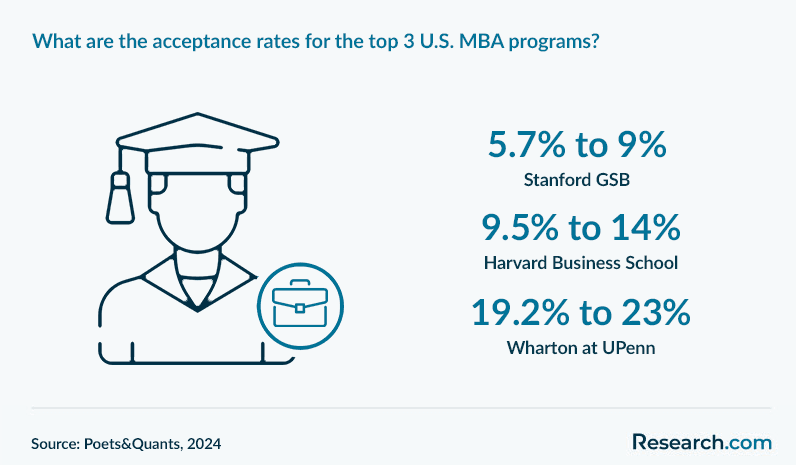
Acceptance rates at well-known MBA programs can also help you set expectations. The chart below shows how competitive prestigious schools such as Stanford, Harvard, and Wharton can be, which is useful when building a realistic application strategy.
What career paths are available for graduates of online MBA programs in entrepreneurship?
Graduates can apply entrepreneurship MBA training in startups, corporate teams, consulting, product organizations, family businesses, social ventures, and investment-related roles. For a wider look at management and business options, review these careers for MBA graduates.
| Career path | What the role involves | Entrepreneurship MBA value |
| Startup Founder | Creates, funds, launches, and manages a new business. | Helps with strategy, finance, marketing, leadership, and business model testing. |
| Business Consultant | Advises organizations on growth, operations, innovation, or strategy. | Builds analytical, financial, and problem-solving skills for client work. |
| Product Manager | Guides product strategy, development, launch, and lifecycle decisions. | Supports market analysis, cross-functional leadership, and customer-focused innovation. |
| Venture Capital Analyst | Evaluates startups, conducts research, and supports investment decisions. | Provides grounding in business models, valuation, markets, and entrepreneurial finance. |
| Corporate Innovation Manager | Leads new business initiatives inside established organizations. | Combines entrepreneurial thinking with organizational leadership and change management. |
| Social Entrepreneur | Builds ventures designed to address social or environmental challenges while remaining financially sustainable. | Connects mission strategy, revenue design, impact measurement, and leadership. |
Some professionals later pursue doctoral business study, such as the fastest online DBA in management degree programs, if they want to move toward executive consulting, academic roles, or advanced management research.
What is the job market for graduates with online MBA degree in entrepreneurship?
The job market for entrepreneurship MBA graduates is broad because the degree supports both self-employment and traditional business roles. Graduates may start companies, expand family businesses, move into consulting, manage products, lead innovation initiatives, or take roles in finance, marketing, strategy, and operations.
Entrepreneurship remains important to the U.S. economy, with small businesses accounting for over half of net job creation between 2021 and 2024. At the same time, employers continue to seek professionals who can identify opportunities, work across functions, use data, adapt to technology, and manage change.
Digital capability is increasingly important for founders and innovation leaders. Some professionals strengthen this area through a fast-track online social media management degree, especially if they need deeper knowledge of digital campaigns, brand visibility, and online customer engagement.
According to the U.S. Bureau of Labor Statistics, employment in business and financial occupations is projected to grow faster than the average for all occupations from 2023 to 2033, with about 963,500 openings projected each year. That outlook does not apply only to entrepreneurs, but it does show continued demand for business, finance, analysis, and management skills commonly developed in MBA programs.
The best job prospects usually go to graduates who combine the MBA with evidence of execution: launched projects, measurable business results, leadership experience, consulting work, technical skills, industry knowledge, or a strong professional network.
What graduates say about MBA in entrepreneurship programs
- My online entrepreneurship MBA helped me keep my full-time role while refining the business model for my startup. The flexible schedule mattered, but the biggest benefit was being able to use class assignments to improve my actual launch plan. Alina
- The program pushed me to think more strategically and introduced me to classmates who were also building new ideas. The simulations and case work made the risks of entrepreneurship feel much more concrete. Rajiv
- The MBA strengthened my leadership skills and gave me a clearer view of finance, operations, and marketing. I left with more confidence in the decisions I needed to make for my venture. Marisol
Key Insights
- The fastest online MBA programs in entrepreneurship can be completed in as little as 10 months, but the shortest option is only worthwhile if you can handle the workload.
- Tuition ranges from $9,824 to $154,339, with an average of $39,508, so calculating total cost is essential before enrolling.
- Average starting salary for graduates is approximately $85,194, but entrepreneur income is highly variable and should not be treated as guaranteed.
- Accreditation matters. Prioritize programs with recognized institutional accreditation and, when possible, respected business accreditation such as AACSB, ACBSP, or IACBE.
- Look for practical learning: venture projects, pitch work, capstones, consulting assignments, simulations, and access to entrepreneurship networks.
- Online programs can be as rigorous as campus programs, but networking and interaction depend heavily on program design.
- Specializations such as innovation, venture capital, technology entrepreneurship, family business, and social entrepreneurship are useful only when they match your actual goals.
- Employment in business and financial occupations is projected to grow faster than average from 2023 to 2033, supporting demand for MBA-level business skills.
- The strongest ROI comes from matching program speed, cost, curriculum, accreditation, and career support to a realistic plan for how you will use the degree.
References:
- American University. Online MBA program information.
- Campbellsville University. Online MBA in Entrepreneurial Leadership details.
- College Tuition Compare. Average Cost of College.
- Drexel University. Online Degree vs. Traditional Degree.
- Glassdoor. Entrepreneur salary data.
- Indeed. Entrepreneur salary information.
- LSU Online. Online MBA in Entrepreneurship and Family Enterprise.
- National Center for Education Statistics. IPEDS Trend Generator.
- National Center for Education Statistics. Price of Attending an Undergraduate Institution.
- Nova Southeastern University. MBA in Entrepreneurship program page.
- Salary.com. Entrepreneur salary research.
- Southeastern Oklahoma State University. Online MBA in Entrepreneurship.
- University of North Carolina Wilmington. Online MBA in Entrepreneurship and Business Development.
- University of Texas Rio Grande Valley. Master of Business Administration in Entrepreneurship.
- U.S. Bureau of Labor Statistics. Entrepreneurship and the U.S. Economy.
- U.S. Bureau of Labor Statistics. Business and Financial Occupations.
- William Paterson University. Online MBA in Entrepreneurship.
- Zippia. Entrepreneur salary estimates.
- ZipRecruiter. Entrepreneur salary estimates.
Other Things You Should Know About Online MBA Programs in Entrepreneurship
The fastest online MBA programs in entrepreneurship for 2027 typically offer accelerated formats allowing completion within 12 to 18 months. Notable programs often include flexible scheduling, intensive coursework, capstone projects, and support services that ensure students can advance at a rapid, yet manageable pace.
Admission requirements typically include a bachelor's degree, a minimum GPA of 3.0, GMAT or GRE scores, and relevant work experience. Some programs may waive test scores for candidates with substantial professional experience or prior graduate-level work. Always verify specific requirements with each institution.
Yes. Many accelerated online MBA programs in entrepreneurship require a capstone, business plan, or venture proposal in the final term. These projects are often worth 3 to 6 credits and may be completed with faculty review instead of a thesis or comprehensive exam.