
2027 How to Become a Paralegal in Texas

Co-Founder and Chief Data Scientist
Becoming a paralegal in Texas is a practical route into the legal field for people who want meaningful legal work without attending law school. The decision is not only about choosing a program. You also need to understand what Texas employers expect, whether certification is worth it, how much training may cost, which cities offer stronger opportunities, and how to build experience when you are new to legal work.
This guide explains how to become a paralegal in Texas in 2026 using a decision-focused approach. You will learn what paralegals do, which education paths make sense for different backgrounds, how voluntary certification works, what salary and job-growth figures suggest, and how to make yourself more competitive in Texas law firms, corporate legal departments, government agencies, and nonprofit legal settings.
Quick Answer: How Do You Become a Paralegal in Texas?
Texas does not require paralegals to hold a state license. Most candidates enter the field by completing a paralegal certificate, associate degree, or bachelor’s degree, gaining hands-on experience through internships or entry-level legal support roles, and optionally earning a national credential such as NALA’s Certified Paralegal credential or an NFPA certification. Employers generally care most about legal research ability, writing skills, familiarity with Texas legal procedures, professionalism, technology skills, and attorney-supervised work experience.
- Texas expects a 12% job growth rate for paralegals from 2022 to 2032, which is faster than the national average for all occupations.
- The median annual salary for paralegals in Texas is approximately $53,000, with metropolitan areas like Houston and Dallas offering higher wage potential.
- Most accredited paralegal certificate programs in Texas require 6 to 12 months of full-time study, enabling quicker entry into the workforce compared to associate degree programs.
- What paralegals do in Texas
- Basic Texas paralegal requirements
- Education options for future paralegals
- Expected cost of becoming a paralegal
- How paralegal certification works in Texas
- Texas paralegal job outlook
- Paralegal salary expectations in Texas
- How career changers can enter the field
- How financial skills can support paralegal work
- How interdisciplinary skills can help paralegals advance
- Skills Texas paralegal employers value
- How law enforcement knowledge can strengthen paralegal work
- How to find Texas paralegal jobs and internships
- Trends changing the paralegal profession in TexasJob-search guidance for paralegal candidates
- How forensic skills can benefit Texas paralegals
What does a paralegal do in Texas?
A Texas paralegal supports attorneys by completing substantive legal tasks under attorney supervision. The work can vary by practice area, but most paralegals help move cases and transactions forward by organizing facts, preparing documents, tracking deadlines, communicating with clients, and researching legal issues. Paralegals cannot give legal advice, represent clients independently, or practice law without attorney oversight.
In Texas, the role often requires knowledge of state court procedures, local filing practices, county-specific deadlines, and practice areas that are especially active in the state, such as real estate, family law, immigration, energy, healthcare, corporate law, and litigation.
- Researching statutes, case law, court rules, and legal procedures that apply to Texas matters.
- Drafting pleadings, discovery requests, contracts, motions, correspondence, and attorney-reviewed legal documents.
- Organizing exhibits, evidence, deposition materials, case timelines, and trial notebooks.
- Monitoring court deadlines and coordinating filings with clerks across Texas counties.
- Supporting matters involving Texas-specific legal issues, including property law, family law, and community property in divorce cases.
- Communicating with clients, witnesses, court staff, vendors, and opposing counsel while staying within ethical limits.
- Using case management systems, e-filing platforms, document tools, and legal research databases.
- Working outside traditional law firms in corporate legal teams, government agencies, legal aid organizations, compliance departments, and nonprofit settings.
| Common Texas paralegal setting | Typical work | Best fit for candidates who... |
| Law firms | Litigation support, client intake, discovery, drafting, trial preparation | Want fast-paced legal work and exposure to multiple cases |
| Corporate legal departments | Contracts, compliance, governance, employment matters, records management | Prefer business-focused legal work and internal client support |
| Government agencies | Administrative records, public law matters, regulatory files, hearings support | Value public service, structured procedures, and government benefits |
| Legal aid and nonprofits | Client screening, document preparation, housing, family, immigration, or benefits support | Want mission-driven work and direct community impact |
| Specialized practice groups | Energy, healthcare, real estate, cybersecurity, immigration, or complex litigation support | Want to build niche expertise that may improve long-term advancement |
What are the basic requirements to become a paralegal in Texas?
The most important point is simple: Texas does not license paralegals at the state level. That gives candidates flexibility, but it also means employers decide what qualifications they prefer. In practice, many Texas employers look for a combination of paralegal education, writing ability, legal research training, technology skills, and real-world exposure to legal offices.
Education and Training
Most candidates begin with one of three options: a paralegal certificate, an associate degree in paralegal studies, or a bachelor’s degree with legal coursework. A formal degree is not legally required by Texas, but it can make a resume more credible, especially for applicants without legal office experience. Career changers who already hold a degree often choose a focused certificate program because it can build legal research, legal writing, civil procedure, document drafting, and ethics skills without requiring a second full degree.
Programs such as the University of Texas at Austin’s paralegal training can help students practice the applied skills Texas legal employers often expect. The best choice is usually a program that includes practical assignments, attorney-led instruction, Texas procedure content, and access to internship or networking opportunities.
Skills and Experience
Paralegal work rewards accuracy. Employers want candidates who can write clearly, track details, manage deadlines, follow instructions, and protect confidential information. Legal research and drafting are central, but so are client communication, document organization, and the ability to work calmly when priorities change.
Experience can come from internships, volunteer work, legal assistant roles, court clerk offices, legal aid clinics, or administrative jobs with transferable skills. Bilingual ability, especially Spanish, may be valuable in many Texas communities because paralegals often help gather information and coordinate communication with diverse clients.
Certification and Ethics
Certification is voluntary in Texas, but it can strengthen your profile. Credentials such as NALA’s Certified Paralegal (CP) or NFPA’s PACE can signal that you understand legal research, ethics, communication, and core practice knowledge. Nearly 40% of Texas paralegals have some certification, which shows that many professionals use credentials to differentiate themselves even though the state does not mandate them.
Ethics are not optional. Paralegals must work under attorney supervision, maintain client confidentiality, avoid conflicts of interest, and never provide independent legal advice. If you are comparing legal support careers, reviewing the requirements to work as court clerk can also help you understand how legal-office roles differ in duties, authority, and public-facing responsibilities.
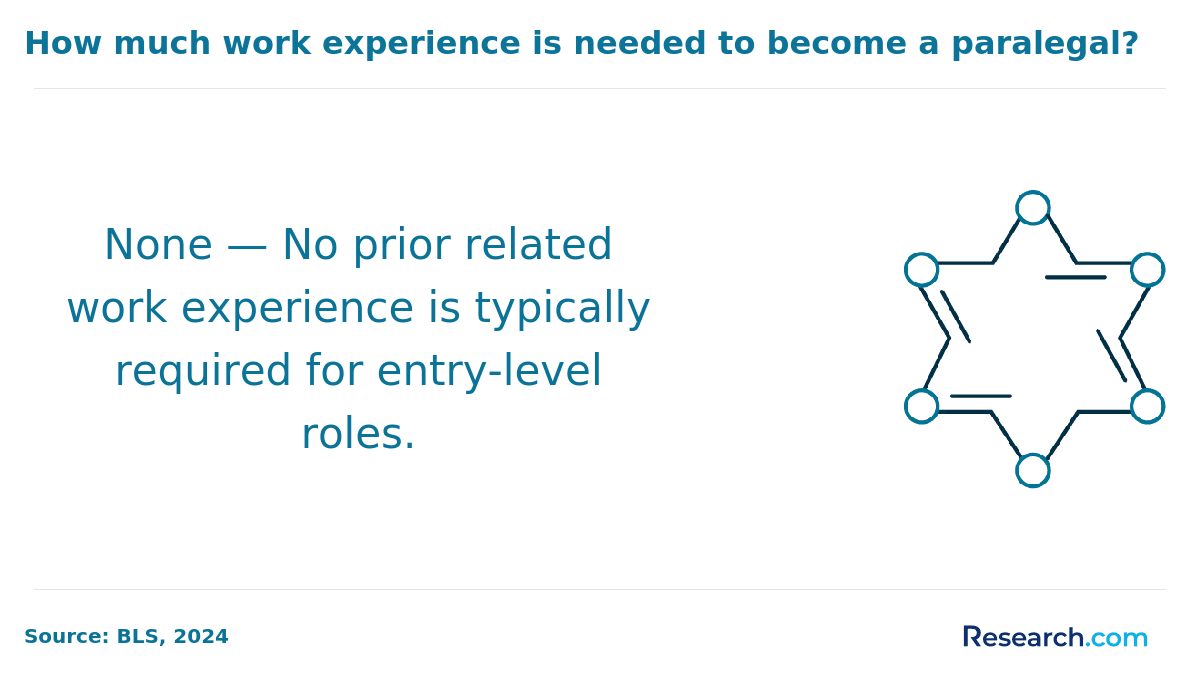
The visual below highlights an encouraging point for new entrants: many entry-level paralegal roles do not require previous full-time legal-sector experience. Education, internships, volunteer work, administrative experience, and strong writing samples can help you compete for your first position.
What education options are available for paralegals in Texas?
Your best education path depends on your current background, budget, timeline, and career target. Someone with a bachelor’s degree may not need the same route as a recent high school graduate. Someone aiming for a specialized corporate legal role may choose differently from someone seeking a quick entry-level job in a small firm.
| Education option | Typical length based on the article data | Best for | Trade-offs to consider |
| Paralegal certificate | Most accredited paralegal certificate programs in Texas require 6 to 12 months of full-time study | Career changers, degree holders, and students seeking a faster route | May be less broad than a degree; quality and employer recognition vary by school |
| Associate degree in paralegal studies | Typically structured as a two-year option | Students starting college and building both general education and legal skills | Takes longer than a certificate but may provide a stronger academic foundation |
| Bachelor’s degree with legal studies or related coursework | Longer than certificate or associate options | Students interested in broader career mobility, specialized legal work, or possible law school later | Usually requires more time and money; not always necessary for entry-level paralegal roles |
| Continuing education | Varies by provider and topic | Working paralegals who need to stay current in technology, ethics, and practice areas | Best used to supplement, not replace, foundational training |
Certificate programs can be a strong fit if you already have college experience and want concentrated legal training. Associate degree programs may make more sense if you are beginning your postsecondary education and want a credential that combines general coursework with paralegal classes. Bachelor’s programs may be useful for candidates who want deeper legal studies, advancement options, or a future law school pathway.
Because Texas does not impose one official education requirement, program quality matters. Look for courses in legal research, legal writing, civil litigation, contracts, ethics, technology, and Texas procedure. Internship access is also important. A program that connects students with local law firms, courts, government offices, or legal aid organizations can be more useful than a program that offers only classroom theory.
Students who need flexibility may consider hybrid or online options, including the best accelerated paralegal programs online. When comparing online programs, confirm whether the curriculum includes practical document drafting, instructor feedback, legal research tools, and employer-recognized training rather than only self-paced reading.
How much does it cost to become a paralegal in Texas?
The cost of becoming a paralegal in Texas depends mainly on the credential you choose, whether you qualify for in-district tuition, and whether the program includes technology, textbooks, research databases, and career support. Tuition is only one part of the budget.
| Cost category | Estimated amount stated in the article | How to evaluate it |
| Community college associate degree tuition | Around $3,000 to $5,000 for local students at community colleges like Austin or Houston | Check in-district versus out-of-district rates, fees, transfer options, and internship access |
| Certificate program tuition | Between $4,000 and $6,000 for programs such as the one at the University of Texas at Austin | Compare total program price, instructor qualifications, employer recognition, and career services |
| Books and materials | $500 to $1,000 annually | Ask whether digital materials, legal databases, or software access are included |
| Certification exam fees | Around $250 to $300 | Budget separately for exam applications, study guides, and prep courses |
| Legal technology workshops | Between $100 and $300 per session | Prioritize training in tools employers actually use, such as e-filing, document management, and research platforms |
| Continuing education | $30 to $100 per credit hour | Plan for ongoing learning if you pursue or maintain professional certification |
| Professional association fees | Around $50 to $100 annually | Consider whether membership includes job boards, mentoring, discounts, or continuing education |
To reduce costs, start with public colleges where you qualify for local tuition, ask about scholarships, compare certificate and associate degree outcomes, and confirm whether Westlaw, LexisNexis, or similar tools are included in tuition. Public libraries, campus subscriptions, and employer-provided access can also help you avoid paying separately for expensive legal research tools.
Do not choose a program based on the lowest sticker price alone. A slightly more expensive option may be worth considering if it has stronger internship placement, attorney instructors, practical drafting assignments, and employer connections. On the other hand, an expensive program is not automatically better. Ask for completion support, career-services details, and examples of legal writing or research assignments before enrolling.
How do you get certified as a paralegal in Texas?
Texas does not require paralegal certification, but certification can help you demonstrate competence to employers. The process usually involves completing education, gaining qualifying experience if required by the credentialing organization, passing an exam, and maintaining the credential through continuing education.
Get the Right Education
Begin with a paralegal program or degree that teaches legal research, drafting, litigation, ethics, and practical office skills. Some candidates look for ABA-approved paralegal programs; others choose respected Texas-based programs through universities or community colleges. The key is to select training that prepares you for real paralegal tasks and any certification exam you plan to take.
Gain Work Experience
Certification pathways often consider both education and work history. The article data notes that candidates may need about one year of relevant experience with a degree or certificate, or five years with just a certificate, depending on the credential pathway. Even when experience is not required for a first job, internships and legal assistant roles can help you understand office workflows, court deadlines, document standards, and client communication.
Pass the Certification Exam
The NALA Certified Paralegal (CP) exam is one recognized option. It tests areas such as legal research, ethics, communication, and substantive legal knowledge. Many candidates prepare through review courses, practice exams, study groups, or local professional associations. If you work full time while studying, create a schedule early and focus on weak areas instead of rereading familiar material.
Stay Ethical and Keep Learning
Certification is not a one-time achievement. Maintaining a credential generally requires continuing education, including ethics training. For Texas paralegals, ongoing learning is especially useful because court technology, e-filing practices, employer expectations, and practice-area procedures continue to change.
Join Local Networks
Professional associations such as TAPA and the Texas Paralegal Division can help you find mentors, continuing education, job postings, and local updates. Networking is not only for job seekers. It can also help working paralegals learn which certifications, software skills, and practice specialties are gaining value in their region.
| Credential decision | When it may be worth it | When to wait |
| National paralegal certification | You want to compete for stronger roles, signal professionalism, or move into a specialized practice area | You are still exploring the field and have not completed basic legal training |
| Continuing education certificate | You need targeted skills in litigation, contracts, legal technology, or ethics | The course does not match your job goals or employer needs |
| Professional association membership | You want networking, mentoring, job leads, and local updates | You will not use the events, resources, or member benefits |
What is the job outlook for paralegals in Texas?
The Texas paralegal job market is stronger than the national picture described in the article data. Texas has around 26,000 paralegals working across the state, and the expected growth rate is 12% over the next decade. That compares with the chart’s national context showing BLS projected growth of just 1 percent for paralegals overall, below the 4 percent average for all jobs.
Demand is not evenly distributed. Houston, Dallas, Austin, and San Antonio tend to offer more opportunities because they have larger concentrations of law firms, corporate headquarters, courts, healthcare organizations, technology companies, real estate activity, and energy-related legal work. Houston’s energy and international trade activity, Austin’s technology sector, and Dallas’s corporate and litigation market can all create different types of paralegal opportunities.
Certification, specialized knowledge, and software fluency can improve your chances. Employers increasingly expect paralegals to handle digital files, e-discovery support, virtual meeting tools, case management systems, and online legal research. If you are still choosing a program, reviewing the best online paralegal programs can help you compare flexible options that may align with employer expectations, especially when the program includes practical assignments and recognized instruction.
The chart below provides useful national context. While the national projection is modest, Texas’s 12 percent expansion suggests that local demand may be more favorable than the broader U.S. average. For job seekers, that means location, practice area, and skills strategy matter.
How much do paralegals make in Texas?
Paralegal pay in Texas varies by city, practice area, employer size, experience, and certification. Entry-level paralegals typically start around $35,000 to $45,000 a year. The state median is around $52,000, while the earlier summary places the median annual salary at approximately $53,000. Experienced paralegals in larger markets or specialized settings may exceed $70,000 annually.
The highest pay potential is often found in major metropolitan areas such as Dallas, Houston, and Austin. Practice area can also influence earnings. Energy law in Houston, corporate legal departments, complex litigation teams, healthcare compliance, and real estate practices may offer stronger compensation for paralegals with relevant experience. Certification can matter as well; the article data notes that paralegals with credentials like the Certified Paralegal (CP) tend to make 10-15% more than those without.
Texas salaries should be evaluated alongside cost of living, commute, benefits, workload, overtime expectations, remote-work options, and advancement potential. A lower salary in a smaller city may offer better overall value than a higher-paying role with long hours and high living costs. Conversely, a major-market job may accelerate your career if it gives you complex case exposure, advanced software skills, and specialized practice experience.
| Career stage or factor | Salary figure stated in the article | What can affect the number |
| Entry-level paralegal | Around $35,000 to $45,000 a year | Education, internships, writing skills, location, and legal office experience |
| Texas median | Around $52,000; approximately $53,000 in the article summary | Employer type, city, practice area, and years of experience |
| National median comparison | About $56,000 nationally | Regional labor markets and cost of living |
| Experienced or specialized paralegal | May exceed $70,000 annually | Large law firms, corporate legal departments, certification, and niche expertise |
| Certification premium | 10-15% more for paralegals with credentials like the Certified Paralegal (CP) | Employer recognition, role level, and practice specialization |
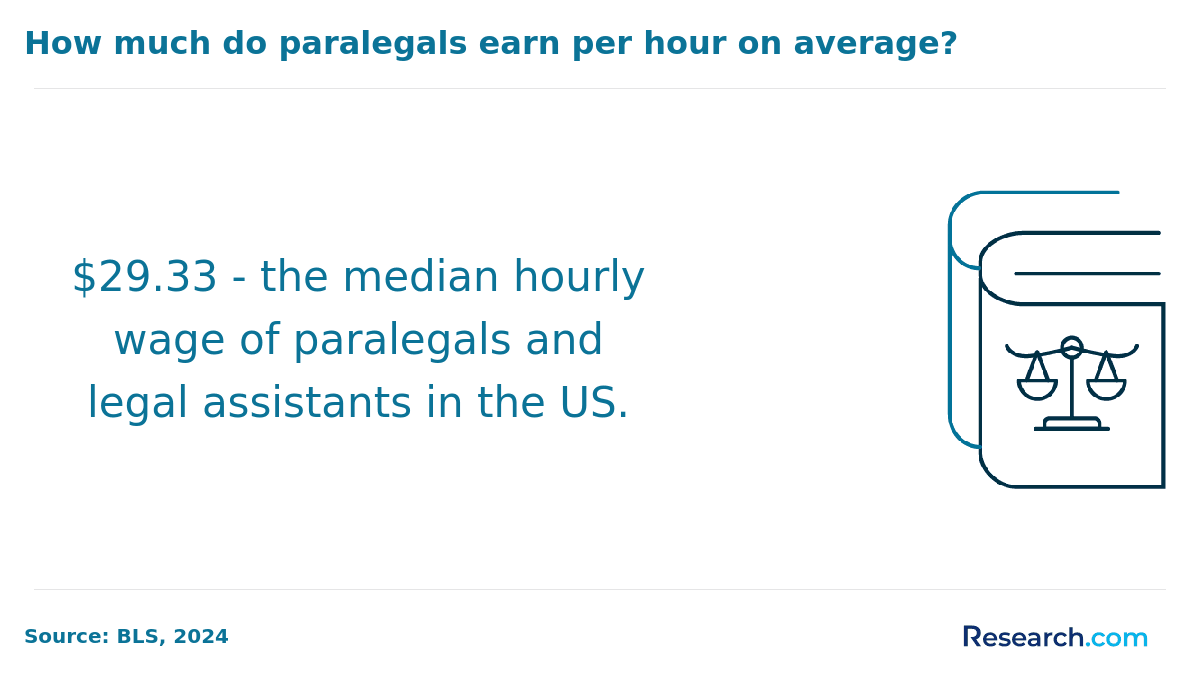
The image below shows the national median hourly wage for paralegals at $29.33. Comparing that figure with Texas’s annual salary ranges can help you estimate purchasing power, especially if you are deciding between a major metro area and a lower-cost region of the state.
What are the steps to switch careers and become a paralegal in Texas?
Career changers often bring useful skills to paralegal work, especially if they have experience in administration, customer service, finance, healthcare, insurance, law enforcement, education, compliance, project coordination, or writing-heavy roles. The challenge is translating that background into legal value.
- Clarify your target role. Decide whether you want litigation, family law, corporate law, real estate, immigration, legal aid, government, or another area. Your target affects which courses, internships, and software skills matter most.
- Choose the right training path. If you already have a degree, a paralegal certificate may be the quickest option. If you are starting college, an associate degree may provide a stronger foundation.
- Build a legal writing sample. Employers may want evidence that you can write clearly, organize facts, and follow legal-document conventions.
- Gain practical exposure. Apply for internships, volunteer positions, legal assistant roles, legal aid opportunities, or courthouse administrative work.
- Highlight transferable skills. Organization, confidentiality, deadline management, research, client communication, billing, records management, and software proficiency can all matter.
- Consider voluntary certification. A national credential can help reassure employers that you understand paralegal responsibilities and ethics.
- Join Texas legal networks. Professional associations, bar events, school alumni groups, and legal staffing firms can uncover openings that may not appear on general job boards.
- Customize every application. Match your resume to the practice area, mention Texas legal training when relevant, and show familiarity with legal software and document workflows.
| Your background | Best first move | How to position yourself |
| Administrative assistant or office manager | Complete a certificate and seek legal assistant or entry-level paralegal roles | Emphasize calendars, records, confidentiality, client communication, and deadline control |
| Teacher or researcher | Build legal research and drafting skills | Show writing, analysis, organization, and ability to explain complex information clearly |
| Finance or accounting professional | Target corporate, bankruptcy, tax-adjacent, or transactional legal teams | Highlight document review, numbers accuracy, reporting, and financial analysis |
| Healthcare worker | Explore medical malpractice, insurance, compliance, or healthcare law support | Use knowledge of records, privacy, terminology, and patient systems |
| Law enforcement or investigations background | Consider litigation, criminal defense, prosecution support, or evidence-heavy practice areas | Emphasize reports, chain of custody, investigative discipline, and attention to detail |
Can supplementary financial skills enhance a Texas paralegal’s career?
Yes. Financial knowledge can make a paralegal more useful in corporate litigation, bankruptcy, transactional law, probate, tax-related matters, and business disputes. Paralegals who understand budgets, invoices, financial statements, cost analysis, and reporting can help attorneys organize evidence, identify inconsistencies, and prepare stronger case materials.
This does not mean every paralegal needs an accounting degree. However, if you want to work with business clients, corporate legal departments, real estate transactions, or complex damages calculations, financial literacy can become a practical advantage. Candidates who want deeper training can compare programs at the best accounting schools in Texas and decide whether accounting coursework would complement their paralegal goals.
Can paralegals leverage interdisciplinary skills for advanced career growth in Texas?
Interdisciplinary knowledge can help paralegals move beyond routine support tasks and contribute to complex matters involving regulation, public policy, land use, technology, housing, transportation, or municipal governance. Texas’s large and diverse economy creates legal issues that often cross professional boundaries.
For example, paralegals who understand real estate development, city planning, permitting, zoning, or public administration may be better prepared for work involving land use, construction, environmental review, or local government. If this type of work interests you, learning more about how to become an urban planner in Texas can help you see where legal support and planning-related knowledge overlap.
What skills do successful paralegals need in Texas?
Successful Texas paralegals combine legal knowledge, communication ability, technology confidence, and professional judgment. Technical legal skills help you complete assignments correctly. Soft skills help you work with attorneys and clients. Digital skills help you stay productive in modern legal offices.
| Skill area | What it includes | Why it matters in Texas |
| Legal research | Using Westlaw, LexisNexis, statutes, court rules, and case law | Texas matters often require state-specific research and county-aware procedure tracking |
| Legal writing and drafting | Pleadings, motions, discovery, contracts, correspondence, summaries, and memos | Attorneys need clean drafts that can be reviewed, revised, and filed efficiently |
| Procedure and deadline management | Calendaring, e-filing, court communication, case tracking, and document control | Missing a deadline can harm a client’s matter and damage employer trust |
| Client communication | Intake, updates, information gathering, professionalism, and cultural awareness | Texas legal offices often serve diverse communities and multilingual clients |
| Technology | Case management software, Clio, MyCase, Microsoft Office, cybersecurity basics, digital files | Legal work is increasingly digital, remote-friendly, and document-intensive |
| Ethics | Confidentiality, attorney supervision, conflicts, and limits on legal advice | Paralegals must avoid unauthorized practice of law and protect client information |
| Specialized industry knowledge | Oil and gas, real estate, healthcare, immigration, corporate law, cybersecurity, or family law | Niche knowledge can help candidates stand out in Texas’s major legal markets |
Because many Texas employers value practical training, candidates should compare programs carefully. Exploring ABA approved paralegal schools can be useful if you want a program with recognized structure while still considering cost and flexibility.
The table that follows highlights employer-valued knowledge areas, including law-and-government expertise at 95 %, English-language mastery, administrative knowledge, and technology fluency. Use those priorities as a guide when choosing courses, building a resume, and deciding which skills to strengthen first.
Can paralegals gain a competitive edge by combining legal and law enforcement insights in Texas?
Yes, especially in litigation, criminal law, personal injury, insurance defense, government work, and cases involving evidence review. A paralegal who understands investigative procedures, chain of custody, report writing, and evidence handling can communicate more effectively with attorneys, investigators, forensic specialists, and law enforcement personnel.
This background must still be applied within paralegal ethical limits. Paralegals do not independently investigate beyond attorney direction or provide legal advice. However, operational discipline from law enforcement training can be valuable when organizing records, preparing chronologies, reviewing discovery, and tracking evidence. Candidates interested in that overlap can review Texas police academy requirements to understand the law enforcement side of evidence-focused work.
How do I find a paralegal job or internship in Texas?
The most effective job search combines training, targeted applications, networking, and proof of practical skills. Texas employers often want to know that you can handle real documents, deadlines, client contact, and legal technology—not just that you completed coursework.
- Start with school-based career support. Ask your program about internships, externships, alumni contacts, employer panels, and legal writing portfolio guidance.
- Apply beyond law firms. Look at corporate legal departments, courts, government offices, legal aid organizations, insurance companies, title companies, compliance departments, and staffing agencies.
- Use Texas-specific networks. Join groups such as the Texas Alliance of Paralegal Associations (TAPA), attend local legal events, and connect with paralegal sections or bar-related groups in your city.
- Target major legal markets strategically. Houston, Dallas, Austin, and San Antonio may offer more openings, but competition can also be stronger.
- Customize your resume by practice area. A family law firm, corporate legal department, immigration nonprofit, and oil-and-gas practice will not value the exact same experience.
- Show software readiness. Mention experience with Westlaw, LexisNexis, Clio, MyCase, Microsoft Office, e-filing, document management, or other relevant tools only when you can discuss them honestly.
- Consider contract or temporary roles. Short-term legal support assignments can help you gain Texas legal experience and meet attorneys who hire permanent staff later.
- Keep learning after you are hired. Continuing education in ethics, e-discovery, litigation support, or Texas procedure can help you move beyond entry-level duties.
| Common mistake | Why it hurts your chances | Better approach |
| Choosing a program without checking reputation or practical training | You may graduate without skills employers recognize | Ask about internships, attorney instructors, legal research tools, and writing feedback |
| Focusing only on tuition | A low-cost program may lack career support or practical assignments | Compare total value, including placement help, software access, and employer connections |
| Assuming certification is legally required | You may spend money before understanding your target employer’s expectations | Treat certification as a career enhancer, not a Texas licensing requirement |
| Using the same resume for every job | Employers may not see your fit for their practice area | Tailor skills, coursework, and examples to each legal setting |
| Ignoring ethics | Unauthorized practice of law and confidentiality errors can end a career quickly | Learn attorney supervision rules, confidentiality standards, and communication boundaries |
| Waiting for the “perfect” job | You may miss roles that build experience | Consider internships, legal assistant roles, contract work, and nonprofit experience |
If you plan to move beyond entry-level paralegal work, you may also compare affordable online masters in legal studies degree programs to see whether graduate-level legal education fits your career goals. A master’s degree is not required for most paralegal jobs, so evaluate the cost carefully against your desired role.
What are the emerging trends shaping the paralegal profession in Texas?
Texas paralegals are working in a profession shaped by technology, remote collaboration, specialization, and changing client expectations. Legal research databases, case management systems, digital document workflows, electronic filing, virtual meetings, and online collaboration tools now affect everyday paralegal tasks.
AI and automation are also changing legal support work. These tools may assist with document review, research organization, summarization, scheduling, and drafting support, but they do not remove the need for human judgment. Paralegals still need to verify information, protect confidentiality, understand attorney instructions, and identify when automated output may be incomplete or inaccurate.
Specialization is another important trend. Texas employers may value paralegals who understand energy, real estate, healthcare, immigration, corporate compliance, cybersecurity, family law, or litigation technology. Community-focused legal work can also overlap with social services, housing, benefits, and family issues. For paralegals drawn to that intersection, reviewing social worker education requirements in Texas may clarify how legal and social-service knowledge can complement each other.
The strongest candidates will be those who keep learning after the first credential. Continuing education, software training, ethics refreshers, and practice-area specialization can help paralegals remain useful as legal work becomes more digital and interdisciplinary.
What do paralegals say about their careers in Texas?
Paralegal career experiences vary by employer, practice area, and training background, but several themes appear consistently: practical coursework matters, internships build confidence, and communication skills are just as important as legal terminology.
Javier described the value of completing a paralegal program at the University of Texas because it helped him practice legal research and drafting before entering a busy law firm. For him, Texas-specific procedure training made the first months of employment less overwhelming.
Monica emphasized the importance of ethics and courtroom protocol after participating in Texas State Bar-related paralegal certification activities. Her internship experience helped her understand how closely paralegals must work with attorneys and how much precision legal work requires.
Deshawn’s volunteer experience with a Houston nonprofit legal aid program showed how paralegal training can support access to justice. Working with diverse clients strengthened his communication skills and helped him see the community impact of accurate legal support.
Can paralegals benefit from forensic specialization in Texas?
Forensic knowledge can be useful for paralegals who work on litigation, criminal matters, personal injury cases, insurance disputes, digital evidence, or complex investigations. Skills such as evidence organization, chain-of-custody documentation, forensic terminology, and digital file review can help attorneys manage fact-heavy cases more effectively.
This specialization is not necessary for every paralegal. It is most useful when your target practice area involves evidence analysis, expert witnesses, investigative records, or technical documentation. If you are interested in a more science-focused legal support path, comparing the paralegal role with how to become a forensic scientist in Texas can help you decide whether you prefer legal support, laboratory analysis, field investigation, or expert evidence work.
Questions to Ask Before Choosing a Texas Paralegal Program
- Is the program designed for beginners, career changers, or students who already have a degree?
- Does the curriculum include Texas procedure, legal research, legal writing, ethics, litigation, and document drafting?
- Are instructors attorneys, experienced paralegals, or legal educators with current practice knowledge?
- Does tuition include legal research database access, software training, textbooks, and exam preparation?
- Are internships, externships, or employer connections available in Texas?
- What career services are provided after completion?
- Does the program help students prepare for voluntary certification exams?
- Can credits transfer into an associate or bachelor’s degree later?
- What are the total costs, including fees, books, technology, and certification expenses?
- Do graduates work in the types of legal settings you are targeting?
Is Becoming a Paralegal in Texas Worth It?
Becoming a paralegal in Texas can be worth it if you want a legal career with a shorter training timeline than law school, you enjoy research and writing, and you can handle detail-heavy work under deadlines. The path is especially attractive for people who want to enter the legal field through a certificate or associate degree, build experience, and later specialize.
It may not be the right fit if you want to provide legal advice independently, dislike document-heavy work, struggle with deadlines, or are not comfortable working under attorney supervision. It is also important to be realistic about salary. Some roles pay well, especially with experience and specialization, but entry-level salaries can be modest, and outcomes are not guaranteed.
| Choose this path if... | Consider another path if... |
| You want legal work without becoming an attorney | You want to represent clients independently or argue cases as a lawyer |
| You are detail-oriented and comfortable with documents | You dislike paperwork, research, and procedural rules |
| You want a faster training route than law school | You are seeking a profession with a required state license and clearly standardized entry rules |
| You can communicate professionally with clients and attorneys | You prefer work with little client contact or deadline pressure |
| You are willing to keep learning technology and legal procedures | You want a role that does not change with software, court systems, or regulations |
Key Insights
- Texas does not license paralegals, so your competitiveness depends on education, experience, writing ability, ethics, technology skills, and employer-recognized training.
- A certificate can be the fastest route for career changers, while an associate degree may be better for students starting college and building a broader foundation.
- Certification is voluntary but can improve credibility, especially for candidates seeking advancement or specialized legal roles.
- Texas’s expected 12% paralegal job growth from 2022 to 2032 makes the state more favorable than the national projection shown in the article data.
- Salary varies widely: entry-level roles commonly start around $35,000 to $45,000, the Texas median is around $52,000 to approximately $53,000, and experienced specialized paralegals may exceed $70,000.
- The strongest job candidates combine Texas legal procedure knowledge with practical drafting, legal research, case management software, and professional communication skills.
- Before enrolling, compare total program cost, internship access, legal technology training, certification preparation, and whether the curriculum fits your target practice area.
Related Articles for Nearby States
- 2027 How to Become a Paralegal in Louisiana
- 2027 How to Become a Paralegal in Oklahoma
- 2027 How to Become a Paralegal in Arkansas
- 2027 How to Become a Paralegal in New Mexico
- 2027 How to Become a Paralegal in Kansas
- 2027 How to Become a Paralegal in Missouri
- 2027 How to Become a Paralegal in Colorado
- 2027 How to Become a Paralegal in Mississippi
- 2027 How to Become a Paralegal in Tennessee
- 2027 How to Become a Paralegal in Arizona
References:
- Clio.com. How to Become a Paralegal in Texas | Clio.
- Ctcd.edu. Central Texas College – For Students of the Real World.
- Degree.lamar.edu. How to Become a Paralegal in Texas | Lamar University Online.
- Legalstudies.com. Texas Christian University – Paralegal Certificate Course – Center for Legal Studies.
- Paralegal411.org. Paralegal Schools in Texas | Paralegal Degree Programs in TX.
- Professionaled.utexas.edu. Paralegal.
- Southtexascollege.edu. Paralegal | South Texas College.
- Tccd.edu. Paralegal Studies — TCC.
- Utsa.edu. Paralegal Certificate Program.
- Web-ded.uta.edu. Paralegal Certificate CER – UTA EEC Division for Enterprise Development.
Other Things You Need to Know About Paralegals in Texas
Texas paralegals often pursue certification from the National Association of Legal Assistants, the National Federation of Paralegal Associations, or the Texas Board of Legal Specialization. These credentials are voluntary, but they can strengthen job prospects and demonstrate professional competence to employers.
Aspiring paralegals in Texas can obtain certifications like the Certified Paralegal (CP) from the National Association of Legal Assistants or the Texas Board of Legal Specialization's paralegal certification. Both certifications require passing an exam and meeting specific educational or work experience requirements.


