2027 Online Electrical Engineering Degrees That Help Build Circuit Design Skills

Co-Founder and Chief Data Scientist
Choosing an online electrical engineering degree is a high-stakes decision because circuit design skills now support everything from electric vehicles to semiconductors and renewable power systems. The U. S. Bureau of Labor Statistics reported a May 2024 median annual wage of $111,910 for electrical engineers, but outcomes depend heavily on accreditation, lab quality, and specialization.
This guide is for students comparing online programs, transfer options, costs, and career paths. You will learn how these degrees work, what to verify before enrolling, and how to judge whether the investment fits your goals.
Key Things You Should Know
- Online electrical engineering degrees can build circuit design skills if they include calculus-based engineering coursework, supervised labs, simulation tools, and design projects rather than only electronics theory.
- ABET accreditation is not required for every engineering job, but it is often important for licensure, graduate study, employer screening, and long-term professional mobility.
- Cost and ROI vary widely: College Board's 2024 pricing data shows average 2024-25 tuition and fees of $11,610 for in-state public four-year colleges, while BLS May 2024 data places electrical engineers' median wage at $111,910.
What are online electrical engineering degrees with circuit design training?
An online electrical engineering degree is a college program that teaches students how electrical systems are analyzed, designed, tested, and improved. Circuit design training focuses on how current, voltage, resistance, capacitance, inductance, semiconductors, signals, and embedded components work together in real devices.
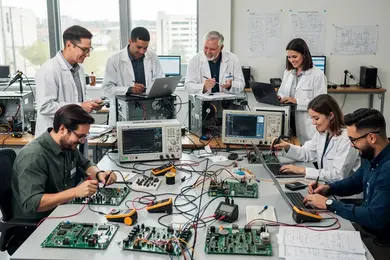
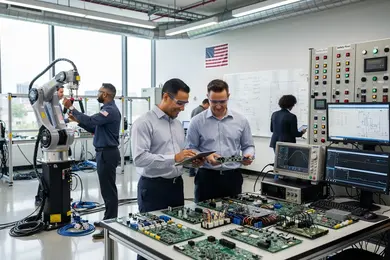
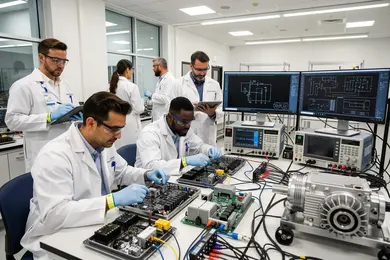
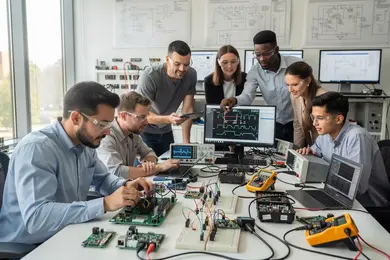
In a strong program, students do more than watch lectures; they use simulation software, lab kits, remote instruments, and design assignments to build and troubleshoot circuits.
These programs are usually offered as bachelor's or master's degrees. A bachelor's degree is the standard entry point for most electrical engineering roles, while a master's degree is often used for specialization in areas such as microelectronics, power systems, communications, signal processing, or embedded systems.
Students comparing broader engineering degrees should pay close attention to whether the curriculum is specifically electrical engineering or a related technology, electronics, or engineering management program.
The table below compares common online degree options and how each typically supports circuit design preparation. This helps you avoid choosing a program whose title sounds similar but leads to a different level of engineering responsibility.
| Program type | Best fit | Circuit design preparation | Important limitation |
| Bachelor of Science in Electrical Engineering | Students seeking entry-level engineering roles or future licensure | Usually includes calculus, physics, circuits, electronics, signals, labs, and capstone design | Requires significant math and lab commitment |
| Bachelor of Electrical Engineering Technology | Students interested in applied testing, manufacturing, field support, or technician-to-engineer pathways | Often emphasizes practical electronics, instrumentation, and implementation | May not meet all employer or PE licensure expectations for engineering roles |
| Master of Science in Electrical Engineering | Engineers or STEM graduates seeking advanced specialization | Can include VLSI, RF circuits, power electronics, controls, or advanced digital design | May require prerequisite undergraduate engineering coursework |
| Graduate certificate in electrical or electronics engineering | Working professionals filling a skills gap | Can target specific tools or subfields such as embedded systems or power electronics | Usually not a substitute for an engineering degree |
A strong circuit-focused program should help students learn the full design process: define requirements, model the circuit, simulate behavior, select components, build or prototype the design, test performance, and revise based on results. That workflow matters because employers often want graduates who can explain design trade-offs, not just solve textbook equations.
How do online and campus electrical engineering programs differ?
The biggest difference is not the lecture content; it is how labs, team design projects, faculty access, and equipment-based learning are delivered. Online programs can work well for disciplined students, working adults, military learners, and students who cannot relocate, but they require careful verification of hands-on requirements.
Quality online engineering programs often use a combination of mailed lab kits, circuit simulation platforms, remote-access lab equipment, in-person intensives, proctored exams, and instructor-reviewed design projects. As with an online exercise science degree, the credibility of an applied online program depends on how well it replaces or supports hands-on learning rather than simply moving lectures to a video platform.
The table below highlights the practical differences that matter most when comparing formats. Use it to decide whether convenience, lab access, or campus networking should carry more weight in your decision.
| Factor | Online electrical engineering | Campus electrical engineering | Decision point |
| Labs | May use home kits, simulations, remote labs, or short residencies | Usually offers direct access to physical labs and instrumentation | Online students should ask exactly how each lab is completed |
| Schedule | Often more flexible, with asynchronous lectures and part-time options | Often follows fixed class and lab times | Online can be better for working students if deadlines are manageable |
| Team projects | May rely on virtual collaboration tools and documented design reviews | Often includes in-person teamwork and prototyping | Both can work if the capstone has real design accountability |
| Faculty access | Usually through office hours, discussion boards, video meetings, and email | Includes in-person office hours and informal lab interaction | Ask about response times and tutoring support |
| Career networking | Can be strong if the school offers online career services and employer partnerships | May offer easier access to local internships, labs, and recruiting events | Students seeking internships should verify remote-friendly career support |
Online learning is usually a better fit if you are organized, comfortable troubleshooting technology, and able to set aside regular time for problem sets and labs. Campus learning may be better if you need frequent face-to-face support, want intensive access to equipment, or plan to join research labs early in your degree.
Is ABET accreditation required for electrical engineering degrees?
ABET accreditation is not legally required for every electrical engineering job, but it is one of the most important quality signals for engineering education in the U.S. ABET evaluates whether a program meets standards for curriculum, faculty, student outcomes, continuous improvement, and professional preparation.
For electrical engineering, this matters because employers and licensing boards often use accreditation as a shortcut for judging whether the degree included sufficient math, science, engineering design, and lab work.
The practical importance of ABET depends on your goal. If you want to become a licensed Professional Engineer, work in regulated infrastructure, enter defense or public-sector engineering, or keep graduate school options open, ABET accreditation is especially important. Some states allow alternative paths to licensure, but they may require additional documentation, experience, or review if the degree is not ABET-accredited.
Before enrolling, confirm accreditation at the program level, not just the institution level. A university can be regionally accredited while a specific electrical engineering program is not ABET-accredited. This is a common mistake because admissions pages may use broad language such as "accredited university" without clearly stating the engineering program's ABET status.
Use this quick check before you apply:
- Look up the exact program name in ABET's official accredited program search rather than relying only on marketing pages.
- Confirm whether the online version and campus version share the same curriculum, faculty oversight, and accreditation status.
- Ask whether the degree title on the transcript is electrical engineering, electrical engineering technology, electronics engineering, or another related field.
- If licensure matters to you, contact your state engineering board before enrolling and ask how it evaluates the specific degree.
If a program is not ABET-accredited, it may still be useful for some technology, technician, sales engineering, software-adjacent, or employer-sponsored advancement paths. The risk is that it may limit options for roles that explicitly require an ABET-accredited engineering degree.
What circuit design courses are included in electrical engineering curricula?
Circuit design training usually begins with foundational analysis and becomes more specialized as students move into electronics, signals, embedded systems, and capstone design. The strongest curricula combine theory with tools used in practice, such as SPICE-based simulation, printed circuit board design software, microcontroller platforms, oscilloscopes, logic analyzers, and hardware description languages.
The table below summarizes common courses and the circuit design skills they support. This can help you read a curriculum map and judge whether a program goes deep enough for your target career.
| Course area | What students learn | Why it matters for circuit design |
| DC and AC circuit analysis | Kirchhoff's laws, impedance, phasors, transient response, and network theorems | Builds the foundation for analyzing how circuits behave under different conditions |
| Electronics | Diodes, transistors, operational amplifiers, biasing, filters, and amplifiers | Prepares students to design and test analog circuits |
| Digital logic design | Boolean algebra, combinational logic, sequential circuits, memory, and timing | Supports work with processors, control logic, and embedded systems |
| Signals and systems | Frequency response, Fourier methods, sampling, filtering, and system behavior | Helps students design circuits for communications, audio, sensors, and controls |
| Microcontrollers and embedded systems | Interfaces, firmware, sensors, actuators, and real-time constraints | Connects hardware design with software-controlled devices |
| Electromagnetics | Fields, transmission lines, wave behavior, and electromagnetic compatibility | Supports RF, high-speed, antenna, and power-related design work |
| Power electronics | Converters, inverters, motor drives, switching devices, and efficiency | Relevant for renewable energy, electric vehicles, robotics, and industrial systems |
| Capstone design | Requirements, prototyping, testing, documentation, teamwork, and presentations | Demonstrates whether students can complete a realistic engineering design cycle |
Students interested in circuit design should look for courses that include measurable projects, not just exams. A program that asks students to simulate, build, document, test, and revise a design will usually be more career-relevant than one that treats circuits only as math exercises.
When reviewing course descriptions, prioritize these learning experiences:
- Use of industry-relevant simulation and design tools such as SPICE, MATLAB, Simulink, HDL tools, or PCB layout software.
- Lab reports that require measurement, error analysis, and comparison between simulated and observed behavior.
- Design projects with constraints such as cost, power consumption, component availability, signal integrity, safety, or manufacturability.
- Exposure to both analog and digital systems, because many modern devices combine sensors, signal conditioning, processors, communications, and power management.
What are the admission requirements for online electrical engineering programs?
Admission requirements vary by school and degree level, but online electrical engineering programs are usually selective about math readiness. Electrical engineering is calculus-based, so students who are not prepared for algebra, trigonometry, calculus, and physics may need prerequisite coursework before taking major classes.
For bachelor's programs, applicants commonly need a high school diploma or equivalent, transcripts, placement scores or evidence of math readiness, and sometimes prior college credit if the program is degree-completion focused. Transfer-friendly online programs may expect students to have already completed calculus, physics, chemistry, composition, and general education courses at a community college or another institution.
For master's programs, applicants usually need a bachelor's degree in electrical engineering or a closely related field. Students from physics, computer engineering, mechanical engineering, or computer science backgrounds may be admitted conditionally if they complete bridge courses in circuits, electronics, signals, or electromagnetics.
Before applying, gather documents and evaluate readiness in a practical sequence:
- Request unofficial transcripts and identify completed math, physics, programming, and engineering courses.
- Compare your coursework against the program's prerequisite list, especially calculus, differential equations, physics, and circuit analysis.
- Ask whether transfer credits are evaluated before admission or only after enrollment.
- Confirm whether online students must attend campus labs, proctored exams, or scheduled synchronous sessions.
- Estimate weekly study time realistically, because engineering courses often require more problem-solving time than many general education courses.
A common mistake is applying to the fastest-looking online program without checking prerequisites. If you are missing calculus or physics, your timeline and cost can change substantially. Taking foundational courses first at an accredited community college may reduce cost and make the engineering curriculum more manageable.

How long does an online electrical engineering degree take?
A full online bachelor's degree in electrical engineering typically takes about four years of full-time study, but many online students take longer because they transfer credits, study part time, or work while enrolled. Degree-completion programs can be shorter if you already have lower-division credits, but upper-division engineering courses often follow a sequence that cannot be rushed.
The table below shows realistic timelines by student type. It is useful because advertised completion times may assume ideal transfer credit, full-time enrollment, and no repeated courses.
| Student situation | Typical timeline | What affects the pace |
| First-time full-time bachelor's student | About 4 years | Course sequencing, lab availability, math placement, and summer enrollment |
| Part-time bachelor's student | About 5 to 7 years | Work schedule, course load, prerequisite chains, and transfer policies |
| Transfer or degree-completion student | About 2 to 3 years after lower-division requirements | How many credits apply directly to the engineering major |
| Master's student with an EE background | About 1.5 to 3 years | Thesis option, course load, employer support, and specialization |
| Master's student changing fields | Often longer than a standard master's path | Bridge courses in circuits, signals, electronics, and math |
Acceleration has trade-offs. Taking more courses per term may shorten the calendar, but it can reduce time for labs, projects, internships, and deep problem-solving. For a circuit design career, portfolio-quality projects and internship experience can be as important as speed.
To keep the timeline under control, students should map prerequisites early. Circuits may require physics and calculus, electronics may require circuits, and senior design may require most core courses. Missing one prerequisite can delay an entire sequence by a term.
How much do online electrical engineering degrees cost?
The cost of an online electrical engineering degree depends on tuition, fees, residency status, transfer credits, lab equipment, textbooks, software, proctoring, and the number of credits you must complete after admission. Online programs are not automatically cheaper than campus programs, but they may reduce relocation, commuting, parking, and lost-work-time costs.
College Board's 2024 pricing report gives useful context for baseline tuition comparisons in the U.S. For 2024-25, average published tuition and fees were:
- $11,610 for in-state students at public four-year institutions
- $30,780 for out-of-state students at public four-year institutions
- $43,350 for students at private nonprofit four-year institutions
Those figures are not specific to online electrical engineering, but they show why residency status and institution type can dramatically affect the total price. They also do not include every cost a circuit-focused program may require, such as lab kits, electronics components, software access, or short campus residencies.
Students should evaluate total cost rather than tuition alone. The same disciplined comparison used for an online library degree can help here: look at credits required, fees, transfer acceptance, employer reimbursement, and likely career relevance rather than focusing only on the advertised per-credit rate.
To reduce cost without weakening the degree, consider these steps:
- Complete transferable calculus, physics, chemistry, and general education courses at an accredited community college before entering the engineering major.
- Ask for a written transfer evaluation before committing to a program, especially if you have military, international, or older credits.
- Compare in-state online tuition, out-of-state online tuition, and any distance-learning surcharges separately.
- Use federal aid, scholarships, employer tuition assistance, and paid internships before relying heavily on private loans.
- Check whether software, lab kits, and proctored exams are included in fees or billed separately.
A major red flag is a school that cannot clearly explain total program cost, accreditation status, transfer rules, and lab requirements before enrollment. If the financial picture is unclear, pause and request a written degree plan.
What jobs can you get with an electrical engineering degree?
An electrical engineering degree can lead to roles in circuit design, power systems, electronics, communications, embedded systems, robotics, semiconductors, aerospace, automotive systems, medical devices, defense, utilities, and manufacturing. The BLS projects employment for electrical and electronics engineers to grow 9% from 2023 to 2033, which is faster than the average for all occupations.
For students, this suggests steady opportunity, but not automatic placement; internships, projects, specialization, location, and security clearance eligibility can all affect outcomes.
Circuit design skills are especially relevant in roles where engineers translate performance requirements into hardware that can be tested, manufactured, and maintained. AI and automation are also changing the field: engineers increasingly use simulation, automated layout support, model-based design, and data-informed testing, but human judgment remains important for safety, reliability, trade-offs, and failure analysis.
The table below summarizes common career paths and how circuit design training applies. Use it to match a degree concentration or elective choices to the kind of work you want after graduation.
| Role | Typical responsibilities | How circuit design skills help |
| Electrical design engineer | Designs, simulates, tests, and documents electrical systems or subsystems | Directly uses circuit analysis, electronics, lab testing, and design review skills |
| Electronics engineer | Works on analog, digital, RF, consumer, industrial, or defense electronics | Requires component selection, signal behavior, debugging, and hardware validation |
| Embedded systems engineer | Connects hardware, firmware, sensors, and communication interfaces | Uses digital circuits, microcontrollers, interfaces, timing, and power constraints |
| Power systems engineer | Supports generation, transmission, distribution, protection, or grid modernization | Uses circuit theory, power electronics, controls, and safety considerations |
| Test engineer | Develops test procedures, validates products, and investigates failures | Relies on measurement, instrumentation, troubleshooting, and statistical thinking |
| Field applications engineer | Helps customers implement components, boards, or systems | Combines technical circuit knowledge with communication and problem-solving |
| Hardware engineer | Designs computing, networking, or device hardware | Uses digital design, signal integrity, PCB concepts, and verification methods |
Some electrical engineers move into data-heavy roles involving sensors, industrial analytics, signal processing, or machine learning for engineering systems. Students interested in that direction may eventually compare electrical engineering graduate options with an online master's data science pathway, especially if their target roles emphasize modeling, analytics, or AI-enabled systems.
For entry-level hiring, employers often look for evidence that students can apply their coursework. Helpful proof includes internships, senior design projects, PCB layouts, simulation files, lab reports, GitHub repositories for embedded work, participation in IEEE or robotics teams, and clear explanations of design decisions during interviews.
What salaries do electrical engineers earn in the U.S.?
Electrical engineering salaries vary by role, experience, industry, region, clearance requirements, and specialization. Median wage data is useful for market context, but it should not be treated as a starting-salary promise. BLS May 2024 data reported a median annual wage of $111,910 for electrical engineers, which indicates strong earning potential for the occupation but still leaves wide variation by employer and location.
The table below shows May 2024 BLS median annual wages for electrical engineering and closely related roles. It helps compare career directions that may use similar engineering foundations but differ in responsibilities and pay structure.
| Occupation | May 2024 median annual wage | How to interpret the figure |
| Electrical engineers | $111,910 | Core benchmark for many power, systems, controls, and electrical design roles |
| Electronics engineers, except computer | $127,590 | Often relevant to communications, devices, defense electronics, and advanced hardware |
| Computer hardware engineers | $155,020 | May require strong digital design, computer architecture, and hardware validation skills |
| Architectural and engineering managers | $165,370 | Reflects management responsibility and usually requires substantial experience |
| Electrical and electronic engineering technologists and technicians | $77,180 | Useful comparison for applied technology and technician-oriented pathways |
Higher pay is often associated with experience, advanced specialization, high-cost regions, leadership responsibility, and industries such as semiconductors, aerospace, defense, energy, and advanced computing. However, students should evaluate salary alongside debt, completion time, job geography, and the likelihood of obtaining internships or cooperative education experience.
A practical ROI question is not "Will this degree pay off?" but "Does this specific program give me credible access to the roles I want at a cost I can manage?" An affordable ABET-accredited program with strong labs and transfer credit may produce a better risk profile than a faster or more expensive option that lacks clear employer alignment.
How do you choose a reputable online electrical engineering program?
Choosing a reputable online electrical engineering program requires more than comparing rankings or tuition. The right program should match your career goal, provide credible engineering labs, disclose costs clearly, support online students, and hold the accreditation needed for your plans.
Build a short list the same way you would evaluate any specialized online credential, whether in engineering, computing, or healthcare: define the outcome first, then verify whether the program's structure can realistically get you there. For electrical engineering, that means looking closely at accreditation, labs, design projects, and employer relevance.
Use these questions when speaking with admissions advisors, faculty, or program coordinators:
- Is the exact online electrical engineering program ABET-accredited, and does the online degree match the campus degree on the transcript?
- How are circuit labs completed, and what equipment, software, kits, or residencies are required?
- Which courses include original design projects rather than only exams or simulations?
- How many credits will transfer into the major, and can the school provide a written degree plan before enrollment?
- What are the total estimated costs, including tuition, fees, lab kits, software, books, travel, and proctoring?
- What career services are available to online students, including internship support, employer connections, resume review, and interview preparation?
- What is the typical course load for working adults, and how often are upper-division engineering courses offered?
- Do graduates enter roles aligned with your goal, such as circuit design, embedded systems, power, electronics, or test engineering?
Watch for red flags. Be cautious if a school overemphasizes speed, avoids clear answers about ABET, cannot explain labs, promises salary outcomes, pressures you to enroll immediately, or refuses to provide a detailed transfer and cost estimate. Engineering is a rigorous field, and a reputable program should be transparent about that rigor.
The best choice is usually the program that balances accreditation, affordability, flexibility, hands-on design, and career fit. If your goal is professional engineering work, do not trade away accreditation or lab quality just to finish faster. If your goal is applied electronics support or employer-specific advancement, a technology-oriented pathway may be acceptable, but you should understand the limits before enrolling.
Other Things You Should Know About Electrical Engineering
Usually, yes. Many programs require circuit simulation software, programming tools, a capable laptop, and sometimes an electronics lab kit with components, a breadboard, sensors, or measurement tools. Ask for the required technology list before enrolling so you can budget accurately.
Yes, studying electrical engineering online while working full-time is feasible. Many programs in 2027 are designed with flexible schedules to accommodate working professionals. These programs offer asynchronous courses, allowing you to study and complete assignments at your own pace.
Yes. Many online electrical engineering programs require a home lab kit for circuit design, often including a multimeter, breadboard, resistors, capacitors, and a function generator or simulation software. Some schools also require at-home experiments to meet ABET-aligned lab outcomes and may specify minimum computer and operating system requirements.
References
- What can you do with an electrical engineering degree? - People of Pacific https://www.pacific.edu/blog/2025/01/24/what-can-you-do-with-an-electrical-engineering-degree/
- Learn electrical engineering | edX https://www.edx.org/learn/electrical-engineering
- Accreditation - ABET https://www.abet.org/accreditation/
- Online Electrical Engineering Degrees https://www.affordablecollegesonline.org/degrees/engineering-programs/electrical-engineering/
- How important is ABET accreditation for Electrical Engineering? https://talk.collegeconfidential.com/t/how-important-is-abet-accreditation-for-electrical-engineering/1941391
- Electronic Circuit Design and Simulation | Free Online Course | Alison https://alison.com/course/understand-electronic-and-microcontroller-circuit-design-and-simulation
- Why PCB Design Courses Are Essential in an Engineering Curriculum https://resources.altium.com/p/why-pcb-design-courses-are-essential-engineering-curriculum
- Best Online Electrical Engineering Degrees 2025 https://www.onlineu.com/degrees/electrical-engineering
- Inside the Best Online Bachelor's in Electrical Engineering Degrees https://www.onlinecolleges.me/engineering-degrees/bachelors/electrical-engineering/
- ABET Accreditation Explained: Do Engineering Students Really Need It? — Lantern College Counseling https://www.lanterncollegecounseling.com/insights/for-aspiring-engineers-understanding-the-value-of-abet-accreditation