2027 Online Electrical Engineering Degrees With Circuit Analysis Coursework

Co-Founder and Chief Data Scientist
Choosing an online electrical engineering degree is a high-stakes decision because circuits sit at the center of power systems, electronics, robotics, communications, and semiconductor work. The U.S. Bureau of Labor Statistics reported a May 2024 median annual wage of $111,910 for electrical engineers, but outcomes depend heavily on accreditation, labs, math preparation, and career fit.
This guide is for students comparing online programs with circuit analysis coursework and explains what to look for, what to avoid, and how to judge whether the degree is a smart investment.
Key Things You Should Know
- ABET accreditation is the clearest quality signal for an online electrical engineering bachelor's program, especially if you may pursue engineering licensure, government work, or roles where employers screen for accredited engineering degrees.
- According to College Board 2024-25 pricing benchmarks, published tuition and fees average $11,610 for in-state public four-year students, $30,780 for out-of-state public students, and $43,350 for private nonprofit four-year students, before aid and living costs.
- The BLS projects 9% employment growth for electrical and electronics engineers from 2023 to 2033, making circuit analysis a durable skill for power, electronics, automation, aerospace, defense, telecommunications, and semiconductor careers.
What is an online electrical engineering degree with circuit analysis coursework?
An online electrical engineering degree with circuit analysis coursework is a distance-based engineering program that teaches students how electrical energy and signals behave in physical and digital systems. Circuit analysis is the foundation: students learn to calculate voltage, current, resistance, impedance, power, frequency response, and transient behavior in direct-current and alternating-current circuits.
At the bachelor's level, the degree typically leads to a Bachelor of Science in Electrical Engineering or Electrical and Computer Engineering. At the graduate level, it may appear as a master's in electrical engineering with electives in power electronics, integrated circuits, signal processing, control systems, or embedded systems.
The "online" format usually means lectures, assignments, simulations, exams, and advising are delivered remotely, while some labs may use mailed kits, simulation software, remote instrumentation, or short campus residencies.
This type of program is best suited to students who want a rigorous engineering pathway but need flexibility because of work, military service, caregiving, location, or transfer status. It is usually not the easiest route for someone who dislikes advanced math or wants a short career-change credential; electrical engineering degrees require calculus, physics, programming, and repeated problem-solving under technical constraints.
The table below shows how common degree levels differ. Use it to match the credential to your starting point and career goal rather than assuming the highest degree is always the best first step:
| Program type | Typical fit | Circuit analysis depth | Common outcome |
| Associate degree or pre-engineering pathway | Students planning to transfer into a bachelor's program | Introductory DC and AC circuits, basic labs, algebra-based or early calculus-based analysis | Transfer preparation, technician roles, or engineering technology pathways |
| Bachelor's degree in electrical engineering | Students seeking entry-level electrical engineering roles | Core circuit theory, electronics, signals, electromagnetics, power, control systems, and design projects | Entry-level engineering roles and possible licensure pathway if accreditation requirements are met |
| Master's degree in electrical engineering | Engineers seeking specialization or advancement | Advanced circuit design, power electronics, RF circuits, semiconductor devices, or mixed-signal systems | Specialized engineering roles, technical leadership, or preparation for research-focused work |
| Graduate certificate | Working professionals needing focused upskilling | Targeted topics such as power systems, electronics, embedded hardware, or signal processing | Skill upgrade without completing a full degree |
A degree is usually worth considering if your target jobs list electrical engineering, electronics engineering, systems engineering, hardware engineering, power engineering, or controls engineering as preferred qualifications. If your goal is general IT, software development, or data analytics, a computing-focused program may be a faster and more direct option.
How do online electrical engineering programs compare to campus-based programs for circuit analysis?
Online and campus-based electrical engineering programs can teach the same circuit theory, but they differ in how students experience labs, peer collaboration, scheduling, and access to equipment. For circuit analysis, the biggest question is not whether lectures are online; it is whether the program gives you enough hands-on practice to connect equations to measurable electrical behavior.
Students comparing formats should evaluate how each program handles lab access, feedback, and design projects. A strong online program will be transparent about equipment kits, software tools, instructor interaction, proctored exams, and any required campus visits.
| Comparison factor | Online electrical engineering program | Campus-based electrical engineering program | Best fit |
| Circuit lectures | Recorded or live online classes, often with replay access | In-person lectures at scheduled times | Online works well for disciplined students who benefit from replaying hard concepts |
| Labs | Mailed kits, simulation platforms, remote lab access, or short residencies | Physical labs with on-campus instruments and immediate instructor support | Campus may be better if you need frequent hands-on coaching |
| Flexibility | Often designed for working adults, transfer students, and military learners | Usually more fixed around daytime schedules | Online is stronger for students balancing school with work or family |
| Networking | Virtual teams, discussion boards, online office hours, and remote project collaboration | More spontaneous interaction with classmates, faculty, and student organizations | Campus may be stronger for students who want a traditional engineering community |
| Accountability | Requires self-management and comfort asking for help remotely | More built-in structure through in-person meetings | Campus may help students who struggle with independent pacing |
Online programs can be academically comparable when they use the same faculty standards, assessment expectations, and design outcomes as campus programs.
However, they are not automatically equivalent in student experience. Before enrolling, ask for sample lab requirements and confirm whether you will need to buy instruments such as a breadboard kit, multimeter, oscilloscope, microcontroller board, or circuit simulation license.
If you want to start by comparing program options, reviewing lists of the top online electrical engineering schools can help you identify institutions to research further, but rankings should be only one input. Accreditation, transfer policy, lab design, total cost, and employer alignment matter more than a school's position on any single list.

Which accreditation and quality standards should online electrical engineering degrees meet?
Accreditation is one of the most important safeguards when choosing an online electrical engineering degree. Institutional accreditation confirms that the college or university meets broad academic and financial standards, while programmatic engineering accreditation evaluates whether the engineering curriculum meets discipline-specific expectations.
For U.S. electrical engineering bachelor's programs, ABET accreditation is the most widely recognized programmatic standard. It matters because some employers, graduate schools, state licensing boards, and federal contractors may treat an ABET-accredited engineering degree differently from a non-accredited or engineering technology credential. Requirements vary, so students who may pursue Professional Engineer licensure should check their state board before enrolling.
The following quality checks help distinguish a serious online electrical engineering program from a weak or misleading one. Use them before speaking with admissions so you can ask precise questions:
- Confirm institutional accreditation through the U.S. Department of Education or the Council for Higher Education Accreditation database, not only through the school's marketing pages.
- Verify whether the exact online electrical engineering program is ABET-accredited, not just whether the university has other accredited programs.
- Ask whether the transcript and diploma identify the program as electrical engineering, electrical and computer engineering, engineering technology, or another title, because these labels can affect employer interpretation.
- Review whether the curriculum includes calculus-based physics, differential equations, circuit analysis, electronics, signals and systems, electromagnetics, embedded systems, and a senior design experience.
- Check how labs are assessed, including whether students build, measure, troubleshoot, and document circuits rather than relying only on simulations.
- Ask how often instructors hold live office hours and whether tutoring is available for calculus, physics, programming, and circuit theory.
A common mistake is assuming that "online" is the risk. In reality, the bigger risk is choosing a program without confirming the exact credential, accreditation status, lab model, and transferability. A well-designed online engineering program can be demanding and credible; a poorly documented program can create problems when applying for jobs, graduate school, or licensure.
What circuit analysis courses and lab experiences are typically included in these programs?
Circuit analysis coursework usually begins with the fundamentals of how electrical quantities relate to one another, then expands into time-varying signals, semiconductor devices, digital systems, and larger power or communication networks. The coursework is math-heavy because engineers must predict system behavior before building or modifying hardware.
Most strong programs combine theory, simulation, and measurement. The table below summarizes common courses and why they matter for students planning circuit-related careers:
| Course or lab area | What students typically learn | Why it matters |
| DC circuit analysis | Ohm's law, Kirchhoff's laws, nodal analysis, mesh analysis, power calculations, equivalent circuits | Builds the problem-solving foundation used throughout electrical engineering |
| AC circuit analysis | Sinusoids, phasors, impedance, resonance, filters, frequency response, complex power | Prepares students for power systems, electronics, communications, and controls |
| Electronics | Diodes, transistors, operational amplifiers, biasing, amplification, switching, rectification | Connects circuit theory to real components used in products and industrial systems |
| Signals and systems | Time-domain and frequency-domain analysis, transfer functions, filtering, sampling concepts | Supports communications, control systems, audio, sensors, and embedded hardware |
| Digital logic and embedded systems | Boolean logic, microcontrollers, interfaces, timing, sensors, firmware-hardware interaction | Useful for automation, robotics, Internet of Things devices, and hardware testing |
| Power systems or power electronics | Three-phase power, transformers, converters, inverters, motor drives, grid-connected systems | Important for utilities, renewable energy integration, electric vehicles, and industrial power |
| Capstone design | Team-based design, constraints, testing, documentation, iteration, and presentation | Shows whether students can apply circuit knowledge to open-ended engineering problems |
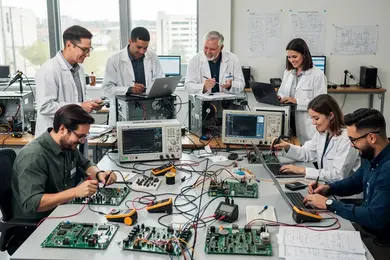
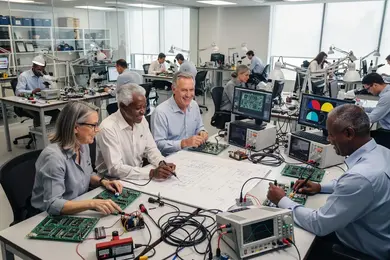
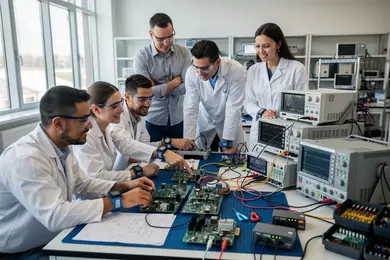
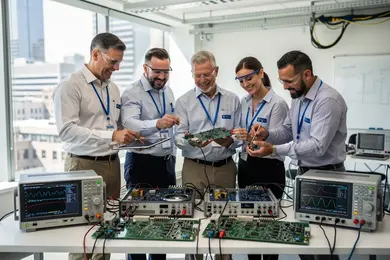
Online lab experiences vary widely, so students should look closely at what "lab" means in each program. A rigorous circuits lab often requires students to assemble circuits, measure voltages and currents, compare results with simulations, explain discrepancies, and troubleshoot faults.
Common online lab formats include several models, and the best programs often use more than one. Understanding the format helps you judge whether the program fits your learning style:
- Mailed lab kits that include breadboards, resistors, capacitors, inductors, sensors, microcontrollers, and measurement tools for home experiments.
- Simulation platforms that let students model circuits, test assumptions, and visualize transient or frequency-domain behavior before building hardware.
- Remote laboratories where students control real instruments through a web interface and collect measurements from physical equipment.
- Short campus residencies or intensive lab weekends for experiments that require specialized instruments or safety supervision.
- Project-based labs where students design, test, document, and revise circuits rather than simply following step-by-step instructions.
AI-assisted design tools and automated circuit simulation are increasingly common in engineering workflows, but they do not replace the need to understand fundamentals. Students who can explain why a simulated design fails in real hardware will be more valuable than students who only know how to run software.
What admission requirements apply to online electrical engineering degrees focused on circuits?
Admission requirements depend on degree level and institutional selectivity, but online electrical engineering programs are usually more structured than many other online majors. The reason is simple: circuit analysis depends on calculus, physics, and problem-solving skills that build in sequence.
For bachelor's programs, applicants may enter as first-year students, transfer students, military students, or degree-completion students. Transfer pathways are common because many learners complete general education, calculus, physics, and introductory programming at a community college before moving into upper-division engineering coursework.
Typical requirements may include the following. Always verify details with the school because prerequisites and transfer rules can differ sharply between institutions:
- High school diploma or equivalent for first-year admission, often with recommended preparation in algebra, trigonometry, precalculus, chemistry, and physics.
- College transcripts for transfer applicants, with minimum grade requirements in calculus, physics, chemistry, engineering, or programming prerequisites.
- Placement testing or prerequisite review for students who have been away from math-heavy coursework for several years.
- Minimum GPA requirements that may be higher for engineering admission than for general university admission.
- For master's programs, a bachelor's degree in electrical engineering, computer engineering, physics, engineering technology, or a related field, sometimes with bridge coursework.
- For international or multilingual applicants, English proficiency documentation when required by the institution.
Students changing careers should be especially careful. If you already have a bachelor's degree in another field, a second bachelor's degree may be necessary for engineering roles that require an ABET-accredited undergraduate background. A master's program may be possible, but it often requires prerequisite coursework in circuits, signals, electromagnetics, programming, and advanced math.
If your interests are closer to software, algorithms, data systems, or artificial intelligence than hardware and circuits, compare electrical engineering with the best online computer science degree options before committing. Computer science may offer a more direct path if you do not need power, electronics, or hardware design coursework.
How long do online electrical engineering programs take, and what do they cost?
Program length depends on transfer credits, enrollment intensity, degree level, and course sequencing. Electrical engineering is harder to accelerate than many online majors because courses often have strict prerequisites: calculus must precede differential equations; physics supports circuits; circuits support electronics, signals, controls, and power courses.
The table below gives realistic timeline expectations. Use it to evaluate whether a program's advertised pace matches your academic starting point and weekly availability:
| Pathway | Typical time to complete | Key timeline variable | Best for |
| Full bachelor's degree from first year | About 4 years full time | Math readiness and course availability | Students beginning college or changing fields early |
| Transfer bachelor's pathway | About 2 to 3 years after transfer | How many prerequisites and engineering credits transfer | Community college students and working adults with prior credits |
| Part-time bachelor's pathway | Often 5 to 6 years or more | Workload, course sequencing, and summer enrollment | Students working full time or managing family responsibilities |
| Master's degree | About 1.5 to 3 years | Thesis, project, coursework-only format, and prerequisites | Engineers seeking specialization or advancement |
| Graduate certificate | Often less than 1 year to 18 months | Number of courses and prerequisite knowledge | Professionals needing targeted skills rather than a full degree |
Costs vary by residency, institution type, transfer credits, fees, equipment, and financial aid. College Board's 2024-25 national benchmarks provide a useful starting point for published tuition and fees at four-year institutions, but online learners should also ask about technology fees, lab kits, proctoring, textbooks, and whether online students receive the same tuition rate regardless of state residency.
- Average published tuition and fees for in-state students at public four-year institutions: $11,610 per year.
- Average published tuition and fees for out-of-state students at public four-year institutions: $30,780 per year.
- Average published tuition and fees for students at private nonprofit four-year institutions: $43,350 per year.
Those figures are sticker prices, not net prices. Grants, employer tuition assistance, military benefits, transfer credits, scholarships, and part-time enrollment can change the actual amount paid. The most useful cost comparison is total program cost after accepted transfer credits and estimated aid, not the per-credit price alone.
To control costs, students should take a practical sequence before enrolling. These steps help reduce the risk of paying for credits that do not move you toward the engineering credential you want:
- Ask for an official transfer credit evaluation before committing to the program.
- Confirm whether calculus, physics, and circuit courses must be completed at the degree-granting institution.
- Compare total tuition, required fees, lab equipment, software, books, and travel for any residencies.
- Check whether the program offers locked tuition, employer billing, military benefits, or scholarships for online engineering students.
- Calculate how many credits you can realistically take each term without failing prerequisite courses that delay graduation.
A common red flag is a program that appears inexpensive per credit but accepts few transfer courses, requires costly travel, or lacks the accreditation needed for your goal. A slightly higher tuition rate can sometimes be a better investment if it shortens time to completion and improves credential recognition.
What entry-level and advanced careers rely on circuit analysis expertise?
Circuit analysis expertise supports a wide range of engineering careers because almost every electrical system must be modeled, tested, protected, powered, or controlled.
Entry-level roles usually involve design support, testing, documentation, troubleshooting, quality validation, and supervised engineering work. Advanced roles may involve architecture, failure analysis, system integration, technical leadership, or specialized design.
The table below connects common roles to circuit-related responsibilities. It is not a salary table; its purpose is to help you see which careers use circuit analysis most directly:
| Career path | How circuit analysis is used | Typical employers | Credential expectations |
| Electrical engineer | Designs, analyzes, tests, and improves electrical systems and components | Utilities, manufacturers, defense contractors, engineering firms, transportation companies | Bachelor's degree in electrical engineering; ABET accreditation may be preferred or required |
| Electronics engineer | Works with analog, digital, mixed-signal, RF, or embedded electronic circuits | Consumer electronics, aerospace, medical devices, telecommunications, semiconductor firms | Bachelor's or master's degree depending on specialization |
| Power systems engineer | Analyzes load flow, protection, grounding, transformers, converters, and grid-connected systems | Utilities, renewable energy companies, industrial facilities, consulting firms | Bachelor's degree; PE licensure may matter for some roles |
| Controls engineer | Applies circuits, sensors, actuators, feedback, and automation logic to industrial systems | Manufacturing, robotics, automotive, aerospace, process industries | Electrical, mechanical, or controls engineering background |
| Hardware test engineer | Builds test procedures, measures performance, validates designs, and investigates failures | Electronics manufacturers, defense, aerospace, medical device companies | Bachelor's degree or engineering technology degree depending on role level |
| Semiconductor or device engineer | Applies electronics, materials, circuits, and measurement methods to chips or devices | Semiconductor manufacturers, research labs, advanced manufacturing firms | Often bachelor's plus specialized coursework; graduate study can help |
Entry-level students should not expect to begin by designing mission-critical systems independently. More realistic first roles include test engineer, electrical design associate, field applications engineer, junior controls engineer, hardware validation engineer, or power systems analyst. These jobs can build the practical experience needed for more advanced design and leadership roles.
Students should also consider adjacent fields. If your main interest is sustainability policy, environmental monitoring, or conservation rather than electrical hardware, it may be useful to compare engineering with what can you get with an environmental science degree. Some clean energy careers need electrical engineers, while others rely more on environmental science, policy, or compliance expertise.
What salary ranges and earning potential exist for electrical engineers specializing in circuits?
Electrical engineering can offer strong earning potential, but salary depends on occupation, industry, location, degree level, clearance requirements, licensure, experience, and technical specialization. Circuit analysis is valuable because it supports roles that require both mathematical reasoning and practical hardware judgment.
The BLS reported a May 2024 median annual wage of $111,910 for electrical engineers and $127,710 for electronics engineers, except computer. These medians are useful benchmarks, but they do not mean a new graduate will start at those amounts; they reflect workers across experience levels, industries, and regions.
The table below summarizes salary context for circuit-related engineering paths using occupational categories that commonly involve circuit analysis. Use it as a planning reference rather than a prediction of personal earnings:
| Role category | Salary context | What can raise earning potential | Important limitation |
| Electrical engineer | BLS May 2024 median annual wage: $111,910 | Power systems expertise, defense work, PE licensure, project leadership, advanced design skills | Entry-level pay may be lower than the occupation-wide median |
| Electronics engineer, except computer | BLS May 2024 median annual wage: $127,710 | RF design, semiconductor experience, aerospace systems, mixed-signal electronics, advanced testing | Some roles require specialized graduate coursework or industry experience |
| Engineering technician or technologist roles | Often lower than engineer roles but may provide practical lab and testing experience | Instrumentation skills, troubleshooting ability, certifications, progression into engineering support | May not substitute for an engineering degree when employers require one |
| Engineering manager or senior technical lead | Typically reached after years of engineering experience | Design ownership, budgeting, cross-functional leadership, safety-critical systems experience | Management roles require more than circuit knowledge alone |
Students evaluating return on investment should compare expected debt with likely career entry points. A lower-cost, ABET-accredited pathway with strong transfer credit may produce a better financial outcome than a higher-cost program with limited employer recognition. Conversely, a more expensive program may be justified if it provides required accreditation, strong labs, relevant electives, and access to employers in your target industry.
Do not choose a program based only on a salary headline. Ask schools for career services data, employer partnerships, internship support, graduate school placement, and examples of recent capstone projects.
The best salary strategy is usually to combine a recognized credential with marketable technical evidence: lab reports, design projects, internships, certifications, and documented software and instrumentation skills.
What is the job outlook for electrical engineers with strong circuit analysis skills?
The job outlook for electrical engineers with strong circuit analysis skills is positive, especially in areas tied to electrification, grid modernization, automation, defense systems, communications, medical devices, and semiconductor manufacturing. The BLS projects 9% employment growth for electrical and electronics engineers from 2023 to 2033, which is faster than the average for all occupations.
That growth should be interpreted carefully. It does not mean every graduate will find the same opportunities in every region or specialization. Demand is strongest when circuit knowledge is paired with practical tools and industry-specific skills, such as printed circuit board design, power electronics, programmable logic controllers, embedded systems, MATLAB, SPICE simulation, Python, laboratory instrumentation, or safety standards.
Several trends are shaping the market for circuit-focused electrical engineers. These trends are worth considering because they influence which electives, projects, and internships may be most valuable:
- Electrification is increasing the need for engineers who understand power conversion, batteries, charging systems, motor drives, and grid-connected equipment.
- Semiconductor and advanced manufacturing investments are raising the value of electronics, device, testing, and process-control knowledge.
- AI-enabled design and simulation tools are changing workflows, but employers still need engineers who can validate results against physical measurements and safety constraints.
- Industrial automation is increasing demand for controls, sensors, actuators, embedded systems, and real-time troubleshooting skills.
- Cyber-physical systems are making it more important for electrical engineers to understand how hardware, firmware, networks, and safety requirements interact.
To improve employability, students should plan beyond the degree checklist. Choose electives that match a target sector, complete internships or co-ops when possible, document design work in a portfolio, and learn the tools listed in job postings for the roles you want. Circuit theory becomes more marketable when employers can see how you apply it.
How can students choose a reputable online electrical engineering program in the United States?
Choosing a reputable online electrical engineering program requires more than comparing tuition and convenience. You are evaluating whether the program can prepare you for rigorous technical work, possible licensure, graduate study, and employer screening in a field where lab competence matters.
Use the following sequence before enrolling. It is designed to prevent the most common mistakes: choosing an unaccredited program, overestimating transfer credits, underestimating time demands, or enrolling in a curriculum that does not match your target career:
- Define your goal first: entry-level electrical engineering, power systems, electronics, controls, embedded systems, graduate school, or a technician-to-engineer pathway.
- Verify institutional accreditation and, for bachelor's programs, whether the exact online electrical engineering program has ABET accreditation.
- Request a written degree plan showing every required course, prerequisite chain, lab requirement, residency requirement, and expected graduation term.
- Ask for an official transfer credit evaluation and confirm whether engineering, math, and science courses will count toward the major.
- Review the lab model by asking what equipment, software, simulations, remote instruments, and in-person sessions are required.
- Compare total cost after transfer credit, fees, lab kits, software, travel, financial aid, scholarships, and employer benefits.
- Check faculty credentials, tutoring access, office hours, class size expectations, and how quickly students receive feedback on technical work.
- Ask about internships, co-ops, capstone sponsors, career services, employer partnerships, and alumni outcomes in circuit-related roles.
- Read the catalog for withdrawal, repeat, probation, transfer, and prerequisite policies so you understand what happens if a difficult course delays progress.
The table below summarizes red flags and better alternatives. Use it as a final screening tool before signing an enrollment agreement or paying a deposit:
| Red flag | Why it matters | Better alternative |
| The school discusses accreditation generally but does not identify the exact program's status | Program-level recognition can affect licensure, employment, and graduate school options | Verify the exact degree name and accreditation status independently |
| The curriculum has few labs or relies only on passive video demonstrations | Circuit analysis requires measurement, troubleshooting, and design practice | Choose a program with hands-on kits, remote labs, residencies, or project-based assessment |
| Admissions promises rapid completion without reviewing prerequisites | Engineering courses are sequential and difficult to compress safely | Request a term-by-term plan based on your transcripts and math readiness |
| The program will not provide clear total cost estimates | Fees, equipment, software, and travel can change affordability | Compare net program cost, not just tuition per credit |
| Career information is vague or unrelated to engineering roles | You need evidence that graduates can move into relevant technical pathways | Ask for examples of capstone projects, employer connections, internships, and alumni roles |
Program evaluation skills apply across online education, not only engineering. For example, students comparing an MLIS degree would also check accreditation, career fit, cost, and outcomes, but electrical engineering adds the extra need to verify labs, math preparation, and engineering-specific recognition.
The smartest choice is the program that fits your target role, budget, schedule, and academic readiness while meeting recognized quality standards. If a school cannot clearly explain accreditation, labs, transfer credits, and total cost, keep looking.
Other Things You Should Know About Electrical Engineering
You do not need to be a software expert before starting, but programming is increasingly important. Electrical engineering students commonly use Python, MATLAB, C, or embedded programming to model circuits, process signals, automate tests, and control hardware.
Yes, in 2027, many universities offer fully online electrical engineering degrees with circuit analysis coursework. These programs provide a flexible schedule, allowing students to study at their own pace while accessing lectures, simulations, and interactive assignments online. Ensure the program is accredited for a recognized qualification.
Yes. Many online electrical engineering degrees can include ABET-accredited coursework if the program itself is accredited by ABET’s Engineering Accreditation Commission. Employers and state licensing boards often look for ABET accreditation, especially for pathways tied to the Fundamentals of Engineering exam and later PE licensure.
References
- ABET-Accredited Bachelor’s in Electronics Engineering Technology https://www.uagrantham.edu/blog/abet-accredited-electronics-engineering-technology-degree/
- Exploring Electrical Engineering: Pathways to Innovation and Careers https://www.amanengineering.com.sg/electrical-engineering-complete-guide-to-career-paths-and-specializations/
- What does a Circuits Engineer do? Career Overview, Roles, Jobs | IES https://careercenter.ies.org/career/circuits-engineer
- Electrical Engineering Careers https://www.learnhowtobecome.org/engineering-careers/electrical/
- Why Choosing Electrical Engineering is a Wise and Future-Proof Career Decision - CertLibrary Blog https://www.certlibrary.com/blog/why-choosing-electrical-engineering-is-a-wise-and-future-proof-career-decision/
- 2025-2026 Academic Catalog https://catalog.wit.edu/course-descriptions/elec/
- Online Electrical Engineering Degrees - BSEE, MSEE https://www.onlineengineeringprograms.com/electrical
- Electrical Engineering Job Market: 2026 Outlook & Pay https://pathwise.io/electrical-engineering-job-market/