
2027 Fastest Online MSN in Forensic Nursing Programs

Co-Founder and Chief Data Scientist
A nurse, like you, often knows the full story behind a patient's injuries. But then the legal process takes over, leaving you to wonder if justice will ever see the whole picture. That pull to do more—to have a direct, decisive impact on the process—is a sign your career is ready for a powerful evolution. This desire for a new challenge comes as 40% of RNs, citing burnout, plan to leave their roles.
An online MSN in forensic nursing offers a path not to leave the field, but to transform your place within it. Crafted by career planning experts with over a decade of experience, this guide is more than a list. It is your strategic map for becoming a vital link in the pursuit of justice.
What are the benefits of getting a fast online MSN in Forensic Nursing degree?
- You gain access to unique investigative career paths where you can directly influence legal outcomes at the intersection of healthcare and law.
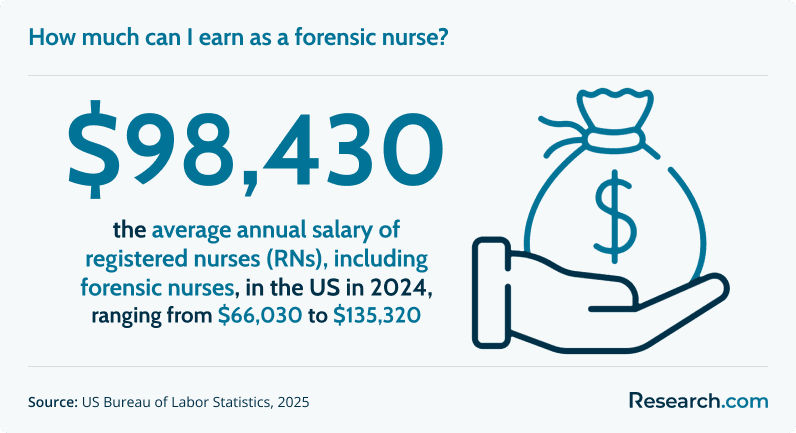
- You can expect an enhanced earning potential, with the average salary for registered nurses being around $98,430 and higher possibilities for certified experts.
- You have the flexibility to pursue this career transformation while continuing to work, thanks to the accessible online format.
What can I expect from a fast online MSN in Forensic Nursing degree program?
You can expect a curriculum that operates right at the intersection of healthcare and the legal system. It’s designed to give you the advanced nursing and legal knowledge needed for expert practice. The most important thing to expect, however, isn't just the coursework; it's understanding the strategic path you'll take to enter the field.
There are three main pathways. You can take the Direct-to-MSN path if you're ready to become a specialist, a Certificate-First approach if you want to add forensic skills to your current practice quickly, or a Staged path to build your credentials over time. Choosing the right approach is the first major decision you'll make. An online MSN in forensic nursing provides the comprehensive educational foundation, which is distinct from a professional certificate that validates your skills for a specific role.
Where can I work with an online MSN in Forensic Nursing degree?
You can find yourself working in a much wider range of settings than you might expect. Graduates take on roles in hospitals as Sexual Assault Nurse Examiners (SANEs), in medical examiner's offices, and within correctional facilities. But the opportunities extend far beyond that. Many build careers in law firms, insurance companies, and government agencies.
It's important to know that much of the work is in the civil legal system, focusing on areas like medical malpractice or personal injury cases—not just what you see on TV. Many professionals also have a "dual role," where they might work as an ER nurse while also serving as the on-call SANE for their facility. This degree gives you the flexibility to either pivot to a dedicated forensic role or add a powerful new skill set to your existing one.
How much can I make with an online MSN in Forensic Nursing degree?
While the U.S. Bureau of Labor Statistics reports an average salary of around $98,430 for registered nurses, which includes forensic nurses, your earning potential with this MSN can be significantly higher.
Your salary will vary widely based on your specific role, location, and experience. The key thing to understand is that the highest earning potential is unlocked not just by the degree, but by achieving expert status through professional certifications. Those who pursue independent consulting work as Legal Nurse Consultants, for example, often have the greatest control over their income.
- List of the Best Fastest Online MSN in Forensic Nursing Programs for 2027 List of Programs
- How long does it take to complete a fast online MSN in forensic nursing degree program? Completion Time
- How does a fast online MSN in forensic nursing degree program compare to an on-campus program? How does a fast online MSN in forensic nursing degree program compare to an on-campus program?
- What is the average cost of a fast online MSN in forensic nursing degree program? Program Cost
- What are the financial aid options for students enrolling in a fast online MSN in forensic nursing degree program? Financial Aid
- What are the prerequisites for enrolling in a fast online MSN in forensic nursing degree program? Requirements
- What courses are typically in a fast online MSN in forensic nursing degree program? What courses are typically in a fast online MSN in forensic nursing degree program?
- What types of specializations are available in a fast online MSN in forensic nursing degree program? What types of specializations are available in a fast online MSN in forensic nursing degree program?
- How to Choose the Best Online MSN in Forensic Nursing Degree Program How to Choose the Best Online MSN in Forensic Nursing Degree Program
- What career paths are available for graduates of a fast online MSN in forensic nursing degree program? What career paths are available for graduates of a fast online MSN in forensic nursing degree program?
- What is the job market for graduates of fast online MSN in forensic nursing degree programs? Job Market
- What Support Services Enhance Student Success in Online Forensic Nursing Programs? What Support Services Enhance Student Success in Online Forensic Nursing Programs?
- What are the emerging trends in forensic nursing education? What are the emerging trends in forensic nursing education?
- What Additional Academic Pathways Can Amplify Your Forensic Nursing Expertise? What Additional Academic Pathways Can Amplify Your Forensic Nursing Expertise?
Best Fast Online MSN in Forensic Nursing Programs for 2027
Choosing an online MSN in forensic nursing is not the same as choosing a general nursing master’s program. You are preparing for work that may involve trauma response, evidence collection, courtroom testimony, death investigation, sexual assault examination, legal consulting, correctional health, or violence prevention. The right program must fit your schedule as a working nurse, but it also has to prepare you for a field where clinical judgment and legal accuracy are both essential.
This guide is for registered nurses comparing fast online MSN forensic nursing programs and trying to decide which option is credible, affordable, flexible, and aligned with their career goals. You will find ranked program options, cost and timeline comparisons, admissions expectations, career paths, certification considerations, and practical questions to ask before enrolling.
Quick Answer: What Is the Fastest Practical Path to an Online MSN in Forensic Nursing?
For BSN-prepared registered nurses, many fast online MSN in forensic nursing programs can be completed in about 2 to 3 years, with several requiring 36 to 39 credits. The fastest option is not always the best option. Nurses should first verify CCNE or ACEN accreditation, clinical placement expectations, forensic nursing faculty experience, and whether the curriculum supports the role they want, such as SANE, legal nurse consultant, forensic nurse investigator, or medicolegal death investigator.
Based on the program information reviewed here, online forensic nursing MSN programs vary meaningfully in cost, required credits, format, campus visit requirements, and clinical support. A lower tuition rate can be attractive, but accreditation, certification readiness, clinical site logistics, and fit with your state licensure situation should carry more weight than speed alone.
How We Ranked These Programs
An MSN is a major academic and financial commitment, especially for nurses balancing employment, family responsibilities, and clinical obligations. Research.com built this ranking to help students compare programs using transparent, education-focused criteria rather than marketing claims. Our Best Fastest Online MSN in Forensic Nursing Programs list is informed by institutional research and our published Research.com ranking methodology.
To evaluate online program quality, institutional characteristics, costs, and outcomes, we reviewed data from the IPEDS database maintained by the National Center for Education Statistics, Peterson’s database and its Distance Learning Licensed Data Set, the College Scorecard, and the National Center for Education Statistics. Program details such as tuition, credits, format, and accreditation should still be confirmed directly with each school before applying.
| Rank | School and Program | Typical Completion Time | Credits | Published Cost Information | Accreditation |
| 1 | Fitchburg State University — Online Master of Science in Forensic Nursing | As few as 3 years | 39 | $347 per credit | Commission on Collegiate Nursing Education (CCNE) |
| 2 | Duquesne University — Master of Science in Nursing, Forensic Nursing track | 2.5 years | 36 | $62,440 total tuition | Commission on Collegiate Nursing Education (CCNE) |
| 3 | Cleveland State University — Online MSN in Forensic Nursing | 2 years part-time | 38 | $618.25 in-state; $619.25 out-of-state per credit | Commission on Collegiate Nursing Education (CCNE) |
| 4 | Xavier University — Master of Science in Nursing, Forensic Track | 2–3 years | 37 | $722 per credit | Commission on Collegiate Nursing Education (CCNE) |
| 5 | Texas A&M University — MSN–Forensic Nursing | Approximately 2 years | 36 | $326.33 in-state; $680.69 out-of-state per credit | Commission on Collegiate Nursing Education (CCNE) |
| 6 | Oakland University — Master of Science in Nursing: Forensic Nursing | 28 months | 39 | $951.50 in-state; $1,078.25 out-of-state per credit | Commission on Collegiate Nursing Education (CCNE) |
| 7 | Stevenson University — Online MSN Forensic Nursing Program | Approximately 2 years | 36 | $641 per credit | Commission on Collegiate Nursing Education (CCNE) |
| 8 | Aspen University — MSN in Forensic Nursing | Approximately 2 years | 36 | $430 per credit | Commission on Collegiate Nursing Education (CCNE) |
| 9 | Monmouth University — Master of Science in Nursing: Forensic Nursing | Approximately 2 years | 39 | $35,820 total tuition | Commission on Collegiate Nursing Education (CCNE) |
| 10 | DeSales University — MSN in Forensic Nursing with Certification in Investigative Forensics | 2–3 years | 51 | $910 per credit | Commission on Collegiate Nursing Education (CCNE) |
1. Fitchburg State University — Online Master of Science in Forensic Nursing
Fitchburg State University offers a flexible MSN option for registered nurses who want to move into forensic nursing while continuing to manage professional responsibilities. The program allows students up to six years to finish, which can be important for nurses whose schedules change because of shifts, family obligations, or clinical workload.
The curriculum is designed to help nurses connect advanced clinical practice with forensic science. Students study trauma assessment, victim advocacy, evidence-related procedures, and collaboration with legal professionals. This makes the program a strong fit for nurses who want a broad forensic foundation rather than a narrow single-role credential.
- Program length: As few as 3 years
- Credits required: 39
- Cost per credit: $347
- Accreditation: Commission on Collegiate Nursing Education (CCNE)
2. Duquesne University — Master of Science in Nursing, Forensic Nursing Track
Duquesne University is notable for its connection with the Cyril H. Wecht Institute of Forensic Science and Law. That interdisciplinary relationship may appeal to nurses who want substantial exposure to the legal, scientific, and investigative dimensions of forensic practice.
The program emphasizes trauma-informed care, victim assessment, evidence handling, and legal processes. Students should note that one campus visit is required, so this is not a fully remote option in the strictest sense. It may be best for nurses who want online flexibility but are willing to travel once for a structured academic experience.
- Program length: 2.5 years
- Credits required: 36
- Total tuition: $62,440
- Accreditation: Commission on Collegiate Nursing Education (CCNE)
3. Cleveland State University — Online MSN in Forensic Nursing
Cleveland State University is designed for nurses who need maximum scheduling control. Coursework is 100% online and asynchronous, there are no required campus residencies, and the program provides full clinical placement services.
The program prepares nurses to use forensic methods and evidence-based practice in settings connected to healthcare, law, and public safety. Potential career directions include legal nurse consulting, forensic psychiatric nursing, and other roles where clinical analysis must be communicated clearly to legal or investigative audiences.
- Program length: 2 years, part-time
- Credits required: 38
- Cost per credit: $618.25 in-state; $619.25 out-of-state
- Accreditation: Commission on Collegiate Nursing Education (CCNE)
4. Xavier University — Master of Science in Nursing, Forensic Track
Xavier University frames its forensic nursing track through a Jesuit educational approach that combines critical inquiry, ethical reflection, and professional formation. The program may appeal to nurses drawn to anti-violence work, victim rights, and community-centered practice.
Students are encouraged to investigate local practicum opportunities during the application process, which can help determine whether the program is realistic for their location and career goals. The curriculum connects nursing practice with legal procedures so graduates can support trauma survivors while understanding how clinical documentation and evidence may be used in legal contexts.
- Program length: 2–3 years
- Credits required: 37
- Cost per credit: $722
- Accreditation: Commission on Collegiate Nursing Education (CCNE)
5. Texas A&M University — MSN–Forensic Nursing
Texas A&M University offers a mostly online MSN in forensic nursing with limited campus visits. This structure can work well for nurses who want online coursework but also value targeted hands-on learning for advanced health assessment.
The program focuses on the care of victims and perpetrators of traumatic events, including how to observe, recognize, collect, and document forensic evidence for potential use in legal proceedings. Students should plan ahead for the final semester because they are responsible for securing their own preceptors for one course.
- Program length: Approximately 2 years
- Credits required: 36
- Cost per credit: $326.33 in-state; $680.69 out-of-state
- Accreditation: Commission on Collegiate Nursing Education (CCNE)
6. Oakland University — Master of Science in Nursing: Forensic Nursing
Oakland University offers a program with a long-standing connection to the development of forensic nursing education. It is described as the first program of its kind in Michigan and is endorsed by Virginia Lynch, the founder of the discipline.
The curriculum prepares nurses to apply both nursing and forensic science principles when caring for patients who may be victims, suspects, or perpetrators of violence. Career possibilities include sexual assault nurse examiner, legal nurse consultant, and other roles that sit between healthcare delivery and legal inquiry.
- Program length: 28 months
- Credits required: 39
- Cost per credit: $951.50 in-state; $1,078.25 out-of-state
- Accreditation: Commission on Collegiate Nursing Education (CCNE)
7. Stevenson University — Online MSN Forensic Nursing Program
Stevenson University uses six 8-week sessions each year, giving students several opportunities to begin or continue coursework in shorter academic blocks. This can be useful for nurses who prefer focused courses rather than long traditional semesters.
The program blends advanced nursing, evidence-based investigation, and trauma care. It may be a practical choice for nurses who want a structured online format with repeated start points and a curriculum that connects clinical practice with forensic responsibilities.
- Program length: Approximately 2 years
- Credits required: 36
- Cost per credit: $641
- Accreditation: Commission on Collegiate Nursing Education (CCNE)
8. Aspen University — MSN in Forensic Nursing
Aspen University provides a lower-cost pathway into forensic nursing compared with many programs on this list and does not charge an application fee. The program is built for practicing nurses who want flexibility and a curriculum that can support advancement into leadership, consulting, corrections, or community violence prevention.
Students explore current issues in the correctional system and complete practicum and capstone work that can be shaped around their professional interests. This may benefit nurses who already have a specific forensic nursing setting in mind and want their graduate work to connect directly to that goal.
- Program length: Approximately 2 years
- Credits required: 36
- Cost per credit: $430
- Accreditation: Commission on Collegiate Nursing Education (CCNE)
9. Monmouth University — Master of Science in Nursing: Forensic Nursing
Monmouth University offers multiple routes into the MSN for nurses with different academic backgrounds, including an RN-to-MSN direct option and a bridge pathway for RNs who hold a non-nursing bachelor’s degree. This structure can be helpful for students who need a defined academic plan rather than a one-size-fits-all admission route.
The program addresses forensic topics such as interpersonal violence while also developing graduate-level skills in research, data management, health informatics, and advanced practice. Applicants should note that a current New Jersey RN license is required.
- Program length: Approximately 2 years
- Credits required: 39
- Total tuition: $35,820
- Accreditation: Commission on Collegiate Nursing Education (CCNE)
10. DeSales University — MSN in Forensic Nursing with Certification in Investigative Forensics
DeSales University combines an MSN in forensic nursing with a Certification in Investigative Forensics. This makes it a distinctive option for nurses who want graduate nursing preparation plus a formal investigative credential embedded in the same program.
The curriculum includes SANE-A and SANE-P courses and is designed to build advanced knowledge of law, forensic science, patient advocacy, and investigative service leadership. With 51 required credits, it is a larger academic commitment than many other programs on this list, but it may be appealing to nurses who want a more expansive credential package.
- Program length: 2–3 years
- Credits required: 51
- Cost per credit: $910
- Accreditation: Commission on Collegiate Nursing Education (CCNE)
How Long Does a Fast Online MSN in Forensic Nursing Take?
For registered nurses who already have a BSN, fast online MSN forensic nursing programs commonly take 1.5 to 3 years and require about 36 to 39 credits. Nurses entering with an associate degree usually need more time because RN-to-MSN or ADN-to-MSN bridge programs include bachelor’s-level nursing content before graduate coursework begins.
This timeline is similar to many advanced nursing and healthcare specializations. Nurses still comparing population-focused pathways may also want to understand how fields such as geriatrics and gerontology differ before committing to a forensic nursing route.
| Enrollment Option | Best For | Main Advantage | Main Trade-Off |
| Full-time study | Nurses who can dedicate substantial weekly time to school | Fastest route to graduation and career transition | More demanding workload, especially for nurses who remain employed |
| Part-time study | Working nurses balancing shifts, family, and school | More sustainable schedule and lower burnout risk | Longer time before completing the MSN |
| RN-to-MSN or ADN-to-MSN bridge | Licensed RNs without a BSN | Creates a direct path from associate-level preparation to graduate study | Usually takes longer because bridge coursework is required |
Full-Time Study: Best When Speed Is the Priority
A full-time plan is the most direct route for nurses who want to move quickly into forensic nursing roles. It requires strong organization and enough flexibility to handle readings, assignments, clinical requirements, and possibly employment at the same time. It is best for students who can protect consistent study time each week.
Part-Time Study: Best for Working Nurses
Part-time enrollment is often the more realistic route for nurses who need to keep working. It lengthens the academic timeline, but it also helps students continue earning income, maintain benefits, and avoid overloading themselves during demanding clinical or legal coursework.
Earning a master’s degree places nurses in a smaller group of advanced-educated professionals. While most nurses hold a bachelor’s degree, the 8% who earn a master’s are choosing a more specialized level of preparation.
Online vs. On-Campus MSN in Forensic Nursing: Which Format Is Better?
The best format depends on how much structure, flexibility, and clinical placement support you need. Online MSN forensic nursing programs are usually better for nurses who must work while studying, while campus-based programs may suit students who prefer face-to-face instruction, local faculty access, and school-arranged clinical networks.
Online options can be especially attractive for nurses who are already comparing accelerated graduate pathways, including fast online BSN-to-MSN bridge programs. The critical point is not whether the program is online or on campus. It is whether the program is properly accredited and whether it can support your clinical and certification goals.
| Factor | Online MSN in Forensic Nursing | On-Campus MSN in Forensic Nursing |
| Schedule flexibility | Often better for working nurses, especially when courses are asynchronous | Usually more fixed because classes meet at scheduled times |
| Clinical placement | May require students to locate local sites or preceptors, though some programs provide placement help | Often uses established regional clinical relationships |
| Networking | Requires more intentional online and local professional outreach | More built-in face-to-face faculty and peer interaction |
| Campus travel | Some programs are fully online; others require limited visits | Regular campus attendance is expected |
| Degree credibility | Strong when accredited by CCNE or ACEN | Strong when accredited by CCNE or ACEN |
The Most Important Online Learning Issue: Clinicals
Clinical logistics can determine whether an online program is practical for you. Some schools help arrange placements, while others expect students to identify qualified preceptors and appropriate sites in their communities. Before enrolling, ask whether the school has placement partnerships near you, how far in advance clinicals must be approved, and what happens if a site falls through.
Forensic nursing also requires professional initiative. If you must secure a preceptor, treat that process as early career networking. The relationships you build with emergency departments, advocacy programs, medical examiner offices, legal teams, or community agencies may later help you find employment or certification-related experience.
How Much Does a Fast Online MSN in Forensic Nursing Cost?
The average total tuition for an online MSN in forensic nursing is around $32,000. Per-credit tuition commonly ranges from $780 for in-state students to $830 for out-of-state students, though private universities and higher-credit programs can cost $50,000 or more. Individual programs in this ranking range widely, so students should compare total cost rather than relying only on advertised per-credit tuition.
Cost variation is common across online degrees, including adjacent science and healthcare-related pathways such as the shortest online bachelor’s programs in natural sciences. For nursing graduate programs, students should also budget for technology fees, books, background checks, clinical compliance requirements, travel if campus visits are required, and certification exam expenses after graduation.
How to Compare True Program Value
The cheapest program is not automatically the best investment. A program with higher tuition may be worth considering if it offers stronger clinical placement support, faculty with active forensic nursing experience, relevant certification preparation, or a curriculum that matches your intended role. A low-cost program that lacks accreditation or cannot support clinical requirements can create serious professional barriers.
Most students begin the funding process by completing the FAFSA. After that, compare federal loans, private loans, employer tuition benefits, scholarships, and payment plans. Remember that the value of the degree depends on your career goals, local job opportunities, certification plans, and ability to complete the program without taking on unsustainable debt.
Accreditation is the non-negotiable cost factor. An unaccredited program may be inexpensive, but it may not support certification eligibility or employer recognition. A properly accredited MSN can help build the foundation for advanced nursing work that may pay above the average RN salary of $98,430, but salary outcomes are never guaranteed and depend on role, location, experience, employer, and certifications.
Financial Aid Options for Online MSN Forensic Nursing Students
Graduate nursing students commonly use a combination of federal loans, private loans, employer tuition assistance, scholarships, payment plans, and personal savings. Nurses should first check whether their employer offers tuition reimbursement, tuition discounts, professional development funds, or paid educational leave. Hospitals and health systems may be more willing to support graduate study when the degree connects to a needed service area, such as sexual assault response, emergency care, legal risk review, or community violence intervention.
Scholarships and Professional Support for Forensic Nurses
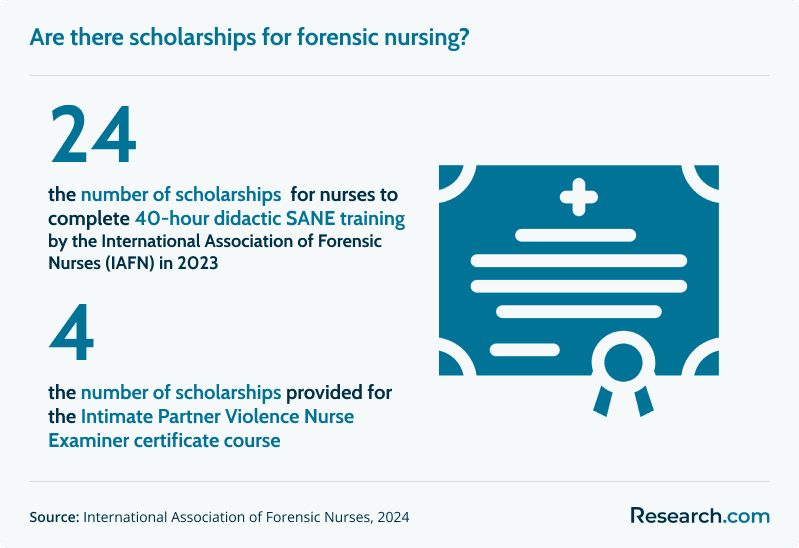
Professional organizations can be valuable sources of targeted support. The International Association of Forensic Nurses is especially relevant for nurses entering this specialty. In 2023, the organization supported aspiring forensic nurses through:
- 24 scholarships for nurses completing the 40-hour didactic SANE training.
- 4 scholarships for the Intimate Partner Violence Nurse Examiner certificate course.
These opportunities matter because they reduce cost and signal professional demand for specialized forensic nursing skills. Students should search for scholarships connected to sexual assault response, victim advocacy, emergency nursing, public health, legal nursing, and violence prevention in addition to general graduate nursing awards.
| Funding Source | Why It May Help | What to Check First |
| Federal student aid | Often the starting point for graduate borrowing | Submit FAFSA and review loan terms carefully |
| Employer tuition reimbursement | Can reduce out-of-pocket cost while you stay employed | Service commitment, grade requirements, annual limits |
| Professional scholarships | May target forensic nursing, SANE training, or violence prevention | Membership requirements, deadlines, certification focus |
| Private loans | Can fill remaining gaps | Interest rate, repayment terms, cosigner requirements |
| School payment plans | May spread tuition across the term | Fees, due dates, and whether financial aid can be combined |
Admissions Requirements for a Fast Online MSN in Forensic Nursing
Admission standards vary by university, but most online MSN forensic nursing programs expect applicants to show that they are licensed, academically prepared, and ready for graduate-level clinical responsibility. Before applying, confirm both the school’s general graduate admission rules and the nursing department’s program-specific requirements.
- Active RN license: Applicants are typically required to hold a current, unencumbered registered nurse license.
- BSN degree: Direct MSN admission usually requires a Bachelor of Science in Nursing from a CCNE- or ACEN-accredited institution.
- Minimum GPA: A cumulative GPA of 3.0 on a 4.0 scale is a common benchmark.
- Clinical experience: Some programs prefer or require one to two years of hands-on nursing experience.
These expectations are more advanced than entry-level healthcare roles. For comparison, students exploring broader community-based healthcare work can review community health worker education and career requirements, which differ significantly from graduate nursing preparation.
Can an ADN-Prepared RN Earn an MSN in Forensic Nursing?
Yes. RNs with an associate degree can look for RN-to-MSN or ADN-to-MSN options. These bridge programs add required BSN-level nursing coursework before or alongside graduate study, allowing students to move toward the MSN without first completing a separate standalone BSN program. The trade-off is time: bridge routes are usually longer than direct BSN-to-MSN pathways.
Common Courses in an Online MSN in Forensic Nursing
An online MSN in forensic nursing combines advanced nursing practice with legal, investigative, and trauma-informed care concepts. Exact course titles differ by institution, but students can expect the curriculum to cover both clinical decision-making and the legal defensibility of nursing documentation and evidence-related work.
- Advanced health assessment for complex trauma and injury evaluation.
- Nursing theory and research to support evidence-based expert practice.
- Victimology and psychosocial care for people affected by violence, abuse, or exploitation.
- Forensic science principles, including evidence collection, preservation, and documentation.
- Legal systems, expert witness preparation, and communication with attorneys or investigators.
Although these programs include legal content, they are not the same as a criminal justice degree online. The forensic nursing MSN remains grounded in nursing assessment, patient care, trauma response, advocacy, and clinical ethics.
Why Research and Theory Courses Matter in Court-Connected Work
Forensic-specific classes may feel more exciting, but research and theory courses are what help nurses defend their conclusions. When a nurse’s documentation, testimony, or expert opinion is challenged, the answer must be based on sound evidence, not intuition.
This is also true in other advanced nursing pathways, including leadership-heavy options such as accelerated online MSN/MBA dual degree programs. Graduate nursing education is designed to strengthen analytical reasoning, evidence evaluation, and professional communication under pressure.
In forensic practice, those skills are essential. A nurse may need to explain why an injury pattern matters, how evidence was preserved, or why a clinical finding supports a particular interpretation. Research literacy helps make that work credible.
Forensic Nursing Specializations and Certifications
Forensic nursing is already a specialized graduate path, but some programs offer more focused options, such as Legal Nurse Consulting or Death Investigation. These tracks can make sense for nurses who already know the specific forensic role they want after graduation.
Unlike broader leadership programs that may prepare graduates for general management roles, such as degrees connected to organizational leadership and management careers, a forensic nursing concentration applies leadership, documentation, and analysis to legal and healthcare intersections.
Degree Concentration vs. Professional Certification
Many nurses are best served by earning a broad forensic nursing MSN and then adding role-specific certification. This keeps the degree flexible while allowing the nurse to specialize after gaining clearer career direction. For example, a graduate may pursue SANE-A® for adult and adolescent sexual assault examination or LNCC® for legal nurse consulting.
| Option | Best For | Advantage | Limitation |
| General forensic nursing MSN | Nurses who want broad forensic preparation | Supports multiple possible roles | May require separate certification for specific practice areas |
| Legal nurse consulting concentration | Nurses interested in law firms, insurers, or case review | Aligns coursework with legal analysis and consultation | Less focused on direct trauma response roles |
| Death investigation concentration | Nurses interested in medicolegal investigation | Targets investigative and documentation skills | May not fit nurses seeking bedside forensic practice |
| Post-degree certification | Nurses who want role-specific credibility | Can be added as career goals evolve | May require training, experience, exams, and renewal |
How to Choose the Best Online MSN in Forensic Nursing Program
The best online MSN in forensic nursing is the one that fits your career target, state licensure situation, schedule, budget, and clinical access. A famous school name matters less than whether the program can help you complete clinical requirements, prepare for relevant certifications, and graduate with a credential employers recognize.
Some nurses compare forensic nursing with other highly specialized MSN pathways, such as fast online MSN adult-gerontology acute care nurse practitioner programs, before choosing a direction. That comparison is worthwhile because forensic nursing does not always lead to the same licensure, prescribing authority, or clinical role structure as nurse practitioner tracks.
Program Selection Checklist
- Verify accreditation: Prioritize programs accredited by the Commission on Collegiate Nursing Education or the Accreditation Commission for Education in Nursing.
- Review clinical placement support: Ask whether the school finds placements, assists with placement, or expects students to secure their own sites and preceptors.
- Match the curriculum to your goal: SANE, legal nurse consultant, forensic investigator, correctional nurse, and death investigation roles require different experiences.
- Check faculty backgrounds: Look for instructors with forensic nursing practice, legal consulting, SANE, investigative, or trauma-informed care expertise.
- Confirm state requirements: If clinicals, licensure, or certification eligibility may be state-dependent, ask the program for written clarification.
- Calculate total cost: Include tuition, fees, books, compliance costs, travel, lost work time, and certification expenses.
Who Should Choose This Degree?
| This Degree May Fit You If... | You May Want Another Path If... |
| You are comfortable working with patients affected by violence, abuse, trauma, or legal conflict. | You prefer a nursing role with minimal exposure to trauma narratives or legal proceedings. |
| You want to combine patient care with documentation, evidence awareness, and advocacy. | You want a direct nurse practitioner scope of practice and should compare NP programs instead. |
| You are detail-oriented and can follow protocols precisely under pressure. | You dislike documentation-heavy work or adversarial review of your conclusions. |
| You are interested in emergency departments, correctional settings, legal consulting, death investigation, or community anti-violence work. | You want a broader management route unrelated to forensic or legal healthcare issues. |
The Resilience Checkpoint
Forensic nursing can be meaningful, but it is emotionally demanding. Before enrolling, ask yourself whether you can remain compassionate and objective while working with trauma, whether you can preserve evidence with precision, and whether you can tolerate having your documentation questioned in legal settings.
This work requires clinical skill, emotional steadiness, ethical judgment, and disciplined communication. If those demands energize you rather than discourage you, forensic nursing may be a strong fit.
Career Paths With an Online MSN in Forensic Nursing
Graduates of online MSN forensic nursing programs often pursue one of two broad paths. The first is a dedicated forensic nursing role, where the nurse’s primary responsibilities involve investigation, legal consulting, forensic assessment, or specialized trauma response. Examples include forensic nurse investigator, legal nurse consultant, medicolegal death investigator, or forensic psychiatric nurse.
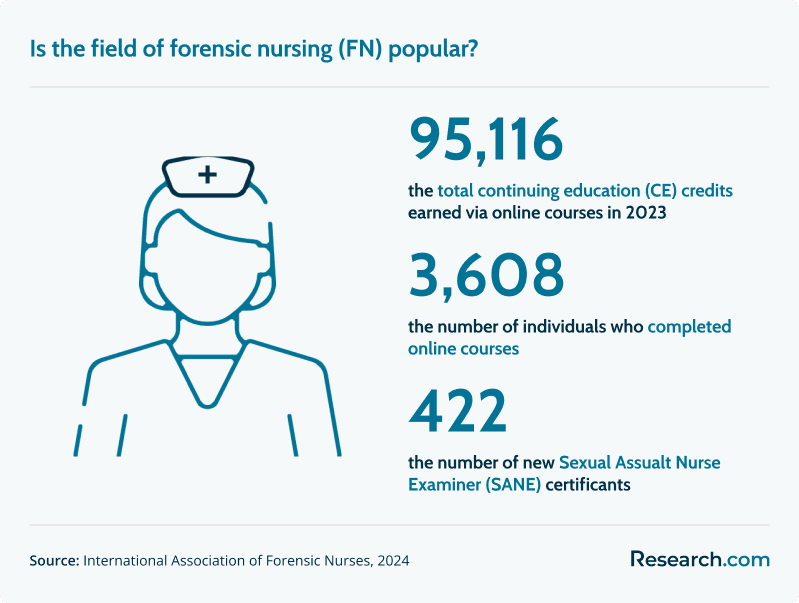
The second path is a dual-role model. In this route, nurses apply forensic expertise inside an existing clinical environment. A common example is a Sexual Assault Nurse Examiner working in an emergency department. The SANE role continues to be important, with over 400 new certificants in 2023 alone. Nurses who want to coordinate SANE services should understand that this differs from broader hospital leadership roles such as clinical nurse leader positions.
| Career Path | Typical Focus | Why an MSN Helps |
| Sexual Assault Nurse Examiner | Trauma-informed care, forensic examination, evidence collection, patient advocacy | Builds advanced assessment, documentation, and leadership skills |
| Legal Nurse Consultant | Medical record review, case analysis, attorney support, expert communication | Strengthens research, clinical interpretation, and legal communication |
| Forensic Nurse Investigator | Injury interpretation, investigative documentation, collaboration with legal authorities | Connects advanced nursing knowledge with forensic methodology |
| Medicolegal Death Investigator | Death scene information, medical history review, documentation, investigative coordination | Supports analytical and interdisciplinary practice |
| Correctional or forensic psychiatric nurse | Care for justice-involved populations or patients in forensic behavioral health settings | Prepares nurses for complex ethical, clinical, and safety considerations |
Your MSN Builds the Foundation; Certification Often Defines the Role
An MSN in forensic nursing demonstrates advanced academic preparation, but many specific forensic roles also require professional certification, specialized training, or employer-defined competency. Certifications such as SANE-A® or Legal Nurse Consultant Certified (LNCC®) can strengthen credibility and may be required or preferred for certain positions.
Before enrolling, identify the certification most relevant to your target role. Then ask each program how its curriculum, clinical experiences, and faculty advising support that credential.
Job Market Outlook for Fast Online MSN Forensic Nursing Graduates
The U.S. Bureau of Labor Statistics does not list “forensic nurse” as a standalone occupational category, so students should be careful when interpreting job outlook claims. A more practical way to evaluate this niche is to look at role-specific certification growth, employer demand in related settings, and the presence of forensic services in hospitals, advocacy centers, legal organizations, correctional facilities, and medical examiner systems.
Certification data suggests growing professional activity in this field. The number of new SANE certificants has increased substantially, with a 74% increase in the total number of certified nurses over the last five years. This indicates that healthcare and legal systems are placing greater value on nurses trained to respond to sexual assault and related trauma with both clinical competence and forensic accuracy.
How to Search for Forensic Nursing Jobs
Forensic nursing jobs are not always posted under the same title. When searching job boards, hospital career pages, law firm openings, public health agencies, and government postings, use multiple keywords. Try “Sexual Assault Nurse Examiner,” “SANE,” “Legal Nurse Consultant,” “Nurse Investigator,” “Forensic Nurse,” “Medicolegal Investigator,” “Clinical Consultant,” and “Correctional Nurse.”
Also search by function, not just title. A role involving trauma documentation, evidence protocols, case review, patient advocacy, or death investigation may be relevant even if “forensic nurse” is not in the job title.
SANE-A (adolescent) and SANE-P (pediatric) Forensic Nursing Certificates Are Becoming Popular

Student Support Services That Matter in Online Forensic Nursing Programs
Strong online programs do more than deliver lectures. They help students navigate graduate coursework, clinical expectations, technology, professional networking, and career planning. For forensic nursing, support is especially important because students may need to coordinate clinical sites, understand legal practice expectations, and prepare for certification-related training.
Look for academic advising, faculty mentoring, virtual simulation, clinical placement guidance, technical support, career services, alumni connections, and financial counseling. Students comparing nursing education costs more broadly may also find it helpful to review Research.com resources on the most affordable online nursing programs, especially if cost is a deciding factor.
Emerging Trends in Forensic Nursing Education
Forensic nursing education is evolving as healthcare, legal systems, and online learning technologies change. Programs increasingly use simulation, digital case studies, telehealth-related concepts, interprofessional learning, and data-informed approaches to help nurses practice decision-making before they enter high-stakes clinical or legal environments.
Some nurses also use the MSN as a stepping stone to doctoral or advanced leadership study. Those interested in higher-level practice, systems leadership, or academic roles may compare forensic nursing with options such as a short online DNP program. The right next step depends on whether the nurse wants deeper clinical authority, leadership responsibilities, research involvement, or policy influence.
Additional Academic Pathways After an MSN in Forensic Nursing
An MSN in forensic nursing can stand on its own, but it can also support further specialization. Some graduates pursue nurse practitioner preparation, doctoral study, healthcare leadership, public health, legal consulting credentials, or policy-focused roles. The strongest pathway depends on whether you want to remain close to patient care, move into consulting, lead programs, conduct research, or influence systems that respond to violence and trauma.
Nurses who want to broaden their clinical authority may compare post-MSN or advanced practice options, including direct-entry nurse practitioner online programs. However, students should confirm admission rules, licensure outcomes, and state authorization because nurse practitioner preparation and forensic nursing preparation are not interchangeable.
Common Mistakes to Avoid When Choosing an Online MSN in Forensic Nursing
| Mistake | Why It Can Hurt You | Better Approach |
| Choosing only the fastest program | A shorter timeline may not provide the clinical support or certification preparation you need. | Compare speed alongside accreditation, curriculum, faculty, and placement help. |
| Ignoring accreditation | An unaccredited program may create problems with employer recognition or certification eligibility. | Verify CCNE or ACEN accreditation before applying. |
| Looking only at tuition | Fees, travel, books, compliance costs, and certification expenses can change the real cost. | Calculate the full cost of attendance and post-graduation credentialing. |
| Assuming online means no in-person requirements | Some programs require campus visits, clinicals, labs, or local preceptors. | Ask for a written breakdown of all in-person obligations. |
| Waiting too long to plan clinicals | Preceptor or site delays can slow graduation. | Start discussing clinical placement requirements before admission. |
| Confusing the MSN with certification | The degree may not automatically qualify you for every forensic nursing role. | Identify the certifications connected to your target career path. |
| Relying only on rankings | A highly ranked program may not match your state, budget, schedule, or career goal. | Use rankings as a shortlist, then evaluate personal fit. |
Questions to Ask Before Applying
- Is the nursing program accredited by CCNE or ACEN?
- Is the program fully online, or are campus visits required?
- Who is responsible for finding clinical sites and preceptors?
- Does the curriculum support SANE-A®, SANE-P, LNCC®, death investigation, or other certification goals?
- Are faculty members experienced in forensic nursing practice, legal consulting, death investigation, or trauma care?
- Can students in my state enroll and complete clinical requirements?
- What is the total cost, including fees, books, travel, and certification expenses?
- What support is available if my clinical placement falls through?
- What career services are available for forensic nursing roles?
- What are recent graduates doing after completing the program?
What Graduates Say About Fast Online MSN in Forensic Nursing Programs
- Valerie: "I entered as an ADN-prepared nurse and assumed graduate school would be unrealistic. The RN-to-MSN bridge format made it possible. I studied after my children went to bed, completed lectures around my work schedule, and slowly built the career path I had been aiming for."
- Ethan: "After a decade in the emergency department, I wanted work that used my clinical background in a different way. The online MSN let me keep my job while learning to evaluate cases with an investigative mindset. Now my documentation and analysis can affect the direction of a case, not just the immediate response."
- Denisse: "I did not want to leave my hospital, but I wanted to serve patients in a more specialized way. The MSN helped me move into a SANE coordinator role in our emergency department. I still work with my team, but I now help provide a service that vulnerable patients urgently need."
Key Insights
- A fast online MSN in forensic nursing is usually a 2- to 3-year commitment for BSN-prepared nurses, with many programs requiring 36 to 39 credits.
- Accreditation is the first filter. Prioritize programs accredited by CCNE or ACEN before comparing tuition, speed, or format.
- Online forensic nursing programs can be credible and flexible, but clinical placement responsibilities vary widely by school.
- The average total tuition for an online MSN in forensic nursing is around $32,000, but some programs can cost $50,000 or more.
- The MSN provides advanced education, but role-specific certifications such as SANE-A® or LNCC® often determine practical career eligibility.
- Forensic nursing is best suited to nurses who can combine compassion, objectivity, precise documentation, and resilience in trauma-connected work.
- Job searches should include related titles such as Legal Nurse Consultant, Nurse Investigator, Medicolegal Investigator, SANE, and Clinical Consultant.
- The best program is not simply the fastest or cheapest one. It is the accredited option that matches your career goal, budget, state requirements, clinical access, and certification plan.
References:
- American Nurses Enterprise. (2023, May 17). How to become a forensic nurse. American Nurses Association. Retrieved November 26, 2024, from https://www.nursingworld.org/content-hub/resources/nursing-resources/how-to-become-a-forensic-nurse/
- Bureau of Labor Statistics, U.S. Department of Labor. (2025). Occupational Employment and Wage Statistics (OEWS) Profiles. Retrieved November 26, 2024, from https://data.bls.gov/oesprofile/
- Bureau of Labor Statistics, U.S. Department of Labor. (2025). Occupational Outlook Handbook: Registered nurses. Retrieved November 26, 2024, from https://www.bls.gov/ooh/healthcare/registered-nurses.htm
- Data USA. (2025). Registered nursing. Retrieved November 26, 2024, from https://datausa.io/profile/cip/registered-nursing
- International Association of Forensic Nurses. (2024). International Association of Forensic Nurses annual report 2023. Retrieved November 26, 2024, from https://www.forensicnurses.org/wp-content/uploads/2024/11/IAFN_AnnualReport_2023_Final.pdf
- National Council of State Boards of Nursing. (2025). 2024 study highlights. Retrieved November 26, 2024, from https://www.ncsbn.org/research/recent-research/workforce/2024-workforce-pn.page
- National Council of State Boards of Nursing. (2025). Active RN licenses. Retrieved November 26, 2024, from https://www.ncsbn.org/nursing-regulation/national-nursing-database/licensure-statistics/active-rn-licenses.page
- Tabanejad, Z., Ebadi, A., & Banazadeh, M. (2024). A systematic literature review on the role of the forensic nursing. Iranian Journal of Nursing and Midwifery Research, 29(1), 1–9. Retrieved November 26, 2024, from https://pmc.ncbi.nlm.nih.gov/articles/PMC12017406/
- U.S. Census Bureau. (2021, April 5). Who are our health care workers? Retrieved November 26, 2024, from https://www.census.gov/library/stories/2021/04/who-are-our-health-care-workers.html
Other Things You Should Know About The Fastest Online MSN in Forensic Nursing Programs
Online MSN programs in forensic nursing typically require clinical placements at approved facilities. In 2027, students may need to complete a certain number of hours, varying by program, at sites like hospitals or forensic laboratories under expert supervision to apply theoretical knowledge practically.
In 2027, typical admission requirements for the fastest online MSN in Forensic Nursing programs include a Bachelor of Science in Nursing (BSN), an active RN license, and some clinical nursing experience. Applicants may also need to submit letters of recommendation, a personal statement, and possibly GRE scores.
Yes. These programs require an active, unencumbered RN license for admission, and students must also meet state authorization rules for online clinical coursework. If the program leads to APRN preparation, graduates may need board approval in the state where they seek practice.


