
2027 Best Online MSN Programs Without Clinicals

Co-Founder and Chief Data Scientist
Feeling the weight of burnout after years at the bedside is a reality for many dedicated nurses. The long shifts and emotional toll can make you question your future in the profession you love. But what if that invaluable clinical experience wasn't an endpoint, but the perfect launchpad for a new, sustainable chapter in your career?
With a critical 7.8% national nurse faculty vacancy rate, the healthcare system urgently needs your skills in a new capacity. To help you make that move, our career planning experts, with over a decade of experience, have created this guide. It focuses specifically on specialist paths like nursing education and informatics—distinct from executive leadership tracks—to help you find the best online MSN programs without clinicals and build a future with impact and balance.
What are the benefits of getting an online MSN program without clinical?
- Pursue high-demand, sustainable careers in fields like nursing education and informatics, leveraging your clinical expertise in a new, systems-level role.
- Increase your long-term earning potential, with salaries for roles like nursing faculty often ranging from $72,000 to over $136,000.
- The flexibility of an online format allows you to advance your education and career without having to step away from your current job or relocate.
What can I expect from an online MSN program without clinical?
You can expect a rigorous academic experience that shifts your focus from hands-on patient tasks to high-level, strategic thinking. The curriculum in online MSN programs without clinicals is designed to build your expertise in areas like healthcare policy, data analysis, and advanced nursing theory.
Many nurses wonder if a program without clinicals will prepare them for a real job. That’s where the capstone project comes in. This isn't just a final paper; it's a practical, in-depth project where you'll tackle a real-world problem in either education or informatics.
Think of it as the bridge between theory and practice. It becomes a key piece in your professional portfolio, proving to employers that you have the specialized skills to lead projects, design curriculum, or improve clinical systems.
Where can I work with an online MSN program without clinical?
An online MSN program without clinicals opens doors to influential roles in two key sectors. Your specific career path will depend on whether you specialize in nursing education or nursing informatics. According to recent data, the primary employment areas include:
- Academic and Healthcare Education: This path leads to roles as a nurse educator or instructor. As of 2023, this field employs 89,900 professionals in settings like colleges, universities, and hospital training departments.
- Healthcare Systems and Technology: This path focuses on improving patient care through data and systems. 62% of nurse informaticists work directly within hospitals or large multi-facility health systems, with others in health tech, insurance, and government.
How much can I make with an online MSN program without clinical?
Salaries vary based on specialization, industry, and experience, but this advanced credential can lead to more senior roles and broader career options away from the bedside. According to recent salary data, the following roles show strong earning potential:
- Nursing Professor: $104,520 per year
- Nurse Educator (Average): $102,263 per year
- Senior Infection Preventionist: $99,408 per year
- Associate Nursing Professor: $93,437 per year
- Medical Sales RN: $91,223 per year
- List of the Best Online MSN Programs Without Clinicals for 2027 List of Programs
- How long does it take to complete an online MSN program without clinical? Completion Time
- How does an online MSN program without clinical compare to an on-campus program? How does an online MSN program without clinical compare to an on-campus program?
- What is the average cost of an online MSN program without clinical? Program Cost
- What are the financial aid options for students enrolling in an online MSN program without clinical? Financial Aid
- What are the prerequisites for enrolling in an online MSN program without clinical? What are the prerequisites for enrolling in an online MSN program without clinical?
- What courses are typically in an online MSN program without clinical? What courses are typically in an online MSN program without clinical?
- What types of specializations are available in an online MSN program without clinical? Specializations
- How to Choose the Best Online MSN Program Without Clinical How to Choose the Best Online MSN Program Without Clinical
- What career paths are available for graduates of an online MSN program without clinical? Career Paths
- What is the job market for graduates of an online MSN program without clinical? Job Market
- What Strategies Can Optimize Success in an Online MSN Program Without Clinicals? What Strategies Can Optimize Success in an Online MSN Program Without Clinicals?
Choosing an online MSN without clinicals is usually not about avoiding advanced nursing work. It is about moving from bedside-focused practice into leadership, education, informatics, quality improvement, or systems-level roles where your RN experience still matters but daily patient care is no longer the center of the job. For working nurses, this path can offer a practical way to advance without completing nurse practitioner-style clinical rotations.
This guide is for licensed RNs comparing nonclinical MSN options, especially nurses who want an online format, a clearer career direction, and a realistic understanding of time, cost, accreditation, practicum expectations, and return on investment. You will find ranked program options, decision tables, admissions guidance, career paths, common mistakes, and practical steps for choosing a program that fits your goals.
Quick Answer: What Is an Online MSN Program Without Clinicals?
An online MSN without clinicals is a graduate nursing degree designed for roles that do not require advanced direct patient care clinical rotations. Common tracks include nursing education, healthcare leadership, nursing management, and health informatics. These programs may still require a practicum, capstone, project, or field experience, so “without clinicals” does not always mean “no hands-on applied work.”
Most full-time students finish in about 18-24 months, while part-time students often take 2-3 years. Tuition commonly ranges from around $20,000 to over $60,000, with the national average sitting around $41,000. The best choice depends on your target role, schedule, budget, accreditation status, and whether the program’s applied requirements match your state, employer, and career plans.
Best Online MSN Programs Without Clinicals for 2027
The programs below are designed for nurses who want graduate-level preparation in nonclinical or less clinically intensive areas such as leadership, management, informatics, and education. Some options include practicums or capstone experiences, so review each curriculum carefully before applying.
How Research.com Evaluates Schools
Because a graduate nursing degree can be a major financial and professional commitment, our ranking process emphasizes transparent, decision-useful information. Research.com uses data from sources including the IPEDS database, Peterson's database, the College Scorecard database, and The National Center for Education Statistics.
These sources help compare online MSN programs without clinicals across factors such as institutional quality, affordability, completion-related data, and student outcomes where available. You can read more about the process on Research.com’s methodology page.
| Rank | School and Program | Best Fit | Length | Tuition or Cost |
| 1 | Duke University - MSN Health Care Systems Majors | Nurses seeking leadership, informatics, or education options at a highly structured graduate nursing program | Approximately 2 years | $85,500.00 total tuition |
| 2 | University of Pennsylvania - MSN in Nursing and Healthcare Leadership | Nurses targeting executive, director, consulting, or patient safety leadership roles | 20-27 months | $68,900.00 total tuition |
| 3 | George Washington University - MSN: Nursing Leadership and Management | Nurses who want healthcare management preparation with practicum-based leadership experience | Approximately 2 years | $58,680.00 total tuition |
| 4 | Grand Canyon University - Master’s in Nursing: Health Informatics Emphasis | RNs interested in data, technology, clinical systems, and informatics roles | Approximately 2 years | $600.00 per credit |
| 5 | Sacred Heart University - Master’s In Nursing: Nursing Management & Executive Leadership | Nurses moving into administrative leadership, quality improvement, or team management | Approximately 2 years | $695.00 per credit |
| 6 | Wilson College - MSN in Nursing Education or Nursing Management | Working nurses who want asynchronous coursework and a choice between education and leadership | 1-2 years | $600.00 per credit |
| 7 | St. Thomas University - Accelerated Master of Science in Nursing | Nurses in Florida and Georgia looking for a shorter online MSN pathway | Approximately 1 year | $19,400.00 total tuition |
| 8 | Norwich University - Master of Science in Nursing: Healthcare Systems Leadership | Nurses who want a systems leadership concentration in a fully online format | 1-2 years | $825.00 per credit |
1. Duke University - MSN Health Care Systems Majors
Duke University offers nonclinical MSN pathways for nurses preparing to lead in education, healthcare systems, and administrative settings. The curriculum includes current topics such as data analytics and artificial intelligence, helping students connect nursing expertise with system improvement, workforce development, and organizational decision-making.
- Program Length: Approximately 2 years
- Specializations: Health Informatics; Nursing and Healthcare Leadership; and Nursing Education
- Required Credits to Graduate: 36-38 credit hours
- Total Tuition: $85,500.00
- Accreditation: Southern Association of Colleges and Schools Commission on Colleges (SACSCOC)
2. University of Pennsylvania - MSN in Nursing and Healthcare Leadership
The University of Pennsylvania delivers an online MSN in Nursing and Healthcare Leadership for nurses who want to guide teams, improve care delivery, and influence organizational strategy. The format includes synchronous online learning and a capstone project, with preparation relevant to roles such as clinical director, healthcare consultant, and safety specialist.
- Program Length: 20-27 months
- Required Course Units to Graduate: 10
- Total Tuition: $68,900.00
- Accreditation: Middle States Commission on Higher Education (MSCHE)
3. George Washington University - MSN: Nursing Leadership and Management
George Washington University structures its MSN in Nursing Leadership and Management around strategic thinking, healthcare policy, operations, and organizational change. Students complete 300 practicum hours, making this a strong option for nurses who want applied leadership preparation rather than a purely classroom-based program.
- Program Length: Approximately 2 years
- Required Credits to Graduate: 36 credit hours
- Total Tuition: $58,680.00
- Accreditation: Middle States Commission on Higher Education (MSCHE)
4. Grand Canyon University - Master’s in Nursing: Health Informatics Emphasis
Grand Canyon University offers an MSN with a Health Informatics emphasis for nurses who want to work with healthcare data, information systems, and evidence-based decision support. The program is framed by a Christian worldview and ends with a 16-week practicum and capstone project focused on applying informatics knowledge in healthcare settings.
- Program Length: Approximately 2 years
- Emphasis: Health Informatics
- Required Credits to Graduate: 40 credits
- Cost per Credit: $600.00
- Accreditation: Higher Learning Commission (HLC)
5. Sacred Heart University - Master’s In Nursing: Nursing Management & Executive Leadership
Sacred Heart University offers an MSN in Nursing Management & Executive Leadership for nurses who want to supervise teams, lead improvement initiatives, and take on administrative responsibility. The program includes 120 practicum hours and emphasizes transformative leadership, quality improvement, and better patient outcomes through organizational change.
- Program Length: Approximately 2 years
- Required Credits to Graduate: 39 credits
- Cost per Credit: $695.00
- Accreditation: New England Commission of Higher Education (NECHE)
6. Wilson College - MSN in Nursing Education or Nursing Management
Wilson College provides an online MSN with two career-focused tracks: Nursing Education and Nursing Leadership and Management. The asynchronous format and no clinical hours requirement may appeal to working nurses who need flexibility while preparing for roles in teaching, staff development, management, or healthcare administration.
- Program Length: 1-2 years
- Tracks: Nursing Education; and Nursing Leadership and Management
- Required Credits to Graduate: 36 credits
- Cost per Credit: $600.00
- Accreditation: Middle States Commission on Higher Education (MSCHE)
7. St. Thomas University - Accelerated Master of Science in Nursing
St. Thomas University offers an accelerated online MSN for nurses in Florida and Georgia who want a shorter graduate pathway. The curriculum emphasizes evidence-based care, diverse populations, data analysis, and healthcare policy advocacy, making it relevant for nurses who want broader system-level influence.
- Program Length: Approximately 1 year
- Required Credits to Graduate: 30 credit hours
- Total Tuition: $19,400.00
- Accreditation: Southern Association of Colleges and Schools Commission on Colleges (SACSCOC)
8. Norwich University - Master of Science in Nursing: Healthcare Systems Leadership
Norwich University offers a fully online MSN in Healthcare Systems Leadership for nurses preparing to manage resources, improve outcomes, and lead change in complex organizations. Its curriculum is aligned to AACN Essentials and focuses on systems thinking, leadership, and healthcare improvement.
- Program Length: 1-2 years
- Concentration: Healthcare Systems Leadership
- Required Credits to Graduate: 30 credit hours
- Cost per Credit: $825.00
- Accreditation: New England Commission of Higher Education (NECHE)
How Long Does an Online MSN Without Clinicals Take?
Most online MSN programs without clinicals take about 18-24 months for full-time students. Part-time formats, which are common among working nurses, often take 2-3 years. These timelines generally assume that you already hold a BSN. If you are entering through one of the ADN to MSN bridge programs, your completion time is usually longer because bridge coursework must be completed before or alongside graduate requirements.
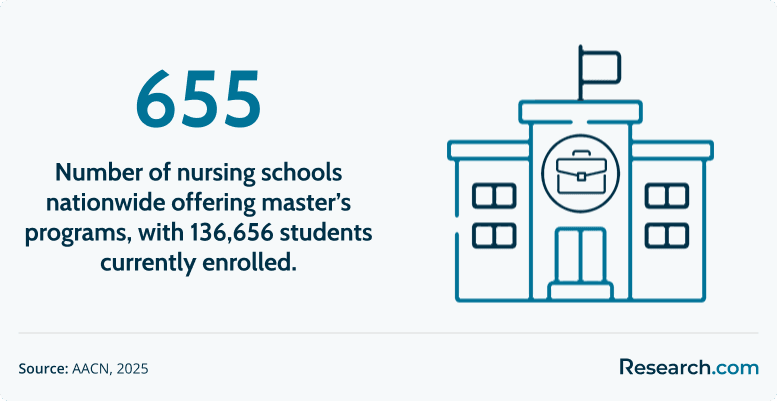
Interest in graduate nursing education remains substantial. There are currently 136,656 students enrolled in master's nursing programs, which reflects how many nurses are using graduate education to move into advanced roles. Your ideal timeline, however, should be based on workload, family responsibilities, finances, employer support, and how quickly you need the credential.
Accelerated vs. Standard Pace: Which Makes More Sense?
A faster program can help you reach a new role sooner, but speed comes with trade-offs. Accelerated study may require fewer breaks, heavier weekly reading and writing demands, and less room for unpredictable work schedules. It can be a strong fit if you have protected study time, tuition support, and a clear career target.
A part-time plan may be the better choice if you are working full time, caring for family, or recovering from burnout. It gives you more time to absorb graduate-level material, complete projects carefully, and apply what you learn in your current job. The strongest timeline is not always the shortest one; it is the one you can finish without compromising your health, finances, or work performance.
| Enrollment Pace | Typical Fit | Main Advantage | Potential Drawback |
| Accelerated full-time | Nurses with flexible work schedules or a strong reason to graduate quickly | Shortest route to completing the MSN | Higher weekly workload and less flexibility |
| Standard full-time | Nurses who can commit significant study hours each week | Balanced pace with steady progress | Can still be difficult with rotating shifts |
| Part-time | Working nurses, parents, caregivers, or students using employer reimbursement | More manageable workload and lower burnout risk | Longer time before seeing career benefits |
Online MSN Without Clinicals vs. On-Campus MSN: What Changes?
For accredited programs, the degree value, faculty expectations, and learning outcomes should be comparable across online and campus formats. Accreditation is what matters most because it confirms that the institution or nursing program meets recognized academic standards. Employers increasingly view online graduate education as normal for working professionals, especially in nursing, where 46% of RNs who recently graduated completed at least part of their degree online.
The biggest difference is not academic legitimacy; it is delivery. Online programs are built for nurses who need to continue working, manage rotating schedules, or avoid relocating. This is similar to how an online MPH epidemiology program can provide graduate-level public health training without requiring students to attend campus daily.
| Factor | Online MSN Without Clinicals | On-Campus MSN |
| Schedule | Often asynchronous or hybrid with more flexibility | Usually tied to fixed class times and campus attendance |
| Networking | Can connect nurses across states, health systems, and specialties | Often stronger local networking and in-person faculty access |
| Learning style | Best for self-directed students who can manage deadlines independently | Best for students who prefer structured classroom interaction |
| Relocation | Usually not required | May require commuting or moving near campus |
| Applied work | May include virtual projects, local practicums, or capstones | May include campus-based activities, local practicums, or in-person projects |
The Networking Advantage Online Students Often Miss
Online MSN students do not always build relationships in the same way campus students do, but they may gain a broader professional network. Instead of meeting only local classmates, you may work with nurses from multiple hospital systems, regions, and specialty settings. That exposure can help you understand how different organizations handle staffing, informatics, education, and leadership challenges.
To make online networking useful, participate early in discussion boards, attend optional live sessions, join group projects actively, and connect with classmates on professional platforms. Passive online students often miss one of the format’s biggest advantages.
How Much Does an Online MSN Program Without Clinicals Cost?
Total tuition for an online MSN program commonly ranges from around $20,000 to over $60,000, with the national average sitting around $41,000. When comparing programs, do not rely only on the advertised cost per credit. The better comparison is total cost of attendance, which includes credits, fees, books, software, travel for any required campus intensives, practicum-related expenses, and the cost of reducing work hours if needed.
This same total-cost mindset applies when comparing any professional graduate degree, including a web development master’s degree online. A lower per-credit price can become less affordable if the program requires more credits, adds recurring fees, or limits transfer credit.
Questions to Ask Before Estimating Cost
- Is tuition charged per credit, per term, or as a flat program rate?
- Are online learning, technology, graduation, simulation, or practicum fees separate?
- Will employer tuition reimbursement cover the program and format?
- Can you transfer graduate credits, and is there a limit?
- Are books, software, background checks, or travel required?
- Will the program pace allow you to keep working enough hours to support yourself?
Understanding ROI for a Nonclinical MSN
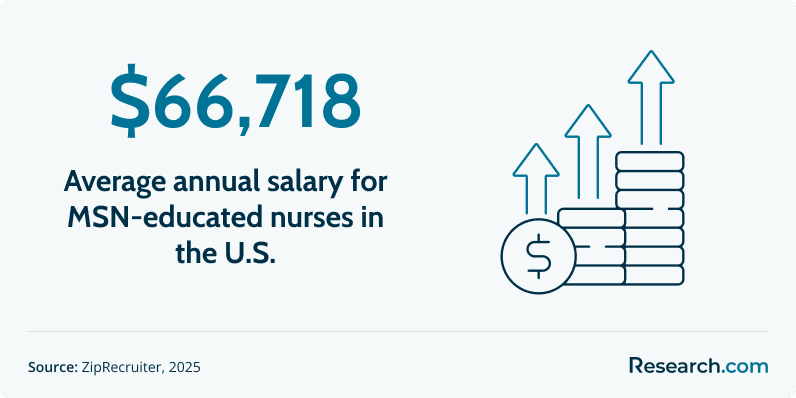
Financial return depends on your role, location, experience, employer, and specialty. Baseline average salaries for MSN-prepared nurses are around $66,718, while earning potential can be higher in specialized roles. For example, nurse educators in the 75th percentile earn upwards of $123,000 annually. These numbers should be treated as reference points, not guarantees.
ROI is not only salary. For many nurses, the return also includes more predictable schedules, less physical strain, an exit from bedside burnout, and a longer sustainable career in the profession. That nonfinancial value matters, especially if the degree helps you stay in nursing in a role that better fits your life.
Financial Aid Options for Online MSN Students Without Clinicals
Sticker price should not be the only factor in your decision. Many working nurses combine federal aid, employer support, scholarships, payment plans, and school-based awards to reduce out-of-pocket costs. The key is to confirm eligibility before enrolling, not after your first bill arrives.
Start With Federal and School-Based Aid
Most students should begin by completing the Free Application for Federal Student Aid (FAFSA). The FAFSA can determine eligibility for federal student loans and may be required for some institutional aid. Many universities also offer scholarships for graduate nursing students, alumni, military-affiliated students, or nurses working in partner health systems.
If your goal is nursing education, ask about the Nurse Faculty Loan Program. It may forgive a significant portion of eligible loans for students who commit to teaching. Requirements can vary, so confirm the exact service obligation and repayment rules with the school’s financial aid office.
Use Employer Tuition Reimbursement Strategically
Your employer may be one of the strongest funding sources. Hospitals and health systems often support nurses pursuing graduate education when the degree fills an organizational need. Before applying, ask human resources or your manager about annual reimbursement limits, grade requirements, approved schools, service commitments, and whether reimbursement is paid upfront or after course completion.
Make the case in practical terms. An informatics MSN can support EHR optimization, reporting, workflow improvement, and patient safety projects. A nursing education MSN can help with preceptor training, onboarding, competency development, and staff education. A leadership MSN can strengthen quality improvement, operations, and team management.
Admission Requirements for Online MSN Programs Without Clinicals
Most online MSN programs without clinicals are designed for licensed nurses who already have professional experience. Requirements differ by school, but applicants commonly need the following:
- An active, unencumbered Registered Nurse (RN) license in the U.S.
- A Bachelor of Science in Nursing (BSN) from an accredited institution.
- A minimum undergraduate GPA, which is usually a 3.0 on a 4.0 scale.
- A certain number of years of clinical experience, which varies by program.
Some nurses worry that an older GPA will automatically prevent admission. That is not always the case. Many graduate nursing programs use holistic review, meaning they may also weigh RN experience, leadership history, recommendations, a personal statement, certifications, and evidence of readiness for graduate writing and research. This differs from MSN direct entry programs online, which are intended for students who do not already have a nursing background.
If your GPA is below the preferred threshold, ask whether the school allows conditional admission, a graduate writing sample, prerequisite coursework, or a probationary first term. Do not assume rejection without talking to an admissions advisor.
Common Courses in an Online MSN Without Clinicals
Nonclinical MSN coursework shifts your focus from individual bedside care to systems, populations, teams, technology, education, and organizational outcomes. The work is often reading- and writing-heavy, with research analysis, presentations, discussion posts, policy papers, and applied projects. In that sense, it can feel closer to graduate leadership study than to undergraduate clinical training, much as an online MBA for veterans builds management and organizational decision-making skills for a broader professional context.
Most programs combine graduate nursing core courses with specialization-specific coursework.
| Course Area | What You Learn | Why It Matters |
| Advanced nursing theory | How nursing frameworks guide leadership, education, and systems thinking | Builds a graduate-level foundation for professional decision-making |
| Evidence-based practice and research | How to evaluate studies, apply evidence, and design improvement projects | Supports quality improvement, education, and informatics work |
| Healthcare policy and ethics | How regulation, reimbursement, ethics, and policy shape healthcare delivery | Prepares nurses to make informed organizational recommendations |
| Data analysis and informatics basics | How healthcare data, EHRs, and reporting tools support care and operations | Useful for informatics, leadership, and quality-focused roles |
| Education or leadership specialization courses | Curriculum design, assessment, staff development, finance, operations, or management | Aligns the degree with your target job function |
| Capstone or practicum | Applied project, field experience, or organizational problem-solving | Helps translate coursework into portfolio-ready experience |
For students considering nursing education, labor-market context matters. The chart below shows the states with the highest employment for nursing instructors.
Nonclinical MSN Specializations: Which Track Should You Choose?
Online MSN programs without clinicals usually focus on education, informatics, leadership, or management. These are different from clinical advanced practice pathways such as the best online MSN to FNP programs, which prepare nurses for direct patient care provider roles and typically require clinical hours tied to licensure or certification.
Your specialization should match the work you want to do after graduation. Do not choose a track only because it sounds flexible. Choose it because the courses, projects, faculty expertise, and alumni outcomes point toward jobs you would actually accept.
| Specialization | Best For Nurses Who... | Common Career Direction | Possible Mismatch If... |
| Nursing Education | Enjoy teaching, mentoring, precepting, and curriculum planning | Nurse educator, clinical instructor, faculty member, staff development specialist | You dislike public speaking, feedback, grading, or academic writing |
| Nursing Informatics | Like EHRs, data, workflow design, analytics, and technology troubleshooting | Nurse informaticist, clinical analyst, EHR specialist, informatics project manager | You want minimal interaction with technology or data systems |
| Nursing Leadership and Management | Want to supervise teams, manage operations, and influence organizational strategy | Nurse manager, director, quality leader, healthcare operations role | You do not want staffing, budgeting, conflict management, or accountability for team outcomes |
| Healthcare Systems Leadership | Prefer broad system improvement, resource management, and policy-informed change | Systems leader, quality improvement specialist, administrative leadership role | You want a narrow technical specialty rather than broad leadership training |
Nurse Educator Track
The nurse educator path fits RNs who like explaining complex ideas, coaching newer nurses, building learning materials, and evaluating competency. Graduates may teach in academic nursing programs, coordinate hospital education, lead simulation or skills training, or design professional development programs. This track is especially relevant for nurses who already enjoy being preceptors or unit-based educators but want formal preparation in curriculum, assessment, and adult learning.
Nurse Informatics Track
Nursing informatics is a good fit for nurses who see workflow problems and want to fix them through better systems. Students learn to connect clinical practice with IT, data, EHR optimization, reporting, and process improvement. The role often requires translating between frontline clinicians, software teams, compliance leaders, and executives.
Nursing Leadership or Management Track
Leadership and management tracks prepare nurses for operational responsibility. Coursework may address finance, staffing, policy, quality improvement, strategic planning, and organizational behavior. This route works best for nurses who want to lead people and systems, not just projects.
If you are leaning toward nursing education, salary by faculty rank can help you understand how compensation may change across academic career stages. The chart below provides that breakdown.
How to Choose the Best Online MSN Program Without Clinicals
The best program is not automatically the highest-ranked or most recognizable. It is the program that prepares you for your target role at a cost and pace you can manage. Use the following checklist before you apply.
- Confirm nursing accreditation. Institutional accreditation matters, but nursing program accreditation is also critical. Check whether the program is accredited by the Accreditation Commission for Education in Nursing (ACEN) or the Commission on Collegiate Nursing Education (CCNE).
- Read the curriculum line by line. Make sure the specialization includes courses directly tied to your goal, whether that is education, informatics, management, or systems leadership.
- Clarify applied requirements. Ask whether the program includes clinicals, practicums, fieldwork, a capstone, simulation, or project hours. “No clinicals” can still involve substantial applied work.
- Evaluate faculty experience. Look for instructors with current or recent practice in your target area, not only general academic credentials.
- Ask about student support. Online graduate students need library access, writing help, technical support, advising, and practicum or capstone guidance.
- Check alumni outcomes. Search for recent graduates on LinkedIn and compare their jobs with the roles you want. This can reveal whether the degree is actually helping students move into your intended field.
- Calculate total cost. Include tuition, fees, books, software, travel, lost wages, and the timing of employer reimbursement.
- Confirm state and employer requirements. If your goal involves certification, faculty employment, or promotion, ask whether the program meets those expectations.
Common Mistakes to Avoid
| Mistake | Why It Can Hurt You | Better Approach |
| Assuming “without clinicals” means no applied work | You may still have practicum, capstone, project, or field requirements | Ask for a written explanation of all experiential requirements |
| Choosing only by tuition per credit | A cheaper credit rate can cost more if the program requires more credits or fees | Compare total program cost and payment timing |
| Ignoring accreditation | It can affect transfer credits, employer recognition, and future academic options | Verify institutional and nursing accreditation before applying |
| Picking a specialization without a job target | You may graduate with a degree that does not match the roles you want | Start with job postings, then match the curriculum to required skills |
| Relying only on rankings | Rankings cannot account for your schedule, employer, geography, or goals | Use rankings as a shortlist, then evaluate fit carefully |
| Overloading your schedule | Graduate nursing courses can be writing- and project-intensive | Choose a pace that matches your actual weekly availability |
Career Paths With an Online MSN Without Clinicals
A nonclinical MSN can help nurses move into roles that shape education, operations, technology, quality, and leadership. It is not limited to hospitals, although many graduates do work in health systems. For example, 62% of nurse informaticists are based in hospital systems. Graduates may also work for universities, community colleges, healthcare technology companies, insurers, consulting firms, professional associations, and government or public health organizations.
These roles are related to but not identical to nurse administration. If you are comparing leadership paths, it may help to review what a nurse administrator does before deciding between management, executive leadership, informatics, or education tracks.
| Career Path | Entry or Transition Roles | Advancement Options | Core Skills |
| Nurse educator | Clinical instructor, staff development specialist, unit educator | Faculty member, program coordinator, department chair, Dean of a College of Nursing | Teaching, curriculum design, assessment, mentoring, communication |
| Nurse informaticist | Clinical analyst, EHR implementation specialist, informatics nurse | Project manager, Director of Clinical Informatics, Chief Nursing Information Officer (CNIO) | Workflow analysis, data, EHR systems, project management, clinical translation |
| Nursing leadership | Charge nurse leader, assistant manager, quality improvement coordinator | Nurse manager, director, executive leadership role | Operations, budgeting, staffing, conflict management, quality improvement |
| Healthcare systems leadership | Improvement specialist, care coordination leader, systems project lead | Program director, systems leader, senior healthcare operations role | Systems thinking, policy, resource management, change leadership |
Nurse Educator Career Path
Nurse educators may begin as clinical instructors, preceptor coordinators, or staff development specialists. With experience, they can move into full-time faculty roles and progress from assistant professor to tenured associate professor. Senior academic leaders may become department chairs or Deans of Colleges of Nursing, where they influence curriculum, hiring, accreditation preparation, and program strategy.
Nurse Informatics Career Path
Nurse informaticists often start in roles such as clinical analyst, EHR support specialist, or implementation specialist. These jobs use clinical experience to improve documentation, workflows, data quality, reporting, and technology adoption. With experience, informatics nurses may lead system upgrades, manage interdisciplinary teams, or move into director-level and executive roles such as Chief Nursing Information Officer (CNIO).
Job Market Outlook for Online MSN Graduates Without Clinicals
The job market for graduates of online MSN programs without clinicals is supported by demand in nursing education, healthcare technology, quality improvement, and leadership. Key areas show projected growth of 9% or higher. Current postings aligned with a nurse educator job description often reflect the ongoing need for master’s-prepared nurses who can teach, train, mentor, and support workforce development.
Why Demand Exists
For nursing education, the faculty pipeline is a major issue. A significant share of current nursing faculty are approaching retirement, and the average age for a full professor is 60.1. As experienced faculty leave, schools need qualified educators to teach future nurses and support enrollment capacity.
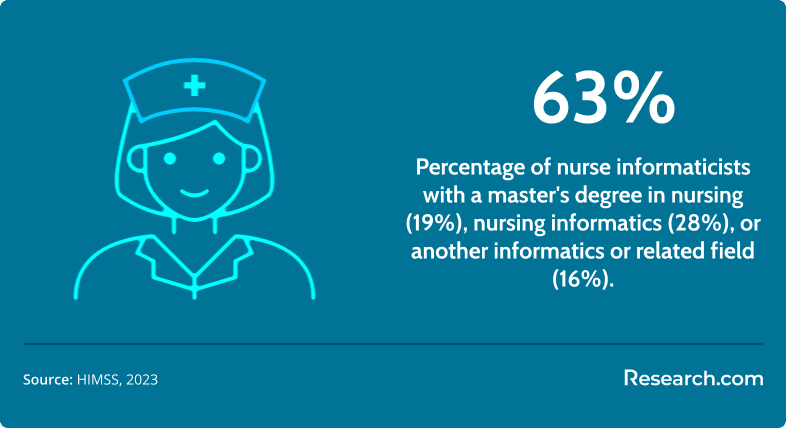
In informatics, demand is tied to the continued expansion of healthcare technology, EHR optimization, analytics, interoperability, and digital workflow improvement. A master’s degree is commonly expected for higher-level informatics leadership. This aligns with the fact that 63% of nurse informaticists hold a master's degree.
Current Trends Affecting Nonclinical MSN Graduates
- AI and analytics are changing healthcare work. Nurses with informatics and data skills can help organizations use technology safely and effectively.
- Nursing schools continue to need qualified faculty. Faculty shortages can affect enrollment capacity, making nurse education a strategic workforce issue.
- Employers value applied leadership experience. Practicums, capstones, and project portfolios can help graduates show evidence of readiness.
- Online graduate education is now mainstream. Working nurses increasingly expect flexible formats, but they still need accredited, well-supported programs.
- Credential-based advancement remains important. Some leadership, faculty, and informatics roles prefer or require graduate education, especially for promotion into higher responsibility.
What Graduates Say About Online MSN Programs Without Clinicals
- : "I used to be the person everyone asked to troubleshoot EHR problems on the unit. Eventually, I realized I was more energized by solving system issues than by staying in direct care. The informatics track helped me connect my clinical background to technology work, and now I help design the tools I once wished worked better. — Lena"
- : "Precepting new nurses was always my favorite part of the job, but I knew I needed formal preparation to teach well. Studying curriculum design, adult learning, and evaluation changed how I approach education. I no longer feel like I am just sharing tips from experience; I feel prepared to teach with purpose. — Anjali"
- : "As a single parent, I could not commit to being online at the same time every week. The asynchronous format made graduate school possible. I listened to lectures during commutes, worked on assignments after bedtime, and kept moving forward without turning my whole life upside down. — Katherine"
How to Succeed in an Online MSN Program Without Clinicals
Success in an online MSN program depends on structure, communication, and early planning. Graduate nursing courses often require more independent reading, writing, research, and project work than students expect. Before classes begin, block weekly study time, review the learning platform, download required software, and identify support services such as tutoring, library help, writing assistance, academic advising, and technical support.
Build relationships early. Introduce yourself to faculty, participate in discussions, and look for mentors in your specialization. If your program includes a practicum or capstone, start thinking about possible project sites and organizational problems before the final term. Nurses still building toward graduate study may also want to compare bridge options such as easy RN-to-BSN bridge programs before committing to an MSN timeline.
Practical Steps Before You Apply
- Write down your target job title, not just your preferred specialization.
- Collect five job postings for that role and list the common degree, skill, and experience requirements.
- Compare those requirements with each program’s courses and capstone options.
- Verify accreditation and ask whether the program has any state authorization limits.
- Calculate total cost, including fees and potential lost work hours.
- Ask your employer about tuition reimbursement before enrolling.
- Speak with current students or alumni if possible.
- Choose a realistic pace that protects your work performance and personal responsibilities.
Questions to Ask Admissions Advisors
- Does the program require clinical hours, practicum hours, fieldwork, or a capstone?
- Can applied requirements be completed near my home or workplace?
- Is the program accredited by ACEN or CCNE?
- What percentage of students complete the program on time?
- What roles do recent graduates hold?
- Are courses asynchronous, synchronous, or a mix of both?
- How often are students required to attend live sessions?
- Are there campus visits, intensives, or travel requirements?
- What support is available for writing, research, technology, and career planning?
- Can I slow down or pause enrollment if my work schedule changes?
Key Insights
- An online MSN without clinicals is best for licensed nurses who want to move into education, informatics, leadership, management, or systems improvement rather than advanced direct patient care.
- “Without clinicals” does not always mean “no applied work.” Some programs require practicums, capstones, field projects, or leadership hours.
- Most full-time students finish in about 18-24 months, while part-time students often take 2-3 years.
- Total tuition commonly ranges from around $20,000 to over $60,000, with the national average sitting around $41,000, but fees and work-hour reductions can change the real cost.
- Accreditation should be non-negotiable. Verify institutional accreditation and nursing program accreditation before enrolling.
- The best specialization depends on the work you want: education for teaching, informatics for data and technology, and leadership or management for operations and team responsibility.
- Career demand is supported by nursing faculty needs, healthcare technology growth, and employer demand for master’s-prepared nurses in systems-level roles.
- Use rankings as a starting point, not the final decision. The right program must fit your schedule, budget, career target, and learning style.
References:
- American Association of Colleges of Nursing. (2024, April 25). Rounds with leadership: Monitoring trends in academic nursing. Retrieved September 10, 2025, from https://www.aacnnursing.org/news-data/all-news/article/rounds-with-leadership-monitoring-trends-in-academic-nursing
- American Association of Colleges of Nursing. (2024, May 2). Schools of nursing enrollment increases across most program levels, signaling strong interest in nursing careers. Retrieved September 10, 2025, from https://www.aacnnursing.org/news-data/all-news/schools-of-nursing-enrollment-increases-across-most-program-levels-signaling-strong-interest-in-nursing-careers
- American Association of Colleges of Nursing. (2024, September). Nursing faculty shortage. Retrieved September 10, 2025, from https://www.aacnnursing.org/news-data/fact-sheets/nursing-faculty-shortage
- Data USA. (n.d.). Registered nurses. Retrieved September 10, 2025, from https://datausa.io/profile/soc/registered-nurses
- Healthcare Information and Management Systems Society. (2020). 2020 HIMSS nursing informatics workforce survey. Retrieved September 10, 2025, from https://www.himss.org/resources/himss-nursing-informatics-workforce-survey
- Health Resources and Services Administration. (2024, February). The U.S. registered nurse workforce: Key findings from the 2022 national sample survey of registered nurses. Retrieved September 10, 2025, from https://bhw.hrsa.gov/sites/default/files/bureau-health-workforce/Nurse-Survey-Fact-Sheet-2024.pdf
- National Council of State Boards of Nursing. (n.d.). NCLEX pass rates. Retrieved September 10, 2025, from https://www.ncsbn.org/exams/exam-statistics-and-publications/nclex-pass-rates.page
- Organization for Associate Degree Nursing. (2024, June). OADN voices June 2024 leadership message. Retrieved September 10, 2025, from https://oadn.org/news/oadn-voices-june-2024-leadership-message/
- Payscale. (n.d.). Master of Science in Nursing (MSN) degree salary. Retrieved September 10, 2025, from https://www.payscale.com/research/US/Degree=Master_of_Science_in_Nursing_(MSN)/Salary
- Payscale. (n.d.). Salary for job: Nurse educator. Retrieved September 10, 2025, from https://www.payscale.com/research/US/Job=Nurse_Educator/Salary
- Smiley, R. A., Allgeyer, R. L., Shobo, Y., Lyons, K. C., Letourneau, R., Zhong, E., & Tilden, S. (2023). The 2022 national nursing workforce survey. Journal of Nursing Regulation, 14(1), S1-S90. https://doi.org/10.1016/S2155-8256(23)00047-9
- U.S. Bureau of Labor Statistics. (2023, November 8). Employer-reported workplace injuries and illnesses. Retrieved September 10, 2025, from https://www.bls.gov/news.release/pdf/osh.pdf
- U.S. Bureau of Labor Statistics. (2024, April 17). Occupational employment and wages, May 2023: 25-1072 nursing instructors and teachers, postsecondary. Occupational Employment Statistics. Retrieved September 10, 2025, from https://www.bls.gov/oes/2023/may/oes251072.htm
- U.S. Bureau of Labor Statistics. (2024, September 4). Registered nurses. Occupational Outlook Handbook. Retrieved September 10, 2025, from https://www.bls.gov/ooh/healthcare/registered-nurses.htm
- U.S. Department of Labor. (n.d.). 25-1072.00 - nursing instructors and teachers, postsecondary. O*NET OnLine. Retrieved September 10, 2025, from https://www.onetonline.org/link/summary/25-1072.00
- ZipRecruiter. (n.d.). MSN salary. Retrieved September 10, 2025, from https://www.ziprecruiter.com/Salaries/Msn-Salary#TableView
- ZipRecruiter. (n.d.). Nurse educator salary. Retrieved September 10, 2025, from https://www.ziprecruiter.com/Salaries/Nurse-Educator-Salary#TableView
Other Things You Should Know About Online MSN Programs Without Clinicals
When evaluating the best online MSN programs without clinicals in 2027, it's crucial to ensure they are accredited by recognized bodies like the Commission on Collegiate Nursing Education (CCNE) or the Accreditation Commission for Education in Nursing (ACEN). Accreditation ensures the program meets educational standards and can enhance career prospects.
Yes, some schools offer RN-to-MSN or bridge pathways for registered nurses without a BSN. These programs usually require an active RN license, an associate degree in nursing, and completion of bridge coursework before starting graduate-level MSN classes.
Typically, online MSN programs without clinicals in 2027 require prerequisite courses in subjects like statistics, health assessment, and nursing research. These foundational courses ensure students are prepared for advanced studies in nursing theory and management. Always check specific program prerequisites before applying.





