2027 Fastest Online BSN to MSN Bridge Programs

Co-Founder and Chief Data Scientist
Many BSN-prepared nurses face a familiar dilemma: rising patient loads, stagnant roles, and the looming risk of burnout. For those seeking advancement without stepping away from patient care, graduate-level training offers a critical path forward—especially as demand for nurse practitioners continues to surge.
With nurse practitioner roles projected to grow by 46%, the shift from RN to APRN has become one of the most strategic moves in healthcare. This guide goes beyond listing schools—it serves as a focused blueprint for exploring specializations, comparing programs, and planning a confident next step into advanced practice.
What are the benefits of enrolling in a fast online BSN to MSN program?
- Completing a BSN-to-MSN program opens the door to advanced positions such as Nurse Educator, Nursing Manager, or Nurse Practitioner, allowing you to take on specialized clinical and leadership responsibilities.
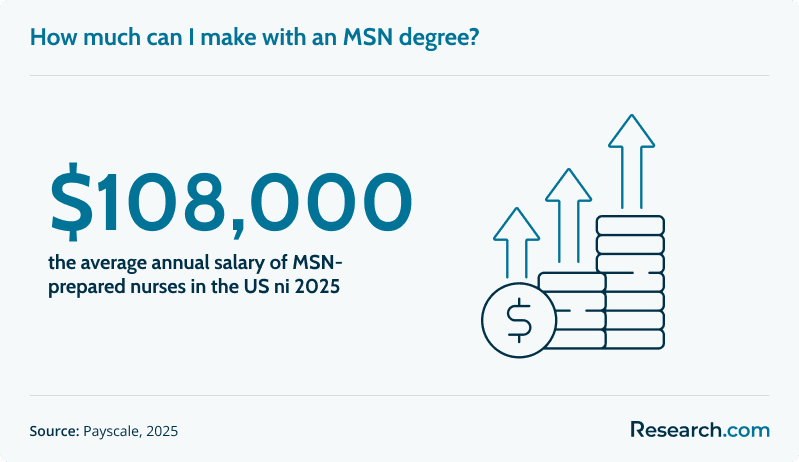
- With an MSN, you can expect to earn an average annual salary of $108,000, which reflects the high value placed on advanced nursing expertise and practice.
- The online format offers the crucial flexibility for working nurses to advance their education and career prospects without having to pause their current employment or personal commitments.
What can I expect from fast online BSN to MSN bridge programs?
You should expect an intensive, streamlined curriculum that requires you to make a fundamental career choice very early on. Think of this as the most important fork in the road for your professional future. These programs are not a single track; they immediately split into two distinct paths.
The first path is Clinical, designed for nurses who want to provide advanced, direct patient care as an Advanced Practice Registered Nurse (APRN), like a Nurse Practitioner. The second path is Non-Clinical, built for nurses who want to lead teams, manage systems, or teach. This track prepares you for roles like Nurse Executive, Nurse Informaticist, or Nurse Educator.
Where can I work with a degree from a fast online BSN to MSN bridge program?
Your work setting will depend entirely on the specialization path you choose. An MSN opens doors far beyond the traditional hospital floor, and your career environment will look very different depending on whether you pursue a clinical or non-clinical track.
If you follow the Clinical Path to become a nurse practitioner, you could work in outpatient specialty clinics, private practices, community health centers, or for rapidly growing telehealth companies. If you choose the Non-Clinical Path, your office could be in a hospital’s executive suite, a corporate headquarters for an insurance or health-tech company, a government agency shaping public health policy, or a university where you are teaching the next generation of nurses.
How much can I make with a degree from fast online BSN to MSN bridge programs?
You can expect a significant salary increase, but the amount depends on the specific role your MSN prepares you for. It’s best to think of it as a ladder of earning potential. As a BSN-prepared registered nurse, your average annual salary is around $98,430. With a Master of Science in Nursing (MSN), that average rises to about $108,000.
However, by leveraging your MSN to become a high-demand specialist like a Nurse Practitioner, your average salary can jump to approximately $132,000 a year, clearly demonstrating the powerful return on this educational investment.
- List of the Fastest Online BSN to MSN Bridge Programs for 2027 List of Programs
- How long does it take to complete a fast online BSN to MSN bridge program? Completion Time
- How does a fast online BSN to MSN bridge program compare to an on-campus program? How does a fast online BSN to MSN bridge program compare to an on-campus program?
- What is the average cost of a fast online BSN to MSN bridge program? Program Cost
- What are the financial aid options for students enrolling in a fast online BSN to MSN bridge program? Financial Aid
- What are the prerequisites for enrolling in fast online BSN to MSN bridge programs? What are the prerequisites for enrolling in fast online BSN to MSN bridge programs?
- What courses are typically in fast online BSN to MSN bridge programs? What courses are typically in fast online BSN to MSN bridge programs?
- What types of specializations are available in fast online BSN to MSN bridge programs? What types of specializations are available in fast online BSN to MSN bridge programs?
- How to Choose the Best Fastest Online BSN to MSN Bridge Program How to Choose the Best Fastest Online BSN to MSN Bridge Program
- What career paths are available for graduates of fast online BSN to MSN bridge programs? What career paths are available for graduates of fast online BSN to MSN bridge programs?
- What is the job market for graduates with a degree from fast online BSN to MSN bridge programs? Job Market
- How Can I Evaluate Program Quality and Financial Value Effectively? How Can I Evaluate Program Quality and Financial Value Effectively?
- What Post-Graduation Career Support Services Are Offered? What Post-Graduation Career Support Services Are Offered?
- Is There a Pathway for Non-Nurses to Enter Advanced Practice Nursing? Is There a Pathway for Non-Nurses to Enter Advanced Practice Nursing?
- Is Pursuing a DNP Online Program Right for You? Is Pursuing a DNP Online Program Right for You?
Fastest Online BSN to MSN Bridge Programs for 2027
Choosing a fast online BSN to MSN bridge program is not just a question of speed. You are deciding how quickly you can move from registered nursing into advanced clinical practice, nursing education, informatics, or leadership while managing work, family obligations, tuition costs, clinical requirements, and licensure rules. The best program is the one that helps you finish efficiently without creating problems later with accreditation, certification eligibility, clinical placement, or state authorization.
This guide is for licensed nurses comparing accelerated online MSN pathways, including BSN-prepared RNs, ADN-prepared RNs exploring bridge options, and nurses weighing clinical versus non-clinical specialties. You will find a ranked program list, cost and timeline comparisons, admissions expectations, specialization options, online-versus-campus trade-offs, career outcomes, and practical questions to ask before enrolling.
Quick Answer: What Is the Fastest Online BSN to MSN Bridge Program?
The fastest online BSN to MSN bridge programs can be completed in as few as 10 months, although many accelerated options take 12 to 24 months and some require 24 to 36 months depending on transfer credits, specialization, practicum hours, and whether the student attends full time. Chamberlain University lists the shortest timeline in this selection, with an MSN pathway that can be completed in as few as 10 months. Western Governors University, Walden University, Charleston Southern University, Arizona State University, Liberty University, Drexel University, and the University of Mary also offer accelerated or flexible online MSN pathways for nurses with different academic backgrounds.
Speed should not be the only deciding factor. Before enrolling, confirm nursing program accreditation, state authorization, clinical placement support, certification eligibility, transfer credit rules, total cost, and whether the specialization matches your career goal.
How We Ranked the Programs
Because an MSN can require a major financial and professional commitment, the ranking process emphasizes transparent program information, affordability indicators, completion timelines, and institutional data. Research.com uses data-informed review practices supported by sources such as the IPEDS database, Peterson's database, the College Scorecard database, and The National Center for Education Statistics.
These sources help provide context on colleges, costs, completion information, and student outcomes. To understand how Research.com evaluates programs and rankings, review the Research.com methodology page.
Fastest Online BSN to MSN Bridge Programs: At-a-Glance Comparison
| Rank | School and Program | Best Fit | Program Length | Credits or Courses | Published Tuition or Cost | Accreditation Listed |
| 1 | Western Governors University - Master of Science in Nursing Education (BSN to MSN) | RNs who want a competency-based nursing education pathway | 18-24 months | 15 Courses | $20,940 | Northwest Commission on Colleges and Universities (NWCCU) |
| 2 | Arizona State University - Master of Science in Nursing | ADN-prepared nurses seeking graduate-level advancement | 24 months | 36 | $1,249.08 (Resident); $1,919.81 (Non-Resident) | Higher Learning Commission (HLC) |
| 3 | Chamberlain University - Master's Degree in Nursing (MSN) | RNs prioritizing the shortest listed completion timeline | As few as 10 months | 36 | $1,429.17 | American Nurses Credentialing Center’s Commission on Accreditation (ANCC) |
| 4 | Walden University - Master of Science in Nursing | Nurses choosing from multiple NP and specialty practice tracks | As few as 14 months | 84-89 quarter credits | $775 | Higher Learning Commission (HLC) |
| 5 | Liberty University - Bachelor of Science in Nursing for RNs: Post-Licensure Master of Science in Nursing | RNs wanting a combined RN-to-BSN-to-MSN route with transfer credit potential | 24 months | 121-153 | $330 | Southern Association of Colleges and Schools Commission on Colleges (SACSCOC) |
| 6 | Drexel University - Master's in Nursing Program (RN-BSN-MSN) | Registered nurses with a non-nursing bachelor's degree | 24-36 months | 15 undergraduate credits + MSN credits | $915 | Middle States Commission on Higher Education (MSCHE) |
| 7 | University of Mary - BSN to MSN: Nursing and Health Care Informatics | BSN-prepared nurses interested in informatics, data, and health technology | 24 months | 64 | $495 | Higher Learning Commission (HLC) |
| 8 | Charleston Southern University - Master of Science in Nursing | Working nurses who prefer short, focused course blocks | 16 months | 39 | $625 | Southern Association of Colleges and Schools Commission on Colleges (SACSCOC) |
1. Western Governors University - Master of Science in Nursing Education (BSN to MSN)
Western Governors University is a strong option for nurses who want an MSN focused on nursing education and prefer a competency-based structure. Instead of moving only by calendar dates, students progress by demonstrating mastery of course material. That format may appeal to experienced nurses who can move quickly through familiar content while spending more time on new concepts such as curriculum design, learning assessment, and instructional strategies aligned with National League for Nursing standards.
- Program Length: 18-24 months
- Required Credits to Graduate: 15 Courses
- Total Tuition: $20,940
- Accreditation: Northwest Commission on Colleges and Universities (NWCCU)
2. Arizona State University - Master of Science in Nursing
Arizona State University offers a graduate pathway designed for nurses with an associate degree who want to move toward advanced nursing roles without first completing a separate BSN. The program emphasizes innovation, leadership, informatics, research, and system-level change, with practicum experiences that can be shaped around the student's professional direction.
- Program Length: 24 months
- Required Credits to Graduate: 36
- Cost per Credit: $1,249.08 (Resident); $1,919.81 (Non-Resident)
- Accreditation: Higher Learning Commission (HLC)
3. Chamberlain University - Master's Degree in Nursing (MSN)
Chamberlain University lists one of the quickest completion options in this group, with an MSN pathway that may be completed in as few as 10 months. This option is best suited for registered nurses who are ready for an intensive pace and want to apply graduate nursing theory, leadership concepts, and advanced practice knowledge to professional settings as quickly as possible.
- Program Length: As few as 10 months
- Required Credits to Graduate: 36
- Cost per Credit: $1,429.17
- Accreditation: American Nurses Credentialing Center’s Commission on Accreditation (ANCC)
4. Walden University - Master of Science in Nursing
Walden University may appeal to nurses who already know the advanced role they want. The MSN offers five nurse practitioner tracks and four specialty practice areas, giving students the opportunity to align coursework with a defined professional goal, whether that is advanced clinical care, leadership, education, or a specialized practice setting.
- Program Length: As few as 14 months
- Required Quarter Credits to Graduate: 84-89
- Cost per Credit: $775
- Accreditation: Higher Learning Commission (HLC)
5. Liberty University - Bachelor of Science in Nursing for RNs: Post-Licensure Master of Science in Nursing
Liberty University provides an RN-to-BSN-to-MSN route for nurses who want to combine degree progression into one pathway. The program allows RNs to apply up to 75 previous credits and may consider additional credit through experience evaluation. It can be a practical fit for working nurses looking for a lower published cost per credit while building toward advanced roles in areas such as administration or informatics.
- Program Length: 24 months
- Required Credits to Graduate: 121-153
- Cost per Credit: $330
- Accreditation: Southern Association of Colleges and Schools Commission on Colleges (SACSCOC)
6. Drexel University - Master's in Nursing Program (RN-BSN-MSN)
Drexel University is designed for registered nurses who already hold a bachelor's degree in another field. Students complete 15 undergraduate bridge credits before moving into the MSN curriculum, allowing them to use prior college experience while transitioning into graduate nursing study. This pathway can be useful for second-degree nurses who want to avoid repeating unnecessary coursework.
- Program Length: 24-36 months
- Required Quarter Credits to Graduate: 15 Undergraduate Credits + MSN Credits
- Cost per Credit: $915
- Accreditation: Middle States Commission on Higher Education (MSCHE)
7. University of Mary - BSN to MSN: Nursing and Health Care Informatics
The University of Mary offers a BSN to MSN option in Nursing and Health Care Informatics for nurses who want to work at the intersection of patient care, data, health records, and technology-enabled care delivery. This track is a better fit for nurses interested in improving systems and information workflows than for those seeking a direct patient-care nurse practitioner role.
- Program Length: 24 months
- Required Credits to Graduate: 64
- Cost per Credit: $495
- Accreditation: Higher Learning Commission (HLC)
8. Charleston Southern University - Master of Science in Nursing
Charleston Southern University structures coursework in five-week intensive classes, which may work well for nurses who prefer concentrating on one subject at a time. The curriculum also incorporates Christian beliefs and prepares students for advanced responsibilities in education or leadership.
- Program Length: 16 months
- Required Credits to Graduate: 39
- Cost per Credit: $625
- Accreditation: Southern Association of Colleges and Schools Commission on Colleges (SACSCOC)
How Long Does a Fast Online BSN to MSN Bridge Program Take?
Most accelerated online BSN to MSN bridge programs take about 12 to 24 months of full-time study, although the actual timeline depends on the student's starting credential, transfer credits, specialty track, clinical or practicum requirements, and course load. Programs with year-round terms, condensed sessions, or competency-based pacing can shorten the academic calendar, but faster does not always mean easier.
Nurse practitioner pathways may take longer than non-clinical MSN tracks because they include advanced clinical coursework and supervised practice requirements. Nurses comparing accelerated practice pathways may also want to review 1 year NP programs to understand how short completion timelines are structured.
What Can Extend Your Timeline?
- Clinical placement delays: If you cannot secure an approved site or preceptor on time, graduation may be pushed back.
- Part-time enrollment: Working full time while studying may require a lighter course load.
- State authorization limits: Some online programs may not accept students from every state or may not meet local licensure requirements.
- Specialization requirements: APRN tracks typically involve more clinical preparation than informatics, education, or leadership tracks.
- Transfer credit review: Bridge pathways can be efficient, but only if previous coursework is accepted as expected.
Certification Comes After Graduation for APRN Roles
Completing the MSN is not always the final step. Graduates entering advanced practice registered nurse roles, such as nurse practitioner positions, must pass a national board certification exam in their specialty area. State licensure requirements also apply. Before enrolling, confirm that the program's curriculum supports the certification exam and state license you plan to pursue.
Online vs. Campus BSN to MSN Bridge Programs: Which Is Better?
An accredited online BSN to MSN program can provide the same graduate credential as a campus-based program, but the learning experience is different. Online programs usually offer more scheduling flexibility for working nurses, while campus programs often provide more predictable in-person structure, peer interaction, and faculty access.
| Factor | Online BSN to MSN Bridge Program | On-Campus BSN to MSN Program |
| Schedule | Usually better for nurses working shifts or managing family responsibilities | Often more structured with set class meeting times |
| Clinical or practicum work | May require students to help identify approved local sites | May have more established regional site relationships |
| Learning style | Best for self-directed students who can manage deadlines independently | Best for students who prefer face-to-face instruction and routine |
| Networking | Can include virtual cohorts, online faculty meetings, and local clinical contacts | Can provide more frequent in-person peer and faculty interaction |
| Relocation | Often not required, though campus visits or intensives may apply | Usually requires living near or commuting to campus |
If you are earlier in your nursing pathway and still comparing bridge options before the BSN or MSN level, reviewing the fastest LVN to RN bridge programs online can help clarify how accelerated nursing pathways differ by starting credential.
The Preceptor Issue: One of the Biggest Risks in Online MSN Programs
Clinical and advanced practice MSN tracks require supervised hands-on training. In many online programs, students share responsibility for identifying preceptors or clinical sites, and this can become a serious obstacle if local providers are unavailable. A strong online program should clearly explain how clinical placement works before you enroll.
Ask admissions staff whether the school guarantees placement, assists with site matching, maintains existing healthcare partnerships, approves student-selected preceptors, or leaves most of the search to the student. Do not rely on vague promises. Clinical placement delays can affect graduation timing, certification eligibility, and tuition planning.
How Much Does a Fast Online BSN to MSN Bridge Program Cost?
Fast online BSN to MSN bridge programs commonly cost about $20,000 to $60,000 in total tuition, with the programs reviewed here averaging around $40,000. Published cost per credit is useful, but it does not show the full financial picture. Students should also examine technology fees, clinical fees, books, background checks, travel for intensives, certification exam costs, and the cost of reducing work hours.
Costs vary by public or private status, residency, transfer credits, specialization, and whether courses are charged by credit, quarter credit, course, or term. Nurses pursuing advanced women’s health roles may also compare accelerated doctoral options such as fast track WHNP DNP programs online when weighing long-term degree plans and cost.
Cost Factors to Compare Before Enrolling
| Cost Factor | Why It Matters | Question to Ask |
| Tuition model | Per-credit, per-course, and term-based tuition can produce very different totals | What is the estimated total tuition for my exact track? |
| Transfer credits | Accepted credits can shorten time and reduce cost | How many credits will be accepted before I commit? |
| Clinical expenses | Travel, onboarding, immunizations, and site fees can add costs | Are clinical placement costs included in tuition? |
| Work reduction | Accelerated programs may require fewer shifts or time away from work | Can students realistically work full time in this track? |
| Certification and licensure | APRN graduates may need exams and state licensing after graduation | Which post-graduation costs should I budget for? |
How to Think About Return on Investment
Tuition should be evaluated against realistic career outcomes, not best-case assumptions. MSN-prepared nurses have an average annual salary of around $108,000, while some advanced practice specialties report higher averages. However, salary varies by specialty, employer, geography, experience, and scope-of-practice rules. A nurse who keeps working while enrolled, uses tuition reimbursement, and chooses a high-demand specialization may see a stronger return than a student who borrows heavily for a program that does not lead to the desired role.
A practical ROI calculation should compare your expected total program cost with your likely post-graduation salary, not only national averages. Also compare MSN outcomes with your current RN income, local job postings, and the exact role you plan to pursue.
Financial Aid Options for Fast Online BSN to MSN Bridge Programs
Working nurses often have more funding options than they realize. The best approach is to combine federal aid research, employer benefits, scholarships, and school-based support before accepting loans.
- Federal student aid: Graduate students can complete the FAFSA to determine eligibility for federal aid programs.
- Nursing scholarships: Universities, foundations, professional associations, and healthcare organizations may offer funding for nurses in graduate study. External resources also list scholarships for nurses pursuing advanced degrees.
- Employer tuition reimbursement: Hospitals and health systems may help pay for graduate nursing education, especially when the degree supports retention, leadership, education, or hard-to-fill specialties.
- Payment plans: Some schools allow students to spread tuition payments across a term.
- Transfer credits: Accepted credits are not financial aid, but they can lower the amount you need to pay.
Use Employer Tuition Benefits Strategically
If you are already employed as a nurse, check your HR portal and talk with your manager before applying. Tuition reimbursement can significantly reduce out-of-pocket costs, but policies often include grade requirements, annual caps, approved school lists, or service commitments after graduation.
Ask whether your employer gives higher support for certain specialties, such as nurse education, leadership, informatics, or nurse practitioner tracks. If the benefit requires you to remain employed for a set period, decide whether that obligation fits your long-term career plan.
Admission Requirements for Fast Online BSN to MSN Bridge Programs
Admission requirements vary by school and pathway, but accelerated MSN bridge programs usually expect applicants to show that they are licensed, academically prepared, and ready for graduate-level nursing work.
- An active, unencumbered Registered Nurse (RN) license
- A Bachelor of Science in Nursing (BSN) from a CCNE- or ACEN-accredited program for BSN-to-MSN tracks
- A minimum undergraduate GPA, often 3.0 on a 4.0 scale
- One to two years of direct patient care experience as an RN in many programs
- Official transcripts from prior colleges
- Professional references, a resume, and a personal statement in many admissions processes
Match Your Experience to the Specialty
Admission is not only about meeting minimum requirements. Competitive clinical tracks may prefer applicants with experience related to the specialty. For example, an acute care pathway may value ICU or emergency department experience, while a psychiatric-mental health pathway may look for behavioral health exposure.
Your personal statement should connect your nursing experience to the program's specialization and your intended role. Nurses interested in women’s health can compare admissions flexibility by reviewing guides to the easiest WHNP online programs, but “easiest to get into” should never replace accreditation, clinical quality, and certification alignment.
Common Courses in Fast Online BSN to MSN Bridge Programs
Most online BSN to MSN bridge programs begin with graduate nursing core courses that prepare students for advanced decision-making, evidence-based practice, leadership, and systems thinking. Nurses who still need the BSN before graduate study may want to compare accelerated LVN to BSN programs online as an earlier step.
- Advanced Nursing Theory
- Research and Evidence-Based Practice
- Healthcare Policy and Advocacy
- Advanced Ethics in Nursing
- Quality Improvement and Patient Safety
- Population Health or Community-Based Care
Clinical vs. Non-Clinical Coursework
| Track Type | Typical Coursework | Best For |
| Clinical APRN pathway | Advanced Pathophysiology, Advanced Pharmacology, Advanced Physical/Health Assessment, diagnosis and management courses, supervised clinical practice | Nurses who want direct patient care authority in roles such as nurse practitioner |
| Education pathway | Curriculum design, teaching strategies, assessment, simulation, academic or clinical education practicum | Nurses who want to teach students, new nurses, or clinical staff |
| Leadership pathway | Organizational leadership, healthcare finance, quality management, staffing, policy, operations | Nurses aiming for management, administration, or executive roles |
| Informatics pathway | Health information systems, data management, workflow improvement, technology implementation, informatics leadership | Nurses interested in health data, electronic records, and care delivery systems |
For a specialty-focused example of how advanced coursework translates into practice preparation, students can review curriculum information for AGNP online programs.
Specializations Available in Fast Online BSN to MSN Bridge Programs
The specialization is the most important academic choice in an MSN program because it determines coursework, clinical requirements, certification options, job titles, and long-term career direction. Most options fall into two broad categories: clinical advanced practice roles and non-clinical graduate nursing roles.
Clinical Specializations
- Family Nurse Practitioner (FNP): Provides primary care across the lifespan and may work in clinics, primary care offices, urgent care, or community settings.
- Adult-Gerontology Acute Care Nurse Practitioner (AG-ACNP): Focuses on adults with complex or acute health needs, often in hospital-based or specialty settings.
- Psychiatric-Mental Health Nurse Practitioner (PMHNP): Provides mental health assessment, treatment, and medication management in psychiatric and behavioral health settings.
Non-Clinical Specializations
- Nurse Executive or Nurse Leader: Prepares nurses for supervision, operations, administration, and organizational decision-making.
- Nurse Educator: Builds preparation for teaching in academic programs, hospitals, simulation labs, or staff development departments.
- Nursing Informatics: Focuses on health technology, data, information systems, and workflow improvement.
How Specialization Affects Salary and Opportunity
Different MSN tracks can lead to different earning potential. Psychiatric nurse practitioner roles can earn an average salary of over $125,000, while family nurse practitioners earn an average of around $106,000. MSN-prepared nurses overall have an average annual salary of around $108,000. These figures are helpful benchmarks, but they should not be treated as guarantees.
Demand also varies by specialty. For example, interest in psychiatric-mental health nursing has led many nurses to compare the shortest PMHNP program options. A fast program can be useful, but only if it prepares you for certification and practice in the state where you intend to work.
How to Choose the Best Fast Online BSN to MSN Bridge Program
The best program is not always the shortest or cheapest. It is the accredited program that gets you to your intended role with the least unnecessary cost, delay, and licensure risk. If you are entering nursing from another healthcare background, accelerated options such as the shortest EMT to RN online programs may be more appropriate before considering MSN-level study.
Use This Checklist Before Applying
- Confirm nursing program accreditation. Institutional accreditation matters, but nursing program accreditation from a recognized nursing accreditor is critical for many certification, licensure, employer, and doctoral study pathways.
- Verify state authorization. Make sure the school can enroll students in your state and that the program supports licensure or certification where you plan to practice.
- Choose the correct specialization. Do not enroll in a general MSN if your goal requires a specific APRN track.
- Ask about clinical placement support. Get written details on whether the school finds placements, assists with them, or expects students to secure their own sites.
- Compare total cost, not only tuition. Include fees, books, travel, clinical onboarding, exam fees, and lost wages if you reduce work hours.
- Review outcomes. Ask for certification pass rates, graduation rates, employment outcomes, and student support data for your specific track.
- Understand transfer credit policies. Request a formal transcript review before assuming credits will apply.
- Check format requirements. Some “online” programs still require campus visits, intensives, synchronous sessions, or local practicum schedules.
Who Should Choose a Fast Online BSN to MSN Program?
- Licensed RNs who already know the advanced role they want
- Working nurses who need flexible coursework but can handle an intensive pace
- Students with strong time-management skills and reliable clinical site access
- Nurses whose employers offer tuition reimbursement or advancement incentives
- RNs prepared to verify certification, licensure, and accreditation details before enrolling
Who Should Consider a Different Path?
- Students who are unsure whether they want clinical practice, education, leadership, or informatics
- Nurses who cannot commit enough weekly study time for an accelerated format
- Applicants whose state licensure goals do not align with the online program
- Students who need extensive in-person academic support
- RNs who have not yet resolved prerequisite, GPA, or licensure issues
Clinical or Non-Clinical MSN: Which Direction Fits You?
Choose a clinical APRN pathway if you want to diagnose, treat, prescribe where permitted, manage patient care, and carry direct responsibility for clinical decisions. Choose a non-clinical MSN if you are more interested in leading teams, teaching nurses, managing budgets, improving systems, or implementing health technology. Both routes can be valuable, but switching tracks later can cost time and money.
Career Paths After a Fast Online BSN to MSN Bridge Program
Graduates of online BSN to MSN bridge programs typically move into either advanced clinical practice or non-clinical graduate nursing roles. The right path depends on whether you want your daily work centered on direct patient management or broader systems-level influence.
| Career Direction | Common Roles | Primary Focus | Good Fit For |
| Advanced clinical practice | Family Nurse Practitioner, Psychiatric-Mental Health Nurse Practitioner, Adult-Gerontology Acute Care Nurse Practitioner | Assessment, diagnosis, treatment planning, medication management, and direct patient care | Nurses who want expanded clinical responsibility |
| Nursing leadership | Nurse Manager, Director of Nursing, Nurse Executive, Chief Nursing Officer | Staffing, operations, budgets, quality improvement, policy, and organizational strategy | Nurses who want to lead people and systems |
| Nursing education | Nurse Educator, Clinical Instructor, Staff Development Specialist | Teaching, curriculum development, competency assessment, simulation, and workforce training | Nurses who enjoy mentoring and instruction |
| Nursing informatics | Nurse Informaticist, Clinical Systems Analyst, Informatics Leader | Health data, electronic systems, workflow improvement, and technology implementation | Nurses interested in technology and process improvement |
Long-Term Career Growth
A nurse practitioner may build a patient panel, move into specialty practice, or eventually open a private practice where permitted. A nurse leader may progress from unit-level management to director-level responsibility and eventually executive leadership. A nurse educator may teach in academic or clinical settings, while an informatics graduate may support major technology initiatives across healthcare organizations.
When comparing helping professions, it can be useful to evaluate long-term income, licensure, and advancement differences. For example, Research.com’s guide to social worker salary and career paths shows how healthcare and human services roles can differ in training, compensation, and career progression.
Job Market for MSN Graduates
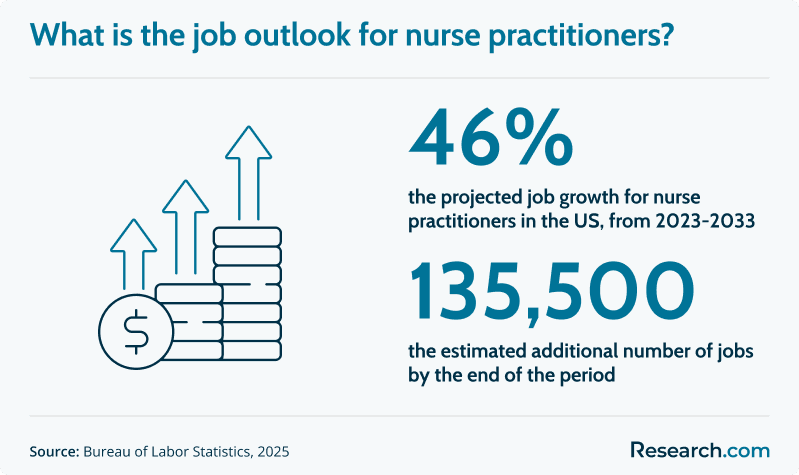
The job outlook is especially strong for nurse practitioners. The U.S. Bureau of Labor Statistics projects that nurse practitioner roles will grow by 46% between 2023 and 2033. Demand is influenced by the healthcare needs of an aging population, expanded emphasis on preventive care, and ongoing workforce needs in advanced practice and nursing leadership.
However, national growth does not guarantee the same demand in every city or specialty. One region may need psychiatric-mental health providers, while another may have more openings for primary care nurse practitioners, nurse educators, or informatics professionals. Before choosing a specialization, review job postings in your target location and speak with local advanced practice nurses, managers, or recruiters.
Do Local Labor Market Research Before You Enroll
- Search job boards for your intended MSN role in your preferred city or state.
- Check whether employers require specific certifications, clinical experience, or doctoral preparation.
- Ask local providers whether they accept students for clinical placements.
- Compare salary ranges with your expected tuition and borrowing.
- Confirm that your online program supports the licensure or certification rules in your state.
Students planning to borrow should complete the FAFSA early and compare grants, scholarships, employer benefits, and loan obligations before committing.
How to Evaluate Program Quality and Financial Value
A high-value online BSN to MSN bridge program should be accredited, transparent about outcomes, realistic about clinical placements, and clear about total cost. Do not make a decision based only on a ranking, a short completion timeline, or a low per-credit rate. Compare the full student experience and the career result the program is designed to support.
Quality Signals to Review
- Nursing program accreditation and institutional accreditation
- Certification exam pass rates for your intended track
- Clinical placement policies and support
- Graduation and retention outcomes
- Faculty experience in the specialty
- Student advising, tutoring, and technical support
- Employer partnerships or practicum site networks
- Transparent tuition, fee, and refund policies
To benchmark nursing education costs, students can compare program pricing with affordability-focused guides such as Research.com’s resource on the cheapest online bsn program.
What Career Support Should an Online MSN Program Offer?
Career support matters because graduate nursing programs are meant to move students into specific roles. Strong programs may provide career advising, resume support, interview preparation, alumni networks, mentorship, certification preparation, job search resources, and employer connections.
Ask whether career services are specific to nursing or shared across the university. Also ask if support continues after graduation. Students comparing advanced nursing entry points can review how support differs in a nurse practitioner direct entry program, especially if they are weighing multiple routes into advanced practice.
Can Non-Nurses Enter Advanced Practice Nursing?
Non-nurses generally do not enter a BSN to MSN bridge program because those programs are designed for licensed nurses. However, specialized direct-entry pathways may allow students with non-nursing backgrounds to complete foundational nursing education, supervised clinical preparation, and graduate-level coursework toward advanced practice goals.
These pathways have different admissions standards, timelines, costs, and licensure steps than RN-focused MSN bridge programs. Prospective students without a nursing background should review NP direct entry programs for non nurses before comparing RN-to-MSN or BSN-to-MSN options.
Should You Choose an MSN or Continue to a DNP?
An MSN can prepare nurses for advanced practice, education, leadership, and informatics roles, while a DNP is a practice-focused doctorate that may strengthen preparation for high-level clinical leadership, evidence-based practice implementation, and systems improvement. The right choice depends on your target role, employer expectations, state requirements, timeline, and budget.
If you already know you want doctoral-level preparation, compare whether it is more efficient to complete an MSN first or choose a pathway that leads directly toward doctoral study. Nurses evaluating accelerated doctorate options can review DNP online programs for additional context.
Common Mistakes to Avoid When Choosing a Fast Online BSN to MSN Program
| Mistake | Why It Can Hurt You | Better Approach |
| Choosing only the shortest program | A fast timeline is not helpful if clinical placement, certification, or licensure requirements are unclear | Balance speed with accreditation, outcomes, and state eligibility |
| Looking only at cost per credit | Fees, credit totals, books, travel, and clinical costs can change the final price | Request a full cost-of-attendance estimate for your exact track |
| Assuming all online programs work in every state | State authorization and licensure rules can limit eligibility | Confirm approval for your state before applying |
| Ignoring clinical placement responsibilities | Students may face delays if they cannot find preceptors | Ask for written placement policies and support details |
| Choosing a specialization too quickly | Changing tracks can add time, credits, and tuition | Research daily responsibilities and local job demand first |
| Assuming salary outcomes are guaranteed | Pay varies by location, role, experience, and employer | Compare national salary data with local job postings |
Questions to Ask Admissions Before Enrolling
- Is the nursing program accredited for my intended specialty?
- Does this program meet certification and licensure requirements in my state?
- Who is responsible for finding clinical or practicum sites?
- What happens if I cannot secure a preceptor on time?
- What is the total estimated cost, including fees and clinical expenses?
- How many of my previous credits will transfer?
- Can students realistically work full time while enrolled?
- Are there required campus visits, intensives, or synchronous class sessions?
- What are the certification pass rates for my track?
- What career services are available before and after graduation?
References
- American Association of Colleges of Nursing. (2025). Nursing shortage fact sheet. Retrieved May 24, 2024, from https://www.aacnnursing.org/news-data/fact-sheets/nursing-shortage
- American Association of Nurse Practitioners. (2023, November 13). Nurse practitioner profession grows to 385,000 strong. Retrieved May 24, 2024, from https://www.aanp.org/news-feed/nurse-practitioner-profession-grows-to-385-000-strong
- Bureau of Labor Statistics. (2025). Nurse anesthetists, nurse midwives, and nurse practitioners. Retrieved May 24, 2024, from https://www.bls.gov/ooh/healthcare/nurse-anesthetists-nurse-midwives-and-nurse-practitioners.htm
- Bureau of Labor Statistics. (2025). Occupational employment and wage statistics (OEWS) profiles. Retrieved May 24, 2024, from https://data.bls.gov/oesprofile/
- Bureau of Labor Statistics. (2025). Registered nurses. Retrieved May 24, 2024, from https://www.bls.gov/ooh/healthcare/registered-nurses.htm
- National Council of State Boards of Nursing. (2025). 2024 study highlights. Retrieved May 24, 2024, from https://www.ncsbn.org/research/recent-research/workforce/2024-workforce-pn.page
- National Council of State Boards of Nursing. (2025). Active RN licenses. Retrieved May 24, 2024, from https://www.ncsbn.org/nursing-regulation/national-nursing-database/licensure-statistics/active-rn-licenses.page
- Payscale. (2025). Master of Science in Nursing (MSN) degree. Retrieved May 24, 2024, from https://www.payscale.com/research/US/Degree=Master_of_Science_in_Nursing_(MSN)/Salary
- U.S. Census Bureau. (2021, April 5). Who are our health care workers? Retrieved May 24, 2024, from https://www.census.gov/library/stories/2021/04/who-are-our-health-care-workers.html
- University of St. Augustine for Health Sciences. (2024). Nursing shortage: A 2024 data study reveals key insights. Retrieved May 24, 2024, from https://www.usa.edu/blog/nursing-shortage/
Key Insights
- The fastest listed online BSN to MSN bridge option in this guide can be completed in as few as 10 months, but many accelerated programs take 12 to 24 months or longer depending on specialization and clinical requirements.
- Program speed should never outrank accreditation, state authorization, certification eligibility, and clinical placement support.
- Online MSN programs are often ideal for working nurses, but they require strong self-management and careful planning around preceptors and practicum sites.
- Total tuition for fast online BSN to MSN bridge programs commonly falls between about $20,000 and $60,000, with an average total tuition around $40,000 among reviewed programs.
- Specialization drives outcomes. A nurse practitioner track, nurse educator track, leadership track, and informatics track can lead to very different coursework, certification steps, work settings, and salaries.
- The U.S. Bureau of Labor Statistics projects 46% growth for nurse practitioner roles between 2023 and 2033, but students should still check local demand before choosing a specialty.
- The best program is the one that aligns with your license, state, budget, schedule, clinical access, and long-term career goal—not simply the one with the shortest advertised timeline.
Other Things You Should Know About Fast Online BSN to MSN Bridge Programs
The clinical practice component in 2027's fastest online BSN to MSN bridge programs typically lasts 300 to 500 hours. These hours are often completed in accelerated formats to align with the program's overall expedited timeframe.
For most MSN tracks, the required exam is the national certification exam tied to the specialty, such as the ANCC for nurse practitioner pathways or the AACN certification for clinical nurse leader programs. State boards and the certifying body set the exact eligibility rules and testing requirements.
Fastest online BSN to MSN bridge programs in 2027 typically require about 36 to 45 credit hours. The exact number depends on the institution and any prior coursework transferred, allowing for completion in as little as 12 to 18 months.