2027 How to Become an Urban Planner in Texas

Co-Founder and Chief Data Scientist
Becoming an urban planner in Texas is a practical career choice for people who want to help communities grow, use land wisely, improve transportation, reduce environmental risk, and plan for long-term population and infrastructure needs. Texas faces visible planning pressures: in 2025, the Texas Infrastructure Report Card gave the state’s local infrastructure an average grade of “C,” with concerns tied to road congestion, pavement conditions, wastewater systems, flood exposure, and public transportation. Those issues make planning work more than a policy exercise; it directly affects housing access, mobility, public safety, economic development, and quality of life.
This guide explains how to become an urban planner in Texas, including education options, certification, timelines, salaries, specializations, internships, and career paths. It is designed for students choosing a degree, career changers comparing planning-related roles, and early-career professionals deciding whether graduate school, AICP certification, or a specialization is worth pursuing.
Quick Answer: How do you become an urban planner in Texas?
Most urban planners in Texas begin with a bachelor’s degree in urban planning, geography, public policy, environmental studies, or a related field. Many professional planning roles prefer or require a master’s degree in urban planning, urban and regional planning, community and regional planning, or a closely related discipline. Texas does not require a state license for urban planners, but many professionals pursue American Institute of Certified Planners (AICP) certification after gaining qualifying experience. A typical path takes about 6 to 8 years when combining undergraduate education, graduate study, internships, and early professional experience.
Key Things to Know About Becoming an Urban Planner in Texas
- Employment for urban and regional planners in the US was projected to increase by 3% between 2024 and 2034.
- Urban and regional planners across the US have a median annual wage of $83,720, or $40.25 per hour. Urban and regional planners in Texas had a median hourly wage of $36.58 in the same period.
- Texas planning careers can involve transportation, housing, zoning, environmental resilience, land use, infrastructure, and community engagement in fast-growing cities and regions.
- Texas A&M University's College of Architecture offers a Bachelor of Science (BS) in Urban and Regional Planning program, a Master of Urban Planning program, and a Doctor of Philosophy (PhD) in Urban and Regional Sciences. The University of Texas at Austin's School of Architecture offers graduate programs in community and regional planning, urban design, and sustainable design.
- Education requirements for urban planners in Texas
- Urban planning specializations to consider in Texas
- Licensing and certification for Texas urban planners
- Timeline to become an urban planner in Texas
- Urban planner salary in Texas
- Career options for urban planners in Texas
- Typical job duties of Texas urban planners
- Business skills that help urban planners lead projects
- Scholarships for urban planning students in Texas
- Advanced business education for planning careers
- Urban planning and public safety in Texas
- Online learning for urban planning professionals
- Cross-disciplinary collaboration in planning
- Urban planning internships and practical experience in Texas
- Social work perspectives in community planning
- Accounting and funding strategies for planning projects
- Legal and regulatory issues in Texas planning
- Ethical responsibilities in urban planning
- Professional organizations for Texas urban planners
- Emerging trends and challenges in Texas urban planning
- Financial expertise for planning and development projects
What are the education requirements for urban planners in Texas?
Urban planning is an applied field, so employers usually look for both academic preparation and evidence that you can work with data, maps, public policy, budgets, communities, and local government processes. In Texas, a bachelor’s degree can open the door to planning assistant, GIS, research, transportation, community development, or policy roles. A master’s degree is often the stronger credential for professional planner positions, especially in larger cities, regional agencies, consulting firms, and specialized planning units.
| Education step | What it prepares you to do | Texas planning examples |
| Bachelor’s degree | Builds a foundation in land use, geography, policy, environmental issues, data analysis, and community development. | Programs may be in urban planning, geography, urban policy, environmental science, public administration, or related fields. |
| Core planning coursework | Helps students understand zoning, planning law, demographics, transportation, sustainability, research methods, and public engagement. | Some programs require at least 120 credit hours and may require a grade of C or higher in major coursework. |
| Internships or service-learning | Provides exposure to real planning meetings, public comments, map preparation, data gathering, and agency workflows. | Students may work with city departments, regional councils, state agencies, consulting firms, or community organizations. |
| Master’s degree | Strengthens professional preparation for planning analyst, city planner, transportation planner, environmental planner, or policy roles. | Graduate study can focus on urban design, transportation, community and regional planning, or sustainable development. |
| Technical skill development | Improves employability by showing that you can analyze and communicate planning evidence. | Useful skills include Geographic Information Systems (GIS), demographic analysis, public presentations, project management, and policy writing. |
Texas students have several academic routes. Texas A&M University offers undergraduate, master’s, and doctoral planning-related options through its College of Architecture. The University of North Texas and Texas State University also list planning-related undergraduate programs. The University of Texas at Austin’s School of Architecture offers graduate study in community and regional planning, urban design, and sustainable design.
Before choosing a program, compare the curriculum against your career goal. A student interested in transportation planning should look for modeling, transit, traffic, and infrastructure coursework. Someone aiming for environmental or resilience planning should look for land use, climate adaptation, flood risk, environmental review, and sustainability content. A future city planner should prioritize zoning, municipal planning, public engagement, planning law, and comprehensive planning.
- Choose a planning-related major intentionally. Urban planning, geography, public policy, environmental studies, economics, architecture, civil engineering, and public administration can all lead into planning, but they prepare students differently.
- Build a portfolio before graduation. Save studio projects, GIS maps, policy memos, community engagement reports, and data visualizations that show your planning judgment.
- Take GIS seriously. Many entry-level planning roles expect comfort with maps, spatial data, demographic layers, and visual communication.
- Use internships to test your fit. Planning work can be public-facing, technical, political, and deadline-driven. Practical experience helps you decide which environment suits you.
What urban planning specializations are available in Texas?
Texas planning problems vary by region. Coastal communities may focus on storm risk and recovery. Large metro areas often deal with congestion, housing, zoning, and transit. Fast-growing suburbs may need infrastructure sequencing, annexation planning, and development review. Rural communities may prioritize economic development, water access, transportation connections, and downtown revitalization.
| Specialization | What planners work on | Who should consider it |
| Transportation planning | Traffic patterns, corridor studies, public transit, pedestrian and bicycle access, freight movement, and long-range mobility plans. | Students who like data, infrastructure, maps, public meetings, and coordination with engineers or transportation agencies. |
| Sustainable development planning | Land use, green building practices, conservation, energy-conscious development, open space, and long-term environmental impacts. | People interested in balancing growth with environmental stewardship and community livability. |
| Disaster and emergency planning | Flood mitigation, hurricane preparedness, evacuation access, resilient infrastructure, recovery planning, and risk reduction. | Planners who want to work at the intersection of land use, public safety, infrastructure, and emergency management. |
| Housing and community development | Affordable housing strategies, neighborhood revitalization, anti-displacement planning, grant-funded projects, and community services. | People who care about equity, housing access, resident engagement, and neighborhood-level planning. |
| Urban design | Street character, public spaces, mixed-use development, design guidelines, walkability, and the physical form of cities. | Students with interests in architecture, design, placemaking, and visual communication. |
The best specialization depends on the problems you want to solve. Transportation planning is a strong fit if you enjoy systems and quantitative analysis. Sustainable development may be better if your focus is land use and environmental impact. Disaster planning suits people who can think across infrastructure, risk, emergency response, and vulnerable populations. If your motivation is neighborhood improvement, housing and community development may be the most relevant path.
Are there licensing requirements for urban planners in Texas?
Texas does not have a state licensure or registration process specifically for urban planners. That means you do not need a Texas-issued planning license to work as an urban planner in the state. However, employers may still prefer candidates with graduate education, specialized experience, strong technical skills, or professional certification.
The most recognized professional credential is certification through the American Institute of Certified Planners (AICP). To pursue AICP certification, candidates must register with the AICP, pass the certification exam, complete the certification maintenance program, and document qualifying professional planning experience.
| Credential | Best for | How it can help in Texas |
| AICP certification | Professional planners seeking a widely recognized planning credential. | Can strengthen credibility for municipal, regional, consulting, and leadership roles. |
| Certified Economic Development (CEcD) | Planners involved in business attraction, redevelopment, workforce, and local economic strategy. | Useful in fast-growing regions where planning and economic development overlap. |
| LEED Accredited Professional | Planners working on sustainability, green building, site planning, and environmental design. | Helpful for projects that emphasize resource efficiency and sustainable development. |
| Professional Transportation Planner (PTP) | Professionals focused on mobility, transportation systems, and infrastructure planning. | Relevant for planners working on transit, road networks, regional mobility, and congestion issues. |
Certification is not a substitute for local knowledge. Texas planners still need to understand municipal ordinances, zoning procedures, development review processes, public engagement expectations, and the legal limits of local planning authority. If your interests are tied to conservation, environmental review, or sustainability, Research.com’s guide to environmental careers can help you compare related career paths.
How long does it take to become an urban planner in Texas?
A common route to professional planning work in Texas takes about 6 to 8 years. That estimate usually includes a four-year bachelor’s degree, a two-year master’s degree, and internship or early professional experience. Some people enter planning with only a bachelor’s degree, while others move into the field after working in public administration, civil engineering, architecture, real estate, GIS, environmental policy, or community development.
| Stage | Typical length | What to focus on |
| Bachelor’s degree | 4 years | Complete planning-related coursework, learn GIS, build a writing sample, and pursue internships. |
| Master’s degree | 2 years | Specialize in areas such as urban design, transportation planning, sustainability, housing, or regional planning. |
| Internship or applied experience | 3 months to 1 year | Work with public agencies, councils of government, transportation organizations, consulting firms, or nonprofits. |
| Certification preparation | Several months | Prepare for AICP certification if it aligns with your career goals and experience level. |
If you want to enter the workforce faster, apply for planning technician, GIS assistant, zoning assistant, community development coordinator, or research analyst positions after your bachelor’s degree. If you want more responsibility, higher-level public sector roles, or consulting opportunities, a master’s degree can make you more competitive.
How much do urban planners in Texas earn?
Urban planner pay in Texas depends on location, employer type, education, experience, and specialization. Larger cities, regional agencies, engineering and planning consulting firms, and specialized transportation or environmental roles may pay differently from smaller municipalities or entry-level public sector jobs. Salary outcomes are not guaranteed, so compare job postings in your target region before choosing a degree or graduate program.
Urban and regional planners across the US have a median annual wage of $83,720, which is equivalent to $40.25 per hour. Urban and regional planners in Texas had a median hourly wage of $36.58 in the same period.
Specialization can affect earning potential. For example, planners with strong skills in transportation analysis, environmental review, GIS, project management, economic development, or development consulting may qualify for roles with different compensation structures than general planning positions. If your interest is environmental impact, climate resilience, conservation, or sustainable infrastructure, you may also want to compare planning with related sustainability careers.
| Factor | Why it matters for pay | What to check before deciding |
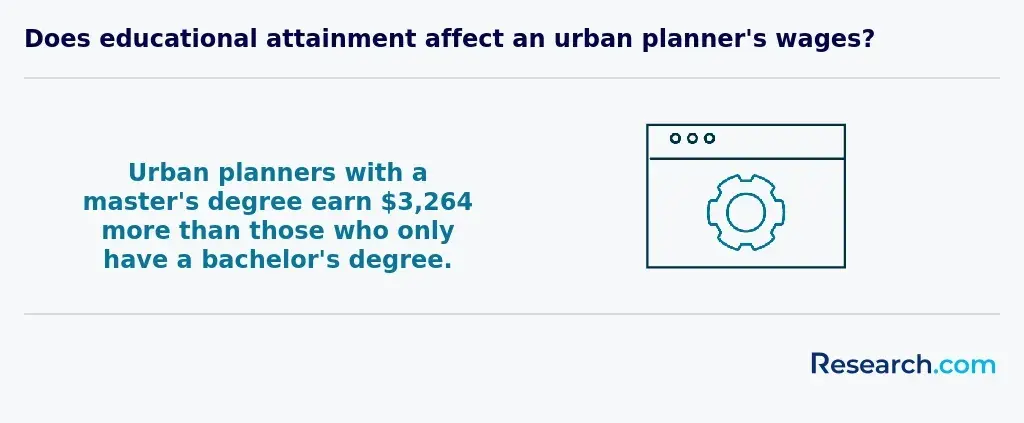
| Education level | Some professional planning roles prefer graduate-level preparation. | Review job postings to see whether a master’s degree is preferred or required. |
| Technical skills | GIS, data analysis, transportation modeling, and grant writing can increase competitiveness. | Look for programs with applied projects and software-based coursework. |
| Employer type | Municipalities, state agencies, regional councils, nonprofits, and consulting firms may have different pay structures. | Compare benefits, promotion paths, workload, and project type, not salary alone. |
| Geographic market | Planning demand and cost of living vary across Texas regions. | Research local job postings in the cities where you actually plan to work. |
In the chart below, you can compare annual mean salaries for urban planners by industry.
What careers are available to urban planners in Texas?
Urban planning careers in Texas exist in city governments, county agencies, councils of government, transportation agencies, environmental organizations, real estate development firms, architecture and engineering firms, nonprofit organizations, and private consulting companies. The right path depends on whether you prefer public service, technical analysis, policy development, community engagement, design, or development work.
| Role | Common responsibilities | Typical employers |
| City planner | Reviews development proposals, prepares comprehensive plans, analyzes zoning issues, supports public meetings, and advises local officials. | City planning departments, county governments, and municipal development offices. |
| Transportation planner | Studies mobility needs, evaluates transit and road projects, analyzes traffic patterns, and supports long-range transportation plans. | Texas Department of Transportation, regional planning agencies, transit agencies, and consulting firms. |
| Environmental planner | Assesses land use impacts, supports environmental compliance, reviews development proposals, and works on resilience or conservation projects. | Public agencies, environmental consulting firms, and organizations connected to the Texas Commission on Environmental Quality. |
| Community development planner | Works on neighborhood plans, housing strategies, grant programs, public engagement, and revitalization efforts. | Local governments, nonprofits, housing agencies, and community development organizations. |
| Planning consultant | Supports public and private clients with studies, plans, public meetings, policy research, and development strategies. | Planning, architecture, engineering, real estate, and multidisciplinary consulting firms. |
| Real estate development planner | Evaluates site feasibility, zoning constraints, permitting steps, community impacts, and project design considerations. | Developers, land use consulting firms, and private-sector project teams. |
Students who want to connect planning with environmental resilience or sustainable development may benefit from comparing planning degrees with top sustainability degree programs online. This is especially useful if you are deciding between a traditional planning curriculum and a broader sustainability-focused degree.
What are the typical responsibilities of urban planners in Texas?
Urban planners help communities make decisions about land, transportation, housing, infrastructure, environmental risk, and public resources. The work can be technical one day and deeply public-facing the next. A planner may analyze demographic data in the morning, revise zoning language in the afternoon, and present at a public meeting in the evening.
- Research population trends, land use patterns, development activity, housing needs, transportation systems, and environmental constraints.
- Analyze data to understand how growth affects infrastructure, neighborhoods, public services, and long-term community needs.
- Prepare comprehensive plans, corridor plans, neighborhood plans, zoning recommendations, and infrastructure-related planning documents.
- Coordinate with elected officials, residents, developers, engineers, attorneys, environmental specialists, and public agencies.
- Support public engagement through meetings, workshops, surveys, presentations, and written summaries of community feedback.
- Review development proposals for consistency with zoning, land use policies, design standards, and public infrastructure requirements.
- Use Geographic Information Systems (GIS) to map patterns, explain alternatives, and communicate planning evidence.
- Help address issues such as affordable housing, transportation access, environmental sustainability, public safety, and flood risk.
| Skill | Why Texas planners need it |
| GIS and spatial analysis | Maps help planners explain land use, demographics, infrastructure gaps, transportation access, and environmental constraints. |
| Public communication | Planning decisions affect residents, businesses, property owners, and elected officials, so clear communication is essential. |
| Policy writing | Planners often translate research into ordinances, plan recommendations, staff reports, and implementation strategies. |
| Project management | Planning projects require timelines, budgets, stakeholder coordination, deliverables, and follow-through. |
| Conflict management | Land use decisions can involve competing interests, so planners must listen carefully and document decisions fairly. |
How Can Urban Planners Enhance Their Business Acumen in Texas?
Business skills matter in urban planning because many projects involve budgets, contracts, market feasibility, public-private partnerships, grant funding, and negotiations with developers or consultants. A planner who understands finance, project management, and organizational strategy can contribute more effectively to implementation, not just plan creation. If you want formal business training, compare planning-related electives with programs at the best business schools in Texas to see whether coursework in management, budgeting, finance, or analytics fits your career plan.
Are there available scholarships for urban planners in Texas?
Urban planning students in Texas can reduce education costs by looking for university scholarships, departmental awards, planning association scholarships, assistantships, internships, and grants. Start with your department, because planning scholarships are often tied to a specific university, major, GPA threshold, or professional involvement requirement.
- The Spirit of Geography Urban Planning Alumni Scholarship: Texas State University provides this scholarship for undergraduate students majoring in Urban and Regional Planning. Applicants must maintain a minimum GPA of 3.0 and participate actively in planning organizations. The award amount varies depending on available funding.
- David Pugh Urban Planning Scholarship: Texas A&M University’s Department of Landscape Architecture and Urban Planning offers this scholarship to students who show academic achievement and commitment to urban planning. The total award depends on funding availability.
- Texas Chapter of the American Planning Association Scholarships: These scholarships support undergraduate and graduate students in planning-related fields. Award amounts vary by scholarship and are intended to help reduce education costs for students preparing for planning careers.
Do not compare programs by tuition alone. Ask about graduate assistantships, paid internships, transfer credit policies, employer tuition benefits, commuting costs, software costs, and whether online or hybrid options can reduce living expenses. Students who need flexibility may also compare planning-related pathways with easiest online programs, while keeping in mind that “easy” should never outweigh accreditation, curriculum quality, and career fit.
How can an advanced business education boost my urban planning career in Texas?
Advanced business education can help urban planners move into leadership, consulting, development, infrastructure finance, economic development, or project management roles. Courses in financial analysis, strategic planning, operations, negotiation, and organizational leadership can be especially useful for planners who manage large projects or coordinate across agencies. If you are comparing graduate options beyond planning, Research.com’s overview of best business masters degrees can help you understand how business credentials differ by career outcome.
How does urban planning impact public safety in Texas?
Urban planning affects public safety through street design, emergency access, land use compatibility, lighting, public spaces, flood mitigation, evacuation planning, and neighborhood connectivity. Well-planned communities can improve emergency response routes, reduce hazardous land use conflicts, support safer pedestrian movement, and create public spaces that encourage visibility and social connection.
Public safety planning is strongest when planners coordinate with emergency managers, police, fire departments, engineers, public health professionals, and community leaders. Related fields can provide useful perspectives; for example, students interested in evidence, investigation, and safety systems may compare planning with Research.com’s guide on forensic science degree in Texas.
How Can Continuous Online Learning Strengthen My Urban Planning Career in Texas?
Urban planning tools and expectations change over time. Online learning can help planners refresh skills in GIS, data dashboards, public finance, grant writing, community engagement platforms, sustainability, transportation analysis, and project management. Short courses and certificates are most valuable when they fill a specific gap in your resume rather than simply adding another credential.
For planners who want broader administrative and management skills, online business coursework can be a practical supplement. Research.com’s guide to the best-rated online bachelor's degrees in business administration may be useful for students who are comparing planning, public administration, and business-oriented pathways.
How Can Cross-Disciplinary Collaboration Enhance Urban Planning in Texas?
Planning decisions affect transportation, housing, health, education, accessibility, utilities, economic development, and environmental quality. For that reason, strong planners know how to work with professionals outside their own field. Collaboration with public health experts, engineers, architects, social workers, environmental scientists, disability advocates, and communication specialists can make plans more realistic and inclusive.
Accessibility and communication are especially important during public engagement. Planners who understand how residents receive, process, and respond to information can design better meetings, outreach materials, and engagement strategies. Related professional guides, including Research.com’s overview of speech pathologist requirements in Texas, can provide perspective on communication access and community needs.
What urban planning internships or practical experiences can I pursue in Texas?
Internships are one of the most important steps for becoming an urban planner in Texas because they show employers that you can apply classroom knowledge to real planning problems. Look for experiences that expose you to GIS, public meetings, plan writing, development review, policy research, transportation studies, environmental analysis, or community engagement.
- Texas Department of Transportation (TxDOT): Internships may involve transportation planning, infrastructure development, traffic analysis, environmental assessment, or public outreach.
- Houston-Galveston Area Council (H-GAC): As a regional planning agency, H-GAC may offer opportunities related to regional development, land use planning, sustainability, data analysis, policy development, and community outreach.
- The Texas A&M Transportation Institute (TTI): Interns may support transportation research, mobility studies, traffic pattern analysis, transportation models, and research on how urban development affects movement.
| Experience type | What you can learn | Career value |
| City planning internship | Zoning, development review, staff reports, public meetings, and municipal procedures. | Strong preparation for city planner and planning assistant roles. |
| Transportation agency internship | Mobility analysis, infrastructure planning, traffic data, environmental review, and public involvement. | Useful for transportation planning and regional mobility careers. |
| Consulting internship | Client work, deliverables, proposal support, research, maps, and project schedules. | Helps students understand private-sector planning expectations. |
| Nonprofit or community development role | Resident engagement, housing issues, neighborhood revitalization, and grant-funded work. | Useful for equitable development, housing, and community planning careers. |
When evaluating schools, also consider practical placement outcomes. Research.com’s resource on top colleges with high ROI can help you think more carefully about cost, outcomes, and return on investment, although program fit and local planning connections should also weigh heavily.
The chart below shows the states with the highest level of employment for urban planners in the United States.
How can social work perspectives enhance urban planning outcomes in Texas?
Urban planning and social work overlap when communities face housing instability, displacement, transportation barriers, food access issues, aging infrastructure, and unequal exposure to environmental risk. Planners who understand social service systems can design outreach processes and land use strategies that better reflect the needs of vulnerable residents.
Social work perspectives can help planners ask better questions: Who benefits from a redevelopment plan? Who may be displaced? Which residents cannot attend evening meetings? Which neighborhoods lack services, sidewalks, parks, or safe transportation options? Students interested in equity-focused planning may find it useful to review social worker education requirements in Texas to understand how community support fields approach vulnerable populations.
How Can Accounting Strategies Optimize Urban Planning Project Funding in Texas?
Planning recommendations only matter if communities can fund and implement them. Accounting and budgeting knowledge helps planners estimate costs, track project spending, compare funding sources, communicate with finance departments, and evaluate long-term maintenance obligations. This is especially important for infrastructure, transportation, housing, and redevelopment projects.
Planners do not need to become accountants, but they should understand budgets, capital improvement planning, grant compliance, cost estimates, and financial reporting basics. For students who want deeper fiscal training, Research.com’s guide to the best accounting schools in Texas can help compare accounting education options that may complement planning work.
How Do Legal and Regulatory Frameworks Influence Urban Planning in Texas?
Texas urban planners work within legal and regulatory systems that shape zoning, permitting, subdivision review, land use decisions, property rights, public meetings, environmental requirements, transportation approvals, and development agreements. A strong planner knows when to consult attorneys, how to document recommendations, and how to explain policy choices without overstepping legal authority.
Legal awareness helps planners reduce risk, communicate clearly with elected officials, and create plans that can survive public review and implementation. If you are interested in the legal side of land use, permitting, or public administration, Research.com’s guide on how to become a paralegal in Texas may help you compare related legal support pathways.
What are the ethical considerations in urban planning projects in Texas?
Urban planners make recommendations that can affect property values, housing access, environmental exposure, transportation options, business activity, and neighborhood identity. Ethical planning requires transparency, careful documentation, honest communication, inclusive engagement, and attention to who may be helped or harmed by a decision.
- Public accountability: Planners should explain assumptions, data sources, trade-offs, and limitations clearly.
- Equitable engagement: Public input processes should not only favor people with time, transportation, language access, or political influence.
- Conflict of interest management: Planners must avoid situations where personal, financial, or political interests compromise professional judgment.
- Environmental responsibility: Development decisions should consider long-term impacts on land, water, air, infrastructure, and public health.
- Respect for community history: Revitalization should not ignore displacement risk, cultural assets, or long-standing neighborhood priorities.
Planning ethics also intersect with social services and community well-being. Students who want to understand community support roles may compare planning with Research.com’s overview of social worker degree requirements in Texas.
What professional organizations in Texas should I join to advance my career as an urban planner?
Professional organizations can help students and early-career planners find mentors, internships, job leads, continuing education, conference opportunities, and updates on planning practice. They are especially useful in Texas because many planning careers are local or regional, and relationships often help candidates understand how agencies and firms actually hire.
| Organization | Why it may help | Best fit |
| American Planning Association (APA) Texas Chapter | Provides access to planning events, professional development, networking, and statewide planning discussions. | Students, practicing planners, consultants, public-sector employees, and AICP candidates. |
| Center for Urban and Regional Planning Research (CURPR) at UTSA | Connects planning research with urban growth, sustainability, and community issues. | Students and professionals interested in research, policy, and applied regional planning. |
| Student Urban Planning Organization (SUPO) at Texas State University | Offers student-focused networking, speakers, community projects, and career preparation activities. | Texas State students beginning their planning careers. |
Join early if you can. Student memberships, local events, and volunteer committees can help you learn the vocabulary of the profession, meet hiring managers, and understand which planning specialties are most active in your region.
What Urban Planners in Texas Have to Say About Their Careers
- "Urban planning in Texas gives me a direct way to serve communities I care about. The work combines design, policy, sustainability, and public input, and the best projects help residents feel that their city is being shaped with them in mind." - Lauren
- "My planning work has required collaboration with local governments, neighborhood groups, engineers, and advocates. That mix has taught me how important social equity is when cities grow and change." - Albert
- "Texas cities are changing quickly, which makes planning challenging and energizing. Projects involving green space, transportation, and better public places are especially rewarding because you can see the results in daily life." - Brian
What emerging trends and challenges are shaping urban planning in Texas?
Texas urban planning is being shaped by growth, infrastructure pressure, housing demand, environmental risk, transportation needs, and the increasing use of digital planning tools. Planners are expected to work with better data, communicate trade-offs clearly, and help communities make decisions that remain useful beyond a single election cycle or development cycle.
- Infrastructure strain: Congestion, road conditions, wastewater needs, flood exposure, and public transportation gaps create demand for coordinated planning.
- Housing and affordability pressure: Fast-growing regions must balance new development, neighborhood stability, infrastructure capacity, and housing access.
- Resilience planning: Flood risk, severe weather, heat, and disaster recovery require land use decisions that account for long-term vulnerability.
- Data-driven planning: GIS, dashboards, scenario modeling, and digital engagement tools are becoming more important in planning analysis and communication.
- Interdisciplinary planning: Health, nutrition, accessibility, social services, and environmental quality increasingly inform community planning decisions. For example, Research.com’s guide on how to become a nutritionist in Texas can help readers see how community health perspectives connect to the built environment.
How Can Financial Expertise Enhance Urban Planning Projects in Texas?
Financial knowledge helps urban planners move from vision to implementation. Plans often depend on capital budgets, grants, developer contributions, bonds, public-private partnerships, tax tools, and phased infrastructure investment. A planner who understands project finance can better evaluate what a community can afford, how to sequence improvements, and how to communicate costs to elected officials and residents.
Financial expertise is especially useful for planners working on redevelopment, transportation, housing, utilities, and large-scale land development. If you want a stronger foundation in budgeting, auditing, taxation, or financial reporting, Research.com’s guide on how to become an accountant in Texas can help you compare accounting-related skills with planning career goals.
Common mistakes to avoid when becoming an urban planner in Texas
| Mistake | Why it can hurt you | Better approach |
| Choosing a program based only on the school name | A well-known university may not have the specialization, studio work, internships, or faculty focus you need. | Compare curriculum, applied projects, internship access, alumni roles, and regional employer connections. |
| Ignoring GIS and data skills | Many entry-level planning roles involve maps, demographic analysis, spatial data, and visual presentations. | Take GIS coursework and include map-based projects in your portfolio. |
| Assuming Texas requires a planning license | Texas does not have a state planning license, so time is better spent understanding employer expectations and AICP pathways. | Focus on degree fit, experience, technical skills, and optional certification when appropriate. |
| Skipping internships | Planning employers often value applied experience because the job involves real regulations, deadlines, and public processes. | Pursue internships with cities, regional agencies, TxDOT-related programs, nonprofits, or consulting firms. |
| Overlooking public communication | Strong analysis will not carry a project if you cannot explain trade-offs to residents and decision-makers. | Practice presentations, memo writing, meeting facilitation, and plain-language explanations. |
| Assuming salary outcomes are automatic | Pay varies by role, region, employer, and experience. | Review current job postings in your target Texas market before committing to a degree cost. |
Questions to ask before choosing an urban planning program in Texas
- Does the program offer coursework in the planning specialization I want, such as transportation, housing, sustainability, urban design, or disaster planning?
- How much GIS, data analysis, and applied studio work will I complete before graduation?
- Where do recent graduates work in Texas, and what types of planning roles do they hold?
- Does the program help students secure internships with city planning departments, regional agencies, TxDOT, consulting firms, or nonprofits?
- Are scholarships, assistantships, paid internships, or employer partnerships available?
- Will the program help me build a portfolio with maps, plans, reports, and public presentation materials?
- If the program is online or hybrid, how does it provide local networking and applied planning experience?
- Does the degree support future AICP certification goals if I decide to pursue that credential?
Related Articles for Nearby States
- 2027 How to Become an Urban Planner in Louisiana
- 2027 How to Become an Urban Planner in Oklahoma
- 2027 How to Become an Urban Planner in Arkansas
- 2027 How to Become an Urban Planner in New Mexico
- 2027 How to Become an Urban Planner in Kansas
- 2027 How to Become an Urban Planner in Missouri
- 2027 How to Become an Urban Planner in Colorado
- 2027 How to Become an Urban Planner in Mississippi
- 2027 How to Become an Urban Planner in Tennessee
- 2027 How to Become an Urban Planner in Arizona
References:
- American Planning Association Texas Chapter. Houston: About Us. https://texas.planning.org/connect-apa-texas/sections-and-regions/houston
- Texas A&M University. (n.d.). Scholarships. https://www.arch.tamu.edu/academics/apply/scholarships
- Texas A&M University. (n.d.). Urban and Regional Planning - BS, Urban Policy Track. https://catalog.tamu.edu/undergraduate/architecture/landscape-architecture-urban-planning/urban-regional-planning-bs
- Texas Career Check. (n.d.). Urban and Regional Planners: O*NET 19-3051.00. https://texascareercheck.com/OccupationInfo/OccupationSummary/19-3051.00
- Texas State University. (n.d.). Bachelor of Science (B.S.) Major in Geography Urban and Regional Planning. https://mycatalog.txstate.edu/undergraduate/liberal-arts/geography/urban-regional-planning-bs
- University of North Texas. (n.d.). Urban and Regional Planning (BA). https://hps.unt.edu/academics/upop-ba.html
- University of Texas. (n.d.). Urban Policy and Planning Degree. https://www.unt.edu/academics/programs/urban-policy-and-planning-degree.html
- University of Texas at San Antonio. (n.d.). Urban Planning Master's Degree Program. https://future.utsa.edu/programs/master/urban-regional-planning
- US Bureau of Labor Statistics. (2025, August 28). Urban and Regional Planners. Occupational Outlook Handbook. https://www.bls.gov/ooh/life-physical-and-social-science/urban-and-regional-planners.htm
Key Insights
- Texas does not require a state license for urban planners, but AICP certification can improve professional credibility after you gain qualifying experience.
- A bachelor’s degree can lead to entry-level planning-related roles, but many professional planner positions are stronger fits for candidates with a master’s degree and applied experience.
- The typical preparation timeline is about 6 to 8 years when combining undergraduate study, graduate study, internships, and early professional development.
- Urban and regional planners across the US have a median annual wage of $83,720, while Texas urban and regional planners had a median hourly wage of $36.58 in the same period.
- The best Texas planning specialization depends on the problems you want to solve: transportation, sustainability, housing, disaster resilience, urban design, and community development each lead to different roles.
- Internships, GIS skills, public communication, and a strong project portfolio are often as important as the degree title when applying for planning jobs.
- Before enrolling, compare program curriculum, internship access, cost, scholarship options, local employer connections, and whether the degree supports your intended planning career path.
Other Things to Know About Becoming an Urban Planner in Texas
In 2027, having experience in urban planning significantly enhances your job prospects in Texas. Employers value practical experience, which can be gained through internships, co-op placements, or previous work in planning roles. Experience demonstrates your ability to apply academic knowledge to real-world challenges.
To become an urban planner in Texas in 2027, you need at least a bachelor's degree in urban planning or a related field such as geography or environmental design. Additionally, obtaining a master's degree in urban planning and gaining certification through the American Institute of Certified Planners (AICP) can enhance career prospects.