2027 How to Become an Urban Planner in Virginia

Co-Founder and Chief Data Scientist
Becoming an urban planner in Virginia is a strong fit for people who want to shape how communities grow, recover, move, preserve land, and prepare for future risks. Virginia has large metropolitan areas, historic towns, coastal communities, rural regions, military-related development, transportation corridors, and fast-changing suburbs, so planning work can vary widely from one locality to another.
Virginia is home to around 1,460 urban and regional planners. These professionals help local governments, state agencies, consulting firms, developers, and community organizations make decisions about land use, housing, transportation, environmental protection, public spaces, zoning, and long-range growth. For students and career changers, the main question is not only how to enter the field, but also whether the education, timeline, salary, and career options match their goals.
This guide explains how to become an urban planner in Virginia in 2026, including degree expectations, certification, internships, specializations, salary data, job options, scholarships, professional organizations, and practical ways to strengthen your career path.
Quick Answer: How Do You Become an Urban Planner in Virginia?
Most urban planners in Virginia start with a bachelor’s degree and then complete a master’s degree in urban planning, regional planning, environmental planning, or a related field. Virginia does not require a state license for urban planners, but many professionals pursue American Institute of Certified Planners certification after gaining qualifying experience. A typical path takes six to eight years when undergraduate education, graduate study, internships, and early professional experience are included.
| Decision Point | What It Means in Virginia | Why It Matters |
| Education | A master’s degree is not legally required, but it is generally ideal for competitive planning roles. | Graduate training helps prepare candidates for policy analysis, land use decisions, public engagement, and technical planning work. |
| Licensing | Virginia has no separate state licensure requirement for urban planners. | Candidates can focus on education, experience, and professional credentials rather than state licensing exams. |
| Certification | AICP certification is optional but respected. | It can improve credibility, especially for planners seeking senior, consulting, or public-sector leadership roles. |
| Salary | Urban planners in Virginia earn an average annual wage of approximately $82,820. | Compensation varies by employer, region, specialization, and experience level. |
| Job Outlook | The projected growth rate is 7% through 2033. | Demand is tied to sustainable development, infrastructure planning, housing needs, and community resilience. |
What to Know Before Choosing This Career
- Urban planning in Virginia can involve public meetings, zoning review, transportation analysis, environmental compliance, housing policy, data mapping, and long-range community planning.
- The job outlook for urban planners in Virginia is promising, with a projected growth rate of 7% through 2033.
- Urban planners in Virginia earn an average annual wage of approximately $82,820, though earnings differ by experience, location, and employer type.
- The University of Virginia and Virginia Commonwealth University are among the leading schools in the state for planning-related study, and Planning Accreditation Board-accredited options include Virginia Tech and Virginia Commonwealth University.
- This career is best for people who are comfortable balancing community needs, policy constraints, environmental concerns, technical analysis, and political decision-making.
- Education requirements for urban planners in Virginia
- Urban planning specializations available in Virginia
- Licensing and certification requirements in Virginia
- How long it takes to become an urban planner in Virginia
- Urban planner salaries in Virginia
- Career paths for urban planners in Virginia
- Common responsibilities of Virginia urban planners
- Using business skills in an urban planning career
- Scholarships for urban planning students in Virginia
- Whether an MBA can support an urban planning career
- Urban planning internships and practical experience in Virginia
- How economic strategy supports planning decisions
- How allied health perspectives can improve planning outcomes
- Professional organizations for Virginia urban planners
- Climate adaptation and urban planning in Virginia
- Interdisciplinary approaches in urban planning
- How scientific analysis can strengthen planning work
- Financial management skills for planners
- Digital innovation in Virginia urban planning
- Legal knowledge for urban planners
Education Requirements for Urban Planners in Virginia
Virginia does not require one single degree title for urban planners, but employers commonly look for candidates with formal training in planning, public policy, geography, architecture, environmental studies, civil engineering, public administration, or a closely related field. For many planning positions, especially those involving policy development, technical analysis, or advancement into leadership, a graduate degree is often the stronger credential.
| Education Level | Typical Purpose | Best For |
| Bachelor’s degree | Builds a foundation in land use, public policy, environmental systems, statistics, design, geography, or community development. | Students seeking entry-level planning support roles, internships, or preparation for graduate school. |
| Master’s degree | Provides advanced training in planning theory, land use law, quantitative analysis, community engagement, and applied studio or capstone work. | Candidates pursuing professional planner roles in government, consulting, transportation, environmental planning, or community development. |
| Graduate certificate or related coursework | Adds targeted skills in GIS, sustainability, transportation, housing, public administration, or economic development. | Career changers or professionals who already hold a degree and want planning-specific skills. |
- Degree expectation: A master’s degree in urban planning, regional planning, environmental planning, or a related field is generally ideal, even though it is not a state licensing requirement. Planning Accreditation Board-accredited institutions include Virginia Tech (Virginia Polytechnic Institute & State University) and Virginia Commonwealth University.
- Important coursework: Strong programs usually cover planning theory, land use law, sustainable community development, public finance, zoning, demographic analysis, transportation systems, environmental review, and quantitative methods for planning analysis.
- Applied learning: Internships, studio courses, capstone projects, and community-based planning assignments are especially important because planning is a practice-oriented profession. Employers want evidence that you can interpret data, write clearly, engage the public, and turn analysis into usable recommendations.
- Specialized study: Students can focus on areas such as environmental planning, transportation, housing, economic development, climate resilience, social equity, or smart city planning, depending on their career goals.
If you are comparing programs, look beyond the degree name. Review faculty expertise, internship placement, GIS training, studio projects, alumni outcomes, and whether the curriculum fits the type of planning work you want to do in Virginia.
This chart illustrates the share of urban planners according to their educational attainment.
Urban Planning Specializations Available in Virginia
Urban planning is not one narrow job. In Virginia, planners may work on transportation corridors, coastal resilience, downtown revitalization, military-adjacent land use, historic preservation, affordable housing, stormwater planning, rural development, public engagement, or regional growth management. Choosing a specialization early can help you select the right courses, internships, software skills, and professional contacts.
| Specialization | What Planners Do | When It Makes Sense |
| Transportation Planning | Analyze traffic patterns, evaluate public transit options, support pedestrian and bicycle planning, and coordinate infrastructure improvements. | Choose this path if you are interested in mobility, congestion, transit access, regional commuting, or infrastructure policy. |
| Environmental Planning | Assess ecological impacts, support green infrastructure, evaluate development proposals, and align land use with sustainability goals. | This is a good fit if you want to connect planning with conservation, climate risk, water quality, and careers in sustainability. |
| Community Development | Work with residents, nonprofits, and local governments on neighborhood revitalization, affordable housing, public spaces, and economic opportunity. | Consider this area if you are drawn to equity, public participation, housing policy, and place-based problem solving. |
| Smart City Planning | Use data, sensors, GIS, digital platforms, and performance metrics to improve planning decisions and public service delivery. | This path suits planners who enjoy technology, analytics, infrastructure systems, and cross-department collaboration. |
The best specialization depends on the communities you want to serve. A planner in Northern Virginia may focus heavily on transportation, housing, and regional growth, while a planner in a coastal community may spend more time on flood risk, environmental review, and resilience planning. In smaller localities, one planner may handle several of these responsibilities at once.
Licensing and Certification Requirements in Virginia
Virginia does not have a separate state license or registration requirement for urban planners. That means you do not need a Virginia-specific planning license to begin working in the field. However, education, experience, technical skill, and professional credibility still matter greatly in hiring and promotion decisions.
The most recognized national credential is certification through the American Institute of Certified Planners. AICP certification is voluntary, but many planners pursue it after meeting the required education and professional experience criteria and passing the certification exam. It can be especially useful for planners who want to move into senior planning, consulting, management, or specialized policy roles.
| Credential | What It Signals | Who Should Consider It |
| AICP Certification | Professional planning competence, ethics awareness, and commitment to the field. | Planners seeking stronger credibility, leadership roles, or competitive public-sector and consulting positions. |
| Leadership in Energy and Environmental Design (LEED) Accredited Professional | Knowledge of sustainable building and development practices. | Planners working with green infrastructure, site planning, environmental policy, or sustainable development. |
| Professional Transportation Planner (PTP) | Specialized transportation planning expertise. | Professionals focused on mobility systems, traffic planning, multimodal networks, or transportation policy. |
| Certified Economic Development (CEcD) | Economic development and business retention knowledge. | Planners working on redevelopment, business districts, regional growth, or community investment strategies. |
If you are still choosing a degree path, compare curriculum, cost, accreditation, and transfer options carefully. Students looking for budget-conscious entry points can review best low-cost online urban planning degrees as part of a broader program search.
How Long Does It Take to Become an Urban Planner in Virginia?
The typical timeline to become an urban planner in Virginia is six to eight years, depending on whether you pursue graduate school immediately, study full time or part time, complete internships, and seek AICP certification after entering the workforce.
| Step | Typical Time | What to Focus On |
| Bachelor’s Degree | Usually four years | Build writing, research, statistics, GIS, policy, environmental, and community engagement skills. The University of Virginia offers a Bachelor of Urban and Environmental Planning requiring 122 credits spanning four years. |
| Master’s Degree | One to two more years | Develop professional planning skills through studio courses, applied research, policy analysis, and internships. Virginia Tech offers a Master of Urban and Regional Planning that fits within this timeframe. |
| Internships or Applied Experience | Three months to a year | Gain experience with public meetings, plan review, mapping, data analysis, planning documents, and local government procedures. |
| AICP Certification Preparation | After at least two years of professional experience | Document qualifying experience, prepare for the exam, and strengthen your professional planning knowledge. |
You can shorten the path by choosing a planning-related undergraduate major, completing internships before graduation, learning GIS early, and building a portfolio of writing samples, maps, public engagement materials, and applied projects. Career changers may take longer if they need prerequisite coursework or part-time graduate study.
This chart reveals the various tenures of urban planners in the U.S.
Urban Planner Salaries in Virginia
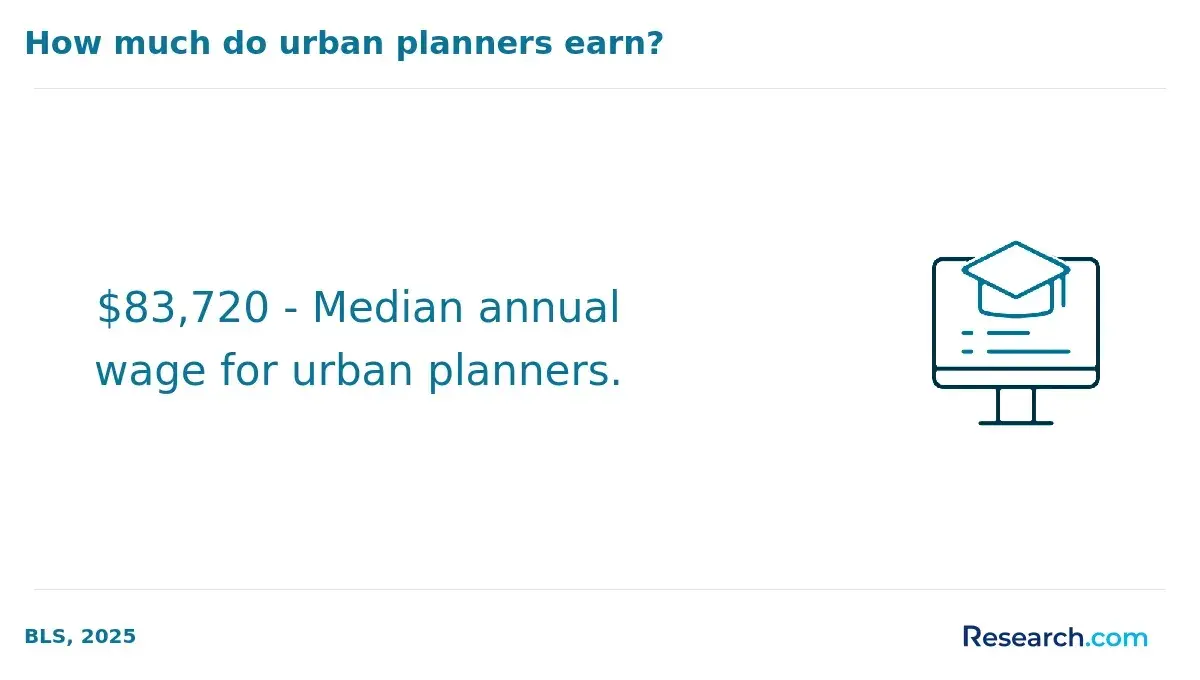
Urban planner pay in Virginia depends on experience, location, employer type, specialization, and responsibility level. The average annual wage is approximately $82,820. Entry-level roles typically pay less, while experienced planners, specialized consultants, and federal government planners may earn more.
| Career Stage or Employer | Annual Pay Figure Stated | How to Interpret It |
| Entry-level urban planners | Around $55,240 per year | Common for early-career roles where planners are building technical, policy, and public engagement experience. |
| Mid-level urban planners | About $79,090 annually | Often reflects several years of experience and greater responsibility for projects, analysis, or review work. |
| Senior urban planners | Around $96,610 per year | Typically tied to advanced expertise, project leadership, supervision, or specialized planning responsibilities. |
| Washington-Arlington-Alexandria (DC-VA-MD-WV) | Average total pay estimated at $102,070 | Compensation may be higher in large, competitive, and federally connected metropolitan labor markets. |
| Federal government planners | $112,590 | Federal roles may offer higher compensation, but competition, requirements, and hiring timelines can differ from local roles. |
Salary should not be the only factor in evaluating this career. Consider benefits, pension or retirement options, remote or hybrid flexibility, workload during public hearings or development review cycles, advancement opportunities, and whether the role aligns with your preferred specialization. Students interested in environmental planning may also compare related programs such as the best online environmental sustainability degrees.
Career Paths for Urban Planners in Virginia
Urban planners in Virginia work in local government, regional agencies, state departments, consulting firms, architecture and engineering companies, real estate development firms, environmental organizations, and community development nonprofits. The right setting depends on whether you prefer public service, technical consulting, policy work, design coordination, or development review.
| Work Setting | Example Roles | Typical Focus |
| Local government | City planner, zoning planner, neighborhood planner, comprehensive planning analyst | Land use review, public meetings, comprehensive plans, zoning updates, housing, and community development. |
| State agencies | Transportation planner, environmental planner, policy analyst | Transportation systems, environmental compliance, infrastructure planning, and state-level program support. |
| Regional organizations | Regional planner, transportation program planner, resilience planner | Cross-jurisdictional planning, regional growth, mobility, environmental strategy, and shared infrastructure needs. |
| Private consulting | Planning consultant, land use planner, urban design analyst | Client projects, development proposals, community engagement, technical reports, and planning studies. |
| Real estate development | Entitlement planner, development project coordinator, land use analyst | Zoning approvals, community needs, feasibility, site planning, and coordination with public agencies. |
In Virginia, local governments such as Richmond and Norfolk hire planners for land use, redevelopment, and infrastructure-related work. The Virginia Department of Transportation (VDOT) is a key employer for transportation planning. Environmental planning roles may be found in agencies such as the Virginia Department of Environmental Quality. Private firms such as Kimley-Horn provide planning services to municipalities and developers, while real estate development firms such as JBG Smith and The Bozzuto Group rely on planning expertise to navigate zoning, approvals, and community expectations.
Common Responsibilities of Urban Planners in Virginia
Urban planners translate community goals into practical plans, policies, regulations, and projects. The day-to-day work varies by employer, but most planners need to combine research, public communication, writing, mapping, policy analysis, and coordination with engineers, architects, elected officials, residents, developers, and environmental professionals.
- Review proposed sites and assess how land use, transportation access, utilities, environmental constraints, and nearby development affect planning decisions.
- Coordinate with local officials, residents, agencies, developers, and community organizations on zoning changes, comprehensive plans, and development proposals.
- Prepare land use plans, transportation recommendations, public space strategies, neighborhood plans, and sustainability-focused planning documents.
- Analyze demographic and economic trends to anticipate housing, mobility, infrastructure, and service needs.
- Support affordable housing initiatives, redevelopment strategies, and revitalization plans for underused or distressed areas.
- Evaluate whether projects comply with local, state, and federal requirements related to land use, environmental protection, accessibility, and public process.
- Facilitate or support public meetings, workshops, open houses, and hearings where community members can review and comment on plans.
- Contribute to disaster risk assessment, emergency preparedness, flood mitigation, and resilience planning where local conditions require it.
Successful planners need more than technical knowledge. They must be able to explain trade-offs, listen to residents, write clearly, interpret regulations, use evidence responsibly, and manage conflict when community priorities compete.
Can Business Skills Strengthen an Urban Planning Career in Virginia?
Business knowledge can make urban planners more effective, especially when projects involve budgets, public-private partnerships, grants, cost estimates, redevelopment financing, or negotiations with developers and agencies. Planning decisions often depend on whether a project is financially realistic, not only whether it is desirable from a design or policy standpoint.
Useful business-related skills include budgeting, project management, procurement awareness, stakeholder negotiation, strategic planning, and financial communication. Students who want to add this perspective may compare coursework or programs at the best business schools in Virginia, especially if they expect to work in development, consulting, economic development, or agency leadership.
Scholarships for Urban Planning Students in Virginia
Urban planning education can be expensive, particularly for students who pursue both undergraduate and graduate study. Scholarships, fellowships, assistantships, and employer tuition support can reduce the cost of entry into the field. Always confirm eligibility, deadlines, enrollment requirements, and award amounts directly with the school or sponsoring organization.
| Scholarship or Fellowship | Who It Supports | Key Eligibility Detail Stated |
| VCPA T. Edward Temple Endowed Scholarship | Second-year students in the Master of Urban and Regional Planning program at Virginia Commonwealth University (VCU) | Candidates must have completed 24 credit hours, including all required first-year courses, and demonstrate the best academic record among eligible applicants. |
| Paul S. Dulaney Memorial Scholarship | Second-year students in the Master of Urban and Environmental Planning program at the University of Virginia (UVA) School of Architecture | Designed for eligible students pursuing graduate planning study at UVA. |
| Virginia Tech Community Scholars Fellowship | Graduate students in the Master of Urban and Regional Planning Program (MURP) | The fellowship aims to provide financial support to minority students. |
| Virginia Urban Forest Council Scholarship | Undergraduate and graduate students studying urban forestry or related fields at any college or university in Virginia | Supports students committed to urban forestry, a field closely connected to environmental planning and community design. |
Students interested in urban forestry, green infrastructure, or environmental planning can also compare options for affordable forestry degree universities when building a broader education plan.
Should You Consider an Advanced Business Degree for Urban Planning?
An advanced business degree is not necessary for every urban planner, but it can be useful for professionals who want to manage large projects, lead consulting teams, work in real estate development, oversee budgets, or move into executive roles. The value depends on your career direction, current experience, tuition cost, employer support, and opportunity cost.
| An Advanced Business Degree May Help If... | It May Not Be Worth It If... |
| You want to lead complex development, infrastructure, or public-private partnership projects. | You are early in your planning career and still need core planning experience. |
| You need stronger finance, management, negotiation, or organizational leadership skills. | Your target roles are technical planning positions where GIS, zoning, environmental review, or policy expertise matters more. |
| Your employer offers tuition support or the degree clearly supports promotion. | The debt would be high and the career payoff is uncertain. |
Before enrolling, compare the degree’s cost with the specific planning roles you want. A broader discussion of return on investment can help you decide whether is MBA worth it for your situation.
Urban Planning Internships and Practical Experience in Virginia
Internships are one of the best ways to test whether urban planning is the right career for you. They also help students build writing samples, GIS maps, public engagement experience, policy memos, and professional references. In Virginia, useful experience can come from local governments, regional planning organizations, state agencies, consulting firms, architecture and design firms, transportation agencies, nonprofits, and environmental organizations.
- AECOM: This global engineering and infrastructure firm may offer internship opportunities connected to planning, design, research, document preparation, and community engagement. Work can expose interns to both local and large-scale infrastructure-related planning projects.
- Virginia Department of Transportation (VDOT): Interns may support transportation planning, infrastructure analysis, data work, project coordination, and public engagement related to mobility and growth.
- Gensler: Interns in Cities + Urban Design may help with master planning, design guidelines, planning studies, and collaboration on high-profile urban design work.
Do not limit your search to positions with “urban planning” in the title. Relevant experience may also appear under transportation, GIS, sustainability, community development, housing, environmental review, resilience, public policy, or infrastructure planning. Students with interdisciplinary interests can also review related options at easy engineering schools when exploring technical pathways that intersect with planning.
How to Make an Internship Application Stronger
- Include a short portfolio with maps, policy memos, studio projects, design boards, data dashboards, or community engagement materials.
- Learn GIS, spreadsheet analysis, basic data visualization, and clear technical writing before applying.
- Show that you understand public process, not just design or research.
- Apply to local government planning departments as well as large firms; smaller offices may provide broader hands-on experience.
- Ask whether the role includes public meetings, site visits, plan review, or report writing, because these experiences are valuable for future employment.
How Economic Strategy Supports Urban Planning Decisions in Virginia
Economic strategy helps planners evaluate whether a proposed project is viable, equitable, and sustainable over time. In practice, this means looking at market conditions, funding sources, infrastructure costs, tax implications, business impacts, housing affordability, and long-term maintenance needs.
Urban planners who understand economic development can better support downtown revitalization, corridor planning, mixed-use districts, industrial land policy, and public investment decisions. For students who want stronger grounding in management and economics, exploring careers in business administration degree can clarify how business training may complement planning work.
How Allied Health Perspectives Can Improve Urban Planning Outcomes in Virginia
Planning decisions affect health, accessibility, mobility, housing stability, public safety, and access to services. Allied health perspectives can help planners think more carefully about how streets, public buildings, parks, transit routes, and community facilities serve people with different needs.
For example, understanding professional requirements in health-related fields, such as speech pathologist requirements in Virginia, can remind planners that accessibility and service delivery are not abstract ideas. They shape how residents interact with schools, clinics, public spaces, and local services.
Professional Organizations for Virginia Urban Planners
Professional organizations can help students and early-career planners find mentors, internships, job leads, continuing education, policy updates, and conference opportunities. They are also useful for understanding how planning issues differ across regions of Virginia.
- American Planning Association (APA) Virginia Chapter: This state chapter supports planners through networking, professional education, advocacy, conferences, and planning resources.
- PlanRVA: Founded in 1969, PlanRVA supports regional collaboration in Central Virginia and offers opportunities to engage with transportation, environmental, and community development issues.
- Emerging Planning Professionals (EPP): Part of the APA Virginia Chapter, EPP supports students, new planners, and professionals at different career stages who want to build connections and strengthen planning practice.
Joining an organization is most valuable when you participate actively. Attend events, ask about mentorship, volunteer for committees, submit student work when possible, and use conferences to learn how planners explain real projects, conflicts, and outcomes.
How Social Work Perspectives Can Inform Urban Planning in Virginia
Urban planning and social work often intersect around housing, homelessness, accessibility, public safety, transportation access, neighborhood stability, and community well-being. Planners who understand social service systems can better identify who may be affected by redevelopment, displacement, zoning changes, transportation gaps, or climate risks.
Reviewing social worker education requirements in Virginia can help planning students understand how social work frameworks approach vulnerable populations, community support, and preventive intervention. This perspective is especially useful for housing, resilience, public space, and neighborhood planning.
How Digital Innovation Can Improve Urban Planning Efficiency in Virginia
Digital planning tools are now central to modern practice. Geographic Information Systems, real-time data analysis, online engagement platforms, scenario modeling, and cloud-based collaboration can help planners evaluate land use patterns, infrastructure capacity, environmental constraints, and community needs more efficiently.
Digital tools do not replace professional judgment. They improve planning when data is accurate, assumptions are transparent, and community input is still taken seriously. Planners who combine technical analysis with financial awareness can also make stronger investment recommendations; related analytical approaches are often emphasized at the best accounting schools in Virginia.
How Climate Change Adaptation Can Shape Urban Planning in Virginia
Climate adaptation is an increasingly important planning concern in Virginia because communities must consider flooding, extreme weather, infrastructure vulnerability, environmental degradation, and resilience for residents who may have fewer resources to recover after disruptions.
Planning strategies may include green infrastructure, risk mapping, updated development standards, resilient transportation planning, open space preservation, and coordination with emergency management. Social vulnerability analysis is also important. Reviewing social worker degree requirements in Virginia can help planners think more carefully about how climate impacts affect different populations.
Interdisciplinary Approaches That Can Broaden an Urban Planning Career in Virginia
Urban planning benefits from collaboration with public health, nutrition, environmental science, engineering, law, finance, social work, data science, architecture, and public administration. The most effective planners often know how to work across disciplines without pretending to be experts in every field.
For example, public health and nutrition perspectives can help planners support walkable neighborhoods, food access, parks, community facilities, and healthier built environments. Students interested in this connection can review how to become a nutritionist in Virginia to understand how health-focused training may connect with planning goals.
How Scientific Analysis Can Strengthen Urban Planning in Virginia
Scientific and investigative thinking can improve planning work by emphasizing evidence, documentation, site analysis, risk evaluation, and careful interpretation of complex conditions. This is especially useful in environmental review, hazard mitigation, infrastructure planning, and compliance-related work.
Planners who enjoy rigorous analysis may find value in understanding methods used in related scientific fields. Exploring a forensic science degree in Virginia can provide a useful comparison for students interested in evidence-based problem solving, documentation, and analytical reasoning.
How Financial Management Skills Can Improve Urban Planning Outcomes
Planning recommendations must often compete for limited funding. Financial management skills help planners evaluate cost estimates, grant opportunities, capital improvement plans, project phasing, maintenance obligations, and the long-term affordability of public investments.
Budget literacy is useful in local government, consulting, transportation, housing, resilience, and redevelopment work. Professionals who want to understand financial systems more deeply can review how to become an accountant in Virginia for insight into accounting and fiscal management concepts that may complement planning practice.
How Legal Knowledge Can Help Urban Planners in Virginia
Urban planners regularly work with zoning ordinances, comprehensive plans, permitting processes, public hearing requirements, environmental regulations, development conditions, easements, and land use disputes. Legal literacy helps planners communicate clearly, reduce procedural errors, and understand the limits of local authority.
You do not need to become an attorney to be an effective planner, but you should be comfortable reading regulations, documenting decisions, and recognizing when legal review is necessary. Students who want a stronger foundation in legal procedures can explore how to become a paralegal in Virginia as a related career and training comparison.
Common Mistakes to Avoid When Preparing for an Urban Planning Career
| Mistake | Why It Can Hurt You | Better Approach |
| Choosing a program based only on tuition | A low-cost program may not offer the specialization, internship access, faculty expertise, or applied training you need. | Compare total cost, curriculum, planning accreditation, fieldwork, alumni placement, and local employer connections. |
| Ignoring GIS and data skills | Many planning roles require mapping, spatial analysis, demographic analysis, or visualization. | Build GIS, spreadsheet, data visualization, and basic statistics skills before graduation. |
| Assuming a degree guarantees a specific salary | Pay depends on location, employer, experience, specialization, and labor market conditions. | Use salary figures as reference points, not guarantees, and compare job postings in your target region. |
| Waiting too long to get practical experience | Graduates without internships or applied projects may struggle to show readiness for planning work. | Seek internships, studio projects, local government volunteer opportunities, or research assistant roles early. |
| Overlooking public communication | Planning work often involves meetings, conflict, community concerns, and complex trade-offs. | Practice writing staff reports, presenting findings, listening to residents, and explaining technical issues simply. |
| Relying only on rankings | A highly ranked program may not match your career goals, geography, budget, or desired specialization. | Ask how each program supports your specific planning path in Virginia. |
Questions to Ask Before Choosing an Urban Planning Program in Virginia
- Is the program aligned with my target specialization, such as transportation, environmental planning, housing, community development, or smart city planning?
- Does the program offer internships, studio courses, capstone projects, or partnerships with Virginia agencies and local governments?
- What GIS, data analysis, public engagement, and planning law training is included?
- Are faculty members active in the planning areas I want to pursue?
- What are the total costs, including tuition, fees, commuting, technology, and lost work time?
- Can I transfer credits, study part time, or complete some coursework online?
- How does the program support job placement, networking, and AICP preparation?
- What kinds of employers hire recent graduates?
Related Articles for Nearby States
- 2027 How to Become an Urban Planner in West Virginia
- 2027 How to Become an Urban Planner in Maryland
- 2027 How to Become an Urban Planner in North Carolina
- 2027 How to Become an Urban Planner in Tennessee
- 2027 How to Become an Urban Planner in Kentucky
- 2027 How to Become an Urban Planner in Pennsylvania
- 2027 How to Become an Urban Planner in South Carolina
- 2027 How to Become an Urban Planner in Ohio
- 2027 How to Become an Urban Planner in Delaware
- 2027 How to Become an Urban Planner in New Jersey
References:
- American Planning Organization. (n.d.). One Path to AICP Certification Guide. https://www.planning.org/media/document/9227012
- American Planning Organization Virginia Chapter. (n.d.). Emerging Planning Professionals (EPP) (Formerly Young Planners Group (YPG)). https://virginia.planning.org/connect-with-apa-virginia/young-planners-group-ypg
- U.S. Bureau of Labor Statistics. (2025, August 25). Urban and Regional Planners. https://www.bls.gov/ooh/Life-Physical-and-Social-Science/Urban-and-regional-planners.htm
- Virginia Department of Workforce Development and Advancement. (n.d.). Long and Short-Term Occupational Projections. https://virginiaworks.com/occupational-projections
- Zippia. (2025). Urban Planner Demographics and Statistics in the US. https://www.zippia.com/urban-planner-jobs/demographics
Key Insights
- Virginia does not require a state license for urban planners, but employers still value strong education, internships, technical skills, and professional credibility.
- A master’s degree is generally ideal for competitive urban planning roles, especially in transportation, environmental planning, community development, and policy-focused positions.
- The typical path takes six to eight years when undergraduate study, graduate school, internships, and early professional experience are included.
- Urban planners in Virginia earn an average annual wage of approximately $82,820, with higher figures reported for senior roles, the Washington-Arlington-Alexandria (DC-VA-MD-WV) area, and federal government employment.
- AICP certification is optional but can support advancement, particularly for planners seeking leadership, consulting, or senior public-sector roles.
- The best preparation combines planning theory with practical experience: GIS, data analysis, public engagement, zoning knowledge, writing ability, and real project exposure.
- Before choosing a program, compare accreditation, cost, internships, specialization options, faculty expertise, and employer connections rather than relying on tuition or rankings alone.
Other Things to Know About Becoming an Urban Planner in Virginia
To become an urban planner in Virginia in 2027, you typically need at least a bachelor’s degree in urban planning or a related field, such as geography or environmental design. Many positions may also require a master's degree for higher-level roles or specialized areas.
Urban planners are indeed in demand in Virginia, driven by the state's ongoing growth and development initiatives. According to the U.S. Bureau of Labor Statistics, the employment of urban and regional planners is projected to grow by 3 percent from 2024 to 2034, about as fast as the average for all occupations, with about 3,400 openings projected each year nationwide on average over the decade. This reflects the increasing need for professionals who can address urbanization challenges, sustainability, and community development. Additionally, cities like Richmond and Virginia Beach are investing in infrastructure and revitalization projects, further enhancing job prospects for aspiring urban planners in the state, as evidenced by over 200 urban planning jobs currently listed in Virginia.
Yes, a bachelor’s degree in urban planning or a related field is typically required to become an urban planner in Virginia in 2027. Many employers prefer candidates with a master’s degree in urban planning or related qualifications to enhance career opportunities.