2027 How to Become an Urban Planner in Wisconsin

Co-Founder and Chief Data Scientist
Becoming an urban planner in Wisconsin is a practical career path for people who want to shape how communities grow, move, build housing, protect natural resources, and use public infrastructure. Wisconsin’s infrastructure needs make this work especially relevant: the American Society of Civil Engineers gave the state’s local infrastructure an average grade of C+, which points to continuing demand for professionals who can help plan roads, transit, parks, water systems, redevelopment, and resilient neighborhoods.
This guide explains how to become an urban planner in Wisconsin in 2026, including the education path, graduate degree options, certifications, salary expectations, job settings, internships, scholarships, and professional organizations. It also covers how to decide whether this career fits your goals, what mistakes to avoid, and which skills can help you advance.
Quick Answer: How do you become an urban planner in Wisconsin?
To become an urban planner in Wisconsin, you typically earn a bachelor’s degree in a related field, complete planning-focused coursework, gain internship or project experience, and often pursue a master’s degree in urban planning or urban and regional planning. Wisconsin does not require a state urban planning license, but many professionals strengthen their credentials through American Institute of Certified Planners (AICP) certification and related specialty certifications.
- Employment for urban and regional planners in the US is projected to increase by 3% by 2034.
- Urban and regional planners across the US had a median annual wage of $83,720. Urban and regional planners in Wisconsin earned $76,580 annually.
- Wisconsin planners can work in local government, transportation, environmental planning, community development, consulting, and regional planning.
- The University of Wisconsin (UW) System, including UW-Milwaukee and UW-Madison, offers urban planning degree programs. UW is accredited by the Higher Learning Commission (HLC).
- What education do you need to become an urban planner in Wisconsin?
- Which urban planning specializations are available in Wisconsin?
- Does Wisconsin require urban planners to be licensed?
- How long does it take to become an urban planner in Wisconsin?
- How much do urban planners earn in Wisconsin?
- What jobs can urban planners pursue in Wisconsin?
- What do urban planners in Wisconsin do day to day?
- How do business and urban planning skills work together in Wisconsin?
- What digital tools support urban planning work in Wisconsin?
- Can business training help urban planners move into leadership roles?
- How can interdisciplinary training improve planning decisions?
- How are urban planning projects funded in Wisconsin?
- How can planners work with health professionals?
- What trends are changing urban planning in Wisconsin?
- How can planners collaborate with social workers?
- How can financial expertise improve planning projects?
- What continuing education options are useful for Wisconsin planners?
- What policy challenges do Wisconsin planners face?
- What scholarships are available for urban planning students in Wisconsin?
- Where can students find urban planning internships in Wisconsin?
- Which professional organizations should Wisconsin urban planners join?
What education do you need to become an urban planner in Wisconsin?
Wisconsin urban planners need a mix of social science, design, public policy, environmental, technical, and communication training. The job is not limited to drawing maps or reviewing zoning applications. Planners analyze community needs, translate public priorities into policies, evaluate development proposals, and help governments and organizations make land use decisions that affect housing, transportation, environmental quality, and public services.
| Education step | What it usually involves | Why it matters for Wisconsin planning careers |
| Bachelor’s degree | Students commonly study geography, political science, architecture, environmental studies, public policy, or a related field. | A bachelor’s degree provides the foundation for entry-level planning support roles or graduate study. |
| Planning-related coursework | Important subjects include urban and regional planning, GIS, sustainable development, land use, transportation systems, public policy, and environmental analysis. | These courses help students understand how communities grow and how regulations, infrastructure, and public input shape development. |
| Graduate degree | Many planners complete a Master of Urban Planning (MUP) or Master of Science in Urban and Regional Planning (MS URPL), which generally requires 2 years of full-time study. | A graduate degree can improve access to professional planning roles, especially in government agencies, consulting, and specialized planning work. |
| Internship or applied project | Students may work with city departments, regional agencies, nonprofits, or infrastructure organizations. | Practical experience helps students build portfolios, learn public meeting processes, and understand how planning decisions are made in real communities. |
Students interested in environmental policy, climate adaptation, land conservation, or green infrastructure may also benefit from coursework connected to sustainability careers. This background can be especially useful for planners who want to work on stormwater systems, environmental review, parks, redevelopment, or energy-conscious land use.
When comparing programs, look beyond the degree title. Review faculty expertise, studio or capstone requirements, internship support, GIS training, alumni outcomes, and whether the curriculum matches your intended specialization. If you plan to work full time while studying, ask whether the program offers evening, hybrid, or part-time options.

Which urban planning specializations are available in Wisconsin?
Urban planning is a broad field, and Wisconsin employers may need different kinds of expertise depending on whether the work is in a large city, suburb, small town, rural county, regional agency, or consulting firm. Choosing a specialization can help you target internships, elective courses, portfolio projects, and early-career roles.
| Specialization | Typical focus | Good fit for students interested in |
| Transportation planning | Transit access, road networks, traffic patterns, pedestrian and bicycle infrastructure, mobility equity, and regional connectivity. | Public transit, infrastructure, traffic analysis, GIS, complete streets, and accessibility. |
| Environmental planning | Environmental review, land conservation, stormwater, green infrastructure, sustainability policies, and development impacts. | Natural resources, climate resilience, watershed planning, and sustainable development. |
| Community development | Neighborhood revitalization, housing access, public spaces, local economic development, and resident engagement. | Affordable housing, public participation, equity, neighborhood planning, and nonprofit work. |
| Sustainable development planning | Long-term resource use, energy-conscious development, land use efficiency, and balancing growth with environmental protection. | Climate planning, smart growth, environmental policy, and resilient communities. |
| Urban design planning | Streetscapes, public realm design, walkability, site planning, and the relationship between buildings and public spaces. | Architecture, landscape design, downtown redevelopment, and placemaking. |
Transportation planning may be a strong fit if you like data, infrastructure, and regional systems. Environmental planning is better suited to students who want to connect land use with ecological protection. Community development may appeal to those who want frequent interaction with residents, nonprofits, and housing organizations. Urban design is often best for visually oriented students who enjoy the built environment and public space design.
The strongest candidates often combine a specialization with a practical technical skill, such as GIS, data analysis, public engagement, grant writing, or policy research.
Does Wisconsin require urban planners to be licensed?
Wisconsin does not have a state-specific licensure or registration requirement for urban planners. This means you do not need a Wisconsin planning license to work in the field. However, employers may still prefer candidates with strong academic preparation, local government experience, GIS skills, public engagement experience, and professional certification.
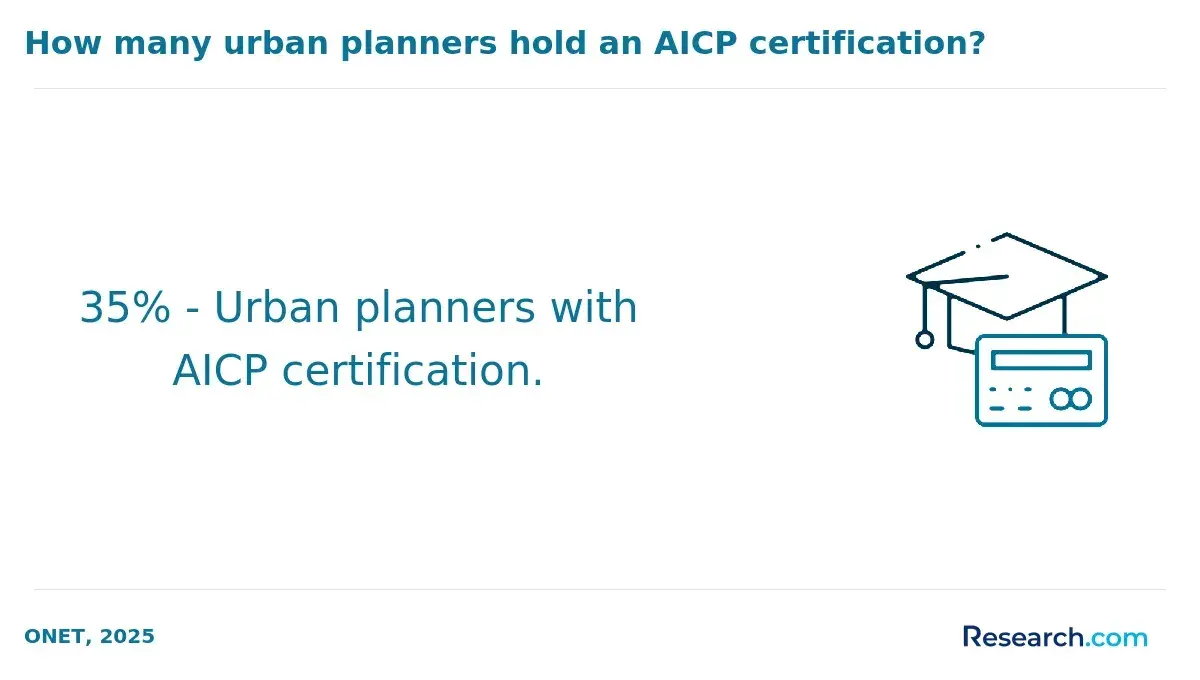
The most recognized professional credential is certification through the American Institute of Certified Planners (AICP). The AICP process involves several professional steps, including registering with AICP, passing the AICP examination, documenting professional planning experience, and completing certification maintenance after certification.
| Credential | Best for | How it can help |
| AICP certification | Professional planners seeking a nationally recognized planning credential. | Signals planning knowledge, professional experience, and commitment to continuing education. |
| Certified Economic Development (CEcD) | Planners focused on local economic development, redevelopment, and business attraction. | Can strengthen work involving economic strategy, public-private partnerships, and community investment. |
| LEED Accredited Professional | Planners involved in sustainable design, green building, and environmentally responsible development. | Demonstrates knowledge of sustainable building practices and green design principles. |
| Professional Transportation Planner (PTP) | Planners specializing in transportation systems, mobility, and infrastructure. | Supports credibility in transportation planning and mobility-focused roles. |
If your planning interests are tied to environmental systems, ecology, or conservation policy, reviewing affordable online environmental science courses may help you identify lower-cost academic options that complement urban planning preparation.
How long does it take to become an urban planner in Wisconsin?
The typical path to becoming an urban planner in Wisconsin takes about 6 to 8 years when it includes both undergraduate and graduate education. The timeline can be shorter for planning-adjacent roles that accept a bachelor’s degree and longer for students who study part time, change fields, or pursue certification after gaining experience.
| Stage | Typical time commitment | What to focus on |
| Bachelor’s degree | About 4 years | Choose a relevant major, build writing and research skills, take GIS or statistics if available, and join planning-related student groups. |
| Internship or applied experience | 3 months to a year | Work with a city, county, regional agency, nonprofit, transportation organization, or planning firm. |
| Master’s degree | Commonly 2 years of full-time study | Develop a specialization, complete studio or capstone work, and build a portfolio of planning projects. |
| AICP preparation | Several months for exam preparation | Review planning law, ethics, methods, history, public participation, and applied planning practice. |
Students who already hold a related bachelor’s degree may be able to move directly into graduate planning study. Career changers should ask admissions advisors whether previous coursework, professional experience, or transferable skills can strengthen their application.
How much do urban planners earn in Wisconsin?
Urban planner salaries in Wisconsin vary by employer, education, experience, geography, specialization, and technical skill level. Planners with graduate degrees, GIS expertise, transportation analysis skills, public finance knowledge, or management responsibilities may have stronger earning potential than entry-level candidates.
Urban and regional planners across the US had a median annual wage of $83,720, equal to $40.25 per hour. In Wisconsin, urban and regional planners had a median wage of $76,580, or $36.82 per hour. Entry-level positions may be closer to the lower end of the range, at around $52,000, while top earners take home $119,410 annually.
| Salary measure | Amount | What it means for career planning |
| US median annual wage | $83,720 | Useful for comparing Wisconsin earnings with national planning salaries. |
| US median hourly wage | $40.25 per hour | Helpful when evaluating consulting, contract, or hourly planning work. |
| Wisconsin median annual wage | $76,580 | A practical benchmark for planning roles in the state. |
| Wisconsin median hourly wage | $36.82 per hour | Provides another way to compare public, private, and regional agency roles. |
| Lower-end entry salary reference | Around $52,000 | Relevant for new graduates and early-career planning assistants. |
| Top-earner salary reference | $119,410 annually | More likely for experienced planners, specialists, supervisors, or high-responsibility roles. |
Salary should not be the only factor in deciding whether planning is worth it. Also compare tuition cost, debt, internship access, local job availability, pension or public-sector benefits, and whether the role gives you experience in a specialization that can support advancement. Students who want an environmentally focused planning path may want to compare top sustainability degree programs online as part of their education research.
What jobs can urban planners pursue in Wisconsin?
Urban planners in Wisconsin can work for city governments, counties, regional planning commissions, state agencies, consulting firms, nonprofits, housing organizations, environmental groups, and infrastructure-related employers. The right role depends on whether you prefer public meetings, research, technical analysis, design, policy writing, project management, or community outreach.
| Role | Where you might work | Common responsibilities |
| City planner | Municipal planning departments, including local governments such as Milwaukee or Madison. | Prepare land use plans, review development proposals, support zoning updates, and coordinate public input. |
| Transportation planner | Transportation agencies, regional planning bodies, consulting firms, or the Wisconsin Department of Transportation. | Analyze mobility needs, evaluate traffic and transit systems, support corridor planning, and improve accessibility. |
| Environmental planner | Government agencies, consulting firms, environmental organizations, or entities such as the Wisconsin Department of Natural Resources. | Assess environmental impacts, support conservation planning, and help projects comply with environmental rules. |
| Community development planner | Nonprofits, housing organizations, local governments, or redevelopment agencies. | Work on neighborhood revitalization, housing programs, public spaces, and community engagement. |
| Urban design planner | Planning departments, architecture-adjacent firms, landscape design teams, or redevelopment organizations. | Improve streetscapes, public spaces, site layouts, walkability, and the visual quality of the built environment. |
Entry-level job titles may include planning assistant, assistant planner, planning technician, GIS planning analyst, community development associate, transportation planning assistant, or zoning technician. With experience, planners can move into senior planner, planning manager, community development director, transportation planning lead, consultant, or agency leadership roles.
What do urban planners in Wisconsin do day to day?
Urban planners balance research, policy, public engagement, technical analysis, and coordination. Their work can change significantly from one employer to another. A municipal planner may spend more time on zoning reviews and public meetings, while a transportation planner may work heavily with data, maps, infrastructure plans, and regional agencies.
- Research demographic patterns, housing needs, land use trends, transportation issues, and environmental impacts.
- Prepare comprehensive plans, neighborhood plans, redevelopment strategies, or transportation recommendations.
- Coordinate with elected officials, residents, developers, engineers, architects, public works departments, and community organizations.
- Review development proposals for zoning, land use, environmental, and community impact considerations.
- Create maps, reports, presentations, and planning documents for public review and decision-making.
- Support revitalization projects in areas facing disinvestment, infrastructure gaps, or economic challenges.
- Monitor zoning codes, land use policies, and municipal procedures to help projects comply with local requirements.
- Use geographic information systems (GIS), data tools, and visualization software to analyze and explain planning issues.
Strong planners are not only technically capable; they are also clear communicators. Public meetings can be difficult, especially when residents are concerned about development, displacement, traffic, affordability, or environmental effects. The ability to listen, explain trade-offs, document feedback, and revise plans is central to effective planning practice.
How do business and urban planning skills work together in Wisconsin?
Urban planning projects must be socially useful, legally workable, environmentally responsible, and financially realistic. Business skills can help planners understand budgets, feasibility, market demand, procurement, stakeholder incentives, and long-term operating costs. This is especially useful for redevelopment projects, housing initiatives, infrastructure investments, and public-private partnerships.
Planners who want to move into management or project leadership may benefit from coursework in finance, accounting, economics, negotiation, project management, or organizational strategy. Comparing programs at the best business schools in Wisconsin can help planning professionals identify training that supports budgeting, market research, financial modeling, and leadership.
What digital tools support urban planning work in Wisconsin?
Digital skills are now central to planning work. GIS helps planners map parcels, transportation networks, environmental constraints, demographic patterns, and development scenarios. CAD and 3D modeling can support site design, streetscape planning, and redevelopment visualization. Data dashboards and smart city tools can help agencies monitor infrastructure, mobility, housing, and service needs.
Technology does not replace community judgment, but it can make planning decisions more transparent and evidence-based. Planners should learn how to communicate data clearly to residents and decision-makers, not just how to generate maps or models. Related fields that rely on data and community-centered decision-making, such as public health and nutrition, can offer useful perspective; for example, reviewing how to become a nutritionist in Wisconsin shows how professional training can connect technical evidence with community outcomes.
Can business training help urban planners move into leadership roles?
Business training can be valuable for planners who want to manage departments, lead consulting teams, negotiate development agreements, or oversee complex public projects. Planning leaders often need to explain costs, compare alternatives, justify funding requests, manage contracts, and coordinate multiple stakeholders.
An accelerated MBA program may be worth considering for experienced planners who already have technical planning knowledge but want stronger management, finance, and strategy skills. This type of training is most useful when it directly supports a planner’s career goal, such as municipal leadership, consulting, real estate development, transportation management, or nonprofit executive work.
How can interdisciplinary training improve planning decisions?
Planning decisions often require evidence from several fields. Environmental science, public policy, engineering, sociology, economics, law, health, and data analysis can all influence whether a plan succeeds. Interdisciplinary training helps planners ask better questions, evaluate risks more carefully, and avoid designing solutions that only work on paper.
For example, investigative and evidence-review methods used in technical fields can sharpen site analysis, infrastructure assessment, and risk evaluation. Students interested in that type of analytical approach can explore how a forensic science degree in Wisconsin develops careful documentation, evidence interpretation, and problem-solving skills.
How are urban planning projects funded in Wisconsin?
Urban planning projects in Wisconsin may be supported by municipal budgets, municipal bonds, federal and state grants, public-private partnerships, nonprofit funding, developer contributions, and regional agency resources. The funding structure depends on the project type, location, public benefit, timeline, and legal authority of the sponsoring organization.
Planners do not always control financing, but they often help define project scope, document need, support grant applications, estimate community benefits, and explain trade-offs to the public. Skills in proposal writing, market analysis, and public finance can make a planner more effective. Students who want to understand the business side of development can review topics connected to business and marketing salary when evaluating how economic knowledge may complement planning work.
How can planners work with health professionals?
Urban planning affects health through housing, transportation, walkability, parks, environmental exposure, food access, noise, safety, and access to services. Collaboration with health professionals can help planners design communities that support mobility, communication, independence, and public well-being.
For example, understanding accessibility and communication needs can help planners improve public facilities, meeting spaces, transit stops, schools, and community centers. Reviewing speech pathologist requirements in Wisconsin can give planners a better sense of how professional training addresses communication barriers and inclusive service environments.
What trends are changing urban planning in Wisconsin?
Several trends are influencing urban planning work in Wisconsin. Planners are increasingly expected to use data tools, address infrastructure needs, consider environmental resilience, support housing affordability, and design more inclusive public processes. Smart city technology, GIS-based analysis, adaptive reuse, green infrastructure, and cross-sector collaboration are becoming more important in many planning contexts.
Financial literacy is also becoming more valuable because many planning recommendations must compete for limited public resources. Professionals who understand budgeting, tax implications, cost-benefit analysis, and long-term maintenance can communicate more effectively with elected officials and finance departments. For planners who want stronger financial skills, learning more about how to become an accountant in Wisconsin can clarify how accounting knowledge supports responsible project planning.
How can planners collaborate with social workers?
Planning and social work overlap in areas such as housing stability, homelessness response, neighborhood revitalization, public safety, accessibility, aging services, and community well-being. Social workers can help planners understand lived experience, service gaps, displacement risks, and barriers faced by vulnerable residents.
Collaboration is especially useful when planning affordable housing, transit access, community facilities, or neighborhood redevelopment. Planners can use insights from social worker education requirements in Wisconsin to better understand how social service professionals are trained to assess needs, coordinate services, and advocate for individuals and communities.
How can financial expertise improve planning projects?
Financial expertise helps planners turn community goals into fundable and sustainable projects. Budgeting, cost estimation, grant management, risk assessment, lifecycle cost analysis, and capital planning all affect whether a project can move from concept to implementation.
Planners who work on redevelopment, transportation, utilities, housing, or public facilities may benefit from formal accounting or finance coursework. Exploring the best accounting schools in Wisconsin can help professionals identify academic options that strengthen fiscal analysis and public accountability skills.
What continuing education options are useful for Wisconsin planners?
Urban planners need continuing education because laws, technology, funding programs, public expectations, and environmental conditions change. Useful professional development options include AICP certification maintenance, APA events, GIS workshops, zoning seminars, public engagement training, grant writing courses, leadership programs, and university-based certificates.
Planners who work closely with regulations, public records, hearings, contracts, or land use procedures may also benefit from legal and policy training. Reviewing how to become a paralegal in Wisconsin can help planners understand how legal research, documentation, and procedural knowledge support regulatory work.
What policy challenges do Wisconsin planners face?
Wisconsin planners often work within complex local and state policy environments. Common challenges include land use conflicts, zoning reform, environmental review, affordable housing constraints, infrastructure maintenance, transportation access, economic redevelopment, public opposition to development, and balancing growth with natural resource protection.
Policy work also requires attention to social impacts. Housing, transportation, and land use decisions can affect access to jobs, schools, health care, and public services. Planners who want a deeper understanding of social systems can review social worker degree requirements in Wisconsin to see how related professionals are trained to evaluate community needs and support vulnerable populations.
Is becoming an urban planner in Wisconsin worth it?
Urban planning can be worth it if you want a career that combines public service, policy, research, design, infrastructure, and community engagement. It may be especially rewarding for people who want their work to affect real places: streets, neighborhoods, parks, housing, transit, downtowns, and public spaces.
| This path may be a good fit if you... | Consider another path if you... |
| Enjoy solving community problems that involve many stakeholders. | Prefer work with clear right-or-wrong answers and limited public debate. |
| Can balance data, policy, design, budgets, and public input. | Want a career that is mostly independent and rarely involves meetings. |
| Care about housing, transportation, sustainability, infrastructure, or land use. | Are not interested in local government, regulation, or community process. |
| Are willing to build technical skills such as GIS, research, writing, and presentation. | Do not want to write reports, explain trade-offs, or revise proposals based on feedback. |
The biggest trade-off is that planning work can be slow and politically sensitive. Projects may take years, and not every recommendation is adopted. However, for people who value long-term public impact, the career can offer meaningful work and diverse specialization options.
How to choose an urban planning program in Wisconsin
Choosing the right program matters because planning education should build both technical ability and professional judgment. Use the questions below before enrolling.
- Accreditation: Is the institution properly accredited, and does the planning program have the academic reputation and employer connections you need?
- Curriculum: Does the program include land use, planning law, GIS, public engagement, sustainability, transportation, and applied planning studios?
- Internship support: Does the school help students connect with city agencies, regional commissions, consulting firms, or nonprofits?
- Faculty expertise: Do professors work in your area of interest, such as transportation, housing, environmental planning, or community development?
- Format: Can you attend full time, part time, online, hybrid, or in person based on your work and family responsibilities?
- Cost: What is the total cost after fees, books, transportation, housing, and lost work time, not just tuition?
- Career outcomes: Where do graduates work, and how quickly do they move into planning-related roles?
- Portfolio opportunities: Will you graduate with maps, reports, studio projects, policy memos, or public presentations you can show employers?
Common mistakes to avoid when preparing for a Wisconsin planning career
| Mistake | Why it can hurt you | Better approach |
| Choosing a program based only on tuition. | A low-cost program may not offer the specialization, internship access, or technical training you need. | Compare total cost, curriculum strength, experiential learning, and employer connections. |
| Ignoring accreditation and institutional credibility. | Employers and graduate schools may question weak or unrecognized credentials. | Verify accreditation before enrolling and ask how the degree is viewed by planning employers. |
| Waiting until graduation to look for experience. | Planning jobs often favor applicants with internships, studio work, public meeting exposure, or GIS projects. | Seek internships, volunteer planning board exposure, research assistant roles, or community projects early. |
| Assuming planning is only design work. | Many roles involve policy writing, zoning, data analysis, meetings, and public process. | Shadow planners, read local plans, and review job descriptions before committing. |
| Underestimating communication skills. | Even strong technical plans can fail if the public and decision-makers do not understand them. | Practice writing concise reports, presenting maps, facilitating meetings, and explaining trade-offs. |
| Relying only on rankings. | A highly ranked program may not match your specialization, location, schedule, or budget. | Use rankings as one input, then compare fit, outcomes, cost, and practical experience. |
What scholarships are available for urban planning students in Wisconsin?
Scholarships and grants can reduce the cost of becoming an urban planner, especially for students pursuing graduate study. Availability, eligibility, and award amounts can change, so students should confirm details directly with the organization or university before applying.
- Wisconsin Chapter of the American Planning Association (APA) Scholarship: This scholarship supports Wisconsin residents who graduated from a public high school in the state. Selection considers financial need, academic performance, and community service for students pursuing urban and regional planning education.
- University of Wisconsin-Milwaukee School of Architecture & Urban Planning (SARUP) Scholarships: UW-Milwaukee SARUP offers scholarships for undergraduate and graduate students that can cover part of tuition costs.
To improve your chances, prepare a strong statement of purpose, document community involvement, request recommendations early, and show how your planning goals connect to Wisconsin communities. Students exploring adjacent academic routes into infrastructure or urban development may also want to compare the least difficult engineering programs while considering how engineering-related coursework could support planning work.
Where can students find urban planning internships in Wisconsin?
Internships are one of the best ways to test whether urban planning fits your interests. They also help you build a portfolio, learn local procedures, understand public meetings, and meet professionals who may later know about job openings. Some opportunities are posted publicly, but others require direct outreach to agencies, firms, faculty, or professional organizations.
- Wisconsin Department of Transportation (WisDOT): Students interested in transportation planning may find opportunities related to traffic analysis, land use coordination, mobility planning, and environmental review.
- Milwaukee Metropolitan Sewerage District (MMSD): Internships may connect planning students with water resource management, stormwater planning, urban infrastructure, and green infrastructure projects.
- Center for Urban Initiatives and Research (CUIR): Students may gain experience with research, data analysis, local government collaboration, and community engagement projects.
When applying, include a writing sample, GIS or mapping examples if you have them, and a short explanation of the planning issues you care about. If your academic background is not directly in planning, show transferable skills such as research, communication, statistics, design, public service, or environmental analysis. Students still comparing flexible education options may also review online degrees with easy majors while deciding how to balance school, work, and experience.
Which professional organizations should Wisconsin urban planners join?
Professional organizations help students and early-career planners find mentors, attend workshops, learn about job openings, understand planning practice, and stay current on policy and technical issues. Membership is not a substitute for education or experience, but it can make the career path easier to navigate.
| Organization or resource | Who it serves | Career value |
| American Planning Association (APA) Wisconsin Chapter | Planning professionals, students, public agencies, and related practitioners in Wisconsin. | Offers networking, conferences, workshops, professional visibility, and planning practice resources. |
| Wisconsin Student Planning Association (WSPA) | Planning students at UW-Madison. | Supports social connection, professional development, events, and the transition from school to practice. |
| Southeastern Wisconsin Regional Planning Commission (SEWRPC) | Regional planning stakeholders in southeastern Wisconsin. | Provides exposure to cross-jurisdictional planning, regional data, and metropolitan planning issues. |
| Private planning firms in Wisconsin | Students and professionals seeking consulting experience. | May offer internships, project exposure, client-facing work, and specialized planning experience. |
To get more value from membership, do more than list the organization on your resume. Attend events, ask informed questions, volunteer for committees, request informational interviews, and follow up with professionals after conferences or workshops.
What urban planners in Wisconsin say about their careers
- "Planning in Wisconsin has allowed me to connect sustainability goals with the everyday needs of communities. The most satisfying part is seeing public spaces, transportation improvements, and neighborhood plans become real benefits for residents." - Charlie
- "The work is collaborative by nature. You learn from residents, engineers, elected officials, developers, and community advocates, and the best projects are the ones shaped by that mix of voices." - Lauren
- "Urban planning here gives professionals a chance to balance growth with environmental responsibility. The work can be complex, but improving public spaces and supporting stronger communities makes it worthwhile." - Kimberly
Related Articles for Nearby States
- 2027 How to Become an Urban Planner in Minnesota
- 2027 How to Become an Urban Planner in Iowa
- 2027 How to Become an Urban Planner in Illinois
- 2027 How to Become an Urban Planner in Michigan
- 2027 How to Become an Urban Planner in Indiana
- 2027 How to Become an Urban Planner in Missouri
- 2027 How to Become an Urban Planner in Ohio
- 2027 How to Become an Urban Planner in South Dakota
- 2027 How to Become an Urban Planner in Nebraska
- 2027 How to Become an Urban Planner in Kentucky
Key Insights
- Wisconsin does not require a state license for urban planners, but AICP certification and specialty credentials can strengthen professional credibility.
- The common education path is a bachelor’s degree followed by a planning-related master’s degree, with the full preparation timeline often taking 6 to 8 years.
- Urban and regional planners in Wisconsin earned a median annual wage of $76,580, compared with the national median annual wage of $83,720.
- The best specialization depends on your interests: transportation, environmental planning, community development, sustainable development, and urban design all lead to different day-to-day work.
- Internships, GIS skills, public engagement experience, and a strong portfolio can matter as much as the degree title when competing for early-career planning jobs.
- Business, finance, legal, health, and social service knowledge can make planners more effective because land use decisions affect budgets, regulations, accessibility, housing, infrastructure, and community well-being.
- Before enrolling in a program, compare accreditation, cost, internship access, curriculum, faculty expertise, and graduate outcomes rather than relying only on rankings or tuition price.
References:
- American Society of Civil Engineers. (2024). 2024 Wisconsin Infrastructure Report Card. https://infrastructurereportcard.org/state-item/wisconsin
- Infinity Market Research. (2025, September 26). Global urban planning service market growth and outlook 2025-31. https://infinitymarketresearch.com/report/urban-planning-service-market/9138
- ONET Online. (2025, December 15). 19-3051.00 - Urban and regional planners. https://www.onetonline.org/link/summary/19-3051.00
- ONET Online. (2025, December 16). Wisconsin Employment Trends 19-3051.00 - Urban and Regional Planners. https://www.onetonline.org/link/localtrends/19-3051.00?st=WI
- University of Wisconsin Eau Claire. (n.d.). Urban and Regional Planning, Certificate. https://catalog.uwec.edu/undergraduate/arts-sciences/geography-anthropology/urban-regional-planning
- Urban Planning Degree. (n.d.). How to Become an Urban Planner in Wisconsin. https://urbanplanningdegree.com/wisconsin
- U.S. Bureau of Labor Statistics. (2025, August 28). Urban and regional planners. Occupational Outlook Handbook. https://www.bls.gov/ooh/life-physical-and-social-science/urban-and-regional-planners.htm
- U.S. Bureau of Labor Statistics. (2024). Occupational Employment and Wage Statistics - May 2024 Wisconsin. Retrieved February 2026, from https://data.bls.gov/oes/#/area/5500000
- Zippia. (2026). Urban planner demographics and statistics in the United States. https://www.zippia.com/urban-planner-jobs/demographics
Other Things to Know About Becoming an Urban Planner in Wisconsin
To become an urban planner in Wisconsin in 2027, you'll need a bachelor's degree in urban planning or a related field. Many employers prefer candidates with a master's degree in urban or regional planning. Additionally, relevant internships and practical experience can significantly enhance job prospects.
Pursuing a career in urban planning in Wisconsin can be a rewarding choice for those passionate about shaping communities and enhancing quality of life. The state offers a unique blend of urban and rural environments, providing planners with diverse challenges and opportunities.
Overall, a career in urban planning in Wisconsin not only allows individuals to make a tangible impact on their communities but also offers a fulfilling professional path in a state committed to thoughtful and sustainable development.