
2027 How to Become an Urban Planner in Florida

Co-Founder and Chief Data Scientist
Becoming an urban planner in Florida means preparing for one of the state’s most practical public-service careers: helping communities decide where housing, roads, businesses, parks, transit, utilities, and protected land should go. The work matters because Florida combines fast-growing metro areas, coastal risk, tourism pressure, housing affordability concerns, and fragile ecosystems. With 91.5% of Florida’s population living in urban areas, planners are central to how the state grows without losing livability.
This guide explains how to become an urban planner in Florida, including education requirements, certification options, likely timelines, salary expectations, specializations, internships, scholarships, professional organizations, and the skills that can help you compete for planning roles. It is designed for students, career changers, and early-career professionals comparing planning with related fields such as environmental science, sustainability, public policy, transportation, and community development.
Quick Answer: How Do You Become an Urban Planner in Florida?
Most urban planners in Florida start with a bachelor’s degree in urban planning, geography, environmental science, public policy, sustainability, or a related field, then pursue a master’s degree in urban and regional planning to improve career options. Florida does not require a state urban planning license, but many professionals pursue American Institute of Certified Planners (AICP) certification after gaining qualifying experience. Internships, GIS skills, community engagement experience, and knowledge of Florida land use, transportation, environmental, and resilience issues can make candidates more competitive.
Key Things to Know About Becoming an Urban Planner in Florida
- The average annual salary for urban planners in Florida is $69,850.
- Highly experienced urban planners in the state can earn upwards of $106,870 annually.
- Florida’s living wage is $57,064, and urban planners earn above this benchmark on average.
- The projected employment of urban planners in Florida by 2030 is 3,550 employees.
- The projected growth of urban planners in Florida through 2032 is 14%.
- Education requirements for urban planners in Florida
- Urban planning specializations in Florida
- Licensing and certification requirements
- How long the career path takes
- Urban planner salary in Florida
- Career paths for Florida urban planners
- Typical responsibilities of urban planners
- Business strategy and urban planning
- Emerging trends affecting planners
- International business ideas in planning
- Important skills for Florida planners
- Business management skills for planning careers
- Cross-disciplinary expertise in planning
- Accounting skills and planning work
- Social services collaboration
- Financial literacy and project budgeting
- Scholarships for urban planning students
- Internships and practical experience
- Professional organizations for urban planners
- Career perspectives from Florida planners
What are the education requirements for urban planners in Florida?
Florida urban planners usually need formal training in land use, transportation, environmental policy, data analysis, community engagement, and public decision-making. A bachelor’s degree may qualify some candidates for planning assistant or technician roles, but a master’s degree is often the stronger credential for long-term advancement, especially in local government, consulting, transportation, environmental planning, and regional planning agencies.
| Education step | Why it matters | Best fit for |
| Bachelor’s degree in urban planning, geography, environmental science, public policy, sustainability, or a related field | Builds a foundation in cities, land use, environmental systems, research, mapping, policy, and public administration. | Students seeking entry-level planning support roles or preparing for graduate study. |
| Master’s degree in urban and regional planning | Provides advanced preparation in planning law, comprehensive planning, transportation, housing, resilience, and applied studio work. | Candidates who want stronger access to planner, senior planner, policy, and consulting roles. |
| Internship, studio project, or field placement | Shows employers that you can apply planning concepts to real communities, documents, meetings, and public processes. | Students who need practical experience before applying for full-time planning jobs. |
| Professional certification or specialized credential | Can strengthen credibility in planning, sustainability, floodplain management, or economic development. | Working professionals who want advancement, specialization, or broader employer recognition. |
Students should look for coursework in land use planning, zoning, planning law, urban design, GIS, transportation planning, environmental policy, housing policy, public finance, community engagement, and coastal or resilience planning. Florida’s planning challenges are highly place-specific, so courses involving sea-level risk, wetlands, disaster planning, tourism, growth management, and infrastructure can be especially useful.
Florida Atlantic University and Florida State University are recognized for accredited master’s programs in this field. Students comparing related undergraduate options may also consider programs in environmental science or sustainability; for example, Research.com’s guide to low-cost online environmental science degrees can help readers evaluate adjacent academic paths.
Who should consider a master’s degree?
A master’s degree makes the most sense if you want to compete for professional planner roles, work in a specialized planning area, pursue AICP certification later, or move into supervisory positions. It may be less urgent if you already have substantial government, GIS, engineering, public policy, or environmental experience and are targeting an entry-level planning support role first.
What urban planning specializations are available in Florida?
Urban planning is not one single job. In Florida, planners often specialize because the state’s needs vary widely by region: coastal cities may prioritize resilience and flood risk, inland communities may focus on growth and transportation, and major metro areas may need housing, redevelopment, and transit planning.
| Specialization | What planners focus on | Why it matters in Florida |
| Transportation planning | Traffic patterns, road safety, transit systems, mobility planning, pedestrian and bicycle access, and infrastructure coordination. | Population growth, tourism, congestion, and regional commuting patterns create continuing demand for mobility solutions. |
| Environmental planning | Environmental review, conservation strategies, natural resource protection, development impacts, and sustainability policies. | Florida’s wetlands, coasts, habitats, and climate exposure require careful balancing of development and preservation. |
| Disaster and emergency planning | Risk reduction, evacuation planning, flood mitigation, hurricane preparedness, recovery coordination, and resilient infrastructure. | Hurricanes, flooding, and coastal vulnerability make resilience planning a core public safety function. |
| Sustainable development planning | Green infrastructure, compact development, energy-conscious design, open space, redevelopment, and long-term livability. | Communities need growth strategies that support economic activity without creating avoidable environmental or infrastructure strain. |
A transportation planner in Florida may spend time reviewing crash data, modeling future travel demand, coordinating with transit agencies, and presenting recommendations to elected officials. An environmental planner may analyze development proposals, coordinate with environmental agencies, and help communities protect natural assets. A disaster planning specialist may focus on evacuation routes, floodplain policies, and recovery frameworks after storms.
The best specialization depends on your strengths. Choose transportation if you like data, systems, and infrastructure. Choose environmental or resilience planning if you want to work at the intersection of land use, climate risk, and resource protection. Choose community development if you are drawn to housing, neighborhood revitalization, equity, and public engagement.
Are there licensing requirements for urban planners in Florida?
Florida does not have a state-specific licensure or registration requirement for urban planners. That means you do not need a Florida planning license to work in the field in the same way that certain professions require state licensure. However, credentials still matter. Many employers value national certification, specialized technical skills, graduate education, and relevant experience.
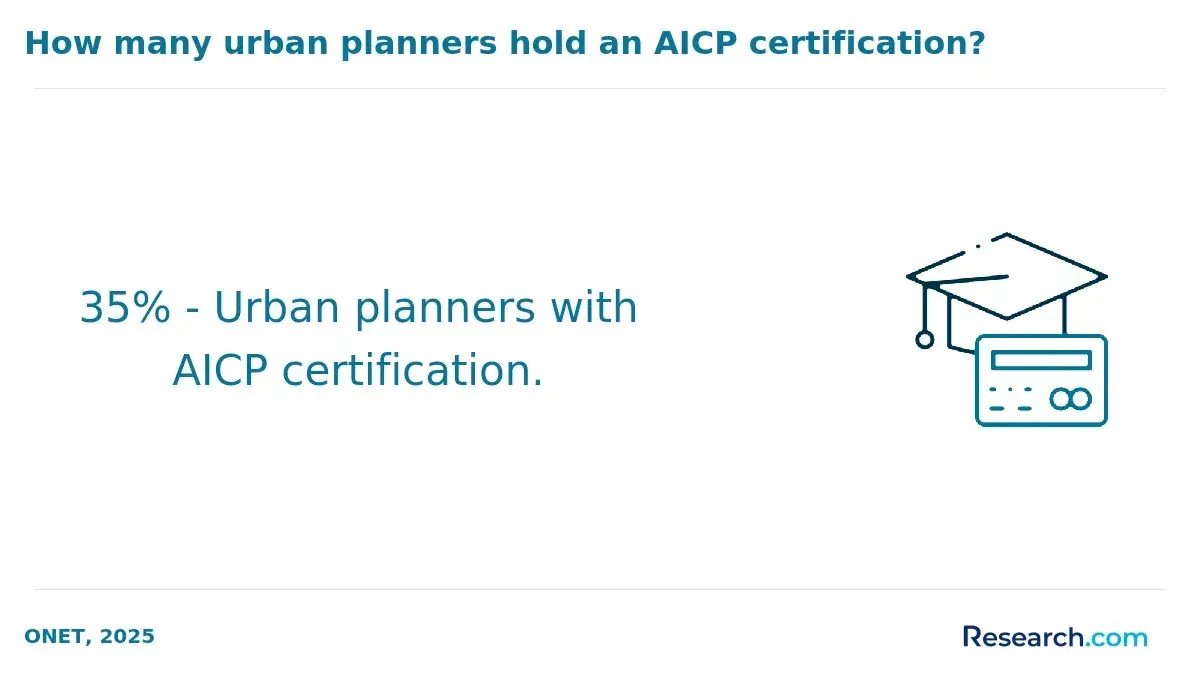
The most recognized professional credential is certification through the American Institute of Certified Planners (AICP). The AICP pathway requires candidates to register, meet education and experience standards, pass the AICP exam, and maintain certification through continuing professional development. While AICP certification is not mandatory for every job, it can help demonstrate professional competence and commitment to planning standards.
| Credential | Best for | How it can help |
| AICP certification | Professional planners seeking stronger recognition and advancement | Signals planning knowledge, professional experience, and commitment to continuing education. |
| LEED Accredited Professional | Planners working on sustainable buildings, green development, or environmentally responsible design | Supports work on sustainability-focused development and green infrastructure conversations. |
| Certified Economic Development (CEcD) | Professionals involved in redevelopment, business attraction, and local economic strategy | Adds credibility when planning work overlaps with economic development and investment strategy. |
| Certified Floodplain Manager (CFM) | Planners working in flood-prone coastal or inland communities | Strengthens expertise in floodplain regulation, mitigation, and risk reduction. |
Students should not assume that certification replaces education or experience. AICP and specialty credentials are most useful when combined with strong planning fundamentals, fieldwork, writing ability, public meeting experience, and knowledge of Florida’s planning context.
How long does it take to become an urban planner in Florida?
The typical route to becoming an urban planner in Florida takes about six to eight years, depending on whether you pursue graduate school immediately, work between degrees, or enter the field through a related discipline.
| Stage | Typical time | What you should accomplish |
| Bachelor’s degree | About four years | Study planning, geography, environmental science, sustainability, public policy, economics, or a related field; begin learning GIS and research methods. |
| Master’s degree | About two years | Complete advanced planning coursework, studio projects, policy analysis, and applied planning assignments. |
| Internship or field experience | Three months to a year | Work with a planning agency, local government, consulting firm, transportation organization, nonprofit, or research center. |
| AICP certification preparation | Often after gaining relevant work experience | Build qualifying experience, prepare for the exam, and document professional planning work. |
Some students shorten the path by choosing accelerated programs, transferring credits, or gaining planning-related work experience during school. Others take longer because they work part time, change fields, or complete graduate school while employed. Online and hybrid programs may increase flexibility, but students should still confirm whether the curriculum provides applied planning experience, faculty support, and relevant internship connections.
How much do urban planners in Florida earn?
Urban planner pay in Florida varies by employer, location, specialization, years of experience, education level, and technical skill set. Government agencies, transportation organizations, consulting firms, environmental organizations, and regional planning bodies may use different pay structures.
| Career level | Annual salary in Florida | What this may represent |
| Entry-level urban planner | Around $45,690 | Planner assistant, junior planner, planning technician, or early-career role with limited independent project responsibility. |
| Average urban planner | $69,850 | Professional planner with stronger project, policy, review, or community engagement responsibilities. |
| Highly experienced urban planner | Upwards of $106,870 | Senior planner, planning manager, specialized consultant, or professional with advanced expertise and leadership duties. |
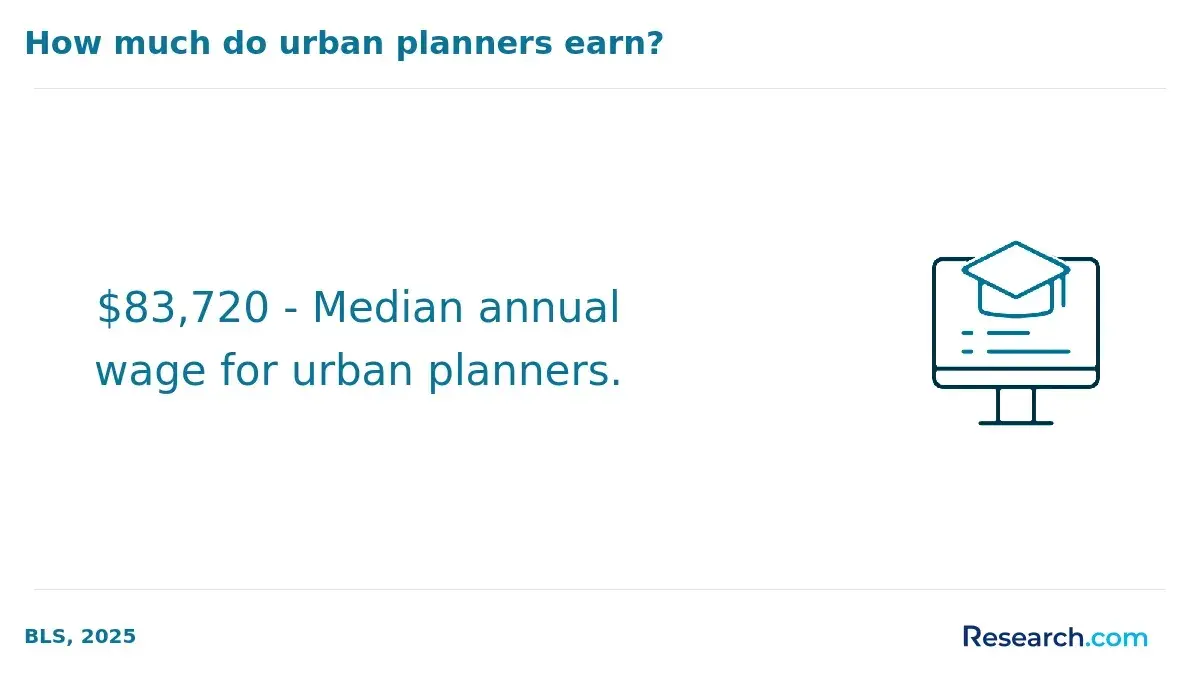
The average annual salary for urban planners in Florida is $69,850, which is about 15% higher than the national average. Florida’s living wage is $57,064, so the average planner salary is above that figure. However, salary outcomes are not guaranteed. A planner working in a smaller jurisdiction may earn differently from one working in a large metro area, transportation agency, or private consulting firm.
Students interested in sustainability-oriented planning work may find useful context in Research.com’s guide to an online bachelor’s degree in sustainability and its overview of sustainability career paths.
Is urban planning in Florida worth it?
Urban planning can be worth it if you want a career that combines public policy, design, data, environmental concerns, and community impact. It is a strong fit for people who enjoy solving complex problems, presenting ideas to different audiences, and working within public decision-making systems. It may not be ideal if you want a purely technical role with little public interaction, a career with immediate high earnings, or work that avoids political and community conflict.
What careers are available to urban planners in Florida?
Urban planning graduates in Florida can work in local government, county planning departments, transportation agencies, environmental organizations, regional planning councils, nonprofit community development groups, and private consulting firms. Titles vary, but many positions involve reviewing development proposals, preparing plans, managing public input, analyzing data, and helping communities make long-term land use decisions.
| Career path | Common employers | Typical focus |
| City planner | Municipal planning departments, city governments, county agencies | Zoning, land use reviews, comprehensive plans, development proposals, and public hearings. |
| Transportation planner | Florida Department of Transportation, metropolitan planning organizations, transit agencies, consulting firms | Mobility, road networks, transit access, safety, congestion, and long-range transportation planning. |
| Environmental planner | Florida Department of Environmental Protection, environmental consulting firms, local governments | Development impacts, conservation, environmental review, resource protection, and sustainability policy. |
| Community development planner | Nonprofits, community development corporations, housing agencies, local governments | Neighborhood revitalization, public engagement, housing needs, equity, and redevelopment strategies. |
| Regional planner | Regional planning councils and metropolitan agencies | Issues that cross city and county boundaries, including transportation, land use, resilience, and economic development. |
The City of Miami, the City of Orlando, Jacksonville, Tampa, and other Florida communities may need planners for development review, zoning, redevelopment, and infrastructure coordination. Candidates who can combine planning knowledge with GIS, writing, public speaking, and policy analysis are often better prepared for these roles.
What are the typical responsibilities of urban planners in Florida?
Urban planners in Florida help communities decide how land should be used and how growth should be managed. Their daily work depends on the employer and specialization, but most planning roles require research, policy writing, stakeholder communication, technical review, and public process management.
- Analyze population trends, land use patterns, housing demand, transportation needs, and environmental constraints.
- Prepare or update comprehensive plans, zoning policies, corridor plans, redevelopment plans, and neighborhood plans.
- Review development applications for consistency with local rules, environmental concerns, and community goals.
- Coordinate with elected officials, planning boards, engineers, architects, environmental specialists, developers, residents, and advocacy groups.
- Use GIS, mapping, surveys, demographic data, and planning software to support recommendations.
- Evaluate transportation systems, public transit needs, pedestrian safety, and access to jobs, schools, services, and public spaces.
- Integrate flood risk, hurricane preparedness, resilience, and climate adaptation into planning documents.
- Support public meetings, workshops, hearings, and community engagement activities.
- Help enforce zoning rules and interpret land development codes.
- Balance economic development, housing needs, environmental protection, cultural resources, and quality of life.
Because Florida communities face both rapid development and environmental limits, planners are often asked to help reconcile competing priorities. A single project may involve housing affordability, wetland protection, traffic impacts, neighborhood concerns, stormwater management, and long-term fiscal costs.
How can incorporating business strategies elevate urban planning in Florida?
Business knowledge can make urban planners more effective because many planning decisions involve budgets, investment, redevelopment, infrastructure costs, and public-private partnerships. A planner who understands market demand, project feasibility, cost-benefit thinking, and funding constraints can better evaluate whether a proposal is realistic, not just whether it looks good on paper.
This does not mean urban planners need to become business executives. It means they should understand how development economics, municipal finance, grants, capital improvement planning, and private investment affect community outcomes. Students who want a stronger foundation in these areas may compare planning with programs listed among the best business schools in Florida.
What emerging trends should urban planners in Florida prepare for?
Florida planners should expect the field to keep shifting toward resilience, data-informed decision-making, housing policy, transportation modernization, and interdisciplinary public health thinking. Communities are asking planners to do more than assign land uses; they want plans that respond to flooding, heat, infrastructure strain, affordability, mobility, and access to essential services.
- Climate resilience: More planning work is likely to involve flood mitigation, storm preparedness, coastal adaptation, and resilient infrastructure.
- Smart city and data tools: Planners increasingly use mapping, dashboards, scenario modeling, and digital public engagement tools to support decisions.
- Housing and redevelopment pressure: Fast-growing areas need strategies for housing supply, affordability, infill development, and neighborhood stability.
- Transportation and mobility change: Communities must coordinate road safety, transit, pedestrian access, tourism movement, and regional commuting needs.
- Health and food systems awareness: Urban design can affect access to parks, healthy food, healthcare, walkability, and community well-being. Readers interested in public health-adjacent careers can also review Research.com’s guide on how to become a nutritionist in Florida.
How can international business insights drive urban planning innovations in Florida?
Florida’s global connections can influence planning through tourism, ports, trade, migration, investment, and international development models. Planners who understand global market patterns may be better prepared to evaluate large-scale redevelopment, logistics districts, waterfront investment, and public-private partnerships.
International business knowledge is most useful when it supports practical planning questions: Who is investing in a district? How might global tourism shape transportation demand? What risks could affect infrastructure financing? How can cities learn from planning models used elsewhere while still respecting local needs? Professionals who want that broader lens may explore international business degree programs online.
What key skills do urban planners in Florida need?
Strong Florida planners combine technical, analytical, legal, financial, and communication skills. The work is rarely limited to drawing maps. Planners must explain trade-offs, defend recommendations, listen to residents, interpret regulations, and coordinate with professionals who may view the same project from very different perspectives.
| Skill area | Why it matters | How to build it |
| GIS and spatial analysis | Planning decisions depend on location, access, hazards, land use, infrastructure, and demographic patterns. | Take GIS courses, complete mapping projects, and build a portfolio with real planning examples. |
| Policy writing | Planners prepare staff reports, ordinances, comprehensive plan language, and public recommendations. | Practice clear memo writing, policy briefs, and plan summaries. |
| Community engagement | Public input can shape whether a plan is trusted, revised, delayed, or approved. | Volunteer at meetings, support workshops, and learn facilitation methods. |
| Environmental and resilience literacy | Florida planning often intersects with flooding, wetlands, hurricanes, conservation, and infrastructure risk. | Study environmental policy, hazard mitigation, sustainability, and floodplain management. |
| Project management | Planning projects require timelines, budgets, consultants, public meetings, and deliverables. | Manage student projects, internships, or cross-functional assignments. |
| Investigative and risk analysis | Planners often need to evaluate evidence, identify inconsistencies, and anticipate community impacts. | Related analytical fields can offer useful models; for example, Research.com explains the path to a forensic science degree in Florida. |
How Can Business Management Skills Contribute to Urban Planning Success in Florida?
Business management skills help planners understand how projects move from idea to implementation. Strategic budgeting, risk assessment, procurement, staffing, performance measurement, and stakeholder management can all affect whether a plan produces real results.
This is especially important when planners work on capital projects, downtown redevelopment, infrastructure upgrades, resilience grants, or public-private partnerships. Readers who want a broader explanation of management concepts can start with Research.com’s overview of what business management is.
Can Cross-Disciplinary Expertise Empower Urban Planning Careers in Florida?
Yes. Urban planning benefits from professionals who can connect land use with housing, public health, engineering, social services, finance, environmental science, communication, and law. Cross-disciplinary knowledge can help planners ask better questions and design more inclusive processes.
For example, communication-focused fields can teach planners how to reach residents with different needs, abilities, and language backgrounds. Research.com’s guide to speech pathologist requirements in Florida is not a planning credential, but it illustrates how specialized communication knowledge can support more accessible engagement practices.
Could a Background in Accounting Benefit My Urban Planning Career?
An accounting background can be valuable for planners who work with infrastructure funding, grants, impact fees, redevelopment budgets, capital improvement plans, or public-private partnerships. Planning recommendations often depend on whether a local government can pay for roads, utilities, parks, stormwater systems, and long-term maintenance.
Accounting knowledge is not required for every planning role, but it can help professionals read budgets, evaluate funding assumptions, and communicate with finance departments. Career changers who already have financial experience can review Research.com’s guide on how to become an accountant in Florida to understand how that skill set differs from and can complement planning work.
How Can Urban Planners Collaborate with Social Services to Enhance Community Outcomes in Florida?
Urban planning and social services often overlap. Housing location, transit access, neighborhood safety, parks, walkability, public facilities, and access to healthcare can all influence community well-being. Planners who collaborate with social service agencies can better understand how land use decisions affect residents with limited income, disabilities, aging needs, transportation barriers, or housing instability.
Partnerships with social service professionals can improve public engagement, identify underserved areas, and support more equitable resource allocation. Readers interested in the human-services side of community work may find Research.com’s overview of social worker education requirements in Florida useful for comparison.
How Can Financial Literacy and Strategic Budgeting Enhance Urban Planning Projects in Florida?
Financial literacy helps planners move beyond vision statements and into implementation. A plan that does not account for funding, phasing, maintenance, staffing, and long-term public costs may be difficult to carry out. Strategic budgeting helps planners prioritize projects, defend recommendations, and communicate trade-offs to elected officials and residents.
Important finance-related planning tasks can include estimating project costs, comparing funding sources, preparing grant narratives, coordinating capital improvements, evaluating fiscal impacts, and supporting public-private partnership negotiations. Professionals who want deeper preparation in finance can compare options in Research.com’s guide to the best accounting schools in Florida.
Common mistakes to avoid when preparing for an urban planning career in Florida
| Mistake | Why it can hurt you | Better approach |
| Choosing a program only because it is convenient | You may miss key planning coursework, applied studio experience, or internship connections. | Compare curriculum, faculty expertise, career outcomes, internship access, and planning accreditation where relevant. |
| Ignoring GIS and data skills | Many planning jobs require mapping, spatial analysis, and evidence-based recommendations. | Build a portfolio with maps, reports, and applied planning projects. |
| Assuming certification is required before entry-level work | You may delay job applications unnecessarily. | Understand that Florida has no state planning license requirement, while AICP is typically pursued after qualifying experience. |
| Focusing only on environmental issues and avoiding policy | Planning requires zoning, legal review, public process, and political decision-making. | Study both environmental systems and the rules that govern land development. |
| Underestimating public communication | Even strong technical recommendations can fail if residents and officials do not understand them. | Practice presentations, public meeting support, facilitation, and plain-language writing. |
| Relying only on rankings or school reputation | A highly ranked school may not be the best fit for your specialization, cost, or location goals. | Ask programs about internships, employer partnerships, alumni roles, transfer policies, and assistantships. |
How to choose the right urban planning program in Florida
- Start with your career goal. Decide whether you are more interested in transportation, environmental planning, resilience, housing, community development, urban design, or policy.
- Review the curriculum carefully. Look for planning law, GIS, land use, transportation, environmental policy, housing, research methods, and studio-based courses.
- Ask about internships. A strong internship can matter as much as coursework when applying for planning jobs.
- Compare total cost, not just tuition. Include fees, transportation, housing, technology, books, and lost work time.
- Look for assistantships and scholarships. Graduate assistantships, fellowships, and department awards can reduce costs.
- Check career placement support. Ask where recent graduates work and whether the program has relationships with local governments, agencies, or consulting firms.
- Evaluate flexibility. If you are working, ask about evening, online, hybrid, or part-time options.
- Confirm transfer and prerequisite policies. Career changers should ask whether prior coursework or professional experience can strengthen admission or reduce repetition.
Students comparing planning with engineering, infrastructure, or built-environment fields may also review Research.com’s guide to engineering degree programs that are easier to pursue, especially if they are deciding between technical and policy-oriented paths.
Are there available scholarships for urban planners in Florida?
Scholarships and fellowships can reduce the cost of preparing for an urban planning career. Availability, eligibility, and award amounts can change, so students should verify deadlines and requirements directly with the institution or scholarship provider.
- Judith Mucci Scholarship Fund: Offered by the University of Florida College of Design, Construction & Planning, this tuition scholarship supports incoming students from the Orlando/East Central Florida area who show strong professional promise in urban planning. Applicants must be from the Orlando/East Central Florida region and submit a scholarship form with a brief statement explaining how living in the area shaped their interest in planning. The amount varies based on the recipient’s qualifications and needs.
- Mark R. Hafen MURP Diversity Scholarship: Offered by the University of South Florida, this scholarship supports graduate students in the Master of Urban and Regional Planning (MURP) program. It provides a $1,000 award annually to a student from historically underrepresented groups and reflects the planning field’s need for broader representation.
- Boardman Fellowship: Available to new graduate students at the University of Central Florida who are interested in environmental management and urban planning, this fellowship offers up to $18,000 for tuition and fees, along with a stipend, in exchange for graduate research assistant work.
When comparing schools, ask whether planning students can access department scholarships, graduate assistantships, research roles, public service fellowships, employer tuition support, or paid internships. Students who are evaluating cost and long-term value may also use Research.com’s guide to the best ROI colleges in the US as a broader framework for thinking about educational return on investment.
What urban planning internships or practical experiences can I pursue in Florida?
Internships are one of the most important steps for becoming employable in urban planning. They help students learn how planning departments operate, how public meetings work, how staff reports are written, and how data becomes policy. They also help students build references and clarify which specialization fits them best.
- Florida Department of Transportation (FDOT): Interns may support transportation planning, traffic analysis, infrastructure projects, public transit work, environmental review, or mobility-related research.
- Hillsborough County City-County Planning Commission: Students may gain experience with land use planning, zoning, comprehensive planning, community engagement, and regional growth issues in the Tampa Bay area.
- Forward Pinellas: As the metropolitan planning organization for Pinellas County, this organization can expose interns to transportation planning, land use coordination, data analysis, policy development, and public outreach.
How to make an internship application stronger
- Create a short portfolio with maps, planning memos, policy briefs, studio projects, or research summaries.
- Learn basic GIS before applying, even if the internship does not list it as required.
- Attend a public planning meeting and be ready to discuss what you observed.
- Tailor your resume to the agency’s work, such as transportation, resilience, housing, zoning, or environmental planning.
- Ask your academic advisor whether internships need prior approval for credit.
What professional organizations in Florida should I join to advance my career as an urban planner?
Professional organizations can help students and early-career planners find mentors, job postings, conferences, training, policy updates, and local networks. They are especially useful in planning because many jobs are connected to public agencies, regional organizations, and professional relationships.
- American Planning Association (APA) Florida Chapter: Established in 1974, this chapter supports planning professionals across Florida through education, networking, conferences, and professional development.
- Florida Planning and Zoning Association (FPZA): FPZA connects planning and zoning professionals and shares job postings, events, and educational resources related to effective local planning practice.
- South Florida Regional Planning Council: Operating since 1974, this council focuses on regional planning issues and gives planners opportunities to engage with challenges that cross municipal boundaries.
- Florida Center for Community Design and Research: Established in 1986 and affiliated with the University of South Florida, this center provides research and technical assistance that can inform community planning and design work.
Questions to ask before committing to this career path
- Do I want a career that involves public meetings, negotiation, and competing community priorities?
- Am I comfortable working with policy documents, zoning codes, maps, data, and long-term plans?
- Which Florida planning challenge interests me most: transportation, climate resilience, housing, redevelopment, environmental protection, or community development?
- Can I afford the education path I am considering, and what scholarships, assistantships, or paid internships are available?
- Does the program I am considering provide applied projects with real communities or agencies?
- Will I need a master’s degree for the jobs I want, or can I begin with an entry-level planning support role?
- How will I build a portfolio that proves I can write, analyze, map, and communicate?
What Urban Planners in Florida Have to Say About Their Careers
- "Urban planning in Florida lets me connect sustainability with the daily needs of local communities. The most satisfying part is watching a plan move from an idea into a project that improves public spaces while respecting the state’s natural environment." - Sam
- "This field has given me the chance to work with residents from many different backgrounds and turn their concerns into practical design and policy choices. The collaboration can be demanding, but it has made me a better listener and a stronger planner." - Jen
- "Florida planning keeps changing, and that is what makes the work meaningful. Whether the issue is climate resilience, safer streets, or better public spaces, I get to help communities make decisions that will matter for years." - Mary
Related Articles for Nearby States
- 2027 How to Become an Urban Planner in Georgia
- 2027 How to Become an Urban Planner in Alabama
- 2027 How to Become an Urban Planner in South Carolina
- 2027 How to Become an Urban Planner in Mississippi
- 2027 How to Become an Urban Planner in Tennessee
- 2027 How to Become an Urban Planner in North Carolina
- 2027 How to Become an Urban Planner in Louisiana
- 2027 How to Become an Urban Planner in Kentucky
- 2027 How to Become an Urban Planner in Arkansas
- 2027 How to Become an Urban Planner in Virginia
Key Insights
- Florida does not require a state license for urban planners, but AICP certification can improve credibility after you gain the required professional experience.
- The most common preparation route is a bachelor’s degree followed by a master’s degree in urban and regional planning, plus internships or fieldwork.
- Urban planners in Florida earn an average annual salary of $69,850, with entry-level salaries around $45,690 and highly experienced professionals earning upwards of $106,870.
- Florida’s planning needs are shaped by urban growth, tourism, transportation pressure, hurricanes, flooding, environmental protection, and housing demand.
- The strongest candidates combine planning education with GIS, policy writing, public engagement, resilience knowledge, and practical internship experience.
- Before choosing a program, compare curriculum, cost, internship access, career support, flexibility, and whether the program aligns with your intended specialization.
References:
- American Institute of Certified Planners – AICP Certification Pathway. American Planning Association. Retrieved from https://www.planning.org/aicp/
- Bureau of Labor Statistics, Urban and Regional Planners – Occupational Outlook Handbook. Retrieved from https://www.bls.gov/ooh/life-physical-and-social-science/urban-and-regional-planners.htm
- Florida Planning & Zoning Association Planner Job Posting. Retrieved from https://www.fpza.org/job-postings/planner-3/
- GOBankingRates (2025). Here’s the Cost of Living in Every State. Retrieved from https://www.gobankingrates.com/money/economy/cost-of-living-by-state/
- GovernmentJobs.com Planner I/II/III in City Hall, FL. Retrieved from https://www.governmentjobs.com/jobs/5169162-0/planner-i-ii-iii
- O*Net OnLine. Florida Employment Trends 19-3051.00 - Urban and Regional Planners. Retrieved from https://www.onetonline.org/link/localtrends/19-3051.00?st=FL
- Unity Environmental University. How to Become an Urban Planner. Retrieved from https://unity.edu/careers/urban-planner/
- Visual Capitalist. Mapping US Urbanization by State. Retrieved from https://www.visualcapitalist.com/sp/mapping-us-urbanization-by-state/
- Zippia. Urban Planner demographics and statistics in the US. Retrieved from https://www.zippia.com/urban-planner-jobs/demographics/
Other Things to Know About Becoming an Urban Planner in Florida
The Florida certification board is the Florida Planning and Zoning Association’s affiliated credentialing body for planners, which issues the AICP credential through the American Institute of Certified Planners. Candidates must meet education and experience standards set by the American Planning Association before taking the exam.
Aspiring urban planners in Florida should consider joining professional organizations like the American Planning Association (APA) Florida Chapter, which offers networking opportunities, continued education programs, and advocacy resources to support professional development in the field.


