
2027 Best International Business Degree Programs Online

Co-Founder and Chief Data Scientist
Choosing an online international business degree is really a decision about fit: whether the program can help you build global business knowledge, manage the cost, study around work or family obligations, and qualify for the kinds of roles you want after graduation. International business programs focus on how companies operate across borders, including trade, finance, marketing, logistics, law, and cross-cultural management.
This guide is designed for students comparing online bachelor’s programs in international business, transfer students looking for flexible completion options, and working adults who want business training with a global focus. You will learn what these programs teach, how much they may cost, how online and campus formats compare, which schools stand out for 2027, what careers graduates pursue, and how to judge whether a program is worth the investment.
Quick answer: Is an online international business degree worth considering?
An online international business degree can be a practical option if you want a business bachelor’s degree with training in global markets, trade rules, international finance, supply chains, and cross-cultural communication. It is best suited for students who want flexibility and are comfortable learning through digital platforms. The strongest programs are accredited, transparent about tuition, offer relevant business courses, and provide career support, internships, study abroad options, or applied projects.
It is not the right choice for everyone. If your target career requires a highly technical credential, professional licensure, or a specialized quantitative background, you may need to compare this degree with accounting, finance, data analytics, supply chain management, economics, or an MBA pathway.
What are the benefits of getting an online international business degree?
- Career flexibility: Graduates can pursue roles across management, finance, marketing, sales, logistics, consulting, and international operations.
- Global business knowledge: Coursework helps students understand trade, international economic trends, market entry strategies, global supply chains, and cultural differences in business decision-making.
- Flexible study format: Online delivery can make it easier to complete a degree while working, caregiving, serving in the military, or living far from campus.
- Competitive earning potential: Graduates may move into business and management roles with salaries ranging from $79,000 to $120,000, with earnings affected by role, location, experience, industry, and employer size.
What can I expect from an online international business degree?
An online international business degree is usually a business bachelor’s program with a global emphasis. Students study core business areas such as accounting, economics, finance, marketing, management, business law, and strategy, then apply those subjects to international markets. The goal is to understand how organizations make decisions when customers, suppliers, employees, currencies, regulations, and competitors span multiple countries.
Typical international business topics include global trade, international finance, cross-border management, global supply chain operations, business law, international marketing, foreign exchange, emerging markets, and negotiation across cultures. Some programs also include internships, capstone projects, simulations, foreign language options, or study abroad opportunities.
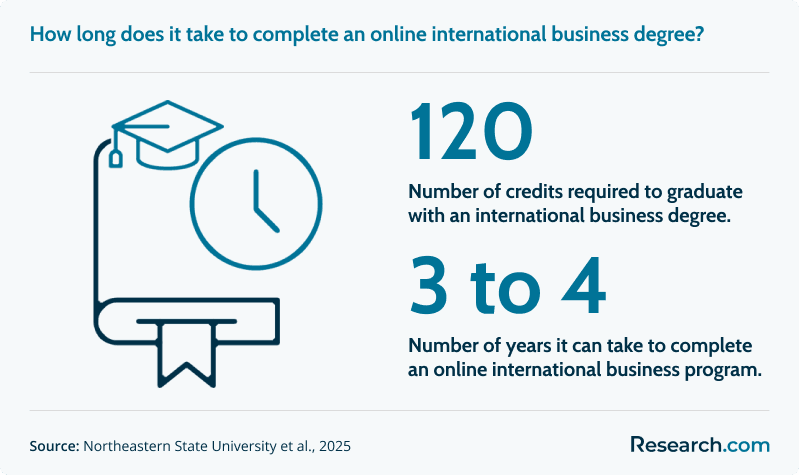
Most bachelor’s programs require around 120 credits. Students usually complete general education requirements, business core courses, major courses, and electives. Tuition varies widely by institution, but many online programs charge between $300 and $600 per credit. Public universities often have lower rates for in-state learners, while private colleges commonly charge higher tuition.
| Program feature | What it usually means for students | Why it matters |
| Credit requirement | Often around 120 credits for a bachelor’s degree | Helps you estimate time to completion and total tuition |
| Business core | Accounting, management, marketing, economics, finance, and strategy | Builds broad business skills that transfer across industries |
| International focus | Trade, global finance, supply chains, law, and cross-cultural leadership | Prepares you for work with multinational employers or global clients |
| Applied learning | Internships, capstones, case studies, simulations, or study abroad | Can strengthen your resume and help you discuss real business problems in interviews |
| Online delivery | Asynchronous courses, live sessions, or a mix of both | Determines how much scheduling flexibility you will have |
Where can I work with an online international business degree?
International business graduates are not limited to one job title. The degree is broad, which means outcomes depend heavily on the skills you build during the program, internships or work experience, language ability, technical tools, and the industry you target. According to 2024 BLS data, 25% of business degree graduates work in management occupations, 23% work in business and financial occupations, and 12% work in sales and related occupations.
Common employment areas include:
- Management occupations: Graduates may pursue project manager, operations manager, general manager, or global operations roles. These jobs often involve leading teams, improving processes, coordinating vendors, and supporting company strategy.
- Business and financial occupations: Possible paths include financial analyst, accountant, consultant, business analyst, or planning-related roles. These positions use financial data, market research, and business analysis to support decisions.
- Sales, marketing, and client-facing roles: Graduates may work in international sales, market development, advertising, customer success, or marketing coordination. These jobs rely on communication, cultural awareness, and knowledge of customer behavior across markets.
- Trade, logistics, and supply chain: Some graduates focus on import/export coordination, global procurement, customs documentation, vendor management, or transportation operations.
Employers may include multinational corporations, logistics firms, banks, manufacturers, technology companies, consulting firms, government agencies, nonprofits, and trade organizations.
How much can I make with an online international business degree?
Salary depends on job function, location, experience, company size, industry, and whether you pursue additional credentials or graduate education. Entry-level roles in business and financial fields may begin between $50,000 and $60,000 per year. With experience, many professionals move closer to median earnings in their occupational group.
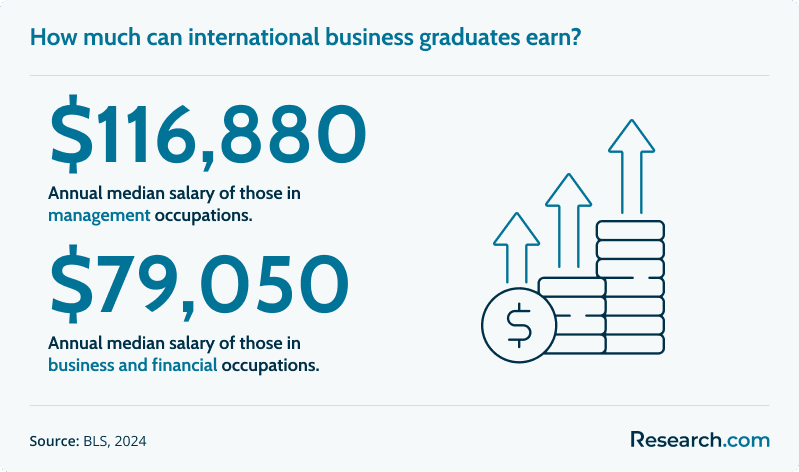
According to 2024 data, business and financial roles offer around $79,050 annually, while management roles have a median of $116,880 per year. Senior professionals in business and financial occupations often earn over $100,000, and experienced managers and executives can earn well above $150,000. These figures are benchmarks, not guarantees.
| Career stage | Common roles | Salary context from the article data |
| Entry level | Import/export coordinator, international sales representative, market research assistant, business analyst trainee | Business and financial roles may start between $50,000 and $60,000 per year |
| Mid level | Financial analyst, international marketing specialist, supply chain analyst, operations manager | Business and financial roles are around $79,050 annually; management roles have a median of $116,880 per year |
| Senior level | International business consultant, global operations director, senior manager, executive | Senior business and financial professionals often earn over $100,000; experienced managers and executives may earn well above $150,000 |
- Best Online International Business Degree Programs for 2027
- How long does it take to complete an online international business degree?
- Online vs. on-campus international business degrees
- Average cost of an online international business degree
- Financial aid options for online international business students
- Admission requirements and prerequisites
- Common international business courses
- Why accreditation matters
- International business specializations
- When a doctoral degree makes sense
- Networking and student support in online programs
- Online international business degree cost vs. MBA cost
- Trends shaping online international business education
- Challenges of earning the degree online
- How project management skills help
- How to choose the right online international business program
- Career paths for graduates
- Do employers value online international business degrees?
- Return on investment
- Worldwide recognition
- Job market outlook
List of the Best Online International Business Degree Programs for 2027
How do we rank schools?
Research.com rankings are built to help students compare programs using transparent, education-focused criteria. Our process draws from established data sources, including the IPEDS database, Peterson’s database, the College Scorecard, and the National Center for Education Statistics. These sources help evaluate institutions and online international business programs using consistent information. To learn more about how rankings are developed, review the Research.com methodology page.
1. Northeastern State University
Northeastern State University offers an online BBA in International Business Management for students who want a business degree centered on global commerce. The program covers cultural diversity, international trade, global business strategy, finance, marketing, and management. Students may strengthen the degree through foreign language study, internships, or study abroad experiences, making it a useful option for learners who want practical exposure alongside online coursework.
- Required Credits to Graduate: 120
- Cost: $260.30 per credit hour for residents, $576.30 per credit hour for non-residents
- Accreditation: Accreditation Council for Business Schools and Programs (ACBSP)
2. Florida International University
Florida International University offers an online BBA in International Business that emphasizes global markets, international trade, finance, and cross-cultural management. Students examine globalization, trade agreements, international organizations, economic trends, and global marketing strategy. This program may be especially relevant for students seeking a public university option with a strong international business identity.
- Required Credits to Graduate: 120
- Cost: $235.57 per credit hour for residents, $648.87 per credit hour for non-residents
- Accreditation: Association to Advance Collegiate Schools of Business (AACSB)
3. Liberty University
Liberty University provides an online B.S. in Business Administration – International Business. The curriculum focuses on international trade, finance, business operations, global expansion, financial regulations, international policy, and business ethics. Liberty also incorporates Christian values into its coursework and offers flexible online study, which may appeal to students looking for a faith-based business program.
- Required Credits to Graduate: 120
- Cost: $390 per credit hour for full-time students, $455 per credit hour for part-time students
- Accreditation: ACBSP
4. Bellevue University
Bellevue University offers an International Business Administration program designed around global trade, marketing, finance, economics, supply chain logistics, and management. Students can select an emphasis area, such as finance or marketing, to align the degree with career goals. Case studies and simulations help students practice decision-making in international business contexts.
- Required Credits to Graduate: 127
- Cost: $449 per credit hour
- Accreditation: International Accreditation Council for Business Education (IACBE)
5. University of Houston-Downtown
The University of Houston-Downtown offers an International Business major that combines business fundamentals with global trade, finance, marketing, trade policy, international finance, and cross-border strategy. The program is designed for students who want to understand how economic and cultural differences shape business activity in multinational companies, government agencies, and trade organizations.
- Required Credits to Graduate: 120
- Cost: $245.75 per credit hour for residents, $665.75 per credit hour for non-residents
- Accreditation: AACSB
6. Northern State University
Northern State University offers an international business program with coursework in international marketing, finance, trade, cross-cultural management, global markets, trade agreements, and cultural communication. Students can gain applied experience through study abroad and faculty-led travel programs, which may be valuable for learners who want exposure to global business settings.
- Required Credits to Graduate: 120
- Cost: $354.75 per credit hour
- Accreditation: ACBSP
7. University of Michigan-Flint
University of Michigan-Flint provides an international business degree that blends global trade, marketing, finance, strategy, regulation, and cross-cultural management. The program includes experiential options such as internships and study abroad, helping students connect business theory with real workplace challenges. Graduates may pursue roles in multinational corporations, consulting, and global management.
- Required Credits to Graduate: 120
- Cost: $568 per credit hour for residents, $626.50 per credit hour for non-residents, $1,137 for international students
- Accreditation: AACSB
8. Everglades University
Everglades University offers a Bachelor of Science in International Business with courses in finance, marketing, management, business technology, ethical leadership, strategic decision-making, analysis, and problem-solving. The degree is structured for students interested in managerial roles in multinational companies, trade organizations, and international business operations.
- Required Credits to Graduate: 123
- Cost: $10,440 per semester
- Accreditation: Southern Association of Colleges and Schools Commission on Colleges (SACSCOC)
9. Minnesota State University, Mankato
Minnesota State University, Mankato offers an international business program focused on cross-cultural management, trade, finance, economics, accounting, marketing, and international strategy. Students can pursue internships, study tours, and electives in marketing, finance, or management. The program is designed to develop a global business mindset for careers in trade, consulting, and multinational organizations.
- Required Credits to Graduate: 120
- Cost: $367.90 per credit hour
- Accreditation: AACSB
10. Southern New Hampshire University
Southern New Hampshire University offers an international business concentration that examines global markets, strategic management, multinational marketing, data analysis, ethical decision-making, and communication in international settings. The online format may suit students who want a flexible path into global organizations, supply chain roles, or international trade careers.
- Required Credits to Graduate: 135
- Cost: $330 per credit hour
- Accreditation: New England Commission of Higher Education (NECHE)
How long does it take to complete an online international business degree program?
A full-time student usually needs about four years to complete an online bachelor’s degree in international business. Students who choose accelerated formats, heavy course loads, summer enrollment, or generous transfer-credit pathways may finish faster. Some accelerated online business degree programs can be completed in as little as three years.
Your timeline depends on the number of credits you transfer, whether courses are offered every term, whether the program uses eight-week or traditional semesters, and how many classes you can realistically handle. Working adults often need a part-time schedule, while students with prior college credits may move more quickly if the school accepts those credits toward major, general education, or elective requirements.
| Student situation | Likely timeline impact | What to check before enrolling |
| First-time full-time student | Often around four years | Course sequence, major requirements, and summer availability |
| Transfer student | May finish sooner | Transfer credit policy and how credits apply to the major |
| Part-time working adult | May need more than four years | Maximum program length, advising support, and course rotation |
| Accelerated learner | May complete faster | Course intensity, workload, tuition structure, and academic expectations |
How does an online international business degree compare to an on-campus program?
Online and on-campus international business degrees can cover the same academic foundation, but the learning experience is different. The best choice depends on your schedule, learning style, need for campus resources, networking preferences, and budget.
| Factor | Online international business degree | On-campus international business degree |
| Flexibility | Often better for students balancing work, family, military service, or location limits | Works well for students who can attend scheduled classes in person |
| Course delivery | Uses learning platforms, recorded lectures, discussion boards, virtual meetings, and digital assignments | Uses classroom instruction, in-person discussion, campus events, and face-to-face activities |
| Interaction | Requires intentional participation through messages, video meetings, and group tools | Provides more immediate access to classmates, faculty, and campus communities |
| Networking | Can connect students across regions and countries through online cohorts and virtual events | Offers clubs, seminars, in-person recruiting, and campus-based networking |
| Resources | Relies on digital libraries, online tutoring, virtual advising, and remote career services | Includes physical libraries, student centers, labs, and campus offices |
| Best for | Self-directed students who need scheduling flexibility | Students who value structured routines and in-person engagement |
If you are still comparing business formats more broadly, a general online business degree may also be worth reviewing before choosing an international business concentration.
What is the average cost of an international online business degree?
The total cost of an online international business degree depends on residency status, public versus private institution, transfer credits, course load, fees, books, and how long you take to graduate. According to 2024 data from the Education Data Initiative, average tuition for in-state students is $40,926, while out-of-state students pay about $59,011. Private colleges typically charge around $62,756 for an online bachelor’s degree.
Tuition is only one part of the budget. Online students may also pay technology fees ranging from $100 to $500 per term, digital textbook and course material costs of $1,200 to $1,500 annually, and proctored exam fees ranging from $20 to $100 per test. These charges can change the real cost of attendance, so students should request a full program cost estimate instead of comparing tuition alone.
| Cost item | Amount stated in the article data | How to evaluate it |
| Average in-state tuition | $40,926 | Ask whether online learners qualify for in-state or special online tuition |
| Average out-of-state tuition | About $59,011 | Check whether the school charges nonresident online students higher rates |
| Private online bachelor’s degree tuition | Around $62,756 | Compare institutional aid, transfer policy, and completion time |
| Technology fees | $100 to $500 per term | Confirm whether these are charged every term or per course |
| Digital textbooks and materials | $1,200 to $1,500 annually | Ask whether courses use open educational resources or inclusive-access fees |
| Proctored exams | $20 to $100 per test | Ask how often proctored testing is required |
The chart below illustrates the average undergraduate tuition and fees in 4-year universities in the US, as reported by the NCES in 2024.
What are the financial aid options for students enrolling in an online international business degree program?
Online international business students may qualify for many of the same aid options as campus students, as long as the institution and program meet eligibility requirements. Start with federal aid, then compare grants, scholarships, institutional aid, employer tuition support, and private loans only if needed.
- Federal aid: Complete the Free Application for Federal Student Aid to be considered for federal grants, loans, and work-study programs.
- Grants: Programs such as the Federal Pell Grant and the Federal Supplemental Educational Opportunity Grant (FSEOG) provide aid that does not need to be repaid if requirements are met.
- Scholarships: Search school, local, professional, and national scholarship sources. Some awards are available for business students, transfer students, adult learners, and online students, including applicants considering business schools with high acceptance rates later in their academic path.
- Institutional aid: Ask each school about merit scholarships, need-based grants, transfer scholarships, military benefits, and tuition discounts.
- Private loans: Private loans can help cover remaining costs, but they should usually be considered after federal aid because terms, protections, and repayment options vary by lender.
Ways to reduce the total cost
- Transfer previously earned credits whenever possible.
- Ask whether the program accepts CLEP, military training, prior learning assessment, or professional certifications for credit.
- Compare tuition by total degree cost, not just per-credit price.
- Check whether online students pay campus fees.
- Choose a course load that helps you graduate efficiently without risking failed or repeated courses.
What are the prerequisites for enrolling in an online international business degree program?
Most online bachelor’s programs in international business use standard undergraduate admission requirements. Selective schools may ask for stronger academic records, while transfer-friendly or adult-focused programs may emphasize previous college work or professional experience.
- High school diploma or GED: First-year applicants generally need proof of high school completion or an equivalent credential.
- Official transcripts: Schools use transcripts to verify prior coursework, grades, transfer eligibility, and prerequisite completion.
- Standardized test scores: Some institutions request SAT or ACT scores, but many online programs are test-optional.
- English proficiency: Applicants whose first language is not English may need TOEFL or IELTS scores.
- Personal statement or essay: Some programs ask applicants to explain their academic interests, career goals, or reasons for choosing international business.
- Letters of recommendation: Certain schools request recommendations from teachers, advisors, supervisors, or employers.
- Technology readiness: Online students need reliable internet access, a computer that meets program requirements, and basic comfort with learning management systems, video meetings, and digital assignments.
- Application fee: Many institutions charge a fee when you submit an application.
What courses are typically in an online international business degree program?
Coursework in an online international business degree should help students connect business fundamentals with global decision-making. A strong curriculum does more than introduce terms; it teaches students how trade policy, currency risk, culture, logistics, data, and law affect business strategy. Some students compare this pathway with the fastest online business administration degree programs when they want a structured business major with clear career applications.
- Global economics: Examines international trade, economic policy, trade patterns, and the forces that influence global markets.
- International finance: Covers foreign exchange, international investment, financial risk, and financing decisions in multinational settings.
- Global marketing: Explores consumer behavior, market research, brand positioning, and promotion across countries and cultures.
- International business law: Introduces legal issues that affect cross-border transactions, contracts, trade, and business operations.
- Cross-cultural management: Builds skills for leading diverse teams, adapting communication styles, and managing workplace expectations across cultures.
- Global supply chain management: Focuses on logistics, production, sourcing, transportation, and the movement of goods and services internationally.
- Business strategy: Teaches students how firms evaluate markets, compete internationally, and make expansion decisions.
- Entrepreneurship and innovation: Looks at launching and scaling ventures with a global perspective.
- Data analytics: Helps students use data to evaluate performance, identify trends, and support business decisions.
How important is accreditation for online international business degree programs?
Accreditation is one of the most important checks before enrolling. It signals that a school or program has been reviewed against recognized academic standards. Accreditation can affect federal financial aid eligibility, transfer credit acceptance, graduate school admission, and employer confidence.
Students should first confirm institutional accreditation. Business-specific accreditation can also be valuable. Common business accreditors include AACSB, ACBSP, and IACBE. AACSB accreditation is often viewed as a strong signal for business schools, but the right choice still depends on cost, curriculum, support, and career fit. Students comparing value-focused options may also want to review the most affordable online business degree programs.
How to verify accreditation
- Find the school’s accreditation page and identify the institutional accreditor.
- Confirm the accreditor through an official accreditor or government database rather than relying only on marketing language.
- Check whether the business school or program has separate business accreditation.
- Ask whether credits are commonly accepted by graduate programs or partner institutions.
- Be cautious with schools that avoid clear accreditation details or promise unusually fast degrees with little coursework.
What types of specializations are available in an online international business degree?
Specializations help students turn a broad international business degree into a more focused career path. The best concentration depends on whether you want to work in trade, finance, marketing, operations, compliance, entrepreneurship, or management.
| Specialization | What you study | Good fit for students interested in |
| International Trade and Logistics | Trade regulations, customs, supply chain strategy, transportation, and cross-border movement of goods | Import/export coordination, logistics, procurement, and supply chain operations |
| Global Finance | International banking, currency exchange, risk management, and multinational investment | Financial analysis, banking, corporate finance, and risk roles |
| Cross-Cultural Management | Leadership, communication, team dynamics, and management across cultures | Human resources, global operations, management, and consulting |
| International Marketing | Global branding, consumer behavior, advertising, and market research | Marketing, sales strategy, product management, and market development |
| Sustainability and Global Business | Environmental, social, and ethical dimensions of international operations | Corporate responsibility, sustainable supply chains, and global strategy |
| Entrepreneurship in Global Markets | Venture creation, innovation, market entry, and growth in international settings | Startups, international expansion, and small business leadership |
| International Business Law and Compliance | Trade agreements, regulations, ethics, contracts, and legal frameworks | Compliance, trade operations, risk management, and policy-related roles |
Graduate-level specializations
Students who want deeper expertise may later pursue a Master’s in International Business (MIB) or an MBA with a global business focus. Graduate programs may include concentrations in global strategy, multinational finance, digital trade, consulting, or supply chain leadership.
Doctoral options, including a Ph.D. in International Business, are usually designed for research, policy analysis, academic careers, or advanced strategy work. Certificate programs can also help professionals add focused skills in areas such as international trade law or global supply chain management without completing another full degree.
The chart below shows the most common degree levels for international business managers, as reported by Zippia in 2025.
Should I pursue a doctoral degree to further enhance my international business career?
A doctoral degree is not necessary for most international business roles. It may make sense if your long-term goal is university teaching, academic research, high-level policy analysis, or specialized executive work that depends on advanced research skills. For many professionals, a master’s degree, graduate certificate, industry certification, language proficiency, or targeted technical training will be more practical than a doctorate.
If you are considering doctoral study, compare the cost, time commitment, research expectations, and career payoff carefully. Professionals exploring advanced business doctorates may want to compare options such as the most affordable online DBA programs.
How can students leverage networking and support services in online international business programs?
Networking matters in international business because many roles depend on relationships, communication, and industry knowledge. Online students should not assume networking will happen automatically. The best programs create structured opportunities through career services, virtual events, alumni communities, employer panels, mentorship, group projects, and internship support.
- Use career services early: Meet with advisors before senior year to identify target roles, internship timelines, and resume gaps.
- Join virtual events: Attend online career fairs, alumni panels, and employer information sessions even if you are not actively job hunting yet.
- Build a global peer network: Group projects with classmates in different regions can help you practice remote collaboration across time zones.
- Ask about internship support: Find out whether the school helps online students access internships, experiential learning, or employer projects.
- Consider future leadership study: Students interested in long-term organizational leadership may also review options such as a PhD in organizational leadership online.
How do the costs of an online international business degree compare to an MBA?
An online bachelor’s degree in international business and an MBA serve different students. A bachelor’s degree is usually an undergraduate credential for students starting or completing their first business degree. An MBA is a graduate degree generally aimed at professionals seeking leadership, management, or career-change opportunities.
Online international business bachelor’s programs often have lower tuition and fewer graduate-level expenses than many MBA programs. MBA programs may include higher tuition, leadership intensives, networking events, specialized career services, and advanced curriculum costs. However, the better comparison is not just price; it is whether the credential matches your experience level and career target. Students comparing graduate business expenses can review this guide to MBA degree cost.
| Question | Online international business bachelor’s degree | MBA with global focus |
| Who is it for? | Students seeking an undergraduate business foundation | Professionals seeking graduate-level leadership preparation |
| Main value | Broad business training with global context | Advanced management, strategy, leadership, and networking |
| Cost profile | Often lower than many MBA pathways | May include higher tuition and additional program-related costs |
| Best timing | Before or early in a business career | After gaining professional experience or when seeking advancement |
What emerging trends are shaping online international business education?
Online international business education is changing as global commerce becomes more digital, data-driven, and complex. Programs are adding more technology-enabled learning, virtual collaboration, analytics, simulations, and applied projects with international business scenarios. Some institutions are also using AI-supported tools to personalize learning, provide faster feedback, or help students practice business analysis.
Students should look for programs that teach both global business fundamentals and modern digital skills. Useful areas include data analytics, e-commerce, digital trade, supply chain technology, remote collaboration, cybersecurity awareness, and ethical use of AI. Students comparing graduate-level innovation and affordability may also find the most affordable AACSB online MBA programs useful for future planning.
What are the potential challenges of earning an online international business degree?
Online learning can be flexible, but it also requires self-management. Students must keep up with readings, discussions, deadlines, group projects, and exams without the daily structure of campus life. Time zones can also complicate international group work or live sessions.
- Self-discipline: You need a weekly study plan and consistent work habits.
- Technology dependence: Reliable internet, updated software, and comfort with online platforms are essential.
- Limited in-person interaction: You may need to be proactive about meeting faculty, classmates, and employers virtually.
- Group project coordination: International business courses often use team-based assignments, which can be challenging across schedules.
- Career preparation: Online students must intentionally seek internships, projects, and networking opportunities.
Students interested in very fast graduate pathways should be especially careful about workload and academic quality when reviewing options such as a fast track MBA 6 months online.
How can project management skills boost my international business career?
Project management skills are highly useful in international business because global work often involves multiple teams, vendors, markets, regulations, timelines, and budgets. A graduate who can organize cross-border projects, manage risk, coordinate communication, and track deliverables can be more valuable in operations, supply chain, consulting, marketing launches, and business expansion roles.
Students can build project management skills through coursework, internships, team assignments, software tools, and targeted training. If you want a stronger project-focused credential, compare options such as accelerated project management degree programs online.
How to choose the best online international business degree program?
The best online international business program is the one that matches your career goals, budget, schedule, and academic needs. Rankings can help narrow the field, but they should not replace your own program comparison.
- Confirm accreditation: Look for institutional accreditation and, when relevant, business accreditation from bodies such as the Association to Advance Collegiate Schools of Business or other recognized accreditors.
- Review the curriculum: Make sure the program includes the global topics that matter for your goals, such as international finance, trade, marketing, logistics, or compliance.
- Check delivery format: Asynchronous courses offer more flexibility, while live sessions may provide more interaction. Some programs blend both.
- Compare total cost: Add tuition, fees, books, technology charges, exam fees, and the cost of extra terms if you attend part time.
- Ask about career support: Look for online access to advising, internship help, resume reviews, employer events, and alumni networks.
- Evaluate transfer policies: Transfer credits can reduce both time and cost, but only if they apply to your degree requirements.
- Look for applied learning: Internships, capstones, simulations, and case studies can help you show employers what you can do.
Common mistakes to avoid
| Mistake | Why it can hurt you | Better approach |
| Choosing a program without checking accreditation | It may affect financial aid, transfer credits, graduate admission, or employer confidence | Verify institutional and business accreditation before applying |
| Comparing only tuition per credit | Fees, books, exam costs, and extra terms can raise the final price | Request the full estimated cost of attendance and graduation plan |
| Assuming all online programs are equally flexible | Live sessions, group projects, or fixed course sequences may conflict with work schedules | Review course format, deadlines, and required meeting times |
| Ignoring transfer credit rules | Credits may transfer as electives but not reduce major requirements | Ask for a written transfer evaluation before enrolling |
| Relying only on rankings | A highly ranked program may not fit your budget, schedule, or career target | Use rankings as one input alongside cost, curriculum, support, and outcomes |
| Assuming salary outcomes are guaranteed | Earnings vary by role, location, experience, and industry | Use salary data as a benchmark and build marketable skills while enrolled |
Questions to ask before applying
- Is the institution accredited, and does the business program have specialized accreditation?
- How many credits will I need after transfer evaluation?
- Are courses asynchronous, live, or blended?
- Does the program offer internships, capstones, simulations, study abroad, or employer projects?
- What is the full cost, including fees and materials?
- What career services are available specifically to online students?
- Which companies or industries commonly recruit graduates?
- Can I choose electives or a specialization aligned with my career goal?
What career paths are available for graduates with an online international business degree?
An online international business degree can support several career directions, especially when paired with internships, data skills, language ability, industry knowledge, or project experience. Graduates may begin in entry-level business roles and move toward management, analysis, consulting, logistics, marketing, or other high-paying business careers over time.
| Career level | Example roles | Typical focus |
| Entry level | International sales representative, market research analyst, import/export coordinator | Researching markets, supporting transactions, managing documentation, assisting sales, and tracking logistics |
| Mid level | Global supply chain manager, international marketing specialist, financial analyst | Developing strategy, analyzing performance, coordinating international operations, and supporting expansion |
| Senior level | International business consultant, global operations director, multinational executive | Leading cross-border strategy, advising organizations, managing teams, and overseeing global business activity |
Industries that may hire international business graduates include banking, logistics, technology, manufacturing, consulting, retail, trade, and government-related organizations. The most competitive candidates typically combine business knowledge with practical skills in analysis, communication, software tools, supply chain systems, finance, or foreign languages.
Do employers value online international business degrees?
Employers can value online international business degrees when they come from accredited institutions and teach relevant, demonstrable skills. Many hiring managers focus less on whether a degree was earned online and more on the school’s credibility, the candidate’s experience, technical ability, communication skills, internships, and evidence of problem-solving.
To make an online degree more marketable, students should build a portfolio of applied work, complete internships or projects when possible, learn business software and data tools, and be ready to explain how online learning strengthened skills such as self-direction, remote collaboration, and digital communication. Students comparing online graduate business perceptions may also review an easy online MBA program guide as part of broader research.
What is the return on investment of an online international business degree?
ROI depends on the relationship between what you pay and what the degree helps you achieve. A lower-cost program with strong transfer credit, useful coursework, and good career support may produce a better personal return than a more expensive program with limited advising or unclear outcomes.
When evaluating ROI, compare tuition, fees, books, time to completion, lost work hours, debt, employer tuition assistance, and likely career outcomes. Salary benchmarks can help, but they should be interpreted carefully. You can compare related earnings information, such as business management degree salary, while remembering that salaries vary by role, region, employer, and experience.
ROI checklist
- How much will I pay after grants, scholarships, employer support, and transfer credits?
- How long will it take me to graduate?
- Will I need loans, and what will repayment look like?
- Does the program support internships, projects, or career placement?
- Which roles do graduates typically pursue?
- Will this degree qualify me for the next step I want, or would another major be more direct?
Is an online international business degree recognized worldwide?
Worldwide recognition depends on the institution, accreditation, employer expectations, and country-specific rules. An online degree from an accredited and reputable school is generally easier to explain to employers, graduate schools, and credential evaluators. However, recognition can vary by country, industry, and organization.
If you plan to work outside the United States, check whether employers or credential evaluation agencies in your target country recognize the institution and degree. If you later pursue graduate business study, programs such as the most reputable online MBA programs may also help expand your international career options.
What is the job market for graduates with an online international business degree?
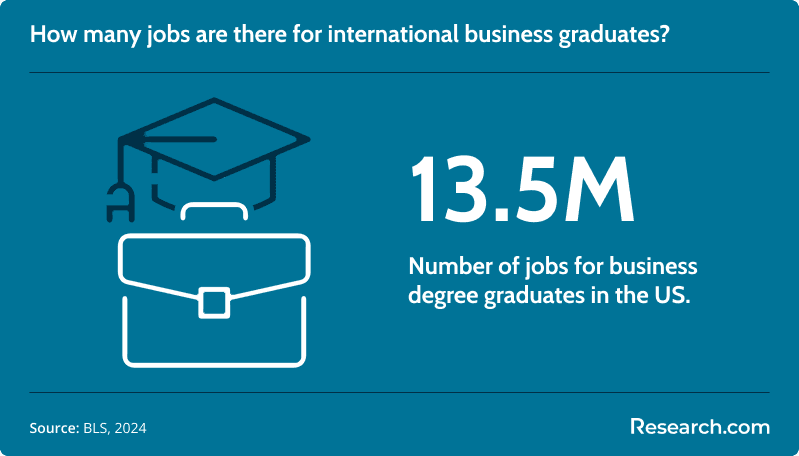
The job market for international business graduates is tied to broader demand in management, business, finance, logistics, sales, marketing, and global operations. Employment in management and business occupations is expected to grow faster than the average for all jobs between 2023 and 2033. Each year, about 1.2 million openings are projected in management roles, while 963,500 openings are expected in business and financial positions, according to the BLS.
Demand is shaped by several forces:
- Global trade and expansion: Companies operating across borders need employees who understand trade rules, supply chains, cultural differences, and international business risks.
- Technology and e-commerce: Digital platforms make it easier for companies to sell, source, and serve customers internationally, increasing the need for business professionals who understand global online markets.
- Economic and geopolitical shifts: Changes in trade policy, emerging markets, supply chain disruption, and international investment patterns create demand for professionals who can interpret risk and adapt strategy.
- Data-driven business decisions: Employers increasingly expect business graduates to use data, analytics tools, and digital communication platforms to support decisions.
References:
- Bureau of Labor Statistics (BLS). (2024a). Business and Financial Occupations. Occupational Outlook Handbook. BLS.
- Bureau of Labor Statistics (BLS). (2024b). Management Occupations. Occupational Outlook Handbook. BLS.
- Bureau of Labor Statistics (BLS). (2024c). Field of degree: Business. Occupational Outlook Handbook. BLS.
- Hanson, M. (2024). Average Cost of Online College. Education Data Initiative.
- National Center for Education Statistics (NCES). (2024). Average undergraduate tuition, fees, room, and board charges for full-time students in degree-granting postsecondary institutions, by control and level of institution and state: Academic years 2021-22 and 2022-23. Digest of Education Statistics. NCES.
- World Trade Orgniazation (WTO). (2024). Global Trade Outlook and Statistics. WTO.
- Zippia. (2025). International Business Manager Education Requirements. Zippia.
Key Insights
- An online international business degree is best for students who want broad business training with a global focus in trade, finance, marketing, supply chains, and cross-cultural management.
- Program quality matters more than delivery format. Prioritize accreditation, curriculum relevance, career support, transfer policies, and applied learning opportunities.
- Most bachelor’s programs require around 120 credits and take about four years full time, though transfer credits and accelerated formats can shorten the timeline.
- Cost varies significantly. Look beyond tuition and include technology fees, materials, proctored exams, residency rules, and the number of credits you still need.
- Career outcomes are broad rather than automatic. Strong candidates use internships, projects, analytics skills, language ability, and networking to target specific roles.
- Salary benchmarks are useful, but not guaranteed. Earnings depend on job title, industry, location, experience, and advancement into business, financial, or management roles.
- If your goal is senior leadership, an MBA or specialized graduate credential may eventually be more useful than a second bachelor’s-level credential.
Other Things You Should Know About Online International Business Degree Programs
The best international business degree programs online in 2027 are offered by esteemed institutions like the University of Southern California, Indiana University, and Arizona State University. They provide comprehensive curricula focusing on global trade, international marketing, and cross-cultural management, leveraging flexible online platforms for diverse, worldwide learners.


