
2027 Best Nursing Schools in Jacksonville, FL – Accredited Nursing Degree Programs Online

Co-Founder and Chief Data Scientist
Choosing a nursing school in Jacksonville, Florida, is not just about finding the closest campus or the fastest program. The better question is whether a program fits your starting point, budget, schedule, licensure goals, and long-term career plan. Jacksonville has options for first-time nursing students, licensed practical nurses moving toward RN roles, registered nurses completing a BSN, and experienced nurses pursuing MSN, nurse practitioner, DNP, or certificate pathways.
The timing matters. The Bureau of Labor Statistics projects registered nurse employment to grow by 5% from 2024 to 2034, faster than the average for all occupations (BLS, 2025). Strong employment demand is one reason many students consider nursing a practical career path, but the quality of your education, clinical preparation, NCLEX readiness, and accreditation status can strongly affect your next steps.
This guide explains the Jacksonville nursing education landscape, compares entry-level, bridge, and advanced nursing programs, reviews local employment and salary data, and gives you practical questions to ask before applying.
Best Nursing Schools in Jacksonville, FL Table of Contents
- Jacksonville Nursing Market: What Students Should Know First
- Is Jacksonville a Good Place to Become a Nurse?
- Entry-Level Nursing Programs in Jacksonville, FL
- Bridge Nursing Programs in Jacksonville, FL
- Advanced Nursing Programs in Jacksonville, FL
- How Jacksonville Nursing Programs Use Technology
- Nursing Certifications That Can Support Career Growth
- Are There Nursing Schools With More Accessible Admissions?
- Work-Life Balance and Living in Jacksonville
- How NP Programs Help RNs Move Into Advanced Practice
- Continuing Education Pathways for Nurses
- Are Affordable Online FNP Programs Worth Considering?
- Should Working RNs Choose an Online RN to BSN Program?
- Can Fast Track Online BSN Programs Shorten the Path?
- Financial Aid Options for Nursing Students
- Can an Online DNP Accelerate Nursing Advancement?
Quick Answer: What Are the Best Nursing School Options in Jacksonville?
The strongest nursing school choice in Jacksonville depends on where you are in your career. First-time students may compare BSN, accelerated BSN, ADN, and practical nursing options. Current LPNs may look for LPN-to-RN bridge tracks. Working RNs often benefit from online RN-to-BSN or RN-to-MSN pathways. Nurses seeking advanced practice, leadership, education, or policy roles may compare MSN, NP, certificate, and DNP programs.
| Student goal | Program type to compare | Best fit for | Key question to ask |
| Start nursing with no license | BSN, accelerated BSN, ADN, PN | New students and career changers | Does the program prepare graduates for the correct NCLEX exam? |
| Move from LPN to RN | LPN-to-RN bridge | Licensed practical nurses seeking RN licensure | How many credits transfer from prior nursing education? |
| Earn a BSN as a working RN | RN-to-BSN | Registered nurses who already hold RN licensure | Can coursework be completed online or part time? |
| Enter advanced practice or leadership | MSN, NP, DNP, graduate certificate | Experienced nurses seeking specialization | Does the program meet certification and licensure requirements for the intended role? |
Jacksonville Nursing Market: What Students Should Know First
Jacksonville’s nursing education options sit within a broader Florida workforce challenge. Florida is facing a serious nursing shortage projected to reach 59,000 nurses by 2035, according to a Florida Hospital Association study cited by CBS-47. Burnout, pandemic-related workforce disruption, and dependence on travel nurses have added pressure to local hospitals and clinics.
Jacksonville schools and healthcare partners have responded with faster and more practice-focused training models. Examples include the HCA Healthcare Center for Clinical Advancement at the University of North Florida, which uses advanced mannequins for hands-on clinical practice, and accelerated options connected with Baptist Health and Jacksonville University. For students comparing timelines, it can also help to review accelerated routes into nursing before choosing a program.
Employment Snapshot
Jacksonville offers multiple nursing career tracks, from nursing assistant roles to advanced practice positions. Registered nurses make up the largest nursing workforce group in the city, with an employment headcount of 17,440. Other notable nursing roles include Nursing Assistants at 6,810, Licensed Practical and Vocational Nurses at 2,670, Nurse Practitioners at 1,570, and Nursing Instructors at 300.
Location quotient data show how concentrated certain occupations are in the Jacksonville metropolitan area compared with national employment patterns. Nurse anesthetists have a location quotient of about 1.60, meaning they are more concentrated locally than in the national labor market. Licensed practical and licensed vocational nurses have a location quotient of about 0.88, indicating a lower local concentration. Registered nurses have a location quotient of 1.16.
Salary Snapshot
Local earnings vary widely by license level, specialization, and work setting. Registered nurses trained by nursing programs in Jacksonville, FL earn approximately 12% less in annual salary than the national average, with average annual pay of $78,490 compared with the national rate of $89,010.
Advanced practice roles show higher earning potential. Nurse anesthetists in the area earn a mean annual wage of about $204,600, while nurse practitioners earn approximately $121,800 annually. Licensed practical and licensed vocational nurses earn around $55,200 per year. Nursing assistants earn a median annual wage of about $35,100.
| Nursing role | Jacksonville employment or wage detail | What it means for students |
| Registered Nurse | 17,440 employed; location quotient of 1.16 | Largest local nursing employment category and a common target for ADN and BSN students. |
| Nurse Practitioner | 1,570 employed; approximately $121,800 annually | Requires graduate-level preparation and appropriate certification or licensure. |
| Nurse Anesthetist | Location quotient of about 1.60; mean annual wage of about $204,600 | Highly specialized advanced practice pathway with strong local concentration. |
| Licensed Practical and Vocational Nurse | 2,670 employed; about $55,200 per year | Can be an entry point, but students should compare LPN, ADN, and bridge options. |
| Nursing Assistant | 6,810 employed; median annual wage of about $35,100 | Often a quicker healthcare entry route, but with lower pay and narrower scope of practice. |
NCLEX Pass Rates
NCLEX pass rates are one of the most important indicators to review because passing the exam is required for licensure. Jacksonville-area programs report different NCLEX-RN outcomes:
- Chamberlain University: 90.9%
- Florida State College at Jacksonville: 79.55%
- Jacksonville University: 81.82%
- Keiser University Jacksonville: 94.12%
For context, national NCLEX-RN pass rates average 89.52% for Bachelor of Science in Nursing programs and 86.82% for Associate Degree in Nursing programs. Chamberlain University and Keiser University Jacksonville exceed those national benchmarks, while Florida State College at Jacksonville is below the ADN benchmark and Jacksonville University is below the BSN benchmark but above the ADN benchmark. Students should confirm the most recent pass rates directly with each school and review how the program supports students preparing for the NCLEX-RN examination.
Is Jacksonville a Good Place to Become a Nurse?
Jacksonville can be a strong choice for students pursuing a nursing degree because it combines a large healthcare market, multiple school options, coastal living, and several pathways from entry-level training to advanced practice. It is not automatically the best fit for every student, however. Your decision should depend on clinical placement quality, total cost, commuting demands, online flexibility, NCLEX outcomes, and whether the program aligns with your intended license or certification.
Major Healthcare Employers
Jacksonville is home to major healthcare organizations, including Mayo Clinic, Baptist Health, UF Health Jacksonville, and other providers. This gives nursing students and graduates exposure to hospitals, specialty practices, outpatient environments, and community health settings. Students interested in research, critical care, perioperative nursing, pediatrics, primary care, or specialty practice should ask each school where clinical rotations are completed.
Pay and Benefits
Compensation is one reason nursing remains attractive in Jacksonville. As of 2024, registered nurses in Jacksonville earn a mean annual wage of about $84,360, while nurse practitioners earn approximately $121,800 per year. Many healthcare employers also offer benefits such as health insurance, retirement plans, continuing education support, and professional development resources, although benefit packages vary by employer and role.
Specialization Options
Jacksonville’s healthcare environment supports many nursing interests, including critical care, family practice, mental health, geriatrics, emergency care, nurse anesthesia, and nursing education. The city’s population and healthcare needs give students opportunities to work with different patient groups and care models.
Education Pathways
Students can compare associate, bachelor’s, bridge, master’s, doctoral, and certificate options through schools such as Jacksonville University, the University of North Florida, Florida State College at Jacksonville, Chamberlain University, FORTIS, Jersey College, and Jacksonville State University. If cost is a major concern, compare local tuition with online options such as the cheapest RN to BSN program options and programs with a lower MSN cost.
Lifestyle and Outdoor Access
Jacksonville’s weather, beaches, parks, and outdoor recreation can make the city appealing for students and nurses who want downtime outside of work or clinical training. A livable schedule matters in nursing education because clinical rotations, labs, studying, and paid work can quickly create burnout if the program structure does not fit your life.
Cost of Living
Jacksonville is often more affordable than many large metropolitan areas. Housing is a key reason. As of 2025, a 1-bedroom apartment in the city center rents for about $1,730 per month, roughly 58% lower than in New York City and about 40% lower than in Miami, according to Numbeo. For nursing students, lower housing costs can make it easier to manage tuition, commuting, books, uniforms, testing fees, and lost income during clinical-heavy terms.
Population Growth and Job Stability
A growing population increases demand for healthcare services, which can support ongoing need for nurses across hospitals, clinics, long-term care, home health, and specialty care. Still, students should avoid assuming that any degree automatically guarantees a specific salary or job. Licensure, clinical performance, specialty, experience, and employer demand all matter.
Professional Community
Professional nursing organizations, including groups such as the Northeast Florida Nurses Association, can help students and working nurses build networks, learn about continuing education, and stay connected to local workforce needs. Some nurses also use professional networks to learn about employer tuition support, bridge degrees, the cheapest RN to BSN online programs, and graduate nursing options.
Entry-Level Nursing Programs in Jacksonville, FL
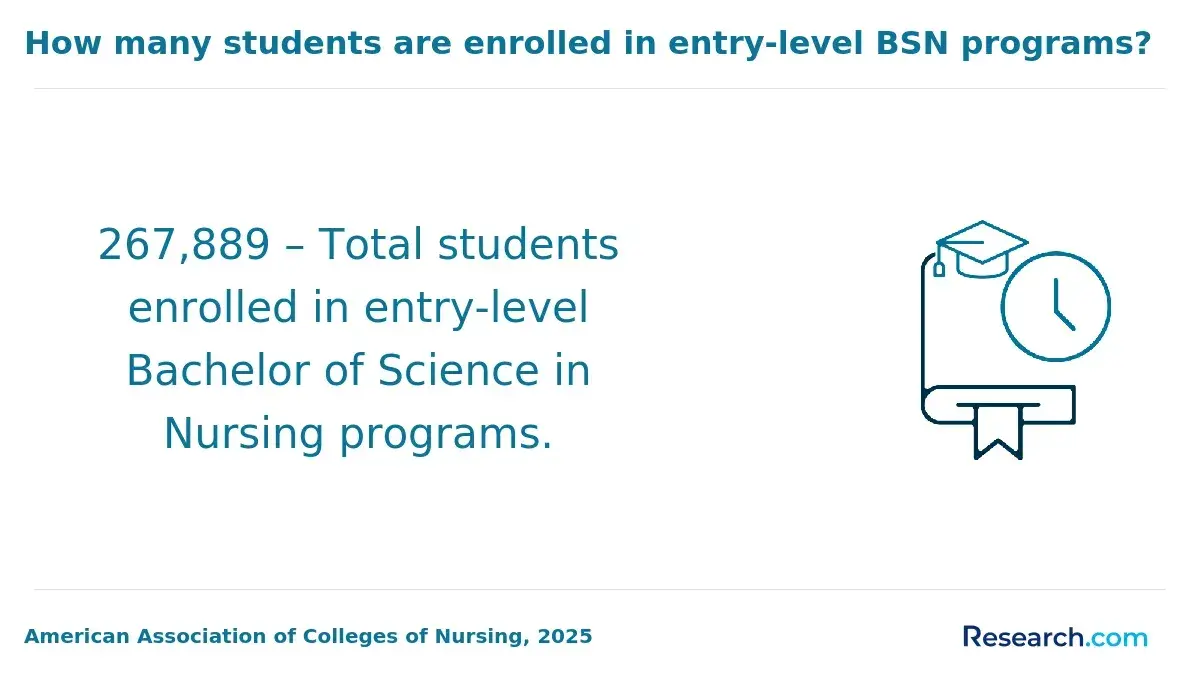
Entry-level nursing programs are designed for students who do not yet hold RN licensure. Jacksonville-area options include traditional BSN programs, accelerated BSN pathways, associate degrees in nursing, and practical nursing programs. The right choice depends on your timeline, prior credits, budget, and whether you want to enter the workforce quickly or complete a bachelor’s degree first.
| Program type | Typical student | Primary outcome | Decision point |
| Traditional BSN | Students beginning undergraduate nursing study | Bachelor’s-level RN preparation | Good fit if you want a broader academic foundation and long-term advancement flexibility. |
| Accelerated BSN | Students who already hold a bachelor’s degree in another field | Faster BSN route | Best for career changers who can manage an intensive schedule. |
| ADN or ASN | Students seeking a shorter RN-preparation route | Eligibility for RN licensure after meeting program and exam requirements | Can be cost-effective, but compare transfer and RN-to-BSN options. |
| Practical Nursing | Students seeking an LPN pathway | Preparation for practical nursing licensure | May lead to employment sooner, but scope and advancement differ from RN roles. |
1. Jacksonville University BSN and Accelerated BSN
Jacksonville University’s Keigwin School of Nursing offers several entry-level pathways for students preparing for professional nursing practice:
- Traditional BSN
- 16-Month Accelerated BSN
- 12-Month Accelerated BSN with Baptist Health
- 12-Month Accelerated BSN in collaboration with Mayo Clinic
The BSN curriculum is designed to help graduates combine knowledge from multiple disciplines, use critical thinking and healthcare technology, provide compassionate and culturally responsive care, communicate effectively with patients and care teams, follow professional and ethical standards, promote health and prevention, apply evidence-based practice, collaborate across disciplines, manage resources with patient safety in mind, and continue learning throughout their careers.
2. University of North Florida BSN and Accelerated BSN
The University of North Florida offers three entry-level BSN routes:
- Regular Prelicensure BSN: Built for students completing their first bachelor’s degree while preparing for nursing practice.
- Accelerated Prelicensure BSN: Created for students who already earned a bachelor’s degree in another field and want to transition into nursing.
- Freshman Admit Nursing BSN: Designed for students who intend to pursue nursing from the start of their undergraduate education.
UNF’s curriculum emphasizes community health, collaboration with agencies, leadership, research awareness, and adaptable nursing care across varied settings. Students should ask how competitive admission is, what prerequisite grades are required, and how clinical placements are assigned.
3. Florida State College at Jacksonville ASN and BSN
Florida State College at Jacksonville offers an Associate in Science in Nursing and a Bachelor of Science in Nursing.
- Associate in Science in Nursing: Combines general education, professional nursing coursework, labs, lectures, and clinical education. Graduates are prepared for entry-level nursing practice and NCLEX-RN eligibility after meeting all program and licensure requirements.
- Bachelor of Science in Nursing: Intended for practicing nurses who want stronger preparation in leadership, critical thinking, cultural responsiveness, and interprofessional patient care. The program offers full-time and part-time study, online course delivery, and faculty with doctoral preparation who remain active in the nursing community.
4. Chamberlain University BSN
Chamberlain University offers a BSN program that can be completed in three years through multiple learning formats:
- 100% Online: Uses live virtual classes, personalized learning, virtual simulations, and next-generation virtual labs. The format includes experiential components, in-person skills evaluation, and clinical rotations.
- Campus Hybrid: Blends online coursework with weekday campus classes, in-person and virtual labs, and weekly clinical rotations.
- Evening-Weekend: Combines online and in-person learning with evening and weekend classes, plus weekly clinical experiences.
Chamberlain’s model emphasizes early hands-on learning, nursing theory application, clinical judgment, lab practice, and patient care readiness. Students comparing this option should confirm clinical site availability, technology requirements, total cost, and NCLEX support.
5. FORTIS PN and ADN
FORTIS offers undergraduate nursing options across campuses, including programs connected with the Denver College of Nursing:
- Practical Nursing: Provides classroom, lab, and clinical learning for students preparing to sit for the NCLEX licensure exam and pursue entry-level licensed practical nursing roles.
- Associate Degree in Nursing: Combines classroom learning with skill-building and clinical practice. After graduating and passing the NCLEX exam, students may seek entry-level registered nursing positions in hospitals and clinical settings.
FORTIS emphasizes traditional classroom teaching, small-group learning, clinical rotations, and practical skill development. Prospective students should ask about accreditation, licensure eligibility, clinical sites, transferability of credits, and job placement support.
Bridge Nursing Programs in Jacksonville, FL
Bridge programs help licensed or experienced nurses build on prior education rather than starting over. These pathways can be useful for LPNs seeking RN licensure, RNs seeking a BSN, or RNs planning graduate study. Before enrolling, confirm how many credits transfer, whether clinical hours are required, and whether the program is accepted by your state board of nursing or target graduate school.
1. Jersey College LPN to RN
Jersey College’s LPN to RN Bridge is part of its Professional Nursing program and leads to an Associate’s Degree in Nursing after successful completion. The curriculum combines nursing courses, general education, classroom theory, assignments, skills labs, and clinical experiences to prepare students for entry-level RN roles.
The program uses a humanistic model that considers physical, emotional, social, economic, and spiritual dimensions of patient care. This can appeal to adult learners balancing employment, family responsibilities, and school while moving from practical nursing toward registered nursing.
2. University of North Florida RN-BSN
The University of North Florida offers an online RN-BSN Bridge Track for licensed registered nurses who want to complete a Bachelor of Science in Nursing. The program is available to RNs nationwide who hold active licensure in their states.
UNF’s RN-to-BSN coursework uses web-enhanced learning and faculty support to strengthen skills in health assessment, family and community nursing, professional communication, research evaluation, critical thinking, and leadership. For working RNs, the online format can make advancement more manageable, but students should still check workload expectations and clinical or practicum requirements.
3. FORTIS RN to BSN
The Denver College of Nursing, affiliated with Fortis, offers a fully online RN-to-BSN pathway. Through an articulation agreement, Fortis ADN graduates can transfer credits into DCN’s online BSN program. The program is designed for working nurses who need structured online delivery and flexible scheduling.
4. Jacksonville State University RN to BSN
Jacksonville State University’s STEP RN-BSN Program allows registered nurses to earn a BSN online in just one year. The program is 100% online, has no waiting lists, awards 35 credit hours for prior RN work, and offers spring, summer, and fall admission. Students may enroll full time or part time.
5. Chamberlain University RN-BSN and RN-MSN
Chamberlain University’s RN to BSN Program can be completed 100% online in as little as one year. Students may choose full-time, part-time, or one-course-at-a-time enrollment. Chamberlain also offers pathways that can support nurses planning continued graduate education.
Advanced Nursing Programs in Jacksonville, FL
Advanced nursing programs are intended for nurses who want to move into specialized clinical practice, nurse practitioner roles, education, administration, quality improvement, policy, or executive leadership. Compare programs carefully because graduate nursing tracks often have different admission standards, clinical hour requirements, certification outcomes, and state licensure implications.
1. Jacksonville University MSN, DNP, and Certificate Programs
Jacksonville University offers multiple graduate nursing options:
- Master of Science in Nursing: The MSN program can be completed in as little as 18 months and includes specialization options. Students may study part time or full time, and the program emphasizes small classes and advising.
- Doctor of Nursing Practice: The DNP program is designed for registered nurses seeking advanced practice or leadership roles. Options include Post-MSN DNP and BSN-DNP pathways, with preparation in quality, safety, leadership, and policy influence.
- Nursing Certificate Programs: These certificate programs support additional specialization and may be completed independently or connected with DNP study. Areas include Family Nurse Practitioner, Psychiatric Mental Health Nurse Practitioner, and Healthcare Quality and Safety.
2. University of North Florida DNP, MSN, NP, and Certificate Options
The University of North Florida School of Nursing offers advanced pathways through the Brooks College of Health:
- Master of Science in Nursing: MSN tracks support preparation in nursing education or leadership and administration.
- Doctor of Nursing Practice: DNP tracks include Family Nurse Practitioner, Certified Registered Nurse Anesthetist, and Psych-Mental Health Nurse Practitioner options.
- Psych-Mental Health Nurse Practitioner Certificate: This post-MSN option is intended for nurses who already hold at least an MSN and APRN licensure. Applicants with a DNP or certain APRN certifications may also qualify. The track prepares graduates for ANCC Psychiatric-Mental Health NP certification.
UNF’s DNP objectives focus on advanced practice competence, interprofessional collaboration, evidence-based program development, information systems, holistic care, and policy leadership. These outcomes are especially relevant for nurses who want roles beyond bedside practice.
3. Chamberlain University MSN, DNP, NP, and Certificates
Chamberlain University offers a Master of Science in Nursing with nine specialty tracks. Students may follow a traditional route, often one class per eight-week session, or an accelerated route with 2 to 3 courses per session. Available specialization areas include:
- Adult Gerontology Nurse Practitioner
- Family Nurse Practitioner
- Psychiatric Mental Health Nurse Practitioner
- Graduate Certificates
4. FORTIS MSN
FORTIS and the Denver College of Nursing offer an online MSN program covering advanced health assessment, pathophysiology, pharmacology, leadership, nursing education, curriculum development, culturally responsive practice, and evidence-based care. The program runs across six academic quarters and is designed for nurses pursuing leadership, practice, or education roles. Students comparing graduate costs may also review an MSN program online before committing.
5. Jacksonville State University MSN, DNP, and Graduate Certificates
Jacksonville State University’s graduate nursing options prepare nurses for several advanced roles:
- Master of Science in Nursing: JSU offers Population Health Nursing tracks, including Nursing Education and Emergency Management, with a focus on vulnerable populations and community health needs.
- Doctor of Nursing Practice: The DNP emphasizes leadership, advanced clinical practice, informatics, quality improvement, and evidence-based healthcare delivery. BSN-DNP options include Family Nurse Practitioner and Adult-Gerontology Acute Care Nurse Practitioner.
- Graduate Certificates: JSU offers certificates in Nursing Education and Emergency Preparedness Nursing Coordinator. These support teaching, disaster preparedness, systems leadership, quality, and safety roles.
How Jacksonville Nursing Programs Use Technology
Technology is now part of nursing education because modern nurses must document care accurately, interpret data, participate in telehealth, use clinical decision tools, and practice safely in increasingly digital environments. Jacksonville nursing schools use a mix of simulation, online platforms, virtual tools, and telehealth training to prepare students for current practice settings.
- Simulation labs: High-fidelity mannequins allow students to practice care decisions, assessments, communication, and emergency responses before working with real patients.
- Virtual and augmented learning: Some programs use immersive tools to help students review anatomy, rehearse procedures, or prepare for complex clinical situations.
- Online learning systems: Hybrid and online courses give students access to lectures, assignments, quizzes, and digital resources while supporting working adults and commuters.
- Telehealth preparation: Programs increasingly teach students how to communicate with patients remotely, complete virtual assessments, and understand remote-care workflows.
Nursing Certifications That Can Support Career Growth
Certifications can help nurses demonstrate focused competence in areas such as emergency care, pediatrics, critical care, oncology, geriatrics, or advanced life support. In Jacksonville’s hospital and specialty-care market, credentials such as Advanced Cardiac Life Support, Pediatric Advanced Life Support, and Certified Emergency Nurse may be useful for certain roles.
Certification is not a substitute for licensure or a degree, but it can strengthen a resume, support specialization, and signal commitment to ongoing professional development. Nurses comparing options can start with a broader guide to the best nursing certifications and then verify which credentials local employers prefer for their target specialty.
Are There Nursing Schools With More Accessible Admissions?
Admission standards vary by program level and school. Some programs place heavy weight on GPA, prerequisite grades, entrance exams, and science coursework. Others use a more holistic review that considers healthcare experience, community involvement, essays, recommendations, or prior licensure. Students who are worried about competitiveness should compare requirements before paying application fees.
Accessible admission does not mean low quality. The safer approach is to look for programs that are accredited, transparent about outcomes, and realistic about student support. If your academic record is uneven, compare prerequisite retake policies, transfer credit rules, tutoring, remediation, and NCLEX preparation. You can also review data-informed resources on easy nursing schools to get into while still prioritizing licensure outcomes and accreditation.
Work-Life Balance and Living in Jacksonville
Jacksonville offers a mix of city amenities, coastal access, and relatively affordable living compared with many larger metro areas. Neighborhoods such as Riverside and San Marco are often attractive to students and healthcare professionals, though commuting time, rent, parking, and clinical site locations should be part of your school comparison.
Nursing school can be demanding even in a flexible program. Students should ask whether lectures are live or asynchronous, how often they must be on campus, whether clinical shifts include weekends or evenings, and how much notice they receive for placements. These details often matter more than the program brochure suggests.
Working nurses who want to continue their education without disrupting their income may compare local options with online pathways, including the cheapest MSN programs, especially if they plan to move into education, administration, or advanced clinical roles.
How NP Programs Help RNs Move Into Advanced Practice
Nurse practitioner programs help registered nurses transition from general RN practice into advanced assessment, diagnosis, pharmacology, health promotion, and specialty care responsibilities. These programs typically combine graduate coursework with supervised clinical experiences and preparation for population-focused certification.
NP pathways are best suited for RNs who want more clinical autonomy, deeper patient management responsibilities, and a defined specialty population. Students should verify that any program they choose meets state requirements and aligns with their intended certification. For nurses comparing bridge options, Research.com’s guide to NP programs can help explain how foundational nursing credentials may connect to graduate-level preparation.
Continuing Education Pathways for Nurses
Continuing education can help Jacksonville nurses move into specialty practice, leadership, education, quality improvement, or advanced clinical care. Common routes include RN-to-BSN degrees, MSN programs, graduate certificates, NP tracks, DNP programs, and specialty certifications.
A Doctor of Nursing Practice may be appropriate for nurses seeking advanced clinical leadership, systems improvement, or high-level practice roles. Cost is a major factor, so students should compare tuition, employer reimbursement, transfer credits, required campus visits, and clinical placement support. Reviewing the most affordable online DNP programs can help nurses weigh advancement against total cost.
Continuing education also supports resilience in a changing healthcare environment. Nurses who keep building skills in informatics, evidence-based practice, communication, leadership, and population health may be better prepared for shifts in care delivery, technology use, and employer expectations.
The Right Choice of Nursing School
The best nursing school in Jacksonville is the one that matches your current credential, schedule, finances, learning style, and target role. A student starting from scratch has different needs than an RN seeking a BSN, an LPN moving toward RN licensure, or an experienced nurse pursuing advanced practice.
Before choosing, compare accreditation, NCLEX outcomes, clinical placement quality, faculty support, total cost, transfer policies, online flexibility, and graduate outcomes. Students who need more flexibility may also compare RN online programs, while nurses pursuing advanced clinical roles may explore NP programs online.
Are Affordable Online FNP Programs Worth Considering?
Affordable online Family Nurse Practitioner programs can be useful for RNs who want advanced practice preparation while managing work and family responsibilities. The key is to compare more than tuition. Students should evaluate accreditation, clinical placement support, faculty access, certification preparation, state authorization, and total fees.
Lower cost is valuable only if the program helps you meet your practice goals. Nurses comparing budget-conscious advanced practice routes may review the cheapest FNP online programs while confirming that each option fits licensure and certification expectations.
Should Working RNs Choose an Online RN to BSN Program?
An online RN-to-BSN program can make sense for licensed RNs who need flexibility while continuing to work. These programs often use asynchronous coursework, digital discussions, online assignments, and practice-focused projects instead of frequent campus attendance.
Still, convenience should not be the only factor. Compare accreditation, faculty responsiveness, technology support, transfer credit acceptance, practicum requirements, and employer recognition. A flexible RN to BSN online program may be a strong fit if it helps you complete the degree without sacrificing quality or licensure mobility.
Can Fast Track Online BSN Programs Shorten the Path?
Fast track BSN programs can help qualified students move through bachelor’s-level nursing preparation more quickly, especially if they already have prior college credit or a previous degree. The trade-off is intensity. Accelerated coursework, labs, clinicals, and exam preparation can be difficult to balance with full-time work.
Students considering this route should ask how clinical hours are scheduled, whether prerequisites must be completed first, what support is available for NCLEX preparation, and how many students successfully finish on time. For additional comparisons, review Research.com’s guide to fast track BSN programs online.
Financial Aid Options for Nursing Students
Nursing students in Jacksonville may use several types of financial support, including scholarships, grants, federal loans, institutional aid, employer tuition reimbursement, and healthcare partnership programs. Working nurses should ask employers about reimbursement rules, grade requirements, service commitments, and annual limits before enrolling.
Do not compare schools by tuition alone. Include fees, uniforms, background checks, immunizations, testing, books, clinical travel, lost wages, and graduation or licensure expenses. Nurses considering graduate mobility may also compare cost-effective RN to MSN online programs.
Can an Online DNP Accelerate Nursing Advancement?
An online DNP can be an efficient route for experienced nurses who want advanced practice, systems leadership, policy, quality improvement, or executive roles. Online delivery may reduce commuting and make coursework easier to schedule around employment, but DNP programs still require serious time, project work, and often clinical or practice experiences.
The fastest option is not always the best option. Compare accreditation, faculty expertise, project support, residency or campus requirements, specialty alignment, and state authorization. Nurses focused on speed can review what is the fastest online DNP program, but they should not compromise program quality or licensure fit.
Common Mistakes to Avoid When Choosing a Nursing School
| Mistake | Why it can hurt you | Better approach |
| Choosing only by location | The nearest program may not have the best outcomes, schedule, or clinical sites. | Compare NCLEX pass rates, clinical placements, cost, accreditation, and support. |
| Ignoring accreditation and licensure fit | A program that does not meet requirements can delay or block licensure or certification. | Confirm approval with the relevant board and ask the school for written details. |
| Looking only at tuition | Fees, supplies, clinical travel, testing, and lost work hours can change the real cost. | Request a full cost estimate before enrolling. |
| Assuming online means easy | Online nursing programs still require labs, clinicals, exams, and strict deadlines. | Ask about weekly time expectations, synchronous sessions, and clinical requirements. |
| Not checking transfer policies | Credits may not apply to future BSN, MSN, or DNP programs. | Ask how credits transfer and whether articulation agreements exist. |
| Relying only on rankings | Rankings may not reflect your goals, budget, schedule, or licensure needs. | Use rankings as one input, not the final decision. |
Questions to Ask Before Applying
- Is the program approved for the license or credential I want?
- What is the most recent NCLEX pass rate for the campus or track I am considering?
- Where are clinical rotations completed, and who arranges them?
- How many students are admitted, retained, and graduated?
- What is the full cost after tuition, fees, supplies, exams, and transportation?
- Can I attend part time, evenings, weekends, hybrid, or online?
- How many of my credits will transfer?
- What academic support is available if I struggle in science courses, skills labs, or NCLEX preparation?
- Does the program meet requirements outside Florida if I plan to move?
- What employers hire graduates from this program?
Key Insights
- Jacksonville offers several nursing entry points: Students can compare PN, ADN, BSN, accelerated BSN, LPN-to-RN, RN-to-BSN, MSN, NP, DNP, and certificate options.
- Workforce demand is real, but outcomes still depend on preparation: Registered nurse employment is projected to grow by 5% from 2024 to 2034, and Florida’s nursing shortage is projected to reach 59,000 nurses by 2035.
- NCLEX results should influence your shortlist: Reported NCLEX-RN pass rates include Chamberlain University at 90.9%, Florida State College at Jacksonville at 79.55%, Jacksonville University at 81.82%, and Keiser University Jacksonville at 94.12%.
- Advanced practice offers higher earning potential: Nurse practitioners earn approximately $121,800 annually in Jacksonville, while nurse anesthetists earn a mean annual wage of about $204,600.
- Cost comparisons should include living expenses: A 1-bedroom city-center apartment rents for about $1,730 per month as of 2025, which may make Jacksonville more manageable than some larger metro areas.
- Online and accelerated programs can help, but they are not shortcuts around quality: Always verify accreditation, clinical requirements, licensure eligibility, and student support before enrolling.
- The best program is goal-specific: A first-time student, LPN, working RN, and future nurse practitioner should evaluate very different pathways.
References:
- Cleavenger, A. (n.d.). “There’s been a huge need for nurses:" Local hospital has a new method to combat nursing shortage. Action News Jax. Read the Action News Jax report
- Cost of Living Comparison Between Miami, FL, United States And Jacksonville, FL, United States. (n.d.). Review the Numbeo city comparison
- U.S. Bureau of Labor Statistics. (2024). Registered nurses: Employment projections. View BLS registered nurse projections
- Numbeo. (2025). Cost of living in Jacksonville, FL. View Jacksonville cost-of-living data
- U.S. Bureau of Labor Statistics. (2024). Occupational employment and wages by metropolitan area: Jacksonville, FL. View Jacksonville occupational wage data
- U.S. Bureau of Labor Statistics. (2024). Occupational employment and wages by metropolitan area: Jacksonville, FL. Review the BLS metropolitan wage table
- U.S. Bureau of Labor Statistics. (2024). Occupational employment and wages by metropolitan area. See the BLS Jacksonville metro data
Other Things You Should Know About The Best Nursing Schools in Jacksonville, FL
Most Florida prelicensure nursing programs require at least 675 clinical hours for an associate degree and 630 clinical hours for a bachelor’s degree, plus supervised practicum or lab work. Programs approved by the Florida Board of Nursing must also place students in approved clinical settings.
Online nursing programs in Jacksonville, FL typically require students to complete a certain number of clinical hours in approved healthcare settings. Requirements vary by program, but students should expect to complete around 500-700 clinical hours to fulfill their degree requirements by 2027.
NCLEX pass rates for nursing schools in Jacksonville vary. Keiser University Jacksonville has the highest pass rate at 94.12%, surpassing the national average. Other schools like Chamberlain University and Jacksonville University have competitive pass rates but fall slightly below the national average for BSN programs.
Jacksonville, FL, offers a range of advanced nursing programs for those looking to further their careers. Options like Master's in Nursing (MSN), Doctor of Nursing Practice (DNP), and specialized certification programs are available online. These programs aim to equip nurses with specialized skills and knowledge for advanced practice and leadership roles.
Yes, Jacksonville offers several bridge programs for nurses, including LPN to RN, RN to BSN, and RN to MSN programs. Institutions like Jersey College and the University of North Florida provide these programs to help nurses advance their careers.


