
2027 Best Nursing Certifications to Consider

Co-Founder and Chief Data Scientist
Choosing a nursing certification is one of the fastest ways for a registered nurse to move toward a specialty, qualify for more focused roles, and show employers verified competence beyond an RN license. The challenge is that “nursing certification” can mean very different things: a short life-support credential, a specialty board certification, a graduate certificate, or an advanced practice credential tied to licensure. This guide explains how nursing certifications work, what they cost, how long they take, which specialties are available, and how to decide whether a certification, bridge program, or advanced degree is the right next step for your career in 2027 and beyond.
Quick answer: Are nursing certifications worth it?
For many RNs, nursing certifications are worth considering when they align with a specific job goal, employer requirement, or specialty pathway. Certifications can help nurses qualify for roles in emergency care, critical care, pediatrics, oncology, informatics, education, administration, surgery, neonatal care, and other settings. They may also support higher pay, although salary depends heavily on specialty, experience, employer, state, shift differentials, and degree level. The best certification is not simply the fastest or cheapest option; it is the one recognized by employers in the role you want.
What are the benefits of nursing certifications?
- Specialized career access: A certification can make it easier to pursue focused roles in areas such as neonatal care, perioperative nursing, emergency nursing, nurse education, healthcare informatics, leadership, and administration.
- Stronger earning potential: Certification may help an RN move beyond the median RN salary of $78,000 per year, especially when the credential is tied to a high-demand specialty or advanced practice role.
- Flexible professional development: Online certification preparation can reduce travel and boarding costs, support interaction with instructors and peers, and allow working nurses to study without leaving their current position.
What can I expect from a nursing certification?
A nursing certification usually confirms that you have developed knowledge and clinical judgment in a defined practice area. Depending on the credential, you may study advanced assessment, disease processes, treatment protocols, medication administration, documentation, procedure support, patient education, care coordination, and specialty-specific safety standards.
Some certifications focus on immediate response skills, such as Basic Life Support or Advanced Cardiovascular Life Support. Others validate experience in a specialty such as emergency nursing, critical care, oncology, informatics, pain management, or wound and ostomy care. Advanced practice credentials may require graduate education, clinical hours, national exams, and state licensure requirements.
Expect certification programs or review courses to emphasize practical decision-making. Nurses often build stronger diagnostic reasoning, sharper patient assessment skills, more confidence with technology such as electronic health records and monitoring systems, and a deeper understanding of how to communicate with physicians, families, and interdisciplinary teams.
Where can I work with a nursing certification?
Nursing certifications apply across a wide range of healthcare environments. Certified nurses may work in hospitals, outpatient clinics, emergency departments, schools, physician offices, long-term care facilities, home health settings, telehealth organizations, insurance companies, public health agencies, and specialty practices.
The scale of the RN workforce shows how broad these opportunities are. Over 6.8 million dedicated RNs serve in various roles, with 1.7 million tending to patients in hospitals, 278,000 supporting outpatient care, and nearly half a million educators nurturing young minds in schools and doctors’ offices. Around 300,000 nurses at nursing homes and other services offer care to diverse populations, while home health brings essential support directly to patients’ homes with 111,000 dedicated professionals. Even specialized sectors like dentistry and insurance carriers benefit from the skills of over 72,000 nurses.
How much can I make with a nursing certification?
Registered nurses earn a median salary of $81,220 per year or $39.05 per hour. Pay for certified nurses varies by specialty, employer type, state, years of experience, education level, schedule, and whether the role involves advanced practice, leadership, or high-acuity care. For comparison, healthcare diagnosing or treating practitioners earn an average of $93,710.
As of November 27, 2023, the average salaries in the United States are $69,120 for a Level 1 Registered Nurse (RN) with a typical range between $62,010 and $79,020, $82,160 for a Level 2 RN with a range between $74,280 and $91,070, $97,400 for a Level 3 RN with a range between $86,100 and $111,300, and $82,200 for Intermediate Registered Nurse Staff with a range between $74,300 and $91,100. Certification can support higher compensation, but it does not guarantee a specific salary.
The employment outlook is also favorable. A steady job growth outlook of 6% growth in employment by 2032 is faster than the average for all occupations, translating to an additional 177,400 job openings. For nurses considering specialization, this demand can make certification a practical way to stand out in competitive or high-need units.
- 2027 list of nursing certification programs
- How long nursing certification programs take
- Online vs. on-campus nursing certification programs
- Average nursing certification program costs
- Financial aid and employer support options
- Common prerequisites for nursing certification
- Typical nursing certification course topics
- Online nursing certification specializations
- Career paths for certified nurses
- Easiest nursing jobs you can get with a certification
- Using certification for advanced practice and leadership
- When a DNP online program may make sense
- How to prepare for a nursing certification exam
- How dual degrees can complement nursing certification
- How to verify accreditation and program quality
- Using certification as a bridge to a higher degree
- Job market for nurses with certification
- Emerging trends in nursing certifications
- Eligibility criteria for specific certifications
- Additional career options with nursing certification
- Affordable accelerated nursing certification programs
2027 List of Nursing Certification Programs
How should you use this list?
This list is designed as a starting point, not a universal ranking of every nursing credential in the United States. Some credentials are short courses, some are specialty board certifications, and some are tied to graduate-level nurse practitioner or advanced practice pathways. Before enrolling, confirm whether the credential is recognized by your employer, accepted in your state, and appropriate for the role you want.
To support program research, our team reviews education and labor-market information using our research methodology. The sources used to create the ranking include:
- IPEDS database
- Peterson’s database, including the Distance Learning Licensed Data Set
- College Scorecard database
- National Center for Education Statistics
There are many nursing certifications beyond the examples below. Some career paths may even connect nursing experience to adjacent healthcare fields, including support roles related to those who become clinical psychologists.
| Certification type | Best fit | Decision tip |
| Life-support credentials | RNs who need required emergency-response skills for clinical roles | Verify whether your employer requires AHA, American Red Cross, or another approved provider. |
| Specialty board certifications | Experienced nurses in areas such as emergency, critical care, oncology, informatics, or perioperative nursing | Check experience-hour requirements before paying for a review course. |
| Advanced practice certifications | Nurses pursuing roles such as FNP, NNP, CNM, or CRNA | Confirm graduate degree, clinical placement, exam, and state licensure requirements. |
| Leadership and education credentials | RNs moving into management, executive practice, or teaching | Compare certification value against MSN, DNP, or dual-degree options. |
1. Advanced Cardiovascular Life Support (ACLS)
- Certification provider: AHA through the American Heart Association ACLS program
- Online option: Online AHA ACLS courses are available through multiple providers, including the Heart & Stroke Foundation of Canada; cost varies.
- Face-to-face option: Hospitals, medical centers, and training centers offer in-person options, such as the University of California, Davis PALS Course; cost varies.
2. Basic Life Support (BLS)
- Certification provider: AHA or American Red Cross
- Online option: Online AHA or Red Cross BLS courses are available through several providers, including the American Red Cross Basic Life Support course; cost varies.
- Face-to-face option: Hospitals, medical centers, training centers, and local community colleges may offer in-person BLS training.
3. Certified Emergency Nurse (CEN)
- Certification provider: Board of Certification for Emergency Nursing
- Online option: BCEN CEN Review Course, self-paced; cost varies.
- Face-to-face option: Review courses are available through organizations such as the Emergency Nurses Association; cost varies.
4. Certified in Executive Nursing Practice (CENP)
- Certification provider: American Nurses Credentialing Center information
- Online option: ANCC CENP Review Course, self-paced, $499.
- Face-to-face option: Some universities and nursing schools, including the University of Pennsylvania School of Nursing, offer related preparation; cost varies.
5. Certified Nurse Educator (CNE)
- Certification provider: National League for Nursing CNE certification or ANCC
- Online option: NLN CNE Review Course, self-paced, $395. ANCC CNE Review Course, self-paced, $499.
- Face-to-face option: Nursing organizations such as the American Association for Colleges of Nursing may offer review options; cost varies.
6. Family Nurse Practitioner (FNP-BC)
- Certification provider: American Academy of Nurse Practitioners
- Online option: Online MSN-FNP programs are available through universities, including Vanderbilt University School of Nursing PMHNP-BC Online Program; cost varies.
- Face-to-face option: Universities and medical schools offer MSN-FNP programs, including the University of Pennsylvania School of Nursing MSN-FNP program; cost varies.
7. Forensic Nurse (FN)
- Certification provider: International Association of Forensic Nurses
- Online option: IAFN Forensic Nurse Certificate Program using online modules and webinars; cost varies.
- Face-to-face option: IAFN Forensic Nurse Certificate Program may be offered through various institutions, including John Jay College of Criminal Justice; cost varies.
8. Informatics Nursing Certification (RN-BC)
- Certification provider: American Nurses Credentialing Center
- Online option: ANCC Informatics Nurse (RN-BC) Review Course, self-paced, $499.
- Face-to-face option: Institutions such as the University of Pittsburgh School of Nursing may offer RN-BC review options; cost varies.
9. Pediatric Advanced Life Support (PALS)
- Certification provider: AHA
- Online option: Online AHA PALS courses are offered by multiple providers, including American Heart Association eLearning, $59.
- Face-to-face option: Hospitals, medical centers, and training centers, including University of California, Davis PALS Course, may offer in-person courses; cost varies.
10. Cannabis Nurse Certification (CNC)
- Certification provider: American Cannabis Nurses Association
- Online option: Self-paced exam preparation course; cost varies.
- Face-to-face option: Some institutions offer in-person training; cost varies.
11. Certified Nurse Informaticist (CNI)
- Certification provider: ANCC Informatics Nursing board certification
- Online option: ANA Enterprise, $395 application.
- Face-to-face option: Programs may be available through institutions such as the University of Maryland School of Nursing; cost varies.
12. Certified Pain Management Nurse (APM)
- Certification provider: ANA Enterprise pain management certification
- Online option: Available through selected institutions, such as University of Pittsburgh School of Nursing APM Review Course, 4 days, $850.
13. Certified Perioperative Nurse (CPN)
- Certification provider: Competency & Credentialing Institute CNOR information
- Online option: CNOR certification resources.
- Face-to-face option: Institutions such as Northwestern Memorial Hospital may offer a CPN Review Course, 4 days, $800.
14. Critical Care Registered Nurse (CCRN)
- Certification provider: American Association of Critical-Care Nurses CCRN Adult
- Online option: AACN CCRN Review Course, $365.
- Face-to-face option: Various institutions provide in-person preparation; cost varies.
15. Cardiac Vascular Nurse (CVRN)
- Certification provider: American Association for Cardiovascular and Pulmonary Rehabilitation
- Online option: AACPR CVRN Review Course, self-paced; cost varies.
- Face-to-face option: Institutions such as the University of Miami School of Nursing may offer preparation; cost varies.
16. Gerontological Nurse (GNP)
- Certification provider: ANCC gerontological nursing certification
- Online option: Online MSN-GNP programs are offered by universities, including the University of California, San Francisco MSN-GNP program; cost varies.
- Face-to-face option: MSN-GNP programs are available through universities and medical schools, including Johns Hopkins University School of Nursing MSN-GNP program; cost varies.
17. Neonatal Nurse Practitioner (NNP-BC)
- Certification provider: National Certification Corporation NNP exam
- Online option: Online NNP programs are available through universities, including Vanderbilt University School of Nursing Neonatal Nurse Practitioner Program; cost varies.
- Face-to-face option: NNP programs are offered by universities and medical schools, including the University of Pennsylvania School of Nursing NNP program; cost varies.
18. Nurse-Midwife (CNM)
- Certification provider: American College of Nurse-Midwives
- Online option: Online MSN-CNM programs are available through universities, including Frontier Nursing University MSN-CNM program; cost varies.
- Face-to-face option: MSN-CNM programs are offered by universities and medical schools, including Yale University School of Nursing MSN-CNM program; cost varies.
19. Oncology Nurse (OCN)
- Certification provider: Oncology Nursing Certification Corporation OCN
- Online option: ONCC OCN Review Course, self-paced, test fees $420.
- Face-to-face option: Institutions such as City of Hope Cancer Center may provide an OCN Review Course; cost varies.
20. Telehealth Nurse Certification (TN-BC)
- Certification provider: Currently under development.
- Online option: Telehealth education resources are available through organizations such as American Telemedicine Association online courses.
- Face-to-face option: In-person programs focused on telehealth skills are emerging.
21. Certified Wound and Ostomy Care Nurse (CWOCN)
- Certification provider: Wound Ostomy and Continence Nurses Society certification
- Online option: WOCN® CWOCN® test fees, $395.
- Face-to-face option: Institutions such as the University of Pennsylvania School of Nursing may offer CWOCN® preparation; cost varies.
How to decide which nursing certification fits your career goal
The best certification depends on the role you want next, not just the credential that looks most impressive. A nurse seeking ICU work may benefit from critical care preparation, while a nurse aiming for education, informatics, leadership, or advanced practice should compare certification with graduate study options.
| Your goal | Certification direction to consider | What to verify first |
| Move into emergency or critical care | CEN, CCRN, ACLS, PALS, or related acute-care credentials | Required clinical hours, unit experience, and employer preference |
| Shift into technology or data-focused roles | Informatics Nursing Certification or Certified Nurse Informaticist | Experience with EHR systems, analytics, workflow improvement, and health IT projects |
| Teach nurses or patients | Certified Nurse Educator or specialty education credentials | Whether the employer requires a graduate degree in addition to certification |
| Become an advanced practice nurse | FNP-BC, NNP-BC, CNM, CRNA, or similar credentials | Graduate degree, clinical placement, national exam, and state licensure rules |
| Enter a lower-stress or more predictable care setting | Ambulatory, school, care coordination, hospice, or outpatient-related credentials | Schedule expectations, patient acuity, and required experience |
Key Findings
- There are more than 50 nursing certifications in the U.S. currently, and newer specialty areas continue to develop, including nursing informatics and the official recognition of cannabis nursing as a specialty nursing practice.
- In 2022, first-time pass rates for U.S. nurse certification exams varied by category, with more challenging specialties generally showing lower pass rates.
- Certification can support earnings above the RN average of $73,584; certified nurse educators earned an average annual wage of $106,344 in 2023, and certified nurse anesthetists earned a median annual wage of $203,090 in 2022.
- Specialty certification can strengthen patient care by improving a nurse’s knowledge, clinical judgment, and readiness for complex practice settings.
- For many nurses, certification also supports professional identity, confidence, and job satisfaction, especially when it leads to work that better matches their preferred patient population or setting.
How long does it take to complete a nursing certification program?
Completion time depends on the credential type. Some certifications can be completed after a short course and exam, while others require years of specialty practice, documented clinical hours, graduate coursework, or continuing education. Before choosing a program, separate the study time from the eligibility requirements; a review course may take weeks, but qualifying experience may take much longer.
- Advanced Certified Hospice and Palliative Nurse (ACHPN): 1,000 hours of practice in advanced diabetes management in 5 years.
- Advanced Diabetes Management (ADM-BC): 5 years.
- Advanced HIV/AIDS Certified Registered Nurse (AACRN): 37 learning modules with associated quizzes, 6 months to complete.
- Advanced Forensic Nursing (AFN-BC): Variable timeline, with each course typically 7 hours.
- Certified Asthma Educator (AE-C): 5 years.
- Clinical Nurse Specialist; Wellness through Acute Care (Adult-Gerontology) (ACCNS-AG): 5 years.
- Certified Pediatric Nurse (CPN): The credential can be earned in a few months, but it requires 1,800 hours of pediatric clinical experience.
- Certified Perioperative Nurse (CNOR): Preparation may take a few months, but eligibility typically requires 2 years and 2,400 hours of perioperative nursing experience.
- Oncology Certified Nurse (OCN): The exam may be prepared for in a few months, but eligibility includes 1 year and 1,000 hours of adult oncology nursing practice.
As it stands in 2022, the levels of nursing education of RNs in the U.S. were as follows: approximately 11,124 nurses held a diploma, around 66,312 had an associate degree, and about 139,615 possessed a baccalaureate degree. In addition, nearly 49,012 nurses had a master’s degree. These education levels matter because some certifications are open to licensed RNs, while advanced practice pathways may require graduate education.
How does an online certification program compare to an on-campus program?
Online and on-campus nursing certification options can both be useful, but they serve different needs. The right format depends on the credential, your work schedule, your access to clinical practice, and whether hands-on skills must be assessed in person.
| Factor | Online certification program | On-campus certification program |
| Flexibility | Often easier for working nurses because coursework may be self-paced or asynchronous. | More structured schedule, which can help nurses who prefer live instruction. |
| Clinical or lab requirements | Some programs still require in-person clinical labs, skills checks, or supervised practice. | Hands-on labs and demonstrations are usually built into the format. |
| Cost | May reduce commuting, boarding, and scheduling costs, though tuition and fees vary. | May involve additional travel or campus-related expenses. |
| Technology and simulation | Can include online simulations, realistic patient scenarios, standardized feedback, and practice with clinical reasoning. | May use simulation labs, live demonstrations, and in-person clinical equipment. |
| Best for | Self-directed learners, nurses with rotating schedules, and those who already have clinical access. | Learners who want direct instructor feedback, hands-on repetition, and scheduled accountability. |
- Accreditation: A properly recognized online program should meet the same quality expectations as comparable in-person preparation.
- Clinical labs: Online delivery does not always mean fully remote completion; some programs require in-person skills evaluation.
- Coursework: Both formats may include specialty content, clinical reasoning, ethics, assessment, and exam preparation.
- Technology: Online simulations can support safe practice, individualized learning, immediate feedback, and standardized scenarios.
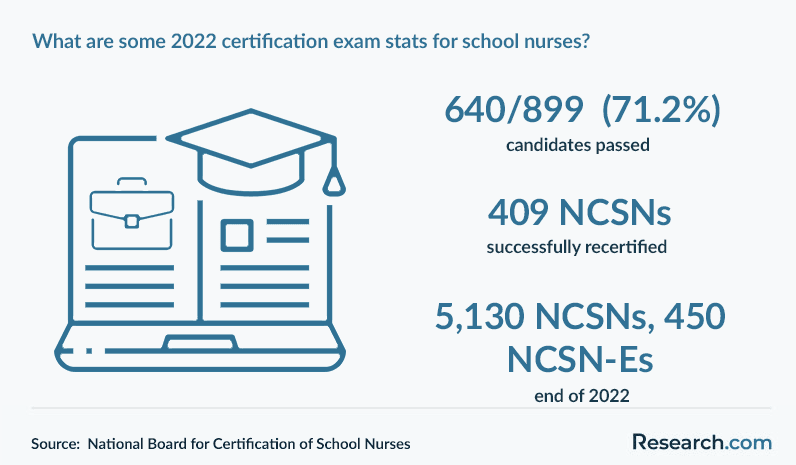
Program format alone does not determine exam success. Whether education was done online, onsite, or as a hybrid program does not really matter in every case; in 2022, 640 out of 899, or 71.2%, of candidates passed the school nurse certification exam.
What is the average cost of a nursing certification program?
Nursing certification costs vary widely because some credentials involve only an exam or review course, while others require graduate coursework, clinical placements, and university tuition. Always compare total cost, not just the advertised exam fee.
- Adult-Gerontology Clinical Nurse Specialist Certification (AGCNS-BC™): $295
- Advanced Cardiovascular Life Support (ACLS) Certification: $2,804
- Basic Life Support (BLS) Certification: $802
- Psychiatric-Mental Health Nurse Practitioner (Across the Lifespan) Certification (PMHNP-BC™): $295
| Cost item | Why it matters |
| Application and exam fees | These are often nonrefundable and may be separate from course costs. |
| Review course or prep materials | Useful for exam readiness, but quality and recognition vary by provider. |
| Clinical or lab expenses | Some credentials require in-person assessment, equipment, or supervised practice. |
| Renewal and continuing education | Certification may require ongoing education or renewal fees after the initial credential. |
| Lost work time | Intensive courses, exams, and clinical requirements can affect scheduling and income. |
What are the financial aid options for students enrolling in a nursing certification program?
Financial aid depends on whether the certification is part of an eligible academic program, a noncredit continuing education course, or an employer-sponsored training pathway. Short review courses may not qualify for the same aid as degree-granting programs, so confirm eligibility before assuming aid will apply.
Federal aid
- FAFSA: Used to determine eligibility for grants, loans, and work-study when the program qualifies.
- Federal Pell Grant: Need-based funding for eligible undergraduate students.
- Federal Direct Loans: Subsidized and unsubsidized loan options may be available for eligible programs.
- TEACH Grant: Funding for students preparing to teach in high-need fields.
State and institutional aid
- State grants: State-specific aid may be available for nursing students.
- Institutional grants: Colleges and universities may provide funding for eligible students and programs.
Other options
- Nurse Corps Scholarship: Scholarship support tied to a service commitment.
- Professional organization grants: Nursing associations may offer scholarships, grants, or exam support.
- Employer reimbursement: Many healthcare employers help pay for certifications that align with staffing needs.
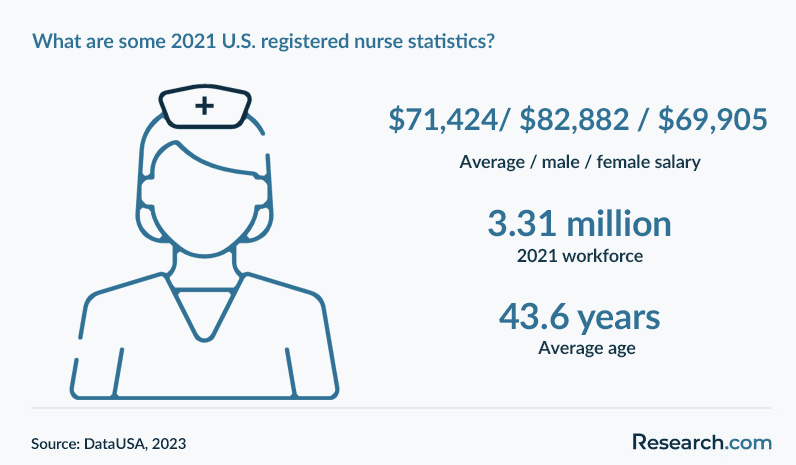
Do not assume certification income will automatically offset debt. In the graphic below, the 2021 average salary for RNs was $71,424, with the average male salary at $82,882 and the average female salary at $69,905, indicating a gender pay gap. Use these figures as a reason to compare expected return carefully, especially if you are paying out of pocket.
What are the prerequisites for enrolling in a nursing certification program?
Prerequisites vary by credential, but most nursing certifications expect applicants to have a nursing or healthcare foundation. Advanced certifications may require a current RN license, clinical hours in a specialty, a graduate degree, or proof of recent practice.
- Science foundation: Biology, chemistry, anatomy, and physiology help prepare nurses for advanced clinical content.
- Nursing or healthcare background: Most programs expect prior nursing coursework or clinical experience so applicants can apply specialty concepts safely.
- Credential-specific requirements: Always review the official eligibility rules for the exact certification, including license status, practice hours, degree level, and exam deadlines.
What course topics are typically in a certification program?
Nursing certification content depends on the specialty, but most programs combine evidence-based practice, clinical judgment, ethical responsibilities, communication, and specialty-specific patient care.
Evidence and research
- Evaluating research and applying findings to patient care.
- Using quality improvement methods to support safer outcomes and more efficient care delivery.
- Making clinical decisions based on evidence, patient assessment, and current standards of practice.
Professional growth
- Ethics and legal responsibilities in clinical practice.
- Cultural competency for caring for diverse patient populations.
- Communication skills for patients, families, physicians, and interdisciplinary teams.
Advanced skills
- Critical care management for complex ICU patients.
- Neonatal and pediatric care for infants, children, and adolescents.
- Cardiac care, including ACLS, monitoring, and ECG interpretation.
- Mental health assessment, diagnosis support, and treatment planning.
- Gerontology and age-related care for older adults.
- Leadership, staffing, resource management, and quality improvement.
Examples of specialty content
- CCRN: Advanced assessment, critical interventions, respiratory care, patient monitoring, and trauma-related care.
- AG-ACNP: Advanced physical assessment, acute and chronic illness management for adults and older adults, pharmacology, and procedures.
- NNP: Assessment and management of critically ill or premature newborns, advanced resuscitation, and developmental care.
What types of specializations are available in online nursing certification programs?
Online nursing certification programs cover many specialties, but nurses should choose based on desired practice setting, licensure implications, and employer recognition. Some nurses enter nursing after studying other disciplines, such as a mathematics degree, but certification generally requires nursing education and licensure first.
Critical care
- Critical Care Registered Nurse (CCRN): Supports critically ill patients in ICUs, emergency departments, and trauma settings.
- Neonatal Intensive Care Nurse (NICN): Focuses on critically ill newborns.
- Pediatric Critical Care Nurse (PCCN): Provides high-acuity care for children and adolescents.
Adult-gerontology
- Adult-Gerontology Acute Care Nurse Practitioner (AG-ACNP): Diagnoses and treats acute and chronic conditions in adults and older adults.
- Adult-Gerontology Primary Care Nurse Practitioner (AG-PCNP): Provides primary care for adult and older adult populations.
- Geriatric Care Nurse Practitioner (GNP): Specializes in health issues affecting older adults.
Mental health
- Psychiatric-Mental Health Nurse Practitioner (PMHNP): Diagnoses and treats mental health conditions across the lifespan.
- Certified Psychiatric-Mental Health Nurse (PMHN): Delivers advanced clinical care for patients with psychiatric and behavioral health needs.
Other specializations
- Women’s Health Nurse Practitioner (WHNP): Works in women’s health, including OB/GYN and primary care.
- Nurse Anesthetist (CRNA): Provides anesthesia for surgeries and procedures.
- Nurse Leader: Focuses on management, operations, and leadership in healthcare settings.
How does one choose the best nursing certification program?
Start with the job posting for the role you want, then work backward. If employers in your target setting repeatedly name a specific certification, that credential should carry more weight than a program with a lower price or easier admissions process.
- Accreditation and recognition: Confirm that the program or credential is accepted by employers, professional bodies, or state licensing boards when applicable.
- Clinical hours: Determine whether the credential requires specialty practice hours before you can sit for the exam.
- Total cost: Include tuition, exam fees, review materials, renewals, travel, and lost work time.
- Labs and simulations: Check whether hands-on skill assessment, simulation, or in-person lab work is required.
- Learning format: Choose online, hybrid, or campus-based study based on your schedule and learning style.
- Prerequisites: Review requirements such as active RN licensure, graduation from an accredited nursing school, exam eligibility, and clinical background.
- Faculty and instructors: Look for instructors with current specialty experience and relevant credentials.
- Outcomes: Ask about exam pass rates, student support, and employment relevance, but remember that placement data can be limited.
- Student support: Consider tutoring, advising, exam preparation, technical help, and career services.
- Specialization fit: Pick a credential that matches your preferred patient population, care setting, and long-term advancement plan.
| Common mistake | Better approach |
| Choosing the cheapest program without checking recognition | Ask your employer or target employer which credential they value. |
| Assuming an online program has no in-person requirements | Confirm clinical, lab, proctoring, and skills-check expectations before enrolling. |
| Ignoring renewal requirements | Review continuing education and renewal costs before you commit. |
| Relying only on rankings | Compare accreditation, eligibility, support, exam alignment, and employer demand. |
| Assuming certification guarantees a raise | Ask HR or your manager how certification affects pay, promotion, and role eligibility. |
What career paths are available for nursing certification program graduates?
Nursing certifications can support lateral moves into new specialties, advancement into leadership, or preparation for advanced practice. The right path depends on your license, degree, clinical experience, and state requirements.
- Ambulatory Care Nurse: Provides care in outpatient settings and may pursue Ambulatory Care Nursing Certification (RN-BC).
- Cardiac Vascular Nurse: Specializes in care for patients with heart and vascular conditions and may pursue Cardiac Vascular Nursing Certification (RN-BC).
- Care Coordination and Transition Management Nurse: Helps manage patient movement across healthcare settings and may pursue Care Coordination and Transition Management Certification (CCCTN).
- Certified Nursing Assistant (CNA): Assists with daily care and patient monitoring; requires a high school diploma, postsecondary certificate, and CNA certification.
- Certified Registered Nurse Anesthetist (CRNA): Provides anesthesia and pain management for procedures and surgeries.
- Clinical Nurse Specialist (CNS): Applies advanced knowledge in a specialty area through care delivery, education, research, and practice improvement.
- Diabetes Care and Education Specialist: Teaches and supports patients managing diabetes and may pursue Certified Diabetes Care and Education Specialist (CDCES) certification.
- Emergency Nurse: Cares for patients in emergency departments and may pursue Certified Emergency Nurse (CEN) certification.
- Flight Nurse: Provides patient care during air transport and may pursue Certified Flight Registered Nurse (CFRN) certification.
- Hospice Nurse: Supports terminally ill patients and families and may pursue Certified Hospice and Palliative Nurse (CHPN) certification.
- Informatics Nurse Specialist: Uses technology, data, and clinical workflows to improve patient care and decision support.
- Labor and Delivery Nurse: Supports patients before, during, and after childbirth and may pursue Inpatient Obstetric Nursing (RNC-OB) certification.
- Legal Nurse Consultant: Applies clinical expertise to legal cases and healthcare-related claims.
- Nurse Educator: Teaches students, trains practicing nurses, and develops clinical education programs.
- Nurse Manager or Nurse Leader: Oversees nursing units, staffing, quality measures, and team performance.
- Nurse Midwife (CNM): Provides women’s health, prenatal, childbirth, and well-woman care.
- Nurse Practitioner (NP): Provides comprehensive care in specialties such as family, adult-gerontology, pediatrics, psychiatric-mental health, and women’s health.
- Nurse Researcher: Conducts research to improve nursing practice and healthcare delivery.
- Occupational Health Nurse: Supports employee health, workplace safety, and prevention programs.
- Public Health Nurse: Works with communities to prevent disease and promote health.
Some certifications are more challenging than others. In 2022 first-time pass rates for U.S. Nurse Certification by category showed meaningful differences across exams, so nurses should review both eligibility and difficulty before committing time and money.
Certifications such as ACCNS-P, ACNPC-AG, and CMC had pass rates at around 83%. More difficult certifications such as ACCNS-N (63.64%) and CCRN-K (Neonatal) (50%) had much lower pass rates. This does not mean you should avoid a difficult credential, but it does mean you should prepare realistically.
What are the easiest nursing jobs you can get with a certification?
The easiest nursing jobs to enter with a certification are usually roles with shorter training timelines, more predictable schedules, or lower acuity than ICU, emergency, or advanced practice roles. Licensed Practical Nurse (LPN) and Certified Nursing Assistant (CNA) pathways are often more accessible because they may require less time than advanced nursing specialties, typically ranging from a few months to a year.
Medical office nursing, outpatient support roles, nursing assistant positions, and some long-term care or home healthcare positions may also be more approachable for people seeking faster entry or steadier hours. These roles still require professionalism, safety awareness, and patient-care skill; “easier” should not be confused with unimportant.
If your goal is quick entry, compare CNA, LPN, outpatient, and medical office roles. If your goal is long-term advancement, consider whether an RN license, specialty certification, BSN, MSN, or advanced practice pathway will better support your plans.
How can nursing certifications support advanced practice and leadership roles?
Certification can help nurses demonstrate specialty readiness, but advanced practice and leadership roles often require more than a certificate. Nurse practitioners, clinical nurse specialists, nurse educators, and executive nurse leaders may need graduate education, documented clinical experience, national exams, and state approval. For RNs who want to move from an associate degree toward graduate-level roles, ADN to MSN bridge programs can provide a more direct academic route than starting over.
Should I consider a DNP online program to enhance my nursing certification?
A DNP may be appropriate if your career goal involves advanced clinical leadership, systems improvement, evidence-based practice, or a terminal practice degree. It is not necessary for every certified nurse. Before choosing a DNP, ask whether the role you want requires it, whether your employer rewards it, and whether the cost and time commitment fit your expected return. Nurses comparing flexible doctoral routes can review options for a DNP online.
How can I optimize my exam preparation for nursing certification?
Strong exam preparation starts with the official exam outline. Build a study schedule around the tested domains, then use practice questions to identify weak areas. Do not rely only on passive reading; apply the content through case studies, simulations, rationales, and discussion with certified nurses in your specialty.
- Download the current candidate handbook or exam blueprint from the certifying body.
- List the eligibility requirements and confirm that you meet them before purchasing a prep course.
- Use practice exams to identify weak domains, then study those areas first.
- Choose review materials aligned with the current exam, not outdated outlines.
- Join a peer study group or ask a certified colleague to explain how exam content appears in practice.
- Schedule the exam only after your practice results show consistent readiness.
Advanced practitioners who want broader family practice preparation may also compare a post-masters FNP program with a standalone certification review course.
Can a dual degree complement my nursing certification?
A dual degree may make sense for nurses who want to move beyond bedside specialization into administration, strategy, finance, operations, or executive leadership. Certification can show clinical expertise, while business or management training can support decisions about staffing, budgeting, quality improvement, and organizational performance. Nurses considering a combined clinical and business route can compare MSN/MBA programs.
How can I verify the accreditation and quality of a nursing certification program?
Start with the official certifying organization, then verify whether the school or course provider is recognized by employers and relevant nursing bodies. Accreditation and quality checks are especially important for online programs, graduate certificates, and credentials tied to licensure.
- Confirm the credentialing body and whether it is recognized in your specialty.
- Check whether the academic institution is properly accredited if the certification is part of a degree or certificate program.
- Ask whether the curriculum follows the current exam blueprint or professional standards.
- Review faculty credentials and current specialty experience.
- Ask for exam pass-rate information when available.
- Verify clinical placement support if the program includes practice-hour requirements.
- Contact your state board of nursing if the program affects licensure or scope of practice.
If you are comparing nursing programs by admissions accessibility, use program quality checks alongside resources such as What is the easiest nursing program to get into?.
Can nursing certifications bridge the gap to a higher academic degree?
Some nurses use certification as a stepping stone toward a BSN, MSN, DNP, or specialized graduate certificate. Certification may strengthen your application, clarify your specialty direction, and demonstrate professional commitment. However, it does not automatically replace required degree credits unless a specific school grants credit or advanced standing.
RNs planning to continue academically can compare flexible bridge options, including easy online BSN bridge programs to get into, especially if they want to combine current clinical experience with a higher academic credential.
What is the job market for graduates with a nursing certification?
The job market for certified nurses is influenced by specialty demand, geography, employer type, and credential recognition. Certification can help you compete for specialized roles, but job outcomes depend on whether you also meet experience, degree, licensure, and scheduling requirements.
- Ambulatory Care Nurse: Cares for patients in outpatient settings. Annual salary: $74,588.
- Cardiac Vascular Nurse: Specializes in cardiovascular health. Annual salary: $$80,000.
- Care Coordination and Transition Management Nurse: Coordinates long-term patient care, similar to a Nurse Care Coordinator. Annual salary: $53,062.
- Certified Nursing Assistant (CNA): Supports patient care and daily activities. Annual salary: $40,000
- Diabetes Care and Education Specialist: Helps patients manage diabetes, similar to a Diabetes Care Specialist. Annual salary: $73,996.
- Emergency Nurse: Provides urgent care in emergency settings. Annual salary: $96,000.
- Flight Nurse: Provides pre-hospital care during aircraft transport. Annual salary: $83,000.
- Hospice Nurse: Delivers comfort-focused end-of-life care. Annual salary: $73,948.
- Labor and Delivery Nurse: Cares for patients during and after childbirth. Annual salary: $72,440.
What are the emerging trends in nursing certifications for 2027 and beyond?
Nursing certification is changing as healthcare becomes more technology-driven, team-based, and specialized. Nurses choosing credentials now should consider whether the specialty is likely to remain relevant in clinical practice, virtual care, population health, or leadership.
- Telehealth and virtual care: As telemedicine expands, nurses need skills in remote assessment, patient communication, remote monitoring, and technology-supported care delivery.
- Geriatric and palliative care: Aging populations increase the need for nurses skilled in chronic disease management, pain control, end-of-life care, and family communication.
- Nursing informatics and data science: Electronic health records, clinical analytics, and workflow improvement are creating demand for nurses who understand both bedside care and data systems.
- Mental health and addiction nursing: Psychiatric care, substance use recovery, trauma-informed care, and behavioral health support continue to be important areas for nursing specialization.
- Integrative and holistic health: Some nurses are pursuing credentials related to wellness, prevention, patient-centered care, and complementary approaches, while still grounding practice in evidence and safety.
What are the eligibility criteria for specific nursing certification programs?
Eligibility rules differ by credential, so read the official handbook for the specific certification. Requirements may include education, license status, experience hours, specialty practice, coursework, endorsements, and exam registration steps.
- Educational prerequisites: Many certifications require at least an Associate Degree in Nursing (ADN) or Bachelor of Science in Nursing (BSN), while advanced certifications may require a Master of Science in Nursing (MSN) or higher.
- Active RN license: Applicants commonly need a current, valid, unencumbered RN license in the state or country where they practice.
- Clinical experience: Specialty certifications such as CCRN or OCN often require practice hours in the relevant area. Some programs may require 1,750 hours of direct patient care experience over two years.
- Specialized coursework: Some credentials require prior training. For example, ACLS candidates may need Basic Life Support preparation first.
- Professional endorsements or references: Some programs may ask for letters from supervisors, instructors, or colleagues to confirm specialty competence.
- Exam requirements: Many credentials require a formal exam, with deadlines, application materials, and eligibility documentation submitted before testing.
If you are exploring what certifications can I get online, compare convenience with legitimacy. A fast online option is useful only if it meets the requirements for your target role.
What else can I do with a nursing certification?
A nursing certification can help you change units, pursue specialty practice, qualify for leadership training, prepare for graduate study, or build expertise in a related healthcare function such as informatics, education, case management, or quality improvement. If you are also comparing non-nursing credentials, review short certificate programs that pay well to understand how other healthcare and career certificates differ from nursing-specific credentials.
What are the most affordable accelerated nursing certification programs available?
Affordable accelerated options can be useful for working RNs who want focused training without committing to a full degree immediately. The key is to avoid confusing “accelerated” with “low quality.” A good accelerated program should still align with current exam standards, provide appropriate support, and be recognized by employers in your specialty.
When comparing cheap accelerated nursing programs, look beyond tuition. Check graduation rates, clinical requirements, exam preparation quality, transfer options, and whether the program supports the nursing role you actually want.
Questions to ask before enrolling in a nursing certification program
- Is this credential required, preferred, or optional for the job I want?
- Which certifying body issues the credential, and is it recognized by employers in my area?
- Do I already meet the license, degree, and clinical-hour requirements?
- Is the program a certification review course, a certificate program, or part of a degree pathway?
- Are there in-person labs, clinical placements, proctored exams, or travel requirements?
- What is the total cost, including application fees, exam fees, study materials, renewal, and continuing education?
- Does my employer offer reimbursement, paid study time, or a raise after certification?
- Will this certification help me move into a specialty, or would a BSN, MSN, DNP, or bridge program be more useful?
Key Insights
- Nursing certification is most valuable when it is tied to a specific role, specialty, employer requirement, or advancement plan.
- Costs, timelines, and eligibility requirements vary widely; always separate review-course length from required clinical experience.
- Online certification programs can be flexible, but some still require in-person labs, skills checks, clinical hours, or proctored exams.
- Certification may improve earning potential, but salary depends on specialty, employer, location, experience, and degree level.
- Advanced practice credentials often require graduate education and licensure steps, not just a short certification course.
- Before enrolling, verify accreditation, certifying-body recognition, employer value, total cost, renewal requirements, and exam alignment.
- For long-term advancement, compare certification with bridge programs, BSN completion, MSN pathways, DNP options, and dual degrees.
References:
- American Association of Critical-Care Nurses. (2023). Certification Exam Statistics and Cut Scores. AACN exam statistics.
- Data USA. (2023). Registered nurses | Data USA. Data USA registered nurses profile.
- Lee, B., Liang, H., Chu, T., & Hung, C. (2019). Effects of simulation-based learning on nursing student competences and clinical performance. Nurse Education in Practice, 41, 102646.
- National Council of State Boards of Nursing, Inc. (2023). NLC States. NCSBN NLC map.
- National Council of State Boards of Nursing, Inc. (2023). Statistics NBCSN. NBCSN statistics.
- PayScale. (2023a). Registered Nurse certified (RN-C) salary. PayScale RN-C salary.
- PayScale. (2023b). Psychiatric Nurse (RN) hourly pay in 2023. PayScale psychiatric nurse hourly rate.
- Salary.com. (2023a). Intermediate Registered Nurse Staff salary | Salary.com Intermediate Registered Nurse Staff salary.
- Salary.com. (2023b). Registered Nurse (RN), Level 1 salary | Salary.com RN Level 1 salary.
- Salary.com. (2023c). Registered Nurse (RN), Level 2 salary | Salary.com RN Level 2 salary.
- Salary.com. (2023d). Registered Nurse (RN), Level 3 salary | Salary.com RN Level 3 salary.
- Smiley, R., Allgeyer, R. L., Shobo, Y., Lyons, K. C., Letourneau, R., Zhong, E. H., Kaminski-Ozturk, N., & Alexander, M. (2023). The 2022 National Nursing Workforce Survey. Journal of Nursing Regulation, 14(1), S1S90.
- U.S. Bureau of Labor Statistics. (2023). Registered Nurses: Occupational Outlook Handbook. U.S. Bureau of Labor Statistics RN outlook.
- U.S. Bureau of Labor Statistics. (2023b). Nurse Anesthetists: Occupational Employment and Wages, May 2022. U.S. Bureau of Labor Statistics nurse anesthetists wages.
Other Things You Should Know About Nursing Certification
In 2027, some of the most valuable nursing certifications include the Critical Care Registered Nurse (CCRN), Family Nurse Practitioner (FNP-BC), and Certified Emergency Nurse (CEN), each offering specialization and potential advancement in their respective fields.
In 2027, prerequisites for nursing certification often include a valid RN license, a specified amount of clinical experience, and potentially a prior degree. Credentialing bodies like ANCC may require 2 years of experience and 2,000 hours in the certification specialty.
- Nursing certifications in the US typically require renewal every few years to ensure that nurses stay updated with current practices and standards.
- Renewal requirements often include completing continuing education credits, such as courses or workshops related to the specific certification area.
- Nurses may also need to demonstrate active practice in their specialty area or provide evidence of ongoing professional development.
- Maintaining certifications not only validates a nurse's expertise but also enhances their credibility and marketability in the healthcare industry.
It's essential for nurses to stay informed about renewal deadlines and requirements to avoid lapses in their certifications.
Yes. Many certifications are strongest when they are accredited by the American Board of Nursing Specialties (ABNS) or approved by a recognized certifying body such as the ANCC. Employers often look for national certification tied to a defined specialty and a proctored exam, not a general certificate.


