2027 Best Online Associate Degrees in General Studies With Flexible Elective Options

Co-Founder and Chief Data Scientist
Choosing an online associate degree in general studies is often a decision about flexibility: you want college credit, transfer options, and room to explore without locking into the wrong major. The College Board reported average published tuition and fees of $4,050 for in-district public two-year colleges in 2024-25, making associate programs a lower-cost starting point for many students. This guide is for working adults, undecided students, transfer-focused learners, and career changers who want to compare programs, understand electives, avoid weak options, and decide whether general studies is the right investment.
Key Things You Should Know
- The strongest online general studies associate degrees are regionally or institutionally accredited, usually require about 60 credits, and are built for transfer, career exploration, or degree completion rather than one narrowly defined occupation.
- Flexible electives are the main advantage: many programs let students apply prior college credits, choose career-related courses, or build a custom pathway toward business, health, technology, education, public service, or liberal arts bachelor's programs.
- Cost and outcomes vary widely, but public two-year colleges remain the benchmark for affordability, with the College Board reporting $4,050 in average in-district tuition and fees for 2024-25; students should still compare total cost, transferability, and advising quality before enrolling.
What are the best online associate degrees in general studies?
The best online associate degrees in general studies are not always the programs with the biggest brand names. For this degree, "best" usually means the program is accredited, affordable, transfer-friendly, generous with electives, transparent about costs, and supported by strong academic advising. A general studies associate degree can be an Associate of Arts, Associate of Science, Associate of General Studies, or Associate of Applied Science, depending on the school and the student's goal.
Students who plan to continue to a bachelor's degree should prioritize transfer-focused programs. If you already know you want a flexible four-year major after the associate degree, it can help to compare online interdisciplinary studies bachelor programs low cost while choosing electives, because the most useful associate courses are often the ones that satisfy future bachelor's requirements.
The table below compares the main types of online general studies associate degrees. Use it to match the degree structure with your next step rather than choosing based on the title alone.
| Program type | Best fit | Typical strength | Main caution |
| Associate of Arts in General Studies | Students planning to transfer into humanities, social sciences, education, communication, or interdisciplinary bachelor's programs | Strong general education and transfer alignment | May include fewer technical or career-specific electives |
| Associate of Science in General Studies | Students interested in science, health, technology, analytics, or STEM-adjacent transfer pathways | More room for math, science, and quantitative electives | Science courses may require labs, proctoring, or specific sequencing |
| Associate of General Studies | Adults with previous credits, undecided students, and learners who need maximum elective flexibility | Often accepts a broad mix of transfer, military, exam, or workforce credits | Transfer value depends heavily on advising and articulation agreements |
| Associate of Applied Science with general studies emphasis | Students who want career-oriented electives and may enter work before transferring | Can combine general education with applied courses | Some credits may not transfer cleanly into bachelor's programs |
A strong program should also offer online student services, including tutoring, library access, transfer advising, career coaching, disability accommodations, and technical support. These services matter because online flexibility only helps if the school also gives students a clear path to registration, degree planning, and completion.
How does a general studies degree support flexible elective choices?
A general studies degree supports flexible elective choices by giving students a required general education foundation plus a large elective area that can be shaped around transfer plans, career interests, or previously earned credits. In many programs, electives may account for one-third or more of the degree, although the exact number depends on the college.
This flexibility is valuable for students who are not ready to choose a specialized major or who want to test a field before committing to a bachelor's degree. For example, a student exploring health and wellness careers may use science and psychology electives before deciding whether to pursue a nutritionist degree online later.
Electives are most useful when they are chosen intentionally. Before enrolling, students should understand the different ways electives can support a degree plan.
- Transfer electives: Courses selected because they are likely to count toward a future bachelor's program, such as statistics, public speaking, biology, psychology, accounting, or introductory computer science.
- Career-focused electives: Courses that build practical skills for entry-level work, such as business software, customer service, digital communication, project management basics, or medical terminology.
- Exploration electives: Courses that help undecided students compare fields before choosing a major, such as criminal justice, sociology, education, marketing, environmental science, or health studies.
- Credit-completion electives: Previously earned college, military, exam-based, or workforce credits that help adult learners finish a credential faster when the school accepts them.
The trade-off is that too much freedom can lead to wasted credits. A flexible elective plan is strongest when it is tied to a transfer map, a target bachelor's major, or a specific skill set employers recognize.
Are online general studies associate degrees accredited?
Many online general studies associate degrees are accredited, but students should verify accreditation before applying. Accreditation is a quality review process that affects federal financial aid eligibility, transfer credit acceptance, employer recognition, and the credibility of the credential. For most students, the key question is whether the institution is accredited by an agency recognized by the U.S. Department of Education or the Council for Higher Education Accreditation.
Program-level accreditation is usually not required for general studies because the major is broad and not tied to licensure. Institutional accreditation is the more important factor. Students should be especially careful with schools that use vague language such as "fully approved" or "internationally recognized" without naming a recognized accreditor.
Use the following steps to check whether an online associate program is legitimate before sharing personal information or paying an application fee.
- Search the school in the U.S. Department of Education's Database of Accredited Postsecondary Institutions and Programs or in the CHEA database.
- Confirm that the accrediting agency listed on the school's website matches the agency shown in the official database.
- Ask whether online students receive the same transcript and diploma wording as campus-based students.
- Review transfer agreements with public universities in your state or with the bachelor's programs you may enter later.
- Check whether the school is authorized to enroll online students in your state, especially if you may use financial aid or live outside the school's home state.
A major red flag is a school that pressures students to enroll immediately, avoids direct answers about accreditation, or promises unusually fast degree completion without reviewing prior credits. Legitimate online programs can be flexible, but they still require documented coursework and academic standards.
What courses are included in a general studies associate degree?
An online associate degree in general studies typically includes general education courses, open electives, and sometimes a first-year seminar or capstone. Most programs are designed to build broad college-level skills: writing, quantitative reasoning, critical thinking, information literacy, communication, and basic scientific and social understanding.
The table below summarizes common course categories. It helps students see which requirements are usually fixed and which areas offer room for customization.
| Course area | Common examples | Why it matters |
| English and communication | College composition, technical writing, public speaking, interpersonal communication | Builds writing and presentation skills used in most jobs and bachelor's programs |
| Mathematics and quantitative reasoning | College algebra, statistics, quantitative literacy, finite math | Supports transfer pathways in business, science, psychology, technology, and social science |
| Natural sciences | Biology, environmental science, anatomy and physiology, chemistry, earth science | Provides scientific literacy and may support health or STEM-related transfer plans |
| Social and behavioral sciences | Psychology, sociology, economics, political science, anthropology | Helps students understand people, organizations, communities, and public systems |
| Humanities and arts | Literature, history, ethics, philosophy, art appreciation, music appreciation | Strengthens cultural literacy, analysis, and written reasoning |
| General electives | Business, technology, education, criminal justice, health, foreign language, leadership | Allows students to personalize the degree around transfer, work, or exploration goals |
Students should pay close attention to math and science placement. A program may be online, but some science courses require lab kits, virtual labs, campus labs, or proctored exams. Those details can affect both cost and scheduling.
What are the admission requirements for online general studies programs?
Admission requirements for online general studies associate degrees are usually accessible compared with selective bachelor's programs. Many community colleges and open-access institutions accept students with a high school diploma, GED, or state-recognized equivalent. However, "open admission" does not always mean every student starts directly in college-level math or writing.
Most applicants should be prepared to submit several standard materials. Requirements vary by school, but the following are common for U.S. online associate programs.
- Completed online application and basic residency information
- Official high school transcript, GED record, or proof of equivalent completion
- Official transcripts from any colleges previously attended
- Placement information, such as high school GPA, prior college credits, standardized test scores, or school-administered assessments
- FAFSA submission if the student plans to use federal financial aid
- Proof of identity, immunization records, or state authorization forms when required by the institution
Adult learners should ask whether the program accepts transfer credits, military training, CLEP exams, DSST exams, Advanced Placement credits, industry certifications, or prior learning assessment. These policies can significantly change the cost and time required to finish, but they must be documented and approved by the school.
A common mistake is applying without sending all prior college transcripts. Even if a previous semester went poorly, schools often require complete academic records, and missing transcripts can delay admission, financial aid, or graduation clearance.
How long does an online general studies associate degree take?
Most online general studies associate degrees require about 60 semester credits. A full-time student taking 15 credits per semester can often finish in two academic years, while part-time students commonly take longer. Accelerated formats may shorten the calendar time, but they require more weekly study hours and careful course sequencing.
The table below compares common pacing options. The best choice depends on work hours, family obligations, financial aid rules, and how quickly the student needs the credential.
| Study pace | Typical credit load | Estimated completion pattern | Best for |
| Full-time | 12 to 15 credits per term | Often about two academic years | Students who can make school a major weekly commitment |
| Part-time | 6 to 9 credits per term | Often three or more years | Working adults, caregivers, and students paying as they go |
| Accelerated | Condensed 5-week, 7-week, or 8-week courses | Can reduce calendar time if courses are available year-round | Organized students with strong time management and reliable internet access |
| Transfer-credit completion | Varies based on accepted credits | Can be shorter when prior credits apply to degree requirements | Students returning to college after previous enrollment, military service, or exams |
Online courses are not automatically easier than campus courses. Asynchronous classes offer scheduling freedom, but students still need time for readings, assignments, discussions, exams, group projects, and advising appointments. A practical rule is to choose a lighter first term if you have not taken college courses recently.
How much do online general studies associate degrees cost?
Online general studies associate degree costs depend on institution type, residency status, credit load, fees, books, technology, and whether prior credits transfer. Public community colleges are often the lowest-cost option for in-state or in-district students, while private and out-of-state programs may cost more but sometimes offer broader start dates or adult-focused advising.
For a realistic comparison, look beyond the advertised per-credit rate. The following cost figures and categories show what students should include when estimating total price.
- The College Board reported average published tuition and fees of $4,050 for in-district public two-year colleges in 2024-25.
- Many associate degrees require about 60 credits, so even a modest per-credit difference can change the final tuition bill substantially.
- Online students may pay technology fees, distance learning fees, proctoring fees, lab fees, transcript fees, graduation fees, and textbook or digital access costs.
- Transfer credits, military credits, exam credits, and prior learning assessment can lower total cost only if they apply to required degree categories.
- Federal Pell Grants, state grants, employer tuition assistance, scholarships, and payment plans may reduce out-of-pocket cost for eligible students.
Students should compare net price, not just sticker price. Net price is the amount paid after grants and scholarships, and it is often more useful than tuition alone. Also check whether taking fewer than 12 credits changes financial aid eligibility, because part-time enrollment may reduce aid amounts or affect satisfactory academic progress rules.
A common cost mistake is choosing the cheapest program without checking transferability. If low-cost credits do not count toward a future bachelor's degree, the student may save money upfront but pay more later by retaking courses.
What jobs can you get with a general studies associate degree?
A general studies associate degree can support entry-level roles that value communication, basic technology use, organization, customer service, and general college-level skills. It is not usually designed for licensed professions, so students who want nursing, teaching licensure, engineering, accounting licensure, or clinical healthcare roles should confirm the required major and credentials before choosing electives.
For many students, the degree works best as a bridge: it can help qualify for jobs that prefer some college or an associate degree while keeping transfer options open. Students interested in athletics, recreation, event operations, or sports business, for example, might use electives as a foundation before comparing an online sports management bachelor's degree.
The table below lists job areas where a general studies associate degree may be relevant. Actual hiring requirements depend on the employer, region, software skills, experience, and the electives completed.
| Job area | Possible entry-level roles | Relevant electives or skills | Important limitation |
| Office and administrative support | Administrative assistant, office coordinator, records clerk, front desk coordinator | Business software, writing, communication, spreadsheets, records management | Routine clerical roles face automation pressure, so software and data skills matter |
| Customer service and sales support | Customer service representative, account support assistant, service coordinator | Communication, psychology, business, conflict resolution, CRM tools | Advancement often depends on performance, product knowledge, and experience |
| Human services and community support | Program assistant, outreach aide, case support assistant, nonprofit coordinator | Psychology, sociology, ethics, public speaking, social services basics | Clinical or counseling roles usually require higher degrees and licensure |
| Business operations support | Operations assistant, logistics assistant, purchasing clerk, project support assistant | Accounting basics, Excel, business communication, statistics, management | More specialized roles may require a business, supply chain, or analytics bachelor's degree |
| Education support | Teaching assistant, tutoring aide, enrollment assistant, student services assistant | Education foundations, child development, writing, communication | Public school teaching licensure requires additional state-approved preparation |
The labor market is also changing because of automation and AI tools. BLS employment projections for 2024-2034 show overall U.S. employment growth, but many routine office tasks are increasingly handled by software. Students can improve their options by choosing electives that build durable skills: data literacy, digital communication, project coordination, writing, and customer-facing problem solving.
What is the salary outlook for general studies graduates?
The salary outlook for general studies graduates depends less on the degree title and more on the role, industry, location, experience, and additional skills. General studies is broad, so it should not be evaluated like a specialized credential that feeds directly into one occupation. It is better to view the degree as a foundation that may improve eligibility for some jobs and support transfer into a bachelor's program.
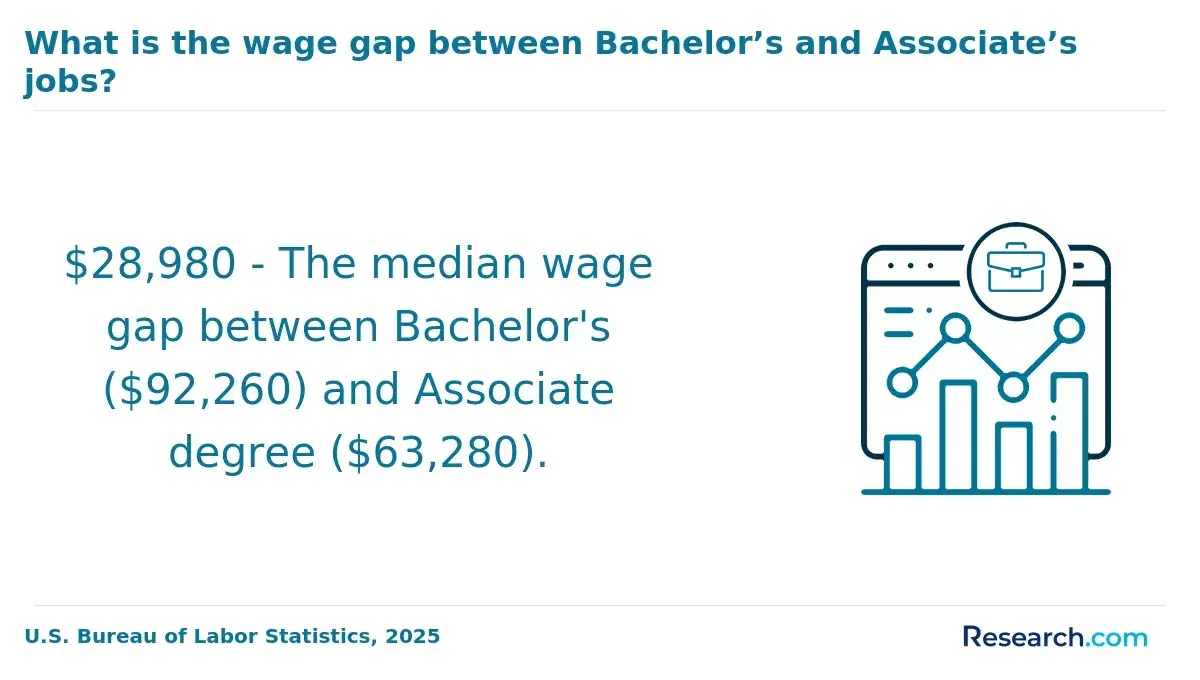
BLS 2024 education data reported median weekly earnings of $1,099 for workers whose highest education level was an associate degree. This figure is not specific to general studies, but it gives useful context: associate-level education is associated with higher median earnings than stopping after high school, while bachelor's-level earnings are typically higher still.
The table below shows salary context for roles that may align with associate-level general education plus job-specific skills. These figures should be used as labor-market reference points, not as promises of individual earnings.
| Role category | Salary context | How general studies may help | What can raise earnings potential |
| Customer service and client support | BLS May 2024 data placed customer service representatives near the lower-to-middle wage range among office roles | Communication, writing, problem solving, and psychology electives can be relevant | Industry knowledge, sales support skills, CRM software, bilingual ability, supervisory experience |
| Administrative and office support | BLS May 2024 wage data shows pay varies widely by industry and responsibility level | General education plus business technology electives can support entry-level office roles | Advanced spreadsheet skills, bookkeeping, scheduling systems, records management, executive support experience |
| Human services support | Pay is often influenced by nonprofit, government, healthcare, or social service funding structures | Psychology, sociology, ethics, and communication courses can provide useful context | Bachelor's completion, case management experience, state-required training, specialized certifications |
| Business operations support | Operational roles may offer stronger advancement when students add quantitative or business skills | Statistics, accounting, business writing, and project management electives can be useful | Excel, data tools, supply chain knowledge, accounting software, bachelor's-level business coursework |
The practical takeaway is that students should connect electives to marketable skills. A general studies associate degree with random electives may be harder to explain to employers, while a degree with a coherent cluster in business, health, technology, human services, or communication can support a clearer career story.
How do you choose a reputable online general studies program?
To choose a reputable online general studies program, start with your goal: transfer, career entry, career change, military credit use, or finishing credits you already earned. Then evaluate programs based on accreditation, cost, credit policies, advising, online support, and how well electives match your next step.
If your long-term goal is business, compare associate electives with bachelor's requirements early. Students considering management, accounting, marketing, or entrepreneurship pathways may also want to review affordable online business schools before choosing business electives at the associate level.
A structured comparison can prevent expensive mistakes. Use these steps before enrolling in any online general studies associate program.
- Confirm institutional accreditation through an official accreditation database, not only the school's marketing pages.
- Request a degree plan showing exactly which courses you need and how transfer or prior learning credits will apply.
- Ask whether the program has articulation agreements with the bachelor's institutions you may attend later.
- Compare total cost, including tuition, fees, books, technology, proctoring, and graduation charges.
- Check course availability for required classes so you do not get delayed by limited online sections.
- Ask whether online students have access to tutoring, advising, library databases, career services, and disability accommodations.
- Review withdrawal, refund, satisfactory academic progress, and transfer credit appeal policies before registering.
The table below highlights common red flags and better alternatives. These are especially important for students returning to college after a long break or transferring credits from multiple schools.
| Red flag | Why it matters | Better alternative |
| The school will not clearly name its accreditor | Unrecognized accreditation can limit financial aid, transfer, and employer acceptance | Choose a school listed in an official accreditation database |
| The program promises unusually fast completion for everyone | Completion speed depends on credits, course load, placement, and course availability | Ask for a personalized transcript evaluation and term-by-term plan |
| Advising focuses only on enrollment, not transfer or career goals | General studies requires intentional elective planning | Work with an academic advisor who can map electives to a bachelor's major or career cluster |
| The advertised tuition excludes major fees | Online, technology, lab, and textbook costs can change affordability | Request a full cost estimate for the entire degree |
| The school accepts many credits but does not apply them to requirements | Accepted credits may still fail to reduce time to graduation | Ask how each credit applies: general education, major requirement, elective, or excess credit |
The best program is the one that gives you a credible credential, a manageable cost, and a clear next step. Rankings can be useful, but they should not replace a careful review of transfer fit, student support, and total cost.
Other Things You Should Know About General Studies
Yes, starting with an associate degree in general studies often provides a broad foundation adaptable to various disciplines. Many online programs offer flexible pathways, allowing you to switch majors as interests evolve, typically without losing credits.
Many employers accept online degrees from accredited institutions, especially when the transcript and diploma come from the same accredited college as campus programs. Employers are more likely to value the degree when you can explain the skills, electives, projects, or work experience connected to it.
Many accredited online associate degrees in general studies accept up to 45 transfer credits toward a 60-credit program. Schools usually require official transcripts, a minimum 2.0 GPA for transfer work, and recent course content for major-specific or upper-division electives.
References
- General Studies Page https://www.calcoast.edu/general-studies/
- Benefits of a General Studies Degree | University of Bridgeport https://www.bridgeport.edu/news/benefits-of-general-studies-degree/
- General Studies Associate Degree | Northern State University in South Dakota https://northern.edu/degrees/general-studies-associate-degree-online
- 2025 Most Affordable Online Associate Degrees https://www.onlineu.com/most-affordable-colleges/associate-degrees
- Future Career Outlook: General Studies Degree | ALU https://alu.edu/alublog/future-career-outlook-general-studies-degree-alu/
- Associate of Arts (AA) in General Studies | Golden Gate University https://ggu.edu/programs/aa-general-studies/
- General Studies Degree Jobs: 10 Careers + Salaries (2026) | Extern https://www.extern.com/post/general-studies-degree-jobs-career-guide