2027 Online Digital Photography Degrees for Students Who Want Fashion Photography Careers

Co-Founder and Chief Data Scientist
Choosing an online digital photography degree for fashion work is really a decision about portfolio quality, industry access, cost, and career fit. The field is competitive, but it is not disappearing: the U.S. Bureau of Labor Statistics reported a May 2024 median annual wage of $42,520 for photographers, with higher earnings often tied to specialization, location, and commercial clients.
This guide is for students who want fashion, editorial, beauty, e-commerce, or brand photography careers and need a practical way to compare online degree options, verify quality, estimate costs, and plan next steps.
Key Things You Should Know
- For fashion photography, the strongest online degree is usually a bachelor's program or transfer-friendly associate-to-bachelor's path that includes lighting, portraiture, studio workflow, digital post-production, art direction, and portfolio development.
- Cost varies widely: College Board's 2024 Trends in College Pricing reported average published tuition and fees of $4,050 for public two-year in-district colleges, $11,610 for public four-year in-state colleges, and $43,350 for private nonprofit four-year colleges.
- The BLS reported a May 2024 median annual wage of $42,520 for photographers, so students should evaluate programs by total cost, portfolio outcomes, internship access, transfer credit, and business training rather than assuming the degree alone will drive earnings.
What is an online digital photography degree and how does it prepare fashion photographers?
An online digital photography degree is a college program that teaches image-making, camera technique, lighting, editing, visual storytelling, and professional practice through a distance-learning format. For aspiring fashion photographers, the degree matters most when it helps students build a commercial-quality portfolio, understand fashion culture, direct people on set, work with stylists and models, and deliver polished images for magazines, brands, agencies, lookbooks, and e-commerce campaigns.
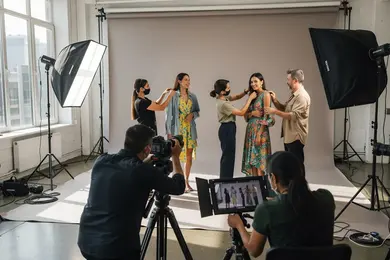
Fashion photography is not only about taking attractive portraits. A working fashion photographer often plans concepts, interprets brand direction, scouts or builds sets, coordinates with makeup artists and wardrobe stylists, manages lighting, directs poses, edits selects, performs color correction, prepares files for print or web, and communicates with clients. Online programs prepare students for this by combining creative assignments with technical critique, software training, and capstone portfolio work.
The best online programs do not try to replace every studio experience with lectures. Instead, they require students to shoot independently, submit projects for critique, use industry-standard editing tools, and document their process. Students usually need access to a camera, lenses, lighting equipment, a reliable computer, and editing software. Some programs also include short residencies, optional campus intensives, or local internship requirements.
Students should understand the difference between a degree and a portfolio. The degree can provide structure, feedback, academic credit, financial aid eligibility, and broader career preparation. The portfolio is what most fashion clients, editors, creative directors, and agencies will evaluate first. The strongest choice is a program that makes the portfolio central, not an afterthought.
Which online digital photography degrees are best for aspiring fashion photographers?
The best online digital photography degree depends on the student's starting point, budget, timeline, and career target. Fashion-focused students should prioritize programs that include studio lighting, portraiture, fashion or commercial photography assignments, Adobe workflow, visual culture, portfolio review, and business courses. Students comparing creative online majors may also want to look at adjacent paths such as a video game designer degree if they are drawn more to concept art, interactive media, or digital worldbuilding than client-based photography.
The table below compares common degree paths and how each fits fashion photography goals. Use it to narrow your options before requesting admissions calls or financial aid estimates.
| Degree option | Typical student fit | Fashion photography value | Main limitation |
| Associate degree in digital photography | Beginners who want a lower-cost start or transfer pathway | Builds fundamentals in camera operation, lighting, editing, and composition | May not provide enough advanced portfolio development for competitive fashion markets |
| Bachelor's degree in photography | Students seeking a complete undergraduate credential and broader art education | Usually offers deeper critique, history, studio practice, portfolio development, and electives | Higher time and cost commitment than certificates or associate programs |
| Bachelor's degree in digital media or visual arts with photography concentration | Students who want photography plus design, video, branding, or multimedia skills | Useful for fashion brands that need still images, short-form video, social content, and campaign assets | Photography coursework may be less specialized than in a dedicated photography major |
| Certificate in digital photography | Career changers, hobbyists, or working creatives who need targeted skills | Can improve lighting, editing, and portfolio pieces quickly | Often less comprehensive and may not carry the same academic value as a degree |
| Master's degree in photography or visual arts | Advanced students pursuing teaching, fine-art practice, or high-level conceptual work | Can refine artistic voice and critical practice for editorial or gallery-oriented fashion work | Usually unnecessary for entry-level commercial fashion photography roles |
A bachelor's degree is often the strongest all-around option for students who want a long-term fashion photography career and do not already have a strong portfolio. An associate degree can be a smart financial starting point if credits transfer cleanly. A certificate can make sense for students who already have a degree, own equipment, or need specific technical training in lighting or editing.
Students should be cautious about programs that advertise fashion photography but offer only one general portrait course. A better program will include repeat opportunities to shoot people, develop concepts, receive critique, and produce portfolio-ready fashion, beauty, product, or editorial images.
How do online digital photography programs compare to campus-based options for fashion careers?
Online photography degrees can work well for motivated students who can create shoots independently and seek local collaborators. Campus-based programs may offer easier access to studios, equipment rooms, faculty critique, fashion departments, model networks, and in-person production teams. The right choice depends less on prestige alone and more on how the format supports portfolio development.
Online creative education has become more accepted across studio-based fields, especially when programs include critique, project documentation, and portfolio assessment. Students exploring other design-heavy options may notice similar trade-offs in programs such as an architecture degree online, where digital delivery can improve flexibility but still requires hands-on project work.
The table below summarizes the trade-offs that matter most for fashion photography students. It focuses on learning experience and career preparation rather than assuming one format is automatically better.
| Factor | Online digital photography degree | Campus-based photography degree |
| Schedule flexibility | Usually better for working students, parents, military students, and career changers | Usually more structured, with scheduled studio time and in-person critique |
| Studio access | Depends on the student's home setup, rentals, local studios, or short residencies | Often stronger if the school has lighting labs, studios, backdrops, and equipment checkout |
| Networking | Requires more initiative through local shoots, online communities, internships, and social platforms | May provide easier access to classmates, faculty, models, stylists, and campus events |
| Portfolio development | Can be strong if assignments are rigorous and critique is detailed | Can be strong if students use studio access and faculty feedback consistently |
| Cost control | May reduce commuting, relocation, and housing costs | May cost more if relocation or on-campus housing is required |
Online programs tend to fit students who are self-directed, already have access to people to photograph, and can organize shoots in their local area. Campus programs may be better for students who need structured studio access, in-person accountability, or direct exposure to fashion, theater, design, or media departments.
A common mistake is choosing online simply because it is convenient. Fashion photography requires repeated practice with real subjects, styling, movement, lighting, and deadlines. If an online student cannot realistically arrange shoots, the format may slow portfolio growth even if the coursework is academically solid.
What fashion-focused courses and skills are included in digital photography degree curricula?
Fashion photography draws from portraiture, commercial photography, art direction, styling awareness, digital editing, and business communication. A good digital photography curriculum gives students enough repetition to build technical control and enough critique to develop taste, originality, and professional judgment.
Students should look for courses and assignments that connect directly to fashion production. The following curriculum areas are especially useful because they map to real tasks on editorial, catalog, beauty, and brand shoots.
- Camera and exposure control: Manual exposure, lens choice, focal length, depth of field, motion, and file formats.
- Studio and location lighting: Strobes, continuous light, modifiers, reflectors, natural light, mixed lighting, and lighting diagrams.
- Portraiture and posing: Direction, body language, facial expression, movement, model communication, and inclusive representation.
- Fashion, beauty, and commercial assignments: Lookbooks, editorial stories, product-with-model shoots, accessories, cosmetics, and e-commerce imagery.
- Digital workflow: Culling, color management, retouching, file delivery, metadata, backups, and non-destructive editing.
- Visual culture and fashion history: Brand references, editorial traditions, image ethics, cultural context, and trend interpretation.
- Business and entrepreneurship: Pricing, contracts, usage rights, licensing, client communication, invoicing, and self-promotion.
- Portfolio and capstone: Cohesive image series, artist or brand statements, website presentation, critique, and professional review.
AI-assisted editing is now part of the practical conversation. Generative fill, automated masking, denoising, skin retouching tools, and image selection software can speed up workflow, but they do not replace lighting skill, taste, direction, or ethical judgment. Students should learn how to use AI tools transparently, avoid misleading representations, and follow client or publication rules on image manipulation.
Fashion students should also develop cross-functional skills. Many entry-level opportunities now combine photography with short-form video, social media assets, e-commerce production, and brand storytelling. Students interested in the marketing side of fashion campaigns may eventually consider a masters in marketing if they want to move toward brand strategy, creative direction, or campaign management rather than remain primarily behind the camera.
How can students verify that an online digital photography program is properly accredited?
Accreditation is one of the first quality checks students should complete before enrolling. In the U.S., institutional accreditation affects federal financial aid eligibility, credit transfer, employer recognition, and graduate school options. Programmatic accreditation may be available for some art and design programs, but it is not always required for photography careers.
Students should verify accreditation directly rather than relying only on marketing language. The safest process is straightforward and can prevent costly enrollment mistakes.
- Search for the school in the U.S. Department of Education's Database of Accredited Postsecondary Institutions and Programs.
- Confirm that the accreditor is recognized by the U.S. Department of Education or the Council for Higher Education Accreditation.
- Check whether the specific campus, online division, or degree level is covered by the accreditation listing.
- Ask the school whether credits transfer to regionally accredited colleges and request examples of transfer agreements if you plan to continue to a bachelor's degree.
- Review whether the program has any art, design, or photography-specific recognition, but do not treat that as a substitute for institutional accreditation.
- Read student complaint, teach-out, and state authorization information, especially if the institution operates nationally online.
Red flags include vague phrases such as "internationally recognized," refusal to name the accreditor, pressure to enroll before financial aid details are clear, and claims that accreditation does not matter for creative careers. While fashion clients usually care more about your portfolio than your transcript, accreditation still matters for financial aid, transfer credits, and long-term academic flexibility.
Veterans, active-duty service members, and military family members should pay extra attention to benefit eligibility, Yellow Ribbon participation, transfer rules, and support services. The same careful accreditation check used for creative programs also applies when comparing a veteran friendly online cybersecurity degree or any other online credential that may be funded with military education benefits.
What are the typical admission requirements for online digital photography degrees in the U.S.?
Admission requirements vary by school and degree level, but most online undergraduate photography programs are more accessible than highly selective studio art conservatories. Applicants usually need a high school diploma or GED for associate and bachelor's programs. Transfer students may need college transcripts, minimum GPA documentation, and course descriptions for prior credits.
Some programs request a portfolio, especially at the bachelor's completion or upper-division level. A portfolio requirement is not necessarily a barrier; it can be a sign that the program takes critique and placement seriously. For beginners, many schools accept general creative samples rather than polished fashion work.
Students should prepare these materials early because missing documents can delay admission, financial aid, and transfer evaluation.
- Official high school, GED, or college transcripts, depending on degree level and transfer status.
- Online application form and any required application fee or fee waiver request.
- Portfolio or creative sample set if required by the program.
- Personal statement explaining artistic goals, career interest, or prior creative experience.
- Proof of English proficiency for applicants whose prior education requires it under school policy.
- FAFSA submission for students seeking federal financial aid at eligible institutions.
- Technology and equipment readiness, including camera access, editing software, and reliable internet.
Applicants should ask whether the school offers conditional admission, transfer credit review before enrollment, prior learning assessment, and portfolio placement. These policies can reduce cost and time, especially for students who already completed art, media, communication, or general education credits.
A common mistake is enrolling before receiving a written transfer credit evaluation. If you plan to start at a community college or complete an associate degree first, confirm exactly how credits apply to the bachelor's curriculum, not just whether the school "accepts transfer students."
How long do online digital photography programs take and what do they cost?
Most associate degrees in digital photography take about two years of full-time study, while bachelor's degrees usually take about four years. Transfer students, part-time students, and accelerated students may finish on different timelines. Certificates can take a few months to one year, depending on course load and depth.
Cost is one of the biggest decision points because fashion photography income can be uneven early in a career. College Board's 2024 Trends in College Pricing reported average published tuition and fees of $4,050 for public two-year in-district colleges, $11,610 for public four-year in-state colleges, and $43,350 for private nonprofit four-year colleges. Those figures are not photography-specific, but they help students understand why community college transfer pathways can substantially reduce upfront tuition.
The table below summarizes typical time and cost considerations by program type. Actual charges vary by institution, residency status, transfer credits, fees, equipment needs, and financial aid.
| Program type | Typical full-time length | Common cost considerations | Best-fit scenario |
| Certificate | Several months to one year | Tuition, software, camera gear, lighting access, and limited aid eligibility in some programs | Skill upgrade or portfolio refresh without committing to a full degree |
| Associate degree | About two years | Often lower tuition at public community colleges, plus general education and equipment costs | Lower-cost entry point or transfer pathway to a bachelor's degree |
| Bachelor's degree | About four years | Higher total tuition, but broader curriculum, more critique, and stronger credential depth | Students who want a complete undergraduate education and time to build a serious portfolio |
| Master's degree | One to three years | Graduate tuition, portfolio review, thesis or capstone costs, and opportunity cost | Advanced artistic practice, teaching goals, or specialized creative research |
Students should calculate total cost of attendance, not tuition alone. Photography programs can require a camera body, lenses, memory cards, storage drives, calibration tools, lighting kits, printing, studio rental, model fees, wardrobe, props, and software subscriptions. Online students may save on relocation but spend more building or renting their own shooting setup.
To compare affordability realistically, take these steps before enrolling.
- Request a full cost estimate that includes tuition, fees, equipment, software, books, portfolio expenses, and graduation fees.
- Ask whether the school offers equipment checkout, software discounts, studio access, or partnerships with local facilities.
- Get a written transfer credit evaluation if you have prior college coursework.
- Compare net price after grants and scholarships, not only published tuition.
- Estimate monthly loan payments before borrowing and compare them with realistic entry-level creative income.
- Ask whether the capstone produces a professional portfolio website, printed book, exhibition, or industry review.
An online degree may be worth it when it gives you structured critique, a credible credential, access to financial aid, and a stronger portfolio than you could build alone. It may not be worth the cost if the curriculum is mostly generic, requires expensive equipment without support, or does not produce work that matches fashion employers and clients.
What fashion photography career paths can graduates pursue with these degrees?
Graduates of online digital photography programs can pursue several fashion-adjacent paths, but many careers begin through freelance projects, assistant roles, e-commerce studios, internships, social media production, or local brand work. A degree can support entry, but the portfolio, client communication, reliability, and network usually determine early traction.
The table below outlines common career paths connected to fashion photography. It separates creative focus from typical responsibilities so students can identify which path fits their interests.
| Career path | Typical responsibilities | Degree relevance | Portfolio focus |
| Fashion photographer | Plan and shoot editorial, campaign, lookbook, beauty, or brand images | Strongly relevant when coursework includes lighting, portraiture, and portfolio critique | Models, styling, movement, lighting concepts, and cohesive visual stories |
| E-commerce photographer | Create consistent product and on-model images for retail websites | Relevant for technical lighting, workflow, color consistency, and file delivery | Clean product images, apparel fit shots, detail images, and batch workflow |
| Photo assistant or digital tech | Support lighting setup, file management, tethering, backups, and on-set workflow | Useful for learning production standards and professional etiquette | Technical competence, behind-the-scenes experience, and reliability |
| Retoucher | Edit skin, fabric, color, composites, and final campaign files | Relevant if the program teaches advanced post-production and color management | Before-and-after examples, beauty retouching, fabric detail, and natural-looking edits |
| Content creator for fashion brands | Produce stills, short video, social assets, and campaign visuals | Relevant when photography is combined with video, branding, and digital media | Platform-ready images, reels, product stories, and brand consistency |
| Creative producer or art director assistant | Coordinate shoots, mood boards, talent, schedules, locations, and creative briefs | Relevant when paired with business, design, or marketing coursework | Campaign concepts, production documents, and finished visual outcomes |
Students should not wait until graduation to build career momentum. Fashion photography rewards visible work, collaboration, and consistency. A smart student portfolio plan includes test shoots with local designers, beauty editorials, thrifted styling concepts, model agency testing where appropriate, student magazine work, and small business campaigns.
A practical career-building sequence can look like this.
- Master lighting and editing fundamentals through class projects and personal shoots.
- Build a small team of models, stylists, makeup artists, designers, and assistants in your local area.
- Create themed portfolio series rather than unrelated single images.
- Assist experienced photographers to learn set etiquette, client expectations, and workflow.
- Publish a clean portfolio website and update it as your work improves.
- Track client communication, licensing terms, invoices, and usage rights from the beginning.
The biggest career mistake is treating fashion photography as only a visual skill. Professional success also depends on deadlines, contracts, licensing, budgeting, communication, file organization, and the ability to collaborate without disrupting a set.
What is the salary range and earning potential for fashion photographers in the U.S.?
Fashion photographer income varies widely because many professionals freelance, combine income streams, or work in commercial studios where pay depends on location, client type, usage rights, and experience. The BLS does not publish a separate national wage category only for fashion photographers, so the closest broad benchmark is the photographer occupation. The BLS reported a May 2024 median annual wage of $42,520 for photographers, which means half of workers in the broader occupation earned more and half earned less.
That median should be treated as a baseline, not a prediction. Fashion photographers who work in major markets, shoot commercial campaigns, license images, or build strong client lists may earn more, while early-career freelancers may earn less or have inconsistent income. Retouching, e-commerce production, assistant work, social content, and video can provide steadier income while a fashion portfolio grows.
The table below shows how different income models can affect earning potential. It is designed to help students understand why career strategy matters as much as the degree itself.
| Work model | How income is usually generated | Income stability | Key earning factor |
| Staff photographer | Salary or hourly pay from a retailer, studio, media company, or brand | Often more stable than freelance work | Technical reliability, production speed, and consistent output |
| Freelance fashion photographer | Day rates, project fees, licensing, usage rights, and retainers | Can fluctuate significantly | Client network, portfolio strength, negotiation, and repeat business |
| E-commerce studio photographer | High-volume image production for apparel, accessories, or retail catalogs | Moderate to stable depending on employer or contract volume | Workflow efficiency, color consistency, and lighting control |
| Retoucher or digital tech | Hourly, project-based, or staff compensation for post-production and file management | Can be steadier for technically strong specialists | Software skill, speed, precision, and reliability under deadlines |
| Hybrid creator | Photography, short-form video, social campaigns, brand partnerships, and content packages | Varies by client base and platform demand | Multimedia skill, brand understanding, and audience-aware storytelling |
Students evaluating ROI should compare likely debt against realistic early-career income, not aspirational top-end campaign rates. A lower-cost accredited pathway, strong portfolio, and practical business training can reduce financial pressure while the student builds industry relationships.
What is the job outlook for fashion photographers and related creative roles?
The job outlook for fashion photographers is mixed: visual content demand remains strong, but competition is high and many opportunities are freelance, project-based, or blended with video and social media production. The BLS Occupational Outlook Handbook projected employment for photographers to grow about as fast as the average for all occupations over the 2023 to 2033 period, with openings driven partly by replacement needs. For students, this means the field is viable but not passive; building a differentiated portfolio and business network is essential.
Fashion and retail brands continue to need images for e-commerce, advertising, social platforms, influencer campaigns, lookbooks, and editorial storytelling. At the same time, smartphones, AI editing, template-based content tools, and lower-cost production models have raised competition for basic image work. The most durable opportunities are likely to favor photographers who can combine technical control, taste, speed, collaboration, and brand understanding.
Students should pay attention to these market trends when choosing a program and planning their portfolio.
- E-commerce production remains important: Retailers need consistent apparel and product imagery, making lighting accuracy, color management, and repeatable workflow valuable.
- Short-form video is increasingly expected: Many fashion clients want stills and motion assets from the same campaign, so video literacy can improve employability.
- AI changes workflow but not creative direction: Automated editing can speed up selection and retouching, but clients still need original concepts, real production, and brand-sensitive judgment.
- Portfolio specificity matters: A student who wants fashion work should show fashion, beauty, accessories, or apparel images rather than relying on landscapes, events, or unrelated portraits.
- Business skills affect survival: Pricing, licensing, contracts, and client management can determine whether creative talent turns into sustainable income.
Students who want the safest path should build multiple employable skills around the core photography degree. Pairing fashion photography with retouching, video, e-commerce workflow, social content, production assistance, or brand strategy can make the transition from school to paid work more realistic.
A good final decision test is simple: choose the program that helps you produce better work, understand the business, control costs, and connect with real collaborators. Avoid programs that rely mainly on inspirational content, vague career promises, or rankings without showing student portfolios, course outcomes, faculty expertise, and support for online learners.
Other Things You Should Know About Digital Photography
A portfolio website is crucial for photography students, particularly in fashion. It serves as a digital showcase for their work, demonstrating their style and skills to potential employers and clients. In 2027, a well-curated online portfolio can significantly enhance a graduate's job prospects in the competitive fashion industry.
Sometimes, especially for introductory admissions samples or concept-driven work. However, fashion photography programs usually expect students to learn manual camera control, lighting, file formats, and professional editing workflows, so smartphone-only work is unlikely to be enough for advanced coursework.
Fashion photography students should learn three-point lighting, softbox use, reflector control, and strobe synchronization. Many programs expect practice with studio lighting setups in 6 to 12 credit hours of lighting or digital imaging coursework, because runway, editorial, and lookbook work depends on precise light shaping.
References
- Should you Study Photography at College or are There Better Options Now? https://digital-photography-school.com/should-you-study-photography-at-college-or-are-there-better-options-now/
- What Can You Do With a Photography Degree? https://pnca.willamette.edu/academics/bfa/photography/career-options
- Photography School, Degree, and Career Guide | All Art Schools https://www.allartschools.com/photography/
- Fashion Film & Photography Course - Undergraduate | Polimoda Fashion School https://www.polimoda.com/courses/undergraduate/fashion-film-photography/
- How Fashion Photographers Find Work — Olivia Bossert Education https://www.oliviabosserteducation.com/photography-education/how-fashion-photographer-find-work
- Vogue Fashion Photography | Vogue College of Fashion https://www.voguecollege.com/courses/fashion-photography/
- Fashion Photography degree – BA (Hons) – Bath Spa University https://www.bathspa.ac.uk/courses/ug-fashion-photography/
- The Photography Institute https://www.thephotographyinstitute.com/us/en/blog-salary
- Photography Course Toronto: Online Training vs In-Person School Comparison https://www.canadianphotographyschool.ca/blog/photography-course-toronto-online-vs-inperson-comparison/
- Careers - Vault https://vault.com/professions/fashion-photographers