2027 Most Affordable Online MSN to PhD Bridge Programs

Co-Founder and Chief Data Scientist
Choosing an online MSN to PhD bridge program is not just a tuition comparison. For nurses who already hold a Master of Science in Nursing, this path can lead to research, faculty, policy, and executive roles—but it also requires years of doctoral study, a dissertation, faculty mentorship, and a clear research agenda.
The challenge is that “affordable” can be difficult to verify. Some schools advertise low per-credit tuition but add technology fees, residency travel, dissertation continuation costs, or out-of-state rates. Others use similar language for PhD and DNP pathways even though the degrees prepare nurses for different kinds of work.
This guide explains how online MSN to PhD bridge programs work, what they cost, which affordable options stand out, how to compare programs, and what career outcomes to expect. It is designed for MSN-prepared nurses who want to become nurse scientists, faculty members, research leaders, or high-level healthcare decision-makers.
Quick Answer: Are Online MSN to PhD Bridge Programs Worth It?
An online MSN to PhD bridge program can be worth it if your goal is to produce nursing research, teach at the university level, influence health policy, or lead evidence-based improvement across healthcare systems. It is usually not the right choice if your primary goal is advanced clinical practice; in that case, a DNP or nurse practitioner pathway may fit better.
The best programs combine accredited doctoral nursing education, strong research mentorship, transparent pricing, flexible online coursework, and faculty expertise that matches your dissertation interests. Affordability should be measured by total cost—not tuition alone.
What Is an Online MSN to PhD Bridge Program?
An online MSN to PhD bridge program is a doctoral nursing pathway for registered nurses who already hold an MSN and want to earn a PhD in Nursing or a closely related nursing science doctorate. The degree focuses on research, theory, scholarship, and knowledge generation rather than advanced bedside practice.
Students typically complete advanced coursework in nursing science, research design, statistics, theory development, grant writing, scholarly publishing, and dissertation research. Many programs are mostly online, but some require short campus visits for intensives, presentations, mentoring, qualifying exams, or dissertation milestones.
MSN to PhD vs. DNP: The Most Important Difference
| Factor | MSN to PhD in Nursing | DNP or Practice Doctorate |
| Main purpose | Prepare nurse scientists, researchers, faculty, and policy scholars | Prepare advanced clinical practice and healthcare practice leaders |
| Final project | Original dissertation that contributes new knowledge | Practice-focused project or quality improvement initiative |
| Best fit for | Nurses who want academic, research, or scientific leadership roles | Nurses who want advanced practice, clinical leadership, or systems improvement roles |
| Clinical hours | Usually limited because the degree is research-centered | Often includes practice hours or clinical application requirements |
| Typical career direction | Faculty, nurse scientist, research director, policy analyst | Nurse practitioner, executive leader, clinical director, practice innovator |
Benefits of Earning an Online MSN to PhD Bridge Qualification
For the right nurse, an MSN to PhD bridge program can expand career options beyond clinical practice and create a pathway into scholarship, leadership, and policy influence.
- Access to research and academic careers: A PhD can qualify nurses for faculty, nurse scientist, postdoctoral, and research leadership roles that usually require doctoral preparation.
- Ability to shape nursing knowledge: PhD-prepared nurses design studies, publish findings, secure research funding, and contribute evidence that can improve healthcare delivery and patient outcomes.
- Potential for higher earnings: According to Payscale.com, the average annual salary for a PhD-prepared nurse is approximately $100,000, though pay varies by role, location, sector, and experience.
- Flexible study options: Online and hybrid formats can help working nurses continue employment while completing doctoral coursework, although dissertation work still requires substantial time.
- Preparation for faculty roles: Because many nursing schools need doctorally prepared educators, a PhD can position graduates for teaching and mentoring future nurses.
What Can I Expect From an MSN to PhD Online Bridge Program?
Expect a demanding doctoral program centered on independent scholarship. Online delivery may reduce commuting, but it does not make the degree easier. Students must be prepared for advanced reading, intensive writing, data analysis, faculty feedback, and a long-term dissertation process.
- Research-heavy coursework: Programs usually include quantitative, qualitative, and mixed-methods research; nursing theory; statistics; measurement; ethics; and scientific writing.
- Dissertation preparation: The dissertation is the core requirement. Students identify a research problem, build a proposal, collect or analyze data, defend findings, and contribute original knowledge to nursing science.
- Faculty mentorship: Strong alignment with a faculty mentor is critical. Some schools require students to identify or secure a mentor before admission.
- Limited traditional clinical requirements: Unlike DNP programs, PhD programs are not primarily designed around clinical practice hours.
- Online plus possible residencies: Many “online” programs still require short campus sessions, workshops, research intensives, or dissertation defenses.
- Multi-year commitment: MSN to PhD study commonly takes several years, especially for part-time students balancing work and family obligations.
Where Can You Work With an Online MSN to PhD Bridge Qualification?
MSN to PhD graduates usually pursue roles that require advanced research, teaching, evaluation, or systems-level leadership skills. Employment settings can include universities, academic medical centers, hospitals, government agencies, nonprofit organizations, private research groups, and healthcare systems.
| Work Setting | Common Roles | Why a PhD Helps |
| Colleges and universities | Nursing faculty, professor, dissertation chair, researcher | Doctoral preparation supports teaching, scholarship, and faculty promotion expectations |
| Hospitals and health systems | Nurse scientist, director of research, quality or outcomes leader | Research expertise supports evidence-based practice and organizational improvement |
| Research organizations | Clinical research scientist, investigator, program evaluator | PhD training prepares graduates to design and evaluate complex studies |
| Government and policy organizations | Health policy analyst, consultant, public health researcher | Advanced methods and data interpretation skills support policy decisions |
| Executive healthcare leadership | Chief nursing officer, research executive, operations leader | Doctoral expertise can strengthen strategic, evidence-based leadership |
How Much Can You Make With an Online MSN to PhD Bridge Qualification?
Compensation depends heavily on job title, employer, geography, research funding, leadership level, and years of experience. The PhD itself does not guarantee a specific salary, but it can open doors to roles with higher responsibility and stronger earning potential.
- Early-career PhD-prepared nurses: Nurses with a PhD typically earn around $99,000 annually.
- Experienced professionals: Salaries may rise to $110,000-$126,000+ with experience and specialized responsibilities.
- High-paying specialized or executive roles: PhD-qualified Certified Nurse Anesthetists (CRNAs) can earn $200,000-$240,000+, while Chief Nursing Officers (CNOs) frequently exceed $240,000.
- Location and employer matter: Pay can vary widely by state, city, healthcare system, academic rank, and whether the role is in academia, research, administration, or advanced practice.
- Most Affordable Online MSN to PhD Bridge Programs for 2027
- How to Choose the Right Affordable Online MSN to PhD Bridge Program
- Admissions Requirements and Application Steps
- Skills You Build in an Online MSN to PhD Bridge Program
- Career Options After an Online MSN to PhD Bridge Program
- Program Costs and Financing Options
- Salary Expectations After an MSN to PhD Bridge Program
- Online vs. Campus MSN to PhD Programs
- How Online MSN to PhD Programs Maintain Academic Quality
- Mentorship and Student Support in Online Doctoral Nursing Programs
- MSN to PhD Programs vs. Direct Entry Nurse Practitioner Programs
- Challenges to Consider Before Enrolling
- Subspecialties and Research Paths for MSN to PhD Graduates
- Job Market for Online MSN to PhD Graduates
- Trends Shaping the Future of PhD-Prepared Nurses
Most Affordable Online MSN to PhD Bridge Programs for 2027
How We Rank Schools
Affordability is only useful when it is paired with academic quality, accreditation, and practical fit. To evaluate programs, we consider publicly available education data and institutional information from sources such as the IPEDS database, Peterson's database including distance learning data, the College Scorecard database, and the National Center for Education Statistics.
Prospective students should still confirm current tuition, fees, state authorization, admissions rules, and residency requirements directly with each school before applying.
1. University of Kentucky
The University of Kentucky offers a fully online PhD in Nursing program for students preparing for clinical research and nursing science careers. The program includes multiple entry options, including a post-BSN route that also serves students with an earned master's degree who want advanced research preparation, as well as a separate post-DNP option for nurses who already hold a clinical doctorate.
Applicants need a 3.3 undergraduate GPA and an accredited BSN, and they must secure a faculty mentor before applying. This mentor requirement makes research fit especially important. Coursework includes examples such as NUR 770 Philosophical Foundations of Nursing Science and NUR 765 Research Design & Methods.
The listed cost is $753.00 per credit, and the university offers a graduate tuition cap that limits charges to a maximum of nine credit hours per semester even when students enroll in more. Graduates are prepared to contribute original research and take leadership roles in professional and interprofessional teams.
- Program Length: 3 to 4 years
- Tracks/Concentrations: Nursing Science, Research
- Tuition Cost: $ $753.00 per credit (capped)
- Required Credits to Graduate: 38-56 credits depending on track
- Accreditation: Commission on Collegiate Nursing Education (CCNE)
2. Florida International University (FIU)
Florida International University offers a Post‐Masters (MSN) PhD in Nursing and Health Sciences bridge program through the Nicole Wertheim College of Nursing & Health Sciences. The program connects MSN-level preparation with doctoral research training and emphasizes healthcare research, evidence-based findings, diverse populations, and underserved communities.
Students complete four years of full-time study and at least 60 credit hours. Requirements include core coursework, candidacy examination credits, and dissertation credits. Doctoral progress is evaluated through a written and oral candidacy examination, proposal defense, and dissertation defense. Students must complete the dissertation within five years of advancing to candidacy.
This structured model may appeal to nurses who want a clear sequence of doctoral milestones and a research focus connected to health outcomes and health sciences.
- Program Length: Typically 4 years
- Tracks/Concentrations: Nursing Research
- Tuition Cost: Resident: $32,806 Non-resident: $72,112
- Required Credits to Graduate: 60 credits
- Accreditation: Commission on Collegiate Nursing Education (CCNE)
3. Mercer University
Mercer University offers a Post-Master’s Ph.D. in Nursing in a distance learning format. Because distance education is affected by state authorization rules, applicants outside Georgia should verify whether Mercer can enroll students from their state before investing time in the application process.
Georgia participates in the State Authorization Reciprocity Agreement (SARA), which establishes standards for interstate distance learning. Even so, state-specific rules can affect availability. Mercer’s preferred plan uses continuous semester enrollment, and admission occurs once each year with new students beginning in the fall.
This program may suit nurses looking for a structured distance pathway with an annual start cycle, provided they meet residency authorization requirements.
- Program Length: Approximately 4 years
- Tracks/Concentrations: Nursing Science and Research
- Tuition Cost: Approximately $14,688 total tuition cost
- Required Credits to Graduate: 58 minimum
- Accreditation: Commission on Collegiate Nursing Education (CCNE)
4. The University of Texas at Tyler
The University of Texas at Tyler offers an MSN to PhD in Nursing pathway for nurses moving from master's-level preparation into doctoral scholarship. The program is designed to help clinicians become scholars who can address nursing science problems and influence policy.
Coursework is delivered through distance learning, with occasional in-person workshops. Students may study part time or full time. Faculty mentorship is emphasized, and the curriculum includes nursing philosophy, advanced statistics, qualitative and quantitative research design, and healthcare policy development.
The program can be a strong option for nurses who want online flexibility while still having some structured in-person engagement for research development.
- Program Length: Varies, typically 4-5 years
- Tracks/Concentrations: Nursing Science, Research
- Tuition Cost: $36,600 total
- Required Credits to Graduate: 12 courses + dissertation
- Accreditation: Commission on Collegiate Nursing Education (CCNE)
5. University of Texas Medical Branch at Galveston
The University of Texas Medical Branch (UTMB) MSN to PhD pathway serves nurses who hold a Master’s of Science in Nursing and want to focus on research areas such as health promotion, human response, healing, biobehavioral research, vulnerable populations, and contemporary pedagogies.
Applicants must hold an active, valid, unencumbered nursing license and an MSN from a nationally accredited institution. The program includes eight semesters and 21 courses. Students can attend a virtual open house to learn more without traveling to Galveston.
UTMB may appeal to nurses who want a structured semester plan and defined research themes supported by faculty mentorship and student resources.
- Program Length: 8 semesters
- Tracks/Concentrations: Nursing Science, Research
- Tuition Cost: Resident: $50.00/credit, Non-resident: $470.00/credit
- Required Credits to Graduate: 21 courses
- Accreditation: Commission on Collegiate Nursing Education (CCNE)
6. Walden University
Walden University offers an online PhD in Nursing with multiple entry points, including tracks for nurses who hold a BSN or MSN and a bridge option for nurses with a Doctor of Nursing Practice (DNP).
Students can choose from five specializations: Healthcare Administration, Interdisciplinary Health, Leadership, Nursing Education, and Population Health. The program is designed for nurses seeking research, academic, and leadership careers, including roles such as nurse educator and medical and health services manager.
Walden also provides online student support, faculty mentoring, academic advising, dissertation resources, and funding options such as grants, scholarships, and financial aid.
- Program Length: Approximately 4 years
- Tracks/Concentrations: Healthcare Administration, Interdisciplinary Health, Leadership, Nursing Education, Population Health
- Tuition Cost: $805 per quarter credit hour for coursework
- Required Credits to Graduate: Not specified
- Accreditation: Commission on Collegiate Nursing Education (CCNE)
7. University of Florida
The University of Florida College of Nursing offers an MSN to PhD pathway for nurses preparing for research, education, and health policy leadership. The program includes advanced research methods, statistical analysis, theoretical foundations, and doctoral-level scholarship.
Students work closely with faculty mentors, many of whom are nationally recognized nurse scientists. The program supports individualized plans of study and encourages applicants to connect with faculty whose research interests match their proposed dissertation area.
Although the program can be completed in as little as three years of full-time study, the listed program length is typically 4-5 years, which may better reflect the time needed for coursework, research development, and dissertation completion.
- Program Length: Typically 4-5 years
- Tracks/Concentrations: Nursing Science, Research
- Tuition Cost: Resident: $448.73; Non-resident: $690.21
- Required Credits to Graduate: 68 credits
- Accreditation: Commission on Collegiate Nursing Education (CCNE)
8. Loma Linda University
Loma Linda University offers a PhD in Nursing pathway for BS/MS to PHD students who want to become nurse scientists and contribute to research and policy development. The curriculum emphasizes statistics, research methods, and evidence-based scholarship.
A notable feature is the inclusion of three statistics courses in the core curriculum, which can benefit students preparing for data-intensive dissertation work. Faculty mentorship supports research in areas such as healthcare innovation, community health, patient care, healthcare systems, and public health.
Applicants should pay close attention to term-specific deadlines and required materials, including transcripts and application fees.
- Program Length: 3-5 years
- Tracks/Concentrations: Nursing Science
- Tuition & Fees:: Year 1: $22,310; Year 2: $23,280l; Year 3: $14,550
- Required Credits to Graduate: Approximately 70 credits
- Accreditation: Commission on Collegiate Nursing Education (CCNE)
How to Choose the Right Affordable Online MSN to PhD Bridge Program
The best affordable program is not always the one with the lowest advertised tuition. A strong choice should match your research interests, professional goals, schedule, funding needs, and state authorization status.
| Selection Factor | What to Check | Why It Matters |
| Research fit | Faculty publications, funded projects, dissertation topics, mentor availability | Your mentor relationship can determine dissertation direction and completion progress |
| Accreditation | CCNE or ACEN status, institutional accreditation, program standing | Accreditation affects credibility, financial aid eligibility, and employer recognition |
| Total cost | Tuition, fees, residency travel, software, dissertation credits, continuation fees | Low tuition can be offset by high mandatory fees or extended enrollment |
| Online format | Asynchronous classes, live sessions, campus visits, dissertation defenses | Format determines whether the program fits work and family obligations |
| Completion support | Writing support, statistics help, research groups, dissertation coaching | Doctoral attrition often happens during independent research phases |
| Funding | Scholarships, assistantships, employer tuition support, faculty loan programs | Funding can change the true affordability of a program |
If you want to strengthen your scientific foundation before or alongside doctoral nursing study, you may also compare related options such as affordable online natural science degree programs.
Questions to Ask Before Applying
- Which faculty member could supervise my dissertation topic?
- How many campus visits are required, and what do they cost?
- Are tuition rates different for in-state and out-of-state online students?
- How many students complete the dissertation within the expected timeline?
- Are students funded through scholarships, fellowships, assistantships, or the Nurse Faculty Loan Program?
- Does the program accept students from my state?
- What statistics, research, or writing support is available online?
- Are graduates placed in faculty, research, or leadership roles that match my goals?
Data from the American Association of Colleges of Nursing (AACN) show that PhD nursing graduation numbers have fluctuated over the past decade. There were 626 graduates in 2013, followed by 735 in 2014 and 707 in 2015. The number then rose to 775 in 2016, 796 in 2017, 802 in 2018, and a peak of 803 in 2019. After that, graduations declined to 760 in 2020, 733 in 2021, and 713 in 2022 before increasing slightly to 742 in 2023.
This pattern matters because PhD-prepared nurses help educate future nurses, lead research, and support evidence-based healthcare. The decline after the 2019 peak highlights why affordable doctoral pathways, scholarships, faculty incentives, and earlier preparation through programs such as affordable online MSN in nursing education programs can be important for the nursing education pipeline.
Admissions Requirements and Application Steps for Online MSN to PhD Bridge Programs
Admission is selective because doctoral nursing programs are evaluating both academic readiness and research potential. A strong application should show that you understand the PhD pathway, have a focused area of inquiry, and can work independently with faculty guidance.
- Accredited MSN: Most applicants need an MSN from an accredited nursing program. If you still need a graduate nursing degree, compare affordable RN to MSN online programs.
- Graduate GPA: Many programs require a minimum GPA, often 3.0 or higher on a 4.0 scale, while competitive programs may expect stronger academic records.
- Active RN license: An active, unencumbered Registered Nurse license is commonly required.
- GRE scores: Some programs require GRE scores, while others waive them or make them optional.
- Letters of recommendation: Programs typically request academic or professional references, ideally from doctoral-prepared nurses, faculty, supervisors, or research mentors.
- CV or resume: Your application should document clinical experience, leadership roles, teaching, publications, presentations, quality improvement, or research involvement.
- Statement of purpose: This is one of the most important documents. It should explain your research interests, career goals, faculty fit, and reason for pursuing a PhD rather than a DNP.
- Interview: Many programs use interviews to assess readiness, communication skills, and fit with faculty research priorities.
- Prerequisite coursework: Some schools require graduate statistics, research methods, or nursing theory before or early in doctoral study.
Application Timeline
| Stage | What to Do | Practical Tip |
| 6-12 months before deadline | Identify research interests and review faculty profiles | Do not apply before confirming that at least one faculty member aligns with your topic |
| 4-8 months before deadline | Contact programs, attend information sessions, verify state authorization | Ask whether online students must travel and how often |
| 3-6 months before deadline | Request transcripts and recommendations | Give recommenders your CV and research statement draft |
| 2-4 months before deadline | Write and revise your statement of purpose | Be specific about your research problem and why the school is a fit |
| After submission | Prepare for interviews and funding discussions | Be ready to explain how you will manage time, work, and dissertation demands |
Skills You Build in a Top Online MSN to PhD Bridge Program
An MSN to PhD program develops the skills needed to ask original research questions, evaluate evidence, conduct studies, write for scholarly audiences, and translate findings into education, policy, or systems change.
- Advanced research design: Students learn how to develop quantitative, qualitative, and mixed-methods studies that address complex nursing and healthcare questions.
- Statistical analysis: Doctoral coursework strengthens the ability to analyze and interpret complex datasets. Nurses who want deeper preparation in analytics may also explore affordable online master's in data science programs.
- Theory development: Students critique, apply, and sometimes extend theoretical frameworks that guide nursing research.
- Grant writing: PhD programs often introduce funding searches, proposal development, research aims, budgets, and grant review expectations.
- Scholarly writing: Students prepare manuscripts, conference abstracts, literature reviews, dissertation chapters, and research presentations.
- Interdisciplinary collaboration: Nurse scientists often work with physicians, statisticians, public health experts, informaticists, social scientists, and policy leaders.
- Ethical research practice: Programs emphasize human subjects protection, research integrity, data management, and responsible dissemination.
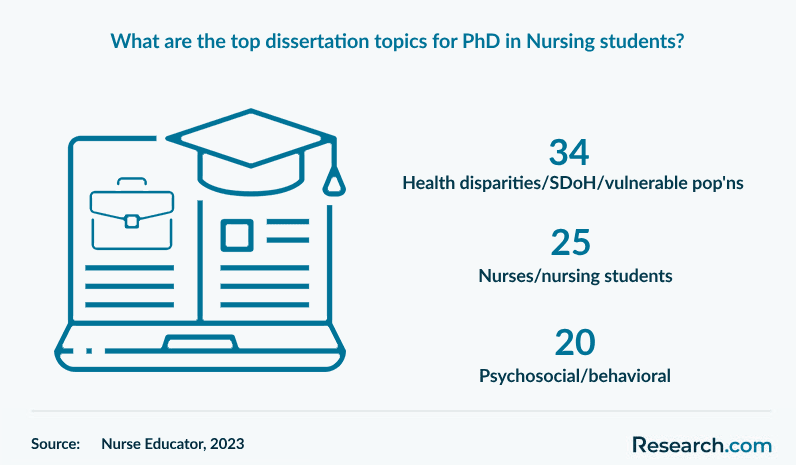
A 2023 study published in Nurse Educator examined PhD-prepared nurses’ areas of inquiry and showed that dissertation topics often focus on major healthcare challenges. The top category was health disparities, social determinants of health (SDoH), and vulnerable populations, with 34 dissertations. Other leading categories included nurses and nursing students with 25 dissertations, psychosocial and behavioral topics with 20, symptom management with 15, and chronic conditions with 13.
These research priorities show that doctoral nursing students are often focused on systemic and population-level issues. Professionals interested in academic leadership and education policy may also compare affordable online PhD programs in higher education as a related path for broader institutional leadership.
Career Options After Completing an Online MSN to PhD Bridge Program
Graduates of MSN to PhD programs are prepared for careers that rely on research literacy, independent scholarship, evidence generation, and leadership. The degree is especially relevant for nurses who want to move into faculty, scientist, policy, or research administration roles.
- University professor or nursing faculty member: Teach undergraduate or graduate nursing students, mentor doctoral learners, conduct research, and contribute to curriculum development.
- Nurse scientist or researcher: Lead research studies in academic centers, hospitals, government agencies, or private organizations.
- Postdoctoral fellow: Complete additional mentored research training before moving into an independent investigator or faculty role.
- Director of research: Manage research programs, evidence-based practice initiatives, clinical trials, or outcomes projects.
- Health policy analyst or consultant: Use data and research findings to advise agencies, nonprofits, healthcare systems, or policy groups.
- Program evaluator: Assess healthcare, education, or public health interventions to determine effectiveness and improve outcomes.
Some nurses also combine doctoral research preparation with additional clinical or technical credentials. For example, short programs such as affordable online phlebotomy technician certification programs may support practical skill-building, though they serve a very different purpose from PhD study.
How Much Do Online MSN to PhD Bridge Programs Cost?
Online MSN to PhD bridge program costs vary widely. The true price can range from tens of thousands to over a hundred thousand dollars depending on tuition rates, required credits, fees, residency travel, dissertation enrollment, and whether students pay resident or non-resident tuition.
- Tuition: Per-credit tuition can range from approximately $400 to over $1,500 per credit.
- Total program cost: Overall costs may range from $20,000 to $120,000 or more depending on school, credit load, and time to completion.
- Fees: Students should check technology fees, online course fees, graduation fees, transcript fees, and dissertation continuation fees.
- Residency expenses: Even online programs may require campus visits, which can add travel, hotel, meals, and time-away-from-work costs.
- Materials: Budget for books, statistical software, research tools, database access, professional memberships, and conference costs.
- Federal aid: Students may apply for federal aid through the Free Application for Federal Student Aid (FAFSA).
- Institutional funding: Some universities provide scholarships, fellowships, teaching assistantships, research assistantships, or tuition discounts.
- Nurse Faculty Loan Program: The Nurse Faculty Loan Program (NFLP) may offer partial loan forgiveness for graduates who commit to faculty roles.
Cost Mistakes to Avoid
| Common Mistake | Why It Can Be Costly | Better Approach |
| Comparing only per-credit tuition | Fees and dissertation credits can change the total price | Request a full cost estimate through expected graduation |
| Ignoring residency requirements | Travel can add thousands in indirect costs | Ask for the number, location, and timing of all required campus visits |
| Assuming online means in-state tuition | Some schools charge different rates for non-residents | Confirm your exact tuition category in writing |
| Underestimating dissertation time | Extra semesters may increase tuition and fees | Ask about average time to completion and dissertation support |
| Not asking about funding | Students may miss scholarships, assistantships, or faculty loan options | Discuss funding before accepting admission |
Salary Expectations After an Online MSN to PhD Bridge Program
A PhD in Nursing can support higher-level roles, but salaries vary by employer and career direction. Academic roles may pay less than executive or advanced practice positions, while research leadership and healthcare administration may offer higher compensation depending on organization and location.
- PhD-prepared nurse: The average annual salary for a PhD-prepared nurse in the USA typically ranges from $99,000 to $126,000, which can be compared with DNP salary ranges by state.
- Nurse educator: Academic nurse educator salaries average around $81,000 to $87,000 annually, depending on institution and experience.
- Clinical research scientist: Professionals in this role can expect to earn around $95,000 per year.
- Health services administrator: Salaries average around $112,000 annually.
- Chief Nursing Officer: CNO roles can exceed $240,000 because of the scale of executive responsibility.
- Certified Nurse Anesthetist: CRNAs with a PhD can earn among the highest nursing salaries, often exceeding $200,000-$239,000 annually.
The average salary for a registered nurse (RN) across the United States is $74,048. The overall national average salary listed for the United States is $108,675. In academic settings, an assistant professor in postsecondary/higher education earns an average of $72,458, while an associate professor averages $67,248. Clinical roles show different ranges, including a charge nurse (RN) at about $80,184 and a clinical nurse leader at $82,534.
More specialized and leadership roles show higher earning potential. A clinical research nurse averages $90,378, a nursing manager averages $98,158, a director of operations averages $112,000, and a nursing director averages $127,295. Advanced practice registered nurses also show strong salaries, including a nurse practitioner (NP) at $110,377 and a hospitalist nurse practitioner at $123,174. Nurses focused on advanced practice rather than research may want to compare accelerated online nurse practitioner programs.
The highest figure listed among the nursing roles is pediatric nurse anesthetist (CRNA), at $182,716. Location also affects salaries: a primary care registered nurse in Seattle, Washington, earns $92,269, while state averages range from Mississippi at $81,463.5 to Washington at $143,553.5. Other location-specific figures include Two Rivers, Wisconsin, at $146,641, Nome, Alaska, at $134,811, and New York, NY, at $101,234 for a registered nurse.
Overall, the salary data show a pattern: pay tends to rise with specialization, advanced practice preparation, leadership responsibility, and geographic demand. A PhD can support career mobility, but it should be evaluated against your target role rather than treated as a guaranteed salary increase.
Online vs. In-Person MSN to PhD Bridge Programs
Online and campus-based PhD programs can lead to the same doctoral credential, but the experience can feel very different. The right format depends on your schedule, learning style, research needs, and access to faculty.
| Format | Advantages | Trade-Offs |
| Online | Flexible location, easier to continue working, access to programs outside your region | Requires strong self-direction and may offer fewer spontaneous networking opportunities |
| Hybrid | Combines online coursework with periodic in-person mentoring, workshops, or intensives | Travel costs and scheduling can be challenging |
| Campus-based | More face-to-face access to faculty, peers, libraries, labs, and campus research culture | Less flexible for working nurses or students who cannot relocate |
Before choosing an online program, ask whether courses are asynchronous, whether live attendance is required, how dissertation meetings are conducted, and whether the school provides online access to library databases, statistical consultation, and writing support.
How Do Online MSN to PhD Bridge Programs Maintain Academic Quality?
Quality in an online doctoral nursing program depends on accreditation, faculty qualifications, research infrastructure, student outcomes, and dissertation oversight. Accreditation by recognized nursing education bodies such as CCNE or ACEN helps verify that the curriculum, faculty, and program processes meet professional standards.
Students should confirm both institutional and nursing program accreditation. They should also review faculty research activity, dissertation expectations, student support services, and graduation outcomes. Comparing programs carefully is just as important at the doctoral level as it is for undergraduate completion pathways such as online RN to BSN programs with no clinicals.
What Mentorship and Support Should Online PhD Nursing Students Expect?
Mentorship is one of the most important predictors of doctoral fit. Online students should expect structured advising, access to research faculty, dissertation committee guidance, academic writing help, library support, and opportunities to participate in scholarly communities.
Strong programs offer virtual seminars, research workgroups, peer cohorts, dissertation workshops, statistics resources, and career development support. Nurses still building their academic foundation may also compare earlier-stage options such as affordable online nursing programs.
How Do Online MSN to PhD Bridge Programs Differ From Direct Entry Nurse Practitioner Programs?
Online MSN to PhD bridge programs are designed for nurses who want to become researchers, faculty members, scholars, or policy leaders. They focus on theory, research methods, data analysis, scholarship, and dissertation work.
Direct entry nurse practitioner programs are different. They are designed to prepare students for advanced clinical practice and patient care responsibilities. The curriculum, clinical expectations, licensing outcomes, and career goals are not the same.
If you want to diagnose, treat, prescribe, and provide advanced patient care, a nurse practitioner pathway may be a better fit. If you want to produce research, teach at the doctoral or graduate level, and influence evidence-based nursing science, the PhD is more aligned.
Challenges of Pursuing an Online MSN to PhD Bridge Program
Online doctoral study offers flexibility, but it also comes with real challenges. Students should evaluate these risks honestly before enrolling.
- Time management: Dissertation work is self-directed and can be difficult to sustain while working full time.
- Isolation: Online students may need to be proactive about building relationships with faculty and peers.
- Research complexity: Advanced statistics, methods, and dissertation design can be demanding, especially for students with limited research experience.
- Technology dependence: Students need reliable internet, research database access, videoconferencing tools, and comfort with online learning platforms.
- State authorization limits: Some schools may not enroll students from every state.
- Misaligned career goals: Students seeking clinical practice advancement may be better served by options such as direct entry nurse practitioner online degrees for non nurses.
Subspecialties and Research Paths for Online MSN to PhD Graduates
Many nurses enter PhD study after completing online Master of Science in Nursing programs and then narrow their doctoral research into a specialized area of nursing science. Your subspecialty should align with faculty expertise, funding possibilities, and the problems you want to solve.
- Nursing education research: Studies teaching strategies, curriculum design, simulation, faculty development, and student outcomes.
- Health systems and outcomes research: Focuses on quality, safety, care delivery, workforce models, and patient outcomes.
- Population health research: Examines disparities, community interventions, public health policy, and social determinants of health.
- Biobehavioral nursing research: Studies biological, psychological, and social factors that influence illness, recovery, and symptom experiences.
- Gerontology nursing research: Focuses on aging, chronic disease, long-term care, dementia, caregiving, and healthy aging.
- Women’s health research: Investigates reproductive health, maternal-child health, gender-based disparities, and health across the lifespan.
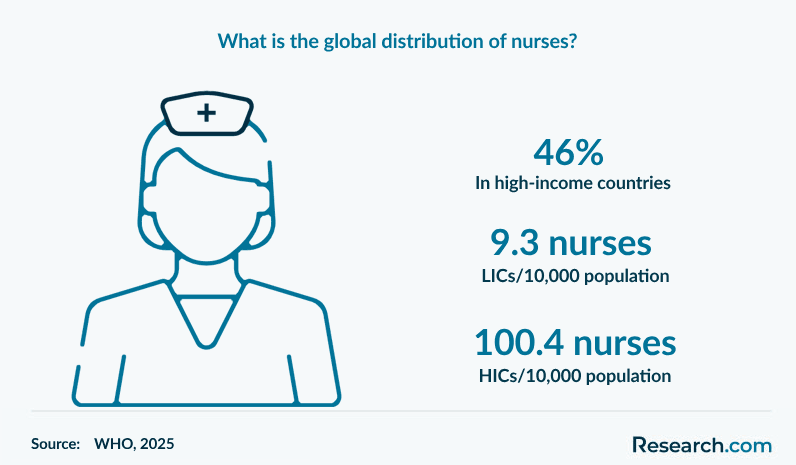
2025 data from the WHO show a major global imbalance in the nursing workforce. High-income countries, with 17% of the world's population, employ 46% of its nurses. Workforce density differs sharply, with 100.4 nurses per 10,000 people in high-income countries compared with 9.3 in low-income nations.
Migration also shapes the workforce. In reporting countries, 15% of nurses are foreign-born, and that share rises to 23% in high-income countries. Small island developing states have a nurse density of 29.6 per 10,000 people compared with 37.1 in non-SIDS countries.
The global nursing workforce is relatively young: 33% of nurses are under age 35, while 19% are aged 55 or older. The profession is 85% female globally, although regional variation exists. Most nurses, 70%, work in the public sector, while 18% work in private for-profit facilities and 11% work in not-for-profit facilities.
These figures show why nurse scientists are needed not only for U.S. faculty roles but also for workforce research, global health equity, migration policy, retention studies, and systems-level nursing strategy.
Job Market for Online MSN to PhD Bridge Program Graduates
The job market for PhD-prepared nurses is shaped by several forces: nursing faculty shortages, demand for evidence-based practice, healthcare systems’ need for outcomes research, and policy interest in workforce and health equity issues.
- Nurse faculty demand: Many schools need doctorally prepared faculty to teach and mentor nursing students.
- Research growth: Healthcare organizations continue to need nurse scientists who can design, evaluate, and translate research.
- Leadership opportunities: Health systems may seek PhD-prepared nurses for research, quality, strategy, and executive roles.
- Policy relevance: PhD graduates can use research expertise to inform legislation, public health programs, and health workforce planning.
- Employment diversity: Graduates may work in universities, hospitals, government agencies, nonprofits, research institutes, or private industry.
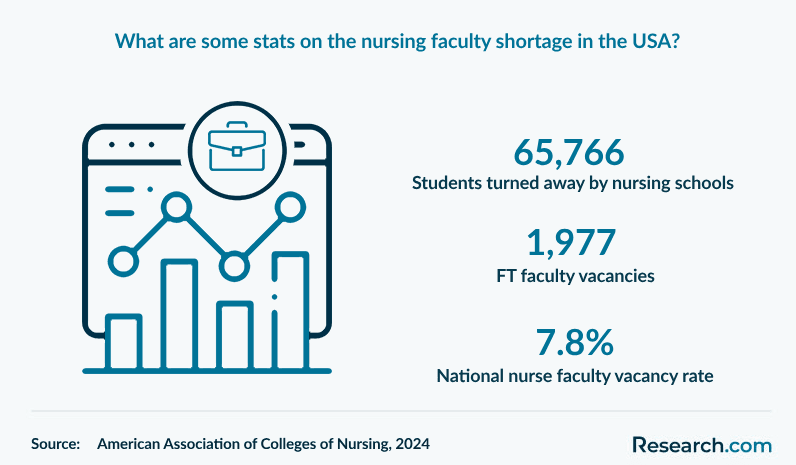
Recent American Association of Colleges of Nursing (AACN) data show the severity of the U.S. nursing faculty shortage. In 2023, U.S. nursing schools turned away 65,766 qualified applicants from baccalaureate and graduate programs, with faculty shortages cited as a major reason. The data also report 1,977 full-time faculty vacancies and another 103 positions needed to meet student demand, producing a national nurse faculty vacancy rate of 7.8%. In addition, 79.8% of vacant faculty positions required or preferred a doctoral degree.
The age profile of current faculty adds urgency. The average age for a doctorally-prepared professor is 61.2 years, while associate professors average 55.6 years and assistant professors average 49.6 years. These figures point to a continuing need for new PhD-prepared nurses who can enter faculty roles and support the nursing education pipeline.
Current Trends Shaping MSN to PhD Nursing Careers
Several trends are changing what PhD-prepared nurses study and where they work. These trends do not replace traditional nursing science, but they expand the kinds of research questions and leadership roles available.
- Artificial intelligence and analytics: Nurse scientists are increasingly needed to evaluate AI tools, clinical decision support, predictive models, bias, safety, and patient outcomes.
- Telehealth and digital care: Remote care models create research opportunities in access, quality, equity, usability, and chronic disease management.
- Health equity and social determinants of health: Research on vulnerable populations, disparities, and structural barriers remains a major doctoral focus.
- Faculty workforce shortages: The need for doctorally prepared educators continues to create opportunities for PhD graduates in academia.
- Interprofessional science: Complex health problems often require collaboration across nursing, medicine, public health, informatics, statistics, and policy.
- Global nursing workforce challenges: Workforce distribution, migration, aging populations, and retention are likely to remain important research areas.
- Accelerated education pathways: Graduates of affordable accelerated nursing programs may later consider MSN and PhD study as long-term academic or research goals.
Who Should Choose an Online MSN to PhD Bridge Program?
An online MSN to PhD bridge program is a strong fit if you want to build a career around research, teaching, evidence generation, dissertation-level scholarship, or health policy. It can also be a good choice if you want to study a specific nursing problem in depth and have access to a faculty mentor with matching expertise.
You may be a good fit if you:
- Enjoy research, writing, analysis, and theory.
- Want to become a professor, nurse scientist, or research leader.
- Have a focused area of inquiry that aligns with faculty expertise.
- Can commit several years to coursework and dissertation development.
- Are comfortable with independent work and long-term academic deadlines.
You may want a different path if you:
- Primarily want to become a nurse practitioner or advanced clinical provider.
- Prefer hands-on clinical training over research and writing.
- Need the fastest route to a practice-focused role.
- Are not ready to commit to dissertation research.
- Cannot meet residency, technology, or time requirements.
Key Insights
- Affordability requires a full-cost view: Compare tuition, fees, dissertation credits, residency travel, software, and time to completion—not just per-credit rates.
- Research fit is essential: The best program is one where faculty expertise aligns with your dissertation interests and career goals.
- The PhD is not the same as the DNP: Choose the PhD for research, teaching, scholarship, and policy; choose a practice doctorate or NP pathway for advanced clinical care.
- Faculty demand is a major opportunity: AACN data show 1,977 full-time faculty vacancies, a 7.8% national vacancy rate, and 79.8% of vacant positions requiring or preferring a doctoral degree.
- PhD graduation trends show a pipeline concern: Nursing PhD graduates peaked at 803 in 2019 and were 742 in 2023, reinforcing the need for affordable doctoral pathways.
- Salary outcomes vary by role: PhD-prepared nurses may earn $99,000 to $126,000 on average, while executive and specialized roles can pay more, depending on responsibilities and location.
- Online does not mean effortless: Successful students need strong self-discipline, research support, faculty access, writing skills, and realistic time management.
- Current research priorities are broadening: Health disparities, workforce issues, AI, telehealth, population health, and global nursing distribution are important areas for future nurse scientists.
References
- American Association of Colleges of Nursing. (2024, May). Nursing faculty shortage fact sheet. American Association of Colleges of Nursing.
- PayScale. (2025, June 7). Assistant Professor, Postsecondary / Higher Education Salary. PayScale.
- PayScale. (2025). Doctorate (PhD), Nursing Salary. PayScale.
- PayScale. (2025, June 7). Associate Professor, Postsecondary / Higher Education Salary. PayScale.
- PayScale. (2025, April 6). Charge Nurse (RN) Hourly Pay in 2025. PayScale.
- PayScale. (2024, February 21). Primary Care Registered Nurse (RN) Hourly Pay in Seattle, WA. PayScale.
- PayScale. (2025, April 13). Nurse Anesthetist (CRNA) with Pediatrics Skills Salary. PayScale.
- PayScale. (2025, April 16). Registered Nurse (RN) Hourly Pay in New York, New York in 2025. PayScale.
- PayScale. (2025, April 22). Nursing Manager Salary in 2025. PayScale.
- PayScale. (2025, April 5). Clinical Nurse Leader Hourly Pay in 2025. PayScale.
- PayScale. (2025, June 7). Clinical Research Nurse Salary. PayScale.
- PayScale. (2025, June 7). Director of Operations Salary. PayScale.
- PayScale. (2025, June 7). Director, Nursing Salary. PayScale.
- PayScale. (2025, June 7). Hospitalist Nurse Practitioner (NP) Salary. PayScale.
- PayScale. (2025, June 7). Pediatrician, General Salary. PayScale.
- PayScale. (2025, May 14). Nurse Practitioner (NP) Salary in 2025. PayScale.
- PayScale. (2025, May 14). Registered Nurse (RN) Hourly Pay in 2025. PayScale.
- Roberts, L. R., & D’Errico, E. (2023). PhD‑Prepared Nurses’ Areas of Inquiry. Nurse Educator, 48(5), 247–253.
- World Health Organization. (2025, May 12). State of the world’s nursing report 2025 (ISBN 978‑92‑4‑011023‑6). World Health Organization.
- ZipRecruiter. (2025, June 7). Phd In Nursing Salary in Florida. ZipRecruiter.
- ZipRecruiter. (2025, June 7). Phd In Nursing Salary in Mississippi. ZipRecruiter.
- ZipRecruiter. (2025, June 7). Phd In Nursing Salary in North Carolina. ZipRecruiter.
- ZipRecruiter. (2025, June 7). Phd In Nursing Salary in United States. ZipRecruiter.
- ZipRecruiter. (2025, June 7). Phd In Nursing Salary in Washington. ZipRecruiter.
- ZipRecruiter. (2025, June 7). Phd Nursing Salary by City. ZipRecruiter.
Other Things You Should Know About the Most Affordable Online MSN to PhD Bridge Programs
Yes, some programs require clinical practice hours for MSN to PhD bridge students. These hours can range from 300 to 500, depending on the specific program. It's crucial to check individual program requirements in 2027 for a detailed breakdown of needed practice hours.
Yes. Many universities list graduate scholarships, dissertation fellowships, and tuition discounts for MSN-to-PhD students. Some awards require a 3.0 GPA, full-time enrollment, or RN licensure. Federal aid starts with the FAFSA, and doctoral students may also qualify for graduate assistantships.