2027 Most Affordable Online MSN in Nurse Executive Leadership Programs

Co-Founder and Chief Data Scientist
Nurse executive leadership is for registered nurses who want to move from primarily managing patient assignments or unit-level operations into roles that shape staffing models, budgets, quality initiatives, policy, and organizational strategy. The need is clear: the U.S. Bureau of Labor Statistics (BLS) projects employment for Medical and Health Services Managers, a category that includes many nurse executive and healthcare administration roles, to grow 29% from 2023 to 2033.
An online MSN in Nurse Executive Leadership can help experienced RNs prepare for that shift without stepping away from full-time work. These programs combine graduate-level nursing knowledge with finance, operations, health policy, human resources, data-informed decision-making, and executive communication.
This guide explains what to expect from an online MSN in Nurse Executive Leadership, how affordable programs compare, what the degree can cost, which admissions requirements matter, how certification fits into career advancement, and how to decide whether this path is worth the investment for your goals.
Quick answer: Is an online MSN in Nurse Executive Leadership a good path?
An online MSN in Nurse Executive Leadership can be a strong option for licensed RNs who already have clinical experience and want to qualify for nurse manager, director of nursing, nurse administrator, chief nursing officer, or healthcare operations roles. It is most useful when the program is accredited, affordable enough to support a reasonable return on investment, includes meaningful practicum experiences, and aligns with leadership certifications such as NE-BC®, NEA-BC, CNML, or CENP.
What are the benefits of getting an online MSN in Nurse Executive Leadership degree?
- Broader influence. Graduates can pursue roles that affect staffing, quality improvement, policy implementation, budgeting, and patient care systems rather than only individual patient encounters.
- Strong earning potential. Professionals with this degree often earn a median salary between $100,000 and $130,000 annually, while top nurse executives and administrators may earn significantly more depending on employer, location, experience, and title.
- Flexible format for working nurses. Online delivery can allow RNs to keep working, complete leadership practicum hours locally, and avoid relocating for graduate school.
- Preparation for executive credentials. Many programs build competencies that support later certification in nurse management or executive nursing practice.
What can I expect from an online MSN in Nurse Executive Leadership degree program?
An online MSN in Nurse Executive Leadership is a graduate nursing program for licensed RNs who want to lead teams, departments, service lines, or entire nursing divisions. The curriculum usually moves beyond bedside clinical decision-making and focuses on how healthcare organizations operate.
Students typically study leadership theory, healthcare finance, quality and safety, organizational behavior, regulatory compliance, informatics, human resource management, ethics, and evidence-based practice. Most programs also include a practicum or immersion experience where students apply leadership concepts in a real healthcare setting under an approved preceptor.
| Program component | What it usually involves | Why it matters for nurse leaders |
| Leadership and organizational management | Change management, communication, team development, and executive decision-making | Prepares nurses to guide departments through staffing, workflow, and culture challenges |
| Healthcare finance | Budget planning, cost analysis, resource allocation, and financial reporting | Helps future leaders connect care quality with operational sustainability |
| Quality improvement and evidence-based practice | Data analysis, patient safety initiatives, outcomes measurement, and process redesign | Supports measurable improvements in care delivery and patient outcomes |
| Policy, ethics, and regulation | Healthcare law, compliance, fiduciary responsibility, and ethical leadership | Builds judgment for high-stakes administrative decisions |
| Practicum or capstone | Applied leadership project completed in a healthcare setting | Allows students to demonstrate readiness for management or executive responsibilities |
Even when coursework is online, the degree is not passive or self-contained. Students should expect research assignments, case analyses, group discussions, project work, and sometimes live online meetings. The best programs make online learning practical by connecting assignments to staffing, budgeting, quality, and organizational problems that working nurses already encounter.
Where can I work with an online MSN in Nurse Executive Leadership degree?
Graduates can work wherever nursing expertise and administrative leadership intersect. The degree is especially relevant in organizations that need leaders who understand clinical practice, workforce pressures, patient safety, regulatory expectations, and financial constraints.
- Hospitals and health systems. Common roles include nurse manager, clinical operations manager, director of nursing, vice president of nursing, or chief nursing officer.
- Outpatient and ambulatory care. Graduates may oversee clinics, specialty practices, care coordination teams, or patient access operations.
- Long-term care and rehabilitation. Leadership roles may involve staffing, compliance, resident care quality, risk management, and workforce development.
- Public health and government agencies. Nurse leaders can contribute to health programs, policy implementation, population health initiatives, and emergency preparedness.
- Insurance, consulting, and healthcare technology companies. Experienced nurse executives may advise on care management, utilization review, quality strategy, informatics, or operational redesign.
- Academic and professional organizations. Some graduates move into administrative education roles, staff development, leadership training, or nursing policy work.
How much can I make with an online MSN in Nurse Executive Leadership?
Salary outcomes vary by job title, employer size, geographic market, years of experience, certification, and scope of authority. An online MSN does not guarantee an executive salary, but it can help nurses qualify for roles with higher compensation than many staff nursing positions.
The BLS provides a useful benchmark through its Medical and Health Services Managers category, which includes many healthcare administrator and nurse executive roles:
- As of May 2024, the median annual salary for these professionals was approximately $117,960.
- The 25th percentile earned around $88,000 annually, and the 75th percentile pocketed about $162,000.
- Top earners in this field can make up to $214,000 or more per year, especially in larger healthcare organizations or metropolitan areas.
For senior executive positions, compensation can be higher. Payscale reports an average annual base salary of $149,791 for a CNO in the US as of May 2025. These figures are best viewed as benchmarks rather than promises: your actual earnings will depend on the role you secure, your leadership record, and the type of organization hiring you.
- Most Affordable Online MSN in Nurse Executive Leadership Programs for 2027
- How long does an online MSN in Nurse Executive Leadership take?
- Online vs. on-campus MSN in Nurse Executive Leadership: what changes?
- How much does an online MSN in Nurse Executive Leadership cost?
- What financial aid can online MSN students use?
- What are the admission requirements?
- Is an online MSN in Nurse Executive Leadership worth it?
- Can an accelerated BSN lead to nurse executive graduate study?
- What challenges should online MSN students expect?
- Which accreditation and licensing issues matter?
- What courses are common in this MSN specialization?
- Which certifications support nurse executive careers?
- How do online programs support mentorship and networking?
- What jobs can graduates pursue?
- What is the job outlook for nurse executive leadership graduates?
List of Most Affordable Online MSN in Nurse Executive Leadership Programs for 2027
How do we rank schools?
There are several ways to move into nurse leadership, but an MSN focused on nurse executive leadership is one of the most direct academic routes for RNs who want administrative authority within healthcare organizations. Cost matters, however. A program that creates too much debt can weaken the value of the credential, especially for nurses aiming for gradual advancement rather than an immediate executive appointment.
To identify affordable online options, our research process reviews data from sources such as the College Scorecard, the IPEDS database, the National Center for Education Statistics, and Peterson’s database, including its Distance Learning Licensed Data Set. More detail is available in the Research.com methodology.
| School | Online nurse executive program | Program length | Cost per credit | Credits | Accreditation |
| Northwest Missouri State University | MSN Nurse Executive | As few as 12 months | $407 | 30 credits | National League for Nursing Commission for Nursing Education Accreditation (NLN CNEA) |
| University of Alabama | MSN Nurse Executive | One to two years | $480 | 33-39 credits | Commission on Collegiate Nursing Education (CCNE) |
| Purdue University Northwest | MSN Nurse Executive | 12 months of full-time study or under two years for part-time students | $512.16 | 32 credits | Accreditation Commission for Education in Nursing (ACEN) |
| Northern Kentucky University | MSN Nurse Executive Leadership | As few as 12 months | $578 | 33 credits | Commission on Collegiate Nursing Education (CCNE) |
| University of South Alabama | MSN Executive Nursing Administration | Three semesters | $594 | 37 | Commission on Collegiate Nursing Education (CCNE) |
1. Northwest Missouri State University
Northwest Missouri State University offers a 100% online MSN Nurse Executive program built for working nurses who want a shorter, flexible route into leadership preparation. The curriculum connects advanced nursing concepts with organizational leadership, finance, quality improvement, and healthcare business strategy. Multiple start dates make it easier for RNs to begin when their work schedule allows.
- Program Length: As few as 12 months
- Tracks/concentrations: MSN Nurse Executive
- Cost per Credit: $407
- Required Credits to Graduate: 30 credits
- Accreditation: National League for Nursing Commission for Nursing Education Accreditation (NLN CNEA)
2. University of Alabama
The University of Alabama’s online MS in Nursing with a Nurse Executive concentration is designed for RNs preparing for director-level and administrative responsibilities. Students complete three practicum courses totaling 540 hours at approved sites they select, while receiving guidance from national faculty. The program offers online flexibility, multiple start dates, and part-time study options.
- Program Length: One to two years
- Tracks/concentrations: MSN Nurse Executive
- Cost per Credit: $480
- Required Credits to Graduate: 33-39 credits
- Accreditation: Commission on Collegiate Nursing Education (CCNE)
3. Purdue University Northwest
Purdue University Northwest’s online MSN Nurse Executive program serves experienced nurses who want leadership preparation without leaving their current workplace. The curriculum includes health policy, finance, informatics, human resources, and evidence-based practice. Students complete a local practicum, and the program offers several start dates along with full-time and part-time pacing.
- Program Length: 12 months of full-time study or under two years for part-time students
- Tracks/concentrations: MSN Nurse Executive
- Cost per Credit: $512.16
- Required Credits to Graduate: 32 credits
- Accreditation: Accreditation Commission for Education in Nursing (ACEN)
4. Northern Kentucky University
Northern Kentucky University provides a fully online MSN in Nurse Executive Leadership with accelerated seven-week courses and several start dates throughout the year. The program covers nursing science, business informatics, finance, organizational psychology, policy, and population health. A 100-hour capstone practicum gives students a structured opportunity to apply leadership skills with a local preceptor.
- Program Length: As few as 12 months
- Tracks/concentrations: MSN Nurse Executive Leadership
- Cost per Credit: $578
- Required Credits to Graduate: 33 credits
- Accreditation: Commission on Collegiate Nursing Education (CCNE)
5. University of South Alabama
The University of South Alabama’s online MSN in Executive Nursing Administration aligns its curriculum with American Nurses Association (ANA) and American Organization for Nursing Leadership (AONL) standards. Students study advanced nursing theory, informatics, finance, and personnel management, then complete three local clinical field components totaling 480 hours. The program includes online orientation, flexible pacing, faculty support, and no travel requirement.
- Program Length: Three semesters
- Tracks/concentrations: MSN Executive Nursing Administration
- Cost per Credit: $594
- Required Credits to Graduate: 37
- Accreditation: Commission on Collegiate Nursing Education (CCNE)
Key data points to know before applying
- Many online MSN in Nurse Executive Leadership programs can be completed in two to three years of part-time study, while accelerated options may take 12 to 18 months.
- The American Association of Colleges of Nursing reports that there are 656 nursing schools in the U.S. offering master’s programs as of Fall 2023.
- Affordable online MSN nurse executive leadership options commonly fall between $400 to $600 per credit hour.
- A paper published by the U.S. Chamber of Commerce predicts that 42 out of 50 states will likely experience nursing staff shortages by 2030, which increases the need for leaders who can address staffing, retention, operations, and care quality.
- BLS projections show that employment growth for Medical and Health Services Managers translates to an average of 61,400 new openings each year until 2033.
- Graduates of online MSN in nurse executive leadership programs who pursue additional certification in this specialization tend to earn higher wages, qualifying for roles with annual salaries reaching $200,000 or more.
How long does it take to complete an online MSN in Nurse Executive Leadership program?
An online MSN in Nurse Executive Leadership usually takes 12 to 30 months, depending on course load, program design, transfer credit, and whether the student enrolls full time or part time.
- Accelerated full-time formats: often 12 to 18 months.
- Part-time formats for working nurses: commonly 24 to 30 months.
- Programs with multiple start dates: may reduce waiting time before enrollment.
- Transfer or prior graduate credits: may shorten the path when accepted by the school.
Because many students remain employed while enrolled, asynchronous courses and local practicum placements can make the degree more manageable. Nurses comparing leadership pathways may also want to review an affordable online MSN nurse administrator degree if they are more interested in administration broadly than executive leadership specifically.
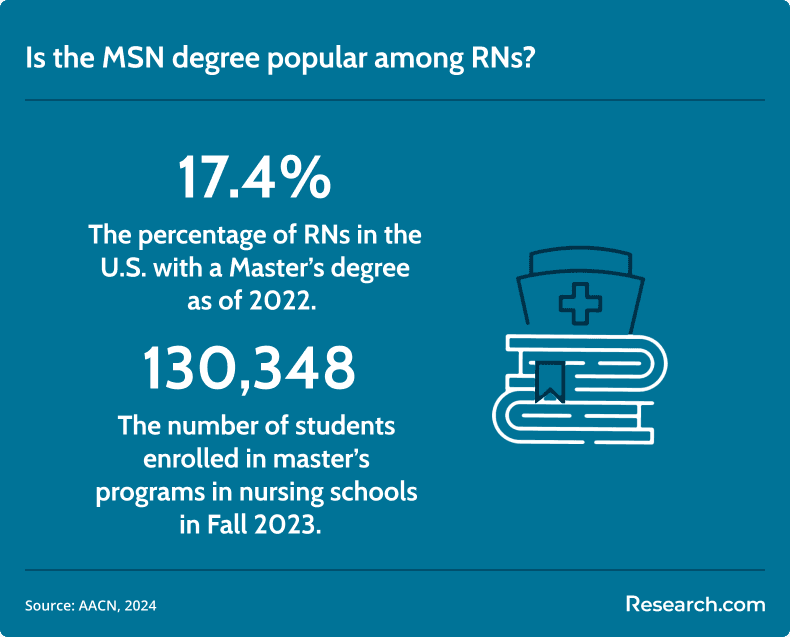
According to a 2024 fact sheet from the American Association of Colleges of Nursing (AACN), 17.4% of registered nurses (RNs) nationwide held a master’s degree as of 2022.
How does an online MSN in Nurse Executive Leadership degree compare to an on-campus program?
Online and on-campus MSN Nurse Executive Leadership programs can lead to the same degree, but the student experience differs. The better choice depends on your schedule, learning style, location, networking preferences, and need for structure.
| Factor | Online MSN Nurse Executive Leadership | On-campus MSN Nurse Executive Leadership |
| Flexibility | Better for nurses working rotating shifts, full-time jobs, or family schedules | Better for students who can attend scheduled classes in person |
| Practicum | Usually completed locally with approved preceptors | May use school-affiliated or regional clinical partners |
| Interaction | Discussion boards, video meetings, email, virtual projects, and online communities | Face-to-face classes, campus events, and informal peer conversations |
| Pacing | Often includes accelerated seven- or eight-week courses | Often follows traditional 15-week semesters |
| Best for | Self-directed nurses who need geographic and schedule flexibility | Students who prefer in-person structure and immediate classroom engagement |
What stays the same?
- Accredited online and on-campus programs are expected to address the same graduate-level leadership competencies.
- Faculty qualifications are often comparable, and some instructors teach in both formats.
- Practicum or clinical immersion requirements remain common regardless of delivery method.
- Employers generally focus more on accreditation, school reputation, experience, and leadership results than whether the coursework was online.
Accelerated or online formats do not automatically reduce academic quality. Similar to the fastest graduate certificate in data analytics online, credibility depends on the institution, curriculum, assessment standards, and outcomes rather than speed alone.
What is different?
- Online students need stronger self-management because fewer reminders happen in person.
- On-campus students may find networking more spontaneous because they share physical classrooms and campus events.
- Online programs may give working nurses more control over when they study, but they can feel isolating if the school does not build active student support.
- Competency-based programs are more commonly online, and some students also compare flexible admission structures such as online colleges with open enrollment and no application fee.
Program quality matters more than delivery format. The same principle applies across nursing education, including specialized options such as online direct entry MSN programs.
The American Association of Colleges of Nursing reports that there are 656 nursing schools in the U.S. offering master’s programs as of Fall 2023.
Online graduate education has also become more common. A 2024 policy brief by Kelchen and Barret notes that master’s programs with some distance education components have grown faster than fully in-person options. That broader trend helps explain why more MSN specializations, including nurse executive leadership, are now available online.
What is the average cost of an online MSN in Nurse Executive Leadership program?
Based on our research, total tuition for an online MSN in Nurse Executive Leadership can range from approximately $12,000 to over $40,000. The final price depends on tuition rate, credits required, fees, residency rules, transfer credit, and how quickly the student completes the program.
Cost factors that change your total price
| Cost factor | What to check | Why it matters |
| Per-credit tuition | Most programs charge per credit, often between $350 to $1,000+ per credit | A small per-credit difference can become substantial across 30 to 40 credits |
| Required credits | Most online MSN Nurse Executive Leadership programs require between 30 to 40 credit hours | A lower tuition rate may not be cheaper if the program requires more credits |
| Residency pricing | Public universities may charge different in-state and out-of-state rates | Some online programs use one flat rate, while others do not |
| Mandatory fees | Technology, infrastructure, graduation, administrative, and program fees | Fees can add hundreds or thousands of dollars beyond tuition |
| Competency-based pricing | Some schools charge by term rather than by credit | Fast-moving students may save money if they complete more work per term |
Affordable programs in this guide charge around $400 to $600 per credit hour. Mid-range programs may fall around $500 to $700 per credit, while some private or higher-priced institutions can exceed $1,000 per credit hour.
Flat-rate pricing can be helpful for distance learners because it avoids large residency-based differences. Similar approaches appear in other online graduate and specialized degree areas, including the cheapest online space studies degree programs.
Fees should not be ignored. The University of Alabama, for example, charges $27 per credit hour as a technology/infrastructure fee, and international students also have to pay a $100 fee per semester. When comparing schools, calculate the full cost of attendance, not just tuition.
Some working-professional programs use pricing models designed around flexibility, a pattern also seen in options such as the cheapest master's in emergency management online. Ask each school about military discounts, alumni pricing, employer partnerships, transfer credits, books, practicum costs, and clinical placement fees.
What are the financial aid options for students enrolling in an online MSN in Nurse Executive Leadership program?
Online MSN students may be able to use federal loans, scholarships, grants, employer tuition assistance, and institutional aid. The best approach is to combine multiple funding sources so you can reduce borrowing before enrollment begins.
Federal financial aid
- Graduate students can complete the Free Application for Federal Student Aid (FAFSA) to determine eligibility for federal aid.
- Direct Unsubsidized Loans and Graduate PLUS Loans are common borrowing options for MSN students.
Nursing-specific scholarships
- Nursing Economic Foundation Scholarships for Advanced Degree Nursing Students. This program awards up to four $5,000 scholarships to U.S. RNs in accredited master’s or doctoral nursing programs focused on administration, management, or leadership.
- DiversityNursing.com Education Award. This $5,000 scholarship supports U.S. registered nurses, undergraduate or graduate nursing students, and licensed or working nurses including RNs, LPNs, NPs, and nurse leaders.
- Pamela Austin Thompson Fellowship Fund. Established by the AONL Foundation, this fund provides grants up to $8,999 for nurse leaders from small, rural, critical-access, or diverse healthcare settings who are enrolled in Nurse Manager or Director Fellowship programs.
State, employer, and school-based funding
- State grants or loan repayment programs may be available for nurses who work in underserved communities or public health roles.
- Hospitals and healthcare systems often offer tuition reimbursement or education stipends for RNs pursuing graduate leadership training.
- Some employers partner with specific universities to provide discounted tuition.
- Universities may offer institutional scholarships, alumni discounts, or program-specific awards. Purdue University Northwest, for example, offers a $1,000 scholarship to online Nurse Executive MSN students who are RN-to-BSN alumni or employed by partner institutions.
Before applying, contact both the school’s financial aid office and your employer’s HR or workforce development department. In 2023-2024, 26% of graduate students received institutional grants, while 8% received private or employer grants.
What are the prerequisites for enrolling in an online MSN in Nurse Executive Leadership program?
Admission requirements vary, but most online MSN Nurse Executive Leadership programs look for evidence that applicants are licensed nurses with the academic foundation, clinical maturity, and leadership potential to succeed in graduate study.
| Requirement | Common expectation | What applicants should verify |
| RN license | Current, unencumbered U.S. registered nurse license | Whether the school accepts students from your state |
| Prior degree | BSN from an accredited institution for most programs | Whether RN-to-MSN bridge pathways exist for ADN-prepared nurses |
| GPA | Often 2.75 to 3.0 or higher | Whether conditional admission is available if your GPA is lower |
| Work experience | Often one to two years of post-licensure RN experience preferred or required | Whether leadership, charge nurse, committee, or project experience strengthens your application |
| Application materials | Resume/CV, personal statement, and one to three recommendations | Whether references should come from supervisors, faculty, or nurse leaders |
| Prerequisite coursework | Statistics, research methods, or health assessment may be required | Whether missing courses can be completed before or early in the MSN |
Most applicants need a BSN, but ADN-prepared nurses may find RN-to-MSN options or complete a bachelor’s first. If you are still finishing undergraduate nursing requirements, compare routes such as RN to BSN without clinicals or an easiest RN to BSN online program before selecting an MSN.
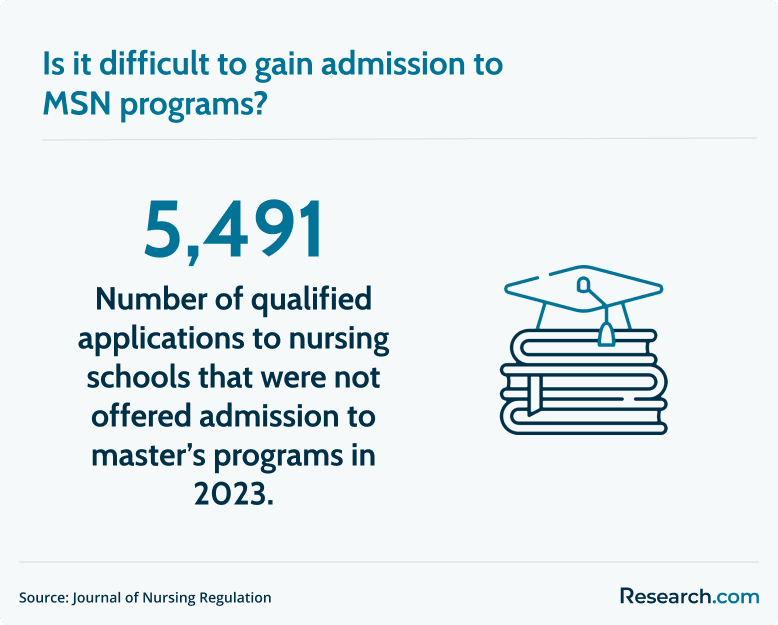
Applications should not be rushed. AACN enrollment trends for 2023 show that applications to master’s programs declined by only 0.9% (1,176 fewer students) since 2022, yet the National Council of State Boards of Nursing (NCSBN) noted in a 2025 paper that 5,491 qualified applications were not offered admission to master’s programs that same year. Strong essays, leadership examples, and targeted recommendations can help applicants stand out.
Is an online MSN in Nurse Executive Leadership degree worth the investment?
An online MSN in Nurse Executive Leadership is most likely to be worth it for RNs who want to move into management, administration, or executive nursing roles and who choose a program with manageable tuition, recognized accreditation, relevant practicum experiences, and strong employer alignment.
| This degree may be worth it if... | You may want another path if... |
| You already have RN experience and want formal preparation for leadership responsibilities | You prefer advanced clinical diagnosis and treatment over administration |
| Your employer values or requires graduate education for management advancement | You are unsure whether you want to leave bedside or direct clinical practice |
| You can use tuition reimbursement, scholarships, or an affordable program to limit debt | The program’s total cost is too high compared with your realistic salary growth |
| You want to pursue nurse executive or nurse manager certification later | You need a doctoral credential for your target role, in which case online DNP programs may be worth comparing |
To evaluate ROI, compare total program cost with your current salary, target job titles, local employer expectations, and the time it may take to move into leadership. The lowest-priced program is not always the best value, but avoiding unnecessary debt is especially important if you plan to advance gradually.
Is an Accelerated BSN Program the Right Springboard for an MSN in Nurse Executive Leadership?
An accelerated BSN can be a good first step toward an MSN in Nurse Executive Leadership for students who already hold a non-nursing bachelor’s degree and want to enter nursing quickly. Programs such as accelerated BSN nursing programs can provide the licensure foundation needed before graduate leadership study.
The key is timing. Nurse executive MSN programs are generally designed for licensed RNs with professional practice experience, not brand-new nurses who have never led teams or worked inside healthcare systems. If you use an accelerated BSN as your entry route, plan to build clinical credibility, participate in committees, seek charge nurse or project responsibilities, and document leadership achievements before applying to graduate school.
What are the common challenges of pursuing an online MSN in Nurse Executive Leadership degree?
Online MSN programs can be convenient, but they require discipline. The most successful students treat the program like a structured professional commitment rather than a collection of flexible assignments.
| Common challenge | Why it happens | Better strategy |
| Underestimating time demands | Leadership courses often require reading, writing, projects, and practicum work | Block weekly study hours before the term begins |
| Weak networking | Online students may not meet peers naturally between classes | Attend live sessions, join discussion groups, and connect with faculty and alumni |
| Difficulty finding a preceptor | Some schools expect students to identify local practicum sites | Ask early about placement support and approval timelines |
| Technology fatigue | Work, class, meetings, and projects may all happen online | Use calendar systems, reduce multitasking, and schedule offline work periods |
| Choosing the wrong program level | Some nurses need a different bridge or advancement path before an MSN | Compare alternatives such as affordable online LPN to RN programs if you are not yet an RN |
What accreditation and licensing standards should I consider?
Accreditation should be one of your first checks. For MSN programs, recognized nursing accreditation from agencies such as the Commission on Collegiate Nursing Education (CCNE) or the Accreditation Commission for Education in Nursing (ACEN) helps indicate that the curriculum meets accepted standards for graduate nursing education.
Prospective students should also confirm that the school is authorized to enroll students from their state, that practicum requirements can be completed where they live, and that the curriculum supports any certification goals they have. Accreditation is not only a quality signal; it can affect employer recognition, eligibility for certain credentials, and transferability of graduate work.
If you are comparing nursing education options more broadly, resources such as easy nursing school can help you understand how admissions accessibility differs from program quality, accreditation, and long-term fit.
What courses are typically in an online MSN in Nurse Executive Leadership program?
Course names vary by school, but most programs are designed around the same core goal: preparing nurses to lead people, budgets, systems, and quality initiatives in complex healthcare settings. A practicum, capstone, or immersion project is usually included.
- Nursing Leadership and Organizational Management. Focuses on leadership models, change strategy, team performance, mentoring, and organizational culture.
- Healthcare Finance and Budgeting. Covers operating budgets, capital budgets, forecasting, revenue considerations, and resource allocation.
- Healthcare Policy, Ethics, and Regulatory Systems. Examines laws, compliance expectations, ethical decision-making, and fiduciary responsibility.
- Evidence-Based Practice and Quality Improvement. Teaches students how to use research and data to improve safety, outcomes, and care processes.
- Human Resource Management and Conflict Resolution. Addresses staffing, recruitment, retention, performance management, professional development, and workplace conflict.
- Strategic Planning and Organizational Behavior. Explores long-term planning, interdisciplinary collaboration, organizational structure, and culture change.
- Health Informatics and Data Analysis. Introduces information systems, performance dashboards, clinical data, and technology-supported decision-making.
The strongest programs connect these subjects to real leadership problems, such as reducing turnover, improving throughput, strengthening patient safety, managing budgets, and leading change across departments.
What are the best certifications for graduates of online MSN in Nurse Executive Leadership programs?
Certifications are not always mandatory, but they can strengthen credibility for nurse management and executive roles. The right credential depends on your experience level, current responsibilities, and target position.
| Certification | Organization | Best suited for | Focus areas |
| Nurse Executive Certification (NE-BC®) | American Nurses Credentialing Center (ANCC) | Nurse leaders managing departments, teams, or service areas | Fiscal management, human resources, strategic planning, and quality improvement |
| Nurse Executive, Advanced Certification (NEA-BC) | American Nurses Credentialing Center (ANCC) | Experienced executives leading larger systems or organizations | Systems thinking, organizational leadership, financial management, and policy |
| Certified Nurse Manager and Leader (CNML) | American Organization for Nursing Leadership (AONL) | Nurse managers overseeing unit or department operations | Staffing, budgeting, quality assurance, and performance improvement |
| Certified in Executive Nursing Practice (CENP) | American Organization for Nursing Leadership (AONL) | Senior nurse leaders responsible for strategic, operational, and financial outcomes | AONL Nurse Executive Competencies, communication, business skills, and health policy |
Credential requirements differ, so review eligibility rules before assuming you qualify immediately after graduation. According to ANCC certification data, 6,220 nurses hold the NEA-BC credential, and 9,156 have obtained NE-BC® certification as of 2024. In that same year, there were 810 first-time test takers for NEA-BC and 1,317 for NE-BC®, with a 70% and 66% passing rate, respectively.
For CENP certification, AONL reports 315 first-time test takers in 2024, of which 58.7% passed.
How do online MSN programs foster mentorship and networking opportunities?
High-quality online MSN Nurse Executive Leadership programs build connection intentionally. Because students are not gathered on campus every week, mentorship and networking must be designed into the program rather than left to chance.
- Preceptor-based practicums connect students with experienced nurse executives or healthcare administrators.
- Live webinars and virtual seminars allow students to discuss leadership problems with faculty, alumni, and industry guests.
- Group projects help students practice collaboration across different healthcare settings and regions.
- Career services and alumni networks can support job searches, resume development, interview preparation, and leadership transitions.
- Professional organization involvement can help students build relationships beyond their own school.
When comparing programs, ask how students are matched with mentors, whether the school helps secure practicum placements, how active the alumni network is, and whether faculty have current executive nursing experience. These support systems are also important in other online MSN specializations, including accelerated MSN women's health nurse practitioner online programs.
What career paths are available for graduates of online MSN in Nurse Executive Leadership programs?
Graduates are usually preparing for leadership and administrative work rather than traditional bedside roles. The degree can support advancement into positions that combine clinical judgment, operational strategy, workforce leadership, and organizational accountability. Industry observers have also emphasized the need for more nurse leaders in the C-suite.
Executive nursing roles
- Chief Nursing Officer or Chief Nurse Executive. Leads nursing strategy, workforce planning, quality priorities, financial performance, and executive-level representation for nursing services.
- Vice President of Patient Care Services or VP of Nursing. Oversees patient care operations, service line performance, staff engagement, and system-level care improvement.
Mid- and senior-level management roles
- Director of Nursing. Manages nursing services for a facility, department, or service area, including staffing, budgets, policy, compliance, and performance.
- Nurse Administrator. Oversees nursing operations, resource management, quality initiatives, and workflow improvement in hospitals, clinics, or nursing care settings.
- Nurse Manager or Clinical Operations Manager. Supervises unit operations, schedules, staffing, evaluations, and quality projects while serving as a bridge between bedside teams and senior leadership. Nurses considering this route may also review what it means to be a nurse case manager, since case management experience can support later operations leadership.
- Executive Director in a healthcare organization. Leads operations for outpatient centers, nonprofits, specialty clinics, or other healthcare organizations beyond a single nursing department.
Specialized leadership and advisory roles
- Healthcare Consultant. Advises hospitals, insurers, law firms, or healthcare organizations on quality, efficiency, staffing, compliance, and strategy.
- Health Systems Analyst or Informatics Nurse Executive. Uses clinical workflow knowledge and data systems to improve operations, reporting, and patient care decisions.
- Nurse Educator with an administrative focus. Leads staff development, nursing education operations, curriculum planning, or professional training programs.
- Policy Analyst or Advocate. Works with agencies, professional associations, or advocacy organizations to influence health policy. Nurses interested in broader population health leadership may also compare the most affordable MPH programs no GRE required.
Certifications can further support advancement and compensation. To provide context, the salary data for several nurse executive roles listed above is based on 2025 estimates from Payscale.
What is the job market for graduates with an online MSN in Nurse Executive Leadership degree?
The job market for MSN Nurse Executive Leadership graduates is favorable because healthcare organizations need leaders who can manage workforce shortages, quality expectations, technology adoption, cost pressures, and patient outcomes.
- A paper published by the U.S. Chamber of Commerce predicts that 42 out of 50 states will likely experience nursing staff shortages by 2030, increasing demand for leaders who can improve retention, staffing systems, and care delivery.
- Nurse leaders are central to addressing burnout, workforce advocacy, and administrative efficiency. A recent study suggests that transformational leadership styles in nursing can positively affect nurses’ intentions to stay in their jobs.
- Graduates may find opportunities in hospitals, health systems, public health agencies, insurance organizations, consulting firms, and healthcare technology companies.
- The BLS projects registered nurse employment to grow 6% from 2023 to 2033, faster than the average for all occupations.
- The BLS also projects employment for Medical and Health Services Managers to grow 29% from 2023 to 2033, equal to roughly 61,400 new openings each year, on average, over the decade.
How to choose the best online MSN in Nurse Executive Leadership program
The best program is not always the fastest or cheapest. It is the one that fits your career goal, state requirements, budget, schedule, and preferred level of support.
- Confirm accreditation first. Look for CCNE, ACEN, or another recognized nursing accreditor relevant to graduate nursing education.
- Calculate total cost. Add tuition, fees, books, technology charges, practicum costs, travel if required, and graduation fees.
- Check practicum expectations. Ask whether the school helps identify preceptors or whether you must secure your own placement.
- Match the curriculum to your goal. Choose finance-heavy and strategy-heavy programs for executive roles; choose management-focused programs if you want unit or department leadership first.
- Ask about certification alignment. If you plan to pursue NE-BC®, NEA-BC, CNML, or CENP, confirm that coursework supports those competencies.
- Review pacing realistically. Accelerated study can save time, but it may be difficult while working full time or managing rotating shifts.
- Evaluate student support. Look for advising, writing support, career services, alumni access, mentorship, and responsive faculty.
- Ask employers what they value. If you hope to advance within your current system, find out whether they prefer specific schools, accreditors, certifications, or experience levels.
Common mistakes to avoid
| Mistake | Why it can hurt you | Better move |
| Choosing only by tuition | The lowest tuition may come with weak support, difficult placement processes, or poor fit | Compare total value, not just price |
| Ignoring accreditation | Employer recognition, certification eligibility, and transfer options may be affected | Verify nursing and institutional accreditation before applying |
| Assuming online means easy | Graduate leadership programs require writing, research, projects, and practicum hours | Create a weekly study and practicum plan before enrollment |
| Waiting too long to plan practicum placement | Approval delays can slow graduation | Ask about placement requirements during admissions conversations |
| Assuming salary increases are automatic | A degree alone may not produce an executive role without experience and results | Build leadership achievements while enrolled |
| Relying only on rankings | A highly ranked program may not fit your state, budget, or work schedule | Use rankings as one input, then verify fit with your own criteria |
Questions to ask before enrolling
- Is the MSN program accredited by CCNE, ACEN, NLN CNEA, or another recognized nursing accreditor?
- Can I complete practicum hours in my state and near my workplace or home?
- Does the school help secure preceptors, or am I responsible for finding one?
- What is the total cost after fees, books, and practicum expenses?
- Are online students eligible for the same scholarships and support services as campus students?
- Does the curriculum align with nurse executive certifications I may want later?
- How many hours per week should I expect to spend on coursework?
- What leadership outcomes do recent graduates report?
- Does my employer offer tuition assistance or prefer certain accredited programs?
- Will the program prepare me for the level of leadership I actually want: unit, department, system, or executive?
References:
- American Association of Colleges of Nursing (April 2024). New AACN Data Points to Enrollment Challenges Facing U.S. Schools of Nursing. https://www.aacnnursing.org/news-data/all-news/new-aacn-data-points-to-enrollment-challenges-facing-us-schools-of-nursing
- American Association of Colleges of Nursing (April 2024). Nursing Workforce Fact Sheet. https://www.aacnnursing.org/news-data/fact-sheets/nursing-workforce-fact-sheet
- American Nurses Credentialing Center (2025). 2024 ANCC Certification Data. https://www.nursingworld.org/globalassets/docs/ancc/ancc-cert-data-website.pdf
- American Organization for Nursing Leadership (December 2024). AONL Credentialing Center Annual Statistics - CENP. https://www.aonl.org/system/files/media/file/2024/12/AnnualStatistics22.24-CENP.pdf
- Hoover, M. et al. (January 2024). Data Deep Dive: A National Nursing Crisis. U.S. Chamber of Commerce. https://www.uschamber.com/workforce/nursing-workforce-data-center-a-national-nursing-crisis
- Kelchen, R. and Barrett, F. (April 2024). Exploring the Growth of Master’s Degree Programs in the United States. Postsecondary Education & Economics Research. https://www.american.edu/spa/peer/upload/peer_masters-degrees_b-2.pdf
- National Council of State Boards of Nursing (January 2025). The 2025 NCSBN Environmental Scan: Going Beyond. https://www.journalofnursingregulation.com/article/S2155-8256(25)00038-9/pdf
- Payscale (March 2025). Average Chief Nursing Officer (CNO) Salary. https://www.payscale.com/research/US/Job=Chief_Nursing_Officer_(CNO)/Salary
- University of Alabama (n.d.). Tuition Rates - Online Degrees. https://studentaccounts.ua.edu/tuition-rates/#distance
- U.S. Bureau of Labor Statistics (n.d.). Occupational Employment and Wage Statistics, Industry: Cross-industry, Private, Federal, State, and Local Government, Period: May 2024. https://data.bls.gov/oes/#/industry/000000 Data retrieved June 2025
- U.S. Bureau of Labor Statistics (April 2025). Medical and Health Services Managers. https://www.bls.gov/ooh/management/medical-and-health-services-managers.htm
- U.S. Bureau of Labor Statistics (April 2025). Registered Nurses. https://www.bls.gov/ooh/healthcare/registered-nurses.htm
Key Insights
- An online MSN in Nurse Executive Leadership is best for experienced RNs who want to lead teams, departments, operations, or nursing strategy rather than focus only on bedside care.
- Affordability should be judged by total cost, not tuition alone. Fees, credit requirements, practicum expenses, and transfer policies can change the real price substantially.
- Accreditation is non-negotiable. It affects employer recognition, educational quality, certification preparation, and long-term credential value.
- The degree can support strong career mobility, but salary gains are not automatic. Leadership experience, measurable achievements, employer needs, location, and certification all influence outcomes.
- Online programs work best for self-directed nurses who can manage deadlines, build relationships virtually, and plan practicum placement early.
- The strongest applicants show more than clinical competence. Charge nurse duties, committee work, quality projects, mentoring, staffing responsibilities, and policy involvement can all demonstrate leadership readiness.
- Before enrolling, ask whether the program prepares you for your target level of leadership: unit manager, director, administrator, vice president, or chief nursing officer.
Other Things You Need to Know About Online MSN in Nurse Executive Leadership Degrees
The 2027 most affordable online MSN in Nurse Executive Leadership programs offer financial aid options such as federal student loans, grants, scholarships, and employer tuition assistance. It's crucial to check each program's financial aid office for specific eligibility criteria and deadlines.
An affordable online MSN in Nurse Executive Leadership program should hold accreditation from either the Commission on Collegiate Nursing Education (CCNE) or the Accreditation Commission for Education in Nursing (ACEN). These accreditors are recognized by employers and are often required for federal financial aid and future doctoral admission.