
2027 Most Affordable Online MSN in Health Systems Management Programs

Co-Founder and Chief Data Scientist
Choosing an affordable online MSN in Health Systems Management is not just a tuition comparison. For registered nurses, this degree can be a bridge from bedside practice into unit leadership, operations, quality improvement, informatics, healthcare administration, and executive-track roles. The challenge is that schools use different labels for similar programs—health systems leadership, nurse executive leadership, nursing administration, healthcare informatics, or MSN/MHA pathways—so comparing cost, accreditation, practicum expectations, and career fit can be confusing.
This guide is designed for working RNs who want a practical, lower-cost route into healthcare leadership without stepping away from employment. You will learn what these programs cover, how to compare online options, which affordable programs stand out for 2027, what admissions requirements to expect, how much the degree may cost, and what salary and job-market data suggest about long-term opportunity.
Quick Answer: Is an Online MSN in Health Systems Management Worth It?
An online MSN in Health Systems Management can be worth it for RNs who want to move into leadership, administration, healthcare operations, quality improvement, informatics, or system-level management. The degree is most useful when the program is properly accredited, includes leadership-focused practicum or capstone work, fits your schedule, and costs enough less than your expected career gain to make financial sense.
The strongest candidates are nurses who already understand clinical workflows and want to influence staffing, budgets, patient safety, technology adoption, policy, and organizational performance. The degree is less ideal for nurses who want to remain primarily in direct advanced clinical practice; those students may be better served by nurse practitioner, nurse-midwifery, or other advanced practice routes.
Top Benefits of an Online MSN in Health Systems Management
- Leadership mobility: The degree can help RNs move toward nurse manager, director, administrator, quality leader, informatics, or operations roles where decisions affect entire units, departments, or systems.
- Higher salary potential: Medical and health services managers had a median annual salary of $117,960 in May 2024, according to the U.S. Bureau of Labor Statistics, which is higher than the median annual wage for registered nurses cited in this guide.
- Work-compatible format: Online delivery allows many nurses to keep working while completing graduate coursework, practicums, and leadership projects.
- Broader influence: Instead of focusing only on one patient assignment or shift, graduates often work on staffing models, budgets, compliance, safety initiatives, health technology, and care delivery improvement.
- Multiple career directions: The degree can support roles in hospitals, outpatient networks, long-term care, public health agencies, consulting, academic settings, and healthcare systems.
What to Expect in an Online MSN in Health Systems Management Program
Online MSN programs in this field usually combine graduate nursing leadership with healthcare administration. Depending on the school, the concentration may be called health systems management, health systems leadership, nurse executive leadership, nursing administration, or healthcare informatics. Some programs are MSN degrees; others pair nursing with a healthcare administration credential.
| Program Element | What It Usually Means for Students | Why It Matters |
| Leadership and organizational management | Courses often cover strategic planning, organizational behavior, change management, healthcare policy, and executive communication. | These topics prepare nurses to lead teams, manage departments, and make decisions beyond direct patient care. |
| Finance and operations | Students study budgeting, resource allocation, cost control, staffing, reimbursement, and performance metrics. | Managers are expected to understand how clinical quality and financial sustainability connect. |
| Quality, safety, and evidence-based practice | Programs emphasize research use, quality improvement methods, patient safety, outcomes measurement, and process redesign. | These skills are central to leadership roles in hospitals and healthcare systems. |
| Health informatics and data | Many programs include electronic health records, analytics, information systems, data governance, and technology-supported care delivery. | Healthcare leaders increasingly rely on data to improve care, staffing, efficiency, and compliance. |
| Practicum, residency, or capstone | Even online programs may require supervised administrative hours, a capstone, an applied project, or occasional campus sessions. | Experiential work helps students apply management concepts in real healthcare settings. |
| Online learning format | Courses may be asynchronous, synchronous, self-paced, cohort-based, or blended with limited in-person requirements. | The format affects how well the program fits shift work, family responsibilities, and employer schedules. |
Where Can You Work With an Online MSN in Health Systems Management?
Graduates can work anywhere healthcare organizations need leaders who understand both nursing practice and system operations. Common employment settings include:
- Hospitals: Nursing administration, unit management, service-line leadership, quality improvement, patient safety, and operational management.
- Healthcare systems: System-wide performance improvement, care coordination, strategic planning, compliance, and population health initiatives.
- Outpatient clinics: Management of large practices, ambulatory care networks, staffing, patient flow, and resource use.
- Long-term care facilities: Leadership roles focused on resident care, regulatory compliance, staffing, and facility operations.
- Government health agencies: Public health program management, healthcare policy, population health operations, and community health administration.
- Consulting firms: Advisory work in healthcare strategy, workflow improvement, technology implementation, and change management.
- Academic institutions: Teaching, program coordination, simulation leadership, or administrative work in nursing and healthcare programs.
How Much Can You Make With an MSN in Health Systems Management?
Salary depends on role, location, employer type, experience, certifications, and scope of responsibility. The degree does not guarantee a specific salary, but it can position RNs for roles that often pay more than staff nursing positions.
- Medical and health services managers: The U.S. Bureau of Labor Statistics reported a median annual salary of $117,960 for Medical and Health Services Managers in May 2024.
- Higher-paying industries: Medical and health services managers in pharmaceutical and medicine manufacturing earned an average of $231,070 annually, while those in general medical and surgical hospitals earned $145,390, according to BLS May 2024 data cited in this guide.
- Early-career management range: New graduates with an MSN in Health Systems Management might start between $77,000 and $95,000 annually, depending on location and role.
- Experienced earnings: With experience and specialization, salaries can exceed $125,000 to over $142,000 annually, according to ZipRecruiter data from May 2025 cited here.
- Top earners: Highly experienced health systems management professionals can earn over $150,000 annually, with some reaching as high as $219,080, based on BLS May 2024 data included in this article.
- Most Affordable Online MSN in Health Systems Management Programs for 2027
- How to Choose the Right Online MSN in Health Systems Management Program
- Prerequisites and Application Requirements
- Skills You Can Build in a Health Systems Management MSN
- Career Options After Graduation
- Program Costs and Financing Options
- Salary Potential After an MSN in Health Systems Management
- Online vs. In-Person MSN Programs
- Subspecialties and Career Paths
- Job Market for Health Systems Management Graduates
- Healthcare Trends Affecting Graduates
- Why Accreditation Matters
- Career Support and Networking
- Alternative Nursing Leadership Pathways
- How Programs Respond to Emerging Healthcare Trends
- Other Factors to Review Before Enrolling
Most Affordable Online MSN in Health Systems Management Programs for 2027
How We Rank Schools
Our rankings are built to help prospective students compare programs using transparent education and affordability information. Research.com’s methodology draws on recognized data sources, including:
- the IPEDS database
- Peterson's database, including its Distance Learning Licensed Data Set
- the College Scorecard database
- the National Center for Education Statistics
Because universities label healthcare leadership pathways differently, the list below includes closely related online MSN, nursing administration, executive leadership, healthcare informatics, and healthcare administration options that may serve RNs pursuing health systems management careers.
| School | Relevant Track or Program | Program Length | Tuition Listed in This Guide | Accreditation Listed |
| Western Governors University | Nursing Informatics (BSN to MSN) | Typically 36 months | Approximately $5,325 per 6-month term | CCNE |
| Purdue Global | Dual MS in Nursing and MHA | 2.5-3 years | Approximately $420 per credit hour | CCNE |
| Liberty University | Nurse Informatics | Approximately 2 years | $565/Credit full time; $615/Credit part time; $275/Credit military graduate | CCNE |
| University of Alabama at Birmingham | Nursing Informatics | Approximately 2-3 years | $702 per credit hour | CCNE |
| University of Central Florida | Healthcare Informatics | Approximately 2 years | $772.69/credit hour | CCNE |
| Northeastern State University | Nursing Informatics | Approximately 2 years | $1,035/credit hour | ACEN |
| Southern New Hampshire University | Nurse Executive Leadership | Approximately 1.5-2 years | Approximately $637 per credit hour | CCNE |
| American College of Education | RN to MSN, Nurse Administration track | 31 months | $19,775 total program cost | CCNE |
| University of North Carolina | Executive MHA | 2 years | NC Resident: $598.00/credit; Non-Resident: $1,634.50/credit | CCNE |
| Fort Hays State University | Nursing Administration | Approximately 2 years | Approximately $318.50 per credit hour in-state; $477.75 per credit hour out-of-state | CCNE |
1. Western Governors University
The online Master of Science in Nursing Informatics (BSN to MSN) at Western Governors University (WGU) is built for nurses who want to use information systems, data, and communication tools to improve care delivery and decision-making. The CCNE-accredited program uses a competency-based structure, and 64% of graduates typically finish within 24 months.
Students may transfer up to 17 credit units, or 47% of coursework, from eligible graduate-level study completed with a "B" or higher within the last five years. Admission requires a BSN and an active, unencumbered RN license in the state of residence or employment. The program does not list a current RN work requirement.
- Program Length: Typically 36 months
- Tracks/Concentrations: Nursing Informatics (BSN to MSN)
- Tuition Cost: Approximately $5,325 per 6-month term (flat rate)
- Required Credits to Graduate: 31 courses
- Accreditation: Commission on Collegiate Nursing Education (CCNE)
2. Purdue Global
Purdue Global offers an online dual Master of Science in Nursing and Master of Health Care Administration program for nurses seeking executive and administrative preparation. The curriculum combines advanced nursing leadership with healthcare administration, making it relevant for RNs interested in hospital administration, long-term care leadership, community health, and broader healthcare management.
The MS in Nursing includes an executive leader concentration, while the MHA portion adds leadership, management, research, and healthcare-sector knowledge across public and private settings. The program requires a minimum of 74 quarter credits and awards both the Master of Science in Nursing and Master of Health Care Administration. The executive leader concentration includes a mentored clinical experience where students apply leadership theory in practice.
- Program Length: 2.5-3 years
- Tracks/Concentrations: dual Master of Science (MS) in Nursing and Master of Health Care Administration (MHA) degree
- Tuition Cost: Approximately $420 per credit hour (varies with scholarships/discounts)
- Required Credits to Graduate: 74 credit hours
- Accreditation: Commission on Collegiate Nursing Education (CCNE)
3. Liberty University
Liberty University offers an online MSN with a Nurse Informatics specialization for nurses who want to apply technology, information systems, and data to healthcare improvement. The program covers epidemiology, healthcare informatics, information systems, and integrated technologies, with instruction delivered from a Christian worldview.
The curriculum builds on prior nursing experience and is delivered 100% online. Students complete a capstone project that involves identifying a professional practice issue, completing a community assessment, and proposing solutions. Coursework also develops leadership, finance, resource management, policy, and statistical literacy skills.
- Program Length: Approximately 2 years
- Tracks/Concentrations: Nurse Informatics
- Tuition Cost: Graduate Full Time: $565/Credit; Graduate Part Time: $615/Credit; Military Graduate: $275/Credit
- Required Credits to Graduate: 36 credit hours
- Accreditation: Commission on Collegiate Nursing Education (CCNE)
4. University of Alabama at Birmingham
The University of Alabama at Birmingham offers a Nursing Informatics specialty within its Nursing Health Systems Leadership Pathway. The program connects nursing science with computer, cognitive, and information sciences so graduates can help design, analyze, and implement health information systems.
Students complete a part-time, distance-accessible curriculum that includes online synchronous courses and periodic on-campus sessions. The program emphasizes evidence-based care, quality improvement, health IT tools, informatics research, policy advocacy, healthcare access, equity, cultural competence, and interprofessional collaboration.
- Program Length: Approximately 2-3 years (full-time/part-time options)
- Tracks/Concentrations: Nursing Informatics
- Tuition Cost: $702 per credit hour
- Required Credits to Graduate: 40 credit hours
- Accreditation: Commission on Collegiate Nursing Education (CCNE)
5. University of Central Florida
The University of Central Florida offers an online Master of Science in Healthcare Informatics for students preparing for leadership roles in healthcare data and information systems. The program covers healthcare IT, database management, biostatistics, and systems analysis through 38 credit hours of coursework.
The curriculum includes an internship and capstone project, giving students applied experience in the field. The program can serve healthcare professionals, recent graduates, and career changers, and it can be completed in as little as two years. Graduates may pursue roles such as health informatics director, informatics nurse specialist, and software developer.
- Program Length: Approximately 2 years
- Tracks/Concentrations: Healthcare Informatics
- Tuition Cost: $772.69/credit hour
- Required Credits to Graduate: 38 credit hours
- Accreditation: Commission on Collegiate Nursing Education (CCNE)
6. Northeastern State University
Northeastern State University offers a 100% online MSN with a Nursing Informatics concentration for bachelor’s-prepared nurses. The 32-credit-hour program includes a 120-hour practicum that may be completed across multiple semesters.
Courses are delivered in 7-week sessions, and students may complete the program in as little as 10 months full-time or up to six years part-time. The concentration focuses on leadership, research, collaboration, information management, technology, data, and healthcare systems improvement.
- Program Length: Approximately 2 years
- Tracks/Concentrations: Nursing Informatics (MSN)
- Tuition Cost: MS Nursing (Online): $1,035/credit hour
- Required Credits to Graduate: 32 credit hours and a 120-hour practicum
- Accreditation: Accreditation Commission for Education in Nursing (ACEN)
7. Southern New Hampshire University
Southern New Hampshire University offers an online MSN with multiple tracks, including Nurse Executive Leadership. Students begin with five core courses before specializing, which can help nurses confirm their preferred direction before committing to a track.
The Nurse Executive Leadership concentration develops skills in strategic planning, human resources, finance, population health, communication, advocacy, evidence-based practice, healthcare technology, change leadership, and interprofessional teamwork. Students complete 135 clinical practicum hours with a preceptor in the final course. Eligible RNs without a BSN may use SNHU’s accelerated online RN to MSN pathway.
- Program Length: Approximately 1.5-2 years
- Tracks/Concentrations: Nurse Executive Leadership
- Tuition Cost: Approximately $637 per credit hour
- Required Credits to Graduate: 36 - 51 credits plus 135 clinical practicum hours
- Accreditation: Commission on Collegiate Nursing Education (CCNE)
8. American College of Education
The American College of Education offers an accelerated online RN to MSN program with a Nurse Administration track. The BSN phase introduces population health and nursing informatics, while the MSN phase focuses on administration, leadership, and systems-based practice.
The program is designed for nurses who want to lead in complex healthcare environments. Students study patient-centered care, evidence-based decision-making, resource and policy management, quality improvement, ethical leadership, and organizational change. ACE’s virtual campus includes multiple start dates and student services such as tutoring.
- Program Length: 31 months
- Tracks/Concentrations: Nurse Administration track
- Tuition Cost: $19,775 total program cost
- Required Credits to Graduate: 55 credit hours
- Accreditation: Commission on Collegiate Nursing Education (CCNE)
9. University of North Carolina (UNC)
The Executive Master of Healthcare Administration at the University of North Carolina (UNC) Gillings School of Global Public Health is designed for working professionals who want to advance or transition within healthcare leadership. The two-year program blends online academic work with in-person sessions and is structured so students can remain employed full time.
The first year focuses on healthcare systems and foundational business topics such as accounting, policy, economics, and leadership. The second year covers healthcare strategy, data analysis, law, and finance, ending with an applied Capstone experience. The program develops 24 targeted competencies and provides individualized feedback.
- Program Length: 2 years
- Tracks/Concentrations: Healthcare administration
- Tuition Cost: NC Resident: $598.00/credit; Non-Resident: $1,634.50/credit
- Required Credits to Graduate: Credits not specified; 24 targeted competencies required
- Accreditation: Commission on Collegiate Nursing Education (CCNE)
10. Fort Hays State University
Fort Hays State University offers an online MSN with a Nursing Administration specialization for nurses preparing for management roles. Core courses include Advanced Statistics, Informatics in Health Care Systems, and Healthcare Policy/Politics/Organization/Cost.
The Nursing Administration track includes courses such as Complexity in Health Care Organization and Administrative Management in Health Care Organizations. Students complete an Apprenticeship in Nursing Administration with 90 precepted clinical hours, along with a two-part Evidence-Based Practice Project focused on development, implementation, and evaluation.
- Program Length: Approximately 2 years
- Tracks/Concentrations: Nursing Administration (MSN)
- Tuition Cost: Approximately $318.50 per credit hour (in-state), $477.75 per credit hour (out-of-state)
- Required Credits to Graduate: 36 credit hours
- Accreditation: Commission on Collegiate Nursing Education (CCNE)
How to Choose the Best Online MSN in Health Systems Management Program
The best program is not always the one with the lowest tuition. For working nurses, the right choice is the program that matches your leadership goal, accepts your background, fits your work schedule, has appropriate accreditation, and offers a total cost you can justify.
| Decision Factor | What to Check | Why It Matters |
| Accreditation | Look for recognized nursing accreditation such as CCNE or the Accreditation Commission for Education in Nursing (ACEN), along with institutional accreditation. | Accreditation can affect federal aid eligibility, employer recognition, transfer credit, certification eligibility, and future doctoral study. |
| Program focus | Compare health systems management, nursing administration, nurse executive leadership, healthcare informatics, and healthcare administration tracks. | Each track leads to different roles. Informatics is not the same as nurse executive leadership, even when both support system-level work. |
| Practicum requirements | Ask how many hours are required, whether you may complete them locally, and whether your current workplace can qualify. | Practicum logistics can affect graduation timeline and workload. |
| Online format | Confirm whether courses are asynchronous, synchronous, cohort-based, self-paced, or hybrid. | Shift workers often need more scheduling flexibility than traditional full-time students. |
| Total cost | Calculate tuition, fees, textbooks, travel, technology, background checks, and lost work hours. | A low per-credit price can still become expensive if the program requires more credits or hidden fees. |
| Transfer credit | Ask whether prior graduate credits, bridge coursework, or RN to MSN credits can shorten the program. | Transfer policies can reduce both time and cost. |
| Career services | Review mentoring, alumni networks, leadership practicums, employer connections, and resume support. | Leadership roles often depend on networking, internal promotion, and demonstrated project outcomes. |
Students comparing broader MSN options can also review accredited online MSN programs to understand how health systems management fits into the wider graduate nursing landscape.
Medical and health services managers held approximately 562,700 jobs in 2023. The largest share of these professionals, 30%, worked in hospitals, including state, local, and private hospitals, according to the U.S. Bureau of Labor Statistics. Offices of physicians accounted for 12% of employment, nursing and residential care facilities accounted for 9%, and government and outpatient care centers each represented 7%.
Prerequisites and Application Requirements for Online MSN Health Systems Management Programs
Admissions requirements vary by university, but most programs expect applicants to show nursing preparation, active licensure, academic readiness, and leadership potential. Some healthcare administration programs are open to broader healthcare professionals, so compare each school’s eligibility criteria carefully, especially if you are also considering affordable online Masters in Healthcare Administration programs.
- Active RN license: Most MSN programs require a current, unencumbered registered nurse license in good standing.
- BSN or bridge eligibility: Many programs require a Bachelor of Science in Nursing, while some accept ADN-prepared RNs through RN to MSN bridge pathways or applicants with a non-nursing bachelor’s degree plus additional coursework.
- Minimum GPA: Schools commonly set a minimum GPA expectation, often around 3.0 or higher.
- Prerequisite coursework: Statistics, research methods, nursing leadership, or health assessment may be required before or during the early part of the program.
- Professional experience: Leadership-focused programs may prefer or require clinical nursing experience, especially for executive or administration tracks.
- Official transcripts: Applicants generally submit transcripts from every postsecondary institution attended.
- Licensure documentation: Schools typically require proof of RN licensure and may verify license status directly.
- Letters of recommendation: Programs may request recommendations from supervisors, faculty, or healthcare leaders who can evaluate clinical ability, professionalism, and leadership readiness.
- Personal statement: Expect to explain why you want graduate nursing leadership preparation, what career outcomes you seek, and how your experience supports those goals.
- Resume or CV: Include nursing roles, leadership activities, certifications, committee work, quality projects, precepting, charge nurse duties, and relevant achievements.
- Interview: Some schools use faculty or admissions interviews to assess fit, communication ability, and readiness for graduate study.
Skills You Can Build in an Online MSN in Health Systems Management
A strong program turns clinical experience into leadership capability. Even the cheapest online healthcare management degree options should be evaluated for whether they teach the management skills employers expect, not only for whether they are inexpensive.
- Strategic planning: Learn how healthcare organizations set priorities, allocate resources, measure progress, and respond to market or policy changes.
- Organizational leadership: Build the ability to lead teams, manage conflict, communicate across disciplines, and shape workplace culture.
- Healthcare finance: Study budgeting, cost analysis, revenue cycle concepts, staffing costs, and financial decision-making in clinical environments.
- Policy and advocacy: Understand how laws, regulations, reimbursement models, and public policy affect care delivery.
- Healthcare informatics: Use electronic health records, data systems, analytics, and technology tools to support decisions and improve outcomes.
- Quality improvement: Learn how to evaluate processes, reduce variation, improve patient safety, and measure care outcomes.
- Human resources management: Develop skills in staffing, recruitment, retention, performance improvement, scheduling, and workforce development.
- Ethical leadership: Practice making decisions that balance patient welfare, organizational priorities, legal duties, and professional standards.
- Project management: Plan and lead initiatives such as new workflow implementation, technology rollouts, safety projects, or care coordination programs.
- Change management: Prepare to guide teams through restructuring, new systems, staffing changes, regulatory shifts, and quality initiatives.
Career Options After Completing an MSN in Health Systems Management
An MSN in Health Systems Management can move nurses from individual patient assignments into roles that shape care delivery, staffing, quality, technology, and organizational strategy. Many of the cheapest BSN to MSN online programs are designed to help nurses qualify for broader leadership opportunities, though advancement also depends on experience, employer needs, and performance.
| Career Path | Typical Responsibilities | Best Fit For |
| Nurse Manager or Director | Supervise departments or units, manage staff, oversee budgets, monitor patient care quality, and support compliance. | RNs with charge nurse, preceptor, committee, or unit leadership experience. |
| Healthcare Administrator | Manage operations for hospitals, clinics, service lines, or healthcare systems. | Nurses interested in broad operational and financial responsibility. |
| Clinical Director | Lead clinical programs, coordinate care standards, supervise teams, and improve service-line performance. | Experienced nurses who want to remain close to clinical operations while leading at a higher level. |
| Quality Improvement Manager | Design and evaluate initiatives that improve patient outcomes, reduce errors, and meet regulatory standards. | Nurses drawn to data, safety, process improvement, and outcomes measurement. |
| Patient Safety Officer | Identify safety risks, investigate incidents, implement prevention strategies, and support a culture of safety. | Nurses with strong systems thinking and attention to risk reduction. |
| Health Information or Informatics Leader | Oversee health data, electronic records, information systems, privacy, analytics, and clinical technology adoption. | RNs interested in technology, data, workflows, and cross-functional problem-solving. |
| Healthcare Consultant | Advise organizations on strategy, workflow redesign, quality, cost control, or change management. | Experienced leaders who want project-based work across multiple organizations. |
| Public Health Manager | Lead programs in government or nonprofit settings focused on population health, access, and community outcomes. | Nurses interested in policy, equity, prevention, and community-level impact. |
| Nurse Educator or Academic Leader | Teach, mentor, coordinate programs, or support professional development in clinical or academic settings. | Nurses who want to combine leadership with teaching; some may later consider the shortest MSN to DNP program options. |
| Policy Analyst or Advocate | Analyze healthcare policies, support advocacy initiatives, and recommend improvements in access, quality, or affordability. | Nurses interested in systems change beyond one organization. |
According to the American Hospital Association, a healthcare system is defined by an ownership, lease, sponsorship, or contract-management relationship with a central organization.
The U.S. healthcare landscape in 2025 included 404 total health systems. The American Hospital Association reported that 68% of the 6,120 total U.S. hospitals and 77% of the 916,752 total U.S. hospital beds were system-affiliated, representing 4,163 hospitals and 703,246 beds within systems. System size varied from 1 to 155 hospitals and from 34 to 39,032 beds. Smaller systems were common, with 227 systems having 1-5 hospitals, while only 17 systems operated 100 or more hospitals.
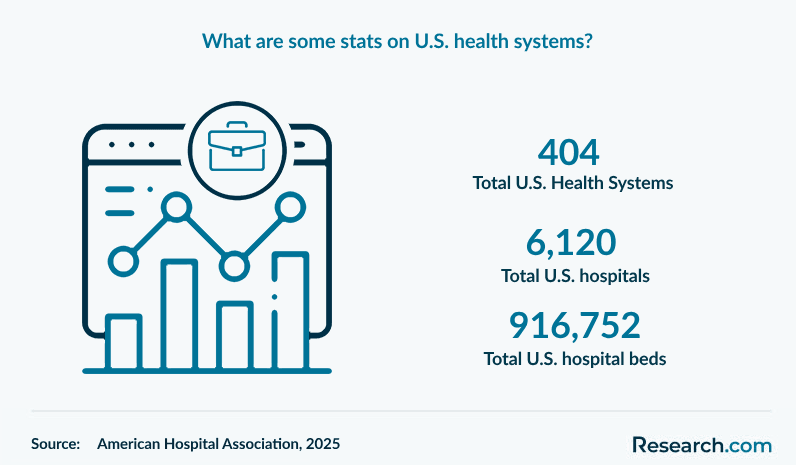
This system structure shows why healthcare organizations need leaders who can coordinate care across facilities, manage costs, interpret data, and align quality goals with operational realities. Consolidation, value-based care, health information technology, and population health strategies all increase the need for managers who understand both nursing practice and organizational performance.
Nurses who want a more specialized clinical advanced-practice route may compare this leadership path with options such as the cheapest online MSN degree in nurse midwifery.
How Much Do Online MSN in Health Systems Management Programs Cost?
Program cost varies widely by institution type, credit requirements, tuition model, transfer policy, and program length. Online study may reduce commuting and relocation costs, but students should still calculate the full cost of attendance before enrolling.
- Tuition: Total tuition may range from approximately $10,000 to $60,000 or more for the entire program, depending on the school and program structure.
- University fees: Common additional costs include application fees, technology fees, graduation fees, clinical tracking fees, background checks, and software charges.
- Books and supplies: Textbooks, digital resources, subscriptions, and required software can add several hundred to a few thousand dollars.
- Practicum-related costs: Students may need to pay for immunization records, drug screening, professional liability insurance, travel, or site documentation.
- Federal student aid: Graduate students may apply for federal loans through the Free Application for Federal Student Aid, including Stafford Loans and Grad PLUS Loans.
- Scholarships: Nursing schools, foundations, professional associations, and healthcare organizations may offer scholarships for graduate nursing students.
- Employer tuition reimbursement: Many hospitals and health systems help pay for advanced education, especially when the degree supports leadership development.
- Private loans: Private loans may help cover gaps but often have different interest rates, repayment terms, and borrower protections than federal loans.
- Payment plans: Some universities allow installment payments across a term or academic year.
- Military benefits: Eligible veterans and active-duty personnel may be able to use GI Bill benefits or other military education assistance.
- Graduate assistantships: These may provide tuition support or stipends, although they are less common in fully online programs for working nurses.
If your goal is quality and safety leadership rather than broad administration, compare this degree with specialized programs such as the cheapest online master's in healthcare quality and patient safety.
Salary Potential After an MSN in Health Systems Management
Salary data should be used as a planning tool, not a guarantee. Employers consider role scope, years of experience, geographic location, facility type, certifications, budget responsibility, and leadership record.
| Salary Data Point | Amount Cited | Source or Context |
| Medical and health services manager median annual wage | $117,960 | BLS, May 2024 |
| Registered nurse median annual wage | about $93,600 per year | BLS, May 2024 |
| Average annual pay for Health Systems Management professional | $102,067 | ZipRecruiter, May 21, 2025 |
| Possible entry-level range for new graduates | $77,000 to $95,000 annually | Role and location dependent |
| Experienced health systems managers | well over $125,000 annually | Especially in high-demand areas or executive roles |
| Average in pharmaceutical and medicine manufacturing | $231,070 | BLS, May 2024 |
| Average in hospitals | $145,390 | BLS, May 2024 |
| Health Systems Management in Barrow, AK | $127,152 | ZipRecruiter, May 2025 |
| National average salary for Health Systems Manager | $84,763 | Salary.com, 2024 |
Salary.com data from 2024 cited in this guide lists a national average salary of $84,763 for Health Systems Manager. The same dataset shows location differences, including $101,879 in California and $81,632 in Texas. Industry also affects pay, with government settings averaging $96,540, the pharmaceutical industry averaging $90,000, and non-profit organizations averaging $78,000.
Certifications and experience can also influence compensation. Salary.com data cited here associates CPHQ with $94,000, HIMSS with $96,000, and 10+ years of experience with $100,000 annually. Nurses interested in population-level leadership may also compare this path with affordable online MSN public health nursing programs.
The financial return of an MSN in Health Systems Management depends on how much you pay, how quickly you finish, whether your employer helps with tuition, and whether the degree supports a realistic move into higher-responsibility roles.
Online vs. In-Person MSN in Health Systems Management Programs
Online and campus-based programs can both prepare nurses for leadership. The better format depends on how you learn, how much schedule control you need, and whether you value local networking or national program access.
| Factor | Online MSN | In-Person MSN |
| Schedule flexibility | Often better for working RNs, especially when courses are asynchronous. | May require fixed class times and commuting. |
| Access | Allows students to enroll without relocating, which can be useful for nurses comparing programs nationwide. | Best for students near a strong local university or health system partner. |
| Networking | May include virtual cohorts, discussion boards, alumni events, and online mentoring. | Often provides more face-to-face contact with faculty, peers, and local employers. |
| Practicum experience | Usually completed locally, but students must confirm site approval and preceptor rules. | May have established regional clinical or administrative placements. |
| Cost considerations | Can reduce commuting and relocation costs, though fees and practicum expenses still matter. | May involve transportation, parking, housing, or lost work time. |
| Learning style | Works best for self-directed students comfortable with digital platforms. | Works well for students who prefer structured classroom interaction. |
Flexibility is one reason online graduate nursing has become popular across specialties, including leadership programs and clinical tracks such as affordable MSN pediatric nurse practitioner programs online.
Subspecialties and Career Paths for Health Systems Management Graduates
An MSN in Health Systems Management can lead to several specialized leadership directions. Choosing a subspecialty early can help you select the right practicum, electives, certifications, and capstone project.
- Hospital administration: Focuses on operational performance, service lines, staffing, patient care quality, and financial sustainability.
- Clinical operations management: Oversees daily clinical workflows, patient flow, resource allocation, and care delivery standards.
- Quality and patient safety: Leads improvement initiatives, safety programs, regulatory readiness, and outcomes measurement.
- Health informatics leadership: Manages data systems, electronic health records, analytics, system implementation, and technology-enabled care improvement. Nurses drawn to analytics may also compare related options such as the cheapest data science masters online programs.
- Nursing informatics: Connects clinical practice with information technology to improve documentation, workflows, decision support, and patient outcomes.
- Care coordination or case management leadership: Supervises teams responsible for transitions of care, complex case management, and resource use.
- Strategic planning: Supports long-term organizational growth, new service lines, market analysis, and performance goals.
- Healthcare human resources: Focuses on workforce planning, recruitment, training, retention, scheduling, and labor relations.
- Healthcare finance and reimbursement: Works with budgets, billing, reimbursement models, cost controls, and financial reporting.
- Public health administration: Leads programs that address community health needs, access, prevention, and health disparities.
- Ambulatory care management: Manages outpatient clinics, urgent care centers, specialty practices, and ambulatory networks.
- Long-term care administration: Oversees nursing homes, assisted living facilities, rehabilitation centers, compliance, and resident care operations.
- Risk management and compliance: Identifies legal, financial, operational, and clinical risks while supporting regulatory adherence.
Job Market for Online MSN in Health Systems Management Graduates
The job market for medical and health services managers is strong because healthcare organizations need leaders who can manage complex operations, staffing, compliance, finances, technology, and quality improvement. RN experience can be a competitive advantage because nurse leaders understand clinical work from the inside.
- Strong demand: Employment of medical and health services managers is projected to grow 28% from 2023 to 2033, much faster than the average for all occupations.
- Large number of openings: Approximately 61,400 openings for medical and health services managers are projected each year, on average, over the decade.
- Healthcare system complexity: Aging populations, chronic disease management, regulatory requirements, and care coordination all increase demand for skilled administrators.
- Value of RN experience: Nurses who move into management bring practical knowledge of staffing, patient care, workflows, safety, and interprofessional collaboration.
- Many employer types: Jobs exist in hospitals, outpatient care centers, physician practices, nursing and residential care facilities, government agencies, and healthcare systems.
- Advanced degree advantage: An MSN in Health Systems Management may improve competitiveness for higher-level management and executive-track opportunities.
- Specialized leadership demand: Employers continue to need managers in quality improvement, informatics, finance, compliance, patient safety, and strategic planning.
Medical and Health Services Managers earned a median pay of $117,960 per year, or $56.71 per hour, in 2024. A bachelor's degree is the typical entry-level education listed for this occupation, with less than five years of related work experience and no on-the-job training generally reported. In 2023, there were 562,700 jobs for Medical and Health Services Managers, and employment was projected to grow by 29% from 2023 to 2033, producing approximately 160,600 new jobs.
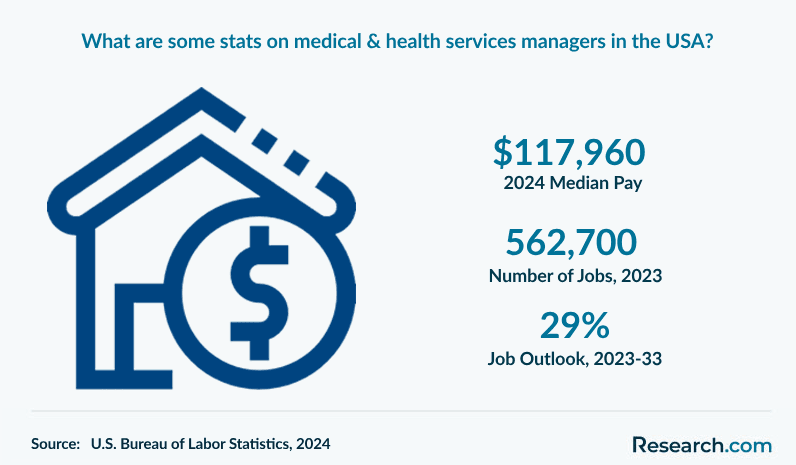
For MSN-prepared nurses, the strongest opportunities usually come from pairing the degree with measurable leadership experience: charge nurse duties, committee work, quality projects, precepting, informatics implementation, budget exposure, or process-improvement outcomes.
Current Healthcare Trends Affecting MSN Health Systems Management Graduates
Healthcare leadership is changing quickly. Graduates need more than traditional management theory; they need to understand technology, workforce pressures, reimbursement shifts, patient experience, and equity.
- Digital transformation: Healthcare organizations are expanding electronic health records, remote monitoring, analytics, AI-enabled tools, and virtual care models. Managers must understand implementation, workflow change, privacy, and staff adoption.
- Telehealth growth: The continued use of telehealth requires leaders who can manage access, quality, documentation, patient experience, and technology-supported care.
- Value-based care: Organizations are increasingly measured on outcomes, cost, prevention, chronic disease management, and population health rather than volume alone.
- Data-driven decisions: Leaders are expected to interpret quality dashboards, staffing data, financial reports, patient outcomes, and operational metrics.
- Health equity and access: Healthcare systems need leaders who can identify disparities and design services that improve access for diverse populations.
- Workforce burnout and staffing shortages: Nurse leaders must address retention, scheduling, staff engagement, psychological safety, and workload management.
- Regulatory complexity: Compliance, privacy, risk management, reimbursement rules, and quality reporting continue to shape leadership decisions.
- Patient experience: Organizations increasingly focus on communication, access, safety, responsiveness, and patient-centered processes.
- Financial pressure: Leaders must balance cost containment with quality, staffing needs, technology investment, and patient outcomes.
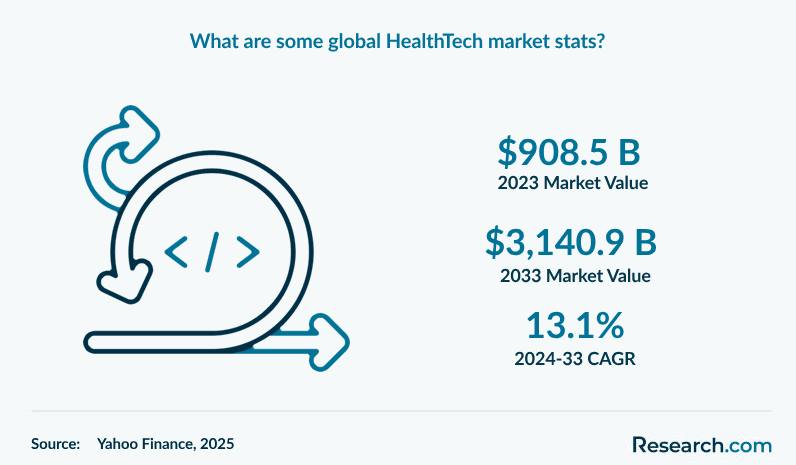
The global HealthTech market was valued at $908.5 billion in 2023 and is projected by Allied Market Research to reach $3,140.9 billion by 2033, with a compound annual growth rate (CAGR) of 13.1% from 2024 to 2033. Growth is supported by increased health awareness, an aging population, government initiatives, and broader use of digital health technologies, although high deployment costs and patient data privacy concerns remain challenges.
Why Accreditation Is Critical for Online MSN in Health Systems Management Programs
Accreditation is one of the first things to verify before applying. A properly accredited program has been reviewed against academic and professional standards, and accreditation can influence employer trust, transfer credit, eligibility for federal financial aid, certification pathways, and admission to future doctoral programs.
For MSN programs, look for nursing programmatic accreditation from recognized bodies such as CCNE or ACEN, along with institutional accreditation. If a program is not clearly accredited, ask the admissions office to identify the accreditor, the current accreditation status, and whether the specific online track is included. Nurses still completing their undergraduate pathway may also compare options such as RN to BSN with least prerequisites.
Career Support and Networking in Online MSN Programs
Career support matters because leadership roles are often filled through internal promotion, professional networks, practicum relationships, and documented project success. Before enrolling, ask whether the program offers faculty mentoring, alumni connections, employer partnerships, resume support, interview preparation, leadership coaching, and help finding practicum sites.
Students planning a lower-cost nursing education pathway can also review affordable RN to BSN online programs before moving into graduate study.
Alternative Pathways for Advancing Nursing Leadership
An MSN in Health Systems Management is best for nurses who want administrative, operational, informatics, or executive leadership roles. It is not the only path to advancement. Nurses who want to diagnose, treat, and manage patients in advanced clinical roles may prefer nurse practitioner pathways, while those who want terminal leadership preparation may later consider a DNP.
Clinical leadership pathways such as direct entry NP programs may be a better fit for students whose primary goal is advanced patient care rather than healthcare administration. The right choice depends on whether you want to lead systems, lead clinical care, or combine both over time.
How Online MSN Health Systems Management Programs Adapt to Emerging Healthcare Trends
Many online MSN leadership programs update coursework to include digital health, telemedicine, data analytics, value-based care, quality improvement, equity, and workforce management. Applied capstones and practicums can help students work on real organizational challenges such as EHR optimization, patient flow, staffing models, safety improvements, or remote-care implementation.
Students coming from outside nursing who are interested in clinical pathways rather than administration may also explore direct entry NP programs for non nurses online.
Common Mistakes to Avoid Before Enrolling
- Choosing only by tuition: A cheap program can become costly if it has extra fees, limited transfer credit, long completion time, or difficult practicum requirements.
- Ignoring accreditation: Always verify institutional and nursing program accreditation before applying.
- Assuming every online program is fully remote: Some programs require campus visits, synchronous sessions, local practicums, or residencies.
- Confusing informatics with administration: Informatics is technology- and data-focused, while nursing administration and executive leadership are broader management pathways.
- Not checking practicum rules: Ask whether you can use your workplace, who approves preceptors, and what happens if a site falls through.
- Overestimating salary guarantees: Degree completion can improve opportunity, but pay depends on market, experience, employer type, and role scope.
- Forgetting employer benefits: Tuition reimbursement, scheduling flexibility, and internal leadership pipelines can change the value of a program.
- Relying only on rankings: Rankings can narrow your list, but your final decision should consider fit, cost, accreditation, career services, and outcomes.
Questions to Ask Before You Apply
- Is the program accredited by CCNE, ACEN, or another recognized nursing accreditor?
- Does the track match my goal: nurse executive, nursing administration, health systems leadership, healthcare informatics, or healthcare administration?
- What is the total program cost after tuition, fees, books, practicum expenses, and technology charges?
- How many credits are required, and how many transfer credits will the school accept?
- Are courses asynchronous, synchronous, self-paced, or cohort-based?
- Are there in-person requirements, campus visits, residencies, or scheduled live sessions?
- How many practicum hours are required, and can I complete them near home or at my current workplace?
- What career support, mentorship, alumni networking, and leadership placement help does the program offer?
- What leadership roles have recent graduates moved into?
- Will my employer reimburse tuition or support flexible scheduling during the program?
Key Insights
- The best affordable program is the one that fits your career target, not just your budget. Compare track names carefully because health systems management, nursing administration, executive leadership, healthcare informatics, and MHA pathways can lead to different roles.
- Accreditation is non-negotiable. Verify institutional accreditation and nursing program accreditation such as CCNE or ACEN before applying.
- Healthcare leadership demand is strong. Medical and health services managers held approximately 562,700 jobs in 2023, and hospitals employed the largest share at 30%.
- Healthcare systems are a major employment environment. In 2025, the U.S. healthcare landscape included 404 total health systems, with 68% of the 6,120 total U.S. hospitals and 77% of the 916,752 total U.S. hospital beds affiliated with systems.
- Salary potential can be attractive but varies widely. Medical and health services managers earned a median annual wage of $117,960 in May 2024, while salary outcomes depend on location, industry, role, experience, and certifications.
- Experience still matters. New graduates may start between $77,000 and $95,000 annually, while experienced managers often earn well over $125,000, and top earners can reach over $219,080 annually.
- Technology is reshaping leadership roles. The HealthTech market was valued at $908.5 billion in 2023 and is projected to reach $3,140.9 billion by 2033, increasing the value of leaders who understand data, informatics, telehealth, and digital transformation.
- Online learning can work well for RNs. The strongest online programs offer flexibility without sacrificing practicum quality, faculty access, career support, or academic rigor.
References
- American Hospital Association. (2025, January 31). Fast facts on U.S. hospitals, 2025. American Hospital Association.
- Bureau of Labor Statistics, U.S. Department of Labor. (2024, May). Medical and Health Services Managers. Occupational Outlook Handbook. Bureau of Labor Statistics.
- Bureau of Labor Statistics, U.S. Department of Labor. (2024, May). Registered Nurses. Occupational Outlook Handbook. Bureau of Labor Statistics.
- Salary.com. (2024). Health Systems Manager salary in government settings. Salary.com.
- Salary.com. (2024). Health Systems Manager salary in outpatient care centers. Salary.com.
- Salary.com. (2024). Health Systems Manager salary in pharmaceutical industry. Salary.com.
- Salary.com. (2024). Health Systems Manager salary in hospitals. Salary.com.
- Salary.com. (2024). Health Systems Manager salary in academic medical centers. Salary.com.
- Salary.com. (2024). Health Systems Manager salary in non-profit organizations. Salary.com.
- Salary.com. (2024). Health Systems Manager salary in insurance industry. Salary.com.
- Salary.com. (2024). Health Systems Manager salary in long-term care facilities. Salary.com.
- Salary.com. (2024). Health Systems Manager salary in consulting firms. Salary.com.
- Salary.com. (2024). Health Systems Manager salary with CPHQ certification. Salary.com.
- Salary.com. (2024). Health Systems Manager salary with HIMSS certification. Salary.com.
- Salary.com. (2024). Health Systems Manager salary with 10+ years experience. Salary.com.
- Salary.com. (2024). Health Systems Manager salary with bachelor's degree. Salary.com.
- Salary.com. (2024). Health Systems Manager salary top 25th percentile. Salary.com.
- Yahoo Finance. (2025, May 1). HealthTech market size to reach $3,140.9 billion by 2033 globally. Yahoo Finance.
- ZipRecruiter. (2025, May 21). Salary: Health Systems Management (May, 2025) United States. ZipRecruiter.
Other Things You Should Know About Online MSN in Health Systems Management Programs
In 2027, the most affordable online MSN in Health Systems Management programs are often offered in a flexible asynchronous format, allowing students to complete coursework at their own pace. However, some programs may incorporate synchronous elements, such as live discussions or real-time lectures, to enhance interaction.
Most online MSN in Health Systems Management programs require applicants to hold a Bachelor of Science in Nursing (BSN). However, some institutions offer bridge programs (e.g., RN-to-MSN) for ADN-prepared nurses who also hold a non-nursing bachelor's degree or are willing to complete additional foundational coursework. This allows a pathway for experienced nurses without a BSN to pursue advanced roles.
Always check the specific program's admission criteria, as pathways can vary significantly. Furthermore, verify with your state's Board of Nursing, as licensure requirements and accepted educational pathways can differ by state.


