
2027 Fastest Online MSN in Public Health Nursing

Co-Founder and Chief Data Scientist
As a specialist in career and education planning, I frequently assist individuals aiming for rapid entry or advancement into stable, in-demand fields within the healthcare industry. The pursuit of the fastest online Master of Science in Nursing (MSN) in Public Health Nursing is a popular and practical goal.
The digital landscape is filled with programs making bold claims about completion times, making it difficult to discern credible, accredited options from those that are merely well-marketed.
The critical task is to evaluate a program's true value and rigor beyond its advertised speed. My purpose is to provide expert clarity, helping you identify a genuinely accelerated program that upholds academic standards and meets your career objectives.
What are the benefits of getting a qualification from the fastest online MSN in Public Health Nursing programs?
- Accelerated Career Entry: A specialized MSN can quickly qualify you for leadership roles in community health, government agencies, and non-profit organizations as a Public Health Nurse, Nurse Educator, or Policy Advisor.
- Competitive Salaries: MSN-prepared nurses in public health command higher salaries. While a BSN-level Public Health Nurse earns around $81,000, those with a master's degree can expect to earn closer to $98,000 annually, with leadership roles surpassing $115,000 depending on location and experience.
- Flexible Learning: The accelerated online format provides the convenience of earning an advanced credential on a condensed timeline, allowing you to balance education with current personal or work commitments.
What can I expect from the fastest online MSN in Public Health Nursing programs?
- Applied Strategic Knowledge: Emphasis is placed on real-world public health scenarios, focusing on areas like epidemiology, health policy, program planning and evaluation, and addressing health disparities within vulnerable populations.
- Structured Curriculum: Delivery typically combines recorded lectures, live online seminars, and community-based clinical or practicum experiences to ensure hands-on competence.
- Condensed Timeline: Programs are designed to be completed quickly, often in 12–20 months, through intensive, focused modules.
Where can I work with an online MSN in Public Health Nursing?
- Government Agencies: Secure leadership and policy roles in local, state, or federal public health departments, such as the Centers for Disease Control and Prevention (CDC) or the National Institutes of Health (NIH).
- Community Health Organizations: Lead programs in community health centers, non-profits, and school systems, focusing on health education, disease prevention, and care for at-risk populations.
- Hospitals and Healthcare Systems: Work as a care coordinator, patient educator, or program manager, developing and implementing population-focused health initiatives.
- Global Health Organizations: Provide expertise to international non-governmental organizations (NGOs), working on global health crises, disaster relief, and health education initiatives abroad.
- Research Institutions and Universities: Work in academic or private research settings, focusing on public health studies, or serve as a faculty member or clinical instructor.
How much can I earn with an online MSN in Public Health Nursing?
- Entry-Level Roles: Graduates with a new MSN in public health typically earn between $75,000 and $90,000 annually in roles such as a Community Health Nurse Lead or Health Program Coordinator.
- Experienced and Lead Roles: With several years of experience, professionals in senior roles, like a Public Health Nurse Manager or Director of Population Health, can earn $95,000–$120,000.
- Specialized and Executive Roles: Professionals who specialize in high-demand fields like epidemiology, health policy analysis, or hold executive-level positions can command higher salaries, often ranging from approximately $110,000 to over $130,000 annually.
- Fastest Online MSN in Public Health Nursing Programs for 2027 List of Programs
- What is the average cost of an online MSN in Public Health Nursing? Average Cost
- What are the financial aid options for an online MSN in Public Health Nursing? Financial Aid
- What are the prerequisites for enrolling in an online MSN in Public Health Nursing program? What are the prerequisites for enrolling in an online MSN in Public Health Nursing program?
- What courses are typically in an online MSN in Public Health Nursing program? What courses are typically in an online MSN in Public Health Nursing program?
- What types of specializations are available for MSN in Public Health Nursing holders? Specializations
- How do you choose the best among the fastest online MSN in Public Health Nursing programs? How do you choose the best among the fastest online MSN in Public Health Nursing programs?
- What career paths are available for graduates of online MSN in Public Health Nursing programs? Career Paths
- How much can I earn with an online MSN in Public Health Nursing? Salaries
- What is the job market like for graduates of an online MSN in Public Health Nursing? Job Market
- What are some current and future trends in public health nursing? What are some current and future trends in public health nursing?
- Is Accreditation Essential for Ensuring Quality in Online MSN Programs? Is Accreditation Essential for Ensuring Quality in Online MSN Programs?
- How Do Online MSN Programs Support Networking and Career Advancement? How Do Online MSN Programs Support Networking and Career Advancement?
- Should I Consider an Online DNP Over an MSN in Public Health Nursing? Should I Consider an Online DNP Over an MSN in Public Health Nursing?
Fastest Online MSN in Public Health Nursing Programs for 2027
Choosing a fast online MSN in Public Health Nursing is usually a balancing act: you want to move into population health, community leadership, or public health policy roles sooner, but you cannot afford to overlook accreditation, practicum requirements, total cost, or whether the program fits around your RN schedule. Public health nursing master’s programs are built for licensed nurses who want to improve health outcomes at the community or population level rather than focus only on one patient at a time.
This guide is for BSN-prepared nurses, ADN-prepared RNs considering bridge options, and working nurses comparing accelerated MSN pathways. You will learn which programs can be completed quickly, what each school requires, how costs differ, what courses and practicum experiences to expect, and how to decide whether an MSN, RN-to-MSN, certificate, or DNP is the better next step. If you are comparing other accelerated advanced nursing options, you may also want to review fast online MSN pediatric nurse practitioner programs to understand how public health tracks differ from advanced practice clinical pathways.
Quick answer: What is the fastest online MSN in Public Health Nursing?
The fastest online MSN in Public Health Nursing programs in this list can be completed in as few as 16 months to 18 months, depending on the school, enrollment pace, transfer credits, and whether the student enters through a BSN-to-MSN or RN-to-MSN pathway. Herzing University reports an average completion time of 16 months, while Walden University and Worcester State University offer options that may be completed in as few as 18 months. However, the “fastest” program is not always the best choice if it lacks the accreditation, practicum support, schedule flexibility, or local clinical placement fit you need.
How this ranking was developed
Because a graduate nursing degree requires a major investment of time and money, Research.com rankings rely on transparent data sources and program-level review. Our ranking methodology considers credible education datasets, institutional information, and factors that matter to prospective students, including affordability, program structure, completion time, accreditation, and online accessibility. Data sources include:
- IPEDS, the federal postsecondary education data system;
- Peterson’s, including distance learning datasets;
- College Scorecard, which provides federal higher education outcomes data; and
- the National Center for Education Statistics.
Use the ranking below as a starting point, then verify current tuition, practicum rules, state authorization, and admission requirements directly with each school before applying.
| School | Fastest stated timeline | Credits | Public health focus | Accreditation listed |
| American Public University / American Military University | 2 years, depending on course load | 36 semester credits | Community/Public Health Nursing | CCNE |
| Herzing University | 16 months on average | 36 credits | Public Health Nursing | CCNE, HLC |
| Jacksonville State University | Approximately 18 months full-time | 38 credits | Population Health | CCNE, SACSCOC |
| Commonwealth University | Typically 2 years full-time; part-time available | 36 credits | Public Health Nursing | CCNE |
| University of Massachusetts Amherst | Typically 2–3 years part-time/flexible | 36 credits | Public Health Nursing | CCNE |
| University of Massachusetts Dartmouth | 3 years, flexible and asynchronous | 36 credits | Global Public Health | CCNE |
| University of North Carolina at Charlotte | Flexible full-time or part-time | 38 credits | Community/Public Health Nursing | CCNE |
| University of Arkansas at Monticello | 36 months | 37 credits | Public Health Nursing | NLN CNEA |
| Walden University | 18 months for BSN to MSN; varies by plan | 53 total quarter credits | Public Health Nursing | CCNE |
| Worcester State University | As few as 18 months | 35 credits | Public and Population Health | CCNE |
1. American Public University (APU) / American Military University (AMU)
American Public University offers an online Master of Science in Nursing with a community and public health emphasis for licensed RNs who already have a nursing bachelor’s degree. The program is built around population health, prevention, health promotion, and the social factors that shape community outcomes. Students prepare to design public health initiatives, support disease prevention efforts, and serve in settings such as public agencies, schools, clinics, and community-based organizations.
The program emphasizes leadership, collaboration, and health equity. Coursework is online and does not require set login times, which can help nurses who work rotating schedules. Students still complete a two-part practicum in their local community, so applicants should think early about possible sites and preceptors. APU does not require entrance exams or GRE scores. In addition to the direct-entry master’s option for BSN-prepared nurses, the university also offers an RN-to-MSN route for nurses with an associate degree.
- Program length: 2 years, though timing varies by course load
- Track or concentration: Community/Public Health Nursing
- Tuition cost per credit: Standard Tuition: $455; Preferred Military Rate: $250; Veteran Grant: $386.75; APUS Opportunity Grant: $409.50
- Credits required: 36 semester credits
- Accreditation: Commission on Collegiate Nursing Education (CCNE)
2. Herzing University
Herzing University offers a Master of Science in Nursing – Public Health Nursing for BSN-prepared nurses and ADN-prepared RNs who enter through the RN-to-MSN pathway. The program is fully online for didactic coursework and focuses on population health, evidence-based practice, advocacy, health policy, and community-level prevention. It is designed for nurses who want to shift from primarily bedside care into broader public health leadership and population health roles.
Students complete 135 clinical practicum hours, and the university states that it helps students secure a placement if they cannot find one independently. Rolling admissions and no fixed application deadlines may appeal to working nurses who want flexibility in when they start. Herzing also offers virtual student services, academic advising, career coaching, and the option to earn dual credit toward an online Doctor of Nursing Practice, making it a practical choice for students who may later pursue doctoral-level leadership.
- Program length: 16 months on average, depending on individual pace
- Track or concentration: Public Health Nursing; RN-to-MSN pathway available
- Tuition cost: $625/credit
- Credits required: 36 credits
- Accreditation: Commission on Collegiate Nursing Education (CCNE), Higher Learning Commission (HLC)
3. Jacksonville State University
Jacksonville State University offers an online MSN in Population Health for registered nurses who want advanced preparation in assessing and improving the health of vulnerable groups. The curriculum includes community needs assessment, aggregate data analysis, program planning, implementation, and evaluation. Students study prevention and health promotion while focusing on a selected vulnerable population, such as older adults or groups affected by racial disparities.
The program also includes systems leadership, disaster management, nursing informatics, quality, and safety. Courses are delivered online, but students should confirm any on-campus events and practicum expectations before enrolling. The degree can support roles in public health practice, management, and research, and it can also serve as preparation for a terminal degree in nursing or public health.
- Program length: Approximately 18 months, full-time
- Track or concentration: Population Health
- Tuition cost: $410/credit
- Credits required: 38 credits
- Accreditation: Commission on Collegiate Nursing Education (CCNE), Southern Association of Colleges and Schools Commission on Colleges (SACSCOC)
4. Commonwealth University
Commonwealth University offers a fully online MSN in Public Health Nursing for nurses pursuing advanced community, public, and school health roles. The program combines nursing science with public health concepts, including population health, health education, prevention, policy, and community engagement. Students can begin in the spring, summer, or fall, and both full-time and part-time enrollment options are available.
The curriculum prepares nurses to identify population-level health problems, create interventions, evaluate outcomes, and advocate for policies that improve community wellness. Practicum experiences take place in the student’s local community, allowing working nurses to connect coursework with real settings and populations. This program may be a strong fit for students who want a flexible pace without giving up applied public health experience.
- Program length: Flexible; typically designed for completion in 2 years full-time, with part-time options available
- Track or concentration: Public Health Nursing
- Tuition cost: $516/credit in-state; $774/credit out-of-state
- Credits required: 36 credits
- Accreditation: Commission on Collegiate Nursing Education (CCNE)
5. University of Massachusetts Amherst
The University of Massachusetts Amherst Elaine Marieb College of Nursing offers a fully online Master of Science in Public Health Nursing focused on leadership, health disparities, and underserved populations. Students learn to analyze health trends, recognize population risk factors, and design evidence-based programs that support public health improvement. The curriculum includes epidemiology, research methods, health policy, and health disparities.
Students complete two supervised practicum experiences that require them to apply public health nursing knowledge with a defined population. The public health nursing track is one of two options in the online Master of Science program. Graduates are prepared for leadership roles in public health departments, federal agencies, and other organizations working to improve outcomes at scale.
- Program length: Varies; typically 2–3 years, part-time/flexible
- Track or concentration: Public Health Nursing
- Tuition cost: $825/credit
- Credits required: 36 credits
- Accreditation: Commission on Collegiate Nursing Education (CCNE)
6. University of Massachusetts Dartmouth
The University of Massachusetts Dartmouth offers an online Master of Science in Nursing with a Global Public Health concentration. Students may also choose a Nursing and Healthcare Education concentration, but the global public health track is intended for nurses who want to work with diverse populations in the United States or internationally. Coursework emphasizes prevention, health policy, healthcare systems, nursing research, and informatics.
The program is fully online and asynchronous, which can be useful for nurses managing shifts or family responsibilities. Students complete an intensive practicum of at least 126 hours and a mentored capstone project. Graduates develop leadership skills for improving patient safety, using evidence in practice, and influencing health systems and policy.
- Program length: 3 years, flexible and asynchronous
- Track or concentration: Global Public Health
- Tuition cost: $617/credit
- Credits required: 36 credits
- Accreditation: Commission on Collegiate Nursing Education (CCNE)
7. University of North Carolina at Charlotte
The University of North Carolina at Charlotte offers an online MSN in Community/Public Health Nursing for nurses preparing for leadership roles in community health, population assessment, and public health intervention. Students learn to identify high-risk groups, assess community needs, work with stakeholders, and design culturally sensitive programs. The curriculum includes nursing theory, health policy, community epidemiology, and biostatistics.
The program requires two internships and a capstone synthesis course in advanced nursing practice. Although the coursework is 100% online, students must complete 360 clinical hours, so placement logistics should be reviewed carefully. Required faculty advising helps students stay aligned with program expectations and competencies associated with public health nursing leadership.
- Program length: Flexible on a part-time or full-time basis
- Track or concentration: Community/Public Health Nursing
- Tuition cost per credit: Resident: $288.82; Outside of NC Non-Resident: $536.98; Non-Resident: $1,098.21
- Credits required: 38 credits
- Accreditation: Commission on Collegiate Nursing Education (CCNE)
8. University of Arkansas at Monticello
The University of Arkansas at Monticello offers a fully online Master of Science in Nursing designed for registered nurses who want to lead community health, prevention, and health promotion efforts. Students study community health, epidemiology, health education, public health policy, and evidence-based nursing practice.
The school provides several pathways, including RN-to-MSN, BSN-to-MSN, and a post-master’s certificate option for nurses who already hold a graduate degree. The BSN-to-MSN track can be completed in 24 months of full-time study, while full-time and part-time formats are available. Graduates may pursue public health nursing specialist, nurse educator, nurse director, administrator, or other leadership roles.
- Program length: 36 months
- Track or concentration: Public Health Nursing
- Tuition cost: In-state tuition and fees (Monticello): $5,430; out-of-state tuition and fees (Monticello): $8,370
- Credits required: 37 credits
- Accreditation: National League for Nursing Commission for Nursing Education Accreditation (NLN CNEA)
9. Walden University
Walden University offers a 100% online MSN in Public Health Nursing for registered nurses seeking population health and community leadership roles. The curriculum helps nurses move from direct care into roles that involve program planning, public health theory, population health, epidemiology, and leadership. Coursework is aligned with standards from the American Association of Colleges of Nursing.
Students complete immersive learning experiences and a practicum project tied to an actual public health issue in their community. Walden offers a BSN-to-MSN track that can be completed in as few as 18 months, depending on pace and enrollment plan. Its Practicum Pledge® provides field placement support if a student is unable to identify a practicum site independently.
- Program length: 18 months for BSN to MSN; varies by pace and enrollment plan
- Track or concentration: Public Health Nursing
- Tuition cost: $500/quarter hour
- Credits required: 53 total quarter credits for BSN to MSN
- Accreditation: Commission on Collegiate Nursing Education (CCNE)
10. Worcester State University
Worcester State University offers a fully online Master of Science in Nursing – Public and Population Health with concentration options in Global and Cross-Cultural Health or Health Systems Transformation. The program prepares nurses to work on broad health outcomes in healthcare, education, government, and community settings. Coursework covers health policy, epidemiology, data science, and population health concepts aligned with national standards for master’s-level nursing education.
Students can tailor their studies toward global health issues or health systems change. Worcester State’s nursing department is one of seven U.S. schools recognized by the AACN and CDC for an innovative population health curriculum. The program can be completed in as few as 18 months and includes a practicum internship that helps students apply public and population health concepts in practice.
- Program length: As few as 18 months
- Tracks or concentrations: Global and Cross-Cultural Health, Health Systems Transformation
- Tuition cost: $17,640 total
- Credits required: 35 credits
- Accreditation: Commission on Collegiate Nursing Education (CCNE)
What is the average cost of an online MSN in Public Health Nursing?
The cost of an online MSN in Public Health Nursing depends on the institution type, residency rules, number of required credits, per-credit tuition, fees, and practicum-related expenses. A lower per-credit rate does not always mean the lowest total cost, because programs vary in credit requirements and fee structures.
| Cost factor | What to check before enrolling |
| Public university tuition | Public programs often cost less, especially for in-state students. Total costs commonly range from $20,000 to $40,000 for the entire certificate. |
| Private university tuition | Private programs may offer flexibility, faster pacing, or stronger placement support, but total costs can range from $40,000 to over $70,000. |
| Residency status | Some public universities charge different rates for in-state, out-of-state, and non-resident online students. |
| Program length and credits | A 35-credit program at a higher rate may cost less than a longer program with a lower rate, so calculate total tuition rather than comparing only per-credit prices. |
| Additional fees | Ask about technology fees, application fees, digital materials, background checks, drug screening, liability insurance, and practicum costs. |
Market data also shows that nursing education is growing financially while enrollment patterns are becoming less predictable. A Validated Insights report cited by Yahoo Finance in 2024 states that the nursing education market generates over $8.5 billion in annual revenue, accounts for nearly 3% of all higher education revenue, and is projected to reach $14.57 billion by 2030 with an annual growth rate above 11%.
From 2025 to 2030, nursing enrollment is expected to rise at a compound annual growth rate (CAGR) of 8.3%, but that growth is not evenly distributed. Two-year associate program enrollment is declining, while BSN programs reported a 7.1% increase in new enrollment between Fall 2023 and Fall 2024.
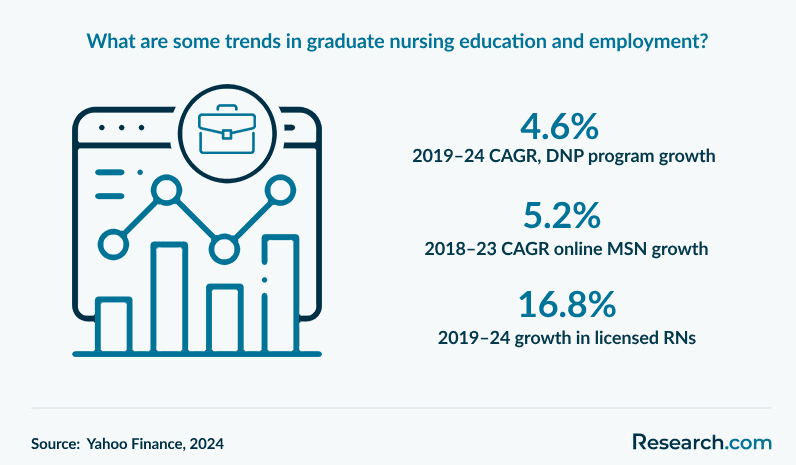
Graduate nursing demand is also mixed. DNP programs are growing at a 4.6% CAGR, above the overall doctoral market’s 1.2% growth. Online MSN programs, however, slowed from an 8.3% CAGR between 2013–2018 to 5.2% between 2018–2023, as reflected in the graphic below. Students comparing accelerated graduate options outside nursing, such as an online accelerated master’s in human resource management, should apply the same cost discipline: compare total program price, credential value, and labor market fit rather than speed alone.
The share of nursing schools reporting enrollment declines increased from 33% in 2022 to 37% in 2024. At the same time, RN labor market signals are more complex than simple shortage narratives suggest. Licensed RNs increased by 16.8% from 2019 to 2024, while employed RNs increased by 7.1%, lowering the employment rate for licensed RNs from 71.0% to 65.1%.
For MSN applicants, the key takeaway is practical: do not assume that a graduate nursing degree automatically produces a salary increase. Choose a program that aligns with the specific public health roles, employers, credentials, and geographic markets you are targeting.
What are the financial aid options for an online MSN in Public Health Nursing?
Financial aid can reduce the out-of-pocket cost of an online MSN, but eligibility depends on accreditation, enrollment status, school policies, employer rules, and whether you are pursuing a degree or certificate. Start by confirming that the institution participates in federal aid programs and that the nursing program is properly accredited.
| Aid option | How it may help | Question to ask |
| Federal student aid | Students in eligible accredited MSN programs may qualify for federal loans or other aid after submitting the Free Application for Federal Student Aid (FAFSA). | Is this exact MSN track eligible for federal aid? |
| Employer tuition assistance | Hospitals, health systems, public agencies, and clinics may reimburse tuition for nurses pursuing approved graduate credentials. | Do I need to stay employed for a certain period after reimbursement? |
| Scholarships and grants | Graduate nursing scholarships may be available through universities, foundations, professional associations, and public health organizations. | Are awards renewable, and do they require public service or specific employment? |
| Institutional payment plans | Some schools offer installment plans or institutional aid that can spread costs over the term. | Are there enrollment fees, interest charges, or late penalties? |
Students considering shorter credentials should compare MSN financial aid with funding options in other accelerated graduate programs, including fields outside nursing such as fast online biotechnology graduate certificates. The right comparison is not only “Which program is cheapest?” but “Which credential supports the role I want and qualifies for the aid I need?”
What are the prerequisites for enrolling in an online MSN in Public Health Nursing program?
Most online MSN in Public Health Nursing programs expect applicants to arrive with a nursing background, an active RN license, and enough academic preparation to handle graduate-level population health coursework. Requirements vary by school and by entry pathway, so BSN-prepared nurses and ADN-prepared nurses should review different admission routes.
| Requirement | What it usually means | Why it matters |
| Bachelor’s degree | A BSN from an accredited institution is a standard requirement for direct MSN admission. | It confirms that the applicant has completed upper-division nursing preparation. |
| Active RN license | Applicants generally need a current, unencumbered U.S. registered nurse license. | Clinical and practicum work typically requires active RN status. |
| RN-to-MSN pathway | ADN-prepared nurses may enter through bridge options such as online RN-to-MSN programs. | This route can shorten the path from associate degree to graduate nursing credential. |
| Minimum GPA | Many programs require a minimum undergraduate GPA, often 3.0 on a 4.0 scale. | Programs use GPA as one measure of readiness for graduate work. |
| Clinical experience | Some schools prefer or require one to two years of RN experience. | Public health nursing leadership often builds on prior patient care and systems experience. |
| Prerequisite coursework | Statistics and health assessment are common prerequisites. | Courses such as epidemiology and biostatistics require comfort with data and assessment concepts. |
What courses are typically in an online MSN in Public Health Nursing program?
An online MSN in Public Health Nursing combines graduate nursing leadership with public health methods. The curriculum is designed to help nurses assess population needs, interpret health data, design interventions, advocate for policy change, and evaluate whether programs actually improve outcomes. These courses are part of the broader set of public health nurse requirements that may include education, licensure, field experience, and role-specific competencies.
| Course area | What students learn |
| Epidemiology | How diseases, injuries, and health conditions are distributed across populations and what factors influence them. |
| Health policy and advocacy | How policy is created, evaluated, and influenced to support health equity and population health goals. |
| Biostatistics | How to use statistical methods to interpret public health data and support evidence-based decisions. |
| Program planning and evaluation | How to design, implement, and assess community health programs. |
| Community health assessment | How to evaluate a community’s needs, strengths, risks, and resources before designing interventions. |
| Social determinants of health | How housing, income, education, environment, access, and other social conditions shape health outcomes. |
| Environmental health sciences | How environmental exposures, pollution, and hazards affect communities and how risks can be reduced. |
| Public health leadership and management | How to manage programs, budgets, teams, strategy, and systems-level change. |
| Health communication | How to communicate health information clearly to diverse audiences and improve health literacy. |
A 2023 national survey of public health nurses identified mental health as the most frequently selected training need, with 32.42% of respondents choosing it. Patient-centered care followed at 31.69%. Evidence-based care and care for medically complex patients were nearly even at 29.66% and 29.62%, respectively. Social determinants of health ranked fifth, selected by 25.19% of respondents, as shown in the chart below.
A second group of training priorities fell between 20% and 23%. These included underserved communities at 22.69%, quality improvement at 21.37%, team-based care at 21.32%, and population health at 20.17%. Lower-priority topics included practice management and administration at 19.49% and value-based care at 11.45%. Another 14.78% of respondents reported no need for additional training.
For students, these findings are useful when comparing curricula. Programs that include mental health, complex care, evidence-based practice, health equity, and social determinants may be better aligned with what public health nurses report needing in the field.
What types of specializations are available for MSN in Public Health Nursing holders?
Some MSN public health nursing programs are broad, while others let students focus on a defined population, setting, or public health function. Specializations can help you build a more focused resume, but they should match your target jobs and practicum opportunities.
| Specialization | Best fit for students interested in |
| Health policy and management | Program administration, policy analysis, public health leadership, and systems change. |
| Epidemiology and disease control | Surveillance, outbreak investigation, infectious disease control, and chronic disease prevention. |
| Global health | International health systems, cross-cultural care, global disparities, and multinational programs. |
| Health education and promotion | Community education, wellness campaigns, prevention programs, and behavior change. |
| Maternal and child health | Programs serving mothers, infants, children, families, and school-age populations. |
| Public health informatics | Data systems, health reporting, analytics, surveillance tools, and information management. |
| Occupational and environmental health | Workplace safety, environmental exposures, community hazards, and risk reduction. |
| Disaster and emergency preparedness | Pandemic response, natural disasters, emergency planning, and population-level crisis response. |
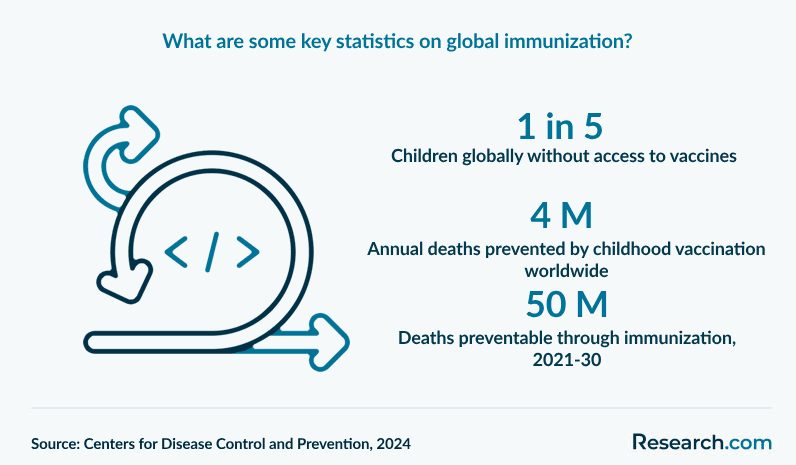
Public health specialization matters because many of the world’s major health gains depend on population-level interventions. Childhood vaccination, for example, prevents an estimated 4 million deaths globally each year and could avert more than 50 million deaths between 2021 and 2030. By 2030, measles vaccination alone is projected to save nearly 19 million lives, while Hepatitis B vaccination could save 14 million.
Despite more than 25 safe and effective vaccines, access remains unequal: 1 in 5 children worldwide still do not receive them. This is one reason public health nurses increasingly need skills in data interpretation, policy, logistics, and community trust-building. Similar data-driven decision-making appears in other fields, including online master’s programs in intelligence, where evidence and analysis also guide high-stakes interventions.
Recent immunization data shows both progress and setbacks. In 2024, about 14.3 million children under one year old received no basic vaccines, which is 1.4 million more than before the pandemic but 171,000 fewer than in 2023. More than half of these “zero-dose” children live in only 10 countries. Immunization remains highly cost-effective: in low- and middle-income countries, every $1 spent produces $52 in savings. The cost to fully immunize a child in a low-income country has also fallen from over $24 in 2013 to $18 today.
For MSN students, these figures show why public health nursing is not limited to education campaigns. It also requires systems thinking, cross-sector coordination, cultural competence, financing awareness, and the ability to translate data into action.
How do you choose the best among the fastest online MSN in Public Health Nursing programs?
The best fast MSN program is the one that helps you reach your target role without creating avoidable problems with accreditation, licensure, practicum placement, cost, or scheduling. Speed matters, but it should not override quality or fit.
| Decision factor | What to look for | Red flag |
| Accreditation | Confirm nursing accreditation through a recognized agency such as the Commission on Collegiate Nursing Education (CCNE). | The school is accredited, but the nursing program or track is unclear. |
| State authorization | Verify that the online program can enroll students in your state and support practicum requirements where you live. | The admissions page does not explain state restrictions. |
| Practicum support | Ask whether the school helps identify sites and preceptors or expects students to find placements alone. | You must secure a placement, but the school provides little guidance. |
| Total cost | Calculate tuition, fees, textbooks, clinical costs, travel, and lost work hours. | The school advertises only per-credit tuition without a full cost estimate. |
| Program pace | Match course load to your work schedule, family responsibilities, and clinical placement availability. | The fastest track requires more time than your current schedule realistically allows. |
| Curriculum fit | Look for epidemiology, health policy, program planning, health disparities, informatics, and leadership coursework. | The program title says public health, but courses are mostly general nursing leadership. |
| Student support | Review advising, technical support, career coaching, library access, and faculty responsiveness. | Online students have limited access to the same support services as campus students. |
Students comparing online options in any field should make accreditation a non-negotiable requirement. Research.com’s guide to accredited online degree programs can help you understand why institutional and programmatic accreditation affect credit transfer, financial aid, employer recognition, and graduate study options.
Common mistakes to avoid when choosing a fast online MSN
- Choosing only by completion time: A 16-month or 18-month program may not be realistic if you work full time and must arrange practicum hours.
- Comparing only tuition per credit: Total cost depends on required credits, fees, residency rules, and clinical expenses.
- Assuming online means no in-person requirements: Most MSN public health nursing programs require practicum hours, and some may require campus events or synchronous sessions.
- Ignoring practicum placement policies: Placement support can make a major difference, especially if you live in a competitive clinical market.
- Overlooking employer expectations: Some roles may prefer public health experience, management experience, certification, or a DNP in addition to the MSN.
- Relying only on rankings: Rankings are useful for narrowing options, but your final choice should reflect your state, schedule, budget, and career target.
What career paths are available for graduates of online MSN in Public Health Nursing programs?
An online MSN in Public Health Nursing can prepare nurses for roles that focus on communities, populations, systems, policy, prevention, and leadership. It is especially useful for RNs who want to move beyond individual bedside care into work that improves outcomes for groups of people.
| Career path | Typical focus |
| Public health nurse manager | Leads nursing teams and public health programs in agencies, clinics, or community organizations. |
| Infection preventionist | Works to reduce infectious disease transmission in hospitals, public health departments, or healthcare systems. |
| Health policy advisor | Analyzes public health issues and advises agencies, organizations, or policymakers. |
| Community health educator | Develops education campaigns and prevention programs for specific populations. |
| Director of population health | Leads health system initiatives designed to improve outcomes for defined patient groups. |
| Nurse researcher | Studies public health problems and contributes to evidence-based policy or practice. |
| Nurse epidemiologist | Tracks disease patterns, investigates outbreaks, collects data, and supports control measures. |
| Disaster preparedness coordinator | Plans and manages public health emergency response strategies for hospitals, agencies, or government organizations such as FEMA. |
| Forensic nurse examiner | Provides care for patients affected by violence, trauma, or abuse while supporting evidence collection and collaboration with law enforcement; this role often requires additional post-graduate training or certification. |
| Director of school health services | Oversees district-wide student health programs, school nurses, policies, and care coordination. |
If you are an ADN-prepared nurse and want a faster bridge to graduate-level nursing roles, compare these MSN options with short RN-to-MSN online nursing programs before committing to a BSN-first pathway.
How much can I earn with an online MSN in Public Health Nursing?
Salary after an MSN in Public Health Nursing depends on role, employer, location, years of experience, leadership responsibility, and specialization. Advanced education can support higher-paying roles, but no degree guarantees a specific salary.
- Early-career or newly advanced roles: Graduates moving into roles such as Health Program Coordinator or Community Health Nurse Lead may see annual salaries between $75,000 and $90,000.
- Mid-career leadership roles: Nurses with additional experience who move into positions such as Public Health Nurse Manager or Director of Population Health often earn between $95,000 and $120,000.
- Executive or specialized roles: Roles involving advanced expertise in epidemiology, policy analysis, or senior leadership may range from $110,000 to over $130,000 annually. These roles can overlap with some of the highest-paying public health careers.
The salary comparison below includes related health and nursing roles, not only positions requiring an MSN in Public Health Nursing. Based on ZipRecruiter and PayScale data shown in the graphic, compensation begins with a junior public health nurse at $52,462 and a generalist public health role at $79,657. A registered nurse earns $82,605. Higher education and leadership roles show higher pay, including a PhD in nursing at $87,500 and a healthcare program director at $89,422.
Several master’s-level and specialized roles fall in the $90,000 range: community health education at $92,000, adult health nursing at $94,000, and palliative care nursing at $99,000. Additional specialized nursing roles exceed $100,000, including a work-from-home wound care travel nurse at $101,711, a nurse with a master’s in nurse midwifery at $103,000, an emergency room RN at $105,397, and a rehab RN at $105,941. The highest salaries in the dataset are a CVS vaccine RN at $118,725 and a family nurse practitioner (NP) at $119,072.
The pattern is clear but should be interpreted carefully: specialization, leadership responsibility, and advanced credentials are often associated with higher compensation. However, public health nursing salaries vary widely by employer type, funding source, region, and whether the role is clinical, administrative, research-based, or policy-focused.
What is the job market like for graduates of an online MSN in Public Health Nursing?
The labor market for nurses with public health and population health expertise is promising but not simple. Registered nursing remains a large occupation with steady projected growth, yet recent data suggests that licensure growth has outpaced employment growth. MSN graduates should therefore focus on building role-specific skills, practicum experience, and employer connections rather than relying only on the credential.
- Registered nurse growth: The registered nurse field is projected to grow 6% from 2023-2033, faster than the average for all occupations.
- New RN jobs: About 197,200 new registered nursing jobs are expected over the decade.
- Market complexity: Licensed RNs increased by 16.8% from 2019 to 2024, while employed RNs increased by 7.1%.
- Employment rate shift: The employment rate for licensed RNs declined from 71.0% in 2019 to 65.1% in 2024.
- Online education growth: The expansion of accredited online degrees has made graduate nursing education more accessible, but accessibility also increases competition in some markets.
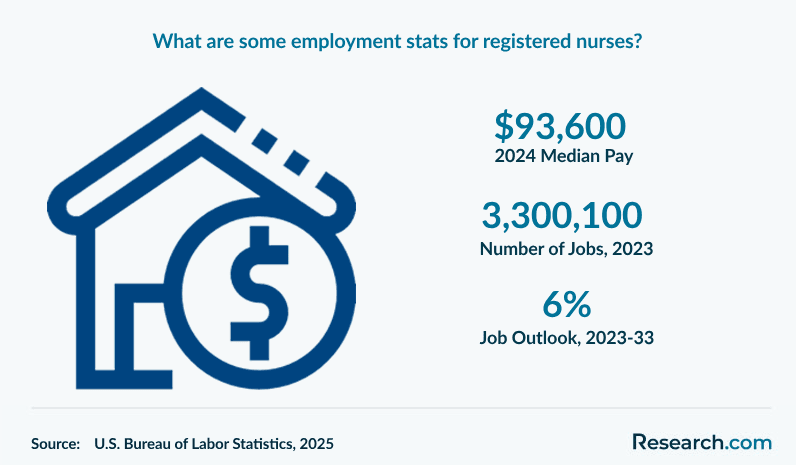
According to 2025 data from the U.S. Bureau of Labor Statistics, registered nurses earned median annual pay of $93,600 in 2024, equal to $45.00 per hour. The occupation had about 3,300,100 jobs in 2023. The 6% projected growth rate from 2023 to 2033 is expected to add around 197,200 jobs over the decade, as shown below.
For MSN public health nursing graduates, the strongest opportunities are likely to go to candidates who combine RN experience with population health analytics, program evaluation, grant awareness, leadership, health equity work, and practical field experience from a well-chosen practicum.
What are some current and future trends in public health nursing?
Public health nursing is changing as communities face more complex health risks, workforce constraints, data demands, and inequities. MSN programs that prepare nurses for these trends may offer stronger long-term value.
- Health equity and social determinants: Public health nurses are increasingly expected to address root causes of disparities, including access, housing, food security, transportation, and income.
- Data and technology: Big data, telehealth, surveillance tools, and geographic information systems are shaping how nurses identify risks and respond to population health problems.
- Climate-related health risks: Air quality, heat exposure, vector-borne disease, and disaster response are becoming more important in community health planning.
- Emergency preparedness: Public health nurses continue to play major roles in outbreak response, disaster planning, vaccination campaigns, and crisis communication.
- Mental and behavioral health: Population health initiatives increasingly integrate mental health, substance use, trauma-informed care, and community-based support.
- Chronic disease prevention: Programs addressing diabetes, heart disease, obesity, and other chronic conditions require prevention-focused nursing leadership.
- Policy and advocacy: Nurses are increasingly asked to translate frontline and community insights into policy recommendations and resource decisions.
- Interprofessional collaboration: Public health nurses often work with social workers, community health workers, epidemiologists, educators, emergency managers, and policy teams.
- Geriatric public health: Aging populations are increasing demand for programs that support healthy aging, chronic disease management, and age-friendly communities.
These trends are central to the broader question of whether a public health degree is worth it. For nurses, the answer depends on whether the program builds practical competencies that match the public health roles available in their region or target sector.
What graduates say about online MSN in Public Health Nursing programs
- Amy: "The accelerated schedule helped me move into community health leadership in 18 months. The practicum was the turning point because it gave me the confidence to apply what I was learning directly to real public health work."
- Matthew: "I kept working full time while completing the program online. Being able to study during evenings and weekends made graduate school possible without stepping away from my job or family responsibilities."
- Eunice: "My faculty brought real public health experience into the courses. I was using new ideas at work almost immediately, especially around community assessment and program planning."
Is accreditation essential for online MSN programs?
Yes. Accreditation is one of the most important quality checks for an online MSN program. It signals that the curriculum, faculty qualifications, learning outcomes, and practicum expectations have been reviewed against recognized standards. For nursing students, programmatic accreditation can affect employer acceptance, eligibility for financial aid, graduate transfer options, and preparation for advanced roles.
Before applying, confirm both institutional accreditation and nursing program accreditation. Do not rely only on marketing language such as “approved,” “recognized,” or “online-friendly.” If you are still building toward graduate nursing admission, you may also compare undergraduate bridge options such as the easiest online RN-to-BSN programs, but verify accreditation there as well.
How do online MSN programs support networking and career advancement?
Strong online MSN programs are not limited to recorded lectures. Many provide virtual discussion groups, faculty mentoring, online seminars, career services, resume support, interview preparation, and practicum-based networking with local healthcare or public health organizations. These connections can matter because many public health roles are built through community partnerships, agency relationships, and field experience.
When evaluating schools, ask how online students interact with faculty, alumni, preceptors, and employers. Also ask whether career support continues after graduation. Students who are changing into nursing from another field may want to compare earlier-stage options such as online accelerated BSN programs for non-nurses before deciding whether an MSN pathway is appropriate now.
Should I consider an online DNP instead of an MSN in Public Health Nursing?
An MSN is usually the more direct choice for nurses who want master’s-level leadership, public health nursing, population health, education, or program management roles. A DNP may be a better fit for nurses aiming for doctoral-level systems leadership, advanced evidence-based practice implementation, executive roles, or higher-level policy and quality improvement work.
The best choice depends on your timeline, budget, current credentials, and long-term goal. If you want the shortest path into public health nursing leadership, an MSN may be sufficient. If you want doctoral-level authority, broader systems influence, or a stronger capstone-based practice doctorate, compare MSN options with short online DNP programs before applying.
Key Insights
- The fastest options are not automatically the best. Herzing University lists an average timeline of 16 months, while Walden University and Worcester State University offer options as short as 18 months, but accreditation, practicum support, cost, and schedule fit matter just as much as speed.
- Practicum planning can make or break the experience. Even fully online MSN programs usually require in-person practicum hours, so ask early who finds the site, who approves the preceptor, and what happens if placements are limited in your area.
- Accreditation should be verified before applying. Look for recognized nursing accreditation such as CCNE or another accepted programmatic accreditor, and confirm that the exact track you want is covered.
- Public health nursing is broader than bedside advancement. Graduates may pursue population health, infection prevention, school health leadership, policy, program evaluation, disaster preparedness, and community health roles.
- Salary outcomes vary by role and employer. Advanced education and specialization can support higher earnings, but location, experience, funding, and leadership responsibility strongly influence pay.
- Market signals are mixed. Registered nursing is projected to grow 6% from 2023-2033, but licensed RN growth has outpaced employed RN growth from 2019 to 2024, so students should choose programs that build practical, differentiated skills.
- The strongest programs prepare nurses for current public health realities. Look for coursework in epidemiology, health equity, mental health, social determinants, informatics, emergency response, policy, and program evaluation.
References
- Castner J, Stanislo K, Castner M, Monsen KA. Public health nursing workforce and learning needs: A national sample survey analysis. Public Health Nurs. 2023 May-Jun;40(3):339-352.
- Centers for Disease Control and Prevention. (2024, April 23). Global immunization: Fast facts. U.S. Department of Health & Human Services. Centers for Disease Control and Prevention.
- Payscale. (2025). Master of Science in Nursing (MSN), Public Health Nursing salary. Payscale.
- U.S. Bureau of Labor Statistics. (2024, April 17). Registered nurses. In Occupational Outlook Handbook. U.S. Bureau of Labor Statistics. https://www.bls.gov/ooh/healthcare/registered-nurses.htm
- Yahoo Finance. (2024, May 1). ValiDate's insights report released on nursing shortage's impact on patient care. Yahoo Finance.
- ZipRecruiter. (2025). Public Health Nurse salary. ZipRecruiter.
Other Things You Should Know About the Fastest Online MSN in Public Health Nursing Programs
To enroll in the fastest online MSN in Public Health Nursing program in 2027, applicants typically need a BSN from an accredited institution, a valid RN license, and a minimum GPA set by the school. Some programs may also require relevant clinical experience and letters of recommendation.
It should hold CCNE or ACEN accreditation. These accreditors review faculty qualifications, curriculum, student support, and clinical preparation. Accreditation also matters for financial aid, state approval, and future certification or doctoral study.


