
2027 Fastest Online Women's Health Nurse Practitioner Graduate Certificate Programs

Co-Founder and Chief Data Scientist
Women’s health is a vital area of care that requires knowledgeable, compassionate providers who understand the unique health needs of women across their lifespan. Women’s Health Nurse Practitioners (WHNPs) play a critical role in delivering specialized care—from reproductive health to menopause management and beyond.
For nurses looking to expand their impact, online WHNP graduate certificate programs offer a flexible path to advanced practice, especially when time is a priority. Accelerated online options allow qualified nurses to fast-track their education without putting their careers on hold.
In this article, we’ll explore the fastest online WHNP certificate programs available, highlight what to expect, and help you find the best fit for your goals.
What are the benefits of obtaining a fast online women's health nurse practitioner graduate certificate?
Earning a fast online WHNP graduate certificate offers several advantages for registered nurses who want to specialize quickly and efficiently. These advantages range from personal and professional, to practical:
- Accelerated Timeline: Complete your certificate in as little as 12–18 months, allowing you to advance your career more quickly than with traditional programs.
- Flexible Learning: Online formats provide the freedom to study on your schedule—ideal for working nurses balancing jobs, family, and other responsibilities.
- Specialized Expertise: Gain in-depth knowledge in areas like reproductive health, prenatal and postnatal care, menopause, and preventive screenings tailored to women’s health.
- Career Growth: Position yourself for advanced roles in OB/GYN clinics, women’s health centers, and primary care practices, often with higher salaries and more autonomy.
- Nationwide Access: Attend top-tier programs without needing to relocate, giving you more options and saving on relocation and commuting costs.
- Cost-Effective Advancement: Many fast-track programs are more affordable due to shorter duration and fewer credit hours, helping you invest wisely in your future.
What can I expect from accelerated online graduate certificate in women's health nurse practitioner programs?
Accelerated online WHNP graduate certificate programs are designed for registered nurses who want to quickly specialize in women’s health while maintaining flexibility in their schedules. These programs combine intensive academic coursework with practical, real-world clinical training, all structured to be completed in a shorter timeframe—typically 12 to 18 months.
Here’s what you can generally expect:
- Focused Curriculum: Courses concentrate on key topics such as reproductive health, prenatal and postnatal care, gynecological conditions, family planning, and menopause management.
- Online Learning Format: Most or all coursework is delivered online, often asynchronously, so you can study at your own pace while balancing work and personal responsibilities.
- Clinical Practicum: Despite being online, you’ll complete hands-on clinical hours in your local area under the supervision of a licensed preceptor.
- Accelerated Timeline: The condensed nature of the program means more intensive learning, often requiring full-time commitment or strong time management for part-time students.
- Certification Preparation: Programs are structured to help you meet the eligibility requirements for the national Women’s Health Nurse Practitioner certification exam.
- Support Services: Many schools offer academic advising, technical assistance, and networking opportunities to help online students stay on track.
Overall, these programs are ideal for motivated nurses ready to advance their careers quickly and make a meaningful impact in women’s healthcare.
Where can I work with a women's health nurse practitioner graduate certificate?
Certified WHNPs are qualified to work in a wide range of healthcare settings focused on female patients across all stages of life. This specialization opens doors to both clinical and leadership roles in environments that prioritize reproductive, gynecological, and preventive care. Some of the most common workplaces include:
- OB/GYN Clinics: Provide prenatal, postnatal, and reproductive health care services in private practices or hospital-affiliated clinics.
- Women’s Health Centers: Offer comprehensive care focused on contraception, fertility counseling, menopause management, and wellness screenings.
- Hospitals and Birthing Centers: Support labor and delivery units or work in outpatient women’s services within larger medical facilities.
- Primary Care Settings: Deliver general health care with a women-centered focus, addressing issues like hypertension, diabetes, and mental health alongside reproductive concerns.
- Community Health Clinics: Serve diverse populations by offering accessible care, education, and preventative services tailored to women’s health needs.
- Telehealth Platforms: Work remotely to provide virtual consultations, follow-ups, and health education—especially beneficial in underserved or rural areas.
This certification not only broadens your career opportunities but also positions you to make a meaningful impact on women’s health and well-being in both clinical and community-based settings.
How much can I make with an online women's health nurse practitioner graduate certificate?
Earning a women’s health nurse practitioner (WHNP) graduate certificate can significantly boost your earning potential. While exact salaries vary based on location, experience, and employer type, WHNPs generally enjoy competitive pay thanks to their advanced clinical skills and specialized training.
- Average Salary: According to the U.S. Bureau of Labor Statistics (2024), nurse practitioners earn a median annual salary of $125,900, with WHNPs often earning within or slightly above that range depending on specialization.
- Top Earners: The highest-paid NPs—including those in women’s health—can make over $160,000 per year, especially in metropolitan areas or private practices.
- Additional Factors: Experience, certifications, and subspecialties (e.g., fertility or menopausal care) can lead to even higher earnings.
- Telehealth & Consulting: WHNPs also have opportunities to supplement income through remote care platforms, education, or consulting roles.
By completing your graduate certificate online, you not only increase your income potential but also save on commuting and housing costs, making it a financially smart option for career advancement.
- List of the Fastest Online Women's Health Nurse Practitioner Graduate Certificate Programs for 2027 List of Programs
- How long does it typically take to earn an online women's health nurse practitioner graduate certificate? Completion Time
- What are the prerequisites for enrolling in graduate certificate online women's health nurse practitioner programs? Requirements
- What is the average cost of online women's health nurse practitioner graduate certificate programs? Cost
- What are the financial aid options for students enrolling in online women's health nurse practitioner programs (graduate certificate)? Financial Aid
- What courses are typically included in online women's health nurse practitioner graduate certificate programs? Courses
- How can I choose the best accelerated online women's health nurse practitioner graduate certificate program? How can I choose the best accelerated online women's health nurse practitioner graduate certificate program?
- What are the differences between graduate certificate on-campus and online women's health nurse practitioner programs? Online vs. On-Campus
- What career paths are available for graduates of online women's health nurse practitioner programs (graduate certificate)? What career paths are available for graduates of online women's health nurse practitioner programs (graduate certificate)?
- What is the job outlook for nurses with an online women's health nurse practitioner graduate certificate? Job Outlook
- What challenges might I face in an online WHNP graduate certificate program? What challenges might I face in an online WHNP graduate certificate program?
- Should I complete an RN to BSN program before pursuing a WHNP graduate certificate? Should I complete an RN to BSN program before pursuing a WHNP graduate certificate?
- What are my next steps for career advancement after completing a WHNP graduate certificate? What are my next steps for career advancement after completing a WHNP graduate certificate?
Fastest Online Women’s Health Nurse Practitioner Graduate Certificate Programs for 2027
A women’s health nurse practitioner graduate certificate is designed for licensed nurses who already have graduate nursing preparation and want to move into advanced practice focused on reproductive, gynecologic, prenatal, postpartum, and preventive care. For many working nurses, the main decision is not whether women’s health matters; it is whether they can complete the credential quickly, affordably, and in a format that still meets certification and state licensure expectations.
This guide explains how accelerated online and hybrid WHNP certificate programs work, which programs on this list offer shorter completion timelines, what prerequisites to expect, how clinical hours are handled, and how to compare cost, accreditation, certification readiness, and career outcomes before enrolling. If you are comparing accelerated online credentials across fields, you may also find it useful to understand how program speed is evaluated in other rankings, such as fast online EdS in special education programs.
Quick answer: What is the fastest online WHNP graduate certificate?
The fastest online women’s health nurse practitioner graduate certificate programs on this list can be completed in about 1.5 years, 18 months, 20 months, or 3-4 semesters, depending on the school, your prior graduate coursework, whether you study full time or part time, and how quickly you complete required clinical hours. Most programs are not fully “online only” because WHNP preparation requires supervised clinical practice, and some programs also require campus visits or hybrid sessions.
| School | Program Format | Program Length | Credits Required | Clinical Hours | Best Fit |
| Vanderbilt University | Online/hybrid | 3-4 semesters | 40 | 630 hours | Nurses seeking a fast specialty pathway within MSN, certificate, MN prespecialty, or BSN-to-DNP options |
| Drexel University | Online with synchronous didactic classes and clinical component | 1.5 years | 37 | Not stated in source text | MSN-prepared nurses who want an online post-graduate WHNP certificate aligned with NCC certification eligibility |
| University of Missouri-Kansas City | Hybrid | 18 months to 2 years | 18 | Not stated in source text | Nurses who want a certificate that can transition into a DNP pathway |
| Kent State University | Fully online coursework | 20 months | 30 | 600 clinical practicum hours | Post-master’s nurses seeking Ohio licensure or certification preparation |
| Herzing University | 100% online coursework plus clinical practicum | 20 months | 39 | 630 clinical hours | Nurses who value a school-stated clinical placement pledge and possible DNP dual credit |
| University of Colorado Anschutz Medical Campus | Hybrid online | 1.5 years | 27 | 630 clinical hours | Nurses seeking a post-graduate certificate with NCC WHNP exam preparation |
How we rank schools
Research.com evaluates online graduate certificate options using institutional and program data from multiple sources, including the IPEDS database, Peterson's database and its Distance Learning Licensed Data Set, the College Scorecard database, and the National Center for Education Statistics. These sources help us compare program structure, distance learning availability, institutional information, and student-facing cost data where available.
Because an online women’s health nurse practitioner graduate certificate can require a substantial financial and clinical commitment, this ranking emphasizes information that helps applicants make practical comparisons rather than relying only on name recognition. The list focuses on online or hybrid graduate certificate programs that allow students to specialize in women’s health. You can read more about our ranking approach in the Research.com methodology section.
1. Vanderbilt University
Vanderbilt University offers a Women’s Health/Gender-Related Nurse Practitioner advanced practice specialty through an online/hybrid format. Most classes are delivered online, but students should plan for several in-person sessions during the program. The specialty prepares students to provide primary health care for females from puberty through the childbearing years and across adulthood.
The WHGRNP specialty is available through several routes, including the Master of Science in Nursing, Master of Nursing Prespecialty, Post-Master's Certificate, and BSN-to-DNP programs. Master of Nursing prespecialty students may complete the WHGRNP specialty in as few as 3 full-time semesters. Post-master’s certificate students may complete the specialty in as few as 4 semesters. The specialty includes 40 credits and 630 hours of clinical practice.
- Location: Nashville, TN
- Program Length: 3-4 semesters
- Credits Required: 40
- Cost: $2,057 per credit hour
- Accreditation: Southern Association of Colleges and Schools Commission on Colleges (SACSCOC); Commission on Collegiate Nursing Education (CCNE)
2. Drexel University
Drexel University offers an online Women’s Health/Gender Related Nurse Practitioner Post Graduate Certificate for nurses who already hold a master’s degree in nursing. The program focuses on advanced care for women and their partners across the lifespan, with particular attention to reproductive and gynecologic health needs.
The curriculum combines synchronous online didactic coursework with a required clinical component. Students learn to assess, diagnose, and manage women’s health promotion needs and health concerns. The program includes 37 credits and can be finished in approximately one and a half years of part-time study. Graduates are eligible for Women’s Health Nurse Practitioner Certification through the National Certification Corporation (NCC).
- Location: Philadelphia, PA
- Program Length: 1.5 years
- Credits Required: 37
- Cost: $1,169 per credit
- Accreditation: CCNE
3. University of Missouri-Kansas City
University of Missouri-Kansas City offers a women’s health nurse practitioner graduate certificate that can support a transition into the Doctor of Nursing Practice (DNP) program. The certificate prepares students for advanced practice nursing focused on gynecological, prenatal, and primary care for women.
The program uses a hybrid model. Most coursework can be completed online, but students must attend required on-campus visits. Courses follow a semester schedule, and students may take one or two classes each semester. The program can be completed in as few as 18 months.
- Location: Kansas City, MO
- Program Length: 18 months to 2 years
- Credits Required: 18
- Cost: $16,610
- Accreditation: Higher Learning Commission, CCNE
4. Kent State University
Kent State University offers a fully online post-master’s WHNP certificate with 600 clinical practicum hours. Students can choose part-time or full-time pacing, and the ability to accelerate depends on the course load they can manage. The program is designed to prepare students for applicable licensure or certification in Ohio.
- Location: Kent, OH
- Program Length: 20 months
- Credits Required: 30
- Cost: $536 per credit hour
- Accreditation: CCNE
5. Herzing University
Herzing University offers a post-master’s WHNP certificate for nurses who want to move into a new advanced practice specialty. The program includes 100% online coursework and an in-person clinical practicum experience. Students must complete 630 clinical hours, and the university states that it pledges clinical placement.
The curriculum is designed to help students prepare for the WHNP-BC exam from the National Certification Corporation. Students may also earn dual credit toward a DNP.
- Location: Birmingham, AL
- Program Length: 20 months
- Credits Required: 39
- Cost: $770 per credit
- Accreditation: CCNE; Higher Learning Commission
6. University of Colorado Anschutz Medical Campus
The University of Colorado Anschutz Medical Campus offers a post-graduate certificate in women’s health NP through a hybrid online format. Graduates can sit for the WHNP exam through the NCC to become board-certified. The program requires 13 credit hours of classroom learning, 14 clinical credits, and 630 clinical hours. Students can complete the program in 1.5 years.
- Location: Aurora, CO
- Program Length: 1.5 years
- Credits Required: 27
- Estimated Total Tuition: $20,025 (CO residents) | $32,450 (non-residents)
- Accreditation: CCNE
How long does it take to earn an online women’s health nurse practitioner graduate certificate?
Most online WHNP graduate certificate timelines depend on three variables: how many graduate credits the school requires, whether your prior MSN or DNP coursework satisfies prerequisite advanced practice courses, and how efficiently you can complete supervised clinical hours. Programs on this list range from 3-4 semesters to 20 months, with some schools describing completion timelines of 1.5 years or 18 months to 2 years.
Accelerated certificates are usually built for nurses who already have graduate nursing preparation. They are shorter than a full MSN or DNP because students are not starting from the beginning of graduate nursing education; instead, they are adding a women’s health population focus and completing the clinical requirements needed for certification eligibility.
| Timeline Factor | How It Can Affect Completion Speed | What to Ask Before Enrolling |
| Enrollment pace | Full-time study may shorten the calendar, while part-time study can make the program more manageable for working nurses. | How many courses must I take each term to finish on the advertised accelerated schedule? |
| Credit requirements | Programs with fewer required credits may be shorter, but only if your previous coursework satisfies all prerequisite expectations. | Will the school evaluate my transcript before admission or only after I enroll? |
| Clinical placement | Delays in securing a preceptor or approved site can extend your timeline even if online coursework is completed on time. | Does the school assign clinical placements, assist with placement, or require students to find their own preceptors? |
| Campus visits | Hybrid sessions or required intensives may affect work schedules, travel costs, and pacing. | How many campus visits are required, and when do they occur? |
| Prior APRN preparation | Some nurses may receive a more focused plan of study if they already completed advanced pathophysiology, advanced pharmacology, and advanced health assessment. | Which courses can be waived, transferred, or accepted as equivalent? |
If your main priority is speed, compare WHNP certificates the same way you would compare other accelerated graduate options: look beyond the advertised calendar length and verify clinical logistics, term structure, and workload. For perspective on how accelerated online programs are structured in another discipline, see Research.com’s guide to fast online master’s in engineering management programs.
What are the prerequisites for online women’s health nurse practitioner graduate certificate programs?
Online WHNP graduate certificates are generally not entry-level nursing programs. They are intended for nurses who already have advanced nursing education and are ready to add a women’s health population focus. Requirements vary by school, but applicants should expect the admissions process to confirm both academic readiness and clinical eligibility.
- Graduate nursing degree: Most programs require an MSN from an accredited institution. Some programs may also consider applicants who hold a Doctor of Nursing Practice (DNP).
- Active RN license: Applicants typically need a current, unencumbered registered nurse license in the state where they will complete clinical hours.
- Minimum GPA: Many schools expect a graduate GPA of 3.0 or higher, though some may review applicants below that level individually.
- Relevant nursing experience: Some programs prefer or require APRN experience or nursing experience connected to women’s health, OB/GYN, reproductive care, or primary care.
- Graduate advanced practice coursework: Schools may require advanced pathophysiology, advanced pharmacology, and advanced health assessment either before enrollment or as part of the certificate plan.
- Professional recommendations and resume: Applicants are commonly asked for 1–3 references and a resume or CV documenting nursing practice and leadership experience.
- Personal statement: Programs often request a short essay explaining why the applicant wants to specialize in women’s health and how the certificate fits their career goals.
Before applying, ask each school to review your prior graduate coursework and clarify whether you will need additional bridge courses. If you are still comparing nurse practitioner populations and want to understand which specialties may have more accessible admissions pathways, Research.com also covers nurse practitioner specialties that may be easier to get into.
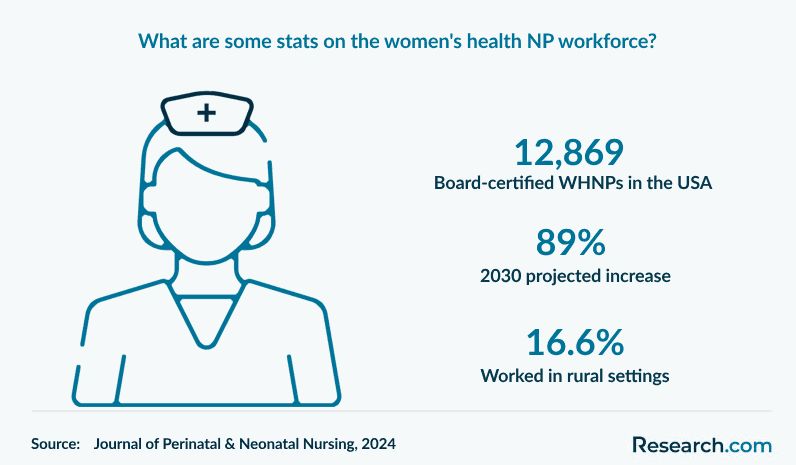
The graphic below notes that there are more than 12,000 board-certified WHNPs in the United States. It also shows how many work in rural settings and the projected increase for these professionals by 2030.
How much do online women’s health nurse practitioner graduate certificate programs cost?
Tuition for an online WHNP graduate certificate varies widely by institution, residency status, credit requirements, and whether the program is public or private. The programs listed here include per-credit rates such as $536 per credit hour, $770 per credit, $1,169 per credit, and $2,057 per credit hour, as well as total tuition figures such as $16,610 and estimated total tuition of $20,025 (CO residents) | $32,450 (non-residents).
Do not compare programs by tuition alone. A lower per-credit price can still become expensive if the certificate requires more credits, travel, background checks, technology fees, or unpaid time away from work for clinicals and campus visits.
| Cost Category | Why It Matters | Question to Ask the School |
| Per-credit tuition | This is the easiest figure to compare, but it does not show the full cost unless you multiply it by the required credits. | What is the total tuition for my specific plan of study? |
| Program fees | Online programs may charge technology, clinical, lab, simulation, or student service fees. | Which fees are mandatory, and are they charged each term? |
| Clinical costs | Students may need immunizations, background checks, drug screening, liability insurance, travel, and clinical site onboarding. | What expenses are students responsible for before beginning clinical rotations? |
| Campus visits | Hybrid programs can require travel, lodging, meals, and time away from work. | How many in-person sessions are required, and what dates should I reserve? |
| Time to completion | A faster program may reduce opportunity cost, but only if the workload is realistic. | Can working nurses complete the accelerated plan without reducing employment hours? |
If cost is your primary concern and you are open to other advanced practice populations, you may also want to compare affordable online pediatric nurse practitioner graduate certificate programs.
The chart below compares annual earnings for NPs, nurse anesthetists, and nurse midwives. Use it as one piece of your ROI analysis, but remember that salary outcomes depend on location, specialty, experience, employer, certification, and state practice authority.
What financial aid options are available for online WHNP graduate certificate students?
Financial aid for graduate certificates can be less straightforward than aid for full degree programs, so applicants should confirm eligibility with each school before assuming federal loans, scholarships, or employer reimbursement will apply. Start with the financial aid office and ask whether the certificate is aid-eligible under the school’s policies.
- Federal financial aid through FAFSA: Some accredited institutions allow students in eligible graduate certificate programs to use federal aid if the program meets required credit and duration rules. Eligibility is program-specific.
- Employer tuition reimbursement: Hospitals, clinics, and health systems may help pay for advanced nursing education when the credential supports staffing needs or role advancement.
- Nursing scholarships and grants: Organizations such as the American Association of Nurse Practitioners (AANP), Nurse Corps Scholarship Program, and HRSA’s Nurse Faculty Loan Program may offer funding or loan-related support for qualifying nurses, including some in women’s health pathways.
- School-based aid: Some universities offer scholarships, graduate awards, payment plans, or limited institutional aid for post-master’s certificate students.
- Military and veteran benefits: Active-duty service members, veterans, and eligible dependents may be able to use GI Bill, Tuition Assistance, or Yellow Ribbon Program benefits.
- Private loans: If federal aid is not available, private loans may help cover remaining costs, but borrowers should compare interest rates, repayment terms, and deferment options carefully.
When comparing costs, ask for a written estimate that includes tuition, fees, clinical expenses, and travel. This same cost-verification approach is useful for other online graduate credentials, including online specialist degree in special education programs.
What courses are included in an online women’s health nurse practitioner graduate certificate?
WHNP certificate curricula build on prior graduate nursing education and focus on advanced assessment, diagnosis, treatment, prevention, and patient education for women and gender-related health needs. Course names vary, but most programs combine didactic coursework with supervised clinical practice in settings such as OB/GYN clinics, women’s health centers, hospitals, or community health organizations.
| Common Course Area | What Students Learn | Why It Matters in WHNP Practice |
| Advanced women’s health assessment | Comprehensive histories, physical exams, screening, and diagnostic reasoning for women’s health concerns. | WHNPs must identify normal findings, risk factors, and conditions that require referral or treatment. |
| Reproductive health and prenatal care | Fertility, contraception, pregnancy management, prenatal screening, and patient counseling. | These topics are central to reproductive and obstetric care across many WHNP settings. |
| Gynecologic health and disease management | Diagnosis and management of common and complex gynecologic conditions. | Graduates need preparation for clinical decision-making in OB/GYN and women’s health clinics. |
| Primary care of women across the lifespan | Preventive care, chronic disease management, mental health considerations, and care from adolescence through post-menopause. | WHNPs often support both reproductive health and broader wellness needs. |
| Advanced pharmacology for women’s health | Medication selection, prescribing considerations, safety, contraindications, and patient education. | Safe prescribing is essential for advanced practice and certification readiness. |
| WHNP clinical practicum | Supervised hands-on care in approved clinical settings. | Clinical hours connect online coursework to real patient care and are required for practice preparation. |
Some programs may also include electives or focused content in areas such as menopause management, sexual health education, or forensic nursing. If you are still clarifying advanced practice terminology, Research.com’s guide to the difference between an advanced practice registered nurse and a nurse practitioner can help you understand how WHNP roles fit within APRN practice.
According to a 2022 survey by the American Association of Nurse Practitioners, the most common NP specialization is Family NP (70.3%). WHNPs did not appear in the top 5, which underscores why women’s health remains a distinct and important advanced practice pathway.
How should I choose the best accelerated online WHNP graduate certificate program?
The best accelerated WHNP certificate is not simply the shortest one. A program should be fast enough to fit your career timeline, but it also needs proper accreditation, certification alignment, clinical support, state authorization, and transparent costs. Use the checklist below before submitting applications.
| Selection Factor | What to Verify | Why It Can Change Your Decision |
| Accreditation | Confirm institutional accreditation and nursing program accreditation, such as CCNE where listed by the program. | Accreditation can affect certification eligibility, licensure review, transfer options, and employer recognition. |
| NCC certification readiness | Ask whether graduates meet educational eligibility expectations for the National Certification Corporation WHNP exam. | A certificate has limited value if it does not support your intended certification pathway. |
| State licensure compatibility | Confirm that the online or hybrid program is authorized for your state and supports APRN licensure where you plan to practice. | State boards of nursing may have different rules for out-of-state online programs and clinical placements. |
| Clinical placement model | Determine whether the school arranges placements, assists with preceptors, or expects students to secure sites independently. | Clinical placement problems are one of the most common reasons online NP students experience delays. |
| Program pace | Review the number of credits per term, synchronous class times, summer enrollment, and clinical hour expectations. | An accelerated plan may be unrealistic if it conflicts with work, family, or clinical site availability. |
| Total cost | Compare tuition, fees, travel, clinical requirements, and lost work time. | The cheapest per-credit rate is not always the lowest total cost. |
| Faculty and outcomes | Review faculty practice backgrounds and request certification-exam pass rates and placement information when available. | Strong faculty and transparent outcomes can signal better student support and certification preparation. |
| Online learning support | Look for advising, technical support, library access, virtual simulation resources, and career services for distance learners. | Online students need reliable support, especially in compressed or clinically intensive programs. |
If you are comparing WHNP certificates with broader nurse practitioner acceleration options, Research.com’s guide to accelerated online NP programs can help you evaluate pace, structure, and trade-offs across specialties.
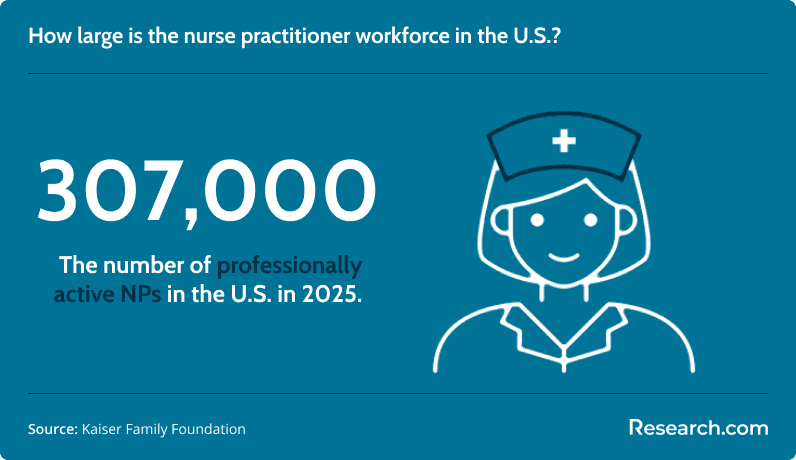
The image below shows the size of the nurse practitioner workforce in the United States. Demand exists across multiple practice settings, but graduates still benefit from choosing a program with strong preparation, credible accreditation, and appropriate clinical support.
Online vs. on-campus WHNP graduate certificates: What is the difference?
Online and on-campus WHNP graduate certificates can lead to similar certification goals, but the student experience can be very different. The right format depends on your schedule, location, learning style, clinical placement needs, and comfort with technology.
| Feature | Online or Hybrid WHNP Certificate | On-Campus WHNP Certificate |
| Flexibility | Often better for working nurses, especially when coursework is asynchronous or offered in a hybrid format. | More structured, with scheduled classes and in-person expectations. |
| Location | May allow students to enroll without relocating, subject to state authorization and clinical site approval. | Best for students who live near campus or can relocate. |
| Clinical placement | Clinical hours are completed in person, often near the student’s community if approved by the school. | Schools may use established local clinical partners near campus. |
| Learning environment | Uses online platforms, recorded or live lectures, virtual discussions, digital exams, and sometimes campus intensives. | Offers face-to-face interaction, campus labs, simulation spaces, and local peer networking. |
| Technology expectations | Requires reliable internet, comfort with learning management systems, and strong self-management. | Technology is still used, but students rely more on in-person instruction and campus resources. |
| Best for | Nurses who need geographic flexibility and can stay organized in a self-directed format. | Students who prefer routine, immediate in-person access to faculty, and campus-based learning. |
Many online nurse practitioner programs combine distance coursework with in-person clinical training. Before choosing either format, confirm whether the program meets certification and APRN licensure requirements in the state where you plan to practice.
What careers can graduates pursue with an online WHNP graduate certificate?
A WHNP graduate certificate prepares nurses for advanced roles focused on women’s health, reproductive care, preventive services, and patient education. Career options depend on certification, state scope-of-practice laws, employer requirements, and prior nursing experience. Graduates of online WHNP programs may work in clinical, community, educational, or telehealth settings.
| Career Path | Typical Responsibilities | Common Work Settings |
| Women’s Health Nurse Practitioner | Provide gynecologic exams, reproductive counseling, family planning, menopause care, health screenings, and preventive services. | Women’s health clinics, OB/GYN practices, primary care offices, community clinics |
| OB/GYN Clinic Practitioner | Manage women’s health concerns in collaboration with physicians or independently where state rules allow. | OB/GYN practices, outpatient specialty clinics, hospital-affiliated practices |
| Reproductive Health Specialist | Support contraception counseling, fertility education, sexual health care, and reproductive life planning. | Reproductive health centers, public health clinics, family planning organizations |
| Prenatal and Postpartum Care Provider | Help monitor pregnancy-related health, provide education, and support postpartum recovery and follow-up care. | Hospitals, birthing centers, OB practices, maternal health programs |
| Public and Community Health Nurse | Deliver screenings, prevention education, and access-focused women’s health services in underserved communities. | Community health centers, public health departments, nonprofit clinics |
| Telehealth WHNP | Provide virtual consultations, follow-up care, education, medication management where permitted, and remote patient support. | Telehealth platforms, health systems, university health services, rural access programs |
| Health Educator or Consultant | Use clinical expertise to develop programs, advise organizations, or educate patients and healthcare teams. | Nonprofits, government agencies, healthcare organizations, academic or training programs |
For nurses who want both direct patient care and advocacy, the WHNP role can be a focused way to serve patients across adolescence, reproductive years, pregnancy, postpartum transitions, and menopause.
What is the job outlook for nurses with an online WHNP graduate certificate?
The broader nurse practitioner labor market remains strong, and women’s health is a meaningful specialty because of ongoing needs in reproductive care, preventive care, prenatal and postpartum services, menopause management, and access in underserved or rural communities. However, employment outcomes are not guaranteed. Your prospects will depend on certification, state practice authority, clinical experience, local employer demand, and whether you can practice in the setting you prefer.
- Overall NP demand is strong: Nurse Practitioner roles are projected to grow by around 46% from 2023 to 2033, adding approximately 135,500 new positions every year.
- WHNPs support access to care: WHNPs can help address needs in OB/GYN, primary care, reproductive health, prenatal care, contraception counseling, and menopause management.
- Practice settings are expanding: WHNPs may work in OB/GYN clinics, women’s health centers, community health clinics, fertility or menopause clinics, university health services, and telehealth platforms.
- Salary varies by role and setting: The source material cites an average annual salary of $132,000 and a median annual salary of $129,000. around $126,000, with top earners over $169,000. Treat these figures as general context, not a promise of earnings.
Current trends that may affect WHNP careers include broader use of telehealth, greater attention to preventive care, ongoing discussion of nurse practitioner practice authority, and demand for clinicians who can serve patients in communities with limited OB/GYN access. Nurses who combine WHNP certification with strong clinical judgment, communication skills, and comfort with digital care tools may be better positioned for flexible or specialized roles.
The chart below shows industries that pay NPs and other advanced practice registered nurses the highest. Use this information to compare possible work settings, but also consider mission fit, patient population, schedule, benefits, and long-term advancement. If you are exploring leadership-oriented healthcare or organizational roles outside direct clinical practice, Research.com also reviews online bachelor’s in organizational leadership programs.
What online WHNP certificate graduates say about the experience
- : "Earning my WHNP certificate online while working full time and caring for my family required discipline, but the flexibility made it possible. The courses were demanding, and the support helped me keep moving forward. I now feel prepared to care for women at different stages of life. — Brenda"
- : "The online option gave me access to a women’s health program I could not find near home. I completed clinical hours locally and built stronger skills in reproductive health and preventive care. Preparing for national certification felt much more realistic because the program connected theory to practice. — Joie"
- : "Online study let me manage my schedule while still interacting with classmates and faculty through virtual discussions and live sessions. I developed more confidence in prenatal and gynecologic care, and the certificate helped open career options I had not considered before. — Lindsey"
What challenges should I expect in an online WHNP graduate certificate?
Online WHNP certificates can be convenient, but they are not easy. Students must manage graduate-level coursework, clinical documentation, preceptor communication, technology requirements, and certification preparation while often continuing to work as nurses.
| Common Challenge | Why It Happens | How to Reduce the Risk |
| Clinical placement delays | Approved preceptors and women’s health sites may be limited in some regions. | Ask about placement support before enrolling and begin planning early. |
| Heavy time demands | Accelerated courses and clinical hours can overlap with work schedules. | Create a term-by-term calendar and discuss schedule flexibility with your employer. |
| State authorization issues | Not every online program can accept students or approve clinicals in every state. | Confirm written state eligibility with the school and your board of nursing. |
| Technology problems | Online coursework depends on reliable platforms, video access, and digital testing tools. | Check system requirements and use school tech support early. |
| Self-directed learning | Online programs require students to track deadlines and ask for help proactively. | Use advising, faculty office hours, peer groups, and structured weekly study blocks. |
If you are still building toward graduate-level nursing study, it may help to compare earlier nursing pathways such as accelerated online BSN programs before committing to an advanced certificate.
Do I need an RN to BSN before pursuing a WHNP graduate certificate?
If you do not yet have a Bachelor of Science in Nursing, you may need to complete additional undergraduate nursing education before becoming eligible for graduate nursing study and, eventually, a WHNP certificate. Many WHNP certificates are post-master’s programs, which means the usual pathway includes RN preparation, a BSN or bridge option, graduate nursing education, and then specialty certificate coursework.
An RN to BSN program can strengthen academic preparation, broaden clinical and leadership knowledge, and help satisfy admission expectations for future graduate nursing programs. Nurses looking for an efficient bridge can compare online RN to BSN programs as an early step toward advanced practice.
What should I do after completing a WHNP graduate certificate?
After finishing a WHNP graduate certificate, your next steps should focus on certification, licensure, employment strategy, and long-term advancement. Completing coursework is only one part of becoming practice-ready.
- Confirm certification eligibility: Verify that your transcript and clinical documentation meet the requirements for the WHNP certification exam through the National Certification Corporation.
- Apply for state APRN licensure: Follow your board of nursing’s process for licensure, prescriptive authority if applicable, and any state-specific documentation.
- Prepare a women’s health-focused resume: Highlight clinical rotations, patient populations, procedures, health education experience, and prior nursing roles.
- Target the right employers: Consider OB/GYN practices, women’s health centers, community clinics, university health services, telehealth organizations, and public health settings.
- Plan continuing education: Stay current on reproductive health, preventive screening, menopause care, maternal health, contraception, and state practice rules.
- Consider a DNP if it fits your goals: A DNP may support leadership, evidence-based practice, clinical education, or systems-level roles. Research.com’s guide to short online DNP programs can help you compare options.
Common mistakes to avoid when choosing an online WHNP certificate
- Choosing only by speed: A shorter program is not better if clinical placement is weak or state licensure alignment is unclear.
- Ignoring accreditation: Confirm institutional and nursing accreditation before applying.
- Assuming online means no campus travel: Many WHNP programs are hybrid or require in-person sessions.
- Underestimating clinical hours: Clinical placements require scheduling, documentation, site approval, and preceptor availability.
- Comparing only tuition: Fees, travel, clinical onboarding costs, and lost work time can change the real price.
- Assuming certification guarantees employment: Certification can qualify you for roles, but hiring depends on employer needs, local demand, experience, and state rules.
- Failing to check state authorization: Always verify that the program can enroll students and approve clinicals in your state.
Questions to ask before applying
- Is the WHNP certificate accredited and aligned with NCC certification eligibility?
- Can the program legally enroll students from my state?
- Will the program meet APRN licensure requirements where I plan to practice?
- How many clinical hours are required, and who is responsible for finding preceptors?
- How many campus visits or intensives are required?
- What is the full cost, including tuition, fees, travel, and clinical expenses?
- Can my prior graduate coursework reduce the number of required credits?
- What are recent certification pass rates and graduate employment outcomes?
- How accessible are faculty, advisors, and technical support for online students?
- Can I complete the accelerated track while working, or should I choose part-time pacing?
References
- American Association of Nurse Practitioners. (2025, May 2). What Nurse Practitioner Students Need to Know About Certification. AANP.
- Centers for Disease Control and Prevention, National Center for Health Statistics. (2025, June 26). Women's Health Fast Stats. CDC NCHS.
- Connors, M. (2023, November 22). A Guide to the Top Nurse Practitioner Specialties and NP Types. Barton Associates.
- Gunja, M., et al. (2024, June 4). Insights into the U.S. Maternal Mortality Crisis: An International Comparison. The Commonwealth Fund.
- Haynes, C. (2025, March 18). Press Release: NPWH Celebrates Nurse Practitioners as the No. 1 Job of 2025. The National Association of Nurse Practitioners in Women's Health.
- Hoyert, D. (2024). Health E-Stat 100: Maternal Mortality Rates in the United States, 2023. National Center for Health Statistics.
- United States Bureau of Labor Statistics. (2025, July 24). Occupational Employment and Wage Statistics Query System. BLS.
- United States Bureau of Labor Statistics. (2023, April 25). Occupational Employment and Wage Statistics | 29-1171 Nurse Practitioners. BLS.
- United States Bureau of Labor Statistics. (2025, April 18). Occupational Outlook Handbook | Nurse Anesthetists, Nurse Midwives, and Nurse Practitioners. BLS.
Key Insights
- The fastest online or hybrid WHNP graduate certificates on this list can be completed in 3-4 semesters, 1.5 years, 18 months to 2 years, or 20 months, but clinical placement can affect the real timeline.
- A WHNP certificate is usually best for MSN- or DNP-prepared nurses who want to add a women’s health advanced practice specialty rather than complete another full degree.
- Accreditation, NCC certification eligibility, state authorization, and clinical placement support are more important than speed alone.
- Total cost should include tuition, fees, clinical expenses, campus travel, and potential work schedule changes, not just the advertised per-credit rate.
- Online WHNP programs still require in-person clinical training; “online” mainly describes didactic coursework, not the full learning experience.
- WHNP graduates may pursue roles in OB/GYN clinics, women’s health centers, community health, reproductive health, prenatal and postpartum care, telehealth, and education or consulting.
- Before enrolling, get written answers about licensure compatibility, clinical placement responsibility, total program cost, and whether your prior graduate coursework can shorten your plan of study.
Other Things You Should Know About the Fastest Online Women’s Health Nurse Practitioner Graduate Certificate Programs
Most fast-track online WHNP graduate certificate programs require 500 to 600 supervised clinical hours focused on women’s health across reproductive, prenatal, and primary care settings. Students usually complete placements with approved preceptors, and schools must verify hours before issuing the certificate.
Students need reliable internet, a computer with updated software, and possibly specific platforms like Zoom or Blackboard. Each program may have unique technological prerequisites, so checking individual requirements is crucial for successful participation in 2027.


