2027 Top Online PMHNP Programs with Best Clinical Placement Rates

Co-Founder and Chief Data Scientist
Over the past decade, nearly 100 new PMHNP tracks have been added across the country. This explosion of options makes it incredibly difficult for dedicated nurses to identify which programs truly prepare them for practice. The single most important factor in a successful education is the quality of your clinical training. Choosing the right program means finding one that guarantees high-quality, relevant clinical placements, removing the biggest source of stress for students.
To help you make a confident decision, our career planning experts, with over 10 years of experience, have created this guide. We'll show you how to evaluate programs and identify the best online PMHNP program with best clinical placement rates to launch your career.
What are the benefits of getting an online PMHNP program with the best clinical placement rates?
- You will be prepared for high-impact roles in diverse settings like hospitals, private practices, and telepsychiatry, addressing the nation's critical need for mental health providers.
- The average salary for a Psychiatric Mental Health Nurse Practitioner is approximately $139,500, ensuring a powerful return on your educational investment.
- An online PMHNP program with the best clinical placement rates provides the flexibility to manage your current work and life commitments while guaranteeing the high-quality clinical training essential for your future competence.
What can I expect from an online PMHNP program with strong clinical placement rates?
You can expect a highly structured and supportive educational partnership. The best online PMHNP programs combine a rigorous, specialized curriculum with a fully managed clinical training experience.
The academic coursework is delivered with the flexibility you need as a working professional. You will engage with expert faculty and a cohort of motivated peers through sophisticated online learning platforms. This is where you will build a deep knowledge base in areas like advanced psychopharmacology and diagnostic reasoning.
The defining feature, however, is the clinical placement support. Instead of you spending hundreds of hours searching for preceptors, a dedicated university team handles everything. They find, vet, and secure high-quality clinical sites and preceptors for you. This model ensures your training is top-tier and allows you to focus completely on developing your skills as a future provider.
Where can I work with an online PMHNP program with the best clinical placement rates?
As a PMHNP, you can work in a wide variety of settings. While nearly 60% of graduates work in traditional healthcare environments, your degree also opens doors to roles in non-profits, government, and private enterprise.
Here are some of the most common career paths:
- Hospitals and Inpatient Facilities: You can provide essential care in acute psychiatric units or offer your expertise as part of a consultation-liaison service.
- Community Mental Health Centers: This path allows you to serve diverse populations in outpatient settings, often making a critical impact in underserved areas.
- Private Practice and Specialty Clinics: You might join a group practice or a specialized clinic focusing on high-need areas like addiction or child psychiatry.
- Telepsychiatry Platforms: This modern approach offers the flexibility to deliver virtual mental healthcare, expanding your reach to patients regardless of their location.
- Government and VA Facilities: You can build a rewarding career serving veterans and other specific populations within large, integrated healthcare systems.
How much can I make with an online PMHNP program with strong clinical placement rates?
The average salary for a PMHNP is around $139,500, but your earning potential can be much higher. Several factors influence your income:
- Geographic Location: Salaries vary significantly by state and demand, with top-paying regions like Idaho offering salaries that can exceed $205,000.
- Practice Setting: Working in specialized facilities, such as residential mental health and substance abuse centers, can command higher pay, averaging around $164,290.
- Years of Experience: Your earnings will grow as you gain expertise, with senior-level PMHNPs earning significantly more than entry-level practitioners.
- Scope of Practice: Practicing in one of the 27 states with Full Practice Authority can increase your professional autonomy and earning potential.
- Further Education: Earning a Doctor of Nursing Practice (DNP) can open doors to leadership roles and salaries in the $140,000 to $150,000 range.
- List of the Top Online PMHNP Programs with Best Clinical Placement Rates for 2027 List of Programs
- How long does it take to complete an online PMHNP program with the best clinical placement rates? Completion Time
- How does an online PMHNP program with strong clinical placement rates compare to an on-campus program? How does an online PMHNP program with strong clinical placement rates compare to an on-campus program?
- What is the average cost of an online PMHNP program with the best clinical placement rates? Program Cost
- What are the financial aid options for students enrolling in an online PMHNP program with the best clinical placement rates? Financial Aid
- What are the prerequisites for enrolling in an online PMHNP program with the best clinical placement rates? What are the prerequisites for enrolling in an online PMHNP program with the best clinical placement rates?
- What courses are typically in an online PMHNP program with the best clinical placement rates? What courses are typically in an online PMHNP program with the best clinical placement rates?
- What types of specializations are available in online PMHNP programs with the best clinical placement rates? Specializations
- How to Choose the Best Online PMHNP Program with Strong Clinical Placement Rates How to Choose the Best Online PMHNP Program with Strong Clinical Placement Rates
- What career paths are available for graduates of online PMHNP programs with the best clinical placement rates? Career Paths
- What is the job market for graduates of online PMHNP programs with strong clinical placement rates? Job Market
Best Online PMHNP Programs with Strong Clinical Placement Rates for 2027
Choosing an online psychiatric-mental health nurse practitioner program is not only about finding flexible classes. For PMHNP students, clinical placement support can determine whether you graduate on time, qualify for certification, and enter practice with enough supervised experience to feel prepared. This guide is for registered nurses comparing online or hybrid PMHNP programs and trying to understand which schools provide strong placement support, how much the degree may cost, how long it can take, and whether the career path fits their goals.
You will find a ranked list of online PMHNP programs with high clinical placement rates, along with practical guidance on admissions, coursework, cost, financial aid, online versus campus formats, specialization options, career outcomes, and questions to ask before enrolling.
Quick answer: What should you look for in an online PMHNP program?
The best online PMHNP program is accredited, prepares students for national board certification, offers transparent clinical placement support, fits your state licensure requirements, and has tuition you can realistically manage. Clinical placement rates matter because PMHNP students must complete supervised practice experiences; if a school expects you to find preceptors alone, delays can affect graduation timelines and certification readiness.
How Research.com ranks schools
Because a PMHNP degree requires a major financial and professional commitment, our ranking process emphasizes transparent, decision-useful information. Research.com reviews available data from sources including the IPEDS database, Peterson's database, the College Scorecard database, and The National Center for Education Statistics.
These sources help establish a consistent data foundation for evaluating nursing programs, institutional characteristics, and student outcomes. You can read more about Research.com’s ranking approach on the methodology page.
Top online PMHNP programs with strong clinical placement rates
| Rank | School and program | Clinical placement rate | Program length | Credits or units | Tuition or cost | Accreditation |
| 1 | University of Iowa — DNP Psychiatric Mental Health Nurse Practitioner. This hybrid doctoral program is designed for nurses preparing for advanced psychiatric-mental health practice, with clinical experiences arranged through the college and small class sizes that support close faculty attention. | 99% | 3-4 years | 73 semester hours | $89,566 (resident); $164,332 (non-resident) | Commission on Collegiate Nursing Education (CCNE) |
| 2 | Kent State University — MSN Psychiatric Mental Health Nurse Practitioner. This fully online program prepares nurses to provide psychiatric care across the lifespan, with faculty mentorship and coursework in assessment, medication management, and therapeutic approaches. | 99% | 2 years (full-time) | 34 | $612.62 (resident); $622.62 (non-resident) per credit | Commission on Collegiate Nursing Education (CCNE) |
| 3 | University of Pennsylvania — MSN Psychiatric Mental Health Nurse Practitioner. Penn’s program combines neuroscience, psychotherapy, and psychopharmacology, while arranging clinical placements through its healthcare network. | 98% | 3 years (part-time) | 14 course units | $103,526 | Commission on Collegiate Nursing Education (CCNE) |
| 4 | Duke University — MSN Psychiatric Mental Health Nurse Practitioner. Duke uses a hybrid model and national clinical network to prepare students for advanced psychiatric practice through training in psychopharmacology and psychotherapy. | 96% | ~2 years | 49 | $110,250 | Commission on Collegiate Nursing Education (CCNE) |
| 5 | Regis College — MSN Psychiatric Mental Health Nurse Practitioner Online. Regis offers synchronous online learning for working nurses and uses a scholar-practitioner model focused on psychiatric assessment, diagnosis, and treatment. | 96% | ~2 years | 51 | $65,025 | Accreditation Commission for Education in Nursing (ACEN) |
| 6 | Johns Hopkins University — DNP Psychiatric Mental Health Nurse Practitioner. This doctoral program prepares advanced practice nurses to deliver holistic mental health care and lead through evidence-based practice and advocacy. | 95% | 3 years | 76 | $156,332 | Commission on Collegiate Nursing Education (CCNE) |
| 7 | University of Washington — DNP Psychiatric Mental Health Nurse Practitioner Lifespan. UW’s research-informed program pre-arranges clinical placements within its network so students can focus on clinical development and evidence-based psychiatric care. | 93% | ~2 years (9 quarters) | 93 quarter credits | $98,766 | Commission on Collegiate Nursing Education (CCNE) |
| 8 | Vanderbilt University — DNP Psychiatric Mental Health Nurse Practitioner. Vanderbilt combines online coursework, intensive campus blocks, and school-arranged clinical experiences in a program that integrates biological and psychosocial mental healthcare. | 92% | ~2 years (4 full-time semesters) | 36 | $74,052 | Commission on Collegiate Nursing Education (CCNE) |
How Long Does an Online PMHNP Program Take?
Most online PMHNP programs take about two to three years, although the timeline depends on whether you study full time or part time, whether you enter an MSN or DNP pathway, and how quickly clinical placements are completed. Working nurses often choose part-time study to keep earning income, while full-time students may finish sooner if their work and family responsibilities allow it.
PMHNP programs cannot usually be compressed in the same way as some non-clinical healthcare programs because students must complete advanced nursing coursework and supervised psychiatric clinical hours. That makes the timeline different from some of the shortest HIM online degree programs, where clinical placement is not typically the central driver of completion time.
Programs are also built around certification preparation. Reported pass-rate benchmarks include ANCC (83%) and AANPCB (82%) certification exams, and students should ask each school for its most recent first-time pass rates before enrolling.
Typical PMHNP timeline
| Stage | What happens | Why it matters |
| Before admission | Complete a BSN, maintain RN licensure, build clinical experience, and prepare application materials. | A stronger clinical background can make your application more competitive and help you handle advanced assessment coursework. |
| Year 1 | Complete foundational graduate courses such as advanced pathophysiology, assessment, pharmacology, and psychiatric theory. | These courses prepare you for safe diagnostic reasoning and medication-related decision-making. |
| Middle to final terms | Begin supervised psychiatric clinical rotations while continuing specialty coursework. | Clinical placement quality affects the patient populations, settings, and mentoring you receive. |
| Final term and after graduation | Finish required clinical hours, graduate, prepare for board certification, and complete state-level practice requirements. | Certification and state authorization are essential before practicing as a PMHNP. |
Online PMHNP Programs vs. On-Campus Programs: Which Format Makes Sense?
Online and on-campus PMHNP programs should meet the same academic, accreditation, and certification-preparation standards. The better choice depends on your schedule, learning preferences, location, and clinical placement needs. Similar to how students ask whether a graphic design degree is worth it by comparing cost, outcomes, and career fit, nurses should evaluate PMHNP programs by weighing flexibility, support, clinical access, and long-term return.
Online PMHNP programs
Online PMHNP programs are usually best for licensed nurses who need to continue working, avoid relocation, or attend a school outside their immediate area. The strongest programs provide structured clinical placement assistance, scheduled faculty access, simulation or intensive experiences when needed, and clear state authorization information.
- Best for: Working RNs, students outside major academic medical centers, and nurses who need schedule flexibility.
- Main advantage: You can often complete didactic coursework without moving or leaving your current job.
- Main risk: Some programs may expect students to identify preceptors, so placement support must be verified before enrollment.
On-campus PMHNP programs
Campus-based programs may appeal to students who prefer in-person class meetings, immediate access to simulation labs, and frequent face-to-face interaction with faculty and peers. The trade-off is less scheduling flexibility and, in many cases, the need to live near campus.
- Best for: Students who learn best in person, can attend fixed class times, or want daily access to campus resources.
- Main advantage: Direct contact with faculty, classmates, libraries, labs, and campus support services.
- Main risk: The schedule may be difficult for nurses balancing shifts, family care, or long commutes.
| Decision factor | Online PMHNP | On-campus PMHNP |
| Flexibility | Generally stronger for working nurses | Usually more fixed and location-dependent |
| Clinical placement | Varies widely; ask whether placements are arranged, vetted, or guaranteed | May use local health system partnerships, but support still varies |
| Networking | Requires intentional participation in virtual meetings, intensives, and professional groups | More built-in peer and faculty interaction |
| Relocation | Often not required, depending on state authorization and campus visit requirements | Often required if you do not live nearby |
| Best fit | Nurses who need access without leaving employment or moving | Students who want a traditional academic environment |
How Much Does an Online PMHNP Program Cost?
The average total tuition for a standard PMHNP program is approximately $101,300. Treat that figure as a planning estimate, not a complete cost of attendance. Tuition is only one part of the budget; students may also pay university fees, clinical-related costs, books, technology expenses, campus immersion travel, background checks, certification preparation, and licensing-related expenses.
Cost should be evaluated alongside career goals and likely practice settings. Students weighing the question of whether a PsyD degree is worth it face a similar issue: the sticker price matters, but so do credential requirements, income potential, time out of the workforce, debt burden, and the type of work the degree makes possible.
Salary potential can increase as PMHNPs gain experience, build specialized skills, and move into higher-responsibility roles, but earnings are not guaranteed. Location, employer type, scope-of-practice rules, clinical experience, and negotiation all affect compensation.
The chart below illustrates how earnings can change as PMHNPs move through different career stages.
Financial Aid Options for Online PMHNP Students
PMHNP students should start financial planning before submitting applications. A high clinical placement rate is valuable, but it does not automatically make a program affordable. Compare total cost, aid eligibility, repayment obligations, and whether you can keep working while enrolled.
- Federal student aid: Completing the Free Application for Federal Student Aid (FAFSA) is typically the first step for accessing federal loans and any applicable federal aid.
- School-based scholarships: Graduate nursing departments and university financial aid offices may offer scholarships or grants for advanced practice nursing students.
- Professional association awards: Organizations such as the American Association of Nurse Practitioners (AANP) may provide scholarship awards, often ranging from $2,500 to $5,000.
- Employer tuition assistance: Hospitals, clinics, and health systems may help pay for graduate nursing education if the degree supports workforce needs.
- Loan repayment programs: Nurses who work in shortage areas or qualifying facilities may be able to pursue options such as the Nurse Corps Loan Repayment Program.
Questions to ask about cost before enrolling
- Is the quoted tuition the total program cost or only the per-credit tuition?
- Are campus visits, intensives, or travel required?
- Does the school charge separate clinical placement, technology, or program fees?
- Can I study part time while keeping my current RN job?
- What percentage of graduate nursing students receive institutional scholarships?
- What happens financially if a clinical placement delay extends my enrollment?
Admission Requirements for Online PMHNP Programs
Most PMHNP admissions committees look for applicants who have both academic readiness and patient-care experience. If you are asking whether a master’s degree is worth it, PMHNP admissions should be viewed through a professional-practice lens: the degree is tied to advanced clinical responsibilities, certification preparation, and state practice authority.
- Nursing degree: A Bachelor of Science in Nursing (BSN) from an accredited school is the typical entry requirement.
- RN license: Applicants generally need an active, unencumbered registered nurse license in the United States.
- Academic record: Many programs expect a minimum cumulative undergraduate GPA of 3.0 on a 4.0 scale.
- Clinical experience: Competitive applicants often have one to two years of full-time RN experience.
- Application file: Schools commonly request a resume, recommendation letters, a personal statement, transcripts, and an interview.
PMHNP admissions can be more clinically demanding than some of the easiest MSN programs to get into. Experience in settings such as Med-Surg, ICU, emergency care, behavioral health, or community health can strengthen assessment skills and show readiness for complex patient presentations.
Courses Commonly Found in Online PMHNP Programs
PMHNP coursework prepares registered nurses to assess, diagnose, and manage psychiatric conditions using advanced nursing, medical, and therapeutic knowledge. Like students considering whether an MFA degree in creative writing is worth it, PMHNP applicants should look beyond course titles and ask how each class supports a specific professional outcome.
- Advanced Pathophysiology: Covers the biological and physiological mechanisms of disease across the lifespan, helping students connect physical health and psychiatric symptoms.
- Advanced Health Assessment: Builds skills in comprehensive physical, psychosocial, and psychiatric assessment.
- Advanced Psychopharmacology: Focuses on psychiatric medications, safe prescribing principles, monitoring, and medication-related clinical decision-making. This is especially important because 76% of psychiatric nurses prescribe medication.
- Diagnostic Reasoning and Management: Teaches differential diagnosis, care planning, risk assessment, and evidence-based treatment selection.
- Psychotherapeutic Modalities: Introduces therapy approaches and how they may be integrated with medication management and ongoing psychiatric care.
PMHNP training differs from the shortest clinical mental health counseling master's programs online because PMHNPs are trained within advanced nursing practice and may have prescriptive responsibilities depending on state law. The curriculum also prepares students for the 175-question ANCC board certification exam.
PMHNP Specializations and Practice Focus Areas
PMHNP is already a specialty within advanced practice nursing, but students can often shape their clinical experience around specific populations, settings, or psychiatric needs. The right focus depends on your prior RN background, local workforce needs, and the patients you want to serve.
- Lifespan practice: PMHNP preparation supports care for patients across age groups, giving graduates flexibility in employment settings.
- Child and adolescent mental health: This focus develops experience with youth psychiatric conditions, family systems, schools, and developmental considerations.
- Substance use and addictions: Students may pursue clinical experiences involving substance use disorders, co-occurring diagnoses, and recovery-oriented care.
- Geriatric psychiatry: This path emphasizes older adults, cognitive changes, polypharmacy concerns, grief, isolation, and complex medical comorbidities.
- Forensic psychiatry: PMHNPs interested in the legal system may seek roles in correctional health, court-related clinics, or forensic treatment settings.
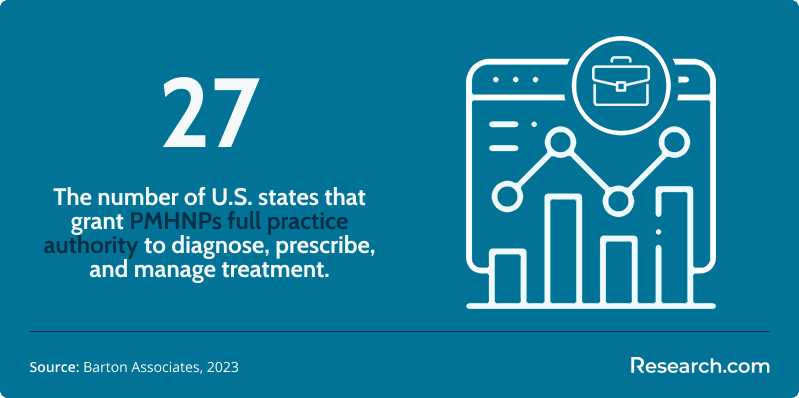
This type of clinical pathway is different from the shortest accredited online school psychology programs, which are centered on educational systems rather than medical psychiatric practice. Location also affects specialization and autonomy: practicing in one of 27 Full Practice Authority states can allow more independent decision-making and may support private practice opportunities.
How to Choose an Online PMHNP Program with Strong Clinical Placement Support
A high placement rate is useful, but it should not be the only deciding factor. The right program must be accredited, authorized for your state, financially realistic, and aligned with the type of psychiatric practice you want after graduation.
- Verify accreditation first: Look for programmatic accreditation from the Commission on Collegiate Nursing Education (CCNE) or the Accreditation Commission for Education in Nursing (ACEN). Accreditation can affect certification eligibility, financial aid, and employer recognition.
- Ask exactly how clinical placement works: Do not accept vague language such as “placement support available.” Ask whether the school identifies sites, contracts with preceptors, verifies credentials, and provides backup options if a site falls through.
- Review board certification outcomes: Ask for current first-time pass rates and compare them with the national benchmark of around 83%.
- Calculate the full cost: Include tuition, fees, travel, books, technology, certification preparation, and potential lost income if you reduce work hours.
- Evaluate faculty and advising: Look for instructors with psychiatric practice experience and confirm that students receive academic advising, clinical coordination, and career support.
- Check state authorization and licensure fit: Online enrollment does not automatically mean the program meets requirements in every state. Confirm that the school can enroll students from your state and that the curriculum supports your licensing pathway.
Common mistakes to avoid
| Mistake | Why it can hurt you | Better approach |
| Choosing a program based only on tuition | A cheaper program may cost more if clinical delays extend graduation. | Compare total cost, placement support, certification outcomes, and schedule flexibility together. |
| Assuming “online” means available in every state | State authorization and licensure requirements can limit enrollment or post-graduation eligibility. | Ask the school to confirm eligibility for your state in writing. |
| Ignoring clinical placement details | Finding your own psychiatric preceptor can be difficult in competitive markets. | Ask who is responsible for locating, approving, and replacing clinical sites. |
| Relying only on rankings | A highly ranked school may not be the best fit for your budget, state, schedule, or specialty goals. | Use rankings as a starting point, then verify fit with admissions, financial aid, and clinical coordinators. |
| Assuming salary outcomes are guaranteed | Pay depends on experience, geography, employer, practice authority, and role. | Research local job postings and talk with PMHNPs in your target setting. |
Career Paths for Online PMHNP Graduates
An online PMHNP degree can lead to direct patient care and, with experience, roles in leadership, education, research, and policy. Your actual opportunities depend on certification, state scope-of-practice rules, prior RN experience, clinical placements, and local employer demand.
| Career path | What the role involves | Median salary |
| Clinical Practitioner | Diagnoses, treats, and manages mental health conditions in settings such as outpatient clinics, hospitals, community health centers, and private practices. Treatment may include medication management, therapy-informed care, and ongoing patient monitoring. | $139,500 per year |
| Healthcare Administrator | Oversees behavioral health programs, service lines, budgets, staffing, compliance, and quality improvement initiatives within healthcare organizations. | $104,800 per year |
| Nurse Educator | Teaches psychiatric nursing students, develops coursework, mentors future clinicians, and may supervise clinical learning experiences. | $78,500 per year |
| Research Scientist | Studies psychiatric care models, treatment outcomes, clinical interventions, or mental health systems to strengthen evidence-based practice. | $99,900 per year |
| Policy Advocate | Works with healthcare organizations, professional associations, or government agencies to improve access, reimbursement, workforce policy, and mental health care delivery. | $128,000 per year |
Leadership, academic, and policy roles may become more accessible with doctoral preparation. A doctor of nursing practice is a common route for nurses seeking higher-level clinical leadership. There are now over 439 DNP programs available, including online DNP programs without clinicals for nurses whose goals are more focused on leadership than additional advanced-practice clinical training.
Job Market Outlook for PMHNP Graduates
The PMHNP job market is supported by a broad need for mental health services and a shortage of psychiatric providers. Reported data shows approximately 38,599 open positions for only about 35,000 practicing PMHNPs in the country. That imbalance can create strong demand for qualified graduates, although individual job outcomes still depend on certification, state regulations, experience, and location.
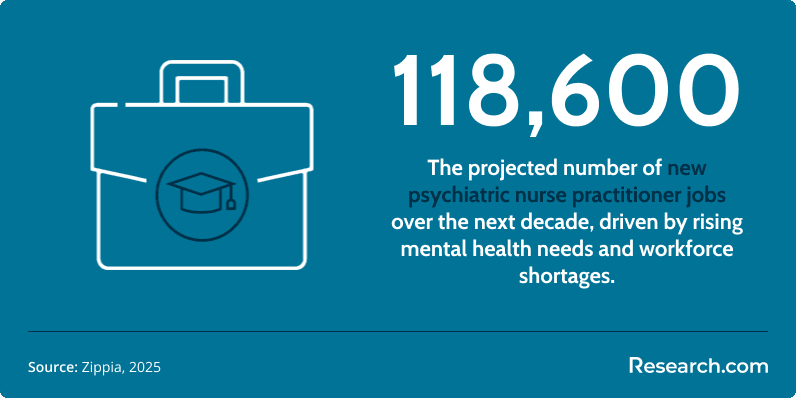
The U.S. Bureau of Labor Statistics forecasts the creation of 118,600 new jobs for nurse practitioners over the next decade. For PMHNP students, this suggests a favorable employment environment, especially for graduates who complete strong clinical placements, pass certification exams, and are willing to serve high-need communities or specialized patient populations.
What Graduates Say About PMHNP Programs with Clinical Placement Support
- : "My community health patients often have layered psychiatric, medical, and social needs. The program helped me connect psychopharmacology, dual-diagnosis care, and practical treatment planning in a way I could use immediately with the people I serve. — Ken"
- : "After 15 years in ICU nursing, I wanted a career change but worried my background would not translate. It turned out that my assessment experience was a real advantage. Online study let me keep working part time, and the PMHNP role gave me the autonomy I was looking for. — Maki"
- : "I had worked as a psychiatric RN for five years and wanted a broader scope of practice. The biggest difference was that the school handled my clinical placements. I trained in an outpatient clinic with complex cases and graduated with much more confidence than I expected. — Arthur"
References
- APEA. (2024). Nurse practitioner certification pass rates. Retrieved from APEA.
- APEA. (2024). 2025 PMHNP career outlook: High need, high demand. Retrieved from APEA.
- Barton Associates. (n.d.). Nurse practitioner scope of practice laws. Retrieved from Barton Associates.
- Salary.com. (2025). Psychiatric Nurse Practitioner NP salary. Retrieved from Salary.com.
- PsychiatryOnline. (2023). Psychiatric Services. Retrieved from PsychiatryOnline.
- Zippia. (2025). Psychiatric Nurse Practitioner trends. Retrieved from Zippia.
Key Insights
- Clinical placement support is one of the most important factors in an online PMHNP program because supervised practice experiences directly affect graduation timing and certification readiness.
- The listed programs report clinical placement rates from 92% to 99%, but students should still ask how each school defines placement support and what happens if a site becomes unavailable.
- Most online PMHNP programs take about two to three years, with part-time study offering flexibility and full-time study offering a faster path for students who can manage the workload.
- The average total tuition for a standard PMHNP program is approximately $101,300, so applicants should compare total cost of attendance rather than tuition alone.
- Accreditation by CCNE or ACEN, board certification preparation, state authorization, and licensure alignment should be verified before enrolling.
- PMHNP graduates can pursue clinical practice, administration, education, research, or policy roles, but outcomes depend on certification, state practice rules, experience, and local demand.
Other Things You Should Know About Online PMHNP Programs with the Best Clinical Placement Rates
Yes. Most online PMHNP programs require an unencumbered, active RN license before admission and before any clinical courses begin. Many also require a BSN, a minimum 3.0 GPA, current CPR certification, and immunization and background-check clearance before clinical placement can be approved.
Programs often partner with local healthcare facilities and employ dedicated placement coordinators to ensure students secure clinical positions. They may also utilize networking events and maintain robust alumni connections to facilitate high placement rates for students in 2027.