
2027 Most Affordable Online Adult-Gerontology PCNP Graduate Certificate Programs

Co-Founder and Chief Data Scientist
An online Adult-Gerontology Primary Care Nurse Practitioner graduate certificate is usually for licensed nurses who already have graduate nursing preparation and want to add adult-gerontology primary care to their scope of advanced practice. The decision is not simply whether the program is online; it is whether the certificate will meet certification requirements, fit your clinical schedule, support licensure in your state, and justify the cost in relation to your career goals.
This guide explains what an online AG-PCNP certificate includes, how long it takes, what it may cost, what clinical requirements to expect, how online programs compare with campus-based options, and how to evaluate programs before enrolling. It is written for working nurses, MSN-prepared applicants, advanced nursing students comparing NP tracks, and career changers who need to understand whether a certificate, MSN, bridge program, or another nursing pathway is the better fit.
Quick answer: Is an online AG-PCNP graduate certificate worth considering?
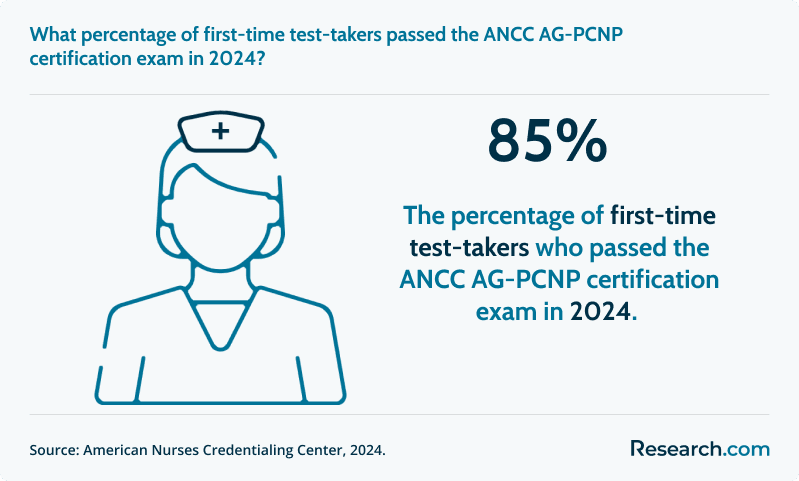
An online adult-gerontology PCNP graduate certificate can be a strong option if you are already a nurse with the required graduate background and want to provide primary care for adults and older adults. The pathway may help prepare you for national certification, expand your practice options, and allow you to keep working while completing online coursework and local clinical hours. In 2024, 85% of first-time test-takers passed the American Nurses Credentialing Center (ANCC) AG-PCNP certification exam.
The certificate is not the right fit for everyone. If you do not already hold the required nursing degree or RN license, you may need an ADN, BSN, direct-entry MSN, or nurse practitioner bridge pathway first. If your goal is acute care, pediatrics, psychiatric-mental health, family practice across the lifespan, or women’s health, another NP concentration may be more appropriate.
What are the main benefits of an online adult-gerontology PCNP graduate certificate?
- Focused preparation for adult and older adult primary care: The certificate builds advanced practice skills for clinical settings such as primary care offices, outpatient clinics, community health centers, long-term care, specialty practices, hospitals, and nursing education.
- Strong earning potential: Adult-gerontology nurse practitioners in primary care report a median salary of around $109,000 to $112,000 annually, with the possibility of $130,000 or more depending on experience, employer, geographic market, and clinical role.
- Flexible study format: Online programs are commonly designed for working nurses, using asynchronous coursework, virtual discussions, and locally arranged clinical experiences so students can continue employment while completing the certificate.
- Certification-oriented curriculum: Programs typically align coursework and clinical training with national AG-PCNP certification expectations, although students must confirm each program’s eligibility rules before enrolling.
What can I expect from an online adult-gerontology PCNP graduate certificate program?
An online adult-gerontology PCNP certificate is an advanced nursing program focused on primary care for adults and older adults. Students study advanced assessment, pharmacology, pathophysiology, prevention, chronic disease management, and evidence-based care planning. Most programs also require supervised clinical practice so students can apply classroom learning to real patient care.
Clinical internship requirements often fall around 585 to 765 hours, though individual programs may require more or less depending on prior coursework, gap analysis results, state requirements, and certification preparation standards. Some programs also include a capstone, practicum seminar, simulation experience, or short campus visit.
Tuition for these programs generally ranges from about $12,000 to $15,000, depending on the school and credit requirements. Some programs cost more when additional prerequisite credits, clinical fees, technology fees, books, travel, or out-of-state tuition apply.
| Program component | What it usually means for students |
| Online coursework | Lectures, assignments, case studies, discussions, and exams are completed through a learning platform. |
| Advanced practice core | Students build knowledge in advanced health assessment, advanced pharmacology, and advanced pathophysiology. |
| AG-PCNP specialty courses | Courses focus on adult primary care, geriatric care, chronic illness, health promotion, and disease prevention. |
| Clinical hours | Students complete supervised practice, often in local primary care or adult-gerontology settings approved by the program. |
| Certification preparation | The curriculum should prepare graduates for the AG-PCNP certification exam, but eligibility should be verified with the school and certifying body. |
Where can I work with an online adult-gerontology PCNP graduate certificate?
Graduates typically pursue adult and older adult primary care roles in outpatient and community-based settings. Common employers include primary care clinics, internal medicine practices, community health centers, hospital outpatient departments, specialty clinics, long-term care organizations, occupational health programs, and telehealth providers.
The credential can also support work in care coordination, clinical education, quality improvement, population health, healthcare consulting, and leadership roles tied to adult and geriatric care. Some graduates move into corporate wellness programs, nonprofit healthcare organizations, government health agencies, research teams, or healthcare technology environments where advanced clinical knowledge is valuable.
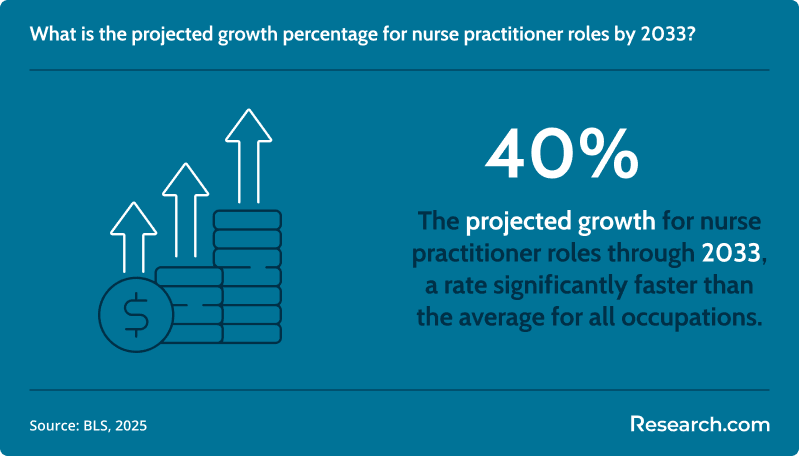
According to the U.S. Bureau of Labor Statistics, nurse practitioner roles are projected to grow 40% through 2033. That demand is connected to primary care needs, chronic disease management, and the aging U.S. population, but job availability still varies by state, scope-of-practice laws, employer type, and local competition.
How much can I make with an online adult-gerontology PCNP graduate certificate?
Adult-gerontology primary care nurse practitioners can earn an average salary of around $109,000 to $112,000 per year, with potential earnings of $130,000 or more. Entry-level nurse practitioners typically earn about $88,000 annually, while those with five to nine years of experience can make over $130,000.
Pay is not guaranteed by earning the certificate alone. Salary depends on clinical experience, certification status, state practice authority, employer setting, shift expectations, geographic location, and whether the role includes leadership, specialty practice, or productivity-based compensation.
| Factor | How it can affect earnings |
| Employer setting | Hospitals and outpatient care facilities may offer higher pay than some educational or nonprofit settings. |
| Location | Urban markets and certain states may pay more, though cost of living should be considered. |
| Experience level | Experienced nurse practitioners often qualify for stronger compensation than new graduates. |
| Certification and scope | National certification and state authorization affect the roles graduates can pursue. |
| Specialized responsibilities | Leadership, specialty clinics, telehealth, and complex-care roles may increase earning potential over time. |
- Best Online Adult-Gerontology PCNP Graduate Certificate Programs for 2027
- Program Length: How Long an Online AG-PCNP Certificate Takes
- Online vs. On-Campus AG-PCNP Graduate Certificate Programs
- Average Cost of an Online AG-PCNP Graduate Certificate
- Financial Aid Options for Online AG-PCNP Certificate Students
- Admission Requirements and Prerequisites
- Typical Courses in an Online AG-PCNP Certificate
- Specializations and Focus Areas
- AG-PCNP Certificate vs. Direct Entry MSN Online Program
- Challenges to Plan For Before Enrolling
- Alternative Pathways for Non-Nurses
- How to Choose the Best Online AG-PCNP Certificate Program
- Accreditation, Certification, and Licensing Checks
- Career Paths for AG-PCNP Certificate Graduates
- Job Market Outlook for AG-PCNP Graduates
- Return on Investment for an Online AG-PCNP Certificate
Best Online Adult-Gerontology PCNP Graduate Certificate Programs for 2027
How Research.com evaluates programs
Choosing a graduate certificate affects your time, finances, certification eligibility, and career mobility. Research.com prioritizes transparent, data-informed review criteria so students can compare programs more carefully instead of relying on advertising claims alone.
Program research draws on sources such as the IPEDS database, Peterson's database, the College Scorecard database, and The National Center for Education Statistics. You can review additional ranking details on Research.com's methodology page.
1. Spring Arbor University
Spring Arbor University offers an online Post-Master's AG PCNP Certificate with a faith-based learning environment. The program is designed for nurses who want to strengthen adult-gerontology primary care knowledge, build clinical reasoning, and prepare for certification while studying in a flexible format.
- Required Credits to Graduate: 500 clinical hours
- Cost: $782 per credit hour
- Accreditation: Commission on Collegiate Nursing Education (CCNE)
2. Walden University
Walden University provides an online Post-Master's Certificate in Adult-Gerontology Primary Care Nurse Practitioner for nurses who already hold a master's degree. The program focuses on the coursework needed to deliver primary care to adults and older adults while giving students a flexible path toward nurse practitioner preparation.
- Required credits to graduate: 38 quarter credits or fewer (can be reduced by transfer credits)
- Cost: $775 per quarter hour
- Accreditation: CCNE
3. Morningside University
Morningside University offers a Post-Master's Certificate in Adult Gerontology Primary Care Nurse Practitioner (AGPCNP) for MSN-prepared nurses. The online format combines specialty coursework with supervised clinical practice to prepare graduates for expanded care of adult and older adult patients.
- Required credits to graduate: 35 total credit hours and 750 clinical/practicum hours
- Cost: $655 per credit
- Accreditation: CCNE
4. Drexel University
Drexel University offers an online Post-Master's Certificate in Adult-Gerontology Primary Care Nurse Practitioner for MSN-prepared clinicians. The curriculum is intended to build advanced primary care knowledge for evidence-based practice in adult and geriatric care settings.
- Required credits to graduate: 34 quarter credits
- Cost: $1134 per credit
- Accreditation: CCNE
5. Purdue Global
Purdue Global offers an online Adult-Gerontology Primary Care Nurse Practitioner Postgraduate Certificate. The program prepares students to provide primary care to adults across the lifespan and supports preparation for national certification exams.
- Required credits to graduate: Minimum of 60 quarter credit hours
- Cost: $420 per credit
- Accreditation: CCNE
6. University of Central Florida
The University of Central Florida offers a Post-Master's Adult-Gerontology Primary Care Nurse Practitioner Graduate Certificate for master's-prepared nurses who want to specialize in primary care for adult and aging populations.
- Required credits to graduate: 18 credit hours beyond the Master's Degree, plus 12 prerequisite credit hours, and up to 660 clinical hours.
- Cost: $369.65 per credit hour (in-state) and $1,194.05 per credit hour (out-of-state)
- Accreditation: CCNE
7. University of Missouri-Kansas City
The University of Missouri-Kansas City provides a blended Post-Master's Certificate in Adult Gerontology Primary Care Nurse Practitioner. The program emphasizes health promotion, disease prevention, and treatment of acute and chronic conditions, with some required campus visits.
- Required credits to graduate: 18 standard credit hours
- Cost: Standard estimated cost is $15,851.70
- Accreditation: CCNE
8. Seton Hall University
Seton Hall University offers online post-master's certificate options for nurses seeking additional nurse practitioner certifications, including Adult-Gerontology Primary and Acute Care, Family, Pediatric, and Psychiatric-Mental Health tracks. Coursework and clinical learning are used to build advanced skills for specific patient populations.
- Required credits to graduate: 18-39 credits (determined by a gap analysis)
- Cost: $1,520
- Accreditation: CCNE
9. Concordia University
Concordia University offers an online MSN-Nurse Practitioner program with concentrations in Family Nurse Practitioner (FNP) or Adult-Gerontology Primary Care Nurse Practitioner. The program uses a holistic approach to prepare graduates for patient care across clinical environments.
- Required credits to graduate: 41 credits
- Cost: $870 per credit
- Accreditation: CCNE
10. Stony Brook University
Stony Brook University offers an Adult-Gerontology Primary Care Nurse Practitioner Advanced Certificate for master's or doctorally prepared nurses. The program includes precepted clinical learning and is structured around state and national certification expectations.
- Required credits to graduate: Minimum of 19 credits, though additional credits may be required based on faculty advisement and prior coursework.
- Cost: Approximately $471 per credit for in-state residents and $963 per credit for out-of-state residents
- Accreditation: CCNE
If you are comparing graduate nursing education with shorter vocational routes, Research.com also publishes guides to non-nursing programs such as affordable online CDL training programs. Those paths serve very different goals, so compare time, licensure, job duties, and long-term advancement before switching fields.
How long does it take to complete an online adult-gerontology PCNP graduate certificate program?
Most online adult-gerontology PCNP certificate programs take about 12 to 20 months, but the exact timeline depends on transfer credits, prior graduate coursework, clinical placement speed, full-time or part-time enrollment, and whether the school requires additional prerequisite courses.
Like RN to BSN fast track programs, many AG-PCNP certificates are designed for working nurses who need flexibility. However, this is a graduate-level advanced practice credential, so the clinical requirement is substantial. Many programs require 540 to 750 hours, and some students take longer if they need to find approved preceptors, complete a gap analysis, or meet state-specific clinical standards.
| Enrollment pace | Typical planning considerations |
| Full-time | May allow completion in as little as 12 to 16 months if prerequisites are complete and clinical placements are secured on time. |
| Part-time | May be better for nurses working demanding schedules, but completion can extend toward two years. |
| Gap-analysis plan | Students may need extra courses or clinical hours if prior graduate coursework does not match program requirements. |
| Clinical placement delays | Finding a qualified preceptor can affect the timeline, especially in competitive regions. |
How does an online adult-gerontology PCNP graduate certificate program compare to an on-campus program?
Online and on-campus AG-PCNP certificate programs can both prepare students for certification, but the learning experience differs. The best choice depends on your work schedule, preferred learning style, access to clinical sites, and need for in-person faculty interaction.
| Comparison point | Online AG-PCNP certificate | On-campus AG-PCNP certificate |
| Flexibility | Often uses asynchronous coursework that can fit around employment and family responsibilities. | Usually follows set class times and campus schedules. |
| Course delivery | Uses virtual lectures, online discussions, assignments, simulations, and learning modules. | Relies more heavily on classroom instruction and in-person activities. |
| Clinical experience | Clinical hours are still mandatory and are often completed near the student’s location, subject to school approval. | Clinical placements may be tied to the school’s local healthcare partners. |
| Faculty access | Interaction happens through email, discussion boards, virtual office hours, and live video sessions. | Students can more easily meet faculty and classmates in person. |
| Best fit | Working nurses who need location flexibility and can stay organized independently. | Students who prefer face-to-face learning and live near a suitable campus. |
Students who are just starting in healthcare may need a different first step. For example, some begin in direct care roles before moving toward nursing. Research.com covers options such as affordable home health aide certification online programs for readers exploring entry-level healthcare pathways.
The chart below compares the cost per credit hour of in-person instruction and online instruction.
What is the average cost of an online adult-gerontology PCNP graduate certificate program?
The average cost of an online adult-gerontology PCNP certificate program typically ranges from about $20,000 to $30,000 in total tuition, depending on credit requirements, tuition rate, residency status, transfer credit, and program length. This investment is much higher than short workforce certificates such as 4-week medical certificate programs online because AG-PCNP training is graduate-level nursing education tied to advanced practice preparation.
When comparing programs, do not look only at advertised tuition. Ask for the full cost of attendance, including clinical placement fees, technology fees, books, simulation costs, background checks, immunization documentation, travel for any campus requirements, certification exam preparation, and state licensure expenses.
| Cost item | Why it matters |
| Tuition | The largest expense and often calculated by credit or quarter hour. |
| Prerequisite credits | Additional courses may increase the total cost if your prior MSN coursework does not transfer. |
| Clinical costs | Some programs charge placement, tracking, or compliance fees. |
| Technology and online fees | Online programs may add platform, software, or distance learning charges. |
| Travel | Residencies, intensives, or required campus visits can add transportation and lodging expenses. |
The next chart shows projected student distribution by delivery mode for 2025 among graduate students.
What are the financial aid options for students enrolling in an online adult-gerontology PCNP graduate certificate program?
Financial aid availability depends on institutional eligibility, program structure, enrollment status, and the student’s own financial profile. Before applying, confirm that the certificate program is eligible for aid and that you understand whether you will be classified as a degree-seeking or certificate-seeking graduate student.
- Federal and state loans: Many accredited institutions participate in federal student aid, which may give eligible students access to federal loans and, in some cases, state-based assistance.
- University scholarships and grants: Some nursing schools offer graduate awards, need-based aid, or scholarships for advanced practice nursing students.
- Employer tuition assistance: Hospitals, clinics, and health systems may reimburse part of the cost if the credential supports workforce needs.
- Loan forgiveness programs: Programs such as the Nurse Faculty Loan Program may provide partial loan forgiveness for graduates who meet specific teaching commitments in nursing education.
- Private loans and payment plans: Schools may offer installment plans or provide information about private education loans, but students should compare repayment terms carefully.
What are the prerequisites for enrolling in an online adult-gerontology PCNP graduate certificate program?
Admission requirements vary by school, but AG-PCNP graduate certificate programs commonly expect applicants to have prior graduate nursing education and active RN licensure. The most important step is to confirm that your background matches the program’s certification and licensure pathway before submitting an application.
- Master’s Degree in Nursing: Many programs require an MSN from an accredited institution. This is similar to the graduate foundation expected in the best online MSN to FNP programs, although the patient population and certification track differ.
- Active RN license: Applicants are typically required to hold a current, unencumbered Registered Nurse license.
- Graduate advanced practice coursework: Schools often expect prior completion of advanced health assessment, advanced pathophysiology, and advanced pharmacology.
- Additional graduate coursework: Some programs review prior study in nursing research, statistics, nursing leadership, and community health nursing.
- Official transcripts: Applicants must document completed degrees and relevant coursework.
- Background check: A criminal background check is commonly required for admission or clinical placement.
- Gap analysis: Schools may compare your previous coursework and clinical hours against certificate requirements to determine whether extra courses or practicum hours are necessary.
If you are not yet an RN, the AG-PCNP certificate is not the starting point. A common sequence is to earn an ADN, gain nursing experience, complete a BSN, pursue graduate nursing education, and then specialize. Research.com’s guide to affordable ADN programs online can help readers understand an earlier nursing pathway.
What courses are typically in an online adult-gerontology PCNP graduate certificate program?
Course names differ by university, but the curriculum usually combines advanced practice foundations with adult-gerontology primary care content. Students learn to assess, diagnose, manage, and educate adult and older adult patients across health conditions and care settings.
- Advanced Pathophysiology: Examines disease processes affecting adults and older adults.
- Advanced Pharmacology: Covers medication management, prescribing principles, safety considerations, and pharmacotherapeutics for adult and geriatric patients.
- Advanced Health Assessment: Develops comprehensive assessment and diagnostic reasoning skills for adult populations.
- Health Promotion and Disease Prevention: Focuses on wellness, screening, prevention, and risk reduction across diverse adult groups.
- Adult Primary Care I and II: Addresses diagnosis and management of acute and chronic conditions in adults and older adults.
- Clinical Practicum: Provides supervised experience in approved adult-gerontology primary care settings.
What types of specializations are available in an online adult-gerontology PCNP graduate certificate program?
AG-PCNP certificates are already specialized: they focus on primary care for adults and older adults. Within that track, schools may offer electives, clinical emphasis areas, or practicum experiences that allow students to build deeper expertise in particular patient needs or care models.
- Primary care across adult life stages: Students prepare to care for young adults, middle-aged adults, older adults, and frail elderly patients.
- Women’s and reproductive health: Some programs include adult women’s health topics, although this differs from diagnostic imaging programs such as online sonography certificate programs.
- Complex geriatric care: Coursework and clinical practice may emphasize multimorbidity, polypharmacy, frailty, cognitive changes, and geriatric syndromes.
- Telehealth: Some curricula introduce virtual care tools and remote patient management models.
- Population health and culturally responsive care: Students may learn to address adult care needs in rural, urban, underserved, and diverse communities.
- Leadership and evidence-based practice: Programs may include quality improvement, interprofessional collaboration, and research translation into clinical care.
How does an AG-PCNP certificate compare with a direct entry MSN online program?
An online AG-PCNP certificate is for nurses who already have the required nursing background and want to add a focused adult-gerontology primary care specialization. A direct entry MSN online program serves a different audience: students without a nursing background who need foundational nursing education and graduate preparation through a broader master’s pathway.
| Pathway | Best for | Key difference |
| Online AG-PCNP certificate | Licensed nurses with the required graduate nursing preparation | Adds adult-gerontology primary care specialization without completing a full second graduate degree in many cases. |
| Direct entry MSN online | Career changers who do not already have a nursing background | Includes entry-level nursing preparation and graduate study, so it is usually a much larger academic commitment. |
What challenges should I anticipate with an online adult-gerontology PCNP certificate program?
The main challenges are not only academic. Students must manage graduate-level coursework, clinical scheduling, preceptor approval, technology requirements, state authorization rules, and work-life balance at the same time.
- Finding clinical placements: Some schools offer strong placement support, while others expect students to identify local preceptors.
- Balancing work and study: Online flexibility helps, but clinical hours often require daytime availability.
- Meeting state rules: Online programs may not be authorized in every state or may not meet every state’s licensure expectations.
- Handling hidden costs: Background checks, documentation systems, travel, exam fees, and compliance requirements can add expenses.
- Comparing NP tracks: Students weighing other specialties may also examine options such as the cheapest psychiatric nurse practitioner programs if their career goals are more aligned with mental health care.
Are there alternative pathways for non-nurses to pursue advanced practice roles?
Non-nurses usually cannot move directly into an AG-PCNP certificate because advanced practice nursing requires nursing education, RN licensure, supervised clinical preparation, and state authorization. The better route depends on the applicant’s current degree, science prerequisites, career timeline, and target NP specialty.
Applicants without a nursing background may compare accelerated BSN, direct-entry MSN, ADN-to-BSN-to-MSN, and nurse practitioner bridge programs for non-nursing majors. Before enrolling, confirm that the program leads to the licensure and certification pathway required in the state where you plan to practice.
How to Choose the Best Online Adult-Gerontology PCNP Graduate Certificate Program
The best online AG-PCNP certificate is the one that meets certification requirements, fits your state’s rules, provides enough clinical support, and offers a realistic path to completion. Rankings can help you create a shortlist, but they should not replace direct verification with the school and state board of nursing.
- Check accreditation first: Look for recognized nursing accreditation such as CCNE or ACEN because accreditation can affect certification eligibility, financial aid access, and employer recognition.
- Verify state authorization: Ask whether the program accepts students from your state and whether it meets your state’s licensure requirements.
- Review clinical placement support: Find out whether the school secures placements, assists with preceptors, or requires you to arrange everything yourself.
- Compare total cost: Include tuition, fees, clinical expenses, travel, exam costs, and any additional prerequisite courses.
- Ask about gap analysis: If you already completed graduate nursing coursework, determine which credits apply and what you still need.
- Evaluate certification preparation: Ask how the curriculum maps to national AG-PCNP certification exam content.
- Look at faculty qualifications: Faculty should have relevant adult-gerontology, primary care, and advanced practice experience.
- Assess student support: Online students benefit from advising, library access, technical support, clinical coordination, and exam preparation resources.
| Question to ask the school | Why it matters |
| Will this certificate make me eligible for AG-PCNP certification? | Certification eligibility is the central reason many students choose this program. |
| Does the program meet requirements in my state? | State authorization and licensure rules can limit where graduates may practice. |
| Who is responsible for finding clinical preceptors? | Clinical placement support can determine whether you finish on schedule. |
| What is the full cost beyond tuition? | Fees, travel, and compliance costs can change the real price. |
| How many credits and clinical hours will I personally need? | Gap analysis may change your timeline and cost. |
Students comparing nursing with hands-on skilled trades can also review Research.com’s guide to the cheapest appliance repair training programs online. This type of program is not a substitute for nursing education, but it may be useful for readers still deciding between healthcare and trade-based careers.
What accreditation and licensing standards should I consider?
Accreditation, certification, and state licensure should be verified before you apply. A program that is convenient or affordable may still be the wrong choice if it does not support the credential you need in your state.
- Program accreditation: Confirm recognition by a nursing accreditor such as the Commission on Collegiate Nursing Education (CCNE) or the Accreditation Commission for Education in Nursing (ACEN).
- Institutional accreditation: Make sure the university itself is properly accredited.
- Certification eligibility: Ask whether graduates are eligible for AG-PCNP national certification exams.
- State licensure requirements: Contact your state board of nursing to confirm that the program meets educational and clinical requirements.
- Clinical hour rules: Verify the number, setting, and supervision requirements for clinical experiences.
- Online authorization: Not every online program can enroll students in every state.
Students comparing nursing program structures may also find it useful to review online RN-BSN programs without clinicals, but AG-PCNP certificates are different because supervised advanced practice clinical hours are typically required.
What career paths are available for graduates of an online adult-gerontology PCNP certificate program?
AG-PCNP certificate graduates typically work with adult and older adult patients in primary care and related settings. The certificate can support direct patient care, care coordination, specialty practice, education, and leadership roles.
- Primary Care Nurse Practitioner: Provide adult and older adult care in clinics, private practices, hospital outpatient departments, community sites, and home-based care models.
- Long-Term and Sub-Acute Care Provider: Manage chronic conditions, functional needs, medication plans, and wellness goals in skilled nursing, assisted living, and sub-acute care settings.
- Occupational and Environmental Health Practitioner: Support adult workers through injury prevention, occupational health assessment, and workplace-related care.
- Public Health or Community Health NP: Work with high-risk, underserved, rural, or urban populations through prevention and chronic disease programs.
- Specialty Clinic NP: Manage adult and geriatric patients in areas such as cardiology, oncology, or palliative care. Students interested in cardiovascular practice can also review Research.com’s guide on how to become a cardiac nurse.
- Telehealth Nurse Practitioner: Provide remote adult and geriatric primary care consultations through telemedicine platforms.
- Academic or Clinical Educator: Teach, precept, or support nursing learners in adult-gerontology or primary care settings.
- Healthcare Leadership or Advocacy Professional: Contribute to care quality, policy, aging services, and patient access initiatives.
What is the job market for graduates with an online adult-gerontology PCNP graduate certificate program?
The job market for nurse practitioners is strong. Nurse practitioner roles, including AG-PCNP roles, are projected to grow 40% from 2023 to 2033, which is much faster than the average for all occupations.
Demand for AG-PCNPs is linked to the aging U.S. population and the need for clinicians who can manage chronic illness, coordinate care, support prevention, and provide adult primary care. The number of Americans aged 65 and older is expected to rise from 17% to 23%, increasing the need for practitioners skilled in care for older adults.
Still, graduates should evaluate local conditions. Job prospects depend on state scope-of-practice laws, payer systems, employer demand, clinical experience, certification status, and willingness to work in underserved or high-need areas.
The following chart shows the largest employers of nurse practitioners in 2023, according to the Bureau of Labor Statistics:
What is the return on investment for an online AG-PCNP certificate program?
The return on investment depends on whether the certificate helps you qualify for the role you want, increases your earning potential, expands your clinical scope, and fits your budget. Because tuition for online adult-gerontology PCNP certificate programs generally ranges from $12,000 to $15,000 and some total program costs may range from about $20,000 to $30,000, students should calculate ROI before enrolling.
| ROI question | What to compare |
| Will the certificate change my job options? | Compare your current RN or advanced nursing role with AG-PCNP positions in your area. |
| How much will the full program cost? | Include tuition, fees, books, clinical expenses, travel, and certification-related costs. |
| How long will it take to recover the investment? | Compare expected earnings with current income, but avoid assuming a guaranteed salary increase. |
| Does another NP specialty fit better? | If your interests are not adult-gerontology primary care, compare other pathways such as an affordable women's health nurse practitioner degree. |
| Will my employer help pay? | Employer tuition assistance can improve ROI, especially for nurses in health systems with primary care shortages. |
Common mistakes to avoid when choosing an online AG-PCNP certificate
- Choosing based only on tuition: A lower per-credit price may not be cheaper if the program requires more credits, extra prerequisites, or expensive travel.
- Ignoring clinical placement responsibility: Students who must find their own preceptors should start networking early.
- Assuming online means fully remote: Clinical hours are in person, and some programs may require campus visits.
- Skipping state authorization checks: A program may be accredited but still not approved for students in every state.
- Confusing AG-PCNP with AG-ACNP: Primary care and acute care tracks prepare students for different practice environments.
- Relying only on rankings: Rankings can help, but certification eligibility, clinical fit, cost, and licensure alignment matter more.
- Assuming salary outcomes are guaranteed: Reported salaries are useful benchmarks, not promises of employment or income.
What graduates say about online adult-gerontology PCNP certificate programs
Completing the online AGPCNP program helped me move forward professionally while continuing to work. The format gave me room to study around my schedule, and the adult and geriatric primary care content improved the way I approach patient visits. - Liam
The online AGPCNP Graduate Certificate expanded my practice goals. The coursework was challenging but manageable, and the clinical experiences helped me connect advanced concepts with real patient care for older adults. - Olivia
Finishing the online AGPCNP certificate gave me stronger tools for assessing and managing complex adult health needs. I use the evidence-based training regularly in practice, especially when caring for aging patients with multiple conditions. - Davi
Key Insights
- An online AG-PCNP graduate certificate is best suited for licensed nurses with the required graduate nursing background who want to specialize in adult and older adult primary care.
- In 2024, 85% of first-time test-takers passed the American Nurses Credentialing Center (ANCC) AG-PCNP certification exam.
- Adult-gerontology nurse practitioners in primary care earn a median annual salary of $109,000 to $112,000, with potential earnings of $130,000 or more, but pay varies by role, location, experience, and employer.
- Online AG-PCNP certificate programs commonly require substantial supervised clinical training, often around 585 to 765 clinical internship hours.
- Tuition for online adult-gerontology PCNP certificate programs generally ranges from $12,000 to $15,000, while broader total program costs can vary depending on credits, fees, and prerequisites.
- Nurse practitioner employment is projected to grow 40% through 2033, making this a strong labor-market pathway for qualified nurses.
- Before enrolling, verify accreditation, state authorization, certification eligibility, clinical placement support, total cost, and whether the AG-PCNP scope matches your career goals.
References:
- Adult-Gerontology Nurse Practitioner (AGNP) salary in 2025 | PayScale. (n.d.). https://www.payscale.com/research/US/Job=Adult-Gerontology_Nurse_Practitioner_(AGNP)/Salary
- ANCC. (2024). ANCC Certification Data. https://www.nursingworld.org/globalassets/docs/ancc/ancc-cert-data-website.pdf
- Fact Sheet: Aging in the United States. (n.d.). PRB. https://www.prb.org/resources/fact-sheet-aging-in-the-united-states
- Hanson, M. (2024, August 31). Cost of Online Education vs. Traditional Education [2024]: Comparison. Education Data Initiative. https://educationdata.org/cost-of-online-education-vs-traditional-education
- Nurse anesthetists, nurse midwives, and nurse practitioners. (2025, April 18). Bureau of Labor Statistics. https://www.bls.gov/ooh/healthcare/nurse-anesthetists-nurse-midwives-and-nurse-practitioners.htm#tab-6
- The Changing Landscape of Online Education (CHLOE) Project | Quality matters. (n.d.). https://www.qualitymatters.org/qa-resources/resource-center/articles-resources/CHLOE-project
Other Things You Should Know About an Online Adult-Gerontology PCNP Graduate Certificate Program
Most online Adult-Gerontology PCNP graduate certificates require 500 to 600 supervised clinical practicum hours, completed in approved primary care or gerontology settings. Programs also require an active RN license and a preceptor who is a qualified nurse practitioner, physician, or physician assistant.
To enroll in a 2027 Adult-Gerontology PCNP graduate certificate program, applicants typically need a current RN license and a master's or doctoral degree in nursing. Specific prerequisites may vary by institution, but these credentials are commonly required for admission into such advanced programs.


