
2027 Easiest Neonatal Nurse Practitioner Online Programs to Get Into

Co-Founder and Chief Data Scientist
Choosing an online neonatal nurse practitioner pathway is not just a question of convenience. You need a program that fits your schedule, supports clinical placement, meets accreditation standards, and prepares you for advanced practice with medically fragile newborns. This guide is for registered nurses comparing flexible online graduate nursing options and trying to understand which programs may be easier to access without sacrificing quality, licensure readiness, or career value.
The need for skilled neonatal clinicians remains clear. In 2024, reports showed neonatal deaths at a rate of 3.65 per 1,000 live births, highlighting the importance of advanced providers who can support newborns, families, NICU teams, and post-discharge care. Below, you will learn what online neonatal nurse practitioner programs involve, how to compare them, what they cost, how clinical training works, and what to verify before enrolling.
Quick Answer: What Is the Easiest Online Neonatal Nurse Practitioner Program?
The easiest neonatal nurse practitioner online program is usually the one that best matches your current nursing background, offers flexible online coursework, provides clinical placement support, has clear admission requirements, and holds recognized nursing accreditation. “Easy” should not mean academically light. Neonatal nurse practitioner preparation is advanced clinical training, so the better question is which accredited program is most accessible, affordable, well-supported, and realistic for your schedule.
What are the benefits of getting the easiest neonatal practitioner online degree?
- Career flexibility: Graduates can pursue advanced nursing roles in hospitals, outpatient care centers, physician offices, and other settings that care for newborns and families.
- Online access: Distance learning makes it possible for working nurses to complete graduate-level coursework without relocating or leaving their current jobs.
- Strong earning potential: Nurse practitioners often earn salaries above $120,000 annually, and pay can be higher in certain industries and practice settings.
What can I expect from the easiest neonatal practitioner online degree?
Online neonatal nurse practitioner programs combine graduate nursing theory, advanced clinical science, and supervised practice. Coursework commonly covers neonatal physiology, advanced pharmacology, health assessment, family-centered care, ethics, leadership, and evidence-based practice. Students also learn how to evaluate newborns, recognize complications, collaborate with NICU teams, and communicate with families during high-stress situations.
Many programs use case-based assignments, virtual simulations, recorded lectures, discussion boards, and clinical decision-making exercises. These tools are helpful, but they do not replace in-person clinical hours. Even when coursework is online, students must complete supervised clinical experiences in approved healthcare settings.
Tuition typically ranges from $500 to $1,000 per credit hour. Many programs require 40 to 50 credit hours, so total tuition varies by school and enrollment pace. Most students finish in two to three years, depending on whether they study full-time or part-time.
| Program feature | What to expect | Why it matters |
| Course format | Mostly online lectures, assignments, simulations, and discussions | Allows working nurses to study without relocating |
| Clinical training | In-person supervised practicums in approved settings | Required for hands-on competency and certification preparation |
| Typical length | Two to three years | Part-time study may be more manageable but takes longer |
| Credit load | Often 40 to 50 credit hours | Determines tuition, timeline, and workload |
| Main risk to check | Whether the program truly supports neonatal advanced practice goals | Not every online MSN or NP track is a neonatal NP track |
Where can I work with the easiest neonatal practitioner online degree?
Neonatal nurse practitioners and related advanced practice nurses work where newborns need specialized assessment, treatment, monitoring, education, or follow-up care. The right setting depends on your certification, state scope of practice, experience, and the program’s clinical focus.
- Physician offices: Offices of physicians employed more than 137,000 nurse practitioners in 2024, making this the largest employment setting for NPs overall.
- Hospitals: General medical and surgical hospitals offered about 61,700 nurse practitioner jobs. Neonatal-focused roles are often connected to NICUs, labor and delivery collaboration, newborn stabilization, or specialty consultation.
- Outpatient care centers: Outpatient care centers employed around 25,400 nurse practitioners and may offer roles involving follow-up care, high-risk infant clinics, or coordinated family support.
- Other practitioner offices and home health care: These settings may involve education, preventive care, discharge follow-up, developmental monitoring, and support for families caring for newborns with ongoing needs.
How much can I make with the easiest neonatal practitioner online degree?
According to the BLS, nurse practitioners earned a median annual salary of $126,260 in 2024. Neonatal specialization may support competitive earnings, especially in hospital-based or high-demand clinical settings, but salary is never guaranteed. Pay depends on certification, employer type, state, years of experience, shift structure, and local demand.
In 2024, nurse practitioners working in general medical and surgical hospitals earned an average of $135,610 per year. Outpatient care centers reported average pay of about $139,860 annually. Physicians’ offices and offices of other health practitioners reported salaries closer to the overall median, ranging from $121,250 to $122,780.
| Setting | Reported nurse practitioner pay | Decision note |
| All nurse practitioners | Median annual salary of $126,260 in 2024 | Useful baseline for comparing advanced practice nursing roles |
| General medical and surgical hospitals | Average of $135,610 per year | Often relevant for NICU and acute-care neonatal practice |
| Outpatient care centers | Average of about $139,860 annually | May offer strong pay with different hours and patient mix |
| Physicians’ offices and other health practitioners’ offices | Approximately $121,250 to $122,780 | May provide more predictable schedules than hospital roles |
- List of the Easiest Neonatal Nurse Practitioner Online Degree Programs for 2027
- How long does it take to complete the easiest neonatal nurse practitioner online program?
- How does the easiest neonatal nurse practitioner online program compare to an on-campus program?
- What is the average cost of the easiest neonatal nurse practitioner online program?
- What are the financial aid options for students enrolling in the easiest neonatal nurse practitioner online program?
- What are the prerequisites for enrolling in the easiest neonatal nurse practitioner online program?
- Is the program accredited and does it meet professional licensure requirements?
- What skills are essential for excelling as a neonatal nurse practitioner?
- How is clinical training integrated into an online neonatal nurse practitioner program?
- What courses are typically in the easiest neonatal nurse practitioner online program?
- How can non-nursing majors transition into neonatal nurse practitioner programs?
- What support services and mentorship opportunities are offered?
- Are neonatal nurse practitioner salaries competitive compared to other advanced practice roles? Review support services again
- Can I accelerate my path to becoming a neonatal nurse practitioner?
- How are student success and program effectiveness measured?
- What challenges might I face in an online neonatal nurse practitioner program?
- How does integrating women's health training benefit neonatal care practice?
- How can I engage in research during my neonatal nurse practitioner online program?
- What types of specializations are available in the easiest neonatal nurse practitioner online program?
- How to choose the best and easiest neonatal nurse practitioner online program?
- What career paths are available for graduates of the easiest neonatal nurse practitioner online program?
- What advanced certifications and professional development opportunities are available?
- What is the job market for graduates with a neonatal nurse practitioner degree? Additional job market note
List of the Easiest Neonatal Nurse Practitioner Online Degree Programs for 2027
How do we rank our schools?
Research.com rankings are built to help students compare schools with more transparency. The process uses established education data sources, including the IPEDS database, Peterson’s database, the College Scorecard, and the National Center for Education Statistics. You can review the broader ranking approach on the Research.com methodology page.
Important note: several programs below are online RN-to-MSN, MSN, or nurse practitioner pathways that may support advancement toward neonatal-related practice but do not all list a dedicated neonatal nurse practitioner track in the program details provided. Before applying, confirm directly with the school that the curriculum, clinical placements, and graduate outcomes align with neonatal NP certification and your state’s licensure expectations.
| School | Best fit | Program length | Accreditation |
| Wilkes University | RNs seeking an online RN-to-MSN pathway with NP track options | 3 years | CCNE |
| Spalding University | RNs interested in MSN preparation with leadership, education, or FNP options | 60 credit hours | CCNE |
| Baker University | RNs seeking an ADN-to-MSN route with administration or education focus | 32 to 34 credit hours | CCNE |
| Edgewood College | Students looking for a shorter ADN-to-MSN structure | 30 credit hours or 21 months | CCNE |
| Texas A&M University | RNs comparing online MSN tracks with local clinical components | 37 to 49 credit hours | CCNE |
1. Wilkes University
Wilkes University offers a 100% online RN to MSN program for registered nurses with an associate degree who want to move into graduate nursing study. The program emphasizes advanced clinical reasoning, professionalism, evidence-based care, and improved patient outcomes. Students also receive support from a Clinical Placement team, which can be especially valuable for working nurses who need help coordinating practicum requirements.
- Program Length: 3 years
- Tracks/Concentrations: Family Nurse Practitioner (FNP), Adult-Gerontology Primary Care (AGPCNP), Psychiatri/Mental Health (PMHNP)
- Cost: $39,366 for FNP, $37,179 for AGPCNP, $38,637 for PMHNP
- Accreditation: Commission on Collegiate Nursing Education (CCNE)
2. Spalding University
Spalding University's online MSN program is designed for registered nurses who want graduate-level preparation without giving up workplace flexibility. The program includes options connected to nurse education, healthcare leadership, and family practice. Its curriculum focuses on stronger clinical judgment, ethical decision-making, evidence-based care, and leadership in changing healthcare environments.
- Program Length: 60 credit hours
- Tracks/Concentrations: FNP, Nurse Education, Healthcare Leadership
- Cost: $600 per credit for Nurse Education and Healthcare Leadership, $815 for FNP
- Accreditation: CCNE
3. Baker University
Baker University's ADN to MSN program is structured for registered nurses who want to move efficiently into graduate nursing preparation. The online format is built to reduce repeated coursework and keep the path more streamlined. Students can focus on nursing education or administration, making this option more relevant for nurses who want leadership, teaching, or systems-focused roles connected to neonatal or pediatric care environments.
- Program Length: 32 to 34 credit hours
- Tracks/Concentrations: Nursing Administration and Nursing Education
- Cost: $100 per credit hour
- Accreditation: CCNE
4. Edgewood College
Edgewood College offers an ADN to MSN route that allows students to complete the MSN in as few as 21 months. The pathway incorporates 12 MSN credits into the undergraduate nursing curriculum, helping students progress into graduate study with less duplication. Coursework includes advanced nursing concepts such as policy, resource management, and teaching strategies.
- Program Length: 30 credit hours or 21 months
- Tracks/Concentrations: AGPCNP, Clinical Nurse Specialist, Clinical Nurse Specialist Adult Gerontology, FNP, MSN Comprehensive, PMHNP
- Cost: $289 per credit for ADN courses, $1,092 for MSN courses
- Accreditation: CCNE
5. Texas A&M University
Texas A&M's online MSN program gives registered nurses several graduate pathways, including family practice, nursing systems leadership, and nurse education. Students complete online coursework along with clinical lab requirements that may be completed locally. This format can work well for nurses who need flexibility while developing advanced nursing and leadership skills.
- Program Length: 37 to 49 credit hours
- Tracks/Concentrations: FNP, Leadership in Nursing Systems, Nurse Educator
- Cost: $4,986 per year for in-state students, $10,888 for out-of-state students
- Accreditation: CCNE
6. Southern New Hampshire University
Southern New Hampshire University offers an accelerated RN to MSN pathway that allows students to take graduate courses during the BSN portion of the program. The structure is designed for working nurses who need online flexibility and want to build knowledge in nursing education, quality, population health, family practice, or executive leadership.
- Program Length: 40 courses
- Tracks/Concentrations: Nursing Education, Population Healthcare, FNP, Healthcare Quality & Safety, Nurse Executive Leadership
- Cost: $330 per credit hour
- Accreditation: CCNE
7. Herzing University
Herzing University offers an online RN to MSN program with multiple specialty choices. The program is built for career-focused nurses who need a flexible schedule while studying advanced nursing topics such as leadership, informatics, policy, public health, and specialty care. Students also have access to career coaching services.
- Program Length: 52 to 64 credits or 20 to 28 months
- Tracks/Concentrations: AGACNP, AGPCNP, FNP, Nursing Education, Nursing Leadership and Administration, Pediatric Nurse Practitioner, PMHNP, Public Health, Women’s Health NP
- Cost: $755 per credit
- Accreditation: CCNE
8. National University
National University's MSN program prepares registered nurses for advanced practice and leadership roles. The curriculum emphasizes research use, healthcare policy, communication, clinical decision-making, and applied practice in community settings. Students considering neonatal-related work should verify whether available tracks and clinical placements support their intended certification route.
- Program Length: 87 to 89 quarter units or 19 months
- Tracks/Concentrations: FNP, PMHNP
- Cost: $450 per credit
- Accreditation: CCNE
9. Stevenson University
Stevenson University's RN to MSN program is an online option for registered nurses seeking graduate preparation in nursing education, leadership, management, or population-based care coordination. Courses are offered in eight-week sessions, which can help working nurses manage academic progress in shorter blocks.
- Program Length: 120 credits
- Tracks/Concentrations: Nursing Education, Nursing Leadership/Management, Population-Based Care Coordination
- Cost: $495 per credit
- Accreditation: CCNE
10. Lamar University
Lamar University's RN to MSN program combines BSN and MSN requirements to create a more streamlined graduate nursing pathway. The program includes administration and education-oriented options that may appeal to nurses seeking leadership, teaching, research, public health, or systems-based roles connected to neonatal care environments.
- Program Length: 58 credits or at least 36 months
- Tracks/Concentrations: Clinical Nurse Leader, Clinical Research Nurse, Public Health Nurse, Certified Nurse Educator, Executive Nurse Leader
- Cost: $27,320
- Accreditation: Accreditation Commission for Education in Nursing (ACEN)
Key Findings
- Most online neonatal nurse practitioner or related graduate nursing programs take 2 to 3 years, depending on full-time or part-time enrollment.
- The average cost for neonatal nurse practitioner online programs ranges from $15,000 to $45,000 for the entire program, although some programs may cost more depending on credits and fees.
- Students commonly complete 40 to 60 credits, including graduate nursing courses and clinical requirements.
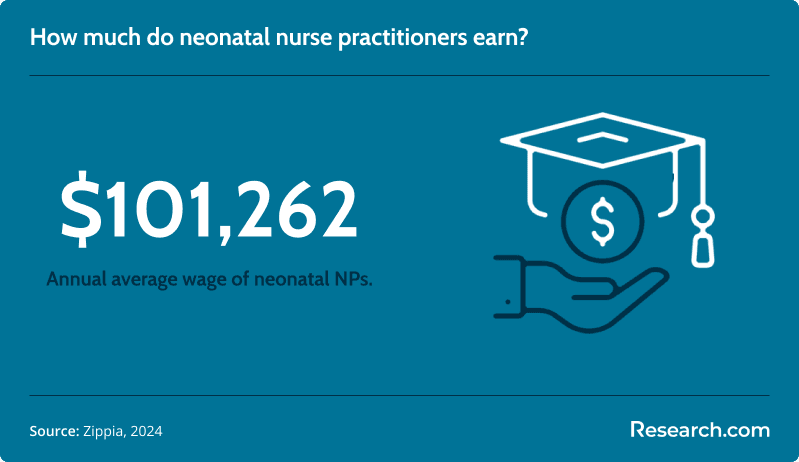
- Neonatal nurse practitioners earn an average annual salary of $110,000 to $130,000, with variation by state, employer, experience, and setting.
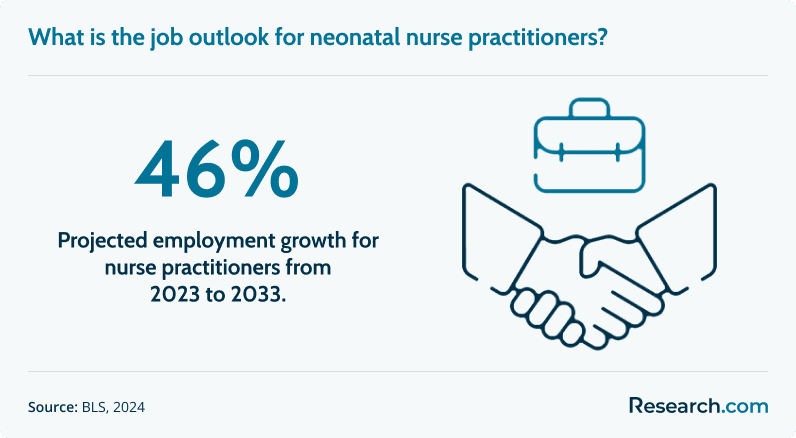
- The job outlook for nurse practitioners is projected to grow by 46% from 2023 to 2033, which is much faster than the average for other occupations.
How long does it take to complete the easiest neonatal nurse practitioner online program?
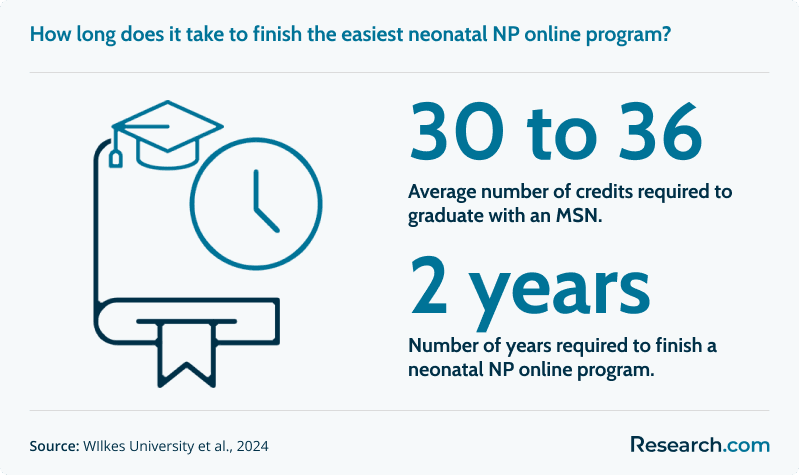
Most students complete an online neonatal nurse practitioner program in two to three years. Full-time students may finish in about two years, especially if the curriculum follows a lockstep sequence and the student can manage 40-50 credit hours without major breaks.
Part-time students often need closer to three years. This option is common among working nurses because it reduces course load pressure and makes clinical scheduling more manageable. The trade-off is a longer time before certification eligibility and potential income advancement.
If you are not yet an RN and want a shorter entry point into nursing, the easiest LPN program to get into may provide a faster starting route. LPN programs typically take one year and can serve as an early step before pursuing RN, BSN, and graduate nursing credentials.
Clinical hours also affect timing. Many programs require 500 to 700 clinical hours, and your ability to secure approved sites and preceptors can speed up or delay graduation. Some nurses also compare neonatal pathways with alternatives such as a 12 month FNP program if they want a broader family practice route rather than a neonatal-focused career.
| Enrollment pace | Typical completion time | Best for | Main drawback |
| Full-time | About two years | Nurses who can reduce work hours or handle a heavy academic load | Less flexibility and higher weekly workload |
| Part-time | About three years | Working nurses balancing employment, family, and clinical hours | Longer time to graduation and certification eligibility |
| Accelerated or bridge route | Varies by prior credits and program design | RNs with strong prior preparation and clear schedules | Can be intense and may limit recovery time between courses |
How does the easiest neonatal nurse practitioner online program compare to an on-campus program?
Online and campus-based neonatal nurse practitioner programs can lead to similar academic goals, but the student experience differs significantly. Online study is usually better for nurses who need flexibility, while campus programs may offer more face-to-face structure and easier access to local faculty networks.
| Factor | Online program | On-campus program | Best choice if... |
| Schedule | More flexible, often with asynchronous coursework | More fixed class times and campus attendance | Choose online if you work variable shifts |
| Cost impact | May reduce commuting, relocation, and housing expenses | May require travel or relocation costs | Choose online if local access is limited |
| Learning style | Requires self-direction and comfort with digital tools | Provides more in-person structure | Choose campus if you prefer live classroom interaction |
| Clinical placement | May require more student involvement in finding sites | May have stronger nearby clinical networks | Choose the program with better placement support |
| Networking | Often virtual through webinars, discussion forums, and online groups | More frequent in-person peer and faculty interaction | Choose campus if local professional connections are a priority |
Students comparing flexible graduate options outside nursing may also review the easiest social work masters programs, especially if they are weighing healthcare-adjacent careers that involve family support, case coordination, or patient advocacy.
What is the average cost of the easiest neonatal nurse practitioner online program?
For programs requiring 40 to 50 credit hours, tuition often falls between $20,000 and $60,000. This estimate does not always include program fees, clinical placement fees, technology fees, books, background checks, immunizations, travel to clinical sites, or certification exam expenses. Some schools add $1,000 to $3,000 in additional fees, so the listed tuition rate is only part of the total cost.
| Cost item | What to check before enrolling |
| Tuition per credit | Confirm whether the rate differs for in-state, out-of-state, online, MSN, or NP courses |
| Required credits | Multiply tuition by total credits, not just core nursing credits |
| Clinical fees | Ask whether the school charges placement, preceptor, lab, or compliance fees |
| Travel expenses | Estimate mileage, lodging, parking, and possible campus intensives |
| Certification and licensure | Budget for exam, application, background check, and state licensing costs |
What are the financial aid options for students enrolling in the easiest neonatal nurse practitioner online program?
Graduate nursing students may use several funding sources, including federal aid, scholarships, employer benefits, and loans. Similar options are often available to students comparing related NP tracks such as the cheapest PMHNP programs.
- Federal Student Aid: Submit the FAFSA to determine eligibility for federal loan options. Graduate students may qualify for Direct Unsubsidized Loans and PLUS Loans.
- Scholarships: Nursing associations, employers, foundations, and schools may offer awards for graduate nursing students. Some are based on specialty, location, service commitment, or academic merit.
- Employer tuition reimbursement: Hospitals and healthcare systems may help pay for advanced nursing education, often in exchange for continued employment after graduation.
- State-based grants and scholarships: Some states provide financial incentives for nurses who agree to work in underserved or high-need areas.
- Loan repayment programs: Programs such as the Nurse Corps Loan Repayment Program may repay part of qualifying student loans for nurses serving in eligible shortage areas.
- Private loans: Private lenders can fill funding gaps, but interest rates and repayment protections may be less favorable than federal options.
- Professional associations: Groups such as the American Association of Nurse Practitioners (AANP) may offer competitive scholarships or professional development support.
What are the prerequisites for enrolling in the easiest neonatal nurse practitioner online program?
Admission requirements vary, but neonatal nurse practitioner programs are graduate-level clinical programs. Schools want evidence that you can handle advanced coursework and safely build toward independent or collaborative advanced practice responsibilities.
- Active RN license: Applicants are usually required to hold an active, unrestricted registered nurse license.
- BSN or bridge eligibility: A Bachelor of Science in Nursing is the most common entry requirement. Some schools offer RN-to-MSN or ADN-to-MSN pathways. If you are much earlier in your healthcare journey, a 6 week medical assistant program may introduce patient care basics, but it does not replace RN or BSN preparation.
- Clinical nursing experience: Many programs expect 1 to 2 years of experience, preferably in neonatal, pediatric, maternal-child, or intensive care settings.
- Minimum GPA: A GPA around 3.0 is often expected, though requirements differ by school.
- Prerequisite coursework: Anatomy, physiology, pharmacology, statistics, and health assessment may be required before or during admission review.
- Professional certifications: Credentials such as Basic Life Support (BLS) or Neonatal Resuscitation Program (NRP) may strengthen an application or be required before clinical placement.
Is the program accredited and does it meet professional licensure requirements?
Accreditation is one of the first things to verify. A recognized nursing accreditation, such as Commission on Collegiate Nursing Education (CCNE) or Accreditation Commission for Education in Nursing (ACEN), indicates that a program has been reviewed against accepted academic and professional standards. Accreditation can also affect certification eligibility, financial aid access, transferability, clinical site approval, and employer confidence.
Licensure is separate from accreditation. Before enrolling, ask whether the program meets nurse practitioner education requirements in your state and whether graduates are eligible for the relevant national certification pathway. State rules can differ, especially for online students completing clinical hours across state lines. If you are still comparing nursing degree value more broadly, salary information for BSN-prepared nurses is available in this guide to BSN nurse salary.
What skills are essential for excelling as a neonatal nurse practitioner?
Neonatal nurse practitioners need advanced clinical judgment, emotional steadiness, precise communication, and the ability to act quickly when newborns deteriorate. The role requires far more than technical knowledge. NNPs often support families during frightening moments, coordinate with neonatologists and bedside nurses, interpret complex patient data, and make decisions in high-pressure environments.
- Advanced assessment: Recognizing subtle changes in newborn respiratory status, feeding tolerance, perfusion, infection risk, and neurological presentation.
- Medication safety: Understanding neonatal dosing, drug interactions, and infant-specific pharmacology.
- Family communication: Explaining complex care plans with empathy and clarity.
- Team coordination: Working closely with physicians, nurses, respiratory therapists, pharmacists, social workers, and lactation specialists.
- Technology readiness: Using electronic health records, remote learning platforms, telehealth tools, and simulation software effectively.
- Adaptability: Responding calmly to rapid clinical changes and evolving protocols.
Nurses comparing compensation across specialties may also find it useful to review the highest paid nurse practitioner roles.
How is clinical training integrated into an online neonatal nurse practitioner program?
Online programs deliver didactic coursework remotely, but clinical training takes place in person. Students complete supervised practicum hours with approved preceptors in appropriate healthcare environments. Schools may also use virtual simulation, unfolding case studies, skills intensives, or remote faculty conferences to connect theory with patient care.
The strongest online programs do not leave clinical placement entirely to the student. Before applying, ask whether the school identifies sites, approves student-proposed sites, provides preceptor agreements, or has dedicated placement coordinators. If you are exploring doctoral pathways after the MSN, compare timeframes with the shortest DNP program options.
What courses are typically in the easiest neonatal nurse practitioner online program?
Course names vary, but the curriculum should prepare students for advanced newborn assessment, diagnosis, treatment planning, family education, and clinical leadership. Common courses include:
- Advanced Physiology and Pathophysiology: Examines normal body function and disease processes, with emphasis on how illness affects organ systems relevant to neonatal care.
- Pharmacology for Advanced Practice Nurses: Covers medication selection, dosing, interactions, and safety considerations for advanced nursing practice, including infant and pediatric concerns.
- Neonatal Health Assessment: Trains students to assess newborn growth, development, respiratory status, feeding, neurological signs, and indicators of complications.
- Neonatal Intensive Care Management: Focuses on critically ill newborns, including respiratory support, infection prevention, nutrition, stabilization, and NICU care coordination.
- Ethics and Policy in Healthcare: Explores ethical decision-making, family involvement, regulatory issues, and policy questions affecting newborn and pediatric care.
- Clinical Practicum in Neonatal Nursing: Provides supervised hands-on experience applying advanced practice skills in approved clinical settings.
- Family-Centered Care in Neonatology: Teaches communication, psychosocial support, shared decision-making, and family education during neonatal treatment.
How can non-nursing majors transition into neonatal nurse practitioner programs?
Non-nursing majors cannot usually enter neonatal nurse practitioner practice directly without first becoming registered nurses. The usual progression is to complete nursing prerequisites, earn an RN-qualifying degree, pass the NCLEX, gain clinical experience, and then apply to graduate nursing programs. Some schools offer accelerated or direct-entry routes for students with non-nursing bachelor’s degrees, but these still include nursing foundations, clinical training, and RN preparation.
If you already hold a bachelor’s degree in another field, review direct entry MSN programs for non nursing majors online to understand how these pathways are structured and what clinical expectations they include.
What support services and mentorship opportunities are offered?
Support can determine whether an online program feels manageable or isolating. Look for schools that provide academic advising, faculty office hours, writing support, technology help, certification preparation, career counseling, and clinical placement guidance. Mentorship also matters because neonatal practice is specialized and emotionally demanding.
Strong programs may offer peer cohorts, alumni connections, virtual networking events, preceptor matching assistance, and faculty-led professional development. Nurses still building toward graduate study may also compare cheap RN to BSN online programs that provide flexible support at the bachelor’s level.
Are neonatal nurse practitioner salaries competitive compared to other advanced practice roles?
Neonatal nurse practitioner salaries can be competitive because the work requires specialized knowledge, high-stakes decision-making, and advanced clinical preparation. Compensation may fall in the mid-$130,000 range in some settings, but it varies by region, employer, certification, shift differentials, experience, and whether the role is hospital-based, outpatient, academic, or administrative.
When comparing advanced practice nursing specialties, look at more than annual pay. Consider schedule demands, call requirements, emotional intensity, patient population, state scope of practice, and long-term advancement. For another specialty salary comparison, review this resource on DNP psych salary.
Can I accelerate my path to becoming a neonatal nurse practitioner?
You may be able to shorten the path if you already have RN licensure, strong academic preparation, relevant NICU or pediatric experience, and transferable credits. RN-to-MSN, ADN-to-MSN, and accelerated BSN-to-MSN pathways may reduce duplicated coursework, but faster is not always better. Neonatal practice requires clinical confidence, and rushing through prerequisites or clinical experiences can create gaps.
To move efficiently, request a transcript evaluation early, ask about transfer credit limits, confirm whether clinical hours can be completed near your location, and choose a program with clear course sequencing. Nurses who still need a BSN may compare the fastest RN to BSN online options before applying to graduate programs.
How are student success and program effectiveness measured?
Program quality should be judged with evidence, not marketing language. Ask schools for licensure or certification exam pass rates, graduation rates, clinical placement outcomes, student satisfaction data, employer feedback, and job placement information. Programs that track and publish outcomes make it easier for applicants to evaluate risk.
Also ask how often the curriculum is reviewed, whether faculty maintain current clinical expertise, and how student performance is assessed during practicum. If you are comparing earlier nursing pathways, an accelerated BSN program may offer similar outcome metrics to review.
What challenges might I face in an online neonatal nurse practitioner program?
The biggest challenges are time pressure, clinical placement logistics, complex coursework, and limited in-person connection. Online students must manage readings, assignments, simulations, exams, clinical schedules, employment, and family responsibilities at the same time. Technology issues and communication delays can add stress.
Plan ahead by building a weekly study schedule, confirming clinical placement procedures before enrollment, staying in regular contact with advisors, and forming a peer support group. If cost is the main concern and you are still progressing through nursing levels, reviewing cheap online LPN to RN programs may help you compare more affordable educational steps.
How does integrating women's health training benefit neonatal care practice?
Women’s health knowledge can strengthen neonatal care because newborn outcomes are closely connected to pregnancy, delivery, maternal health, and family support. Understanding perinatal complications, maternal risk factors, lactation, postpartum recovery, and care coordination can help neonatal providers communicate more effectively with maternal health teams.
Some nurses choose to broaden their scope by studying related fields such as women’s health. If that pathway interests you, compare accelerated womens health nurse practitioner MSN programs to understand how the curriculum differs from neonatal-focused preparation.
How can I engage in research during my neonatal nurse practitioner online program?
Research experience can help you become a stronger evidence-based clinician. Online students may participate in faculty projects, quality improvement initiatives, literature reviews, data analysis assignments, capstone projects, or practice-change proposals. Digital libraries and online research portals make it possible to build research skills even without frequent campus visits.
Ask whether the program offers faculty mentorship, publication opportunities, poster presentations, research practicums, or access to neonatal quality improvement projects. Students still choosing where to begin their nursing education can also review easy nursing schools.
What types of specializations are available in the easiest neonatal nurse practitioner online program?
Specializations help students align graduate training with specific career goals. Availability varies widely, and not every online MSN or NP program includes a neonatal concentration. Confirm the exact population focus before enrolling.
- Neonatal Critical Care: Focuses on premature, medically fragile, or critically ill newborns in NICU settings. Topics may include respiratory support, stabilization, nutrition, infection control, and surgical collaboration.
- Pediatric-Neonatal Health: Connects newborn care with broader pediatric assessment and management, which may appeal to nurses who want a wider child health focus.
- Developmental and Behavioral Neonatology: Emphasizes long-term developmental monitoring, behavioral concerns, growth delays, and outcomes for infants born prematurely or with complex conditions.
- Family-Centered Neonatal Care: Prepares nurses to support families through communication, education, emotional support, and shared decision-making during newborn treatment.
- Neonatal Nurse Educator: Supports nurses who want to teach, mentor, or train neonatal care teams. An affordable online master's degree in communications may complement this path for professionals who want stronger teaching, leadership, or public-facing communication skills.
The chart below lists the most common industries for neonatal nurse practitioners, as published by Zippia in 2024.
How to choose the best and easiest neonatal nurse practitioner online program?
The best program is the one that meets your professional goal, state requirements, budget, schedule, and clinical training needs. Do not choose based only on the word “online” or “easy.” Neonatal advanced practice is specialized, and the wrong program can cost time and money without leading to the role you want.
- Confirm accreditation: Check whether the program is accredited by a recognized body such as the Commission on Collegiate Nursing Education (CCNE).
- Verify certification alignment: Ask whether graduates are eligible for the neonatal NP certification pathway you intend to pursue.
- Review admission standards: Make sure your RN license, degree level, GPA, work experience, and prerequisites match the requirements.
- Calculate total cost: Include tuition, fees, travel, clinical expenses, books, certification, and potential lost work hours.
- Ask about clinical placement: Find out whether the school provides placement support or expects students to secure their own sites.
- Compare schedules: Decide whether full-time, part-time, asynchronous, cohort-based, or accelerated study fits your life.
- Evaluate faculty and student support: Look for neonatal expertise, responsive advising, certification preparation, and mentorship.
| Question to ask | Why it matters |
| Does the program have a dedicated neonatal NP track? | Some online MSN programs are related to nursing advancement but do not prepare students specifically for neonatal NP certification. |
| Will the program meet my state’s licensure requirements? | State authorization and NP rules can vary for online students. |
| Who finds clinical sites and preceptors? | Clinical placement delays can postpone graduation. |
| What are the certification pass rates and graduation rates? | Outcomes help you judge program effectiveness. |
| Are there campus visits or skills intensives? | Travel requirements can affect cost and scheduling. |
Common Mistakes to Avoid When Choosing an Online Neonatal Nurse Practitioner Program
- Assuming every online MSN leads to neonatal NP practice: Verify the population focus and certification route before applying.
- Checking tuition but ignoring fees: Clinical fees, travel, books, and certification costs can change the real price.
- Overlooking accreditation: Non-accredited programs may create problems with certification, licensure, financial aid, or employment.
- Waiting too long to plan clinical placements: Preceptor shortages can delay progress, especially in specialized neonatal settings.
- Choosing only by speed: A faster program is not useful if it leaves you underprepared or does not meet state requirements.
- Relying only on rankings: Rankings can help narrow options, but your decision should also include licensure fit, clinical support, cost, and outcomes.
What career paths are available for graduates of the easiest neonatal nurse practitioner online program?
Graduates may pursue clinical, educational, leadership, research, and care coordination roles, depending on their certification, state scope of practice, clinical experience, and employer needs.
- Neonatal Intensive Care Unit (NICU) Practitioner: Provides advanced care for premature, critically ill, or medically complex newborns in NICU settings.
- Pediatric Nurse Practitioner: Some graduates broaden their work to include infants and children in hospitals, clinics, or outpatient settings, depending on training and certification.
- Clinical Researcher: Supports neonatal studies, quality improvement projects, or clinical trials aimed at improving newborn outcomes.
- Hospital Administrator or Manager: Uses clinical expertise to improve care systems, staffing, protocols, and policy. Additional training such as a public policy degree online may support healthcare policy or leadership goals.
- Nursing Educator: Teaches neonatal nursing concepts to students, staff nurses, or interprofessional care teams.
- Home Healthcare Specialist: Helps families care for newborns after discharge, with emphasis on education, monitoring, and coordinated follow-up.
If you are comparing helping professions outside advanced nursing, this guide to social worker vs. therapist explaining the differences explains how education, licensing, and scope of practice differ.
What advanced certifications and professional development opportunities are available?
Additional credentials can strengthen a neonatal nurse practitioner’s expertise and career mobility. Depending on role requirements, nurses may pursue training in neonatal resuscitation, advanced pediatric life support, quality improvement, leadership, informatics, education, or specialized clinical procedures. Continuing education through workshops, conferences, webinars, and professional associations helps practitioners stay current as protocols, technology, and patient care standards evolve.
Professional development does not have to stay within one specialty. Some nurses broaden their long-term options by studying adjacent populations and aging-related care, including careers in gerontology, especially if they are interested in leadership, education, or family-centered systems of care across the lifespan.
What is the job market for graduates with a neonatal nurse practitioner degree?
The broader nurse practitioner labor market is strong. According to BLS projections, nurse practitioner roles are expected to grow by 46% between 2023 and 2033, representing about 135,500 new jobs. Neonatal nurse practitioners may benefit from demand in hospitals, outpatient clinics, and home healthcare services that support newborns, premature infants, and families after discharge.
Still, job availability varies by region, employer, NICU level, state practice authority, and local workforce supply. Before choosing a program, review job postings in your target area and note required certifications, years of NICU experience, schedule expectations, and preferred degree level.
Current Trends Affecting Online Neonatal Nurse Practitioner Education
- Greater use of simulation: Online programs increasingly rely on virtual scenarios and simulation-based learning to build clinical reasoning before students enter practicum sites.
- More competition for clinical placements: Specialized neonatal preceptors can be limited, making placement support a major program selection factor.
- Technology-enabled care: Telehealth, electronic documentation, remote monitoring, and digital learning platforms are now part of many advanced nursing workflows.
- Employer focus on readiness: Hospitals and specialty clinics often value applicants who bring relevant bedside experience, strong communication skills, and evidence-based practice training.
- Rising attention to outcomes: Students are increasingly expected to compare graduation rates, certification pass rates, placement support, and total program cost before enrolling.
Practical Steps Before You Apply
- Define your target role: Decide whether you want NICU practice, pediatric care, education, leadership, research, or another advanced nursing path.
- Confirm the exact track: Ask admissions whether the program is specifically designed for neonatal nurse practitioner preparation.
- Check accreditation and state authorization: Verify both program accreditation and whether the school can enroll students from your state.
- Request outcomes data: Ask for graduation rates, certification pass rates, clinical placement support details, and recent graduate employment information.
- Map clinical requirements: Identify possible clinical sites early and ask whether the school assists with preceptors.
- Calculate full cost: Include tuition, fees, travel, technology, books, clinical compliance, and certification expenses.
- Talk to current students or alumni: Ask about workload, faculty responsiveness, clinical placement difficulty, and whether the program delivered what was promised.
- Compare at least three programs: Use the same criteria for each school so you can make a clear decision instead of relying on marketing claims.
References:
- Bureau of Labor Statistics (2024a). 29-1171 Nurse Practitioners. Occupational Employment and Wage Statistics. BLS.
- Bureau of Labor Statistics (2024b). Nurse Anesthetists, Nurse Midwives, and Nurse Practitioners. Occupational Outlook Handbook. BLS.
- Ely, D. M. & Driscoll, A. K. (2024). Infant Mortality in the United States: Provisional Data From the 2023 Period Linked Birth/Infant Death File. Vital Statistics Surveillance Report. CDC.
- Zippia. (2024a). Neonatal Nurse Practitioner Demographics and Statistics in the US. Zippia.
- Zippia. (2024b). What is a Neonatal Nurse Practitioner and How to Become One. Zippia.
Key Insights
- The easiest online neonatal nurse practitioner program is not the least rigorous one; it is the accredited program that best fits your background, schedule, state requirements, clinical placement needs, and career goal.
- Always verify that a program actually prepares students for neonatal NP practice. Some online MSN and NP pathways support nursing advancement but do not list a dedicated neonatal track.
- Clinical placement support is a major decision factor because neonatal practice requires supervised in-person experience, even when coursework is fully online.
- Total cost should include more than tuition. Fees, travel, clinical requirements, technology, books, and certification expenses can change the real price significantly.
- The broader nurse practitioner market is projected to grow by 46% from 2023 to 2033, but local neonatal job availability depends on region, employer needs, NICU access, and certification requirements.
- Before enrolling, ask schools for accreditation status, state authorization, certification eligibility, clinical placement procedures, graduation rates, and certification pass rates.
Other Things You Should Know About Neonatal Nurse Practitioner Programs
In 2027, typical application materials for neonatal nurse practitioner online programs include a completed application form, official transcripts, a current registered nurse license, letters of recommendation, a personal statement, and proof of clinical experience. Specific requirements vary by program, so check the individual program's website for detailed information.
Most neonatal nurse practitioner online programs require at least 500 to 720 supervised clinical hours, completed in approved neonatal settings such as NICUs or newborn nurseries. Students usually arrange a clinical preceptor, and the school must approve the site before rotations can begin.


