
2027 Highest Paid Nurse Practitioner (NP) Specialties

Co-Founder and Chief Data Scientist
Choosing a nurse practitioner specialty is not just a salary decision. The highest-paid nurse practitioner specialties can offer strong earnings, expanded autonomy, and long-term career mobility, but they may also require extra certification, demanding clinical environments, irregular schedules, or a higher emotional load. For RNs, BSN students, MSN students, and practicing NPs comparing specialty tracks, the real question is: which path offers the best fit for your skills, lifestyle, location, and financial goals?
This guide breaks down the highest-paying NP specialties, what nurse practitioners do, how to become one, which states and industries pay the most, and how to evaluate work-life balance, education costs, job demand, and advancement potential before committing to a specialty.
Quick answer: Which nurse practitioner specialties pay the most?
Based on the salary figures cited in this guide, aesthetic nurse practitioners lead the list with a median annual salary of $141,375, followed by neonatal nurse practitioners at $140,610 and emergency nurse practitioners at $134,719. Pay varies by specialty, state, employer type, experience, certification, and practice setting. Nurse practitioners overall earned around $128,490 in 2023, while the profession is projected to grow by 46% from 2023 to 2033, with 135,500 new jobs projected by 2033.
Key things to know before choosing a high-paying NP specialty
- Aesthetic nurse practitioners report one of the highest median annual salaries among the specialties listed here at $141,375, while neonatal nurse practitioners follow closely at $140,610.
- Nurse practitioner employment is projected to grow by 46% from 2023 to 2033, with 135,500 new jobs projected by 2033, making the role one of the stronger advanced practice career paths in healthcare.
- California has the highest average annual salary for nurse practitioners at $161,540, followed by Nevada at $148,670, although higher pay should always be compared against housing, taxes, commuting, and licensing requirements.
- NPs are not limited to bedside or clinic-based roles. Some move into education, research, consulting, healthcare policy, administration, or business support services, where the average annual salary is $180,570.
- Interest in advanced nursing practice continues to rise: 8,862 nursing practice degrees were awarded in 2022, a 10.9% increase from the prior year.
- Highest-paying nurse practitioner specialties
- What nurse practitioners actually do
- How to become a nurse practitioner
- How to choose the right NP specialty
- Career paths for nurse practitioners
- What affects nurse practitioner earning potential?
- Top-paying states for nurse practitioners
- Ways to move into an NP role faster
- Lower-stress NP specialty options
- How advanced education can improve NP career options
- NP pathways for non-nurses
- Trends shaping nurse practitioner specialties
- Fast-track RN to BSN programs and NP preparation
- Accelerated FNP programs
- Choosing nursing education that supports NP success
- Trade-offs of high-paying NP specialties
- Salary negotiation strategies for nurse practitioners
- Affordable women’s health NP programs
- Accelerated education pathways for high-paying NP roles
- Highest-paying industries for nurse practitioners
- Nurse practitioner job market outlook
- Pay and work-life balance by specialty
- Common mistakes to avoid when choosing an NP specialty
What are the highest-paying NP specialties?
The best-paid nurse practitioner specialties tend to combine advanced clinical judgment, specialized procedures, high patient acuity, or strong market demand. Salary should not be the only deciding factor, but it is an important part of evaluating return on education, especially for nurses comparing MSN, DNP, post-master’s certificate, and specialty certification options. Broader DNP salary data can also help you compare how advanced education may affect long-term earnings.
| Rank | NP specialty | Median annual salary | Salary range | Best fit for nurses who want |
| 1 | Aesthetic nurse practitioner | $141,375 | $121,912 to $164,704 | Procedural work, client-facing care, dermatology or cosmetic medicine settings |
| 2 | Neonatal nurse practitioner | $140,610 | $118,907 to $162,427 | NICU care, high-acuity newborn care, hospital-based practice |
| 3 | Emergency nurse practitioner | $134,719 | $107,550 to $162,316 | Fast decision-making, urgent care, trauma, and unpredictable clinical cases |
| 4 | Psychiatric mental health nurse practitioner | $129,790 | $107,094 to $152,391 | Mental health diagnosis, therapy-informed care, medication management |
| 5 | Adult gerontology primary care nurse practitioner | $128,754 | $111,369 to $151,153 | Adult primary care, chronic disease management, older adult care |
| 6 | Family nurse practitioner | $126,320 | $108,916 to $147,163 | Broad primary care, flexibility, and work with patients across the lifespan |
| 7 | Oncology nurse practitioner | $122,967 | $107,880 to $139,128 | Cancer care, complex treatment planning, symptom management |
| 8 | Pediatric nurse practitioner | $118,100 | $100,715 to $138,542 | Children’s health, family education, developmental care |
| 9 | Women’s health nurse practitioner | $115,742 | $99,237 to $134,622 | Reproductive health, pregnancy-related care, preventive care for women |
| 10 | Adult gerontology acute care nurse practitioner | $109,090 | $93,146 to $130,069 | Hospital medicine, critical care, acute and complex adult conditions |
1. Aesthetic Nurse Practitioner — $141,375
Aesthetic nurse practitioners provide cosmetic and dermatology-related services such as Botox, dermal fillers, and skin rejuvenation procedures. They often work in medical spas, dermatology offices, cosmetic practices, or private clinics. This specialty can be financially attractive because services are often procedure-based and may be offered in consumer-driven settings. However, nurses considering this path should evaluate malpractice coverage, state practice rules, hands-on training quality, and the business side of aesthetic care.
2. Neonatal Nurse Practitioner — $140,610
Neonatal nurse practitioners care for premature, critically ill, or medically fragile newborns, commonly in neonatal intensive care units. The role requires comfort with high-acuity decision-making, family communication, and collaboration with neonatologists and NICU teams. The pay is strong, but the emotional intensity and shift demands can be significant.
3. Emergency Nurse Practitioner — $134,719
Emergency nurse practitioners treat urgent injuries, acute illnesses, and trauma-related conditions in emergency departments and urgent care settings. This specialty suits nurses who work well under pressure, make quick clinical decisions, and can manage unpredictable patient flow. Compensation can be competitive, but schedule variability and burnout risk should be considered.
4. Psychiatric Mental Health Nurse Practitioner — $129,790
Psychiatric mental health nurse practitioners assess, diagnose, and treat behavioral health and psychiatric conditions, including depression, anxiety, bipolar disorder, and other mental health concerns. They may work in hospitals, outpatient clinics, telehealth practices, correctional settings, community mental health centers, or private practice. Because mental health access remains a major need, this specialty can offer strong demand and flexible practice models. For location-specific comparisons, review psychiatric nurse practitioner salary by state.
5. Adult Gerontology Primary Care Nurse Practitioner — $128,754
Adult gerontology primary care nurse practitioners focus on adult and older adult patients, often managing chronic conditions, preventive care, medication plans, and age-related health concerns. They may work in primary care clinics, internal medicine offices, long-term care settings, and community-based care environments. This specialty can be a strong fit for nurses who want long-term patient relationships and a growing older adult patient population.
6. Family Nurse Practitioner — $126,320
Family nurse practitioners provide primary care across age groups, making the FNP one of the most flexible NP credentials. They often work in family medicine practices, community health centers, retail clinics, outpatient systems, and rural care settings. FNPs may not always top specialty salary lists, but their broad scope can provide strong employment flexibility.
7. Oncology Nurse Practitioner — $122,967
Oncology nurse practitioners support patients through cancer diagnosis, treatment, symptom control, medication management, survivorship care, and palliative conversations. They typically work in hospitals, cancer centers, specialty clinics, and infusion settings. This specialty can be deeply meaningful, but it often requires emotional resilience and strong communication skills.
8. Pediatric Nurse Practitioner — $118,100
Pediatric nurse practitioners care for infants, children, adolescents, and their families. Their work may include preventive care, acute illness treatment, developmental monitoring, school health coordination, and chronic condition management. This path is ideal for nurses who enjoy family-centered care and child development, even if the salary is lower than some high-acuity specialties.
9. Women’s Health Nurse Practitioner — $115,742
Women’s health nurse practitioners focus on reproductive health, gynecologic care, pregnancy-related services, menopause management, contraception counseling, and preventive screenings. They commonly work in OB-GYN practices, women’s health clinics, family planning organizations, and community care settings. Nurses drawn to advocacy, preventive care, and longitudinal patient relationships may find this specialty rewarding.
10. Adult Gerontology Acute Care Nurse Practitioner — $109,090
Adult gerontology acute care nurse practitioners treat adults and older adults with serious, complex, or rapidly changing conditions. They often practice in hospitals, intensive care units, specialty services, and critical care environments. Although the listed median salary is lower than several other specialties in this guide, the role can offer advanced clinical responsibility and strong hospital-based career mobility.
Nursing is not the only advanced clinical pathway for professionals interested in diagnosis, treatment planning, and patient care. If you are comparing NP and PA routes, Research.com’s guide on how many years to become a physician assistant can help you understand how the physician assistant pathway differs.
The highest-paying nurse practitioner specialty is not automatically the best specialty for every nurse. The right choice depends on the patient population you want to serve, the type of clinical pressure you can sustain, the schedule you want, and the education or certification you are willing to complete.
What do nurse practitioners do?
Nurse practitioners are advanced practice registered nurses who assess patients, diagnose conditions, order and interpret tests, prescribe medications where authorized, manage treatment plans, and provide preventive care. Their day-to-day work depends heavily on specialty, employer, and state scope-of-practice rules. According to O*NET, the role requires advanced nursing practice skills, including clinical evaluation, patient education, documentation, and coordination with other healthcare professionals.
Common nurse practitioner responsibilities include:
- Completing health histories, physical exams, and clinical assessments.
- Diagnosing acute and chronic conditions within the NP’s scope of practice.
- Creating treatment plans and adjusting them as patient needs change.
- Prescribing medications and monitoring response, side effects, and adherence.
- Teaching patients and families about prevention, disease management, and follow-up care.
- Working with physicians, nurses, pharmacists, therapists, social workers, and other clinicians.
- Performing procedures such as suturing or intravenous line placement when permitted by specialty training and state regulations.
NPs work in hospitals, outpatient clinics, private practices, urgent care centers, long-term care facilities, telehealth settings, specialty practices, and community health organizations. Salary also differs by education level and role. If you are comparing graduate nursing options, this guide to how much MSN graduates make may help you evaluate earning potential beyond entry-level RN roles.
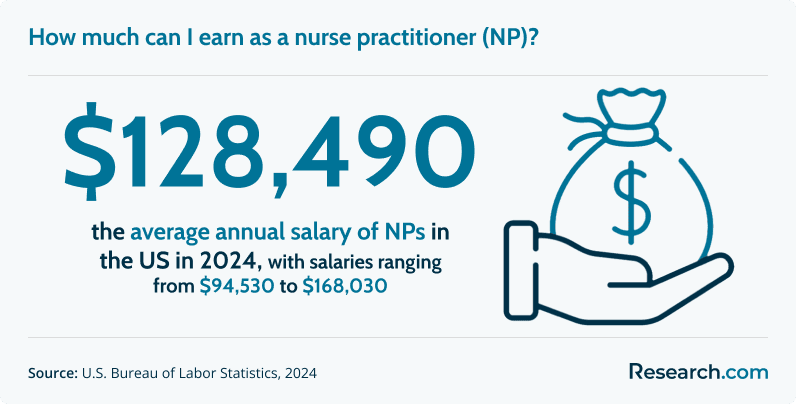
Across nurse practitioner roles, NPs in the United States earned around $128,490 in 2023.
How do you become a nurse practitioner?
To become a nurse practitioner, you generally need RN licensure, graduate-level nurse practitioner education, supervised clinical experience, national certification in a population focus or specialty, and state authorization to practice. The route can vary depending on whether you already hold a BSN, are an RN without a BSN, or have a non-nursing bachelor’s degree. For a deeper timeline breakdown, see Research.com’s guide on how to be a nurse practitioner.
| Pathway | Who it is designed for | Typical length stated | Key consideration |
| BSN to MSN or DNP | Registered nurses who already hold a BSN | Two to four years | Common route for nurses who want a traditional graduate NP pathway |
| Accelerated RN to MSN | RNs who do not yet have a BSN | Three to four years | Combines undergraduate and graduate coursework |
| Direct-entry MSN | Applicants with a non-nursing bachelor’s degree | Two to three years | Intensive option that requires careful licensure and clinical placement review |
| Graduate certificate in nurse practitioner | MSN-prepared nurses seeking an NP specialty | One to two years | Focused route for nurses who already have graduate nursing preparation |
Students looking for lower-cost options can compare cheapest online nurse practitioner programs, but affordability should be weighed against accreditation, clinical placement support, certification exam preparation, faculty expertise, and state authorization. Online coursework can be flexible, but every NP pathway still requires supervised clinical experience.
From undergraduate preparation to NP practice, the full transition often takes six to eight years. The average age of nurse practitioners was 42.6 years in 2022, which shows that many NPs enter advanced practice after building experience in RN roles first.
How do you choose your nurse practitioner specialty?
The right NP specialty should match your clinical interests, preferred patient population, tolerance for stress, desired schedule, local job market, and willingness to complete specialized training. A specialty that pays more but drains you emotionally or limits your location options may not be the strongest long-term choice.
| Decision factor | Why it matters | Questions to ask yourself |
| Patient population | NP certification is often tied to the type of patients you are trained to treat. | Do I want to work with newborns, children, adults, older adults, families, women, or mental health patients? |
| Clinical setting | Hospital, outpatient, telehealth, emergency, and private practice jobs can feel very different. | Do I prefer predictable clinic days, acute care intensity, or a procedural environment? |
| Schedule | Some roles involve nights, weekends, call, holidays, or rotating shifts. | What schedule can I sustain for several years? |
| Salary and debt | Higher pay can help offset graduate school costs, but income is not guaranteed. | How much will the program cost, and what salary range is realistic in my region? |
| Certification and licensing | State rules and national certification requirements affect employability. | Will this program qualify me for certification and practice in the state where I plan to work? |
| Long-term mobility | Some specialties are broad, while others are narrower but more lucrative. | Do I want flexibility across settings or deep expertise in one niche? |
If you are still completing earlier nursing education and need flexible study options, affordable online colleges may be worth comparing. Just make sure any nursing program you consider supports your eventual licensure, transfer, and graduate admission goals.
What are the career paths available for nurse practitioners?
Many nurse practitioners begin in direct patient care, but the NP credential can also support advancement into leadership, teaching, research, policy, administration, consulting, and entrepreneurship. The best path depends on whether you want to remain clinically focused or move into broader healthcare influence.
- Clinical practice and specialty care: NPs can build careers in primary care, acute care, psychiatry, pediatrics, women’s health, oncology, emergency care, aesthetic medicine, and other specialty settings.
- Clinical leadership: Experienced NPs may supervise care teams, lead quality improvement initiatives, coordinate complex patient services, or help design clinical workflows.
- Education and academia: Some NPs teach in nursing programs, mentor students, supervise clinical learning, or contribute to curriculum development.
- Healthcare administration: NPs interested in operations may move into management roles involving staffing, budgeting, patient care standards, compliance, and service delivery.
- Research and innovation: Research-focused NPs may contribute to clinical studies, evidence-based practice initiatives, health outcomes projects, or academic research teams.
- Entrepreneurship and consulting: Some NPs open practices where permitted, launch aesthetic or specialty clinics, advise healthcare organizations, or develop services that improve patient care.
Additional education can support nontraditional NP roles. For example, an affordable online public health degree may strengthen preparation for population health, policy, community health, program management, or healthcare leadership positions.
Employment settings also matter. In 2023, the largest NP employment groups included offices of physicians, with 137,030 NPs, and general medical and surgical hospitals, with 61,740 NPs. The chart below shows industries with the highest level of nurse practitioner employment in 2023.
What factors influence the earning potential of nurse practitioner specialties?
Nurse practitioner salary is shaped by more than specialty alone. A high-paying specialty in a low-demand region may not outperform a broader specialty in a competitive market. Before choosing a program or certification track, evaluate the full compensation picture.
- Specialty: Niche, procedural, high-acuity, or shortage-driven specialties often pay more. Aesthetic, neonatal, emergency, and psychiatric mental health roles are examples from the salary list above.
- Location: State, city, rural demand, employer competition, and cost of living can all influence compensation. Higher salaries in expensive states may not always mean higher disposable income.
- Experience: New graduates typically have less leverage than NPs with years of practice, specialty expertise, leadership experience, or a strong patient panel.
- Practice setting: Hospitals, private practices, specialty clinics, business support services, home health, and residential mental health or substance abuse facilities may offer different pay structures.
- Education and credentials: MSN, DNP, post-master’s certificates, specialty certification, procedural training, and leadership preparation can improve competitiveness for advanced roles.
- Scope-of-practice environment: State practice authority and employer policies can affect autonomy, job responsibilities, and compensation models.
If you are still early in your nursing education, choosing a future specialty does not mean locking yourself into one job forever. It means using your BSN, RN experience, clinical rotations, and graduate program research strategically. Students comparing affordable RN to BSN online programs can start by looking at transfer policies, graduate school placement, and whether the program prepares them well for advanced nursing coursework.
Which states pay nurse practitioners the most?
Nurse practitioner pay differs by state because of labor demand, employer competition, cost of living, reimbursement patterns, healthcare access needs, and state practice rules. California has the highest average annual salary for NPs at $161,540, followed by Nevada at $148,670. High-paying states can be attractive, but relocation decisions should factor in housing costs, commuting, taxes, family needs, and whether your certification meets state requirements.
Several states also have strong job growth projections. Arizona is projected to see a 71.3% increase in NP jobs by 2032, equal to 860 new positions. New Mexico is projected at 64.8%, with 200 openings, while Arkansas is projected at 61.3%, with 360 openings. Texas is projected at 60.0%, with 2,240 openings, and California is projected at 58.6%, with 2,500 openings.
For nurses weighing relocation, the best state is not always the one with the highest salary. A stronger choice may be the state where your specialty is in demand, your scope of practice supports your goals, and your net income remains strong after major living expenses. The chart below shows additional state salary details.
What strategies can accelerate your transition to a nurse practitioner role?
Moving from RN to nurse practitioner can be faster when you plan backward from the specialty, certification, and state where you want to practice. Start by confirming whether you need a BSN, MSN, DNP, bridge program, or post-master’s certificate. Then compare programs by accreditation, clinical placement support, full-time versus part-time pacing, transfer credit rules, and certification exam preparation. Nurses exploring time-efficient routes can also review Research.com’s guide to the fastest way to become a nurse to understand how earlier nursing education choices affect future NP timelines.
Which nurse practitioner specialties are known for lower stress levels?
Lower-stress NP roles are usually those with more predictable schedules, lower patient acuity, fewer emergency decisions, and manageable administrative demands. Some outpatient family practice, women’s health, school-based, telehealth, or preventive care roles may feel more sustainable than emergency, acute care, or NICU settings, although stress depends heavily on employer, staffing, patient volume, and personal fit. If lifestyle is a major priority, compare specialty pay with schedule stability, emotional intensity, call requirements, and documentation load. For broader nursing career comparisons, see Research.com’s resource on least stressful nursing specialties.
How can advanced education elevate your nurse practitioner career?
Advanced education can expand clinical confidence, improve eligibility for leadership roles, and support movement into specialized practice, administration, policy, teaching, or evidence-based practice work. DNP programs, in particular, may include advanced clinical leadership, quality improvement, health systems, policy, and practice-focused scholarship. Working nurses who need flexibility can compare online DNP programs, but they should verify accreditation, clinical requirements, state authorization, faculty support, and whether the degree aligns with their intended NP specialty.
Can non-nurses pursue nurse practitioner careers?
People with a non-nursing bachelor’s degree may be able to enter the nursing profession through direct-entry graduate pathways, but they should be especially careful when evaluating licensure steps. Direct-entry MSN programs online typically combine foundational nursing preparation with graduate coursework and clinical training. Before enrolling, applicants should confirm accreditation, RN licensure preparation, clinical placement structure, state approval, certification outcomes, and whether the program actually leads to the NP population focus they want.
What emerging trends are shaping the future of nurse practitioner specialties?
Several forces are changing NP career planning: telehealth, remote patient monitoring, team-based care, mental health access needs, aging populations, and employer demand for clinicians who can manage complex care efficiently. Accelerated programs, including options such as a 12-month FNP program online, may appeal to nurses who want a faster transition, but speed should never come at the expense of clinical quality, certification readiness, or licensure eligibility.
Is investing in a fast track RN to BSN program worth it?
A fast-track RN to BSN program can be worthwhile if it helps you meet graduate admission requirements sooner, reduces duplicated coursework, fits your work schedule, and supports long-term NP goals. The return depends on tuition, transfer credits, employer tuition support, time to completion, and whether the BSN program is accepted by the MSN or DNP programs you may later pursue. Nurses comparing faster bachelor’s completion routes can review RN to BSN online fast track opportunities as part of a broader NP education plan.
Can accelerated FNP programs fast-track your career?
Accelerated FNP programs can shorten the time to graduate-level preparation for nurses who are ready for intensive coursework and clinical expectations. These programs may be useful for experienced RNs who have a clear primary care goal, strong time management skills, and access to reliable clinical placement support. Before choosing accelerated FNP programs, compare graduation requirements, clinical hour expectations, certification pass preparation, faculty access, and whether the pace is realistic while working.
How can choosing the right nursing education enhance your NP career success?
Your NP career starts long before graduate school. Strong nursing education can improve your clinical foundation, strengthen graduate applications, and help you avoid costly delays caused by transfer problems or accreditation issues. When comparing schools, look beyond admission ease. Ask whether the curriculum builds strong assessment, pharmacology, pathophysiology, evidence-based practice, and clinical reasoning skills. If you are still exploring entry options, Research.com’s guide to what is the easiest nursing school to get into? can help you think through access while still prioritizing quality and licensure outcomes.
Are there trade-offs associated with high-paying NP specialties?
High-paying NP specialties often involve trade-offs. Aesthetic roles may require business development and procedure-specific training. Neonatal and emergency roles may involve high acuity, difficult outcomes, rotating shifts, or emotional strain. Psychiatric mental health practice can offer flexibility but may involve complex, emotionally demanding cases. Nurses pursuing advanced credentials should compare earnings potential against burnout risk, malpractice exposure, schedule demands, and education cost. Lower-cost doctoral options, such as cheap DNP programs, may help reduce financial pressure, but program quality and fit remain essential.
How can nurse practitioners negotiate competitive salaries?
NP salary negotiation should be based on evidence, not guesswork. Bring specialty-specific salary data, local market information, productivity expectations, certification details, and examples of clinical value you provide. Ask about base salary, bonuses, call pay, productivity incentives, continuing education funds, malpractice coverage, retirement contributions, schedule flexibility, and paid time off. Additional credentials from programs such as cheap BSN to DNP programs online may strengthen your case when they align with the employer’s needs, but the strongest negotiation strategy connects your training directly to measurable patient care, access, revenue, quality, or operational outcomes.
Are affordable women's health NP programs worth the investment?
Affordable women’s health NP programs can be a strong investment for nurses committed to reproductive health, gynecologic care, preventive services, pregnancy-related care, and women’s health across the lifespan. The value depends on accreditation, certification eligibility, clinical placement quality, faculty expertise, total cost, and employment opportunities in your region. Nurses comparing lower-cost WHNP routes can review cheapest WHNP online programs, but should confirm that affordability does not come with weak clinical support or limited state authorization.
How can accelerated education programs streamline your pathway to high-paying NP roles?
Accelerated education can reduce delays between career stages when used strategically. For example, some RN to BSN options may help working nurses complete bachelor’s requirements faster before applying to graduate NP programs. Programs such as RN to BSN online without clinicals may appeal to experienced RNs, but students should confirm transfer policies, graduate school acceptance, accreditation, and whether the program supports their long-term NP plan.
Which industries pay nurse practitioners the most?
Industry can affect NP pay as much as specialty. Some employers pay more because they require specialized knowledge, complex care coordination, procedural skills, organizational consulting, or difficult-to-staff services. Business support services report the highest average annual salary for NPs at $180,570. This category may include advisory, consulting, or organizational health-related roles where advanced clinical and business knowledge can be valuable.
Residential mental health and substance abuse facilities report an average annual salary of $158,140. These settings may require NPs to manage complex behavioral health needs, medication plans, crisis risk, and interdisciplinary care. Other settings, including business, professional, labor, political, and similar organizations, as well as home health care services, may also provide competitive opportunities depending on role requirements and location.
NPs who want to work outside traditional clinical settings may benefit from complementary graduate education in public health, leadership, informatics, or administration. Comparing affordable online masters programs can help identify options that broaden career mobility without unnecessary debt.
The chart below shows the highest-paying industries for nurse practitioners in 2023.
What is the job market for nurse practitioners?
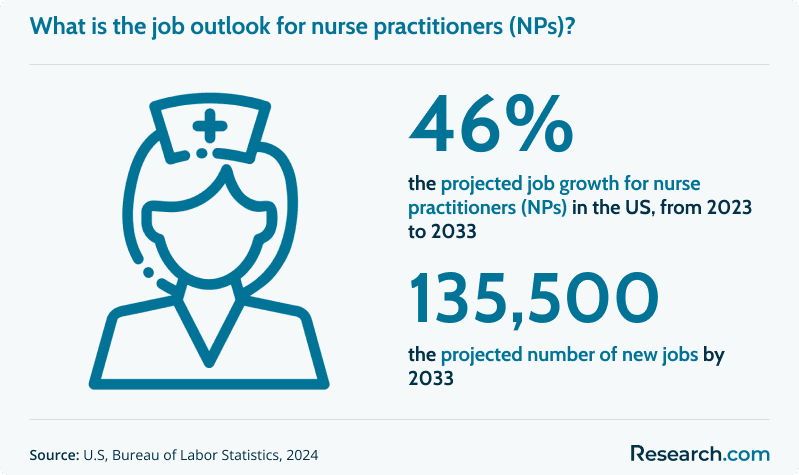
The nurse practitioner job market remains strong in the cited projections. NP employment is expected to grow by 46% from 2023 to 2033, with 135,500 new jobs projected by 2033. This demand is connected to expanded healthcare access needs, aging populations, primary care demand, and the use of advanced practice clinicians across care settings. In 2022, 8,862 nursing practice degrees were awarded, representing 10.9% growth from the previous year.
State-level growth projections also vary. Arizona is projected to increase by 71.3%, with 860 annual openings. New Mexico follows at 64.8%, with 200 openings, and Arkansas at 61.3%, with 360 openings. Texas is projected at 60.0%, with 2,240 openings, while California is projected at 58.6%, with 2,500 openings. For job seekers, these figures suggest that both specialty choice and geography can shape opportunity.
Are some specialties better for work-life balance and pay?
Yes, some NP specialties may provide a stronger balance of compensation and lifestyle, but the answer depends on the specific employer and your personal definition of balance. A high salary may not feel worthwhile if the role requires constant call, unsafe staffing, emotional overload, or a schedule that conflicts with family responsibilities.
| Specialty or setting | Potential work-life advantage | Possible drawback |
| Family nurse practitioner in outpatient care | May offer more predictable clinic hours and long-term patient relationships | Salary may be lower than some niche or high-acuity specialties |
| Psychiatric mental health nurse practitioner | May offer telehealth or private practice flexibility | Cases can be emotionally demanding and documentation-heavy |
| Aesthetic nurse practitioner | May provide schedule control in private practice or med spa settings | Income can depend on market demand, procedures, and business development |
| Neonatal or emergency nurse practitioner | High clinical impact and competitive pay | May involve intense acuity, shift work, and emotional stress |
| Women’s health or preventive care roles | May offer more structured outpatient schedules | Pay may vary widely by employer and region |
The best work-life balance usually comes from alignment: the patients you want to serve, the setting you enjoy, the schedule you can maintain, and the compensation you need. For many NPs, a slightly lower-paying specialty with healthier working conditions can be the better long-term decision.
Common mistakes to avoid when choosing an NP specialty
- Choosing only by salary: High pay can come with high acuity, irregular hours, added liability, or emotionally difficult work.
- Ignoring accreditation: Graduate nursing programs should be evaluated carefully because accreditation can affect financial aid, certification eligibility, transfer options, and employer acceptance.
- Assuming every online program works in every state: State authorization, clinical placement rules, and licensure requirements vary. Confirm before enrolling.
- Underestimating clinical placement issues: A flexible online program is not helpful if you cannot secure appropriate clinical experiences.
- Focusing only on tuition: Total cost also includes fees, books, travel, lost work time, certification exams, background checks, and clinical requirements.
- Relying only on rankings: Rankings can help you build a shortlist, but your final decision should include licensure fit, specialty preparation, faculty support, graduation outcomes, and clinical partnerships.
- Assuming salary outcomes are guaranteed: Published salary figures are useful benchmarks, not promises. Your earnings depend on location, experience, employer, schedule, certification, and negotiation.
Questions to ask before enrolling in an NP program
- Is the program accredited and accepted for NP certification in my intended specialty?
- Will the program meet licensure requirements in the state where I plan to practice?
- Who is responsible for finding clinical placements?
- What certification exam does the program prepare graduates to take?
- How many clinical hours are required, and where can they be completed?
- What is the total program cost after fees, travel, books, and lost work time?
- Can I attend part-time while working, or is the pace too intensive?
- Does the curriculum match the patient population I want to serve?
- What support is available for working nurses, online students, or students outside the school’s home state?
- How does the specialty’s expected salary compare with my education debt and preferred location?
Here's what nurse practitioners say about high-paying specialties
- As an aesthetic NP, I value both the income potential and the chance to help clients feel more comfortable and confident. The schedule flexibility is a major benefit, and seeing visible results from treatment makes the work satisfying. - Haley
- Psychiatric NP work has given me financial stability, but the most meaningful part is supporting people during difficult periods in their lives. Mental health care is essential, and I can see how my role affects patients and families. - Marcus
- Pediatric NP practice has been rewarding professionally and financially. Helping children recover and supporting families through care decisions gives the role a sense of purpose, and the compensation is competitive for the work involved. - Olga
Key Insights
- Aesthetic nurse practitioners have the highest median annual salary listed in this guide at $141,375, followed by neonatal nurse practitioners at $140,610 and emergency nurse practitioners at $134,719.
- Nurse practitioner employment is projected to grow by 46% from 2023 to 2033, with 135,500 new jobs projected by 2033.
- California is the top-paying state in the cited data, with an average annual NP salary of $161,540, but cost of living can reduce the real advantage of a higher salary.
- Business support services report the highest average annual industry salary for NPs at $180,570.
- The average annual salary of NPs in the US in 2023 is $128,490.
- Arizona and New Mexico show especially strong projected NP job growth, at 71.3% and 64.8%, respectively, from 2022 to 2032.
- The best NP specialty is not necessarily the highest-paid one. Strong decisions balance salary, specialty demand, education cost, clinical fit, schedule, burnout risk, and state licensure requirements.
References:
- U.S. Bureau of Labor Statistics. (2024). Nurse anesthetists, nurse midwives, and nurse practitioners. BLS. Retrieved December 10, 2024, from BLS.
- U.S. Bureau of Labor Statistics. (2024). Occupational employment and wages, May 2023 - 29-1171 Nurse practitioners. BLS. Retrieved December 10, 2024, from BLS.
- Salary.com. (2024). Adult gerontology acute care nurse practitioner. Salary.com. Retrieved December 11, 2024, from Salary.com.
- Salary.com. (2024). Adult primary care nurse practitioner. Salary.com. Retrieved December 11, 2024, from Salary.com.
- Salary.com. (2024). Aesthetic nurse practitioner salary in the United States. Salary.com. Retrieved December 11, 2024, from Salary.com.
- Salary.com. (2024). Family nurse practitioner (NP) salary in the United States. Salary.com. Retrieved December 11, 2024, from Salary.com.
- Salary.com. (2024). Neonatal nurse practitioner (NP). Salary.com. Retrieved December 11, 2024, from Salary.com.
- Salary.com. (2024). Nurse practitioner - oncology salary in the United States. Salary.com. Retrieved December 11, 2024, from Salary.com.
- Salary.com. (2024). Nurse practitioner - women's health salary in the United States. Salary.com. Retrieved December 11, 2024, from Salary.com.
- Salary.com. (2024). Psychiatric nurse practitioner (NP) salary in the United States. Salary.com. Retrieved December 11, 2024, from Salary.com.
- Salary.com. (2024). Pediatric nurse practitioner (NP) salary in the United States. Salary.com. Retrieved December 11, 2024, from Salary.com.
Other Things You Should Know About Nurse Practitioner Specialties
Certifications from nationally recognized bodies such as ANCC, AANP, and AACN can strengthen access to high-paying NP roles. Specialty credentials like ACNP-AG, FNP-BC, or PMHNP-BC are commonly preferred by employers and may support higher pay in acute care, psychiatric, and specialty practice settings.
In 2027, Psychiatric Mental Health (PMHNP) and Neonatal NPs are projected to earn the highest salaries due to increasing demand for mental health services and specialized neonatal care. These fields require advanced expertise and experience, contributing to higher earning potential.
To become a high-earning NP in 2027, you typically need a master's degree in nursing, national board certification, and experience in a high-paying specialty like anesthesiology or psychiatry. State licensure and continuing education could also be essential for maintaining high earnings.


