
2027 Best Accelerated Online Nurse Executive Leadership MSN Programs

Co-Founder and Chief Data Scientist
With more than 4.7 million registered nurses (RNs) nationwide, nurses represent the largest segment of the U.S. healthcare workforce. Their influence is growing not just at the bedside but also in boardrooms, policy discussions, and administrative decision-making.
Online nurse executive leadership MSN programs equip RNs with the knowledge and skills to lead these efforts. Graduates of these programs are prepared to take on senior roles such as clinical directors, nurse leaders, and healthcare administrators. Through these programs, they are positioned to shape the future of healthcare delivery.
In this article, we will introduce the best accelerated online nurse executive leadership MSN programs to consider. You will also find information on admissions criteria, career outcomes, salary ranges, job growth, and other relevant factors to support your next step.
What are the benefits of getting into accelerated online nurse executive leadership MSN programs?
- Accelerated online programs allow working nurses to balance coursework with professional and personal responsibilities, as well as to explore digital tools and network across healthcare systems.
- Students can apply leadership strategies and evidence-based practices directly in their clinical settings.
- Graduates of online nurse executive leadership MSN programs earn an annual salary between $70,000 and $200,000 or more, depending on the employer type, level of experience, and location.
What can I expect from accelerated online nurse executive leadership MSN programs?
Accelerated online nurse executive leadership MSN programs are designed for experienced nurses ready to move into upper-level administrative and leadership roles. These programs condense coursework into shorter academic terms, helping students earn their degrees faster than traditional formats.
Aspiring students can expect the following:
- Courses are typically delivered in six- to eight-week terms for quicker degree completion.
- Coursework emphasizes healthcare policy, organizational leadership, and systems management.
- Students develop advanced decision-making and strategic planning skills aligned with executive roles.
- Interactive online platforms support video lectures, discussion boards, and case-based assignments.
Where can I work with an online nurse executive leadership MSN?
Graduates of online nurse executive leadership MSN programs take on strategic, administrative, and operational responsibilities that directly impact patient care, team performance, and organizational success. These roles are in high demand across a variety of healthcare settings.
- Hospitals: Nurse executives manage clinical operations, oversee nursing staff, and develop policies that improve patient care quality and safety.
- Outpatient Clinics: Nurse leaders coordinate care delivery, streamline workflows, and ensure compliance with healthcare regulations.
- Long-Term Care Facilities: Nurse administrators supervise daily operations, support nursing teams, and implement care standards for elderly or chronically ill patients.
- Government Agencies: These professionals help shape public health strategies, manage healthcare programs, and advise on health policy development.
- Insurance or Managed Care Organizations: Nurse executives contribute to case management, care quality assessments, and cost-control initiatives.
How much can I make with an online nurse executive leadership MSN?
According to the U.S. Bureau of Labor Statistics, medical and health services managers—roles that graduates of online nurse executive leadership MSN programs are qualified to pursue—earn an average annual salary of $137,730. Salaries typically range from $69,680 at the 10th percentile to $219,080 at the 90th percentile.
Meanwhile, data from PayScale shows that board-certified nurse executives earn an average of $150,000 per year, with a salary range between $95,000 and $237,000.
However, a number of factors shape income levels. For instance, experience typically affects wages, with entry-level nurse leaders generally falling toward the lower end of the salary range and those with significant leadership experience commanding much higher wages.
Additional credentials, such as board certifications or specialized training, may also boost earning potential. Geographic location is another key consideration, with nurse executive administrators working in states like California, New York, or Massachusetts often earning more due to higher demand and cost of living.
Therefore, aspiring professionals should carefully weigh these variables when planning their career trajectory and evaluating potential salary outcomes.
- Best Accelerated Online Nurse Executive Leadership MSN Programs for 2027 List of Programs
- What is an accelerated online nurse executive leadership MSN program? Degree Overview
- How long does it take to complete an accelerated online nurse executive leadership MSN program? Completion Time
- What is the average cost of an accelerated online nurse executive leadership MSN program? Program Cost
- What courses are included in an accelerated online nurse executive leadership MSN program? What courses are included in an accelerated online nurse executive leadership MSN program?
- What skills are needed in an accelerated online nurse executive leadership MSN program? What skills are needed in an accelerated online nurse executive leadership MSN program?
- What is the best certification for graduates of accelerated online nurse executive leadership MSN programs? What is the best certification for graduates of accelerated online nurse executive leadership MSN programs?
- What are some time management tips for accelerated online nurse executive leadership MSN students? What are some time management tips for accelerated online nurse executive leadership MSN students?
- What career paths are available to graduates of accelerated online nurse executive leadership MSN programs? Career Paths
- What is the job market for graduates with an accelerated online nurse executive leadership MSN? Job Outlook
- Which type of nurse leadership role is best for you? Which type of nurse leadership role is best for you?
- How can I verify the accreditation and quality of my MSN program? How can I verify the accreditation and quality of my MSN program?
- Should I Pursue a DNP Instead of an MSN for Nurse Executive Leadership? Should I Pursue a DNP Instead of an MSN for Nurse Executive Leadership?
- Can NP Direct Entry Programs Enhance Your Leadership Career? Can NP Direct Entry Programs Enhance Your Leadership Career?
Best Accelerated Online Nurse Executive Leadership MSN Programs for 2027
Nurses who want to move from bedside care into administration, operations, quality improvement, or executive leadership often face a practical question: which online MSN program can help them advance without leaving the workforce for several years? Accelerated online nurse executive leadership MSN programs are designed for experienced registered nurses who need graduate-level leadership training in a shorter, more flexible format.
This guide explains how these programs work, what they cost, how long they take, which careers they can support, and how to compare options before enrolling. It also highlights programs with accelerated online formats, leadership-focused curricula, and recognized nursing or healthcare management accreditation.
Quick answer: What is the best accelerated online nurse executive leadership MSN program?
The best accelerated online nurse executive leadership MSN program depends on your timeline, budget, residency status, practicum needs, and career goal. Students looking for the shortest path may prefer programs that can be completed in 12 months, while nurses targeting senior executive roles may prioritize practicum depth, leadership accreditation, faculty expertise, and preparation for certifications such as NE-BC, NEA-BC, CNML, or CENP.
Most programs in this guide are MSN pathways in nurse leadership, nursing administration, or healthcare leadership. One listed option is an MHA program, which may be a better fit for nurses who want broader healthcare administration training rather than a nursing-specific graduate degree.
How do we rank schools?
Research.com recognizes that a graduate nursing degree affects your finances, schedule, and long-term career direction. Our ranking process uses a structured methodology designed to evaluate programs with transparency and consistency.
To strengthen the ranking, Research.com also reviews information from the Integrated Postsecondary Education Data System, Peterson’s database, including its Distance Learning Licensed Data Set, College Scorecard, and the National Center for Education Statistics (NCES). These sources help prospective students compare program structure, cost, delivery format, institutional data, and other decision-making factors.
Program comparison at a glance
| Rank | School | Program focus | Program length | Credits | Listed cost | Accreditation |
| 1 | University of Alabama in Huntsville | Nursing Executive Leadership and Administration | 12 months | 30 | $445 per credit hour | Commission on Collegiate Nursing Education (CCNE) |
| 2 | University of North Carolina Wilmington | Healthcare Administration | 12 months | 48 | $345.52 resident; $1,292.80 nonresident per credit hour | Commission on Accreditation of Healthcare Management Education (CAHME) |
| 3 | Wilmington University | Executive Leadership | 12 months | 36 | $1,611 per course | CCNE |
| 4 | Northern Kentucky University | Nurse Executive Leadership | 12 months | 33 | $600 per credit hour | CCNE |
| 5 | Northwest Missouri State University | Nurse Executive | 12 months | 30 | $407 per credit hour | National League for Nursing Commission for Nursing Education Accreditation (NLN CNEA) |
| 6 | University of North Carolina at Chapel Hill | Health Care Leadership and Administration | 18–24 months | 33 | $1,031.34 resident; $2,067.84 nonresident per credit hour | CCNE |
| 7 | Chamberlain University | Nurse Executive Leadership | 18–24 months | 36 | $720–$735 per credit hour | CCNE |
| 8 | University of Pennsylvania | Nursing and Healthcare Leadership | 20 months | 10 | $75,569 estimated total cost, part-time | CCNE |
| 9 | Stevenson University Online | Nursing Leadership/Management | 20–24 months | 36 | $641 per credit hour | CCNE |
| 10 | Benedictine University | Nurse Executive Leader | 20–24 months | 36 | $670 per credit hour | CCNE |
1. University of Alabama in Huntsville
The online MSN at the University of Alabama in Huntsville is built for nurses who want a direct path into management, administration, and leadership in healthcare organizations. The fully online format supports faster completion while helping working nurses build competencies tied to AONL and QSEN expectations.
The curriculum emphasizes communication, team-based practice, patient-centered care, cultural responsiveness, evidence-informed leadership, and the use of healthcare technology to support quality improvement.
- Program Length: 12 months
- Tracks/Concentrations: Nursing Executive Leadership and Administration
- Cost per Credit Hour: $445
- Required Credits to Graduate: 30
- Accreditation: Commission on Collegiate Nursing Education (CCNE)
2. University of North Carolina Wilmington
The online Master of Healthcare Administration program at the University of North Carolina Wilmington is a healthcare administration pathway rather than an MSN, making it most relevant for nurses who want broad leadership preparation across healthcare systems. Students study topics such as healthcare reform, population health, ethics, and evidence-based management.
The program develops skills in strategic planning, communication, data analysis, and problem-solving so graduates can help improve care delivery and organizational performance in a changing healthcare environment.
- Program Length: 12 months
- Tracks/Concentrations: Healthcare Administration
- Cost per Credit Hour: $345.52 (resident), $1,292.80 (nonresident)
- Required Credits to Graduate: 48
- Accreditation: Commission on Accreditation of Healthcare Management Education (CAHME)
3. Wilmington University
Wilmington University offers an MSN in Nurse Leadership with fully online accelerated courses and scheduling flexibility for working professionals. The program is intended for experienced nurses preparing for broader leadership authority in healthcare settings.
Students connect theory, research, ethics, policy, and systems-based care while strengthening their ability to make decisions, influence organizational practice, and lead improvement efforts. Two capstone courses allow learners to apply their leadership training to practice-based challenges.
- Program Length: 12 months
- Tracks/Concentrations: Executive Leadership
- Cost per Course: $1,611
- Required Credits to Graduate: 36
- Accreditation: CCNE
4. Northern Kentucky University
The online MSN at Northern Kentucky University uses seven-week courses and a fully online format. Its curriculum combines nursing leadership with business, psychology, informatics, and finance so students can evaluate systems, manage resources, use data, and implement evidence-based solutions.
The program includes 100 required clinical hours and a capstone practicum, giving students an opportunity to connect leadership theory with organizational change and patient outcome improvement.
- Program Length: 12 months
- Tracks/Concentrations: Nurse Executive Leadership
- Cost per Credit Hour: $600
- Required Credits to Graduate: 33
- Accreditation: CCNE
5. Northwest Missouri State University
The online MSN at Northwest Missouri State University prepares nurses to lead within regulated healthcare environments while supporting safety, quality, and organizational effectiveness. Students can shape their learning around professional goals and leadership interests.
The program includes a professional portfolio and a practice-focused capstone project. Coursework addresses human resources, conflict management, mentorship, quality improvement, and evidence-based leadership for healthcare delivery.
- Program Length: 12 months
- Tracks/Concentrations: Nurse Executive
- Cost per Credit Hour: $407
- Required Credits to Graduate: 30
- Accreditation: National League for Nursing Commission for Nursing Education Accreditation (NLN CNEA)
6. University of North Carolina at Chapel Hill
The online MSN at the University of North Carolina at Chapel Hill blends nursing leadership, policy, systems thinking, organizational management, and healthcare business knowledge. Its Health Care Leadership and Administration pathway is designed for nurses who want to lead improvement while maintaining a care-centered perspective.
Students complete 420 clinical hours through tailored placements in administration, quality improvement, and HR management. The program offers full-time and part-time options and combines asynchronous learning with live online sessions.
- Program Length: 18–24 months
- Tracks/Concentrations: Health Care Leadership and Administration
- Cost per Credit Hour: $1,031.34 (resident), $2,067.84 (nonresident)
- Required Credits to Graduate: 33
- Accreditation: CCNE
7. Chamberlain University
Chamberlain University provides an online MSN focused on preparing nurses for senior leadership responsibilities in healthcare organizations. The program uses interactive assignments, applied case studies, and reflective activities to help students connect leadership concepts with real workplace problems.
A 144-hour practicum is a major part of the program. During this experience, students work with a site mentor and interdisciplinary colleagues on a leadership or quality improvement project, building practical experience in organizational change.
- Program Length: 18–24 months
- Tracks/Concentrations: Nurse Executive Leadership
- Cost per Credit Hour: $720–$735
- Required Credits to Graduate: 36
- Accreditation: CCNE
8. University of Pennsylvania
The University of Pennsylvania offers an online 10-course MSN in Nursing and Healthcare Leadership. The program combines academic leadership theory with applied learning through cases, projects, and hands-on experiences.
Students examine organizational systems, financial evaluation, project management, design thinking, and improvement strategy. The program includes 260 hours of direct and indirect practice in core courses, plus 240 additional hours in the capstone project.
- Program Length: 20 months
- Tracks/Concentrations: Nursing and Healthcare Leadership
- Estimated Total Cost: $75,569 (part-time)
- Required Credits to Graduate: 10
- Accreditation: CCNE
9. Stevenson University Online
Stevenson University Online offers an accelerated MSN for licensed RNs with a BSN who want to move into nursing leadership and management. The fully online program is organized into six eight-week sessions, which can help working nurses plan coursework around professional and personal commitments.
Students develop applied skills in healthcare operations, organizational problem-solving, and nursing management. Small class sizes, individualized support, and online engagement are designed to help students progress while continuing their careers.
- Program Length: 20–24 months
- Tracks/Concentrations: Nursing Leadership/Management
- Cost per Credit Hour: $641
- Required Credits to Graduate: 36
- Accreditation: CCNE
10. Benedictine University
The online MSN at Benedictine University is structured for working nurses who need a flexible graduate program that supports leadership advancement. The Nurse Executive Leader track prepares students for administrative and management responsibilities in healthcare organizations.
Courses are taught by faculty with doctoral degrees and advanced certifications. The curriculum emphasizes strategic leadership, communication, budgeting, team management, and practical decision-making in healthcare settings.
- Program Length: 20–24 months
- Tracks/Concentrations: Nurse Executive Leader
- Cost per Credit Hour: $670
- Required Credits to Graduate: 36
- Accreditation: CCNE
What is an accelerated online nurse executive leadership MSN program?
An accelerated online nurse executive leadership MSN is a graduate nursing program for registered nurses who want to move into leadership, management, administration, or executive roles. Depending on the school, the program may be labeled nurse executive leadership, nursing administration, nurse leadership, healthcare leadership, or healthcare and nursing leadership.
The “accelerated” format means the program is structured for faster completion than a traditional part-time graduate pathway. Courses are commonly offered online, often in shorter terms, so working nurses can continue employment while completing leadership coursework and practicum requirements.
These programs combine advanced nursing knowledge with business and management training. Common topics include healthcare finance, quality improvement, human resources, policy, organizational behavior, informatics, strategic planning, and evidence-based decision-making.
The degree is most useful for nurses who want to lead teams, manage departments, influence policy, improve patient care systems, or prepare for higher administrative responsibility. It also overlaps with the broader benefits of organizational leadership degree pathways because students learn how to guide people, budgets, change initiatives, and complex systems.
Who should consider this degree?
- Experienced RNs seeking leadership roles: The degree can support movement into nurse manager, director, administrator, quality, informatics, or executive tracks.
- BSN-prepared nurses who want a graduate credential: Many accelerated MSN programs are built for nurses who already hold a BSN.
- Working nurses who need flexibility: Online delivery can reduce commuting and allow students to complete coursework around shifts.
- Nurses interested in systems improvement: The curriculum is strongest for learners who want to improve staffing, workflows, patient outcomes, budgets, and organizational performance.
Who may need a different path?
- Nurses who want independent advanced clinical practice: A nurse practitioner pathway may be more appropriate than a nurse executive MSN.
- Professionals seeking the highest practice doctorate: A DNP may fit better for nurses targeting top policy, systems leadership, or advanced clinical practice roles.
- Students without nursing preparation: Direct-entry or prelicensure nursing routes may be necessary before MSN-level nursing leadership study.
- Students who need a state-specific credential: Always confirm whether an online program meets your state’s licensure, authorization, practicum, or employer requirements.
How long does it take to complete an accelerated online nurse executive leadership MSN program?
Accelerated online nurse executive leadership MSN programs are often designed for completion in 12 to 20 months, although actual time depends on the school, course load, transfer credits, practicum requirements, and whether a student studies full time or part time.
Many programs use asynchronous coursework, condensed sessions, year-round enrollment, and flexible pacing to support nurses who continue working. Students should still expect a demanding schedule because accelerated graduate programs compress reading, writing, projects, and practicum work into shorter terms.
BSN-prepared students may be able to finish faster than students who need bridge coursework or additional prerequisites. According to the 2024 National Nursing Workforce Survey (Smiley et al., 2025), 47.8% of RNs across the U.S. report a BSN as their highest nursing credential, making it the most common credential and a widely used graduate nursing entry point.
The same workforce data notes that 20.6% of RNs have already completed a master’s degree. This reflects continued interest in advanced nursing education, including leadership, administration, advanced practice, and specialized clinical pathways.
| Completion factor | How it affects your timeline | What to ask before enrolling |
| Course length | Seven- or eight-week terms can speed progress but increase weekly workload. | How many courses can I take at once while working? |
| Full-time versus part-time study | Full-time study may shorten completion; part-time study may be more manageable. | Can I switch pacing if my work schedule changes? |
| Transfer credits | Approved graduate credits may reduce required coursework. | How many credits can transfer, and which courses are eligible? |
| Practicum hours | Clinical or leadership practice hours can affect scheduling and graduation timing. | Will the school help me secure a site and preceptor? |
| Start dates | Multiple annual start dates can reduce waiting time. | When is the next start date, and are courses offered every term? |
What is the average cost of an accelerated online nurse executive leadership MSN program?
Costs vary substantially by institution type, residency classification, credit requirement, and fee structure. For master’s programs broadly, tuition and fees cost $9,50 at public four-year institutions and $31,930 at private nonprofit four-year universities (Ma et al., 2024).
For many MSN programs, tuition and fees may fall between $350 and $1,700 per credit hour, and most programs require 30 to 40 credits. Public universities are often less expensive for residents, while private universities and highly selective nursing schools may charge higher rates.
Students should compare more than tuition. Online graduate nursing students may also pay technology fees, course materials, background check costs, practicum-related expenses, graduation fees, and possible travel if a program has any in-person requirements.
Accelerated online formats can reduce some indirect costs because students may avoid relocation and commuting while continuing to work. Programs such as the shortest master’s in nurse executive leadership online may also reduce the time spent paying tuition and waiting for career advancement opportunities.
Some schools charge the same online tuition rate regardless of residency, while others maintain separate resident and nonresident pricing. Certain healthcare employers may also offer tuition reimbursement, preferred partner discounts, or professional development funding.
Because the National Sample Survey of Registered Nurses (HRSA, 2024) reports that 2.2 million RNs, or 51%, have used loans to finance their education, applicants should build a full cost plan before enrolling. Compare tuition, fees, employer benefits, scholarships, repayment obligations, and the realistic salary range for your target role.
Cost factors to compare before choosing a program
| Cost factor | Why it matters | Decision tip |
| Per-credit tuition | A lower per-credit rate may not always mean a lower total cost if the program requires more credits. | Compare required credits and tuition together. |
| Resident versus nonresident pricing | Public universities may charge very different rates based on residency. | Confirm your tuition classification in writing. |
| Fees | Online, technology, clinical, and graduation fees can increase the total bill. | Ask for a full program cost sheet, not only tuition. |
| Practicum expenses | Students may need background checks, immunizations, placement documentation, or travel. | Ask who arranges placements and what costs students cover. |
| Employer reimbursement | Healthcare employers may help pay for leadership education. | Check service commitments, grade requirements, and annual limits. |
| Program speed | Finishing faster may reduce time in school but can increase short-term workload. | Balance acceleration with burnout risk. |
What courses are included in an accelerated online nurse executive leadership MSN program?
Accelerated nurse executive leadership MSN curricula usually combine advanced nursing leadership with healthcare business, systems management, quality improvement, and evidence-based practice. Students who want a more focused quality and safety pathway may also compare an accelerated MSN in healthcare quality and patient safety online.
Course names vary by institution, but many programs include the following subjects:
- Informatics for Nurse Administration: Students examine how data systems, electronic health records, analytics tools, and healthcare technologies support administrative and clinical decisions.
- Accounting and Finance: This coursework helps nurse leaders interpret budgets, evaluate costs, understand financial reports, and make resource decisions in healthcare organizations.
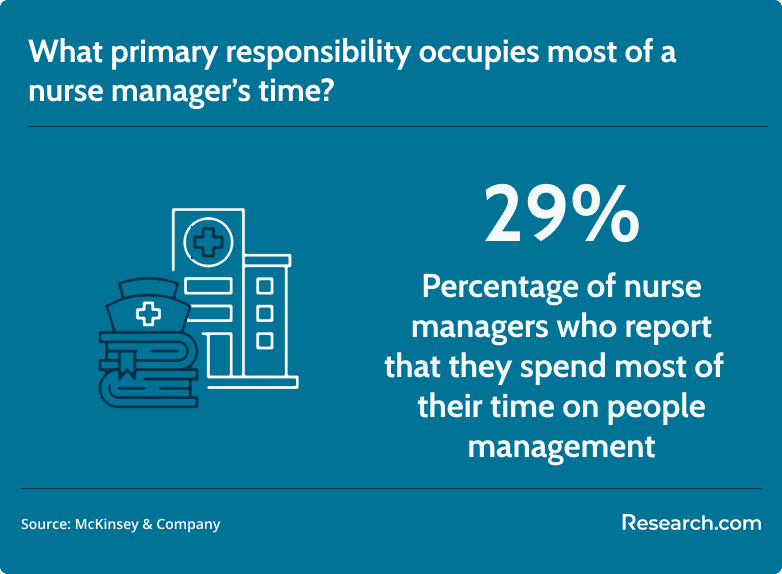
- HR Management and Organizational Behavior in Healthcare: Because 29% of nurse managers spend much of their work on people management (Berlin et al., 2025), this course is central to leadership preparation. Students study staffing, engagement, conflict resolution, workforce planning, and team performance.
- Healthcare Delivery Systems: Students analyze how U.S. healthcare organizations operate, including public and private roles, regulatory structures, policy pressures, and emerging system trends.
- Evidence Based Practice in the Health Professions: This course trains students to assess research, apply findings, and support clinical or administrative decisions that improve outcomes.
- Healthcare Strategic Planning and Analysis: Students learn how to create, evaluate, and implement long-term strategies that connect organizational goals with patient care priorities.
Some programs also include electives or applied projects in population health, infection prevention, compliance, analytics, telehealth, or specialized clinical areas. Nurses comparing adjacent roles may also review telemetry nurse requirements to understand how clinical specialization differs from administrative leadership preparation.
What skills are needed in an accelerated online nurse executive leadership MSN program?
Successful nurse executives need more than clinical experience. They must lead people, interpret data, manage budgets, understand policy, and guide change across complex healthcare systems. Many programs align leadership development with competency areas identified by the American Organization for Nursing Leadership (AONL).
| Skill area | What it means in practice | Why it matters for nurse leaders |
| Business skills and principles | Budgeting, finance, strategic planning, performance improvement, and resource allocation. | Nurse leaders must connect patient care goals with operational and financial realities. |
| Communication and relationship building | Conflict resolution, stakeholder communication, trust-building, and interprofessional collaboration. | Leadership depends on clear communication across teams, departments, and executive groups. |
| Knowledge of the healthcare environment | Policy, reimbursement, quality metrics, regulation, compliance, and patient safety expectations. | Leaders need context to advocate for patients and staff while meeting institutional requirements. |
| Professionalism | Ethics, accountability, cultural respect, resilience, adaptability, and integrity. | Executive nursing roles require sound judgment under pressure. |
| Leadership | Influencing teams, guiding change, developing staff, and improving outcomes. | Strong leadership helps organizations respond to workforce, quality, and operational challenges. |
Healthcare leadership also overlaps with administrative support, compliance, and operational workflows found in other healthcare roles. For comparison, students can review how competencies differ from medical office assistant qualifications.
The need for strong nurse leadership is significant. AONL’s Nursing Leadership Insight Study reports that 49% of nurse leaders identify recruiting and retaining staff as their organization’s top concern. Staffing gaps can increase pressure on leaders and reduce the time available to support the mental and emotional well-being of their teams.
Nurses who want to combine leadership with advanced mental health expertise may also consider specialized pathways such as the fastest online MSN in psychiatric mental health nurse practitioner programs, although those programs prepare students for a different advanced practice focus than nurse executive leadership.
The chart below summarizes major challenges reported by nurse leaders.
What is the best certification for graduates of accelerated online nurse executive leadership MSN programs?
The best certification depends on your current role and the level of leadership you are pursuing. Certifications can help demonstrate that your experience and education align with recognized nurse leadership standards, but they do not replace employer requirements, state rules, or role-specific experience.
Some nurses build leadership knowledge through a fast track graduate certificate in nursing leadership online before or after earning a full MSN. Certificates may be useful for focused skill development, while national certifications validate professional competency.
| Certification | Best suited for | Focus areas |
| Nurse Executive Certification | Nurse leaders in managerial or administrative roles. | The ANCC NE-BC credential covers strategic management, ethics, risk management, and healthcare economics. |
| Nurse Executive, Advanced Certification | Senior nurse leaders responsible for complex systems and strategic initiatives. | The ANCC NEA-BC credential emphasizes organizational leadership, systems thinking, and policy development. |
| Certified Nurse Manager and Leader | Mid-level nurse managers and nurses moving from unit leadership into broader management. | The AONL CNML credential assesses HR management, quality improvement, finance, and performance measurement. |
| Certified in Executive Nursing Practice | Upper-level nurse executives and aspiring chief nursing officers. | The AONL CENP credential focuses on executive leadership and business competencies. |
Some nurse leaders eventually pursue a Doctor of Nursing Practice. A DNP is not a certification, but it can strengthen preparation for advanced systems leadership, policy work, and evidence-based innovation. Nurses comparing advanced options often ask what can you do with a DNP before deciding whether a doctorate is necessary for their goals.
What are some time management tips for accelerated online nurse executive leadership MSN students?
An accelerated MSN can be manageable for working nurses, but it requires planning. Students often balance shifts, family obligations, practicum requirements, group projects, and graduate-level writing. The faster the program, the less room there is for procrastination.
Students may shorten their timeline by transferring eligible credits, requesting course waivers when allowed, taking consecutive terms, or choosing heavier course loads. However, moving faster is only useful if the pace is sustainable.
- Use one master calendar: Track work shifts, due dates, practicum hours, exams, meetings, and family commitments in a single system.
- Protect weekly study blocks: Reserve consistent time for reading, research, discussion posts, writing, and project work.
- Prioritize by urgency and impact: Complete time-sensitive assignments first, but do not ignore long-term papers or capstone work.
- Break large assignments into milestones: Set smaller targets for literature reviews, outlines, drafts, revisions, and final submissions.
- Reduce avoidable distractions: Silence notifications, prepare a dedicated study space, and communicate study hours to family or roommates.
- Contact faculty early: Ask questions before confusion turns into missed deadlines.
- Use asynchronous flexibility wisely: Schedule lectures and assignments during your strongest focus periods, not just whenever time is left over.
- Plan recovery time: Short breaks and realistic rest periods reduce burnout and improve retention.
- Coordinate practicum logistics early: Waiting too long to confirm a site or mentor can delay progress.
Time management is not only an academic survival skill. It is also leadership training. Nurse executives routinely manage competing priorities, urgent problems, staffing constraints, and long-term improvement projects.
What career paths are available to graduates of accelerated online nurse executive leadership MSN programs?
Graduates may qualify for leadership roles in hospitals, health systems, outpatient centers, public health agencies, long-term care, consulting, quality improvement, informatics, and case management. Actual eligibility depends on experience, employer requirements, certifications, location, and prior clinical background.
| Career path | Average wage listed | Typical responsibilities |
| Case Management Directors | $82,258 | Coordinate complex care processes, oversee discharge planning, manage resources, and work with providers, insurers, and social service teams. |
| Clinical Nurse Leaders | $91,900 | Improve care coordination, monitor outcomes, support evidence-based practice, and connect clinical care with systems improvement. |
| Nurse Consultants | $96,206 | Advise organizations on compliance, policy, quality, workflow, and operational improvement. |
| Nurse Informaticists | $98,409 | Use clinical knowledge, data, and technology to optimize electronic health records, workflows, analytics, and decision support. Students comparing this path can review more detail on nurse informaticist salary. |
| Nursing Directors | $108,675 | Manage departments or nursing units, oversee staff, support compliance, and connect frontline needs with executive strategy. |
| Medical and Health Services Managers | $137,730 | Plan, direct, and evaluate healthcare services in hospitals, clinics, physician practices, public health organizations, and other settings. |
| Chief Nursing Officers | $155,833 | Lead nursing strategy, budgeting, workforce development, policy implementation, and patient care initiatives across organizations or systems. |
These roles show why nurse executive MSN programs combine nursing, finance, staffing, policy, quality, and operations. The strongest candidates typically pair the degree with leadership experience, measurable project outcomes, strong communication skills, and, when appropriate, certification.
The chart below compares the average wages for the roles listed above.
What is the job market for graduates with an accelerated online nurse executive leadership MSN?
The job market for nurse leaders is shaped by healthcare expansion, workforce shortages, patient safety expectations, technology adoption, quality measurement, and the need for efficient operations. Nurse executives are expected to manage people, budgets, care standards, compliance issues, and organizational change.
According to the U.S. Bureau of Labor Statistics, employment of medical and health services managers, a category that may include nurse executives, is projected to grow by 28.5% from 2023 to 2033. The BLS also projects about 61,400 job openings each year, reflecting both new roles and replacement needs.
Demand is not only about growth. Healthcare organizations also need leaders who can address staff retention, rising patient volumes, quality benchmarks, and regulatory requirements. Nurse executives can play a central role in improving work environments, designing care models, and aligning clinical practice with organizational goals.
Workforce pressure remains a serious issue. The International Council of Nurses reports that 48.4% of National Nurses’ Associations across countries observed a moderate to high increase in nurse attrition. In this environment, nurse leaders are increasingly responsible for retention strategies, staff well-being, workforce planning, and healthy workplace culture.
Current trends affecting nurse executive leadership
- Staffing and retention remain central leadership challenges: Nurse leaders are expected to address vacancy pressure, burnout risk, team morale, and professional development.
- Data-driven management is becoming standard: Leaders increasingly use dashboards, quality metrics, staffing data, and financial reports to guide decisions.
- Technology is changing leadership work: Electronic health records, informatics, virtual care, and analytics require nurse executives who understand both clinical practice and digital systems.
- Quality and safety expectations are high: Healthcare organizations need leaders who can improve outcomes while meeting compliance and performance standards.
- Employers value practical leadership experience: A degree can help, but candidates often need evidence of project leadership, staff supervision, process improvement, or measurable outcomes.
Which type of nurse leadership role is best for you?
Nurse leadership is not one job. Some roles focus on daily unit operations, while others emphasize executive strategy, staff development, quality improvement, or system-wide policy. The right fit depends on whether you prefer direct clinical connection, people management, operational planning, or high-level decision-making.
| Role | Main focus | Best fit if you want to... |
| Nurse Administrator | Department operations, budgets, staffing systems, and administrative workflows. | Lead the business and operational side of nursing with limited direct patient care. |
| Nurse Manager | Unit supervision, scheduling, resource management, staff support, and regulatory compliance. | Guide clinical teams while staying close to day-to-day nursing operations. |
| Director of Nursing | Organizational nursing strategy, policy implementation, staffing, budgets, and quality standards. | Influence nursing practice at a department or organization-wide level. |
| Clinical Nurse Leader | Care coordination, outcome improvement, patient safety, and evidence-based practice. | Remain connected to patient care while leading systems-level improvement. Learn more about what does a clinical nurse leader do. |
| Chief Nursing Officer or Chief Nurse Executive | Executive nursing strategy, workforce planning, budgeting, policy, and organizational leadership. | Shape nursing priorities and represent nursing at the highest leadership level. |
If you enjoy mentoring staff and solving immediate workflow problems, nurse manager roles may be a strong match. If you prefer budgets, policy, and system-level decisions, nursing administration or executive leadership may fit better. If patient outcomes and quality improvement are your primary interest, a clinical nurse leader or quality-focused role may be more appropriate.
The chart below shows common tasks performed by nurse leaders.
How can I verify the accreditation and quality of my MSN program?
Start by confirming institutional accreditation and programmatic nursing accreditation. For nurse executive leadership MSN programs, look for recognition from organizations such as the Commission on Collegiate Nursing Education (CCNE) or the Accreditation Commission for Education in Nursing (ACEN). Some healthcare administration programs may instead hold accreditation from the Commission on Accreditation of Healthcare Management Education (CAHME).
Do not rely only on marketing language. Check the accreditor’s database, review the school’s accreditation page, and ask whether the program is authorized to enroll students in your state. Also examine faculty qualifications, practicum support, graduation requirements, certification preparation, student support, and published outcome information when available.
Students comparing affordability across nursing pathways can also review RN-BSN programs online cheap as a reference point for cost-conscious nursing education, although RN-BSN pathways serve a different academic level than MSN programs.
Questions to ask before applying
- Is the university institutionally accredited?
- Is the MSN program accredited by CCNE, ACEN, or another relevant body?
- Is the program authorized for students in my state?
- Who arranges practicum placements, the school or the student?
- Are there any campus visits, synchronous sessions, or travel requirements?
- What is the full cost, including fees and practicum expenses?
- Does the curriculum prepare students for NE-BC, NEA-BC, CNML, or CENP certification?
- What leadership roles do graduates typically pursue?
Should I pursue a DNP instead of an MSN for nurse executive leadership?
An MSN is often the practical graduate degree for nurses who want to move into management, administration, quality leadership, or director-level roles. It typically focuses on operational leadership, finance, staffing, evidence-based management, and healthcare systems.
A DNP may be a better fit if you want doctoral-level preparation in systems leadership, policy, advanced clinical practice, or evidence-based innovation. The DNP may also be useful for nurses targeting the highest leadership roles, but it generally requires more time, money, and academic commitment than an accelerated MSN.
If you are weighing the doctorate option, compare curriculum, practicum expectations, admission requirements, cost, and timeline. You can also review the shortest DNP program online options to understand how streamlined doctoral pathways differ from MSN leadership programs.
| Path | Best for | Key trade-off |
| Accelerated MSN in nurse executive leadership | RNs seeking faster preparation for leadership, administration, management, or director roles. | Shorter and more targeted, but not a doctoral credential. |
| DNP | Nurses seeking doctoral-level systems leadership, policy influence, or advanced practice preparation. | More advanced credential, but typically greater time and cost commitment. |
| Graduate certificate | Nurses who already have a graduate degree or want focused leadership coursework. | Less comprehensive than a full MSN or DNP. |
Can NP direct entry programs enhance your leadership career?
NP direct entry programs serve a different audience from nurse executive leadership MSN programs. They are designed for people with non-nursing bachelor’s degrees who want to transition into nursing and eventually prepare for nurse practitioner credentials.
For future leaders, direct-entry NP training can build advanced clinical judgment and decision-making skills. However, it is not the most direct route for licensed RNs who already have a BSN and want administrative, executive, or systems leadership roles. Those students usually benefit more from an MSN in nurse leadership, an MSN in healthcare leadership, a graduate leadership certificate, or a DNP, depending on career goals.
If you are entering nursing from another field and want to compare advanced clinical pathways, review our guide to NP direct entry programs.
Common mistakes to avoid when choosing an accelerated online nurse executive leadership MSN
| Mistake | Why it can hurt you | Better approach |
| Choosing based only on speed | The fastest program may not offer the practicum depth, support, or pacing you need. | Compare completion time with workload, support services, and leadership outcomes. |
| Ignoring accreditation | Employers and certification bodies may care about recognized accreditation. | Verify institutional and programmatic accreditation before applying. |
| Looking only at tuition | Fees, materials, practicum costs, and residency pricing can change the total cost. | Request a full cost estimate from each school. |
| Assuming online means fully flexible | Some programs have live sessions, group work, practicum scheduling, or fixed deadlines. | Ask about synchronous requirements and weekly workload. |
| Waiting to plan practicum hours | Placement delays can slow graduation. | Ask early how sites and mentors are approved. |
| Assuming salary outcomes are guaranteed | Pay depends on location, employer, role, experience, and leadership history. | Use salary data as a guide, not a promise. |
| Relying only on rankings | A highly ranked program may not match your state, budget, schedule, or career goal. | Use rankings as a starting point, then compare fit. |
How to choose the right accelerated online nurse executive leadership MSN program
- Define your target role: Decide whether you want to become a nurse manager, director of nursing, quality leader, informatics leader, administrator, or chief nursing officer.
- Confirm admission fit: Check whether the program requires a BSN, RN license, work experience, statistics, GPA minimums, or prerequisites.
- Verify accreditation and state authorization: Confirm both the school’s institutional accreditation and the program’s nursing or healthcare management accreditation.
- Compare curriculum depth: Look for finance, HR, strategy, informatics, quality improvement, policy, leadership practicum, and capstone work.
- Evaluate practicum support: Ask whether the school helps locate placements and whether your current employer can serve as a site.
- Calculate full cost: Include tuition, fees, books, technology, practicum expenses, and possible travel.
- Assess workload honestly: A 12-month program can be efficient, but it may be intense for nurses working full time.
- Check certification alignment: If you plan to pursue NE-BC, NEA-BC, CNML, or CENP, ask how the curriculum supports preparation.
- Review student support: Look for advising, library access, writing help, career services, faculty responsiveness, and technical support.
- Compare ROI realistically: Match program cost to your expected career path, employer tuition benefits, local leadership opportunities, and long-term goals.
What graduates say about online nurse executive leadership MSN programs
- Lana: "I had reached a point where advancement felt limited. Earning my MSN online gave me the credential, business foundation, and strategic mindset I needed to move into executive leadership. Because the program was online, I could keep working while preparing for the next stage of my career."
- Mary Anne: "Returning to school after years in practice felt overwhelming at first, but the online format gave me structure and support. The courses pushed me to grow as a professional and as a person, and I became more confident in my leadership abilities."
- Nikki: "I did not think I could balance full-time work, family responsibilities, and graduate school until I found an accelerated online program. The flexible schedule, responsive faculty, and peer discussions helped me stay engaged while building the skills I needed for leadership."
References
- American Association of Colleges of Nursing. (n.d.). Clinical Nurse Leader (CNL). Retrieved July 21, 2025, from https://www.aacnnursing.org/cnl
- American Nurses Association. (2024, February 13). What is a Chief Nursing Officer / Chief Nurse Executive? https://www.nursingworld.org/content-hub/resources/nursing-leadership/chief-nursing-officer
- American Organization for Nursing Leadership. (2025). Nursing Leadership Insight Study. https://www.aonl.org/resources/nursing-leadership-survey
- Berlin, G., Murphy, M., Bilazarian, A., & Hammer, S. (2025, May 6). Nurse managers: The backbone of a strong nursing workforce. McKinsey & Company. https://www.mckinsey.com/industries/healthcare/our-insights/nurse-managers-the-backbone-of-a-strong-nursing-workforce
- Health Resources & Services Administration. (2024, March). 2022 National Sample Survey of Registered Nurses Snapshot. https://bhw.hrsa.gov/sites/default/files/bureau-health-workforce/Nurse-Survey-Fact-Sheet-2024.pdf
- Ma, J., Pender, M., & Oster, M. (2024). Trends in College Pricing and Student Aid 2024. https://research.collegeboard.org/trends/college-pricing
- PayScale. (2025). Average Clinical Nurse Leader Hourly Pay. Retrieved July 21, 2025, from https://www.payscale.com/research/US/Job=Clinical_Nurse_Leader/Salary
- U.S. Bureau of Labor Statistics. (2024). Medical and Health Services Managers [Interactive data]. May 2024 OEWS Profiles, Occupational Employment and Wage Statistics (OEWS) Profiles. Retrieved July 21, 2025, from https://data.bls.gov/oesprofile
- U.S. Bureau of Labor Statistics. (2025, April 18). Occupational projections, 2023–33, and worker characteristics, 2023 (Numbers in thousands). Employment Projections. https://www.bls.gov/emp/tables/occupational-projections-and-characteristics.htm
- ZipRecruiter. (2025, July 13). Chief Nursing Officer Salary. Retrieved July 21, 2025, from https://www.ziprecruiter.com/Salaries/Chief-Nursing-Officer-Salary
Key Insights
- Accelerated online nurse executive leadership MSN programs are best for licensed nurses who want to move into management, administration, quality improvement, or executive leadership without pausing their careers for several years.
- Program length varies, but many accelerated options can be completed in 12 to 20 months. Faster completion can save time, but it also increases workload intensity.
- Cost comparisons should include tuition, credits, residency rates, fees, practicum expenses, books, and employer tuition benefits. A low per-credit rate does not always mean the lowest total cost.
- Accreditation matters. Look for institutional accreditation and relevant programmatic accreditation such as CCNE, ACEN, CAHME, or NLN CNEA, depending on the program type.
- The strongest programs combine leadership, finance, HR, informatics, quality improvement, policy, evidence-based practice, and applied practicum or capstone experiences.
- Certifications such as NE-BC, NEA-BC, CNML, and CENP can strengthen professional credibility, but the right credential depends on your leadership level and career target.
- An MSN is usually the more direct route for operational nursing leadership, while a DNP may be better for nurses seeking doctoral-level systems leadership, policy influence, or advanced practice preparation.
- Do not choose a program based only on speed or rankings. The right program should match your state, budget, schedule, accreditation needs, practicum access, and long-term leadership goals.
Other Things You Should Know About the Best Accelerated Online Nurse Executive Leadership MSN Programs
The 2027 accelerated online Nurse Executive Leadership MSN programs often integrate clinical practice through virtual simulations and required capstone projects, aligning theoretical knowledge with practical leadership skills. These components typically fulfill up to 60 clinical practice hours, enhancing real-world decision-making and problem-solving abilities.
Most programs require a BSN, an active RN license, and recent completion of statistics, undergraduate nursing research, and health assessment with a grade of B or higher. Some schools also require a minimum 3.0 GPA and one year of RN experience before admission.


