2027 Online Electrical Engineering Degrees That Prepare Students for Long-Term Professional Growth

Co-Founder and Chief Data Scientist
Choosing an online electrical engineering degree is a high-stakes decision because the right program can open doors in power systems, semiconductors, automation, communications, robotics, and renewable energy. The U. S. Bureau of Labor Statistics reports a May 2024 median annual wage of $111,910 for electrical engineers, making program quality and career fit especially important. This guide is for prospective students, working adults, transfer students, and career changers who want to understand accreditation, costs, timelines, skills, and outcomes before committing time and money.
Key Things You Should Know
- Accreditation matters most: students seeking engineering licensure, graduate school flexibility, or broad employer recognition should prioritize institutionally accredited colleges and, when available, ABET-accredited electrical engineering programs.
- Costs vary widely, but College Board's 2024-25 published tuition benchmarks show why total price matters: average tuition and fees were $11,610 for in-state public four-year colleges, $30,780 for out-of-state public colleges, and $43,350 for private nonprofit colleges.
- Electrical engineering remains a long-term technical field: BLS projects 9% growth for electrical and electronics engineers from 2023 to 2033, but outcomes depend on specialization, internships, hands-on projects, location, and industry demand.
What is an online electrical engineering degree and how does it compare to campus programs?
An online electrical engineering degree is a college program that teaches the theory, mathematics, design methods, and applied technologies used to build, test, and improve electrical and electronic systems. Students study subjects such as circuits, electromagnetics, signal processing, power systems, control systems, embedded systems, and digital logic. In an online format, lectures, assignments, simulations, exams, and discussions are delivered through a learning platform, while labs may be completed through mailed kits, remote instrumentation, simulation software, short campus residencies, or approved local facilities.
The biggest misconception is that "online" means less rigorous. In strong programs, the degree requirements, faculty expectations, math sequence, and engineering outcomes are similar to campus programs. The real difference is delivery. Online students need stronger time management, reliable technology, and comfort learning from recorded lectures, virtual labs, and asynchronous discussions.
The table below compares the practical differences that matter most when choosing between online and campus study. Use it to decide which format fits your schedule, learning style, and career goals.
| Factor | Online electrical engineering degree | Campus electrical engineering degree |
| Best fit | Working adults, military learners, transfer students, students far from engineering schools | Traditional full-time students, students who want daily in-person labs and campus recruiting |
| Lab experience | May use virtual labs, remote equipment, mailed lab kits, or short residencies | Usually uses dedicated campus labs and in-person lab supervision |
| Schedule | Often asynchronous or hybrid, with more flexibility | Typically fixed class and lab times |
| Networking | Requires intentional effort through projects, faculty contact, online events, and internships | Easier access to clubs, labs, career fairs, and peer study groups |
| Employer recognition | Strong when the school is properly accredited and the transcript does not signal lower academic standards | Strong when the program has recognized accreditation and industry relationships |
Online study makes sense if flexibility is essential and the program has credible labs, advising, and accreditation. Campus study may be better if you want daily access to equipment, undergraduate research labs, engineering clubs, or a highly structured environment. Either format can be worthwhile when the curriculum aligns with your target field and gives you evidence of hands-on competence.
How do accredited online electrical engineering programs ensure quality and recognition in the U.S.?
Accreditation is the quality-control system that helps students, employers, graduate schools, and licensing boards evaluate whether a college or engineering program meets recognized standards. For online electrical engineering degrees, students should understand two layers: institutional accreditation and programmatic accreditation.
Institutional accreditation applies to the college or university as a whole. It affects federal financial aid eligibility, transfer credit acceptance, and general academic recognition. Programmatic accreditation, especially ABET accreditation for engineering, evaluates whether a specific engineering program meets outcomes related to mathematics, science, design, ethics, experimentation, teamwork, and professional practice.
Students who plan to pursue the Professional Engineer license should be especially careful. Licensure rules are set by state boards, and many boards prefer or require an ABET-accredited engineering degree for the most direct pathway to exams and experience requirements. A non-ABET program may still be useful for some technical roles, but it can create extra steps or limitations for licensure, government engineering positions, or graduate admission.
Before enrolling, verify quality using a short sequence rather than relying on marketing language. These steps reduce the risk of choosing a program that looks convenient but lacks recognition:
- Confirm that the college has institutional accreditation from an agency recognized by the U.S. Department of Education or the Council for Higher Education Accreditation.
- Search ABET's public database for the exact program name, degree level, campus or online designation, and accreditation date.
- Ask whether online students complete the same engineering outcomes, lab requirements, and capstone expectations as campus students.
- Check how the school supports internships, cooperative education, career services, and faculty advising for remote learners.
- Contact your state engineering board if licensure is part of your long-term plan.
Veterans and active-duty students should also check military education benefits, transfer-credit rules, deployment flexibility, and dedicated advising. A focused list of military friendly online electrical engineering degree programs can help service members compare options that understand military transcripts, tuition assistance, and scheduling disruptions.
What types of online electrical engineering degrees are available and which pathway fits different goals?
Online electrical engineering education is not one-size-fits-all. The right credential depends on whether you want to enter the field, complete a bachelor's degree, specialize after an engineering degree, move into leadership, or reskill for a technical role adjacent to electrical engineering.
The table below summarizes the most common pathways and the goals they usually support. It is especially useful if you are comparing a full degree against a shorter credential.
| Pathway | Typical purpose | Best for | Important caution |
| Associate degree in electrical engineering technology | Builds technician-level skills in circuits, electronics, testing, and troubleshooting | Students seeking technician roles or a lower-cost transfer route | May not transfer cleanly into an engineering bachelor's program unless articulation is clear |
| Bachelor's degree in electrical engineering | Prepares students for engineering design, analysis, systems work, and graduate study | Students seeking entry-level electrical engineer roles or eventual PE licensure | Students should verify ABET accreditation if licensure or broad recognition matters |
| Bachelor's degree in electrical engineering technology | Focuses more on application, implementation, testing, and operations | Students targeting applied engineering technology, field engineering, or technical operations roles | May not be treated the same as an engineering degree by all employers or licensing boards |
| Master's degree in electrical engineering | Deepens expertise in areas such as power, controls, communications, semiconductors, or signal processing | Engineers seeking specialization, advancement, research preparation, or technical leadership | Usually requires a strong math and engineering background |
| Graduate certificate | Adds focused skills in a narrower technical area | Working engineers who need targeted upskilling without a full degree | Less comprehensive than a master's degree and may not change eligibility for some roles |
A bachelor's degree is usually the central credential for someone who wants to become an electrical engineer. An associate degree can be a smart first step if cost is a concern, but students should confirm transferability before enrolling. A master's degree is more valuable after a student has a defined technical direction, such as power electronics, autonomous systems, wireless communications, or semiconductor design.
Students should also be realistic about fit. If you enjoy physics, calculus, systems thinking, and long problem sets, electrical engineering can be a strong investment. If you mainly want quick entry into IT support, web development, or general business technology, a different program may offer a faster and less math-intensive path.
What core courses and technical skills do students learn in online electrical engineering programs?
Electrical engineering programs are built around mathematics, science, design, and experimentation. Online students should expect a demanding sequence, not a simplified technology overview. The strongest programs teach both theory and the ability to apply that theory to real devices, systems, and design constraints.
The table below connects common course areas with the skills students should expect to build. This helps you evaluate whether a curriculum supports your target career field.
| Course or skill area | What students learn | Career relevance |
| Calculus, differential equations, and linear algebra | Mathematical modeling, system behavior, optimization, and signal analysis | Needed for advanced engineering analysis, controls, communications, and graduate study |
| Circuit analysis and electronics | Voltage, current, impedance, amplifiers, filters, semiconductor devices, and measurement | Core foundation for nearly every electrical engineering role |
| Digital logic and embedded systems | Microcontrollers, digital circuits, hardware-software interfaces, and real-time constraints | Useful in robotics, consumer electronics, automotive systems, aerospace, and IoT |
| Signals and systems | Frequency response, sampling, filtering, communication signals, and system modeling | Important for telecommunications, audio, radar, sensors, and data acquisition |
| Power systems and energy conversion | Generation, transmission, motors, transformers, renewable integration, and grid reliability | Relevant to utilities, renewable energy, manufacturing, transportation, and infrastructure |
| Control systems | Feedback, stability, controllers, automation, and dynamic systems | Valuable in robotics, aerospace, industrial automation, and autonomous systems |
| Engineering design and capstone | Requirements analysis, prototyping, testing, teamwork, documentation, and trade-off decisions | Shows employers that students can move from theory to working solutions |
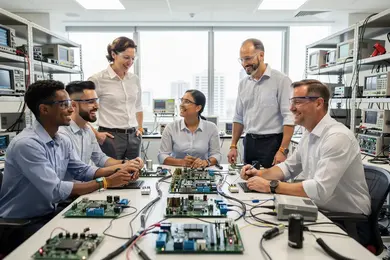
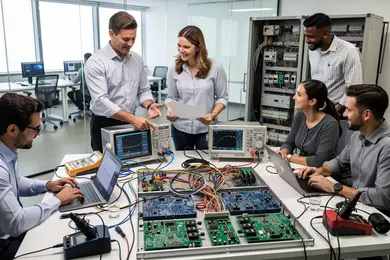
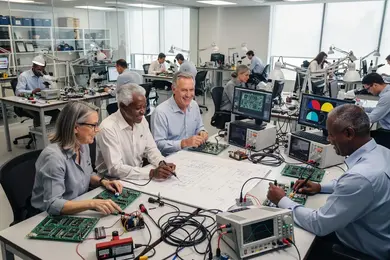
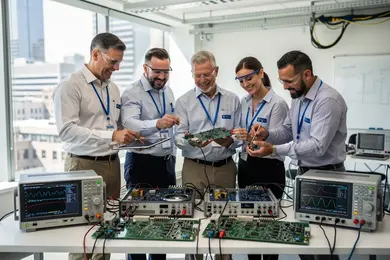
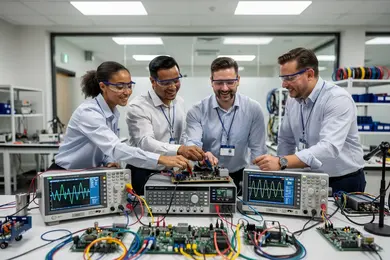
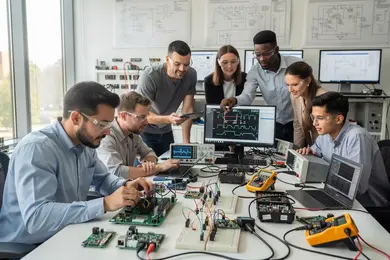
Online learners should pay close attention to the lab model. Simulations are useful, but employers also value evidence that a graduate can troubleshoot hardware, use instruments, document test results, and work safely. When comparing programs, ask how students use oscilloscopes, power supplies, circuit boards, microcontrollers, design software, and lab reports.
Students can strengthen their long-term prospects by building a portfolio as they study. Useful portfolio evidence includes design reports, circuit simulations, embedded systems projects, senior capstone documentation, Git repositories for hardware-related code, and short explanations of design trade-offs. The goal is to show how you think, not just what classes you completed.
What are typical admission requirements for online electrical engineering degrees at U.S. colleges?
Admission requirements depend on the degree level, selectivity of the college, and whether the student is entering as a first-year applicant, transfer student, or graduate applicant. Because electrical engineering is math-heavy, schools often look closely at readiness for calculus, physics, and college-level problem solving.
At the bachelor's level, applicants commonly submit high school transcripts or GED documentation, college transcripts if applicable, standardized test scores when required, and proof of prerequisite coursework. Many online completion programs are designed for transfer students and may expect prior credits in calculus, chemistry, physics, computer programming, or general education.
Graduate applicants usually need a bachelor's degree in electrical engineering, computer engineering, or a closely related field. Students from adjacent backgrounds may be admitted conditionally, but they may need prerequisite courses in circuits, signals, electronics, or mathematics before starting advanced coursework.
Use the following checklist before applying so you do not waste application fees on programs that do not match your background:
- Compare your completed math and science courses against the program's prerequisite list.
- Ask whether transfer credits are evaluated before or after admission, because this affects cost and timeline.
- Confirm whether lab science credits must be completed in person, online, or through a specific approved format.
- Check whether the program requires synchronous attendance, proctored exams, campus visits, or residency labs.
- Ask whether prior military, industry, or technician training can count as elective credit, and whether that credit applies to the major or only to general electives.
A common mistake is assuming that admission to the university means admission to the engineering major. Some colleges require students to complete gateway courses with minimum grades before formally entering upper-division engineering coursework. This can affect financial planning, graduation timing, and eligibility for advanced classes.

How long do online electrical engineering programs take, and what schedules suit working adults?
Program length depends on degree level, transfer credits, course load, prerequisites, and lab requirements. A traditional bachelor's degree usually requires about four years of full-time study, but online students often follow part-time schedules because they are balancing employment, caregiving, military service, or relocation.
Students with an associate degree or substantial prior college credit may complete an online bachelor's completion pathway faster, but only if their credits apply directly to the curriculum. Electrical engineering has a tight course sequence, so missing one prerequisite can delay several later courses. This is why transfer evaluations matter before enrollment, not after the first semester begins.
The table below shows common schedule models and the trade-offs students should consider. It can help working adults choose a pace that is ambitious without becoming unrealistic.
| Schedule model | Typical fit | Main advantage | Main trade-off |
| Full-time online | Students who can reduce work hours or study as their main commitment | Fastest path to completion | Heavy workload, especially during lab and math-intensive terms |
| Part-time online | Working adults, parents, military learners, and students with variable schedules | More sustainable with employment | Longer time to degree and potential changes in tuition or curriculum requirements |
| Accelerated terms | Students with strong preparation and disciplined weekly study routines | Can speed up general education or selected technical courses | May be difficult for calculus, physics, circuits, and lab-heavy courses |
| Cohort-based online | Students who want structure and peer consistency | Clear sequence and built-in community | Less flexibility if life or work obligations interrupt progress |
| Hybrid or residency-based | Students who can travel occasionally for labs or intensive sessions | Improves hands-on learning and faculty interaction | Travel costs and scheduling constraints |
Working adults should build a term-by-term plan with an advisor before committing. The plan should identify hard prerequisites, lab terms, summer availability, and any required campus visits. Students comparing engineering with other online professional fields, such as online library schools, should remember that engineering schedules are often less flexible because technical courses must be completed in sequence.
What do online electrical engineering degrees cost, and how can students finance their studies?
The cost of an online electrical engineering degree includes more than tuition. Students should budget for technology fees, lab kits, simulation software, textbooks, proctoring, travel for required residencies, hardware, graduation fees, and the opportunity cost of reducing work hours. The lowest advertised tuition is not always the lowest total cost.
College Board's 2024-25 tuition and fee benchmarks show the broader pricing environment: average published tuition and fees were $11,610 for in-state students at public four-year colleges, $30,780 for out-of-state students at public four-year colleges, and $43,350 at private nonprofit four-year colleges. Online programs may charge different rates, but these benchmarks help students understand why residency status, transfer credit, and institutional aid can significantly affect total cost.
When comparing programs, look at the full cost of attendance rather than one tuition line. Key cost categories usually include the following:
- Tuition per credit and the total number of credits required after transfer evaluation
- Mandatory online, technology, engineering, lab, and proctoring fees
- Books, circuit kits, calculators, software, hardware, and measurement tools
- Travel, lodging, and time away from work for required labs or orientations
- Repeated-course costs if a prerequisite sequence is interrupted or a minimum grade is not met
- Interest costs if loans are used and repayment is delayed until after graduation
Students can reduce net cost by starting at a community college with a clear transfer agreement, using employer tuition assistance, applying for engineering scholarships, completing the FAFSA, comparing in-state online tuition policies, and asking whether military or industry training can count toward elective credit. Borrowing can be reasonable for a strong program tied to a clear career plan, but students should avoid taking on high debt for a program with weak accreditation, limited advising, or unclear career outcomes.
Cost comparison is useful across fields, not only engineering. For example, students researching graduate professional programs often compare tuition in the same way they would review MLIS degree cost: by looking at total credits, fees, residency requirements, aid, and realistic salary context rather than headline tuition alone.
What electrical engineering careers can graduates pursue and in which industries do they work?
Electrical engineering graduates can work anywhere organizations design, power, automate, connect, or control technology. Career options depend on degree level, specialization, internships, portfolio quality, and whether the student completed an engineering or engineering technology pathway.
The table below outlines common roles and where they often appear. It is not a guarantee of eligibility, but it shows how coursework and industry demand connect.
| Career path | Typical responsibilities | Common industries |
| Electrical engineer | Designs, tests, analyzes, and improves electrical systems, components, or equipment | Manufacturing, utilities, aerospace, defense, transportation, construction, consulting |
| Power systems engineer | Works on generation, transmission, distribution, grid reliability, and energy integration | Utilities, renewable energy, infrastructure, industrial facilities |
| Controls engineer | Designs automation, feedback systems, motor control, and process control solutions | Manufacturing, robotics, aerospace, automotive, energy |
| Embedded systems engineer | Develops hardware-software systems for devices, sensors, and controllers | Consumer electronics, medical devices, automotive, IoT, defense |
| Electronics design engineer | Designs circuit boards, analog systems, digital systems, and test procedures | Semiconductors, electronics manufacturing, telecommunications, aerospace |
| Test engineer | Creates validation plans, runs experiments, analyzes failures, and documents performance | Hardware companies, manufacturing, defense, automotive, medical technology |
| Field applications or sales engineer | Explains technical products, supports customers, and connects engineering with business needs | Semiconductors, industrial equipment, automation, software-hardware vendors |
Electrical engineering is also connected to broader sustainability and infrastructure work. Students interested in clean energy, grid modernization, environmental monitoring, or climate technology may want to compare engineering with related paths such as what can you do with an environmental science major, especially if they are deciding between technical design roles and science-policy or conservation-focused roles.
Entry-level candidates improve their chances by completing internships, cooperative education, undergraduate research, student design competitions, or independent projects. Employers often want evidence that graduates can communicate clearly, debug problems, work in teams, and explain trade-offs involving cost, reliability, safety, and performance.
What salary ranges and earning potential can electrical engineers expect over the long term?
Electrical engineering can offer strong earning potential, but salaries vary by industry, location, specialization, degree level, security clearance, licensure, and experience. The best way to use salary data is to understand the market context, then compare it with the cost and quality of the program you are considering.
The U.S. Bureau of Labor Statistics reported a May 2024 median annual wage of $111,910 for electrical engineers. That median is not a promise for new graduates; it is the midpoint across workers in the occupation. Entry-level salaries may be lower, while experienced engineers in high-demand industries or high-cost regions may exceed the median.
Salary growth often comes from specialization and responsibility. Engineers who move from basic testing into design ownership, systems architecture, project leadership, power reliability, semiconductor work, automation, or technical management may see stronger long-term mobility. A master's degree can help in specialized roles, but it is most valuable when paired with a clear technical direction and relevant projects.
Students should evaluate return on investment using a practical sequence rather than relying on a single salary number:
- Estimate total program cost after transfer credit, scholarships, employer aid, and required fees.
- Compare that cost with realistic entry-level roles in your region and target industry.
- Check whether the degree supports licensure, graduate school, or advancement into specialized engineering roles.
- Review internship access, employer partnerships, career services, and capstone quality.
- Consider how long part-time study may delay career transition or promotion.
A common mistake is choosing a program only because it is fast or inexpensive. A low-cost program that lacks recognized accreditation, meaningful labs, or career support may produce weaker value than a moderately priced program with stronger outcomes. The smarter question is not "What is the cheapest degree?" but "Which affordable program gives me the strongest path to the work I want?"
How is the job market for electrical engineers changing, and what skills future-proof a career?
The electrical engineering job market is being shaped by electrification, grid modernization, semiconductor investment, automation, advanced manufacturing, defense technology, electric vehicles, robotics, data centers, and renewable energy integration. These trends do not make every role equally easy to enter, but they do increase the value of engineers who can connect theory with practical systems.
BLS projects 9% employment growth for electrical and electronics engineers from 2023 to 2033. For students, this suggests a favorable long-term outlook compared with many occupations, but competition can still be strong for desirable entry-level roles. Graduates who rely only on coursework may be less competitive than those who build project evidence, internship experience, and software-hardware fluency.
AI and automation are changing the work, not eliminating the need for engineering judgment. Engineers increasingly use simulation tools, automated testing, AI-assisted coding, digital twins, and model-based design. However, human expertise remains critical for defining requirements, validating safety, interpreting test failures, managing trade-offs, and designing reliable systems under real-world constraints.
To future-proof an electrical engineering career, students should build a balanced skill set. The following areas are especially useful because they apply across multiple industries:
- Strong fundamentals in circuits, signals, power, controls, electromagnetics, and engineering mathematics
- Programming ability in languages commonly used for engineering analysis, embedded systems, automation, or data workflows
- Comfort with simulation, modeling, computer-aided design, and test automation tools
- Hands-on lab competence, including measurement, troubleshooting, documentation, and safety practices
- Systems thinking that connects hardware, software, cost, reliability, manufacturing, and user requirements
- Communication skills for design reviews, reports, cross-functional teamwork, and client or stakeholder discussions
Students should also avoid three red flags when choosing a program: vague lab descriptions, unclear accreditation language, and limited access to faculty or career support. A credible online electrical engineering program should be able to explain exactly how students practice design, complete experiments, receive feedback, and prepare for employment or graduate study.
Other Things You Should Know About Electrical Engineering
Many universities do not list the delivery format on the diploma, but policies vary by school. Ask the registrar directly whether the diploma or transcript identifies the program as online, distance education, or a specific campus option.
It may be possible, but requirements vary by state. If PE licensure is a goal, prioritize an ABET-accredited engineering program and confirm requirements with the state licensing board before enrolling.
For PE licensure, the degree should come from a program accredited by ABET’s Engineering Accreditation Commission. ABET accreditation is the standard many state licensing boards use when reviewing education. Without it, graduates may need extra documentation or additional coursework before sitting for the FE exam or applying for licensure.
Yes, but you may need to refresh algebra, trigonometry, calculus, and physics before entering core engineering courses. Many returning students start with prerequisite courses or a part-time schedule to rebuild academic momentum.
References
- Accreditation - ABET https://www.abet.org/accreditation/
- How Long Does It Take to Become an Electrical Engineer? https://bestelectriczone.com/how-long-does-it-take-to-become-an-electrical-engineer/
- ABET-Accredited Bachelor’s in Electronics Engineering Technology https://www.uagrantham.edu/blog/abet-accredited-electronics-engineering-technology-degree/
- Future of Electrical Engineering: Jobs in Renewable Energy, EV Technology & Power Automation https://www.jiscollege.ac.in/blog/future-of-electrical-engineering-jobs-in-renewable-energy-ev-technology-power-automation
- What jobs can you do with an electrical engineering degree? https://targetjobs.co.uk/careers-advice/engineering/what-jobs-can-you-do-electrical-engineering-degree
- Salary for Electrical Engineer: Is it a high paying career? https://www.stonebridge.uk.com/blog/engineering/salary-for-electrical-engineer-or/
- Electrical Engineering Job Market: 2026 Outlook & Pay https://pathwise.io/electrical-engineering-job-market/
- Essential Skills You Learn in an Electrical Engineering Course – Discover Training https://discovertraining.net/essential-skills-you-learn-in-an-electrical-engineering-course/