2027 How to Compare Online Electrical Engineering Degrees by Technical Depth

Co-Founder and Chief Data Scientist
Choosing an online electrical engineering degree is not just about flexibility; it is about whether the program is technically deep enough for the jobs you want. The Bureau of Labor Statistics reports a 2024 median pay of $118,780 for electrical and electronics engineers, which makes program quality and career fit financially important.
This guide is for prospective undergraduates, transfer students, and career changers comparing online options. You will learn how to judge rigor, labs, accreditation, prerequisites, workload, specializations, and career outcomes before enrolling.
Key Things You Should Know
- A technically strong online electrical engineering degree should include calculus-based physics, circuits, electronics, signals and systems, electromagnetics, digital systems, control systems, engineering design, and documented lab work.
- ABET accreditation matters because it signals that the program has been reviewed against engineering education standards and may affect graduate school, Professional Engineer licensure pathways, and employer screening.
- College Board's 2024-25 published tuition data lists average public in-state tuition and fees at $11,610, while engineering students should also budget for lab kits, software, proctoring, and a time load that can exceed many non-lab online majors.
How can you compare online electrical engineering degrees by technical depth and rigor?
The fastest way to compare online electrical engineering degrees is to look beyond the delivery format and inspect the curriculum architecture. A rigorous program is not simply one that has many engineering course titles; it should show a sequenced path from math and physics into analysis, design, simulation, lab validation, and a capstone project.
Technical depth refers to how far the program takes you into mathematical modeling, hardware behavior, signal analysis, system design, and engineering constraints. Rigor refers to how demanding the program is in prerequisites, assessments, laboratory expectations, faculty qualifications, and design projects.
Use the following comparison points to separate a technically serious engineering program from a lighter technology-oriented or applied program. These criteria help you evaluate what you will actually be able to do after completing the degree:
- Math intensity: Look for calculus I-III, differential equations, linear algebra, probability, and engineering statistics rather than only general college algebra or survey math.
- Physics foundation: A strong electrical engineering curriculum normally uses calculus-based mechanics, electricity, magnetism, and sometimes modern physics.
- Core engineering sequence: Circuits, electronics, signals, electromagnetics, embedded systems, digital logic, microprocessors, controls, and power systems should build on one another.
- Labs and design work: The program should require measurement, simulation, troubleshooting, technical reports, and a senior design or capstone experience.
- Assessment difficulty: Exams, proctored assessments, design reviews, and cumulative projects usually indicate more rigor than discussion-only or open-book coursework.
- Faculty and industry connection: Review whether instructors have engineering research, industry practice, patents, funded projects, or professional licensure experience.
A useful warning sign is a curriculum that promises rapid completion but skips foundational prerequisites. Electrical engineering is cumulative: if a program compresses too much without showing how students master calculus, physics, and circuits, it may be flexible but not deep enough for engineering roles that require design accountability.
What core electrical engineering topics should a technically robust online curriculum include?
A strong online electrical engineering curriculum should train students to analyze, design, build, and test electrical and electronic systems. That requires more than programming or general technology courses; it requires mathematical modeling, physical principles, lab methods, and design trade-offs.
The table below summarizes the major technical areas to look for and why each matters. Use it to audit a program's course catalog before speaking with admissions:
| Curriculum area | What it should cover | Why it signals technical depth |
| Mathematics | Calculus, differential equations, linear algebra, probability, numerical methods | Supports circuit analysis, control theory, signal processing, electromagnetics, and modeling |
| Physics and engineering science | Calculus-based mechanics, electricity and magnetism, materials or thermal concepts | Connects equations to real physical behavior in devices and systems |
| Circuits and electronics | DC and AC circuits, transient response, semiconductor devices, analog electronics, operational amplifiers | Forms the backbone for hardware design, testing, and troubleshooting |
| Digital systems | Logic design, computer organization, microcontrollers, embedded programming, hardware description concepts | Prepares students for embedded systems, robotics, computing hardware, and automation roles |
| Signals and systems | Fourier analysis, filters, sampling, transforms, communication signals, system response | Builds analytical skill for telecommunications, audio, radar, biomedical devices, and controls |
| Electromagnetics | Fields, waves, transmission lines, antennas, electromagnetic compatibility | Indicates advanced theoretical preparation beyond basic circuits |
| Power and energy | Power systems, machines, power electronics, renewable integration, grid fundamentals | Supports work in utilities, electrification, energy storage, and industrial systems |
| Engineering design | Capstone project, constraints, safety, ethics, documentation, testing, iteration | Shows whether students can apply theory to open-ended engineering problems |
Course names alone can be misleading, so read syllabi when available. A "signals" course that includes transforms, sampling, and lab-based filtering is deeper than one that only introduces terminology; an "electronics" course with device modeling and measurement is stronger than one built mostly around broad concepts.
How do online electrical engineering programs differ from campus-based options in hands-on training?
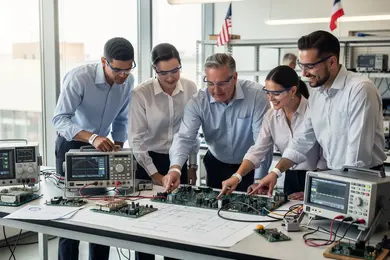
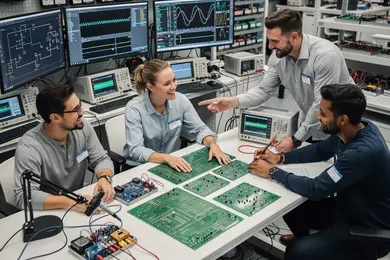
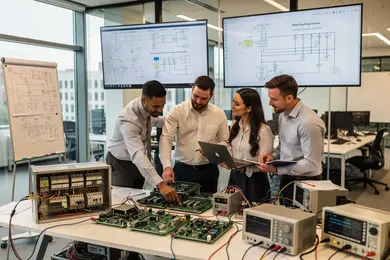
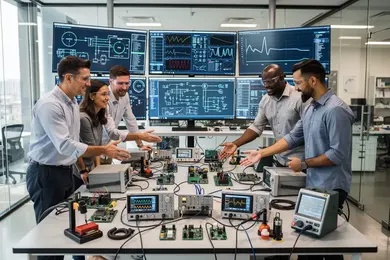
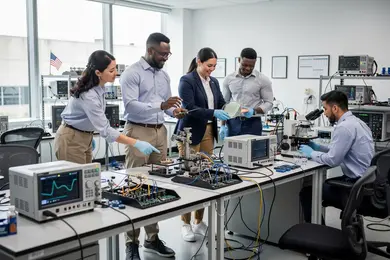
The biggest concern with online electrical engineering is not lectures; theory can often be delivered effectively online. The harder question is whether students get enough hands-on training with instruments, components, design tools, and real troubleshooting.
The table below compares common lab models. It can help you ask the right questions about how an online program replaces or supplements campus laboratory access:
| Training model | How it works | Best fit | Main limitation |
| Home lab kits | Students receive or buy components, breadboards, microcontrollers, meters, and sometimes portable oscilloscopes | Working adults and remote students who need flexibility | May not match the scale or precision of campus equipment |
| Remote-access labs | Students control real equipment over the internet and collect data remotely | Programs emphasizing measurement and instrumentation | Scheduling, latency, and limited open-ended tinkering can be constraints |
| Simulation labs | Students use tools for circuits, signals, electromagnetic fields, controls, or embedded systems | Theory-heavy courses where modeling is central | Simulation can hide real-world noise, tolerances, wiring errors, and failure modes |
| Short campus residencies | Online students visit campus for intensive lab sessions or project work | Students who can travel and want stronger lab validation | Travel, lodging, and time away from work add cost |
| Local proctored or partner labs | Students complete approved work at a nearby college, employer, or testing site | Transfer students or students near technical facilities | Availability and approval rules vary by institution |
A high-quality online program should explain its lab model in detail, including required equipment, software, safety expectations, lab reports, data collection, and how instructors verify student work. If a school cannot clearly describe how students practice measurement and debugging, the program may be better suited to electrical engineering technology than engineering design.
Campus programs usually have an advantage in access to large-scale equipment, research laboratories, student design teams, and spontaneous faculty interaction. Online programs may be better for students who already work in technical environments, have disciplined study habits, or can use employer facilities to reinforce what they learn.
Which accreditation and ABET standards matter most for online electrical engineering degrees?
Accreditation is one of the most important filters when comparing online electrical engineering degrees. Institutional accreditation means the college or university is recognized as a legitimate higher education provider, while programmatic accreditation evaluates whether the engineering program itself meets discipline-specific standards.
For electrical engineering, ABET accreditation is the key programmatic benchmark in the United States. ABET-accredited engineering programs are reviewed for curriculum, faculty, facilities, student outcomes, continuous improvement, and engineering design. This does not mean every non-ABET program is low quality, but it does mean students should investigate more carefully before enrolling.
These accreditation checks are especially important before paying deposits or transferring credits. They can affect whether your degree supports licensure, graduate study, employer review, and professional credibility:
- Confirm that the institution has recognized institutional accreditation, not only a state license to operate.
- Search for the exact electrical engineering program in ABET's accredited program database, including the delivery location or online designation if listed.
- Check whether the degree is a Bachelor of Science in Electrical Engineering, electrical engineering technology, electronics engineering technology, or another related credential.
- Ask whether graduates meet educational requirements for the Fundamentals of Engineering exam in your state, because licensure rules can vary.
- Verify whether online and campus students receive the same degree title, transcript wording, faculty oversight, and capstone requirements.
Field-specific accreditation differs across disciplines, so do not assume the same rules apply to every online degree. For example, someone comparing a best online nutrition degree would look at different professional standards than an engineering student; electrical engineering candidates should focus first on institutional accreditation, ABET status, licensure relevance, and technical curriculum evidence.
How do course sequences and prerequisites affect the technical depth of an electrical engineering major?
Electrical engineering is sequential. A program's rigor often becomes visible in its prerequisite map because advanced topics depend on earlier mastery of calculus, physics, circuits, programming, and systems thinking.
A deep program usually delays upper-division engineering courses until students have the required math and science background. That may feel slower, but it protects students from reaching advanced courses without the tools needed to understand them.
The following sequence shows how a technically serious curriculum typically builds. Use it to spot gaps when reviewing sample plans of study:
- Foundation stage: Calculus, chemistry or general engineering science, calculus-based physics, introductory programming, and engineering problem solving.
- Core analysis stage: Circuit analysis, differential equations, electronics, digital logic, signals and systems, and lab methods.
- Systems stage: Electromagnetics, controls, power, communications, embedded systems, microprocessors, or energy conversion.
- Specialization stage: Technical electives in areas such as power electronics, semiconductor devices, robotics, wireless systems, or machine learning applications.
- Design stage: Senior capstone, team-based design, safety and ethics review, testing, documentation, and presentation.
Be cautious if advanced courses are offered without prerequisites or if transfer students can skip core analysis courses without documented equivalencies. Flexible scheduling is valuable, but removing prerequisites from a cumulative engineering major can reduce technical depth and increase the risk of struggling later.

What admission requirements signal stronger math and science preparation for online programs?
Admission requirements can reveal whether an online electrical engineering program expects students to handle a rigorous curriculum. Open admission is not automatically bad, especially for access-oriented public institutions, but strong support structures and placement standards become more important when a program serves students with varied preparation.
For first-time students, look for evidence that the school assesses readiness in mathematics, laboratory science, and computing. For transfer students, the key question is whether prior credits are evaluated by engineering faculty rather than only by a general admissions office.
These admissions signals often indicate a program designed for engineering-level work rather than broad technical exposure. They are not guarantees of quality, but they help you judge whether the school takes preparation seriously:
- Math placement into calculus: Strong programs usually expect students to reach calculus early or provide a clear path through precalculus without delaying engineering progress indefinitely.
- Calculus-based science expectations: Requirements in physics with lab are more aligned with engineering than general physical science survey courses.
- Programming or computing readiness: Introductory coding, MATLAB-style computation, Python, C, or embedded programming preparation can support later coursework.
- Transfer credit scrutiny: Engineering departments should review circuits, physics, and calculus transfer courses for content, level, and lab equivalence.
- Minimum grade rules: Requirements to earn a C or higher in prerequisites can indicate that the program enforces mastery before advancement.
- Academic support: Tutoring, faculty office hours, online lab help, and math refreshers are especially important for working adults returning to school.
Students who are not yet calculus-ready should not necessarily avoid electrical engineering. A better approach is to choose a program with a transparent preparatory pathway, realistic timeline, and advising that explains how remedial or bridge coursework affects cost and graduation date.
How long do online electrical engineering degrees take, and how intensive is the workload?
A bachelor's degree in electrical engineering typically requires about four years of full-time study for first-time students, but online students often take longer because many are working adults or transfer students. Completion time depends on math placement, transfer credits, course availability, lab scheduling, and whether the program allows part-time progression through prerequisites.
Electrical engineering is workload-heavy because problem sets, labs, simulations, debugging, and design documentation take time outside lectures. A three-credit humanities course and a three-credit circuits course may look equal on a transcript, but the weekly effort can be very different.
Use the workload comparison below to choose a pace that fits your life. The right option is the one you can sustain while still learning the material deeply:
| Study pace | Typical student profile | Technical trade-off | Planning concern |
| Full-time | Students who can prioritize school and take labs during scheduled windows | Faster progress through prerequisites and better continuity across math-heavy courses | Less room for full-time employment or family obligations |
| Part-time | Working adults, military students, parents, and career changers | More time to absorb difficult material but longer time to graduation | Prerequisite chains can stretch the timeline if courses are not offered every term |
| Accelerated | Students with strong transfer credits and excellent math preparation | Can reduce time in school but may compress demanding technical courses | Risk of overload if labs, exams, and design projects overlap |
| Transfer-completion | Students with prior calculus, physics, general education, or engineering coursework | Efficient when prior credits match program outcomes | Upper-division courses may still require strict sequencing |
Cost should be evaluated with time, not tuition alone. College Board's 2024-25 data lists average published tuition and fees at $11,610 for in-state students at public four-year institutions and $43,350 at private nonprofit four-year institutions, but online engineering students may also face software, lab kit, equipment, and proctoring costs.
If affordability is your main constraint, comparing a cheapest online engineering degree list can be a useful starting point, as long as you still verify ABET status, labs, and curriculum depth.
What concentration areas indicate advanced technical specialization in electrical engineering online?
Concentrations and technical electives show whether an online program lets students move beyond the general core into industry-relevant specialization. A concentration is most valuable when it includes advanced prerequisites, lab or simulation work, and a capstone aligned with the specialty.
The best concentration depends on the work you want to do. Power systems, embedded systems, communications, and semiconductor-related paths can lead to very different course choices, software tools, and employers.
These concentration areas often indicate meaningful technical specialization when they are supported by advanced coursework rather than a single survey class:
- Power and energy systems: Useful for students interested in utilities, renewable energy integration, power electronics, electric vehicles, grid modernization, and industrial power.
- Embedded systems and computer engineering: Strong fit for students who want to work with microcontrollers, firmware, robotics, sensors, Internet of Things devices, or hardware-software integration.
- Communications and signal processing: Relevant to wireless systems, audio and image processing, radar, telecommunications, biomedical signals, and defense applications.
- Controls and automation: Valuable for manufacturing, robotics, aerospace systems, process control, autonomous platforms, and mechatronics.
- Microelectronics and semiconductors: Appropriate for students interested in devices, integrated circuits, fabrication concepts, testing, and electronics design.
- Electromagnetics and RF systems: Important for antennas, microwave systems, electromagnetic compatibility, wireless hardware, and high-frequency design.
- Data-driven electrical systems: Useful when courses combine sensors, signals, optimization, machine learning applications, and engineering analytics.
AI and automation are changing expectations in many electrical engineering roles. Employers increasingly value engineers who can combine domain knowledge with coding, data analysis, modeling, and intelligent systems. Students drawn more strongly to analytics than hardware may also compare an online master in data science later, but for engineering design roles, the electrical engineering foundation remains the more direct route.
How do technical depth and school choice impact electrical engineering careers and salaries?
Technical depth affects career options because many electrical engineering roles require more than general technical familiarity. Employers may expect graduates to model systems, read schematics, interpret test data, work with design constraints, use specialized software, and communicate engineering decisions clearly.
According to the Bureau of Labor Statistics, the 2024 median pay for electrical and electronics engineers was $118,780. This figure is not a promise for any graduate; actual pay depends on role, industry, region, experience, security clearance, graduate education, and the technical relevance of your coursework.
The table below connects common career directions with the technical preparation that tends to matter. Use it to match program depth to career goals rather than choosing a school based only on convenience:
| Career direction | Typical work | Technical preparation to look for |
| Power engineer | Designs, analyzes, or maintains electrical power systems, energy equipment, or grid-related infrastructure | Power systems, machines, power electronics, controls, safety, and energy conversion labs |
| Electronics design engineer | Works on analog or digital circuits, boards, sensors, and hardware products | Circuits, electronics, PCB concepts, instrumentation, embedded systems, and design testing |
| Embedded systems engineer | Develops hardware-software systems for devices, robotics, vehicles, or industrial equipment | Microcontrollers, C or C++, digital systems, real-time systems, sensors, and debugging |
| Controls engineer | Builds or maintains automated systems used in manufacturing, aerospace, robotics, or process industries | Differential equations, control theory, signal processing, feedback systems, and simulation |
| RF or communications engineer | Works with wireless systems, antennas, signals, transmission, or networked hardware | Electromagnetics, signals, communications, RF labs, probability, and spectrum concepts |
| Test or validation engineer | Measures product performance, investigates failures, documents results, and supports quality improvement | Lab methods, instrumentation, statistics, circuits, technical writing, and troubleshooting |
School choice matters most when it affects accreditation, curriculum rigor, lab access, faculty expertise, employer networks, and project experience. Institution type alone does not determine return on investment; a lower-cost public program with strong ABET status and labs may serve one student better than a more expensive private option, while another student may benefit from a specialized program with stronger industry connections.
What criteria should students use to choose a reputable, high-rigour online electrical engineering program?
A reputable, high-rigour online electrical engineering program should be transparent about accreditation, curriculum, labs, student support, costs, and outcomes. If a school makes it difficult to verify these basics, treat that as a red flag rather than a minor inconvenience.
Before applying, use a structured evaluation process. This helps you avoid choosing a program based only on tuition, advertising, rankings, or speed:
- Verify accreditation first: Confirm institutional accreditation and whether the specific electrical engineering program is ABET-accredited.
- Audit the curriculum: Compare required courses against calculus, physics, circuits, electronics, signals, electromagnetics, controls, power, embedded systems, labs, and capstone design.
- Ask for lab details: Request a list of required lab kits, software, instruments, remote lab platforms, campus residencies, and safety requirements.
- Check course availability: Ask how often upper-division courses are offered and whether part-time students can stay on sequence.
- Review transfer policies: Make sure engineering faculty evaluate technical transfer credits, especially calculus, physics, circuits, and labs.
- Calculate total cost: Include tuition, fees, equipment, software, travel, proctoring, repeated courses, and the cost of taking longer than planned.
- Evaluate student support: Look for math tutoring, lab help, faculty office hours, career advising, disability services, and online library access.
- Request outcome information: Ask about graduate school placement, employer partnerships, senior design examples, internship support, and licensure preparation where applicable.
- Watch for unrealistic promises: Be cautious of guaranteed jobs, guaranteed salaries, very short timelines, or vague claims about being "industry aligned" without course-level evidence.
Program evaluation principles vary by field, but the habit of checking accreditation, outcomes, and total cost applies widely. A student comparing a library degree, for example, would review different professional standards, while an electrical engineering student should prioritize ABET, technical sequencing, and lab validation.
The best choice is usually the program that fits your career goal, academic preparation, budget, and schedule without sacrificing the engineering fundamentals. If you want design-intensive engineering roles, choose depth over speed; if you want technical operations or maintenance roles, an engineering technology path may be more practical and faster.
Other Things You Should Know About Electrical Engineering
A technically rigorous online electrical engineering degree should include at least 8 to 12 semester credits of lab-based work, plus circuit analysis, electronics, signals, and systems courses. Look for virtual labs, remote instrumentation, and a capstone that requires design documentation and testing.
Some students do, but it is demanding. A part-time schedule is usually more realistic for full-time workers because engineering courses often require long problem sets, labs, simulations, exams, and project deadlines.
Common complementary minors include computer science, mathematics, physics, data analytics, robotics, renewable energy, business, or cybersecurity. The best choice depends on whether you want to work in hardware design, embedded systems, power, automation, communications, or technical management.
References
- Is Electrical Engineering Hard? - Delta Wye Electric https://deltawye.com/how-difficult-is-electrical-engineering/
- How to Get Into a Mathematics or Data Science Program in Europe — 2026 - StudyinEurope.eu https://www.studyineurope.eu/mathematics-data/admission-guide/
- Why Choosing Electrical Engineering is a Wise and Future-Proof Career Decision - CertLibrary Blog https://www.certlibrary.com/blog/why-choosing-electrical-engineering-is-a-wise-and-future-proof-career-decision/
- Electrical Engineering Careers | How To Become An Electrical Engineer https://www.learnhowtobecome.org/engineering-careers/electrical-engineer/
- What IB Subjects Help Most for Future STEM Applicants https://athenaeducation.co.in/ib-subjects-for-future-stem-applicants/
- Your Career Options in Electrical Engineering - Electrical Engineering https://electrical.mines.edu/your-career-options-in-electrical-engineering/
- Can you teach 'real' engineering at a distance? | Tony Bates https://www.tonybates.ca/2009/07/05/can-you-teach-real-engineering-at-a-distance/
- Inside the Best Online Bachelor's in Electrical Engineering Degrees https://www.onlinecolleges.me/engineering-degrees/bachelors/electrical-engineering/
- Electrical Engineering Option (EE) https://www.catalog.caltech.edu/current/information-for-undergraduate-students/graduation-requirements-all-options/electrical-engineering-option-ee/
- High School Classes Required for College Admission - National Association for College Admission Counseling (NACAC) https://www.nacacnet.org/high-school-classes-required-for-college-admission/