
2027 Air Force Nurse Salary by State

Co-Founder and Chief Data Scientist
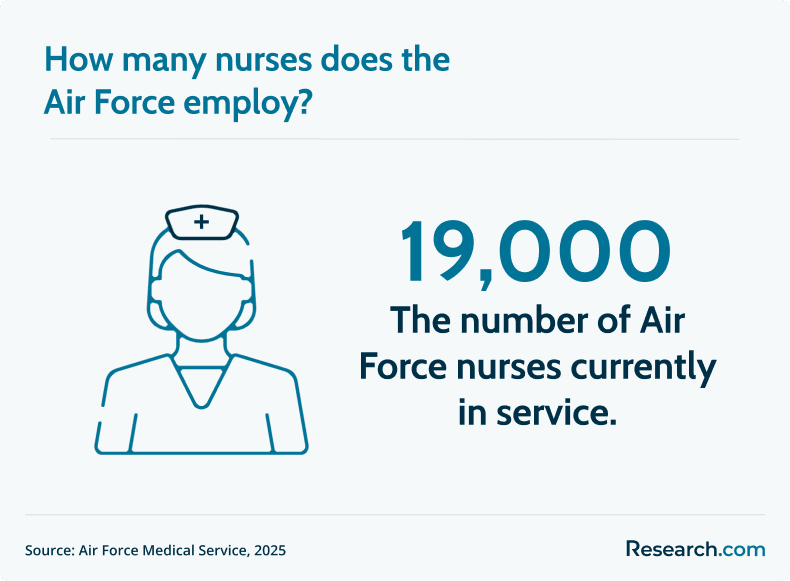
Being an Air Force nurse means joining a vast medical network that extends across the globe. The Nurse Corps includes nearly 19,000 nurses and aerospace or surgical services technicians in the Total Force. With a workforce of this size, salaries and benefits are structured carefully to recruit and retain skilled professionals across every state.
In this article, I will explain what Air Force nurses earn for 2027, beginning with overall salary levels and moving into state-by-state comparisons. I will also cover how special pay and state tax rates affect take-home income, and point out which states provide the highest compensation. These details will help you understand how geography, rank, and career stage shape the earnings of Air Force nurses today.
Key Things to Know About Air Force Nurse Salaries
- Civilian nurses earned a median of $93,600, while other sources report Air Force nurses averaging $70,859 with highs near $156,000.
- Among the highest-paying locations, Air Force nurse pay averages at $114,777 a year in Nome, AK, while California leads with $112,500 at the state level.
- As an Air Force nurse, you can earn an extra $15,000–$25,000 annually through special pays like board certification, incentive pay, and retention bonuses.
- The National Defense Authorization Act authorized a 4.5% raise in 2025, ensuring Air Force nurse salaries remain competitive with inflation and civilian wage growth.
- How much does an Air Force nurse make? Average Salary
- What is the average Air Force nurse salary by state? Salary by State
- What types of special pay are available to an Air Force nurse? Special Pay
- What are the top-paying cities for an Air Force nurse? Top-Paying Cities
- What states have the lowest tax rates for an Air Force nurse? Tax Rates by State
- How much does a new Air Force nurse earn in their first year? First-year Earnings
- What career paths lead to the highest-paying nursing roles in the Air Force? Career Paths
- What advanced degrees can influence Air Force nurse salaries? What advanced degrees can influence Air Force nurse salaries?
- What industry certifications can affect Air Force nurse salaries? Certifications
- What is the outlook for Air Force nurse salaries in the future? Salary Outlook
- Can online education programs boost career growth for Air Force nurses? Can online education programs boost career growth for Air Force nurses?
- How can pursuing a DNP influence career advancement and salary growth? How can pursuing a DNP influence career advancement and salary growth?
How much does an Air Force nurse make?
An Air Force nurse’s pay is not calculated like a civilian hospital salary. Military nurses are commissioned officers, so their income starts with Department of Defense officer base pay and then changes based on rank, years of service, housing allowance, subsistence allowance, specialty pay, bonuses, duty location, deployment status, and tax treatment. This guide explains how those pieces fit together so you can estimate real compensation, compare military nursing with civilian nursing, and understand which choices can raise long-term earnings.
If you are deciding whether the Air Force Nurse Corps is financially worthwhile, focus on total compensation rather than base pay alone. A civilian registered nurse earned a national median of $93,600 in May 2024, according to the Bureau of Labor Statistics, while a new Air Force nurse may begin below that figure in base pay but can narrow the gap through tax-free allowances, bonuses, benefits, and predictable officer promotion.
Quick answer: what should you expect?
A newly commissioned Air Force nurse generally starts as a second lieutenant, or O-1. The cited 2025 officer base-pay range for an O-1 is $3,998.40–$4,161.90 per month, or about $47,981–$49,943 per year before allowances and special pays. With Basic Allowance for Housing, Basic Allowance for Subsistence, and possible incentives, first-year total compensation can reach $70,000 or more, with higher totals in expensive housing markets.
| Pay measure | What it shows | Why it matters |
| Civilian registered nurse median | $93,600 in May 2024 | This is the national benchmark for comparing military nursing with civilian RN employment. |
| O-1 monthly base pay | $3,998.40–$4,161.90 | This is the starting officer pay range before allowances, bonuses, or special pays. |
| O-1 annual base pay | Roughly $47,981–$49,943 | This is the salary foundation for a new Air Force nurse. |
| Unofficial Air Force nurse average | About $70,859 annually, with some totals up to $156,000 | Career-site estimates may reflect allowances and incentives, but they are not official pay tables. |
How does an Air Force nurse salary compare with a civilian nurse salary?
The cleanest comparison starts with base pay, then adds the parts of military compensation that do not exist in most civilian jobs. Civilian employers usually quote wages or annual salaries. The Air Force uses officer pay tables plus allowances and specialty incentives.
- Civilian salary benchmark: Registered nurses earned a national median salary of $93,600 in May 2024. Individual civilian pay can vary widely by specialty, shift, union status, employer, and region.
- Military starting point: Second lieutenants, or O-1 officers, earn $3,998.40–$4,161.90 per month depending on service credit, which equals about $47,981–$49,943 per year before additional compensation.
- Early promotion effect: First lieutenants, or O-2 officers, start at $4,606.80 per month and move upward with time in service, so pay growth is more structured than in many civilian settings.
- Unofficial total-pay estimates: Career websites using self-reported or aggregated data place Air Force nurse pay at an average of about $70,859 annually, with some reported totals up to $156,000. These figures should be treated as estimates, not guaranteed earnings.
In practical terms, civilian nursing may look stronger when you compare only starting base pay. The Air Force becomes more competitive when tax-free allowances, health benefits, specialty pay, retirement value, education benefits, and promotion timelines are included. This is similar to how students evaluate long-term value when comparing GMAT expectations and business school return on investment: the headline number is only one part of the decision.
How does an Air Force nurse salary compare with an Army or Navy nurse salary?
Air Force, Army, and Navy nurses use the same Department of Defense officer pay tables. That means an O-1 nurse with the same years of service receives the same base pay across branches. Differences usually come from assignment location, housing allowance, deployment, specialty utilization, and bonus eligibility.
| Branch | Base-pay rule | Unofficial average or reported range | How to interpret it |
| Air Force Nurse Corps | Uses the same Department of Defense officer pay chart | Average of about $70,859, with some reports up to $156,000 | Reported totals may include allowances, specialty pay, and location effects. |
| Army Nurse Corps | Uses the same Department of Defense officer pay chart | Average of $67,236, with upper ranges up to $176,500 | Differences from Air Force figures are more likely tied to roles and assignments than base pay. |
| Navy Nurse Corps | Uses the same Department of Defense officer pay chart | Average of $67,436, with maximums near $142,500 | Duty station and operational needs can change total compensation. |
The main takeaway: base pay is equal across the services at the same rank and time in service. If one branch appears to pay more in salary-site data, the difference usually reflects where nurses are stationed, what specialties they hold, and which incentives apply.
What is the average Air Force nurse salary by state?
Air Force nurse base pay is the same nationwide because it comes from federal officer pay tables. State-to-state differences appear when Basic Allowance for Housing, local cost of living, and state income tax rules are added to the calculation. A nurse stationed in a high-cost area can receive a much larger housing allowance than a nurse in a lower-cost region, even when both hold the same rank.
The estimates below combine 2025 O-2 base pay with dependent BAH estimates for representative duty stations. They are rounded annual totals intended for comparison, not official individualized pay quotes.
| State and representative duty station | Estimated annual total | Main reason for the difference |
| California, Travis AFB | About $110,000–$115,000 | High housing allowance in an expensive market |
| New York, Long Island | Near $105,000–$110,000 | One of the highest housing-cost areas in the comparison |
| Maryland/DC Metro | Around $100,000–$105,000 | Higher BAH near Washington, DC |
| Virginia, Hampton Roads | About $95,000–$100,000 | Strong regional housing adjustment |
| Washington, Seattle Area | Around $93,000–$98,000 | Elevated housing costs |
| Nevada, Las Vegas/Nellis AFB | About $90,000–$95,000 | Solid BAH additions |
| Colorado, Denver/Colorado Springs | Around $85,000–$90,000 | Cost-of-living and housing-market effects |
| Texas, San Antonio | Near $80,000–$85,000 | Moderate housing allowance compared with coastal states |
| Florida, Tampa/MacDill AFB | About $78,000–$82,000 | Smaller housing allowances in many metro areas |
| Ohio, Wright-Patterson AFB | Near $75,000–$78,000 | Lower housing costs, with no state tax on military income |
| North Carolina, Seymour Johnson AFB | About $74,000–$77,000 | Lower housing costs and state tax considerations |
High-cost states such as California and New York may produce six-figure estimated totals because BAH is larger. Lower-cost states may show smaller gross totals, but the buying power can still be attractive if rent, taxes, and everyday expenses are lower. That is why Air Force nurses should compare net pay and cost of living, not only the annual compensation estimate.
Students comparing military nursing with other healthcare paths should also note that shorter clinical programs, such as the fastest online surgical technology associate degree options, follow a very different training, credentialing, and pay structure.
The graph below presents the top states by pay using illustrative averages based on 2025 O-2 base pay plus housing allowances.
What types of special pay are available to an Air Force nurse?
Special and incentive pays are one of the biggest reasons Air Force nurse compensation can rise above base pay. The military pay system is standardized, so bonuses and special pays help the Air Force compete for hard-to-fill specialties, reward advanced credentials, and retain experienced nurses in mission-critical roles.
The categories below describe common special pays available to Air Force nurses for the cited year. Eligibility depends on specialty, certification, assignment, service agreement, and current Air Force needs.
| Special pay type | Amount stated | Who it may help most |
| Board Certification Pay (BCP) | Up to $8,000 per year | Nurses who maintain approved professional certification |
| Incentive Pay (IP) | $10,000–$20,000 per year | Nurses in areas such as critical care, emergency, perioperative, flight nursing, and certain advanced practice roles |
| Retention Bonus (RB) | $20,000–$60,000 annually | Nurses who sign multiyear service agreements, especially Certified Registered Nurse Anesthetists and mental health nurse practitioners |
| Health Professions Accession Bonus (AB) | $30,000 for a 3-year obligation or $50,000 for a 4-year obligation | Newly commissioned nurses who meet accession bonus rules |
| Hazardous Duty Incentive Pay (HDIP) | $150–$250 per month for aeromedical evacuation aircrew nurses and $150 per month for non-crew hazardous assignments | Nurses assigned to qualifying hazardous or flight-related duties |
| Hostile Fire/Imminent Danger Pay (HFP/IDP) | $225 per month | Nurses serving in combat zones or other designated areas |
| Assignment or Hardship Pays (AIP/HDP) | Up to $3,000 per month in assignment incentive pay and $50–$150 per month in hardship duty pay depending on location | Nurses assigned to select missions or hardship locations |
These payments are not automatic for every nurse. They are tied to current policy, specialty qualification, assignment, and service commitments. Before making career plans around a bonus, nurses should verify eligibility with an Air Force recruiter, medical officer recruiter, or personnel office.
The logic is similar to qualification-based careers in other federal fields. Just as candidates review CIA agent qualification requirements before pursuing intelligence roles, Air Force nurses should understand which credentials and assignments make them eligible for higher compensation.
What are the top-paying cities for an Air Force nurse?
The highest reported cities for Air Force nurse pay tend to be expensive metro areas or remote locations where compensation must account for housing, recruitment difficulty, or local labor-market pressure. The figures below come from aggregated job market data that blend civilian and military salary signals, so they should be read as estimates rather than official Department of Defense pay rates.
| City | Estimated hourly pay | Estimated annual pay | Why pay appears high |
| Nome, Alaska | About $55.18 per hour | $114,777 annually | Remote location and staffing demand |
| Berkeley, California | Around $54.47 per hour | $113,291 annually | Bay Area living costs and nearby healthcare labor markets |
| Sitka, Alaska | Approximately $53.59 per hour | $111,463 annually | Geographic isolation and regional demand |
| San Francisco, California | Roughly $52.41 per hour | $109,010 annually | Very high housing and living costs |
| Santa Clara, California | About $52.24 per hour | $108,665 annually | Silicon Valley cost pressures |
| Sunnyvale, California | Around $52.21 per hour | $108,592 annually | High-cost regional labor market |
| Livermore, California | Approximately $52.18 per hour | $108,530 annually | Bay Area compensation influence |
| San Jose, California | About $52.13 per hour | $108,438 annually | Large Silicon Valley healthcare market |
| Daly City, California | Roughly $51.55 per hour | $107,208 annually | Proximity to San Francisco |
| Santa Cruz, California | About $51.36 per hour | $106,835 annually | Coastal housing costs and regional demand |
These city figures are useful for understanding market pressure, but they should not be used as a guaranteed Air Force paycheck estimate. An actual military nurse’s pay depends on rank, years of service, BAH rate, dependency status, specialty pays, deployment status, and tax treatment. Location affects pay most clearly through BAH, not through a city-specific base salary.
Location-driven pay differences are common across healthcare. For example, professionals exploring speech-language pathology employment settings also have to compare work setting, region, demand, and cost of living before judging compensation.
The graph below shows how these city estimates compare with the broader distribution of Air Force nurse pay.
What states have the lowest tax rates for an Air Force nurse?
Taxes can change take-home pay substantially. Base pay is set federally, but state income tax rules determine how much of that income remains after state withholding. Some states do not have a personal income tax, and others tax income at relatively low rates or provide military-specific treatment.
The following states are listed as low-tax environments for Air Force nurses in 2025 based on the stated tax information.
| State or group | Tax detail stated | Why it matters for Air Force nurses |
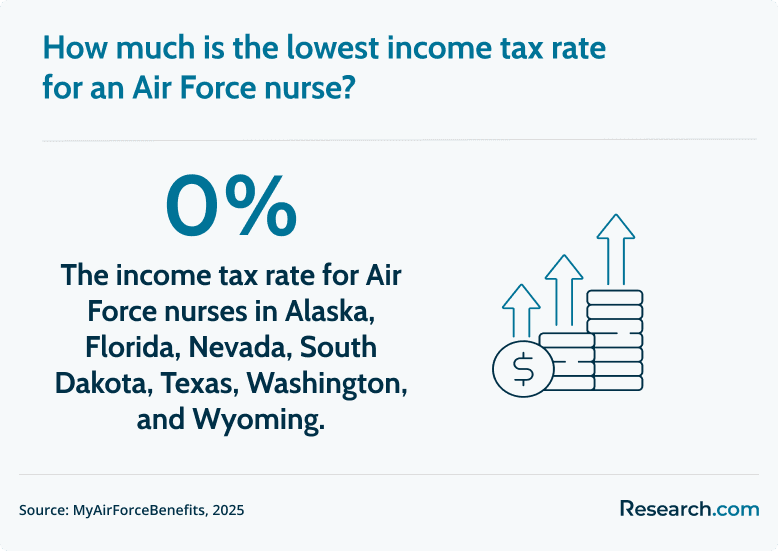
| Alaska, Florida, Nevada, South Dakota, Texas, Washington, and Wyoming | No personal income tax | Military pay is not reduced by state personal income tax in these states. |
| North Dakota | Top marginal rates between 1.10% and 2.90% | Nurses at Minot or Grand Forks AFB face one of the lowest burdens among states with income tax. |
| Arizona | Flat tax of 2.5% | Nurses at Davis-Monthan AFB get a predictable and modest state tax rate. |
| Indiana | Flat rate of 3.05% | The rate is among the lower state income tax rates in the Midwest. |
| Louisiana | Flat 3.0% rate | The state offers a relatively low tax bill for nurses assigned in the region. |
| Pennsylvania | Statewide rate of 3.07% | The rate is comparatively affordable for the Northeast. |
| Ohio | Progressive rates capped near 3.5% | Nurses at Wright-Patterson AFB face a relatively low state income tax burden. |
| Iowa | Flat rate of about 3.8% | Recent tax reforms place Iowa below many higher-tax states. |
Low-tax states can improve net pay, but taxes should not be the only factor in assignment preferences. Housing costs, spouse employment, childcare, commuting, healthcare access, and long-term career opportunities can outweigh a small tax difference. A no-income-tax state with high rent may not always leave a nurse better off than a lower-cost state with a modest income tax.
The same net-pay mindset applies to civilian healthcare planning. When students review guides such as national certified medical assistant salary and career paths, the useful comparison is not only gross salary but also training cost, local wages, and take-home value.
How much does a new Air Force nurse earn in their first year?
A new Air Force nurse typically enters as a second lieutenant, or O-1. Using the cited 2025 pay figures, annual base pay is about $47,981 to $49,943, depending on prior service or credit for advanced education. That base pay is only the starting layer of compensation.
First-year nurses may also receive tax-free allowances. Basic Allowance for Subsistence adds about $320 per month. Basic Allowance for Housing varies by duty station and is cited as averaging between $18,000 and $33,000 per year. Because these allowances are exempt from federal income tax, they can be especially valuable compared with taxable salary.
| First-year pay component | Amount stated | Important note |
| O-1 base pay | About $47,981 to $49,943 annually | Taxable base pay tied to officer rank and service credit |
| Basic Allowance for Subsistence | About $320 per month | Tax-free allowance for food-related costs |
| Basic Allowance for Housing | Averaging between $18,000 and $33,000 per year | Tax-free allowance that changes by duty station and dependency status |
| Estimated first-year total compensation | Typically $70,000 or more when allowances are included | Higher-cost locations can push total compensation above this level |
A nurse assigned to a high-cost area such as San Francisco or New York may see a much larger compensation package because housing allowance rises with the local market. A nurse in a lower-cost region may have a smaller gross total but stronger purchasing power if housing and daily expenses are lower.
This starting structure can appeal to people who want an organized career path early in nursing. Others may enter the field through civilian routes, including those becoming a nurse later in life, where pay depends more heavily on employer, region, prior experience, and degree pathway.
What career paths lead to the highest-paying nursing roles in the Air Force?
The highest Air Force nursing earnings usually go to nurses who combine officer advancement with advanced practice credentials, difficult-to-fill specialties, and eligibility for incentive or retention pay. These roles require more education and responsibility, but they can move compensation well beyond standard entry-level pay.
| High-paying path | Pay figure stated | Why it can pay more |
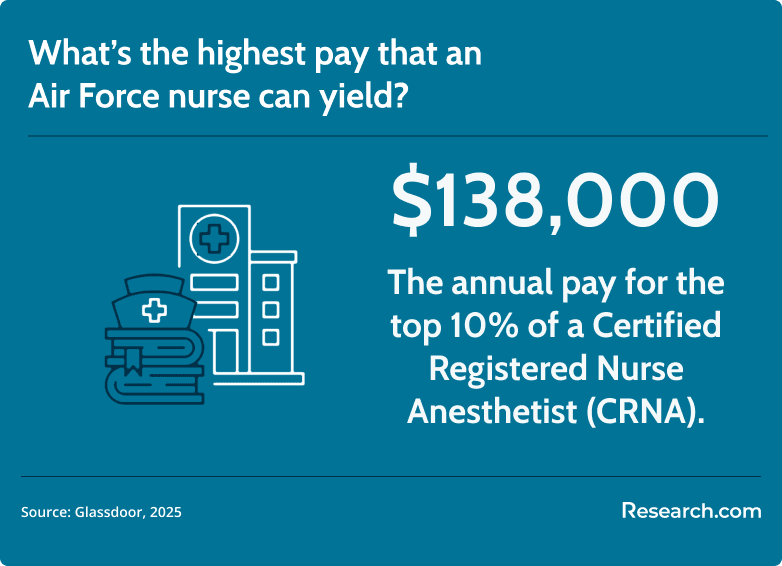
| Certified Registered Nurse Anesthetist (CRNA) | $87,000 to $138,000 annually, averaging about $110,000 | CRNAs provide anesthesia services, a high-demand capability in both military and civilian systems. |
| Psychiatric/Mental Health Nurse Practitioner (PMHNP) | Averaging $117,134 per year | Mental health care is a priority across the force, supporting stronger demand for this specialty. |
| Nurse Practitioner, general | Average of $130,295 annually, or $62.64 per hour | Broad practice authority allows NPs to support primary care and specialty care needs. |
| Critical care, emergency, flight nursing, and advanced practice roles | Incentive and retention pays ranging from $10,000 to $60,000 annually | These specialties support operational readiness and are harder to staff. |
For nurses who want the strongest earnings path, the decision is usually not simply “stay in longer.” It is “stay in, specialize, certify, and compete for assignments that align with Air Force needs.” Advanced practice education can also expand leadership opportunities, similar to how civilian nurses evaluate the best jobs for nurses with an MSN and MBA when weighing clinical leadership, administration, and income potential.
What advanced degrees can influence Air Force nurse salaries?
Advanced degrees can raise an Air Force nurse’s earnings by opening access to advanced practice roles, improving promotion competitiveness, and supporting eligibility for specialty incentives. A graduate degree does not automatically guarantee a specific salary, but it can place a nurse on a higher-value career track.
The examples below compare stated advanced-degree outcomes with a new O-1 nurse’s first-year compensation of about $70,000.
| Degree or graduate pathway | Stated compensation impact | Best fit |
| Master of Science in Nursing (MSN) | Required for nurse practitioner roles, which average $130,295 annually or $62.64 per hour; cited as an 86% increase over entry-level earnings | Nurses aiming for advanced clinical practice |
| Doctor of Nursing Practice (DNP) | Supports promotion to field-grade ranks such as major, or O-4; DFAS pay tables show annual base pay plus allowances exceeding $120,000, cited as a 71% increase compared with first-year compensation | Nurses targeting advanced practice, leadership, and evidence-based clinical roles |
| Certified Registered Nurse Anesthetist (CRNA) program | Leads to CRNA roles earning $87,000–$138,000 annually, averaging about $110,000, cited as a 57% increase over O-1 earnings | Nurses pursuing anesthesia practice |
| Psychiatric/Mental Health Nurse Practitioner (PMHNP) programs | Average of $117,134 annually, cited as a 67% increase compared with a new officer’s first year | Nurses interested in behavioral health and mental health care |
| Dual-degree programs, including MSN/MPH or MSN/MBA | May strengthen promotion potential to senior officer ranks; at O-5 and above, DFAS tables show annual pay exceeding $135,000, nearly a 100% increase from initial earnings | Nurses aiming for command, administration, public health, or healthcare management roles |
When choosing a graduate program, Air Force nurses should ask whether the degree supports a recognized specialty, whether it aligns with Air Force manning needs, and whether it improves promotion or assignment competitiveness. Graduate education is most valuable when it connects directly to a clinical role, operational need, or leadership track.
Civilian bridge programs show the same pattern: the right education can change role eligibility and earning potential. For example, accelerated EMT-to-RN online bridge programs help healthcare workers qualify for a different scope of practice, while graduate nursing education can move Air Force nurses into advanced practice or senior leadership.
What industry certifications can affect Air Force nurse salaries?
Certifications can help Air Force nurses prove specialty competence, qualify for certain assignments, and strengthen eligibility for incentive pay or advancement. They are usually faster to earn than degrees, but they still require preparation, renewal, and hands-on expertise. The most useful certifications are those that match the nurse’s assignment goals and Air Force staffing needs.
| Certification | Issuing organization stated | How it can support Air Force nursing pay or advancement |
| Critical Care Registered Nurse (CCRN) | American Association of Critical-Care Nurses (AACN) | Supports intensive care placement and may align with incentive pay for critical care specialists. |
| Certified Emergency Nurse (CEN) | Board of Certification for Emergency Nursing (BCEN) | Strengthens competitiveness for emergency department assignments and deployment-relevant roles. |
| Certified Nurse Operating Room (CNOR) | Competency & Credentialing Institute (CCI) | Helps perioperative nurses compete for surgical team and leadership responsibilities. |
| Certified Flight Registered Nurse (CFRN) | BCEN | Supports aeromedical evacuation duties and can connect to Hazardous Duty Incentive Pay when on flight status. |
| Trauma Nursing Core Course (TNCC) | Emergency Nurses Association (ENA) | Often supports trauma assignments, including deployment teams and combat support settings. |
| Advanced Cardiac Life Support (ACLS) and Pediatric Advanced Life Support (PALS) | American Heart Association (AHA) | Commonly required for advanced emergency response in adult and pediatric clinical roles. |
The best certification strategy is targeted, not random. A nurse who wants flight nursing should prioritize aeromedical and emergency credentials. A nurse seeking intensive care assignments should build critical care experience and certification. Credentials matter most when they match documented competency and current mission needs.
What is the outlook for Air Force nurse salaries in the future?
The salary outlook for Air Force nurses appears stable because military pay is structured, healthcare demand remains strong, and the Air Force uses incentives to compete for difficult-to-fill nursing specialties. However, future pay depends on federal budgets, annual pay raises, bonus policy, staffing needs, and specialty shortages.
The Bureau of Labor Statistics projects that registered nurse employment will grow 6% from 2022 to 2032, faster than the average for all occupations. Civilian demand matters because the Air Force must compete with hospitals, clinics, travel nursing opportunities, and advanced practice employers for the same licensed talent.
Military pay also changes through federal authorization. In 2025, active-duty service members are receiving a 4.5% raise. Annual adjustments can support steady growth in base pay, while specialty bonuses may continue to target areas such as mental health, anesthesia, critical care, emergency care, and flight nursing.
| Trend | Likely effect on Air Force nurse pay | What nurses should watch |
| National RN demand | May increase pressure to keep military nurse compensation competitive | BLS employment projections and civilian wage trends |
| Annual military pay raises | Can raise base pay across ranks | National Defense Authorization Act updates and DFAS pay tables |
| Shortages in specialized care | Can support incentive and retention bonuses | Bonus lists for anesthesia, mental health, critical care, and other high-need areas |
| Advanced practice expansion | May improve earnings for nurses with graduate preparation | Air Force staffing priorities and credential requirements |
Air Force nursing pay is less volatile than many civilian roles because base pay follows a federal schedule. The variable part is incentive pay: the highest earners will likely continue to be nurses whose specialties match Air Force shortages and operational needs.
Structured public-service careers often share this pattern. A guide on how to become a police officer, for example, also has to account for rank systems, public budgets, geographic differences, and specialized assignment pay.
Can online education programs boost career growth for Air Force nurses?
Online education can help Air Force nurses build credentials without stepping away from service, but the value depends on accreditation, transfer policies, clinical requirements, military tuition support, and whether the program supports promotion or specialty goals. An accessible online RN-to-BSN program may be useful for nurses who need a flexible academic path, but “easy” should not mean low-quality. Air Force nurses should confirm that the program is properly accredited and respected by military and civilian employers.
How to evaluate an online nursing program while serving
- Check accreditation first: Make sure the school and nursing program hold recognized accreditation before applying.
- Ask about military transfer credit: Some schools may award credit for prior coursework, clinical experience, or military training.
- Confirm clinical requirements: Online does not always mean fully remote, especially in nursing.
- Compare total cost, not only tuition: Fees, books, technology costs, and travel can change the real price.
- Align the degree with your next role: A BSN, MSN, DNP, or specialty track should support a specific assignment, promotion goal, or advanced practice plan.
How can pursuing a DNP influence career advancement and salary growth?
A Doctor of Nursing Practice can strengthen an Air Force nurse’s profile for advanced clinical practice, evidence-based care leadership, and senior responsibilities. It does not automatically produce a bonus or promotion, but it may support competitiveness for field-grade roles, advanced practice assignments, and leadership positions. Nurses considering an online or flexible DNP program should look beyond convenience and verify accreditation, clinical placement support, cost, faculty expertise, and whether the curriculum fits Air Force career goals.
When a DNP may be worth considering
- You want advanced practice authority: A DNP may fit nurses pursuing high-responsibility clinical roles.
- You are aiming for leadership: The degree can support systems improvement, quality, policy, and clinical administration.
- You can manage the service-school balance: Graduate study requires time, clinical planning, and command support.
- The program has a clear return: The best choice is a degree that supports promotion, assignment eligibility, or post-service career options.
Common mistakes to avoid when estimating Air Force nurse pay
| Mistake | Why it causes confusion | Better approach |
| Comparing civilian salary to military base pay only | It ignores tax-free allowances and special pays. | Compare total compensation, tax treatment, benefits, and retirement value. |
| Treating salary-site estimates as official pay | Aggregated data may combine different ranks, specialties, and locations. | Use DFAS pay tables and BAH calculators for official baseline estimates. |
| Assuming every nurse receives bonuses | Bonuses depend on specialty, certification, assignment, and service agreements. | Verify current eligibility before planning around incentive pay. |
| Ignoring cost of living | A higher gross total in an expensive city may not mean better purchasing power. | Compare rent, taxes, commuting, childcare, and local expenses. |
| Choosing a degree program only because it is flexible | Convenience does not guarantee career value. | Confirm accreditation, clinical requirements, military compatibility, and role alignment. |
Questions Air Force nurses should ask before making a pay-related career decision
- What rank and years-of-service category will apply when I commission?
- What BAH rate applies to my likely duty station and dependency status?
- Which special pays are currently available for my specialty?
- Would an MSN, DNP, CRNA, or PMHNP pathway qualify me for a higher-demand role?
- Which certifications are most relevant to my desired assignment?
- How will state income tax affect my take-home pay?
- What service obligation comes with an accession bonus, retention bonus, or funded education opportunity?
- How does this path compare with civilian nursing compensation in the city where I would otherwise work?
Key Insights
- Air Force nurse pay starts with officer rank: A new O-1 nurse has cited annual base pay of about $47,981–$49,943, but that is not the full compensation package.
- Allowances change the picture: BAS and BAH can push first-year total compensation to $70,000 or more, especially in high-cost housing areas.
- Base pay is the same across military branches: Air Force, Army, and Navy nurses at the same rank and service time use the same Department of Defense officer pay chart.
- Specialty drives higher earnings: CRNAs, nurse practitioners, mental health nurse practitioners, critical care nurses, emergency nurses, and flight nurses may qualify for stronger compensation through advanced roles and incentives.
- Location matters through BAH and taxes: California and New York may produce higher gross totals, while low-tax states can improve take-home pay.
- Education and certification should be strategic: The best programs and credentials are those that support Air Force needs, promotion potential, and post-service career options.
- Use official sources for final estimates: Salary websites can provide context, but DFAS pay tables, BAH rates, and current Air Force special-pay rules are the most important sources for planning.
References:
- Air Force Medical Service. (2025). Nurse Corps. U.S. Air Force. https://www.airforcemedicine.af.mil/About-Us/Medical-Branches/Nurse-Corps/
- Better Nurse. (2023). Military Nurse Salary: A Guide to Earnings and Benefits. https://betternurse.org/military-nurse-salary/
- Defense Finance and Accounting Service. (2024). Basic Pay – Officers. https://www.dfas.mil/MilitaryMembers/payentitlements/Pay-Tables/Basic-Pay/CO/
- Defense Finance and Accounting Service. (2024). Nurse Corps Board Certification Pay (BCP), Incentive Pay (IP) and Retention Bonus (RB), FY2025. https://www.dfas.mil/MilitaryMembers/payentitlements/Pay-Tables/HPO5/
- Defense Finance and Accounting Service. (2025). Military Pay Tables & Information. https://www.dfas.mil/militarymembers/payentitlements/Pay-Tables
- Defense Travel Management Office. (2025). Basic Allowance for Housing rates by Military Housing Area. https://www.travel.dod.mil/Allowances/Basic-Allowance-for-Housing/
- Glassdoor. (2025). US Air Force Certified Registered Nurse Anesthetist Salaries. https://www.glassdoor.com/Salary/US-Air-Force-Certified-Registered-Nurse-Anesthetist-Salaries-E41283_D_KO13%2C51.htm
- MyAirForceBenefits. (2024). Which states tax my active duty or reserve military pay? https://myairforcebenefits.us.af.mil/News/Which-states-tax-my-Active-Duty-or-Reserve-military-pay
- Secretary of Defense (Comptroller). (2025). DoD FMR Vol. 7A, Ch. 5: Health Professions Officer Special and Incentive Pay. https://comptroller.defense.gov/FMR/vol7a_chapters/
- USAFacts. (2024). Which states have the highest and lowest income tax? https://usafacts.org/articles/which-states-have-the-highest-and-lowest-income-tax/
- ZipRecruiter. (2025). Air Force RN Salary. https://www.ziprecruiter.com/Salaries/Air-Force-Rn-Salary
Other Things You Should Know About Air Force Nurse Salaries
Active duty Air Force nurses receive federal base pay plus allowances such as Basic Allowance for Housing and Basic Allowance for Subsistence. Reserve and Guard nurses are paid mainly for drill periods and annual training, with compensation tied to pay grade and duty status under Department of Defense pay tables.
In 2027, an Air Force nurse’s salary can be influenced by state-specific factors such as cost of living, local demand for nursing professionals, and available incentives. For instance, states with higher living costs or nursing shortages may offer additional allowances or incentives to attract and retain nurses.
To become an Air Force nurse in 2027, a candidate must have a Bachelor of Science in Nursing (BSN) degree and hold an active Registered Nurse (RN) license. Additionally, candidates typically need to pass the National Council Licensure Examination (NCLEX-RN).


