
2027 How to Become a Nurse in North Dakota

Co-Founder and Chief Data Scientist
Becoming a nurse in North Dakota is a practical career path for people who want stable healthcare work, direct patient impact, and room to advance into specialized or advanced practice roles. The state has over 10,000 registered nurses, an average annual RN salary of $79,190, and projected nursing job growth of 10.4% through 2032, with about 770 openings each year. At the same time, North Dakota’s rural healthcare needs, aging population, and retiring workforce make licensure, clinical preparation, and program choice especially important.
This guide explains how to become a nurse in North Dakota in 2026, including education options, licensing steps, compact license rules, nursing roles, job outlook, online program considerations, financial aid, and advancement paths such as nurse practitioner, nurse midwife, and other APRN careers.
Quick Answer: How do you become a nurse in North Dakota?
To become a nurse in North Dakota, you must complete an approved nursing education program, pass the appropriate NCLEX exam, apply to the North Dakota Board of Nursing, complete the required background check, and maintain your license through renewal and continuing education. Registered nurses usually earn an ADN or BSN before taking the NCLEX-RN, while licensed practical nurses complete a practical nursing program and pass the NCLEX-PN.
Key Things You Need to Know About Becoming a Nurse in North Dakota
- North Dakota is experiencing a nursing workforce gap, with projections indicating a need for over 1,000 additional registered nurses by 2025. Demand is tied to an aging population, rural care access needs, and retirements among experienced nurses.
- Registered nurses in North Dakota earned an average salary of around $79,190 per year in 2023. Actual take-home value depends heavily on where you live and work, since Fargo, Bismarck, rural hospitals, long-term care facilities, and travel roles can differ in pay and cost of living.
- RN employment in North Dakota is projected to grow by 10.4% through 2032, with about 770 average annual openings. That creates opportunities for new graduates, compact nurses, and experienced RNs willing to work in high-need areas.
- The usual RN entry points are an Associate Degree in Nursing (ADN) or a Bachelor of Science in Nursing (BSN). ADN programs may help students enter the workforce sooner, while BSN programs can strengthen long-term advancement options and may be preferred by some employers.
- Nurses can specialize in areas such as geriatrics, pediatrics, mental health, neonatal care, rural health, and advanced practice. The best path depends on your timeline, budget, academic background, and willingness to pursue graduate education.
- Steps to become a nurse in North Dakota
- Education requirements for North Dakota nurses
- Types of nurses allowed to practice in North Dakota
- North Dakota nursing licensing requirements
- Nursing license types in North Dakota
- Compact nurse practice in North Dakota
- Practicing nursing without a license in North Dakota
- Current state of nursing in North Dakota
- LPN options in North Dakota
- North Dakota nursing job outlook
- Direct-entry MSN programs in North Dakota and job outlook considerations
- Advanced nursing education in North Dakota
- How to choose an online nursing program in North Dakota
- Nurse midwife transition path and online program factors
- Continuing education and professional development
- How to evaluate nursing schools, license maintenance, online learning, advanced education, and career demand
- Interdisciplinary collaboration in healthcare
- Nurse practitioner transition path
- Advanced practice nurse compensation and advancement, NP preparation, and team-based care
- Career pathways beyond bedside nursing
- Financial aid for nursing students and cost-planning questions
What are the steps to becoming a nurse in North Dakota?
The path to nursing licensure in North Dakota is straightforward, but each step matters. The program you choose must prepare you for clinical practice, NCLEX testing, and the license category you want.
- Choose the nursing role you want. Decide whether you want to become a CNA, LPN, RN, or eventually an APRN. Each role has a different education level, scope of practice, timeline, and salary potential.
- Complete an approved nursing program. North Dakota offers multiple nursing education pathways, including eight Bachelor of Science in Nursing (BSN) programs and five Associate of Applied Science (AAS) programs. Students who already have college credits, a prior bachelor’s degree, or LPN experience may qualify for bridge or accelerated options.
- Finish required clinical training. Nursing programs include supervised clinical experiences in healthcare settings. If you enroll in an online or out-of-state program, confirm that its clinical placements are accepted by the North Dakota Board of Nursing before committing.
- Apply for licensure through the North Dakota Board of Nursing. You will need to submit proof of education, meet application requirements, and complete the background check process.
- Pass the appropriate NCLEX exam. RN candidates take the NCLEX-RN, while LPN candidates take the NCLEX-PN. Candidates who schedule the exam may receive temporary authorization to work in North Dakota for 90 days or until exam results are available. If you do not pass, you can retest after a 45-day waiting period.
- Maintain your license after approval. Licensed nurses must renew their credentials and meet continuing education and practice requirements to remain in good standing.
| Step | What to verify before moving forward | Why it matters |
| Pick a role | RN, LPN, CNA, or APRN career goal | Your target role determines the degree, exam, and license you need. |
| Select a program | Approval status, accreditation, clinical placement access | An unsuitable program can delay licensure or limit employment options. |
| Complete clinicals | Location, supervision, and state approval | Hands-on experience is required for safe practice and exam readiness. |
| Take NCLEX | Correct exam type and eligibility documentation | Passing the NCLEX is required for RN or LPN licensure. |
| Renew license | Continuing education and practice requirements | Renewal keeps your license active and protects your ability to work. |
Specialized nursing roles can also shape your long-term plans. For example, neonatal nurses are highly valued in many healthcare systems, and the neonatal nurse salary in the state is higher than $100,000.
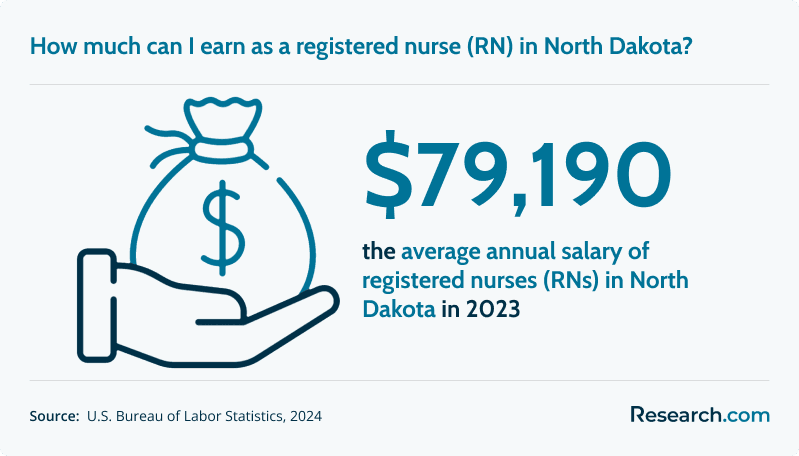
In 2023, there were around 10,350 registered nurses (RNs) in North Dakota earning around $79,190 per year on average. This is also close to the reported ADN nursing salary in the state, though individual pay varies by employer, location, specialty, shifts, and experience.
What are the educational requirements for becoming a nurse in North Dakota?
North Dakota nursing education requirements depend on the license you want. Entry-level nursing students usually choose practical nursing, ADN, or BSN programs, while nurses seeking advanced practice, leadership, or research roles continue into graduate study.
| Education option | Typical purpose | Best fit | Licensure or career result |
| Practical nursing program | Preparation for basic nursing care | Students who want a shorter path into nursing | Eligibility for NCLEX-PN and LPN licensure |
| Associate Degree in Nursing (ADN) | Entry-level registered nursing preparation | Students seeking a faster RN pathway, often through community colleges | Eligibility for NCLEX-RN and RN licensure |
| Bachelor of Science in Nursing (BSN) | Broader RN preparation with leadership, public health, and research foundations | Students who want stronger advancement potential or plan graduate study | Eligibility for NCLEX-RN and RN licensure |
| Master of Science in Nursing (MSN) | Advanced clinical, leadership, or specialty preparation | RNs aiming for roles such as nurse practitioner or clinical nurse specialist | Graduate-level nursing roles, depending on specialization and certification |
| Doctor of Nursing Practice (DNP) or PhD | Highest-level practice leadership or research preparation | Nurses seeking executive, advanced clinical, faculty, or research roles | Advanced practice, leadership, academic, or research opportunities |
- ADN programs are commonly completed in about two years and prepare graduates for entry-level RN practice after passing the NCLEX-RN.
- BSN programs usually take four years and include more extensive coursework in evidence-based practice, leadership, community health, and care coordination.
- MSN programs generally require additional study beyond the BSN and may lead to nurse practitioner, clinical nurse specialist, educator, or leadership roles.
- DNP and PhD programs serve different goals: the DNP is practice-focused, while the PhD emphasizes research and academic scholarship. Some schools offer easy DNP programs to get into that are available to North Dakota residents.
Why accreditation matters
Accreditation is one of the first things to check when comparing nursing schools. A properly accredited or approved program is more likely to meet licensure expectations, support transfer or graduate study, and satisfy employer requirements. Do not assume that an online program qualifies you for North Dakota licensure just because it accepts students from the state.
Alternative education pathways
Students with previous college experience may be able to shorten their nursing timeline. For example, someone who previously completed healthcare-related coursework through an accelerated online sonography degree may have transferable science or general education credits, depending on the nursing school’s policy.
Career changers can also look at bridge and second-degree formats, including online nursing degree for non nurses options. Before enrolling, ask whether clinical placements are arranged in North Dakota, whether the program is accepted by the state board, and whether graduates are eligible for the NCLEX exam you need.
What types of nurses can legally practice in North Dakota?
North Dakota recognizes several nursing-related roles. The right choice depends on how much responsibility you want, how long you want to study, and whether you plan to move into advanced practice later.
- Registered Nurses (RNs): RNs provide direct care, assess patients, administer medications, coordinate care plans, educate patients and families, and work with physicians and other clinicians. RN candidates typically complete an ADN or BSN and pass the NCLEX-RN.
- Licensed Practical Nurses (LPNs): LPNs deliver basic nursing care under the supervision of RNs, physicians, or other authorized providers. They usually complete a practical nursing program and pass the NCLEX-PN.
- Advanced Practice Registered Nurses (APRNs): APRNs include nurse practitioners, clinical nurse specialists, certified registered nurse anesthetists, and certified nurse midwives. These roles require graduate nursing education and specialty certification.
- Certified Nursing Assistants (CNAs): CNAs are not licensed nurses, but they are important members of the care team. They help with daily living needs, mobility, vital signs, and patient support under supervision.
| Role | Common education level | Typical exam or credential | Common work settings |
| CNA | State-approved training program | Competency exam | Long-term care, hospitals, assisted living, home care |
| LPN | Practical nursing program | NCLEX-PN | Clinics, long-term care, hospitals, home health |
| RN | ADN or BSN | NCLEX-RN | Hospitals, clinics, public health, schools, long-term care |
| APRN | MSN, DNP, or other graduate nursing preparation | National specialty certification and state authorization | Primary care, specialty clinics, hospitals, anesthesia, women’s health |
The growth of specialized nursing reflects broader healthcare changes. Rural access, chronic disease management, care coordination, telehealth, and interdisciplinary practice all increase the need for nurses who can work across settings and adapt to new technology.
What are the licensing requirements for nurses in North Dakota?
North Dakota nursing licensure is managed by the North Dakota Board of Nursing. Requirements vary by role, but RN and LPN applicants generally move through the same core stages: education, examination, application, background check, and renewal.
- Approved education: RN applicants generally need an ADN or BSN from an approved program. LPN applicants complete practical nursing education, often in about one year.
- NCLEX exam: RN candidates take the NCLEX-RN, while LPN candidates take the NCLEX-PN. The exam measures whether a candidate is prepared for safe entry-level practice.
- Application to the state board: Applicants submit required documentation, education verification, examination information, and fees to the North Dakota Board of Nursing. As of 2023, the RN application fee is approximately $135, while the LPN application fee is around $125.
- Criminal background check: Nursing applicants must complete a background check, including fingerprinting. This step supports patient safety and professional accountability.
- License renewal: Nurses must renew their license and meet ongoing requirements to continue practicing legally.
Licensure is not just paperwork. It confirms that a nurse has met minimum education, examination, and conduct standards before caring for patients.
What types of nursing licenses are available in North Dakota?
North Dakota offers multiple nursing credentials, each tied to a specific scope of practice. Choosing the right one should be based on your career goal, how quickly you need to start working, and whether you want the option to advance into graduate-level roles later.
- Registered Nurse (RN) License: RN licensure is the standard credential for professional registered nursing practice. Candidates complete an accredited or approved ADN or BSN program, pass the NCLEX-RN, and meet North Dakota Board of Nursing requirements. RNs may perform patient assessment, medication administration, care coordination, patient education, and clinical decision-making within their scope.
- Licensed Practical Nurse (LPN) License: LPN licensure is a shorter route into nursing. Practical nursing programs usually focus on core bedside skills, basic medication administration, vital signs, documentation, and supervised care. Graduates must pass the NCLEX-PN.
- Advanced Practice Registered Nurse (APRN) License: APRN authorization applies to advanced roles such as nurse practitioner, clinical nurse specialist, certified registered nurse anesthetist, and certified nurse midwife. Applicants need graduate nursing education and national certification in their specialty.
- Nursing Assistant Certification: CNA certification is a common starting point for people who want patient care experience before committing to LPN or RN education. CNAs are not licensed nurses, but the role can help students confirm whether nursing is the right fit.
Among nursing occupations in the state, CRNAs are the highest-paid in the listed data, with an average annual salary of $234,950 in 2023. See the chart below for salary comparisons.
Can a Compact nurse practice in North Dakota?
Yes. North Dakota participates in the Nurse Licensure Compact (NLC), which allows eligible nurses with a multistate license from another compact state to practice in North Dakota without applying for a separate single-state North Dakota license. North Dakota has participated in the NLC since January 1, 2004, and moved to the enhanced Compact on January 19, 2018.
This is important for travel nurses, relocating nurses, military spouses, telehealth nurses, and employers trying to fill roles quickly. A compact license can reduce administrative delays, but nurses still need to follow North Dakota’s scope-of-practice rules and employer policies while working in the state.
| Situation | What it means in North Dakota | What to check |
| You hold a valid multistate compact license | You may be able to practice in North Dakota without a separate state license | Confirm your compact status and eligibility before accepting work |
| You move your primary residence to North Dakota | Your licensure obligations may change | Review Board of Nursing requirements for declaring a primary state of residence |
| You are licensed in a non-compact state | You may need to apply for North Dakota licensure | Verify endorsement requirements with the state board |
| You want to work remotely with North Dakota patients | Telehealth may involve state-specific practice rules | Check both compact privileges and employer compliance policies |
The compact is also useful for career changers planning longer-term nursing education. If you already hold a bachelor’s degree and want a graduate-entry pathway, fast MSN programs for non-nurses may be worth comparing, especially if they provide state-approved clinical experiences.
Can you practice as a nurse without a license in North Dakota?
No. You cannot legally practice as a nurse in North Dakota without the proper license or authorization. The North Dakota Board of Nursing requires nurses to hold a valid credential before performing nursing duties within the licensed scope of practice.
This requirement protects patients and employers by making sure nurses have completed approved education, passed required exams, and met professional standards. It can be frustrating for qualified candidates waiting on paperwork, especially internationally educated nurses or nurses moving from non-compact states, but working without authorization can lead to serious professional and legal consequences.
- Patient safety: Licensing helps verify that nurses have the minimum preparation needed for safe care.
- Professional accountability: The license gives the state board authority to investigate unsafe practice or misconduct.
- Workforce access: North Dakota needs nurses, especially in rural settings, but shortages do not remove licensure requirements.
- International mobility: Foreign-trained nurses may bring valuable experience, but they still must complete North Dakota’s licensure process before practicing.
Foreign-trained nurses account for 15% of the U.S. RN workforce, and many face complex credential review and testing steps before they can work in the United States. A better approach is not to bypass licensure, but to identify approved pathways that recognize prior education while maintaining patient safety standards.
What is the state of nursing in North Dakota?
Nursing in North Dakota is shaped by three realities: persistent demand, rural access challenges, and a healthcare system that depends heavily on nurses across hospitals, clinics, long-term care, home health, and public health settings.
Employment demand
The demand for nurses remains strong because North Dakota’s healthcare needs continue to grow. An aging population, chronic health conditions, retirements, and rural provider shortages all contribute to hiring pressure. Healthcare is one of the fastest-growing industries in the state, according to the North Dakota Department of Labor and Human Rights.
For new nurses, this means job opportunities may be available in a variety of settings. For employers, it means retention, safe staffing, mentorship, and rural recruitment are ongoing challenges.
Cost of living and quality-of-life considerations
North Dakota is often viewed as more affordable than many larger metropolitan states, particularly for housing and daily expenses. That can help new nurses manage student loan payments and early-career budgets. However, salary comparisons should always be local. A higher salary in one city may not go as far if housing, commuting, childcare, or shift requirements are more expensive.
Where nurses work in North Dakota
- Hospitals and health systems: These employers typically offer acute care, specialty units, emergency care, surgery, intensive care, and leadership pathways.
- Long-term care and assisted living: Demand is tied to aging residents and the need for chronic care support.
- Clinics and rural health centers: These settings may offer predictable schedules and broad patient-care responsibilities.
- Home health and community care: Growth in care-at-home models creates opportunities for nurses comfortable with independent work and patient education.
- Public health and school nursing: These roles may appeal to nurses interested in prevention, education, and community-level health outcomes.
In 2023, there were around 10,350 registered nurses (RNs) in the state. See the chart below for employment levels in selected nursing occupations.
What options are available for aspiring LPNs in North Dakota?
Becoming an LPN can be a strong entry point for students who want to begin nursing work sooner and possibly bridge into RN education later. LPNs provide basic nursing care, monitor patients, support medication and treatment routines within their scope, and work under appropriate supervision.
Students can compare campus-based and flexible options, including online LPN programs in North Dakota. When reviewing any LPN program, ask whether clinical placements are local, whether graduates are eligible for the NCLEX-PN, and whether credits can transfer into an LPN-to-RN or LPN-to-BSN pathway.
| LPN pathway question | Why it matters |
| Is the program approved for North Dakota licensure? | Approval affects NCLEX-PN eligibility and your ability to become licensed. |
| Where are clinicals completed? | Online coursework still requires hands-on practice in approved settings. |
| Can credits transfer later? | Transfer policies affect how easily you can move from LPN to RN education. |
| What are the total costs? | Fees, supplies, testing, transportation, and lost work hours can change affordability. |
What is the job outlook for nursing in North Dakota?
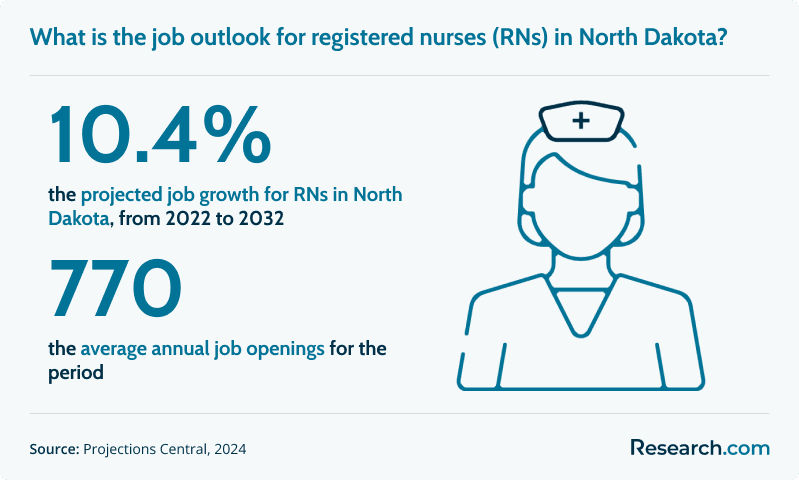
The nursing job outlook in North Dakota is positive. According to the U.S. Bureau of Labor Statistics through Projections Central, registered nurse employment in North Dakota is projected to grow by approximately 10.4% from 2022 to 2032. That equals an average of 770 annual openings during the period.
Demand is strongest where healthcare access is hardest to maintain: rural hospitals, long-term care facilities, community clinics, behavioral health settings, home health agencies, and specialty services that serve older adults. Nurses with flexibility, strong clinical skills, and willingness to work in underserved areas may find more options.
How AI, telehealth, and technology are changing nursing work
Technology is not replacing nurses, but it is changing daily responsibilities. Nurses increasingly use electronic health records, remote monitoring tools, telehealth platforms, medication safety systems, and clinical decision-support tools. These technologies make documentation, patient education, care coordination, and data interpretation more important skills for new graduates.
The best nursing candidates in 2026 will not only know bedside care. They will also be able to communicate across teams, use digital systems accurately, recognize when technology output needs clinical judgment, and support patients who receive care remotely.
Could a direct-entry MSN program accelerate your nursing career in North Dakota?
A direct-entry MSN can be useful for people who already hold a bachelor’s degree in another field and want to enter nursing through an intensive graduate pathway. These programs are designed for career changers and may combine prelicensure nursing coursework, clinical preparation, and graduate-level leadership or specialty content.
This option may make sense if you already have strong academic preparation, can handle an accelerated schedule, and want a pathway that may support future advanced practice or leadership goals. It may not be the best fit if you need the lowest-cost route, want to work full time during school, or are not ready for a demanding clinical program. To compare accessible options, review an easiest MSN program guide and verify North Dakota clinical and licensure compatibility before applying.
How can I transition to a nurse practitioner role in North Dakota?
To become a nurse practitioner in North Dakota, you generally need to become an RN first, earn graduate nursing education in an NP specialty, complete required clinical training, obtain national certification, and meet state APRN requirements. The transition is not only academic; it also requires stronger diagnostic reasoning, prescribing knowledge, patient management skills, and professional independence.
- Earn and maintain RN licensure.
- Gain clinical experience in a relevant patient-care area.
- Choose an NP specialty, such as family practice, adult-gerontology, pediatrics, psychiatric-mental health, or acute care.
- Complete an accredited graduate nursing program with supervised clinical hours.
- Pass the national certification exam for your NP specialty.
- Apply for state authorization and meet all North Dakota Board of Nursing requirements.
For a focused breakdown of training, licensure, and specialty considerations, see the guide to nurse practitioner education requirements in North Dakota.
What are the compensation and career advancement benefits for advanced practice nurses in North Dakota?
Advanced practice nursing can offer broader responsibility, more autonomy, and higher earning potential than many traditional nursing roles. Nurses who earn graduate or doctoral credentials, including a DNP, may qualify for clinical leadership, rural primary care, specialty practice, education, administration, or policy roles.
In North Dakota, advanced practice nurses may also benefit from incentives designed to address regional shortages. Depending on employer and location, these may include continuing education support, retention incentives, relocation assistance, or loan repayment opportunities connected to rural and underserved care. These benefits are not guaranteed, so candidates should evaluate each offer carefully.
How does North Dakota promote rural healthcare through nursing?
Nurses are central to rural healthcare access in North Dakota. In smaller communities, nurses may take on broad responsibilities, coordinate care across distance, educate patients with limited local specialty access, and support continuity between hospitals, clinics, home health, and long-term care.
- Loan forgiveness programs: Some programs support nurses who agree to work in rural or underserved locations for a defined period.
- Telehealth initiatives: Telehealth helps connect patients in remote areas with clinicians and can expand nursing roles in triage, education, monitoring, and follow-up.
- Rural health clinics: These facilities improve local access to primary and preventive care, often relying heavily on nurses and advanced practice nurses.
- Continuing education: Training focused on rural practice can help nurses manage limited resources, emergency stabilization, chronic disease care, and care coordination.
The role of advanced nursing education in North Dakota
Advanced nursing education helps North Dakota address complex care needs, rural provider shortages, chronic disease management, and specialty access gaps. Nurses who pursue graduate education can move into roles that involve diagnosis, prescribing, care leadership, clinical education, quality improvement, and health policy.
Prospective APRNs can compare the best NP programs in North Dakota to find options aligned with their preferred specialty and clinical goals. The strongest programs combine rigorous coursework, supervised clinical preparation, faculty support, board certification preparation, and state-specific licensure guidance.
Advanced education is most worthwhile when it matches a clear career goal. Before enrolling, ask whether the credential is required for the role you want, whether the program has clinical placement support, what the total cost will be, and whether graduates are eligible for the certification exam tied to your specialty.
What factors should you consider when choosing an online nursing program in North Dakota?
Online nursing programs can be convenient, but they are not all equal. Nursing is a licensed clinical profession, so flexibility should never come at the expense of approval, accreditation, clinical quality, or licensure eligibility.
| Factor | What to ask | Red flag |
| Accreditation and approval | Is the program recognized by the appropriate agencies and accepted for North Dakota licensure? | The school cannot clearly explain licensure eligibility. |
| Clinical placements | Does the school arrange clinical sites in North Dakota or require students to find their own? | You are responsible for securing all clinical placements without support. |
| NCLEX preparation | How does the curriculum prepare students for the NCLEX-RN or NCLEX-PN? | The school avoids discussing exam outcomes or licensure preparation. |
| Schedule flexibility | Can you complete coursework while working or managing family responsibilities? | The program markets flexibility but requires frequent weekday attendance. |
| Total cost | What are tuition, fees, supplies, travel, testing, and clinical costs? | The advertised tuition excludes major required expenses. |
| Student support | Are tutoring, advising, simulation labs, and career services available? | Support is limited after enrollment. |
For a curated starting point, compare the best online nursing programs in North Dakota, then confirm details directly with each school and the state board before applying.
What are the continuing education and professional development requirements for nurses in North Dakota?
North Dakota nurses must keep their licenses current by meeting renewal and continuing competency requirements. These requirements are meant to ensure that nurses remain informed about current practice standards, patient safety, documentation, ethics, and emerging clinical issues.
Professional development should not be treated as a last-minute renewal task. Nurses who intentionally choose continuing education in areas such as rural health, geriatric care, mental health, informatics, leadership, or specialty certification can improve both patient care and advancement potential. For detailed state-specific guidance, review the requirements for nursing licensure in North Dakota.
Which criteria should you use to evaluate nursing schools in North Dakota?
The best nursing school is not always the most famous or the closest. It is the school that matches your license goal, budget, learning style, clinical needs, and long-term career plan.
- State approval and accreditation: Confirm that the program meets licensure requirements.
- Clinical training quality: Ask where students complete clinicals and how placements are supervised.
- NCLEX preparation: Review how the school supports exam readiness.
- Faculty access: Strong advising and instructor support matter, especially in accelerated or online programs.
- Transfer and bridge options: If you may continue from LPN to RN or ADN to BSN, review transfer policies before enrolling.
- Cost transparency: Compare full cost, not just tuition.
- Schedule format: Make sure class times, labs, clinicals, and commute requirements fit your life.
- Career support: Look for employer partnerships, job placement support, and local healthcare connections.
For program comparisons, start with the best nursing schools in North Dakota, then use direct questions to verify which school is the best fit for you.
How can nurses transition to a nurse midwife role in North Dakota?
Nurse midwives provide care related to pregnancy, birth, postpartum health, reproductive care, and women’s health. In North Dakota, this role requires advanced nursing education, clinical preparation, specialty certification, and compliance with state APRN requirements.
This path is best for RNs who are committed to women’s health, comfortable with high-responsibility clinical decision-making, and willing to complete graduate education. When comparing programs, look for strong clinical placements in prenatal, labor and delivery, postpartum, and reproductive health settings. For a step-by-step overview, see how to become a nurse midwife in North Dakota.
Common mistakes to avoid when becoming a nurse in North Dakota
- Choosing a school without checking approval: Always verify that the program supports North Dakota licensure.
- Looking only at tuition: Fees, books, uniforms, supplies, background checks, testing, transportation, and lost work time can raise the real cost.
- Assuming online means fully remote: Nursing programs still require labs, simulations, and in-person clinical experiences.
- Ignoring clinical placement details: A program that leaves placement entirely to students can create delays.
- Choosing ADN or BSN without a long-term plan: ADN may be faster; BSN may support broader advancement. The better option depends on your goals.
- Relying only on rankings: Rankings can help, but licensure eligibility, cost, clinical access, and student support are more important.
- Assuming salary outcomes are guaranteed: Pay varies by location, employer, specialty, shifts, overtime, credentials, and experience.
- Waiting until graduation to understand licensure: Review board requirements before enrolling, during the program, and before applying for the NCLEX.
Why is interdisciplinary collaboration essential for enhancing healthcare outcomes?
Nursing work in North Dakota increasingly depends on team-based care. Nurses collaborate with physicians, pharmacists, social workers, therapists, care coordinators, and community health workers to improve medication safety, discharge planning, chronic disease management, and patient education.
Collaboration is especially important in rural areas, where patients may have limited access to specialists. For example, nurses who work closely with pharmacists can help identify medication conflicts, improve adherence, and support safer transitions after hospitalization. Readers interested in pharmacy careers can learn how to become a pharmacist in North Dakota.
How can nurses expand their career pathways beyond traditional roles?
Nursing experience can lead to careers beyond bedside care. Some nurses move into case management, quality improvement, healthcare administration, informatics, utilization review, education, public health, compliance, or healthcare consulting. Others use clinical knowledge to move into administrative healthcare roles.
For nurses interested in the financial and documentation side of healthcare delivery, medical billing and coding can provide a different path with less direct patient care. Learn more through this guide on how to become a medical biller and coder in North Dakota.
What financial aid options can help fund your nursing education in North Dakota?
Financing nursing school requires more than finding the lowest listed tuition. Students should compare grants, scholarships, employer tuition assistance, federal student loans, work-study opportunities, loan repayment programs, and school-specific awards. Some aid may be tied to academic performance, financial need, location, or a commitment to work in underserved areas.
Students pursuing entry-level nursing or practical nursing should also compare shorter, lower-cost routes before committing to a longer degree. For related entry-level career planning, review resources on how to become an LVN in North Dakota.
Cost-planning questions to ask before enrolling
- What is the total program cost, including tuition, fees, books, uniforms, supplies, testing, and background checks?
- Are clinical sites close enough to avoid major travel or housing costs?
- Can I work while enrolled, or is the schedule too intensive?
- Does the school offer scholarships or payment plans for nursing students?
- Are there employer partnerships, loan repayment options, or rural service incentives?
- If I start with an LPN or ADN, will my credits transfer into an RN or BSN program later?
Key Insights
- North Dakota offers a strong nursing market, with around 10,350 RNs in 2023, an average RN salary of $79,190, projected RN growth of 10.4% from 2022 to 2032, and about 770 annual openings.
- The fastest practical route into nursing is usually LPN training, while ADN and BSN programs lead to RN licensure. A BSN may offer stronger long-term mobility, but an ADN may help some students enter the workforce sooner.
- You cannot practice nursing in North Dakota without a valid license or appropriate compact authorization. Licensure requires approved education, NCLEX testing, application review, and a background check.
- North Dakota’s Nurse Licensure Compact participation makes the state more accessible for eligible multistate-license nurses, but compact nurses must still follow North Dakota practice rules.
- Rural healthcare demand creates opportunities for nurses who are flexible, clinically strong, and interested in underserved communities, telehealth, long-term care, or advanced practice.
- Online nursing programs can be useful, but students must verify accreditation, clinical placement arrangements, NCLEX eligibility, and North Dakota licensure compatibility before enrolling.
- Advanced nursing education can open doors to nurse practitioner, nurse midwife, CRNA, leadership, and policy roles, but graduate school should be tied to a clear career and ROI plan.
- The smartest nursing school choice is not based on ranking alone. Prioritize approval, clinical quality, affordability, exam preparation, transfer options, and career support.
Related Articles for Nearby States
- 2027 How to Become a Nurse in South Dakota
- 2027 How to Become a Nurse in Minnesota
- 2027 How to Become a Nurse in Montana
- 2027 How to Become a Nurse in Nebraska
- 2027 How to Become a Nurse in Wyoming
- 2027 How to Become a Nurse in Iowa
- 2027 How to Become a Nurse in Wisconsin
- 2027 How to Become a Nurse in Colorado
- 2027 How to Become a Nurse in Kansas
- 2027 How to Become a Nurse in Illinois
References:
- nursing-school-degrees.com (06 Jan 2021). Becoming an RN in North Dakota. nursing-school-degrees.com
- ndbon.org (14 Aug 2024). Overview - ND Board of Nursing. ndbon.org
- Nazareno, J., Yoshioka, E., Adia, A., Restar, A., Operario, D., & Choy, C. (2021). From Imperialism to Inpatient Care: Work Differences in Characteristics and Experiences of Filipino and White Registered Nurses in the United States and Implications for COVID-19. Gender, Work and Organization.
Other Things You Need to Know About Nursing in North Dakota
To become a nurse in North Dakota in 2027, first obtain a nursing degree from an accredited program, either through an ADN or BSN. Pass the NCLEX-RN exam. Apply for licensure through the North Dakota Board of Nursing and complete a background check. Maintain continuing education units to renew your license.
Becoming a nurse in North Dakota requires not only a solid educational foundation but also effective preparation for the National Council Licensure Examination (NCLEX). Here are some useful tips and resources to help you succeed in your nursing career in the state.
- NCLEX Preparation Courses: Enrolling in NCLEX preparation courses can significantly enhance your chances of passing the exam. Many institutions in North Dakota offer these courses, which provide comprehensive reviews of nursing content, test-taking strategies, and practice questions. Resources like Kaplan and Hurst Review Services are popular choices among nursing students.
- Study Groups: Collaborating with peers can be incredibly beneficial. Forming or joining a study group allows you to share knowledge, quiz each other, and discuss challenging topics. Many nursing programs in North Dakota encourage this collaborative approach, fostering a supportive learning environment.
- Practice Tests: Regularly taking practice tests is crucial for familiarizing yourself with the NCLEX format and question styles. Websites like UWorld and Pearson VUE offer practice exams that simulate the actual test experience. This can help identify areas where you need further study.
- Time Management: Effective time management is essential for balancing study, work, and personal life. Creating a study schedule that allocates specific times for review, practice tests, and relaxation can help you stay organized and reduce stress.
- Professional Organizations: Joining professional organizations such as the North Dakota Nurses Association (NDNA) can provide valuable networking opportunities, resources, and continuing education. Membership often includes access to workshops, conferences, and mentorship programs that can enhance your professional development.
By utilizing these resources and strategies, aspiring nurses in North Dakota can better prepare themselves for both the NCLEX and their future careers, ultimately contributing to the state's healthcare system.


