
2027 How to Become a Nurse in New Hampshire

Co-Founder and Chief Data Scientist
Becoming a nurse in New Hampshire means choosing the right education path, meeting state licensing rules, passing the required exam, and planning for long-term career growth. The process is manageable, but it is not something to approach casually: the program you select must support licensure, the license type must match the role you want, and renewal requirements continue after you start working. This guide is written for prospective nursing students, career changers, licensed nurses moving to New Hampshire, LPNs considering RN pathways, and RNs thinking about advanced practice. You will learn how nursing education, licensure, compact privileges, job outlook, salary expectations, online programs, and advancement options fit together so you can make a practical decision before investing time and money.
Quick answer: How do you become a nurse in New Hampshire?
To become a nurse in New Hampshire, you must complete an approved nursing education program, pass the appropriate NCLEX exam, apply for licensure through the New Hampshire Board of Nursing, complete fingerprinting and background check requirements, and maintain your license through renewal and continuing education. RNs generally complete an ADN or BSN and pass the NCLEX-RN, while LPNs complete an approved practical nursing program and pass the NCLEX-PN. APRNs need graduate nursing education, national certification, and state authorization for advanced practice.
Key Things You Should Know About Becoming a Nurse in New Hampshire
- New Hampshire has been facing a nursing shortage, with projections showing a need for over 1,000 additional registered nurses by 2025. For new nurses, that can mean more hiring opportunities, especially in settings with persistent staffing needs.
- The average salary for registered nurses in New Hampshire is approximately $75,000 per year. Earnings may be higher or lower depending on experience, specialty, shift, employer, and region, with some nurses earning upwards of $90,000 annually in certain roles or settings.
- The employment outlook is favorable. The Bureau of Labor Statistics projected 7% growth for registered nursing positions from 2019 to 2029, with demand influenced by population aging and the continued need for healthcare services.
- New Hampshire nursing candidates must complete an accredited or approved nursing program. Common RN routes include an Associate Degree in Nursing (ADN) and a Bachelor of Science in Nursing (BSN).
- Graduates must pass the NCLEX-RN for RN licensure or the NCLEX-PN for LPN licensure. The licensing process also includes documentation, fees, and background review through the state board.
- New Hampshire participates in the Nurse Licensure Compact, which can make practice easier for eligible nurses with a multistate license from another compact state.
- The state offers a strong quality-of-life appeal, including smaller communities, outdoor recreation, and access to a range of healthcare employers, but students should still compare wages, commuting distance, and cost of living before choosing where to work.
- Steps to become a nurse in New Hampshire
- Education requirements for New Hampshire nurses
- Types of nurses authorized to practice in New Hampshire
- New Hampshire nursing licensing requirements
- Nursing license types in New Hampshire
- Compact nurse practice rules in New Hampshire
- Practicing nursing without a license in New Hampshire
- Current state of nursing in New Hampshire
- Career advancement options for New Hampshire nurses
- Nursing job outlook and pay in New Hampshire
- RN vs. BSN: what the difference means
- Education options for LPNs in New Hampshire
- Steps to become an LVN in New Hampshire
- Nursing education opportunities in New Hampshire
- How nurses keep a New Hampshire license active
- Financial aid options for New Hampshire nursing students
- Nurse midwife career options in New Hampshire
- Moving from nursing into pharmacy careers
- Nurse practitioner education requirements in New Hampshire
- Using nursing experience in medical billing and coding
- Online nursing programs in New Hampshire
What are the steps to becoming a nurse in New Hampshire?
The path to nursing in New Hampshire depends on whether you want to become an LPN, RN, APRN, or nursing assistant. The broad sequence is similar for most licensed nursing roles: choose the role, complete the required education, gain supervised clinical experience, pass the required exam, apply for licensure, and keep the license current.
- Decide which nursing role fits your goal. RNs, LPNs, APRNs, and LNAs have different scopes of practice, education requirements, and career outcomes. If you want the fastest route into bedside support, an LPN or LNA path may be appropriate. If you want broader clinical responsibility and more advancement options, RN education is usually the better starting point.
- Choose an approved nursing program. RN candidates commonly complete either an Associate Degree in Nursing (ADN), often finished in about two years, or a Bachelor of Science in Nursing (BSN), which generally takes four years. LPN candidates complete an approved practical nursing program. APRNs must complete graduate-level nursing education.
- Complete required clinical training. Nursing programs include supervised patient-care experiences. These clinical hours are not optional; they are how students learn assessment, documentation, medication safety, communication, and teamwork in real healthcare settings.
- Pass the correct licensing exam. RN graduates take the NCLEX-RN. LPN graduates take the NCLEX-PN. Passing the exam is required before full licensure.
- Apply through the New Hampshire Board of Nursing. Applicants submit education documentation, complete fingerprinting and background check steps, pay applicable fees, and follow board instructions.
- Maintain your license after approval. New Hampshire nurses renew their licenses every two years and must complete continuing education. Requirements described in this article include 15 to 30 hours of continuing education, depending on license type and renewal category.
| Goal | Typical education route | Required exam or credential step | Best fit for |
| Licensed Nursing Assistant | State-approved training program | Competency exam and registry listing | Students who want a fast entry point into patient care |
| Licensed Practical Nurse | Approved practical nursing program | NCLEX-PN | Students seeking direct care roles under RN or physician supervision |
| Registered Nurse | ADN or BSN | NCLEX-RN | Students who want broader clinical responsibility and more employer options |
| Advanced Practice Registered Nurse | Master’s or doctoral nursing degree | National certification and state APRN authorization | RNs pursuing roles such as NP, CNM, CRNA, or CNS |
If you are comparing specialties early, include pay, schedule, and work environment in your research. For example, nurses interested in cosmetic or aesthetic settings may want to review how much aesthetic nurses make an hour as part of a broader specialty comparison.
What are the educational requirements for becoming a nurse in New Hampshire?
New Hampshire nursing education requirements depend on the level of practice. The most important decision for future RNs is whether to start with an ADN or BSN. Both can lead to RN licensure when the program meets state requirements, but they differ in time, cost, curriculum depth, and advancement potential.
| Nursing education option | Typical length stated in this guide | What it prepares you for | Decision point |
| Associate Degree in Nursing (ADN) | About two years | RN licensure eligibility after passing the NCLEX-RN | Often a practical route for students who want a shorter path to RN entry |
| Bachelor of Science in Nursing (BSN) | Generally four years | RN licensure eligibility plus broader preparation in leadership, research, and community health | Often preferred by hospitals and useful for long-term advancement |
| Master of Science in Nursing (MSN) | Typically an additional two years beyond the BSN | Advanced practice, education, leadership, and specialty roles | Appropriate for RNs pursuing NP, educator, or leadership pathways |
| Doctoral nursing study | Varies by program | Advanced clinical practice, systems leadership, research, or academic roles | Best for nurses targeting high-level practice or scholarly leadership |
- ADN programs: ADN programs are commonly available through community colleges and prepare graduates for entry-level RN practice. Students comparing costs may find it useful to review affordable online nursing program options, while confirming that any program they consider meets New Hampshire licensure expectations.
- BSN programs: BSN programs usually include more coursework in evidence-based practice, public health, leadership, and care coordination. This can matter if you want to work in hospitals, move into charge nurse roles, or continue to graduate school.
- MSN programs: An MSN can prepare nurses for advanced clinical or nonclinical roles. Working nurses often compare flexible formats, including online MSN programs, but clinical placement requirements should be reviewed before enrolling.
- Doctoral programs: Doctoral nursing pathways may focus on advanced practice, research, or healthcare leadership. Students comparing online doctoral formats can review resources such as online doctoral program options, while verifying that the program type matches their nursing career goal.
Accreditation and state approval matter more than convenience. Before enrolling, confirm that the program is recognized for licensure, includes required clinical training, prepares students for the NCLEX when applicable, and has clear policies for transfer credits, clinical placements, and student support.
Flexible formats can help adult learners, but they require careful review:
- Accelerated nursing programs: These are designed for students who already hold a degree and may lead to nursing completion in as little as 12 to 18 months. They can be intense and may limit the ability to work full time.
- Online and hybrid nursing courses: Online coursework can reduce commuting and improve flexibility, but nursing still requires in-person labs, simulations, or clinical hours. Do not assume a program is fully online unless the school clearly explains all requirements.
- LPN-to-RN pathways: Bridge programs can help practical nurses build on prior training. Students should ask how much credit is awarded for LPN coursework and whether clinical placements are arranged by the school.
What types of nurses can legally practice in New Hampshire?
New Hampshire recognizes multiple nursing and nursing-support roles. Each role has a distinct scope of practice, which determines what the professional may legally do for patients. Choosing the right path starts with understanding those differences.
- Registered Nurses (RNs): RNs complete an approved nursing program, usually through an ADN or BSN route, and pass the NCLEX-RN. They assess patients, administer treatments, coordinate care, educate patients and families, and collaborate with physicians and other healthcare professionals.
- Licensed Practical Nurses (LPNs): LPNs complete an approved practical nursing program and pass the NCLEX-PN. They provide hands-on nursing care, often under the supervision of an RN or physician, and may work in long-term care, clinics, home health, rehabilitation, and other settings.
- Advanced Practice Registered Nurses (APRNs): APRNs include nurse practitioners, clinical nurse specialists, certified registered nurse anesthetists, and certified nurse midwives. They need graduate nursing education and specialty certification. In New Hampshire, APRNs have a high level of professional autonomy compared with many states.
- Certified Nursing Assistants or Licensed Nursing Assistants: These professionals are not licensed nurses in the same way as RNs or LPNs, but they are essential members of the care team. They help with activities of daily living, basic monitoring, mobility support, and patient comfort after completing approved training and competency requirements.
The 2022 National Nursing Workforce Survey conducted by Smiley et al. reported the highest nursing education levels among RNs in the United States. According to that survey, 51.1% of RNs held a Bachelor of Science in Nursing, 24.3% held an Associate Degree in Nursing, 17.9% held a Master of Science in Nursing, 4.1% held a Diploma, 1.6% held a Doctor of Nursing Practice, and 0.9% held a PhD. The chart below presents those education levels.
What are the licensing requirements for nurses in New Hampshire?
New Hampshire nursing licensure is managed by the New Hampshire Board of Nursing. The board verifies that applicants meet education, examination, background, and professional standards before they are authorized to practice.
The basic requirements vary by license category:
- Registered Nurse (RN): Complete an associate or bachelor’s degree in nursing, pass the NCLEX-RN, and apply for state licensure.
- Licensed Practical Nurse (LPN): Complete an accredited or approved practical nursing program, pass the NCLEX-PN, and apply for licensure.
- Advanced Practice Registered Nurse (APRN): Complete graduate nursing education, obtain the required specialty certification, and meet state APRN requirements.
Most applicants should prepare for the following licensing steps:
- Submit the application. Provide the required forms, educational documentation, exam information, and other materials requested by the board.
- Complete fingerprinting and background checks. New Hampshire requires fingerprinting for nursing applicants. A background review helps the board evaluate public safety and professional fitness.
- Pay required fees. Application fees typically range from $50 to $100, depending on license type. Candidates should also budget for NCLEX costs, fingerprinting, transcripts, and possible program-related fees.
- Meet renewal and continuing education rules. Licensure is not a one-time task. Nurses must keep their license active, complete required continuing education, and follow the board’s professional standards.
| Licensing step | Why it matters | Common mistake to avoid |
| Program approval or accreditation check | Confirms the education can support licensure eligibility | Choosing a convenient program without verifying licensure alignment |
| NCLEX registration and preparation | Passing the correct exam is required for RN or LPN licensure | Waiting until graduation to understand exam timelines and fees |
| Background check and fingerprinting | Required for applicant review and patient safety | Assuming this step is optional or can be skipped |
| License renewal planning | Protects your ability to continue practicing | Missing continuing education or renewal deadlines |
What types of nursing licenses are available in New Hampshire?
New Hampshire offers several nursing license and credential categories. The right one depends on how much responsibility you want, how long you are willing to study, and whether your long-term goal is direct care, advanced practice, leadership, education, or a specialized clinical role.
- Registered Nurse (RN): RNs complete an approved nursing program and pass the NCLEX-RN. They assess patient needs, implement care plans, administer medications and treatments within scope, document care, and coordinate with the healthcare team. RNs must complete 30 hours of continuing education every two years to maintain their license.
- Licensed Practical Nurse (LPN): LPNs complete an approved practical nursing program and pass the NCLEX-PN. They provide basic nursing care under appropriate supervision. LPNs are also required to complete 30 hours of continuing education for renewal.
- Licensed Nursing Assistant (LNA): LNAs support patients with basic care needs and assist nursing staff. This is often the quickest route into hands-on healthcare work and can be a useful first step before nursing school.
- Advanced Practice Registered Nurse (APRN): APRNs include nurse practitioners, certified nurse midwives, certified registered nurse anesthetists, and clinical nurse specialists. These roles require a master’s degree and specialty certification, along with continuing education and clinical practice expectations for license maintenance.
New Hampshire is a Nurse Licensure Compact state, which means eligible nurses with a multistate license from another compact state may be able to practice in New Hampshire without applying for a separate single-state license. Nurses planning advanced practice should also compare long-term earnings and education costs. For example, reviewing state-by-state DNP salaries can help APRN-focused nurses think through graduate school return on investment.
Nationally, most RN survey respondents held an RN license. In the cited workforce data, 94.9% reported holding a Registered Nurse license, 9.8% reported an Advanced Practice Registered Nurse license, and 0.8% reported a Licensed Practical Nurse or Licensed Vocational Nurse license. The chart below summarizes those license categories.
Can a Compact nurse practice in New Hampshire?
Yes. New Hampshire participates in the Nurse Licensure Compact (NLC). If you hold an eligible multistate nursing license from another compact state and your primary state of residence is that compact state, you may practice in New Hampshire under compact privileges without obtaining a separate New Hampshire single-state license.
- Compact participation: New Hampshire’s NLC membership allows eligible nurses to work across participating compact states more easily. The compact is especially useful for travel nurses, telehealth nurses, and nurses living near state borders.
- Eligibility depends on your home state. A compact license is tied to your primary state of residence. If your home state is not a compact state, or if you move your primary residence to New Hampshire, you may need to apply under New Hampshire rules.
- Endorsement is available for noncompact situations. Nurses licensed in another state or U.S. territory may apply by endorsement if they meet New Hampshire’s requirements, including proof of licensure, education, NCLEX passage, recent practice, and continuing education where applicable.
- Temporary licensing may help during processing. Some applicants may be eligible for temporary authorization while their full application is reviewed.
- Renewal still matters. Whether you hold a New Hampshire license or practice under compact privileges, you are responsible for understanding the rules that apply to your practice setting.
Compact mobility can make New Hampshire attractive for nurses who want flexibility. However, nurses should still confirm employer requirements, specialty rules, APRN restrictions, and renewal obligations before accepting a position. Additional short credentials may also strengthen a healthcare résumé; students and working nurses can compare quick medical certifications that pay well in healthcare when exploring complementary skills.
Can you practice as a nurse without a license in New Hampshire?
No. You cannot legally practice as a nurse in New Hampshire without the proper license or authorization. Practicing nursing without a valid license can put patients at risk and may lead to serious legal and professional consequences. Even if you have completed nursing school, you are not fully licensed until you meet the board’s requirements and receive authorization to practice.
- A valid license is required. Nurses must hold an active license from the New Hampshire Board of Nursing or qualify to practice through compact privileges.
- Education alone is not enough. Completing an ADN, BSN, practical nursing program, or graduate nursing program does not by itself authorize independent nursing practice.
- The NCLEX is a required gatekeeping step for RN and LPN licensure. RN candidates take the NCLEX-RN, and LPN candidates take the NCLEX-PN.
- Continuing education protects ongoing practice rights. Once licensed, nurses must complete renewal requirements to keep practicing legally.
The growth of advanced practice nursing also reinforces why licensure matters. The number of nurse practitioners in the U.S. more than doubled from approximately 91,000 to 190,000 between 2010 and 2017, reflecting expanded reliance on highly trained clinicians. As nursing roles grow, state oversight remains central to patient safety and scope-of-practice clarity.
- : "A New Hampshire nurse described the licensing process this way: “I wanted to start caring for patients as soon as possible, but I learned quickly that enthusiasm does not replace licensure. Studying for the NCLEX was stressful because so much depended on it. When my license was issued, I finally felt ready and legally prepared to take responsibility for patient care.”"
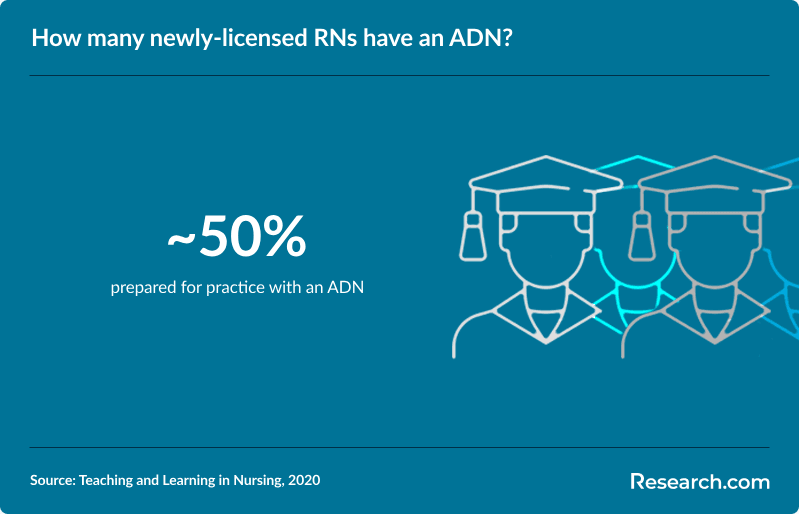
About half of newly licensed registered nurses in the United States are prepared for practice with an Associate Degree in Nursing, as shown in the figure below.
What is the state of nursing in New Hampshire?
Nursing in New Hampshire includes RNs, LPNs, APRNs, LNAs, and other healthcare team members working across hospitals, outpatient centers, long-term care facilities, community health programs, home care, and rural clinics. The New Hampshire Board of Nursing sets and enforces standards that support patient safety, professional accountability, and consistent practice expectations.
The state’s demand for nurses is shaped by familiar healthcare pressures: an aging population, chronic disease management, workforce turnover, preventive care needs, and staffing shortages in certain locations. Rural communities may have fewer healthcare providers, creating both access challenges and meaningful opportunities for nurses who want to serve underserved areas.
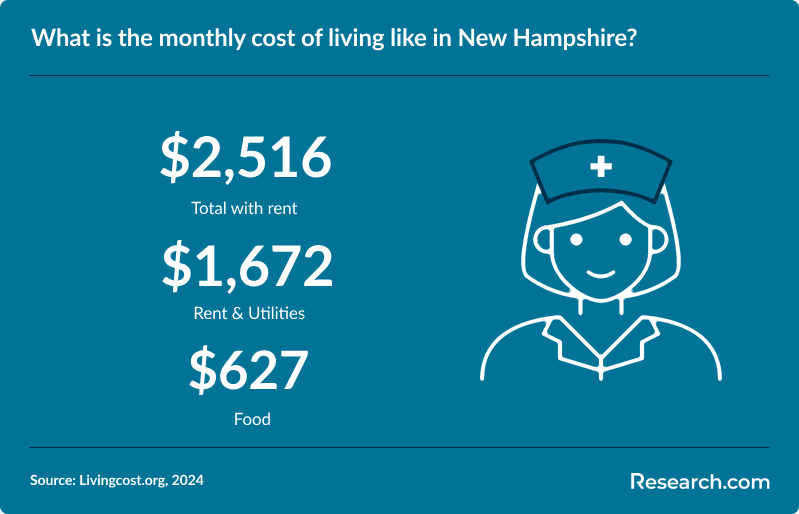
Cost of living should be part of any nursing career decision. In New Hampshire, single residents can expect to spend approximately $2,516 per month on total living expenses, including rent. Without rent, the average monthly cost is $844. Housing, including rent and utilities, accounts for $1,672 per month, while food costs average around $627 per month. These costs are shown in the graphic below.
Nursing salaries can help offset living expenses, but affordability varies by region. A salary that works well in one community may feel tighter in a higher-cost housing market. Before accepting a job, compare base pay, shift differentials, benefits, commute costs, loan payments, and overtime expectations.
New Hampshire nurses can work in several employment sectors:
- Hospitals: Acute care, emergency departments, intensive care, surgical units, maternity care, oncology, behavioral health, and specialty services.
- Outpatient care centers: Ambulatory surgery, specialty clinics, primary care, urgent care, dialysis, infusion, and diagnostic services.
- Long-term care and rehabilitation: Skilled nursing, post-acute recovery, memory care, and chronic care management.
- Community and public health: Prevention programs, home visiting, vaccination, case management, and care coordination.
- Home health and hospice: Patient care in residential settings, often requiring strong assessment and independent decision-making skills.
Students interested in expanding their health knowledge beyond nursing may also consider related education areas, such as nutrition and dietetics, when those programs support their long-term career goals.
How can nurses advance their careers in New Hampshire?
Nurses in New Hampshire can advance by earning higher degrees, adding specialty certifications, gaining leadership experience, moving into advanced practice, or transitioning into adjacent healthcare fields. The best option depends on whether you want more clinical authority, higher pay potential, more predictable hours, teaching responsibilities, or administrative leadership.
| Advancement path | What it can lead to | When it makes sense |
| RN-to-BSN completion | Broader hospital opportunities, leadership preparation, graduate school eligibility | You are an ADN-prepared RN and want more mobility |
| Specialty certification | Recognition in areas such as critical care, emergency, perioperative, oncology, or informatics | You want to deepen expertise without immediately pursuing another degree |
| MSN or DNP | Nurse practitioner, nurse educator, nurse leader, or advanced clinical roles | You want advanced responsibility or a specialty provider role |
| Management and leadership | Charge nurse, nurse manager, director, quality improvement, operations | You enjoy staffing, systems improvement, mentoring, and policy work |
| Adjacent healthcare careers | Pharmacy, medical billing and coding, informatics, compliance, case management | You want to use clinical knowledge in a less bedside-focused role |
When comparing education options for advancement, look beyond the degree title. Ask whether the school has strong clinical partnerships, board exam preparation, career services, flexible scheduling, and transparent completion expectations. Nurses comparing programs can start with resources on the best schools for registered nurses and then verify state-specific fit.
What is the job outlook for nursing in New Hampshire?
The nursing job outlook in New Hampshire is generally strong, but it varies by specialty, employer, geography, and level of education. The state’s need for nurses is tied to demographic change, ongoing healthcare utilization, and staffing needs in both urban and rural communities.
The U.S. Bureau of Labor Statistics projected continued demand for nurses. By 2030, New Hampshire is expected to see a growth rate of approximately 10% for registered nurses, reflecting broader demand for healthcare services and an aging population.
Compensation is also competitive. The average annual wage for registered nurses in New Hampshire is around $75,000, although actual earnings depend on specialty, experience, shift, employer type, and location. Reported top-paying metropolitan areas include:
- Manchester-Nashua: average salary of approximately $78,000
- Concord: average salary of about $76,000
Common higher-paying employment settings include:
- Hospitals, which often offer shift differentials, specialty units, and advancement ladders
- Outpatient care centers, especially those focused on specialized services
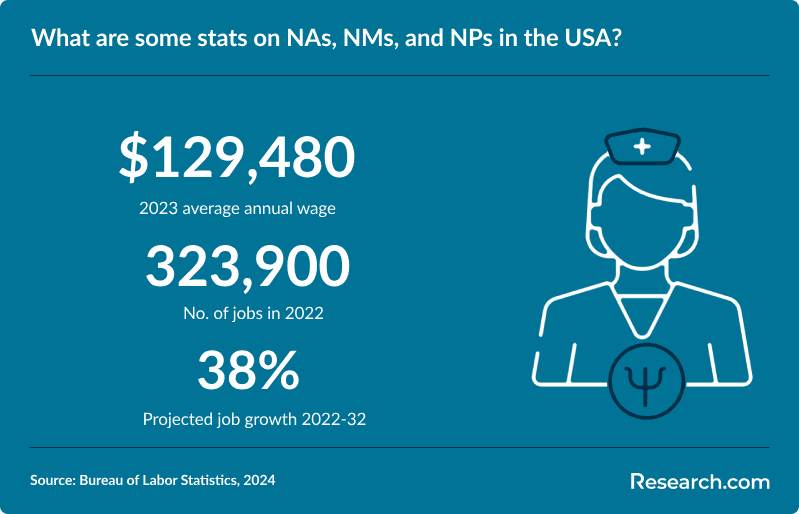
Advanced practice roles have a different labor market. Nationally, nurse anesthetists, nurse midwives, and nurse practitioners earned a median annual wage of $129,480 or $62.25 per hour in 2023. A master’s degree is typically required for entry into these roles. The field included 323,900 jobs in 2022, with projected growth of 38% between 2022 and 2032 and an estimated 123,600 new jobs during that period. The graphic below summarizes these national figures.
For job seekers, the practical takeaway is simple: licensure gets you eligible, but specialty skills, schedule flexibility, clinical experience, and willingness to work in high-need settings can strongly influence job options.
What is the RN vs BSN degree difference?
RN and BSN are not the same type of credential. RN is a professional license. BSN is an academic degree. A person can become an RN through an approved ADN or BSN pathway after passing the NCLEX-RN, but a BSN usually includes broader coursework in leadership, research, community health, population health, and evidence-based practice.
| Comparison point | RN through ADN | RN with BSN |
| Credential type | Licensure route through an associate degree | Licensure route through a bachelor’s degree |
| Typical time stated in this guide | About two years | Generally four years |
| Curriculum emphasis | Core nursing practice and clinical readiness | Clinical practice plus leadership, research, and community health |
| Career planning value | Can be a faster path to RN employment | Can support broader advancement and graduate study |
If you are deciding between the two, consider timeline, cost, transfer options, employer expectations, and whether you plan to pursue graduate nursing later. For a deeper comparison, review the RN vs BSN degree difference.
What educational options are available for LPNs in New Hampshire?
LPNs in New Hampshire can continue their education in several ways. Some remain in practical nursing and add specialty experience. Others pursue LPN-to-RN bridge programs, RN-to-BSN pathways after becoming registered nurses, or eventually graduate nursing study. The right route depends on how quickly you want to advance, whether you can attend full time, and how much clinical flexibility you need.
- Practical nursing programs: These prepare students for the NCLEX-PN and entry-level LPN practice.
- LPN-to-RN programs: These bridge programs build on prior LPN training and may reduce the time needed to become an RN.
- Online or hybrid coursework: Some programs offer didactic courses online, but clinical training still requires in-person participation.
- BSN completion after RN licensure: LPNs who become RNs may later complete a BSN to expand advancement options.
Prospective students can compare online LPN programs in New Hampshire, but they should confirm accreditation, approval status, NCLEX preparation, clinical placement support, and whether graduates are eligible for New Hampshire licensure.
What are the steps to become an LVN in New Hampshire?
New Hampshire commonly uses the Licensed Practical Nurse title rather than Licensed Vocational Nurse, but LVN and LPN pathways are often discussed together because both refer to practical or vocational nursing roles in different states. Candidates pursuing this level of nursing should complete an approved program with classroom instruction and clinical practice, pass the NCLEX-PN, and follow New Hampshire’s licensure process.
- Confirm the correct practical nursing title and licensure category for New Hampshire.
- Enroll in an approved practical nursing program.
- Complete all classroom, lab, and clinical requirements.
- Register for and pass the NCLEX-PN.
- Apply for licensure through the state board and complete background requirements.
- Renew the license and meet continuing education expectations after approval.
For a step-by-step resource focused on this pathway, see how to become an LVN in New Hampshire.
What are the top nursing education opportunities in New Hampshire?
New Hampshire offers nursing education options for first-time students, working LPNs, licensed RNs, and nurses preparing for advanced practice. The strongest program is not always the most famous or the cheapest; it is the one that matches your license goal, learning format, budget, clinical needs, and career plan.
Students should evaluate programs using these criteria:
- Licensure alignment: Does the program meet New Hampshire requirements for the role you want?
- Accreditation and approval: Is the program recognized by appropriate nursing education and state authorities?
- Clinical placement support: Does the school arrange placements, or must students find their own sites?
- NCLEX preparation: How does the curriculum support exam readiness?
- Schedule format: Can you realistically complete the program while managing work, family, and commuting?
- Cost transparency: Are fees, uniforms, equipment, background checks, exam costs, and travel expenses clearly explained?
- Career fit: Does the program support the setting or specialty you want, such as hospital nursing, long-term care, primary care, or advanced practice?
Nurse practitioner programs are a major option for RNs who want advanced clinical responsibility. When comparing NP programs, look at specialty tracks, certification preparation, faculty support, and clinical site expectations. Students can review the best NP programs in New Hampshire as a starting point, then verify details directly with each school.
Bridge programs are also important. LPN-to-RN, RN-to-BSN, and RN-to-MSN pathways can help working nurses advance without starting over. However, transfer credit policies differ, so nurses should ask for a written degree plan before enrolling.
How do nurses maintain licensure in New Hampshire?
New Hampshire nurses must renew their licenses on schedule and complete the continuing education or competency requirements attached to their license type. Renewal is usually biennial, and nurses should track deadlines well before the expiration date.
- Monitor your renewal date. Do not rely only on employer reminders. The license holder is responsible for renewal.
- Complete continuing education. Requirements described in this guide include 15 to 30 hours of continuing education, depending on the license and renewal requirements.
- Keep documentation. Save certificates, transcripts, or proof of completion in case of audit or employer review.
- Update certifications. Specialty credentials, CPR, ACLS, or other employer-required certifications may have separate renewal cycles.
- Report changes as required. Address changes, disciplinary issues, or practice status changes may need to be reported according to board rules.
For a focused licensing guide, review the requirements for nursing licensure in New Hampshire.
What financial aid options are available for nurses in New Hampshire?
Nursing school can include tuition, books, lab fees, uniforms, equipment, background checks, immunizations, licensing exams, transportation, and lost work hours. Financial aid planning should begin before enrollment, not after the first bill arrives.
| Financial aid option | How it may help | What to verify |
| Federal grants and loans | Can help cover tuition and eligible education costs | FAFSA eligibility, borrowing limits, interest, and repayment terms |
| State scholarships or grants | May reduce out-of-pocket costs for eligible residents or high-need fields | Residency rules, deadlines, service commitments, and renewal criteria |
| School-based scholarships | Can support students based on need, merit, service, or program type | Whether awards are renewable and whether separate applications are required |
| Employer tuition assistance | May help working CNAs, LNAs, LPNs, or RNs advance | Work commitments, grade requirements, reimbursement timing, and eligible programs |
| Loan repayment or service programs | May support nurses who work in high-need areas or qualifying settings | Employment setting requirements and service obligations |
Students comparing schools should ask financial aid offices for the total program cost, not just tuition. Reviewing the best nursing schools in New Hampshire can also help identify institutions that may offer scholarships, flexible payment options, or program-specific aid.
What are the nurse midwife career opportunities in New Hampshire?
Nurse midwives in New Hampshire provide maternal, reproductive, and women’s health services in settings such as hospitals, birthing centers, community clinics, and outpatient practices. Their work may include prenatal care, labor and birth support, postpartum care, gynecologic care, education, and coordination with physicians and other clinicians when needed.
This path is best for nurses who are comfortable with advanced assessment, patient education, family-centered care, and responsibility across the reproductive health continuum. It requires graduate nursing education, certification, and state authorization. Nurses considering this route should review clinical hour expectations, preceptor availability, liability coverage, and practice authority rules before choosing a program.
For detailed pathway guidance, see how to become a nurse midwife in New Hampshire.
Can nursing professionals transition to pharmacy careers in New Hampshire?
Yes, nursing professionals can transition toward pharmacy careers, but the move requires additional education and a different licensing process. Nursing experience can be valuable because nurses understand medication administration, patient counseling, side effects, adherence barriers, documentation, and clinical workflows. However, pharmacy is a separate profession with its own academic and regulatory requirements.
This transition may make sense for nurses who are especially interested in pharmacology, medication safety, clinical consulting, research, informatics, or patient education in a medication-focused environment. It may not be the best option for someone seeking a short credential change, because pharmacist preparation typically requires substantial education and licensure steps. For more detail, review how to become a pharmacist in New Hampshire.
What are the nurse practitioner education requirements in New Hampshire?
Nurse practitioners in New Hampshire must complete graduate-level nursing education and meet the requirements for advanced practice authorization. Most candidates earn either a Master of Science in Nursing or a Doctor of Nursing Practice in a specialty area such as family practice, adult-gerontology, psychiatric-mental health, pediatrics, acute care, or women’s health.
- Active RN foundation: NP candidates generally begin as licensed registered nurses.
- Graduate nursing degree: A master’s or doctoral program provides advanced clinical coursework and supervised clinical practice.
- Specialty preparation: The program should match the population or care setting in which the nurse wants to practice.
- National certification: Certification in the NP specialty is typically required before state authorization.
- State requirements: Candidates must follow New Hampshire’s APRN licensure process and ongoing renewal rules.
Before enrolling, ask whether the program helps secure clinical placements in or near New Hampshire, whether it meets certification eligibility standards, and whether graduates are prepared for state authorization. For a focused explanation, review the nurse practitioner education requirements in New Hampshire.
Can nurses leverage their clinical expertise for medical billing and coding in New Hampshire?
Yes. Nurses who want a less physically demanding or more administrative healthcare role may be able to use their clinical knowledge in medical billing and coding. Their understanding of diagnoses, procedures, documentation, care plans, and medical terminology can be an advantage when reviewing records and supporting accurate claims.
This path may appeal to nurses interested in remote work, compliance, revenue cycle operations, utilization review, documentation improvement, or healthcare administration. It is not the same as bedside nursing, and it requires training in coding systems, payer rules, reimbursement processes, privacy standards, and audit expectations.
Nurses considering this shift should compare certification options, job descriptions, remote-work requirements, and employer expectations. To learn the qualifications and steps, see how to become a medical biller and coder in New Hampshire.
Are online nursing programs an effective alternative in New Hampshire?
Online nursing programs can be effective for New Hampshire students when they are accredited, approved for the intended license path, and transparent about in-person requirements. Nursing cannot be learned entirely through online lectures. Even online and hybrid programs usually require labs, simulations, clinical rotations, proctored exams, or campus visits.
| Online program factor | Why it matters | Question to ask before enrolling |
| Accreditation and state approval | Licensure eligibility depends on program recognition | Will this program qualify me for New Hampshire licensure? |
| Clinical placements | Nursing students need supervised patient-care experience | Does the school arrange clinical sites, or am I responsible? |
| Residency or lab requirements | Some online programs still require campus attendance | How often must I travel, and where? |
| NCLEX preparation | Exam performance affects licensure timing | What academic support is available for NCLEX readiness? |
| Technology and student support | Online students need reliable advising, tutoring, and technical help | What support is available outside normal business hours? |
Online programs may be a strong fit for working adults, parents, rural students, and licensed nurses returning for BSN or MSN completion. They may be a poor fit for students who need frequent in-person faculty support, have limited internet access, or cannot travel for clinical requirements. To compare options, review the best online nursing programs in New Hampshire.
Common mistakes to avoid when becoming a nurse in New Hampshire
- Choosing a program before checking licensure eligibility. A program can be convenient or affordable and still fail to meet your licensing needs.
- Looking only at tuition. Total cost includes fees, supplies, testing, clinical travel, background checks, uniforms, and time away from work.
- Assuming online means fully remote. Nursing programs almost always include in-person clinical or skills requirements.
- Ignoring transfer credit rules. LPN-to-RN, RN-to-BSN, and second-degree students should get transfer evaluations in writing.
- Waiting too long to prepare for the NCLEX. Exam readiness should be built throughout the program, not started after graduation.
- Assuming salary averages guarantee personal income. Actual pay varies by employer, shift, specialty, region, and experience.
- Forgetting renewal obligations. Licensure maintenance is part of professional practice, not an administrative detail.
- Relying only on rankings. Rankings can be useful, but your best program depends on licensure fit, clinical support, cost, and schedule.
What do nurses say about becoming a nurse in New Hampshire?
- “I entered nursing because I wanted work that mattered to real people. In New Hampshire, the communities are small enough that you often get to know patients beyond a single appointment. After work, being close to hiking trails, lakes, and quiet outdoor spaces helps me reset.” Arlene
- “My nursing career here has pushed me to keep learning. I have had opportunities to attend workshops, build new skills, and work with updated clinical practices. The best part is being able to give patients more personal attention.” Bastian
- “As a Nurse Practitioner, I value the collaborative culture in New Hampshire healthcare. The work is demanding, but the professional relationships and the state’s natural environment make the career feel sustainable.” Janice
Related Articles for Nearby States
- 2027 How to Become a Nurse in Vermont
- 2027 How to Become a Nurse in Massachusetts
- 2027 How to Become a Nurse in Maine
- 2027 How to Become a Nurse in New York
- 2027 How to Become a Nurse in Connecticut
- 2027 How to Become a Nurse in Rhode Island
- 2027 How to Become a Nurse in New Jersey
- 2027 How to Become a Nurse in Pennsylvania
- 2027 How to Become a Nurse in Delaware
- 2027 How to Become a Nurse in Maryland
References:
- AMN Healthcare. (2024). New Hampshire nursing license and renewal. AMN Healthcare
- Bureau of Labor Statistics. (2024). Nurse anesthetists, nurse midwives, and nurse practitioners. Bureau of Labor Statistics.
- Living Cost. (2024). Cost of living in New Hampshire. Living Cost.
- New Hampshire Board of Nursing. (2024). New Hampshire nursing licensure information. New Hampshire Board of Nursing.
- Sullivan, K. (2023). The impact of regulation on nursing practice: A review of the literature. Journal of Nursing Regulation, 14(1), 25-32.
- Southern New Hampshire University. (2024). How to become a nurse. Southern New Hampshire University.
- U.S. Nursing License Map. (2024). New Hampshire nursing license. U.S. Nursing License Map.
Key Insights
- New Hampshire nursing careers begin with the license goal. Choose LNA, LPN, RN, or APRN first, then select the education path that legally supports that role.
- RN candidates commonly choose between an ADN and BSN. The ADN can be a shorter entry route, while the BSN may offer broader long-term mobility and graduate school preparation.
- Licensure requires more than graduation. RN and LPN candidates must pass the correct NCLEX exam, apply through the New Hampshire Board of Nursing, and complete background requirements.
- New Hampshire’s Nurse Licensure Compact participation can help eligible multistate nurses practice across state lines, but moving your primary residence or pursuing APRN practice may trigger additional requirements.
- Online nursing programs can work well, especially for working adults, but students must confirm accreditation, clinical placement support, and New Hampshire licensure eligibility before enrolling.
- Salary and job outlook are encouraging, with RN average pay around $75,000 and advanced practice roles showing strong national demand, but individual outcomes depend on specialty, location, experience, and employer.
- The smartest nursing school decision balances accreditation, total cost, clinical access, NCLEX preparation, schedule fit, and career goals—not ranking or tuition alone.
Other Things You Should Know About Becoming a Nurse in New Hampshire
In 2027, New Hampshire offers a variety of nursing programs, including those at community colleges, universities, and online institutions. Programs typically cover essential nursing skills, clinical practice, and specialized areas such as pediatrics or geriatrics, ensuring comprehensive training for aspiring nurses.
To become a nurse in New Hampshire in 2027, you must complete an accredited nursing program, pass the NCLEX-RN exam, and apply for a license with the New Hampshire Board of Nursing. Continuing education and background checks are also required.
To become a nurse in New Hampshire in 2027, complete an accredited nursing program (ASN or BSN), pass the NCLEX-RN exam, apply for licensure with the New Hampshire Board of Nursing, and maintain your license through continuing education and renewal.


