
2027 Best LPN Programs in New Hampshire – Accredited Online LPN Programs

Co-Founder and Chief Data Scientist
Choosing an LPN program in New Hampshire is not just a school search. It is a licensing decision, a cost decision, and a career-timing decision. The state has 9.68 registered nurses (RNs) for every 1,000 people, and local projections point to approximately 1,210 nursing openings each year, which means practical nursing remains an important entry point into healthcare work in the state (NurseJournal.org, n.d.; Projections Central, n.d.).
This guide is for students asking how to become an LPN in New Hampshire, whether online LPN programs are available, how much training may cost, and which programs can support licensure or advancement. You will also learn how to evaluate accreditation, clinical requirements, career pathways, and the practical trade-offs between entry-level LPN programs and LPN-to-RN bridge options for healthcare careers in clinical and administrative settings.
Best Online LPN Programs in New Hampshire Table of Contents
- How do you become an LPN in New Hampshire?
- How much does an LPN program in New Hampshire usually cost?
- How long does LPN training take in New Hampshire?
- Can you complete LPN training online in New Hampshire?
- What advancement options do New Hampshire LPNs have?
- Online and hybrid LPN programs in New Hampshire for 2027
- Is New Hampshire a good state for LPNs?
- What should you do after becoming an LPN in New Hampshire?
- What jobs can you pursue with an LPN credential in New Hampshire?
- How do you check whether an online LPN program is credible?
- What are the licensing steps for LPNs in New Hampshire?
- What accreditation and quality standards matter for New Hampshire LPN programs?
- How is technology changing LPN education in New Hampshire?
- What professional development and networking options are available to LPNs?
- What is the salary outlook for LPNs in New Hampshire?
- Can LPNs move into nutrition-related careers?
- Can LPNs become nurse midwives in New Hampshire?
- How do employer partnerships support LPN career outcomes in New Hampshire?
- How can LPNs work toward nurse practitioner roles in New Hampshire?
Quick Answer: Can You Become an LPN Online in New Hampshire?
You cannot complete every part of LPN training online in New Hampshire because practical nursing requires in-person clinical practice. However, some approved programs use online or hybrid coursework for lecture-based classes while requiring labs, simulations, and supervised clinical rotations in person. To qualify for the NCLEX-PN and state licensure, you must graduate from a program approved by the New Hampshire Board of Nursing.
The fastest local option listed in this guide can be completed in as few as 11 months, while many LPN programs take about one year or three semesters. Costs vary widely, from community college tuition listed at $215 per credit for New Hampshire residents to program costs as high as $25,000.
How to Become an LPN in New Hampshire
Practical nurses in New Hampshire are licensed through the New Hampshire Board of Nursing (NHBON). The basic path is straightforward: complete an approved practical nursing program, apply to the Board, pass the NCLEX-PN, and keep your license active through work and continuing education requirements.
Step 1: Choose an Approved Traditional or Hybrid LPN Program
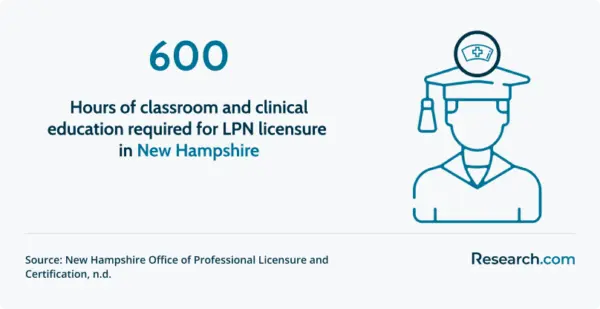
Your first requirement is to complete a state-approved LPN program. New Hampshire requires approved practical nursing education to include at least 600 hours of classroom and clinical learning in areas such as nursing fundamentals, medical nursing, mental health nursing, and maternal and child health nursing. At this time, three entry-level LPN programs are approved by the NHBON (New Hampshire Office of Professional Licensure and Certification, n.d.).
This approval matters more than convenience. If a program is not accepted by the New Hampshire Board of Nursing, you may not be eligible for licensure in the state even if the coursework looks similar to another nursing program.
Step 2: Submit Your LPN License Application
After finishing an approved program, you can apply for licensure through the pathway that fits your situation, such as examination, endorsement, or comparable education. Typical application materials include the following:
- A copy of a state-issued driver’s license
- Official transcripts from your degree and practical nursing program
- A criminal background check
- A $148 application fee
Step 3: Take the NCLEX-PN
Once the Board reviews your application and confirms that you are eligible to test, you can receive authorization for the NCLEX-PN. This national exam evaluates whether you are prepared for safe entry-level practical nursing practice, including basic care, medication-related care, and safety procedures. The listed $200 testing fee applies to the exam (NCLEX, n.d.).
Step 4: Receive Your License and Keep It Active
The Board makes its licensing decision after it receives your NCLEX-PN result. Applicants can monitor their application status through the Board of Nursing website.
New Hampshire LPN licenses are valid for two years. For renewal, LPNs must document at least 400 working hours, complete 30 hours of continuing education, and pay a $108 renewal fee (New Hampshire Office of Professional Licensure and Certification, n.d.).
What Is the Typical Cost of an LPN Program in New Hampshire?
LPN training costs in New Hampshire depend heavily on the school type, residency status, program length, and whether fees, supplies, testing, uniforms, and clinical-related expenses are included. Based on the programs reviewed here, an LPN credential from a partially online program can cost as much as $25,000, which is the listed price for the entry-level LPN Training Program at LNA Health Careers.
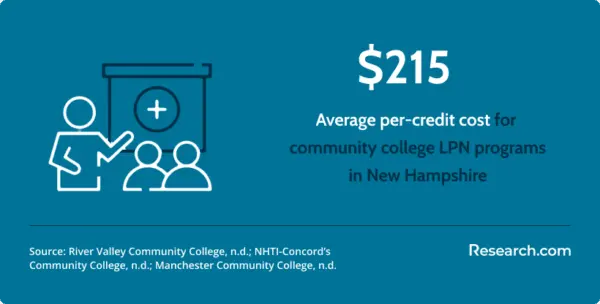
Community college options can be less expensive, especially for New Hampshire residents. Listed tuition is $215 per credit for in-state students and $490 per credit for non-residents. For example, River Valley Community College’s LPN program can cost as little as $12,800 for an in-state student.
| Cost Factor | Why It Matters | What to Check Before Enrolling |
| Tuition rate | Community colleges and private training providers may price programs very differently. | Confirm whether the published price is per credit, per clock hour, or total program cost. |
| Residency status | New Hampshire residents may pay less at community colleges than out-of-state students. | Ask whether you qualify for the $215 per credit resident rate or the $490 per credit non-resident rate. |
| Clinical costs | Clinical placement can involve transportation, health screenings, background checks, or required supplies. | Request a full cost sheet, not just tuition. |
| Licensing and exam fees | Licensure and testing add required expenses after graduation. | Budget for the $148 application fee and the $200 NCLEX-PN testing fee. |
| Program format | Hybrid courses may reduce commuting for lectures but not for clinical rotations. | Ask how often you must attend campus, labs, or clinical sites in person. |
How Long Does It Take to Become a LPN in New Hampshire?
Many students can finish LPN training in about one year or three semesters. Some programs are structured to move faster. For example, the LPN program at LNA Health Careers can be completed in as few as 11 months.
Program length may differ if you look outside New Hampshire. Some LPN programs in Maine, for instance, can take as few as nine months. Before choosing an out-of-state program, verify that the education will satisfy New Hampshire licensure requirements.
| Path | Typical Timeline Mentioned | Best For | Important Limitation |
| Entry-level LPN program in New Hampshire | About one year or three semesters | Students who want the shortest local route into practical nursing | Must be approved by the New Hampshire Board of Nursing |
| Accelerated local LPN option | As few as 11 months | Students who can manage a faster academic and clinical pace | Faster completion can mean a more demanding weekly schedule |
| Out-of-state LPN program | As few as nine months in some Maine programs | Students willing to compare nearby state options | Licensure eligibility in New Hampshire must be confirmed before enrollment |
| LPN-to-RN bridge program | Two years in programs listed here | Current LPNs who want RN licensure and broader responsibilities | This is an advancement path, not an entry-level LPN route |
Can You Become a LPN in New Hampshire With an Online Degree?
You can complete some LPN coursework online, but you should not expect a fully online route to New Hampshire LPN licensure. Practical nursing is a hands-on profession, so programs must include supervised clinical education and skills practice that cannot be replaced entirely by online assignments.
The New Hampshire Board of Nursing approves partially online LPN programs when they meet state education standards for licensure. In these programs, lecture-based coursework may be delivered online, while labs, simulations, and clinical rotations still take place in person.
Understanding Career Advancement Options for LPNs in New Hampshire
Becoming an LPN can be either a destination or a first step. Some students use practical nursing to enter the workforce quickly, gain bedside experience, and later pursue registered nursing. Others remain in LPN roles and build experience in long-term care, outpatient care, home health, or other patient-care settings.
For LPNs who want a broader scope of practice, an LPN-to-Associate Degree in Nursing (ADN) pathway can provide a more direct route toward RN licensure. NHTI-Concord’s Community College and Manchester Community College offer LPN-to-RN options designed for licensed practical nurses who are ready for additional academic and clinical preparation.
RN licensure can also support later movement into roles such as nurse practitioner, nurse manager, or nurse educator. If you want to map the full RN pathway, review Research.com’s guide on how to become a registered nurse in New Hampshire, which explains state requirements, education options, and licensing steps.
| Career Goal | Recommended Next Step | When This Makes Sense |
| Start working in nursing quickly | Complete an approved entry-level LPN program | You want a shorter route into direct patient care. |
| Expand clinical responsibility | Enroll in an LPN-to-RN bridge program | You already hold an LPN license and want RN eligibility. |
| Move toward advanced practice | Progress from LPN to RN, then pursue graduate nursing preparation | You eventually want roles such as nurse practitioner or nurse midwife. |
| Shift into related health fields | Add focused training in areas such as nutrition or healthcare support | You want to use clinical experience outside traditional bedside nursing. |
Online LPN Programs in New Hampshire for 2027
New Hampshire does not currently offer a wide selection of fully online LPN programs. The programs below either prepare students for entry-level practical nursing with some flexible or online components, or they support licensed LPNs who want to continue into RN preparation. Students comparing online nursing degree programs should remember that LPN licensure still requires approved clinical education.
River Valley Community College
River Valley Community College offers a Licensed Practical Nursing Program that combines classroom instruction, simulation-based practice, and supervised clinical learning. The program is designed for students preparing for entry-level practical nursing and for those who may later want to continue into the college’s ADN program and pursue RN licensure.
- Program Length: One year
- Tracks/concentrations: Practical Nursing
- Estimated Cost: $215 per credit
- Required Credits to Graduate: 36
- Accreditation: Accreditation Commission for Education in Nursing (ACEN)
LNA Health Careers
The LPN Training Program at LNA Health Careers is built for students preparing for practical nursing roles in busy care environments. Its format includes online general education courses, simulated clinical activities, and in-person clinical rotations supervised by experienced nurses.
- Program Length: 11 months
- Tracks/concentrations: Practical Nursing
- Estimated Cost: $25,000
- Required Credits to Graduate: 1,401 clock hours
- Accreditation: New Hampshire Board of Nursing (NHBON)
Harmony Health Care Institute
Harmony Health Care Institute’s Licensed Practical Nursing Program serves adult learners preparing for entry-level practical nursing practice. The curriculum emphasizes evidence-based instruction and is supported by flexible scheduling, learning resources, and career services.
- Program Length: 13 months
- Tracks/concentrations: Practical Nursing
- Estimated Cost: $18,975
- Required Credits to Graduate: 1,173 clock hours
- Accreditation: Accreditation Commission for Education in Nursing (ACEN)
NHTI-Concord’s Community College
NHTI-Concord’s Community College provides an associate-level LPN to RN Completion program for licensed practical nurses who want to become registered nurses or continue toward higher nursing education. The on-campus program emphasizes clinical competence, collaborative practice, and culturally responsive patient care.
- Program Length: Two years
- Tracks/concentrations: Nursing
- Estimated Cost: $215 per credit
- Required Credits to Graduate: 70
- Accreditation: Accreditation Commission for Education in Nursing (ACEN)
Manchester Community College
Manchester Community College offers a Nursing Program with an LPN-to-RN bridge option for current LPNs. Students complete hybrid coursework, simulation learning, and clinical experiences, and graduates are prepared to sit for the NCLEX-RN exam.
- Program Length: Two years
- Tracks/concentrations: Nursing
- Estimated Cost: $215 per credit
- Required Credits to Graduate: 70
- Accreditation: Accreditation Commission for Education in Nursing (ACEN)
Is New Hampshire Good for LPNs?
New Hampshire can be a practical state for LPNs because the nursing workforce has continuing demand and LPN training can be completed faster than many registered nursing pathways. The state’s shortage context is also important: 9.68 registered nurses are available for every 1,000 people, and there are approximately 1,210 nursing openings each year.
That said, whether New Hampshire is “good” for you depends on your goals. If you want quick entry into patient care, an approved LPN program may be a reasonable starting point. If your long-term goal is advanced practice, leadership, or broader clinical independence, you should compare LPN training with RN and bridge pathways before committing.
What Are the Next Steps After Becoming an LPN in New Hampshire?
After earning your LPN license, your next move should match your career target. Some LPNs focus on gaining experience and maintaining licensure. Others begin planning for a BSN, MSN, or advanced practice role. If your goal is specialization or expanded practice authority, comparing the best nurse practitioner programs in New Hampshire can help you understand how far the education pathway may extend.
- Build clinical experience in the setting where you want to grow, such as long-term care, outpatient care, or home health.
- Track renewal requirements early so you do not fall behind on continuing education or work-hour documentation.
- Ask employers whether they offer tuition support for LPN-to-RN or RN-to-BSN pathways.
- Compare bridge programs before your license renewal period so you can plan prerequisites and finances.
- Keep records of clinical skills, certifications, and supervisor feedback for future applications.
What Can You Do With an LPN Degree in New Hampshire?
An LPN credential prepares you for practical nursing work under the scope allowed by New Hampshire law and employer policies. Students often ask, “What can you do with a nursing degree in New Hampshire?” For LPNs, the answer depends on licensure, experience, work setting, and whether you later pursue RN or advanced nursing education.
Projections Central reports that New Hampshire employment demand for LPNs is expected to grow 7.6% by 2030. Advancement can change the outlook significantly: projected growth is 8.8% for RNs and 58.7% for nurse practitioners in New Hampshire (Projections Central, n.d.).
| Role | Projected Job Growth Nationwide (Through 2030) | Projected Job Growth in NH (Through 2030) | Average Annual Job Openings in NH |
| Licensed Practical Nurses (LPNs) | 9.3% | 7.6% | 180 |
| Registered Nurses (RNs) | 9% | 8.8% | 880 |
| Nurse Practitioners (NPs) | 52.2% | 58.7% | 140 |
How Can You Assess the Credibility of Online LPN Programs?
The most important credibility check is state approval. A convenient online format is not enough if the program does not meet New Hampshire licensing expectations. You should also review accreditation, clinical placement arrangements, NCLEX-PN outcomes, faculty support, student services, and graduate feedback.
When comparing hybrid practical nursing programs with broader online nursing programs for non-nurses, remember that LPN education has a very specific licensing purpose. A general healthcare or nursing-related program may not qualify you for the NCLEX-PN.
| Question to Ask | Why It Matters |
| Is the program approved by the New Hampshire Board of Nursing? | Approval affects eligibility for licensure and the NCLEX-PN. |
| Are clinical rotations arranged by the school? | Students should know whether the program provides placements or expects them to find sites. |
| What parts of the program are online, on campus, or at clinical sites? | Hybrid programs vary, and commuting requirements can affect your schedule and budget. |
| What are the NCLEX-PN outcomes? | Exam results can help you evaluate how well the program prepares students for licensure. |
| What student support is available? | Tutoring, advising, remediation, and career support can affect completion and job readiness. |
What Are the Detailed Licensing Procedures for LPNs in New Hampshire?
The licensing process includes more than graduating and passing an exam. Applicants must submit required documentation, complete a criminal background check, and ensure that transcripts and clinical education records meet Board expectations. Errors or missing documents can delay approval.
For a more detailed licensing checklist, see Research.com’s guide to New Hampshire nursing license requirements. Reviewing the process before you finish school can help you avoid delays between graduation, testing, and employment.
What Are the Accreditation and Quality Assurance Standards for LPN Programs in New Hampshire?
A strong LPN program should meet state approval requirements and demonstrate clear academic and clinical quality standards. Prospective students should verify current New Hampshire Board of Nursing approval, review any nursing accreditation listed by the school, and examine how the program tracks student outcomes.
Quality indicators include transparent curriculum requirements, documented clinical partnerships, student support services, and NCLEX-PN preparation. These checks align with the broader pathway explained in Research.com’s guide on how to become a certified LPN in New Hampshire.
How Is Technology Improving LPN Training in New Hampshire?
Technology is making hybrid LPN education more flexible, but it does not remove the need for hands-on practice. The strongest programs use technology to reinforce clinical judgment, documentation skills, and preparation for in-person patient care.
- Virtual simulations: Simulation tools let students work through patient-care scenarios before entering clinical settings. These exercises can support decision-making practice in areas such as assessment, medication administration, and patient safety.
- Learning management systems: Online platforms can deliver lectures, quizzes, discussion boards, recorded demonstrations, and course materials, giving students more ways to review content outside scheduled class time.
- Electronic health record training: EHR practice helps students learn how patient information is documented, updated, and used in care coordination.
- Telehealth exposure: Some programs introduce remote care concepts so students understand how patient follow-up, monitoring, and communication may occur in modern healthcare settings.
What Are the Professional Development and Networking Opportunities for LPNs in New Hampshire?
LPNs can strengthen their careers by continuing to learn after licensure. Useful options include employer training, specialty workshops, continuing education, mentoring, and professional events where nurses learn about regulatory updates and changing clinical practices.
If you plan to move from practical nursing into RN education, comparing the best nursing schools in New Hampshire can help you identify programs with bridge options, clinical partnerships, and academic support that match your goals.
What Is the Salary Outlook for LPNs in New Hampshire?
LPN pay in New Hampshire can vary by location, experience level, shift, employer type, and care setting. Hospitals, long-term care facilities, outpatient clinics, and home health providers may structure compensation differently, and benefits can be as important as hourly or annual pay.
Before enrolling, compare expected earnings with total program cost, time out of the workforce, commuting, fees, and the possibility of later bridge education. You may also want to compare practical nursing with adjacent healthcare training options, such as the best medical assistant programs in New Hampshire, if your goal is a faster or lower-cost entry into healthcare support work.
Can I Transition From a Paramedic to an RN?
Paramedics who want to become registered nurses may be able to use bridge programs designed for healthcare professionals with emergency care experience. These programs can recognize prior training while adding nursing-specific coursework, clinical preparation, leadership concepts, and evidence-based practice.
If you are comparing emergency medical services experience with nursing advancement, Research.com’s paramedic to RN bridge guide explains how these pathways may work and what applicants should review before enrolling.
Can LPNs Transition Into Nutrition Careers?
LPNs who are interested in wellness, prevention, dietary education, or community health may consider additional nutrition-focused training. Clinical nursing experience can be useful in nutrition-adjacent roles because LPNs already understand patient care, chronic conditions, and health behavior challenges.
Requirements vary by role, so students should review state expectations carefully. Research.com’s guide on how to become a nutritionist in New Hampshire can help you compare education and credential options.
What Are the Steps for LPNs to Advance to Nurse Practitioner Roles in New Hampshire?
The LPN-to-nurse practitioner pathway is a long-term academic progression. LPNs generally need to move into registered nursing first, complete the required undergraduate nursing preparation, gain clinical experience, and then pursue graduate-level nursing education for advanced practice.
Because nurse practitioner preparation is highly regulated and clinically intensive, program accreditation, supervised practice requirements, and admission prerequisites matter. For a complete outline of this advanced route, see Research.com’s guide on how to become a nurse practitioner in New Hampshire.
Can LPNs Transition Into Nurse Midwife Roles in New Hampshire?
LPNs interested in maternal care can build toward midwifery, but the path requires substantial additional education beyond practical nursing. Students should expect to progress through higher levels of nursing preparation and meet advanced clinical standards before entering midwifery practice.
To understand the degree sequence, clinical expectations, and accreditation issues for this specialty, review Research.com’s guide to nurse midwife education requirements in New Hampshire.
What Employer Partnerships Enhance LPN Career Success in New Hampshire?
Employer partnerships can make a practical difference in LPN training. Programs connected with local hospitals, clinics, long-term care facilities, or other healthcare organizations may offer more structured clinical placements, stronger exposure to real work settings, and better career support.
Before enrolling, ask each school where students complete clinical rotations, whether placements are guaranteed, how scheduling works, and whether local employers recruit graduates. To compare broader nursing options with online or hybrid features, review Research.com’s guide to the best online nursing programs in New Hampshire.
Common Mistakes to Avoid When Choosing an LPN Program in New Hampshire
| Mistake | Why It Can Hurt You | Better Approach |
| Choosing a program because it says “online” without checking approval | An unapproved program may not qualify you for New Hampshire licensure. | Confirm New Hampshire Board of Nursing approval before applying. |
| Looking only at tuition | Fees, supplies, transportation, testing, and licensing costs can change the real price. | Request a full estimated cost of attendance. |
| Assuming clinicals will fit your schedule | Clinical rotations may require weekday, evening, weekend, or travel commitments. | Ask for sample clinical schedules and placement locations. |
| Ignoring bridge options | You may choose an LPN program that does not align well with later RN goals. | Ask whether credits or training support future LPN-to-RN admission. |
| Assuming salary outcomes are guaranteed | Pay depends on employer, setting, location, experience, and shifts. | Compare local job postings, benefits, and advancement pathways before enrolling. |
How to Choose the Right LPN Program in New Hampshire
- Start with licensure eligibility. Confirm that the program is approved by the New Hampshire Board of Nursing.
- Compare format honestly. Identify which courses are online, which labs are in person, and where clinical rotations take place.
- Calculate the full cost. Include tuition, fees, books, uniforms, transportation, background checks, testing, and licensure expenses.
- Check outcomes. Ask about completion rates, NCLEX-PN preparation, graduate employment support, and student services.
- Plan beyond the first job. If RN, NP, nurse midwife, or another healthcare path interests you, choose a program that will not limit your next step.
- Talk to admissions and nursing faculty. Ask direct questions about clinical placement, schedule flexibility, remediation support, and expectations for working students.
Begin Your Career Through an Approved LPN Program in New Hampshire
New Hampshire’s nursing demand makes LPN training a practical option for students who want a faster route into direct patient care. The key is to choose a program that is approved, affordable for your situation, realistic for your schedule, and aligned with your long-term goals.
If your ambitions extend beyond practical nursing, plan early. LPN-to-RN programs, BSN pathways, graduate nursing programs, and advanced practice careers each have different prerequisites and timelines. Students asking, “What are the qualifications to become a nurse practitioner?” should view LPN training as one possible first stage in a longer nursing career path.
Key Insights
- New Hampshire has ongoing nursing demand: The state has 9.68 registered nurses for every 1,000 people and approximately 1,210 nursing openings each year.
- LPN training is one of the faster nursing entry points: Many programs take about one year or three semesters, while one listed program can be completed in as few as 11 months.
- Fully online LPN licensure is not realistic: Hybrid coursework may be available, but labs and clinical rotations must still be completed in person.
- Board approval is non-negotiable: To qualify for the NCLEX-PN and New Hampshire licensure, students must complete an approved practical nursing program.
- Costs vary significantly: Listed options range from community college pricing at $215 per credit for New Hampshire residents to a program cost of $25,000.
- LPN can lead to RN and advanced nursing paths: Bridge programs at schools such as NHTI-Concord’s Community College and Manchester Community College support LPN-to-RN progression.
- Do not choose on convenience alone: Accreditation, clinical placement, licensing eligibility, schedule fit, cost, and future transfer or bridge options should all factor into your decision.
- Plan for renewal from the start: New Hampshire LPNs must renew every two years with at least 400 working hours, 30 hours of continuing education, and a $108 fee.
Related Articles for Nearby States
- 2027 Best LPN Programs in Vermont – Accredited Online LPN Programs
- 2027 Best LPN Programs in Massachusetts – Accredited Online LPN Programs
- 2027 Best LPN Programs in Maine – Accredited Online LPN Programs
- 2027 Best LPN Programs in New York – Accredited Online LPN Programs
- 2027 Best LPN Programs in Connecticut – Accredited Online LPN Programs
- 2027 Best LPN Programs in New Jersey – Accredited Online LPN Programs
- 2027 Best LPN Programs in Pennsylvania – Accredited Online LPN Programs
- 2027 Best LPN Programs in Delaware – Accredited Online LPN Programs
- 2027 Best LPN Programs in Maryland – Accredited Online LPN Programs
- 2027 Best LPN Programs in Virginia – Accredited Online LPN Programs
References:
- New Hampshire Office of Professional Licensure and Certification. (n.d.). LPN-RN Programs | NH Office of Professional Licensure and Certification. New Hampshire Office of Professional Licensure and Certification. https://www.oplc.nh.gov/lpn-rn-programs
- NurseJournal.org. (n.d.). The U.S. Nursing Shortage: A State-by-State Breakdown. NurseJournal.org. https://nursejournal.org/articles/the-us-nursing-shortage-state-by-state-breakdown
- Projections Central. (n.d.). Long-Term Occupational Projections. Projections Central. https://projectionscentral.org/Projections/LongTerm?AreaName=%22new+hampshire%22%2C+%22united+states%22&Name=nurse&items_per_page=1000
Other Things You Should Know About LPN Programs in New Hampshire
To become an LPN in New Hampshire, you must complete an approved LPN program, pass the NCLEX-PN exam, and apply for licensure with the New Hampshire Board of Nursing.
The cost of an LPN program in New Hampshire can range from approximately $12,800 at community colleges for in-state students to $25,000 at other institutions like LNA Health Careers.
In 2027, several accredited online platforms offer hybrid LPN programs in New Hampshire. These programs typically combine online coursework with required clinical practice in local healthcare settings. Prospective students must ensure their chosen program is accredited by relevant nursing accreditation bodies.
To obtain LPN licensure in New Hampshire, you must complete an approved LPN program, pass the NCLEX-PN exam, submit an application with the necessary documents, and pay the required fees. Additionally, you must complete a criminal background check.
Some of the best online LPN programs in New Hampshire include those offered by River Valley Community College, LNA Health Careers, Harmony Health Care Institute, NHTI-Concord’s Community College, and Manchester Community College. These programs offer various combinations of online coursework and in-person clinical training.
LPN licenses in New Hampshire are valid for two years. To renew your license, you must complete 400 working hours, take 30 hours of continuing education, and pay a $108 renewal fee.
Yes, financial aid options are available for LPN programs in New Hampshire. Students can apply for federal financial aid, scholarships, grants, and potentially employer-sponsored tuition assistance programs. It is advisable to check with the individual institutions for specific financial aid opportunities.


