
2027 Most Affordable Online LVN Programs

Co-Founder and Chief Data Scientist
Choosing an online LVN program is not simply a question of finding the lowest tuition. You also need to confirm that the program is approved for licensure in your state, includes supervised clinical training, prepares you for the NCLEX-PN, and fits your schedule well enough that you can finish. That matters because licensed vocational nurses and licensed practical nurses are a major part of the U.S. healthcare workforce, with 962,582 LVNs in the country.
This guide is designed for students who want an affordable, practical route into nursing without committing immediately to a longer registered nursing degree. It explains what online LVN programs include, how much they cost, how long they take, where graduates work, what salaries look like, and how to compare programs before enrolling.
Quick Answer: Are Online LVN Programs Worth Considering?
An online LVN program can be a good choice if you want a faster nursing pathway, need flexible online coursework, and can complete required in-person labs and clinical rotations. These programs are not fully online because nursing licensure requires supervised hands-on training. Graduates typically prepare for the NCLEX-PN and entry-level roles as LVNs or LPNs in hospitals, clinics, long-term care, home health, and related settings.
| Key question | Short answer |
| What does an online LVN program lead to? | Eligibility to pursue LVN or LPN licensure after meeting state requirements and passing the NCLEX-PN. |
| How long does it usually take? | Most full-time online or hybrid LVN programs take 12 to 18 months. |
| How much does it cost? | Many LPN programs cost between $5,000 and $15,000, though some vary by state, residency, and school type. |
| Can the clinical portion be completed online? | No. Students must complete in-person labs or clinical rotations at approved healthcare sites. |
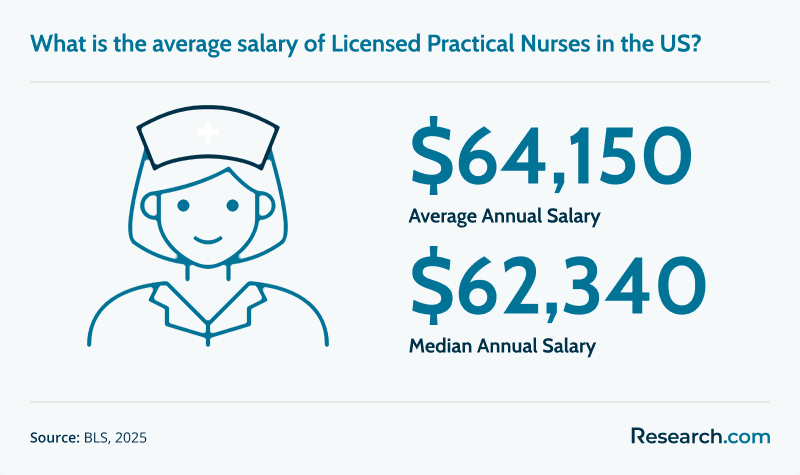
| What is the salary outlook? | Licensed practical and vocational nurses earn an average annual salary of $64,150 and a median annual salary of $62,340. |
What are the main benefits of an online LVN program?
- Faster entry into nursing: LVN and LPN programs are typically shorter than RN degree pathways, making them attractive to students who want to start working sooner.
- Flexible classroom learning: Many programs deliver theory courses online, which can help students balance school with work, caregiving, or commuting limits.
- Clear career preparation: Graduates can pursue roles such as LVN, LPN, home health nurse, clinic nurse, nursing home staff nurse, hospice nurse, correctional facility nurse, and school nurse assistant.
- Potentially lower total expenses: Online and hybrid formats may reduce transportation, relocation, and housing costs, though tuition and fees still vary widely.
What can I expect from an online LVN program?
An online LVN program usually combines digital coursework with required in-person clinical education. The online portion covers nursing theory and foundational healthcare topics such as anatomy, pharmacology, nutrition, infection control, communication, documentation, and patient care principles. Depending on the school, students may complete readings, recorded lectures, quizzes, discussion boards, virtual simulations, proctored tests, and skills-preparation activities through a learning platform.
The clinical portion is what makes LVN education different from many other online certificates. Students must demonstrate hands-on skills under supervision in approved healthcare settings. These experiences may take place in hospitals, nursing homes, clinics, rehabilitation centers, or other approved sites. Programs may also require campus visits for simulation labs, skills checkoffs, exams, or orientation.
The best way to think about these programs is “hybrid nursing training,” not fully online nursing training. Online delivery can make the academic side more flexible, but students still need reliable availability for labs, clinical shifts, travel, and instructor-supervised patient care.
Where can I work with an online LVN program?
Graduates of approved online or hybrid LVN programs can work in many of the same settings as graduates of campus-based practical nursing programs, provided they meet state licensing rules. LVNs and LPNs generally deliver basic nursing care under the supervision of registered nurses, physicians, dentists, or other authorized healthcare professionals.
| Work setting | What LVNs and LPNs commonly do | Best fit for students who want |
| Hospitals | Support bedside care, monitor patient status, assist care teams, and help with basic procedures. | A faster-paced environment with exposure to acute care. |
| Nursing homes and long-term care facilities | Care for older adults or chronically ill residents, administer medications, observe changes, and document care. | Ongoing patient relationships and routine clinical responsibilities. |
| Home health agencies | Visit patients at home, support chronic condition management, assist with personal care, and monitor treatment plans. | More independent work and one-on-one patient care. |
| Outpatient clinics | Assist with intake, vital signs, patient education, basic procedures, and provider support. | Daytime clinical work and less emphasis on inpatient care. |
| Physicians’ offices | Prepare patients for exams, update records, support minor procedures, and coordinate routine care. | A smaller practice setting with both clinical and administrative tasks. |
| Hospice and palliative care centers | Help manage comfort, symptoms, and emotional support for patients and families. | Compassion-focused care for patients with serious illness. |
| Schools | Assist with student health needs, minor injuries, chronic condition monitoring, and health documentation. | A community-based setting under school health supervision. |
| Correctional facilities | Provide routine and urgent care for inmates, document health needs, and work with correctional healthcare teams. | A structured but challenging healthcare environment. |
| Rehabilitation centers | Support patients recovering from surgery, injury, addiction, or illness as part of a care team. | Helping patients regain function over time. |
How much can I make with an online LVN program?
According to the United States Bureau of Labor Statistics, licensed practical and vocational nurses earn an average annual salary of $64,150 and a median annual salary of $62,340. That median is higher than the median annual salary of all U.S. professions, which is $49,500.
Reported LVN and LPN wages generally range from $47,960 to $80,510. Where an individual falls within that range depends on experience, employer type, job responsibilities, geographic location, shift differentials, and whether the role includes senior or supervisory duties. New graduates should not assume they will start at the median or top of the range.
Higher-paying opportunities may be found in certain industries and states. The industries with the highest average annual salaries are management, technical, and scientific consulting services ($72,720); employment services ($72,200); and insurance carriers ($72,190). The states with the highest average annual salaries are California ($76,580), Rhode Island ($75,470), and Washington ($75,410).
- Most Affordable Online LVN Programs for 2027
- How long does it take to complete an online LVN program?
- How do online LVN programs compare with campus programs?
- What does an online LVN program usually cost?
- What financial aid can online LVN students use?
- What prerequisites do online LVN programs require?
- What classes are included in online LVN programs?
- What skills do online LVN students build?
- How do I check accreditation and quality?
- What challenges should online LVN students expect?
- How can LVNs advance after graduation?
- What specializations can LVNs pursue later?
- Why do state licensure rules matter?
- How should I choose an online LVN program?
- What jobs can online LVN graduates pursue?
- What is the job market for LVN graduates?
Most Affordable Online LVN Programs for 2027
How were these programs ranked?
Affordability matters, but it should not be the only factor students use to choose an LVN program. A low-cost program is only a good value if it is properly approved, prepares students for licensure, provides clinical access, and fits the student’s state and schedule. For this ranking, Research.com considered affordability and publicly available institutional information from reliable education data sources, including the IPEDS database, Peterson's database, College Scorecard, and the National Center for Education Statistics.
For more detail on how Research.com evaluates schools and programs, review the Research.com methodology page.
| Rank | School and program | Length | Credits or hours | Published cost detail |
| 1 | Lake Area Technical College Licensed Practical E-Degree | 11 - 18 months | N/A | $244 - $291 per credit |
| 2 | Holmes Community College Practical Nursing Program | 5 semesters | 45 credits | $160 per credit |
| 3 | Pinellas Technical College Practical Nursing Program | 15 months | 1,350 hours | $7,816.50 total cost |
| 4 | Northland Community and Technical College Practical Nursing Diploma | 1 year | 42 credits | $187.53 per credit |
| 5 | Hinds Community College Practical Nursing Program | 1 year | 45 credits | $1,850 in-state per semester; $3,375 out-of-state per semester |
| 6 | Montana State University Billings Practical Nurse Certificate of Applied Science | 1 year | 40 credits | Annual tuition around $4,270 |
| 7 | Blinn College Vocational Nursing Certificate - Blended Online Option | 1 year | 39 credits | $64 in-state per credit; $279 out-of-state per credit |
| 8 | North Central Texas College Vocational Nursing Program | 1 year | 42 credits | $112 in-district; $212 in-state; $317 out-of-state per credit |
| 9 | Texas State Technical College Vocational Nursing | 1 year | 50 credits | $15,657 estimated total program cost |
| 10 | Blinn College Vocational Nursing Certificate - Blended Online Option | 1 year | 39 credits | $64 in-district; $123 in-state; $279 out-of-state per credit |
1. Lake Area Technical College Licensed Practical E-Degree
The Licensed Practical E-Degree at Lake Area Technical College is built for students who want online nursing theory with required in-person clinical training. Learners may choose a full-time 11-month schedule or an 18-month part-time option. Students complete theory remotely while meeting hands-on requirements on campus. Graduates are prepared to pursue the NCLEX-PN and may continue into the college’s Registered Nursing program. The program costs $244 - $291 per credit hour and is accredited by the Accreditation Commission for Education in Nursing.
- Program length: 11 - 18 months
- Required credits to graduate: N/A
- Cost per credit: $244 - $291
- Accreditation: Accreditation Commission for Education in Nursing
2. Holmes Community College Practical Nursing Program
The Practical Nursing program at Holmes Community College uses a five-semester hybrid structure with online lectures, campus-based labs, clinical experiences, and in-person testing. The 45-credit curriculum includes nursing fundamentals, body structure and function, pharmacology, and care for pediatric, maternal/newborn, psychiatric, and other patient populations. Clinical placements are available through partner healthcare facilities across nine counties. Students prepare for the NCLEX-PN and can participate in a student nursing organization that supports scholarships and community service.
- Program length: 5 semesters
- Required credits to graduate: 45
- Cost per credit: $160
- Accreditation: Southern Association of Colleges and Schools Commission on Colleges
3. Pinellas Technical College Practical Nursing Program
The Practical Nursing program at Pinellas Technical College is a 1,350-hour pathway that prepares students for LPN employment through traditional and hybrid formats. The curriculum is organized into five sequential courses covering foundational nursing, medical-surgical nursing, and care for maternal, newborn, and pediatric patients. In the hybrid version, students complete 675 academic hours online and 675 clinical hours during evenings and weekends at local healthcare facilities. The program is approved by the Florida State Board of Nursing and includes articulation agreements for students who later pursue registered nursing education.
- Program length: 15 months
- Required credits to graduate: N/A
- Total cost: $7,816.50
- Accreditation: Council on Occupational Education
4. Northland Community and Technical College Practical Nursing Diploma
The Practical Nursing Diploma at Northland Community & Technical College is a one-year, 42-credit program designed to prepare students for LPN practice in settings such as hospitals, clinics, and home care. General education courses are available online, but Minnesota Board of Nursing requirements mean students must attend six courses on campus, with clinical experiences based at the East Grand Forks campus. Applicants need a high school diploma or GED, qualifying prerequisite grades of “C” or higher, nursing assistant competency, and required health and safety documentation. The program is accredited by the Higher Learning Commission, the Minnesota Board of Nursing, and the National League for Nursing.
- Program length: 1 year
- Required credits to graduate: 42
- Cost per credit: $187.53
- Accreditation: S
5. Hinds Community College Practical Nursing Program
The Practical Nursing program at Hinds Community College prepares students to deliver general nursing care under the supervision of registered nurses, physicians, or dentists. The program blends biological, physical, behavioral, and social science foundations with nursing procedures and practical patient care. Students can choose traditional or part-time evening/weekend options at multiple campuses, with selected courses available online. Admission is competitive and considers ACT scores and academic history. Applicants must hold a high school diploma or equivalent. The program is accredited by the Mississippi Community College Board and includes mentorship, job placement potential, and financial aid options.
- Program length: 1 year
- Required credits to graduate: 45
- Cost per semester: $1,850 (in-state); $3,375 (out-of-state)
- Accreditation: Mississippi Community College Board
6. Montana State University Billings Practical Nurse Certificate of Applied Science
The Practical Nurse Certificate of Applied Science at Montana State University Billings is aimed at Montana residents seeking a flexible route to LPN licensure. The program is delivered primarily online, with prerequisite courses available remotely and nursing semesters combining online study, limited campus labs, and local clinical placements. Students complete more than 400 hours of lab and clinical work, and required campus visits are scheduled in advance. The program is fully approved by the Montana State Board of Nursing and prepares graduates for the NCLEX-PN. Annual tuition is around $4,270.
- Program length: 1 year
- Required credits to graduate: 40
- Annual cost: $4,270
- Accreditation: Northwest Commission of Colleges and Universities
7. Blinn College Vocational Nursing Certificate - Blended Online Option
The Vocational Nursing Certificate - Blended Online Option at Blinn College is a one-year LVN pathway approved by the Texas Board of Nursing. It is best suited to students who are organized, independent, and able to manage an intense weekly workload. Theory coursework is online, but quizzes, testing, labs, and clinicals take place in person under faculty supervision in the Brenham area. Weekly campus requirements vary by semester, and the program requires about 40 hours per week of coursework and clinical training. Graduates are eligible for LVN licensure in Texas and other nurse licensure compact states, and the program reports an NCLEX-PN pass rate above the state average.
- Program length: 1 year
- Required credits to graduate: 39
- Cost per credit: $64 (in-state); $279 (out-of-state)
- Accreditation: Southern Association of Colleges and Schools Commission on Colleges
8. North Central Texas College Vocational Nursing Program
The Vocational Nursing program at North Central Texas College is a one-year LVN certificate approved by the Texas Board of Nursing. Students can study at Gainesville, Corinth, Bowie, and Graham, or choose a hybrid online format. The program trains students to provide direct care across the lifespan under the supervision of registered nurses or physicians. Coursework emphasizes scientific principles, clinical judgment, technical nursing skills, simulation, clinical training, and a capstone project. Hybrid students use the Leo & Mabel Scott Health Science Center for simulation experiences. Graduates may take the NCLEX-PN for licensure, and tuition depends on residency status.
- Program length: 1 year
- Required credits to graduate: 42
- Cost per credit: $112 (in-district); $212 (in-state); $317 (out-of-state)
- Accreditation: Southern Association of Colleges & Schools Commission on Colleges
9. Texas State Technical College Vocational Nursing
The Vocational Nursing program at Texas State Technical College is a 12-month online hybrid certificate offered through the Breckenridge, Harlingen, and Sweetwater campuses. Students complete online learning along with classroom instruction, simulation labs, virtual clinics, and on-site clinical experiences. The program prepares students for the NCLEX-PN and LVN licensure, with strong pass rates reported at multiple campuses. Admission includes a mandatory information session, specific prerequisites, and the ATI-TEAS exam. The estimated total program cost is $15,657, and scholarships are available.
- Program length: 1 year
- Required credits to graduate: 50
- Total cost: $15,657
- Accreditation: Southern Association of Colleges & Schools Commission on Colleges
10. Blinn College Vocational Nursing Certificate - Blended Online Option
The Blinn College Vocational Nursing Certificate - Blended Online Option is a 12-month program that begins each Fall on the Brenham campus. Theory courses are delivered online, but students attend campus for quizzes, tests, labs, and faculty-supervised clinicals. Clinical schedules change by semester, so students should expect meaningful in-person commitments throughout the year. The program requires roughly 40 hours per week for coursework and clinicals, making full-time employment difficult. The 39-credit curriculum is intended for students who are self-motivated, detail-oriented, and prepared for a demanding schedule.
- Program length: 1 year
- Required credits to graduate: 39
- Cost per credit: $64 (in-district); $123 (in-state); $279 (out-of-state)
- Accreditation: Southern Association of Colleges & Schools Commission on Colleges
How long does it take to complete an online LVN program?
Most online or hybrid LVN programs take 12 to 18 months for full-time students. These programs are usually structured and intensive, meaning students move through required courses, labs, and clinical rotations on a set timeline. A full-time format is best for students who can make nursing school their main priority.
Part-time students often need 18 to 24 months or longer. This slower pace can work better for working adults, parents, and students who need fewer courses per term, but it also delays licensure eligibility and entry into the workforce.
Program length can also depend on prerequisites, transfer credits, and course sequencing. Prior coursework in biology, anatomy, or related subjects may reduce the number of classes a student needs, but it usually does not eliminate required nursing labs and clinical hours. All LVN students must complete approved in-person clinical training before they can meet licensure expectations.
Students who eventually want to become registered nurses may compare LVN training with online LPN to RN programs, especially if they want a future bridge option after gaining practical nursing experience.
The chart below shows that California and Texas have the highest number of practical nursing licenses.
How do online LVN programs compare with on-campus programs?
Online and campus LVN programs can prepare students for the same licensure pathway when they meet state requirements. The major difference is not the nursing goal but the delivery model. Online programs move much of the classroom theory into a digital format, while campus programs provide more face-to-face instruction from the start. Both require hands-on clinical experience.
| Comparison factor | Online or hybrid LVN program | On-campus LVN program |
| Course delivery | Nursing theory is commonly delivered through online modules, recorded lectures, assignments, discussions, and exams. | Students attend scheduled classes in person for most academic instruction. |
| Clinical training | Still required in person at approved healthcare sites, campus labs, or simulation centers. | Required in person and usually coordinated through the school’s local clinical network. |
| Schedule flexibility | Often better for students who need asynchronous study time, though clinical schedules remain fixed. | Less flexible because lectures, labs, and clinicals are commonly tied to set campus schedules. |
| Student interaction | Communication occurs through email, video meetings, discussion boards, and online office hours. | Students get more immediate in-person access to instructors, classmates, and lab support. |
| Technology needs | Requires a dependable computer, strong internet access, webcam or proctoring tools, and comfort with learning platforms. | Requires fewer remote-learning tools, although most schools still use digital platforms for materials and grades. |
| Best for | Self-directed students who can manage deadlines and travel for clinical requirements. | Students who prefer structure, frequent face-to-face support, and campus-based learning. |
What is the average cost of an online LVN program?
The average tuition for LPN programs typically ranges from $5,000 to $15,000. The final cost depends on the school, state residency status, program length, course load, and whether tuition is charged by credit, semester, or full program. Public community colleges are often less expensive than private institutions, especially for in-state or in-district students.
Certificate and diploma programs are usually the most direct and affordable route for students focused on LVN licensure. These commonly cost between $5,000 and $10,000. Associate degree options can cost around $10,000 to $20,000, but they may include broader general education coursework and credits that could be useful later. Both pathways can prepare students for the NCLEX-PN when they meet state approval standards.
| Cost item | Why it matters |
| Tuition | The largest expense and the number most schools advertise first. |
| Fees | May include technology fees, lab fees, clinical fees, testing fees, and graduation fees. |
| Books and online resources | Nursing texts, access codes, and digital platforms can add meaningful expenses. |
| Uniforms and clinical supplies | Students may need scrubs, shoes, a stethoscope, protective equipment, and other supplies. |
| Transportation | Even online students must travel to labs, clinical sites, testing locations, or campus intensives. |
| Licensure and exam costs | Students should budget for NCLEX-PN-related and state licensing expenses. |
What are the financial aid options for students enrolling in an online LVN program?
Many students need help paying for LVN training. The most useful strategy is to confirm that the program is eligible for aid, complete required applications early, and compare the total net price rather than tuition alone. Common funding options include grants, loans, scholarships, workforce programs, employer support, and military education benefits.
- Federal financial aid: Students who submit the Free Application for Federal Student Aid may qualify for Pell Grants, subsidized or unsubsidized loans, and federal work-study, depending on eligibility and the school’s participation.
- State and school-based aid: Some states offer grants or scholarships for residents entering approved nursing programs. Colleges may also provide need-based awards, merit scholarships, discounts, or payment plans.
- Workforce development funding: State and local workforce agencies may support training for in-demand healthcare roles, especially for unemployed or underemployed students.
- Military and employer benefits: Veterans, active-duty service members, eligible family members, and employees of some healthcare organizations may be able to use GI Bill® benefits, tuition assistance, reimbursement, or sponsorship.
- Private scholarships and grants: Professional groups, community foundations, and organizations such as the National League for Nursing may provide awards based on need, merit, service goals, or nursing commitment.
Students comparing affordability across fields can also review how program costs and aid vary in other education pathways, such as the most affordable online early childhood development degree programs.
What are the prerequisites for enrolling in an online LVN program?
Most online LVN programs require a high school diploma or GED. Because students enter clinical environments, schools commonly require a background check, drug screening, immunization records, physical examination, and CPR certification. Some programs also require an entrance exam such as the TEAS, which evaluates reading, math, science, and English skills.
Applicants with a strong foundation in science may be better prepared for courses such as anatomy, physiology, and pharmacology. Requirements still vary by school and state, so students should request a current admissions checklist before applying. Missing health documents, prerequisite courses, or exam scores can delay admission even if the student otherwise qualifies.
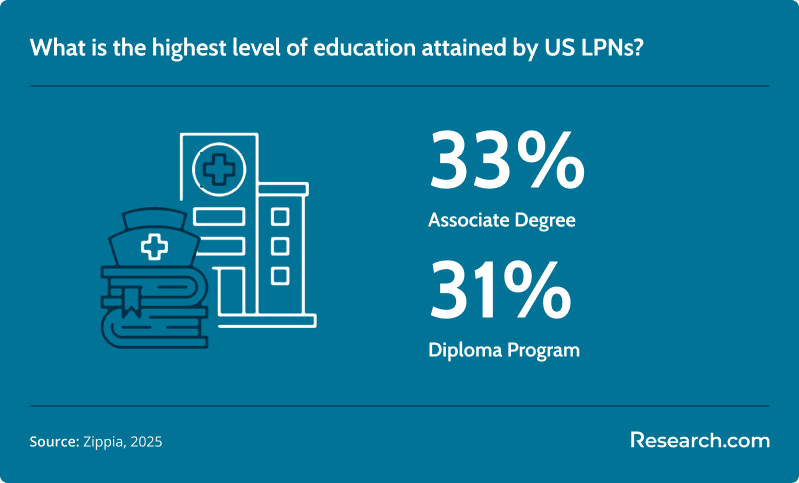
According to Zippia, 33% of LPNs or LVNs in the United States hold associate degrees, 31% completed diploma or certificate programs, 15% have bachelor's degrees, and 5% earned a high school diploma.
Certified nursing assistants who want to move into practical nursing may also consider online CNA to LPN bridge programs, which can provide a more direct transition for students with relevant patient care experience.
What courses are typically in an online LVN program?
Online LVN curricula are built around basic nursing theory, clinical safety, patient care, and preparation for supervised practice. Many courses are online, but clinical skill development happens through labs, simulations, and healthcare-site rotations. Students comparing practical nursing roles can also use an LPN career guide to see how coursework connects to real jobs.
Foundational health science courses
- Anatomy and physiology: Students study body systems, structure, function, and how normal processes relate to illness and care.
- Nutrition: This course explains how food, hydration, and diet affect recovery, prevention, and wellness across patient groups.
- Medical terminology: Students learn the language, abbreviations, and documentation terms used in healthcare settings.
- Pharmacology: Learners study medication categories, safe administration, patient monitoring, and potential side effects.
Core practical nursing courses
- Fundamentals of nursing: This course introduces basic nursing care, hygiene, infection prevention, safety, mobility, and vital signs.
- Vocational nursing skills: Students practice procedures such as injections, wound care, positioning, transfers, and basic treatment support.
- Mental health nursing: Learners explore therapeutic communication, behavioral health conditions, and supportive care within the LVN scope.
- Gerontology: This course focuses on aging, chronic conditions, mobility concerns, cognitive changes, and elder care.
- Maternal and child health nursing: Students learn care principles for pregnancy, childbirth, newborns, infants, and children.
Clinical and professional preparation
- Clinical practicum: Students apply nursing skills in real healthcare settings under supervision.
- Patient care across the lifespan: Learners adapt care for newborns, children, adults, and older adults.
- Leadership and professional development: Coursework may cover ethics, prioritization, documentation, teamwork, professionalism, and workplace expectations.
Students evaluating healthcare training may also compare similar program structures in fields such as the most affordable online dental assistant associate degree programs, where online theory and clinical preparation are also important.
What are the essential skills developed in online LVN programs?
Online LVN programs build both knowledge and hands-on nursing ability. The online coursework teaches concepts, while clinical rotations test whether students can apply them safely with real patients.
- Basic clinical care: Students learn to take vital signs, assist with hygiene and mobility, administer medications within scope, support wound care, and recognize changes in patient condition.
- Communication: LVNs must explain care clearly, listen to patient concerns, communicate with families, and report observations to RNs and providers.
- Critical thinking: Students practice identifying urgent changes, prioritizing tasks, following care plans, and knowing when to escalate concerns.
- Documentation and legal awareness: Programs teach accurate charting, privacy expectations, patient rights, scope of practice, and professional boundaries.
- Time management: Clinical environments require students to organize multiple tasks, complete care efficiently, and maintain accuracy under pressure.
- Cultural competence and compassion: Students learn to provide respectful care to patients with different backgrounds, beliefs, ages, and health needs.
According to Zippia, the skills that most frequently appear on licensed practical nurse resumes are patient care (22.5%), CPR (10.7%), home health (10.2%), medication administration (4.1%), and quality care (3.9%).
How do I know if my online LVN program is accredited and quality-assured?
Start by confirming state Board of Nursing approval. This is the most important step because state approval affects whether graduates can sit for the NCLEX-PN and pursue licensure. Then check institutional accreditation and, when available, nursing-specific accreditation from organizations such as the Accreditation Commission for Education in Nursing.
A quality program should also be transparent about clinical placements, faculty qualifications, student support, graduation outcomes, and NCLEX-PN performance. Be cautious if a school avoids clear answers about state approval, clinical site availability, or licensure eligibility in your state.
Students thinking far beyond practical nursing may later review advanced nursing pathways such as an accelerated DNP program, but LVN students should first focus on state-approved entry-level training and licensure readiness.
What challenges do online LVN students encounter?
Online LVN students often underestimate how demanding hybrid nursing training can be. The coursework may be flexible, but deadlines, exams, labs, clinical rotations, and skills evaluations are not optional. Students need consistent study habits, reliable technology, and the ability to attend in-person requirements when scheduled.
- Clinical scheduling conflicts: Online students may still need daytime, evening, weekend, or rotating clinical availability.
- Technology problems: Weak internet, outdated computers, or unfamiliar learning platforms can interfere with progress.
- Limited face-to-face contact: Students who need frequent in-person explanation may struggle with online instruction.
- Heavy weekly workload: Some programs require a near full-time commitment even if lectures are online.
- Licensure uncertainty: Enrolling in a program that does not meet a student’s state requirements can create serious delays.
Students who already plan to continue beyond LVN practice can explore future options such as easy RN to BSN online programs after considering the RN bridge requirements that may apply.
What are the long-term career advancement opportunities after completing an online LVN program?
An LVN credential can be an entry point into nursing, not necessarily the final stop. Many LVNs gain experience, then pursue additional education to become registered nurses, specialize in a care area, move into supervisory work, or prepare for higher-level nursing degrees.
| Advancement option | What it can lead to | When it makes sense |
| LVN/LPN to RN bridge | Registered nursing licensure pathway and broader clinical scope. | For LVNs who want more responsibility and a longer-term nursing career. |
| Specialty certifications | Stronger preparation for focused settings such as geriatrics, IV therapy, wound care, or mental health support. | For LVNs who want to deepen skills without immediately entering a degree program. |
| Supervisory or charge roles | Leadership in long-term care or other settings, depending on employer and state scope rules. | For experienced LVNs with strong communication and organization skills. |
| Advanced nursing pathways | Longer-term progression toward advanced clinical roles. | For students committed to additional education beyond RN preparation. |
Some students eventually compare advanced routes such as direct-entry NP programs for non-nurses, but LVNs should carefully map each step because advanced practice pathways usually require additional nursing education and licensure milestones.
What specialization opportunities can follow an online LVN program?
After licensure and clinical experience, LVNs may build expertise in settings such as geriatrics, rehabilitation, home health, hospice, pediatrics, mental health, correctional healthcare, or long-term care. Specialization usually depends on employer needs, state scope of practice, continuing education, and additional credentials.
LVNs interested in mental health nursing may eventually look at psychiatric nursing pathways, including resources such as the most affordable online psychiatric nurse practitioner programs. However, nurse practitioner preparation is an advanced route and requires additional education beyond LVN training.
Does my state’s licensure requirement affect online LVN program choices?
Yes. State licensure rules should be one of the first things you check before applying to any online LVN program. Nursing is regulated at the state level, and a program that works for one student may not meet another student’s licensure requirements in a different state.
Students should contact their state Board of Nursing and ask whether the program is approved for NCLEX-PN eligibility, whether out-of-state online programs are accepted, and whether clinical placements must occur in specific settings or locations. This is especially important for students who live in one state but enroll in a program based elsewhere.
Students comparing nursing school options more broadly may also review admission-focused resources such as the easiest nursing schools with high acceptance rates, but admission ease should never replace licensure verification.
How do I choose the best online LVN program?
The best online LVN program is the one that is affordable, state-approved, clinically feasible, and realistic for your schedule. A low tuition rate is not enough if the program does not help you qualify for licensure or if clinical sites are too far away to attend consistently.
Questions to ask before applying
| Question | Why it matters |
| Is the program approved by my state Board of Nursing? | This affects NCLEX-PN eligibility and licensure. |
| Where will I complete labs and clinical rotations? | Online coursework does not remove in-person clinical requirements. |
| What is the NCLEX-PN pass rate? | Pass rates can help show how well the program prepares students for licensure testing. |
| What is the true total cost? | Tuition may not include fees, supplies, books, testing, travel, and licensure expenses. |
| Can I attend while working? | Some programs require about 40 hours per week of coursework and clinical training. |
| Does the school help arrange clinical placements? | Clinical placement support can make completion much more manageable. |
| Are credits transferable? | This matters if you plan to enter an LPN-to-RN or other nursing bridge program later. |
| What support services are available online? | Tutoring, advising, faculty access, and technical support can affect completion. |
Common mistakes to avoid
- Assuming “online” means fully remote: LVN programs require in-person clinical training.
- Choosing by tuition only: A cheaper program may cost more overall if travel, fees, or clinical logistics are difficult.
- Skipping state licensure checks: State Board approval is essential for NCLEX-PN eligibility.
- Ignoring NCLEX-PN outcomes: Pass rates can reveal how well students are being prepared.
- Overestimating available time: Hybrid LVN programs can be difficult to complete while working full time.
- Not asking about clinical placement support: Students should know whether the school assigns sites or expects students to find their own.
- Assuming salary outcomes are guaranteed: Pay varies by employer, state, experience, schedule, and role.
Students who want a framework for comparing online programs across price, flexibility, and curriculum can also examine resources such as the most affordable online artificial intelligence degree programs, though nursing students should give special priority to licensure and clinical requirements.
According to the National Council of State Boards of Nursing, the 2025 Q1 NCLEX-PN exam pass rate for all candidates is 77.25%. First-time, U.S.-educated takers have a pass rate of 86.28%, while first-time, internationally educated takers have a pass rate of 61.29%.
What career paths are available for graduates of online LVN programs?
Graduates of approved LVN programs typically pursue practical nursing roles that involve basic patient care, documentation, observation, and support for registered nurses or physicians. The exact scope of practice depends on state rules and employer policies.
- Licensed Vocational Nurse or Licensed Practical Nurse: Most graduates begin in LVN or LPN roles, checking vital signs, administering medications within scope, assisting with daily care, reporting patient changes, and supporting care plans. Those interested in mobile assignments can learn how to become a travel LPN.
- Home health nurse: LVNs in home health visit patients where they live, help monitor chronic conditions, support medication routines, and assist with personal care.
- Nursing home staff nurse: In long-term care, LVNs help manage resident care, administer treatments, document changes, and support comfort and safety.
- Clinic or outpatient nurse: LVNs in ambulatory care help with intake, basic testing, patient preparation, injections, documentation, and provider support.
- Hospice nurse: LVNs in hospice settings focus on comfort, symptom support, family communication, and compassionate end-of-life care.
- School nurse assistant: LVNs may support school health offices by helping with screenings, minor injuries, medication routines, and chronic condition monitoring.
- Correctional facility nurse: LVNs in jails or prisons provide routine and urgent care in a secure environment that requires professionalism and adaptability.
LVNs who want to expand their scope of practice may later consider a 2 semester LPN to RN program, depending on admission requirements, clinical availability, and state rules.
Students who want to compare other entry-level healthcare credentials can review the most affordable online patient care technician certification programs to understand how patient care roles differ by training level.
What is the job market for graduates with an online LVN program?
The Bureau of Labor Statistics projects employment of LVNs and LPNs to grow by 3% from 2023 to 2033, which is comparable to the national average of 4%. Although the growth rate is modest, the occupation still produces many openings because healthcare employers need to replace workers who retire, change occupations, or leave the labor force. The BLS expects 54,000 openings each year during that period. Indeed currently lists over 69,000 openings for LPNs and LVNs.
The states with the highest number of active PN licenses are California (114,315), Texas (101,240), New York (76,962), Florida (66,116), and Ohio (51,474). Students who want more local options should still research their city or region, because statewide totals do not guarantee jobs in every community.
The industries employing the most LVNs are nursing care facilities (171,290), general medical and surgical hospitals (84,870), home health care services (78,100), offices of physicians (74,850), and retirement and elderly care facilities (41,760).
Current Trends Affecting Online LVN Students
- Hybrid learning is becoming normal in practical nursing: More programs use online lectures, digital testing, virtual simulations, and scheduled campus labs, but clinical care remains in person.
- Employers still value hands-on readiness: Students should choose programs with strong clinical coordination, not just convenient online coursework.
- Technology skills matter more: LVNs increasingly use electronic health records, online scheduling tools, digital documentation systems, and telehealth-adjacent workflows.
- Long-term care and home health remain important employment areas: Nursing care facilities, home health services, and retirement and elderly care facilities employ large numbers of LVNs.
- Bridge pathways are a major planning factor: Many students enter LVN programs with the intention of later becoming RNs, so transfer policies and articulation agreements should be reviewed early.
Who Should Choose an Online LVN Program?
| Online LVN programs may fit you if... | You may want another option if... |
| You want a shorter entry-level nursing pathway. | You already know you want the broader scope of an RN and can enter an RN program directly. |
| You can manage online coursework independently. | You learn best with daily in-person classroom instruction. |
| You can travel to labs, clinical sites, and required campus sessions. | You need a program with no in-person requirements, which is not realistic for LVN licensure. |
| You want to work in long-term care, home health, clinics, or similar settings. | You want advanced practice, leadership, or specialized nursing roles immediately. |
| You plan to use LVN training as a stepping stone to RN education later. | You are not prepared for a demanding schedule with clinical obligations. |
What Graduates Say About Online LVN Programs
-
: "
Studying LVN online gave me the flexibility to complete theory work around my schedule while still getting supervised clinical practice locally. The online classroom helped me stay connected with classmates and instructors, and earning my LVN credential felt both practical and rewarding. – Siobhan
"
-
: "
The online format helped me build discipline and time management while learning the basics of nursing care. Interactive lessons and class discussions kept me engaged even though I was not on campus every day. I was able to keep moving toward my goal without relocating or commuting constantly. – Roy
"
-
: "
I was unsure about online nursing education at first, but the format worked better than I expected. The modules and virtual activities helped reinforce the material, and I appreciated being able to study without moving. The self-paced parts let me review difficult topics until I understood them. – Michelle
"
Key Insights
- Online LVN programs are best understood as hybrid programs: coursework may be online, but labs and clinical training must be completed in person.
- Most full-time online LVN programs take 12 to 18 months, while part-time options can take 18 to 24 months or longer.
- LPN program tuition commonly ranges from $5,000 to $15,000, but students should compare total cost, including books, supplies, fees, travel, and licensure expenses.
- State Board of Nursing approval is essential. Do not enroll until you confirm that the program meets licensure requirements where you plan to practice.
- Licensed practical and vocational nurses earn an average annual salary of $64,150 and a median annual salary of $62,340, but individual pay depends heavily on setting, location, experience, and responsibilities.
- According to Zippia, 33% of LPNs or LVNs in the United States hold associate degrees, 31% completed diploma or certificate programs, 15% have bachelor's degrees, and 5% earned a high school diploma.
- The 2025 Q1 NCLEX-PN pass rate is 77.25% for all candidates, 86.28% for first-time U.S.-educated takers, and 61.29% for first-time internationally educated takers.
- Employment of LVNs is projected to grow by 3% from 2023 to 2033, with 54,000 openings expected each year.
- The states with the highest number of active PN licenses are California (114,315), Texas (101,240), New York (76,962), Florida (66,116), and Ohio (51,474).
- The strongest program choice is usually not the cheapest one on paper; it is the program that balances affordability, licensure eligibility, clinical access, NCLEX-PN preparation, and schedule fit.
References
- BLS (2024, April 3). 29-2061 Licensed Practical and Licensed Vocational Nurses. BLS occupational employment data
- BLS (2025, May 21). Industry: Cross-industry, Private, Federal, State, and Local Government Period: May 2024. BLS industry data
- BLS (2025, April 18). Licensed Practical and Licensed Vocational Nurses. BLS Occupational Outlook Handbook BLS salary reference
- National Council of State Boards of Nursing (2025, May 20). NUMBER OF ACTIVE PN LICENSES BY STATE. National Council of State Boards of Nursing active license data
- Zippia (2025, January 8). Licensed Practical Nurse Education Requirements. Zippia education requirements NCSBN license data
- Zippia (2025, January 8). Licensed Practical Nurse skills for your resume and career. Zippia LPN skills data
Other Things You Should Know About Online LVN Programs
Typically, prerequisites include a high school diploma or GED, completion of certain science courses, and a minimum GPA. Some programs may require entrance exams or relevant work experience, ensuring applicants are prepared for the rigors of the LVN curriculum.
Yes, many online LVN programs in 2027 provide financial aid options, including scholarships and federal loans. Prospective students should check specific program websites for eligibility criteria and deadlines to apply, ensuring they understand how aid impacts overall affordability.
An affordable online LVN program should be approved by the state nursing board and accredited by the National League for Nursing Commission for Nursing Education Accreditation, or another recognized nursing accreditor. Accreditation matters because it affects eligibility for licensure, clinical placement, and transfer of credits.


