
2027 LPN Certificates vs. Nursing Associate Degrees: How Do They Differ?

Co-Founder and Chief Data Scientist
Choosing between an LPN certificate and an Associate Degree in Nursing (ADN) is one of the first major decisions for aspiring nurses. The right option depends on how quickly you want to start working, how much responsibility you want at the bedside, how much time and money you can invest now, and whether your long-term goal is to remain in practical nursing, become a registered nurse, or continue toward advanced practice. This guide explains the differences between LPN and ADN programs, licensing exams, course requirements, job duties, salaries, bridge options, online study considerations, accreditation, and common mistakes to avoid so you can choose a nursing pathway with clearer expectations.
Quick answer: LPN certificate vs. ADN
An LPN certificate is usually the faster route into nursing, commonly described as a 1-year certificate path that prepares graduates for the NCLEX-PN and practical nursing roles under RN or physician supervision. An ADN is typically a 2-year associate degree that prepares graduates for the NCLEX-RN and registered nurse roles with a broader scope of practice, higher median pay, and more advancement options. If your priority is speed and lower upfront cost, an LPN program may fit. If your goal is RN licensure, stronger career mobility, and higher earning potential, an ADN is often the more direct choice.
Key facts to know before choosing
- Licensed Practical and Licensed Vocational Nurses earned a median salary of $59,730 in 2023.
- Registered nurses (RNs), including ADN-prepared RNs, have projected growth of 6% by 2032, equal to an estimated 177,400 new jobs according to BLS data.
- The Licensed Practical and Licensed Vocational Nurses field is projected to add 34,900 jobs by 2032, with 5% growth according to BLS data.
- The median salary for Registered Nurses (RNs) in May 2023 was $86,070; the range was $63,720 to $132,680 from the 10th to 90th percentile.
- U.S. Bachelor's degree graduates had NCLEX pass rates of 90.3%, compared with 82.8% for Associate's degree graduates in 2020.
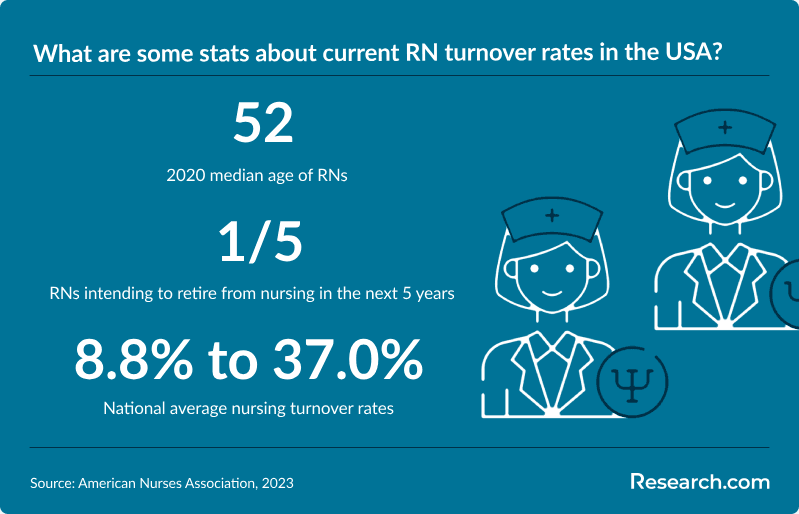
- The American Nurses Association (2023) reports national RN turnover rates ranging from 8.8% to 37.0%, a median RN age of 52, and one out of five nurses intending to retire within 5 years.
- Bridge programs can help LPNs, ADNs, and RNs move into higher credentials without always starting over from the beginning.
- Nursing education pathway from LPN to doctoral practice
- LPN vs. ADN: similarities, differences, and scope of practice
- Jobs, duties, and advancement options for LPNs and ADN-prepared RNs
- RN and LPN job outlook in the United States
- Typical LPN and ADN courses
- Admission prerequisites for LPN and ADN programs
- Licensing exams for LPNs and ADN graduates
- How to decide whether LPN or ADN is right for you
- Bridge programs for LPNs, ADNs, and RNs
- LPN and ADN salary comparison
- Job shadowing and mentorship for nursing students
- Online LPN and ADN program benefits and clinical mentoring considerations
- Why accreditation matters in nursing education
- Advanced nursing careers after LPN or ADN training
- How to strengthen your nursing school application
- Nursing and business dual degree options
- Career and salary advantages of nursing associate degrees
- How RN to BSN bridge programs affect career growth
- How online nursing programs handle clinical experience
- Whether accelerated online associate degrees are worth considering
- Advanced certifications for nursing career growth
- Financial aid resources for nursing students, plus certification planning, accelerated study options, ADN value, and admissions strategy
Student perspectives on LPN and ADN pathways
-
: "
Completing my LPN coursework online gave me the schedule control I needed while I kept working full-time. I could study around my shifts, use what I learned right away at work, and lean on instructors when I needed clarification. The experience helped me feel more capable and ready for nursing practice. -Drew
"
-
: "
As a working parent, I needed an ADN program that could fit around family responsibilities. The online format let me move through lectures and assignments with more flexibility, while clinical rotations gave me the hands-on experience I needed to become an RN. -Lucy
"
-
: "
I was unsure whether I could return to school with my schedule, but the online LPN format made the transition manageable. Virtual lectures, online collaboration, and remote exams helped me stay engaged, and instructor support kept me from feeling isolated. -Cameron
"
What is the career pathway for nurses starting from the lowest to the highest nursing degree?
Nursing credentials build on one another. Some students enter through practical nursing, others go straight into RN preparation, and many return later for bachelor’s, master’s, or doctoral education. Understanding the sequence helps you avoid choosing a program that is too limited for your long-term goal.
| Credential or degree | Typical preparation | Role it supports | Best fit |
| Licensed Practical Nurse (LPN) | 1-year certificate program | Basic nursing care under RN or physician supervision | Students who want a faster entry point into direct patient care |
| Registered Nurse (RN) through ADN | Associate's Degree in Nursing (ADN), commonly 2 years | RN practice after passing the NCLEX-RN exam | Students who want RN licensure without starting with a 4-year degree |
| Registered Nurse (RN) through BSN | Bachelor of Science in Nursing (BSN), commonly 4 years | RN practice with broader preparation in leadership, research, and population health | Students targeting employers or roles that prefer bachelor’s-prepared nurses |
| Master of Science in Nursing (MSN) | Advanced degree program of 1.5-2 years for RNs with a BSN | Advanced nursing roles such as nurse practitioner, clinical nurse specialist, or nurse educator | RNs who want specialization, advanced practice, teaching, or leadership |
| Doctor of Nursing Practice (DNP) | Doctoral program of 3-4 years for nurses with an MSN | High-level advanced practice, systems leadership, innovation, and evidence-based practice | Nurses seeking the highest practice-focused nursing credential |
For RNs planning to move into nurse practitioner roles, it is useful to compare timelines early. Programs such as 1 year nurse practitioner programs can help experienced nurses evaluate accelerated graduate options, while this guide on how long from RN to nurse practitioner explains the steps from RN preparation to advanced practice.
Students who already hold a degree in another field may not need to begin with a traditional first-time nursing pathway. Some online nursing programs for non nurses are designed for career changers who want a structured route into nursing.
What are the key similarities and differences between LPN and ADN degrees?
LPN and ADN programs both prepare students for patient care, but they do not lead to the same license or professional authority. The most important difference is that an LPN program leads to practical nursing licensure, while an ADN leads to RN licensure after passing the NCLEX-RN.
| Factor | LPN certificate | ADN degree |
| Usual length | 1 year certificate program | 2 years of full-time study |
| Licensing exam | NCLEX-PN | NCLEX-RN |
| License outcome | Licensed Practical Nurse or Licensed Vocational Nurse, depending on state terminology | Registered Nurse |
| Scope of practice | Basic patient care, typically under RN or physician supervision | Broader patient assessment, medication administration, care planning, and coordination |
| Independence | More limited and supervision-based | Greater responsibility and more independent clinical judgment within RN scope |
| Advancement | Possible through specialization, lead LPN roles, or LPN-to-RN bridge programs | Stronger path to specialty nursing, charge nurse roles, BSN, MSN, and advanced practice |
| Median salary data cited | $59,730 in 2023 for Licensed Practical and Licensed Vocational Nurses | $86,070 in May 2023 for Registered Nurses |
The two pathways overlap in foundational nursing topics. Both introduce anatomy and physiology, patient safety, communication, documentation, infection control, and bedside care. Both also require clinical training. However, ADN programs go further into assessment, care planning, leadership, evidence-based practice, and complex patient care.
The workforce context also matters. The American Nurses Association (2023) reports national RN turnover rates ranging from 8.8% to 37.0%, with a median RN age of 52 and 20% intending to retire within 5 years. Those figures do not guarantee individual job offers, but they help explain why healthcare employers continue to pay close attention to RN recruitment, retention, and career mobility.
What are the typical jobs, responsibilities, and advancement opportunities for LPNs and ADNs?
LPNs and ADN-prepared RNs both care for patients, but the level of decision-making differs. LPNs usually carry out practical bedside care and report changes to RNs or physicians. ADN graduates who pass the NCLEX-RN become registered nurses and can take on broader assessment, planning, and coordination duties.
Licensed Practical Nurse (LPN) roles
The main job for graduates of an LPN certificate program is Licensed Practical Nurse. In some states, the equivalent title is Licensed Vocational Nurse (LVN). LPNs may work in nursing homes, hospitals, clinics, physician offices, home healthcare, and long-term care settings.
- Direct patient care: Helping patients with bathing, dressing, eating, mobility, and comfort.
- Vital signs: Measuring and recording temperature, blood pressure, pulse, and respiration.
- Patient monitoring: Watching for changes and reporting concerns to RNs or physicians.
- Medication support: Administering certain medications by approved routes, depending on state regulations and employer policy.
- Documentation: Recording care accurately and updating patient charts.
- Communication: Relaying information to patients, families, RNs, physicians, and other members of the care team.
LPNs can work in hospitals, although opportunities may be more common in medical-surgical units, mother-baby units, outpatient departments, rehabilitation areas, and other settings that align with the LPN scope of practice. Fast-paced critical care environments often require RN-level preparation.
Advancement for LPNs usually comes through experience, specialty training, lead LPN responsibilities, or returning to school. LPNs may pursue wound care, geriatrics, pediatrics, or other focused areas where permitted. Those who want wider clinical authority often use an LPN-to-RN pathway.
ADN-prepared Registered Nurse roles
ADN graduates who pass the NCLEX-RN become registered nurses. They may work in hospitals, nursing homes, home healthcare agencies, physician offices, clinics, ambulatory surgery centers, rehabilitation centers, and specialty departments such as pediatrics, emergency care, or medical-surgical units.
- Patient assessment: Collecting health histories, reviewing symptoms, evaluating condition changes, and identifying nursing priorities.
- Care planning: Working with physicians and other professionals to create and adjust care plans.
- Medication administration: Giving medications through approved routes, including oral, intravenous, and injection methods, while following safety protocols.
- Wound care: Assessing, dressing, and monitoring wounds according to care plans.
- Patient education: Teaching patients and families about diagnoses, medications, discharge instructions, and self-care.
- Documentation and communication: Maintaining detailed records and coordinating with the broader healthcare team.
- Procedural support: Assisting with clinical procedures, specimen collection, catheter insertion, and CPR when needed.
ADN-prepared RNs generally have more advancement pathways than LPNs. They may pursue specialty certifications, charge nurse roles, nurse education responsibilities, RN-to-BSN programs, MSN programs, and eventually advanced practice roles. For a closer look at compensation by location, see this guide to Associate Degree in Nursing salary, which notes average salaries ranging from $65,000 to $77,000 per year.
What is the job growth outlook for RNs in the USA?
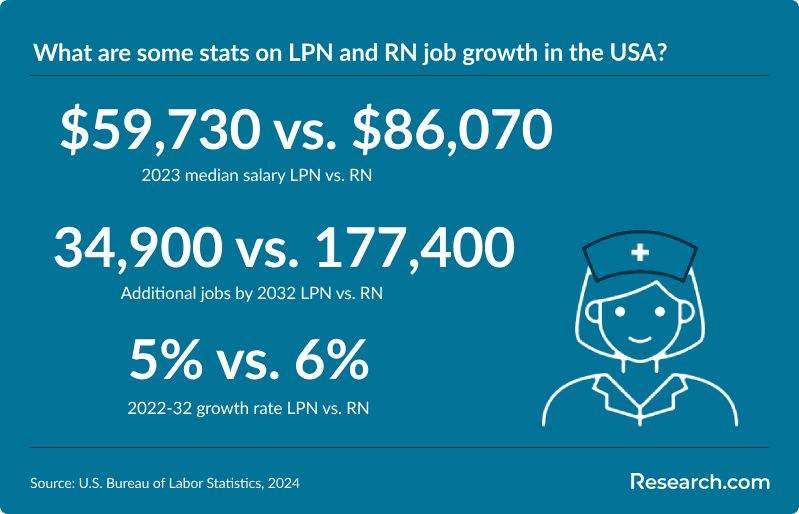
BLS data cited for this guide shows positive employment projections for both practical nurses and registered nurses. Licensed Practical and Licensed Vocational Nurses are projected to grow by 5% by 2032, with 34,900 jobs added. Registered Nurses are projected to grow by 6% by 2032, with an estimated 177,400 new jobs.
The salary difference is also substantial in the cited data: Licensed Practical and Licensed Vocational Nurses earned a median salary of $59,730 in 2023, while Registered Nurses had a median salary of $86,070 in May 2023. These figures are national medians, not promises of pay. Actual wages vary by state, employer, shift, specialty, experience, and union or nonunion status.
For many students, the outlook supports a practical strategy: start where you can realistically succeed, but choose a pathway that does not block future RN advancement. If you begin as an LPN, verify whether your credits and license can transfer into an LPN-to-ADN or LPN-to-RN bridge program later.
What courses are typically included in an LPN vs. ADN program?
LPN and ADN curricula both start with nursing fundamentals, but ADN programs add more depth in assessment, clinical judgment, leadership, research, and complex care. Course names differ by school, so always review the official curriculum before applying.
| Course area | LPN program emphasis | ADN program emphasis |
| Fundamentals of nursing | Basic bedside care, safety, infection control, communication, and legal responsibilities | Foundational care plus broader RN-level decision-making |
| Medical terminology | Common healthcare language, abbreviations, records, diagnoses, and procedures | Used across more advanced documentation, assessment, and care planning |
| Anatomy and physiology | Core body systems and functions | Often more detailed preparation for assessment and disease processes |
| Nutrition | Basic nutritional needs across health and illness | Nutrition planning as part of comprehensive care |
| Maternal-neonatal and pediatric nursing | Introductory care for mothers, newborns, infants, and children | Expanded family-centered care and clinical reasoning |
| Gerontological nursing | Care of older adults and age-related health concerns | Broader assessment and coordination for older adult populations; related careers in gerontology continue to matter as populations age |
| Pharmacology | Medication basics, side effects, safe administration, and dosage calculations | More complex medication administration and monitoring within RN scope |
| Mental health nursing | May be introduced depending on program structure | Commonly included with more depth in psychiatric and behavioral health care |
| Community health nursing | Often limited or introductory | Public health, prevention, community-based care, and population health concepts |
| Leadership and management | Usually limited | Communication, delegation, coordination, and possible supervision responsibilities |
| Research and evidence-based practice | Usually limited | Evaluating research and applying evidence to nursing decisions |
| Clinical practice | Supervised practical care experience | More extensive clinical rotations across varied healthcare settings |
The key curriculum difference is depth. LPN programs are designed for focused practical care. ADN programs prepare students for RN-level judgment, broader patient assessment, and more complex clinical responsibilities.
What are the prerequisites for LPN vs. ADN programs?
LPN programs often have more accessible entry requirements, while ADN programs are usually more academically competitive because they lead to RN licensure. Requirements vary by school and state, so confirm details directly with each program.
| Requirement | LPN programs | ADN programs |
| Education | High school diploma or GED is commonly required | High school diploma or GED is commonly required |
| Math and science | Basic math and science may be required | Stronger preparation is often expected, including courses such as algebra, biology, and chemistry |
| Entrance testing | Some programs require an entrance exam | Many programs use exams such as TEAS or HESI to assess readiness |
| GPA | May be considered, depending on the program | Minimum GPA requirements may apply for high school or prior college work |
| Health requirements | Immunizations are typically required | Immunizations are typically required |
| Background check | Often mandatory for clinical placement and patient contact | Often mandatory for clinical placement and patient contact |
| Additional materials | May include prerequisite courses or documentation | May include prerequisite courses, English proficiency testing such as TOEFL when applicable, recommendation letters, or a personal statement |
Before applying, ask whether prerequisites expire, whether repeated courses are accepted, how entrance exam scores are weighted, and whether admission is based on minimum eligibility or competitive ranking.
What exams do I need to pass to become an LPN vs. an ADN?
Graduating from a nursing program is not enough to practice. You must meet your state board’s requirements and pass the appropriate national licensing exam. Students comparing practical nursing routes can also review the steps to become LPN online.
LPN licensing exam: NCLEX-PN
The NCLEX-PN is the National Council Licensure Examination for Practical Nurses. It is a computer-based exam that evaluates whether candidates have the knowledge, judgment, and skills needed for safe entry-level LPN practice.
- Fundamentals of nursing care
- Gerontological nursing
- Infection control
- Maternity and pediatric nursing
- Medical-surgical nursing
- Mental health nursing
- Pharmacology
ADN licensing exam: NCLEX-RN
The NCLEX-RN is the National Council Licensure Examination for Registered Nurses. It is broader than the NCLEX-PN because RN practice includes more complex assessment, planning, intervention, and evaluation responsibilities.
- Content areas also tested in practical nursing preparation
- Advanced nursing concepts and principles
- Leadership and management
- Patient safety and quality improvement
NCLEX-RN is generally considered more demanding because RNs have a wider scope of practice. Candidates may only take the relevant NCLEX after completing an eligible program and meeting the state board’s application requirements. Fees, timelines, and documentation rules vary by state.
Pass-rate data can help you evaluate program performance, but it should not be the only factor. First-time US-educated NCLEX test-takers had a pass rate of 79.9%, compared with 43.74% for repeat test-takers and 43.18% for international test-takers. U.S. Bachelor's degree graduates had a pass rate of 90.3%, compared with 82.8% for Associate's degree graduates in 2020.
Should I choose an LPN program or an ADN program?
The better choice depends on your constraints and goals. Choose an LPN program if you need the shortest practical path into paid nursing work and are comfortable starting with a more supervised role. Choose an ADN program if your goal is to become an RN as directly as possible and you can commit to the longer, more rigorous program.
| Choose this path if... | LPN certificate may fit | ADN may fit |
| You need to enter the workforce quickly | Stronger fit because programs are commonly described as 1 year | Less direct because full-time study is commonly 2 years |
| You want RN licensure | Not enough by itself; you would need a bridge later | Direct pathway to NCLEX-RN eligibility after program completion |
| You want a broader scope of practice | More limited scope under supervision | Stronger fit because RN responsibilities are broader |
| You are minimizing upfront cost | Often lower because of shorter duration | Usually higher upfront investment |
| You want long-term advancement options | Possible, but usually requires additional education | Stronger foundation for BSN, MSN, leadership, and specialization |
| You prefer highly focused bedside care | Good fit if practical patient care is your main goal | Good fit if you also want assessment, coordination, and care planning responsibilities |
Pros and cons of an LPN program
- Pros: Faster entry into nursing, lower upfront cost in many cases, and a focused practical care role.
- Cons: Narrower scope of practice, lower median salary than RNs in the cited data, and fewer advancement options without more education.
Pros and cons of an ADN program
- Pros: RN eligibility, wider scope of practice, higher median salary in the cited data, more specialty and leadership pathways, and better alignment with later BSN or MSN study.
- Cons: Longer training, higher cost than many LPN programs, and more demanding coursework in science, nursing theory, and clinical reasoning.
Questions to ask before deciding
- Do I need to start earning as soon as possible, or can I invest more time now for RN preparation?
- Does my state limit LPN medication administration, IV therapy, or hospital roles in ways that affect my goals?
- Will credits from the program transfer into an RN or BSN pathway later?
- What are the program’s NCLEX pass rates, clinical placement sites, and graduation outcomes?
- Can I manage the schedule, clinical requirements, transportation, and study time?
- Will my employer or local hospitals hire LPNs, ADNs, BSNs, or all three?
What available nursing bridging programs are there for LPNs, ADNs, and other nurses?
Bridge programs are designed for nurses who already have one credential and want to move to the next level without repeating every course from the beginning. They can be especially valuable if you start as an LPN for speed but later decide you want RN responsibilities, or if you earn an ADN and later need a BSN for advancement.
LPNs exploring RN pathways can compare 6 month LPN to RN program options, but it is essential to verify accreditation, state board approval, clinical placement rules, and whether the timeline is realistic for your background.
| Bridge pathway | Who it serves | Typical purpose | Important checks |
| LPN-to-ADN | Licensed Practical Nurses | Builds on practical nursing experience to prepare for RN licensure through an ADN route | Credit transfer, clinical hours, NCLEX-RN eligibility, state approval |
| ADN-to-BSN | RNs with an Associate's Degree in Nursing | Adds bachelor’s-level study in leadership, research, theory, and evidence-based practice | Accreditation, employer tuition benefits, practicum requirements, transfer credits |
| RN-to-MSN | Registered nurses who meet program requirements | Moves nurses toward graduate study and possible advanced roles | Required bachelor’s coursework, specialization, clinical requirements, licensure outcomes |
| Post-baccalaureate certificate | BSN-prepared nurses seeking focused expertise | Provides concentrated preparation in areas such as critical care, pediatrics, or informatics | Certification eligibility, employer recognition, and whether a full MSN is needed instead |
Some nurses compare long-term bridge routes such as ADN to NP programs, while others begin by reviewing flexible online nursing programs. If you are unsure which specialty or degree level fits your goals, comparing nursing majors can help you map possible directions before committing.
When comparing bridge programs, focus on fit rather than speed alone. Ask whether the program is accredited, whether your state board recognizes it, how clinical placements are arranged, how much credit you receive for prior learning, and whether graduates are eligible for the license or certification you want.
What are the average salaries for LPNs and ADNs in the US?
The salary gap between LPNs and RNs is one of the biggest practical differences between these pathways. According to the cited BLS data, Licensed Practical and Licensed Vocational Nurses earned a median salary of $59,730 in 2023. Registered Nurses had a median salary of $86,070 in 2023, with projected growth of 6% by 2032 and an estimated 177,400 new jobs.
Additional salary references cited for LPNs include:
- BLS: $59,730
- Salary.com: $53,700
- Payscale: $52,072
According to the BLS, in May 2023, median annual wages for registered nurses were highest in the government sector at $99,840, followed by hospitals, including state, local, and private hospitals, at $88,430. Ambulatory healthcare services were listed at $81,230, nursing and residential care facilities at $79,280, and educational services, including state, local, and private educational services, at $71,550.
Higher credentials may also support later advancement. Nurses who eventually want the highest academic credential in the field can compare options such as affordable PhD nursing programs, though that path is much farther beyond the initial LPN vs. ADN decision.
What are the job shadowing and mentorship opportunities for LPN and ADN students?
Job shadowing and mentorship help students see what nursing work looks like before they commit to a program or specialty. They are especially useful because classroom descriptions rarely capture the pace, emotional demands, teamwork, and documentation responsibilities of nursing.
Job shadowing opportunities
- Reality check: Shadowing lets students observe patient care, nurse-patient communication, routine duties, and urgent situations in actual healthcare settings.
- Specialty exposure: Students may observe areas such as pediatrics, geriatrics, mental health, emergency care, or outpatient practice to see which environments fit their strengths.
- Professional networking: Shadowing can introduce students to nurses, hiring managers, clinical educators, and possible references.
Mentorship opportunities
- Academic and clinical guidance: Mentors can explain how to manage coursework, clinical rotations, time pressure, and exam preparation.
- Skill development: A strong mentor can help students improve communication, prioritization, clinical judgment, and confidence.
- Career planning: Mentors can discuss specialty options, certification timing, bridge programs, and work-life challenges in nursing.
When evaluating programs, ask whether mentorship is formal or informal, whether students receive clinical site support, and whether the school helps arrange shadowing or expects students to find opportunities independently.
What are the benefits of pursuing an online LPN or ADN program?
Online LPN and ADN programs can make nursing education more accessible, but students should understand the limits of the format. Nursing cannot be completed entirely through online coursework because clinical practice requires supervised hands-on training in approved healthcare settings.
- Flexible coursework: Online lectures and assignments can help students who work, parent, or manage other responsibilities.
- Reduced commuting burden: Students may spend less time traveling for classroom instruction, although clinical travel is still required.
- Broader program access: Online delivery can expand choices for students who live far from campus-based nursing schools.
- Self-directed pacing in some courses: Asynchronous coursework can help students review complex topics more carefully or move faster through familiar material.
- Work-school balance: Online formats may make it easier for working adults to keep earning while completing prerequisites or nursing theory courses.
- Clinical skill development: Reputable programs still require in-person clinical rotations in hospitals, clinics, long-term care facilities, or similar settings.
Online does not automatically mean easier. Nursing programs still require discipline, lab skills, clinical hours, exams, and state board compliance. If you are comparing programs with more accessible admissions, review options such as the easiest LPN program to get into, but do not choose based only on admission convenience.
Is accreditation the key to a quality nursing education?
Accreditation is one of the most important checks before enrolling in any LPN, ADN, bridge, or online nursing program. It can affect financial aid eligibility, credit transfer, employer recognition, and whether graduates can move smoothly into higher degrees. State board approval is also critical because licensure eligibility is controlled at the state level.
When comparing options, including LPN to RN online programs, ask whether the program is accredited by recognized nursing accrediting bodies such as the Accreditation Commission for Education in Nursing (ACEN) or the Commission on Collegiate Nursing Education (CCNE), when applicable. Also confirm that the state board of nursing recognizes the program for the license you plan to pursue.
What advanced nursing career paths are available after LPN/ADN programs?
LPN and ADN credentials can be starting points rather than endpoints. LPNs may bridge to RN preparation. ADN-prepared RNs may move into BSN, MSN, certificate, leadership, education, management, or advanced practice pathways. The right route depends on whether you want to remain in direct bedside care, specialize clinically, teach, manage teams, or practice with greater autonomy.
Some nurses eventually consider doctoral routes, including options such as the easiest DNP program online. Before moving into advanced degrees, evaluate the program’s clinical simulation resources, mentorship, research expectations, specialty alignment, and state licensure implications.
How to get accepted into nursing programs with high admission standards
Nursing admissions can be competitive, especially for ADN and BSN pathways with limited clinical seats. Strong applicants usually plan early, complete prerequisites carefully, prepare for entrance exams, and demonstrate readiness for patient care.
- Earn strong grades in science and math prerequisites.
- Prepare seriously for TEAS, HESI, or other required entrance exams.
- Gain relevant exposure through healthcare work, volunteering, CNA experience, shadowing, or caregiving where appropriate.
- Request recommendations from people who can speak to reliability, communication, maturity, and academic readiness.
- Write a focused personal statement that explains why nursing fits your goals and how you handle responsibility.
- Apply to a balanced list of programs rather than relying on one highly competitive option.
If you are worried about selectivity, compare the easiest nursing schools to get into. Easier admission should not replace quality checks, but it can help you identify realistic entry points.
Can dual degree programs expand my career opportunities in nursing and business?
Dual degree pathways that combine nursing with business can be useful for nurses who want leadership, operations, administration, consulting, or executive roles. These programs connect clinical knowledge with budgeting, strategy, management, quality improvement, and organizational decision-making.
Nurses considering this direction can review the best MSN MBA online programs to see how graduate nursing and business coursework may support long-term leadership goals. This path is usually more relevant after RN experience, not as the first step for someone still choosing between LPN and ADN.
What are the career and salary advantages of nursing associate degrees over other fields?
An ADN can be a strong associate degree option because it leads to RN licensure eligibility rather than only a general academic credential. In the cited BLS data, Registered Nurses earned a median salary of $86,070 annually, which makes nursing stand out among many associate-level career paths.
The ADN also supports career stacking. Graduates can work as RNs, pursue certifications, move into specialty areas, and later complete ADN-to-BSN or graduate pathways. For students comparing high-value associate degrees, nursing often appears among the best associate degrees because it connects education directly to a licensed healthcare role.
How do RN to BSN bridge programs impact my nursing career?
RN to BSN bridge programs help ADN-prepared RNs add bachelor’s-level preparation in leadership, research, community health, evidence-based practice, and broader systems thinking. A BSN may support advancement into certain leadership roles, specialty areas, or graduate programs, depending on employer expectations and local hiring patterns.
If you already hold RN licensure and want a faster bachelor’s pathway, review the top 6-month RN to BSN bridge programs online. Compare transfer credit policies, clinical or practicum requirements, accreditation, tuition, employer reimbursement, and workload before enrolling.
How do online nursing programs deliver practical clinical experience?
Online nursing programs usually separate theory delivery from hands-on training. Lectures, readings, discussions, and some simulations may be online, while labs and clinical rotations occur in person. Many programs work with local healthcare partners so students can complete supervised clinical requirements near their area, but placement support varies widely.
Simulation labs, virtual scenarios, and skills practice can support learning, but they do not replace required clinical contact with patients when state boards and accrediting standards require it. Students considering advanced online practice routes can compare options such as the fastest online MSN psychiatric mental health nurse practitioner programs, but should still verify clinical placement expectations.
Is an accelerated online associate degree program a smart investment?
An accelerated online associate degree can be worthwhile for disciplined students who already meet prerequisites, can manage a heavier workload, and understand that clinical requirements still take time. The potential upside is faster progress. The risk is burnout, weak skill development, or choosing a program that is not recognized for licensure or transfer.
Before enrolling, compare total cost, clinical placement logistics, NCLEX preparation, state board approval, accreditation, transferability, and realistic weekly study hours. Students researching faster formats can review 1 year associate degree programs online for broader context.
What advanced certifications can propel my nursing career further?
Certifications can help nurses document specialized expertise after they have the right license, experience, and educational background. Common areas include acute care, family practice, critical care, pediatrics, informatics, wound care, and mental health, depending on role and credential level.
Advanced practice nurses with graduate preparation may compare options such as online post-master's FNP programs. Before pursuing any certificate, confirm eligibility requirements, required clinical hours, employer value, renewal rules, and whether the credential aligns with your intended scope of practice.
What financial aid resources are available for nursing students?
Nursing students may be able to use scholarships, grants, work-study, employer tuition assistance, state aid, federal student loans, and school-based awards. Aid availability depends on enrollment status, school eligibility, financial need, academic performance, and program type.
Do not compare schools by tuition alone. Include fees, books, uniforms, background checks, immunizations, testing fees, commuting, childcare, missed work, clinical travel, and exam preparation. Students considering advanced practice affordability can also compare options such as cheapest psychiatric nurse practitioner programs after completing earlier nursing credentials.
Common mistakes to avoid when choosing an LPN or ADN program
| Mistake | Why it creates problems | Better approach |
| Choosing the fastest program without checking approval | You may complete coursework that does not meet licensure or employer expectations | Verify state board approval and accreditation before applying |
| Looking only at tuition | Fees, clinical travel, supplies, and lost work time can change the real cost | Calculate total attendance cost and compare financial aid packages |
| Assuming online means fully remote | Nursing requires supervised clinical practice | Ask where labs and clinical rotations happen and who arranges placements |
| Ignoring NCLEX outcomes | Low pass rates may signal weak preparation or poor student support | Review pass rates along with retention, graduation, and clinical support |
| Assuming salary medians apply to every graduate | Pay varies by region, employer, specialty, shift, and experience | Research local job postings and talk to nurses in your area |
| Starting with LPN without a bridge plan | You may later discover limited credit transfer into RN programs | Ask how LPN credits transfer before enrolling |
| Relying only on rankings or advertising | Marketing may not reflect licensure fit, clinical quality, or student support | Speak with admissions, current students, graduates, and your state board |
Key Insights
- LPN is faster; ADN is broader. LPN certificates are commonly described as 1-year programs, while ADN programs usually require 2 years of full-time study and prepare graduates for RN licensure.
- The licensing exam determines the role. LPN graduates take the NCLEX-PN. ADN graduates take the NCLEX-RN and can become Registered Nurses after meeting state requirements.
- RN roles offer higher median pay in the cited data. Licensed Practical and Licensed Vocational Nurses earned a median salary of $59,730 in 2023, while Registered Nurses had a median salary of $86,070.
- Both occupations show projected growth. Licensed Practical and Licensed Vocational Nurses are projected to grow by 5%, adding 34,900 jobs by 2032. Registered Nurses are projected to grow by 6%, adding 177,400 jobs by 2032.
- NCLEX performance is a useful quality signal. In 2020, U.S. Bachelor's degree graduates had a 90.3% NCLEX pass rate, compared with 82.8% for Associate's degree graduates.
- Bridge programs protect long-term mobility. LPN-to-ADN, ADN-to-BSN, RN-to-MSN, and certificate pathways can help nurses advance without abandoning prior experience.
- Accreditation and state approval are nonnegotiable. Before enrolling, confirm that the program supports licensure eligibility, credit transfer, financial aid access, and employer recognition.
- The best choice is personal but should be strategic. Choose LPN if speed and lower upfront investment matter most. Choose ADN if your goal is RN licensure, broader responsibility, and stronger advancement potential.
References:
- American Nurses Association. (2023). Nursing workforce. American Nurses Association.
- American Nurses Association. (2023). The State of the Nursing Workforce. American Nurses Association.
- Bureau of Labor Statistics (BLS). (2024). Occupational Employment and Wages, May 2020: 29-2061 Licensed Practical and Licensed Vocational Nurses. Bureau of Labor Statistics.
- Bureau of Labor Statistics (BLS). (2024). Registered Nurses. Bureau of Labor Statistics.
- National Center for Biotechnology Information. (2018). The future of nursing: Leading change, advancing health. NCBI.
- Salary.com. (2024). Licensed Practical Nurse (LPN) Salary. Salary.com.
- Payscale. (2024). Licensed Practical Nurse (LPN) Hourly Rate. Payscale.
Other Things You Need to Know About LPN Certificates and Nursing Associate Degrees
In 2027, LPN certificate programs focus on practical skills with clinical rotations for direct patient care. Nursing associate degree programs offer more comprehensive training, combining advanced coursework with clinical practicums, preparing students for broader roles, including leadership.
To become a vocational nurse in the US, you must pass the NCLEX-PN exam. Vocational nursing programs prepare students through coursework in nursing fundamentals, pharmacology, and patient care, along with hands-on clinical practice. Many programs also offer NCLEX-PN review courses and practice exams to help students thoroughly prepare for the licensure exam.
LPN certificate programs focus on basic nursing care, often completed in 12-18 months, emphasizing practical skills like patient monitoring and personal care. Nursing associate degrees span about 2-3 years, covering broader topics, including anatomy, pharmacology, and leadership, preparing graduates for more advanced roles.


