
2027 How to Become a Nurse in Iowa

Co-Founder and Chief Data Scientist
Becoming a nurse in Iowa is a practical career goal, but the path is not as simple as choosing a school and applying for jobs. You need to understand which nursing role fits your goals, whether your program qualifies you for Iowa licensure, how the NCLEX works, what costs to expect, and how Iowa’s workforce demand may affect your options after graduation.
Iowa is facing a significant nursing shortage, with projections indicating a need for over 10,000 additional nurses by 2030. That creates opportunity, especially for graduates willing to work in hospitals, long-term care, home health, rural communities, and advanced practice roles. It also makes choosing the right education and licensing path more important, because delays caused by the wrong program, incomplete documents, or missed renewal rules can slow down your entry into the workforce.
This guide explains how to become a nurse in Iowa, including education routes, license types, compact licensure, financial aid, job outlook, continuing education, bridge programs, and common mistakes to avoid.
Quick Answer: How Do You Become a Nurse in Iowa?
To become a nurse in Iowa, you must graduate from an Iowa Board of Nursing-approved or appropriately accredited nursing program, pass the correct NCLEX exam, complete the Iowa Board of Nursing application process, satisfy background check requirements, and maintain your license through renewal and continuing education. The exact route depends on whether you want to become an LPN, RN, APRN, nurse practitioner, nurse midwife, or another nursing professional.
| Goal | Typical Education Route | Required Exam or Credential | Best Fit For |
| Licensed Practical Nurse | Practical nursing program, often about one year | NCLEX-PN | Students who want a faster entry into bedside care |
| Registered Nurse | ADN or BSN nursing program | NCLEX-RN | Students seeking broader clinical responsibility and more advancement options |
| Advanced Practice Registered Nurse | Graduate nursing degree, usually MSN or DNP | National specialty certification plus Iowa requirements | RNs who want advanced clinical, leadership, or specialty roles |
| Certified Nursing Assistant | State-approved nurse aide training | Competency exam | Students who want patient-care experience before nursing school |
Key Things to Know Before Starting
- The average salary for registered nurses in Iowa is approximately $66,000 per year. Actual pay depends on location, experience, education level, specialty, shift differentials, and employer type.
- The employment outlook is positive. The Bureau of Labor Statistics projects a 7% growth rate for registered nursing positions through 2029, while Iowa Workforce Development projects RN employment growth of 10% from 2020 to 2030.
- Iowa requires nurses to complete an accredited or approved nursing program and pass the NCLEX-RN or NCLEX-PN before full licensure.
- Financial support may be available through scholarships, grants, loan repayment options, employer tuition benefits, and state workforce programs.
- Program approval matters. A nursing program that is convenient or inexpensive is not a good choice if it does not meet Iowa licensure standards.
- Steps to become a nurse in Iowa
- Education requirements for Iowa nurses
- Types of nurses allowed to practice in Iowa
- Iowa nursing licensing requirements
- Nursing license options in Iowa
- Nurse Licensure Compact rules in Iowa
- Financial aid for nursing students in Iowa
- Whether you can practice without a license
- Current state of nursing in Iowa
- Bridge programs for Iowa nurses
- Nurse practitioner education requirements
- Easiest nurse practitioner specialties to enter
- Continuing education for career growth
- LVN and LPN pathways in Iowa
- Online nursing education in Iowa
- Renewal and continuing education rules
- Networking and mentorship for nurses
- Nurse midwife pathway in Iowa
- Stress management strategies for nurses
- Best education routes for LPNs
- Nursing job outlook in Iowa
- Ways to diversify a nursing career
What are the steps to becoming a nurse in Iowa?
The basic path to nursing licensure in Iowa follows a clear sequence: choose the right role, complete an approved education program, pass the required exam, apply to the Iowa Board of Nursing, and keep your license active. The details differ by license type, but the decision points are similar for most candidates.
- Choose your nursing role first. Decide whether you are aiming for LPN, RN, APRN, CNA, nurse practitioner, or nurse midwife. This choice determines the program length, exam, cost, and scope of practice.
- Enroll in an approved or properly accredited program. Iowa candidates should verify that their nursing program meets Iowa Board of Nursing standards. Out-of-state and online programs need careful review because not every program automatically qualifies graduates for Iowa licensure.
- Complete clinical and classroom requirements. Nursing programs include both theory and supervised clinical practice. Clinical placement quality matters because it affects confidence, skills, and employability after graduation.
- Pass the NCLEX exam. LPN candidates take the NCLEX-PN, while RN candidates take the NCLEX-RN. The exam measures whether you are prepared for safe entry-level practice.
- Submit your licensure application. Apply through the Iowa Board of Nursing and provide required documentation, such as education verification, exam results, and application materials.
- Complete the background check process. Iowa reviews criminal history as part of licensure. A past conviction does not always mean automatic denial, but candidates should review the state’s Criminal Conviction Eligibility guidelines before applying.
- Maintain your license after approval. Iowa nurses must renew their licenses and meet continuing education requirements. Missing renewal deadlines can interrupt employment.
- Plan ahead if educated outside the United States. Foreign-educated nurses may need credential evaluation, additional documentation, and possibly extra steps before Iowa licensure.
If you are not ready for nursing school yet, a CNA role can help you gain patient-care experience and understand whether clinical work fits you. Reviewing CNA salary by state can also help you compare short-term healthcare roles while planning for nursing school.
| Step | What to Verify | Common Mistake to Avoid |
| Program selection | Approval, accreditation, clinical placements, NCLEX preparation | Choosing based only on location or tuition |
| Application | Transcripts, background check instructions, fee requirements | Waiting until after graduation to learn the licensing process |
| Exam preparation | NCLEX format, school pass-rate support, remediation resources | Assuming graduation alone guarantees passing the NCLEX |
| Career launch | Employer requirements, shift expectations, specialty training | Applying only to one type of healthcare setting |
What are the educational requirements for becoming a nurse in Iowa?
Iowa nursing education requirements depend on the license or role you want. The fastest route is not always the best route, and the most advanced route is not always necessary. Students should compare time, cost, career mobility, and future degree plans before enrolling.
| Pathway | Typical Length or Level | Leads To | Decision Guidance |
| LPN diploma or practical nursing program | Often about one year | NCLEX-PN and LPN licensure | Good for students who want to enter nursing quickly and may later bridge to RN study |
| Associate Degree in Nursing | Typically a two-year program | NCLEX-RN and RN licensure | Often attractive for students seeking a lower-cost route to RN practice |
| Bachelor of Science in Nursing | Four-year degree | NCLEX-RN and RN licensure | Useful for students who want broader preparation, leadership options, and stronger long-term mobility |
| Master of Science in Nursing | Graduate-level nursing education | Advanced clinical, leadership, or specialty roles | Appropriate for RNs pursuing nurse practitioner or other advanced roles |
| Doctor of Nursing Practice | Doctoral-level practice degree | Advanced practice and high-level clinical leadership | Best for nurses pursuing advanced practice depth or senior practice leadership |
For registered nursing, Iowa students commonly choose either an ADN or BSN. Both can prepare graduates for the NCLEX-RN, but the BSN usually includes more coursework in leadership, community health, research, and care coordination. Students who already know they want graduate study should consider how easily credits transfer into MSN or DNP programs. Those comparing doctoral options can review affordable online DNP programs for BSN holders.
Accreditation and state approval are non-negotiable. Iowa-based nursing programs must meet Iowa Board of Nursing expectations, while out-of-state programs should be accredited by an agency recognized by the U.S. Department of Education. Online programs can be convenient, but students should confirm that clinical placements, state authorization, and licensure preparation align with Iowa rules.
The chart below shows that most RNs in the U.S. have a BSN as their highest educational attainment.
What types of nurses can legally practice in Iowa?
Iowa recognizes multiple nursing and nursing-related roles. Each has a different scope of practice, education requirement, and level of responsibility. Understanding these distinctions helps students avoid enrolling in a program that does not match their career goal.
- Registered Nurses: RNs assess patients, administer medications, coordinate care, educate patients and families, and collaborate with healthcare teams. Iowa RN candidates generally complete an ADN or BSN and pass the NCLEX-RN. Programs accredited by the Accreditation Commission for Education in Nursing or the Commission on Collegiate Nursing Education are commonly recognized.
- Licensed Practical Nurses: LPNs provide basic nursing care, monitor patients, assist with daily needs, and work under the supervision of RNs, physicians, or other authorized providers. Candidates complete a state-approved practical nursing program and pass the NCLEX-PN.
- Advanced Practice Registered Nurses: APRNs include nurse practitioners, clinical nurse specialists, certified registered nurse anesthetists, and certified nurse midwives. These nurses need graduate nursing education and national certification in a specialty area.
- Certified Nursing Assistants: CNAs are not licensed nurses, but they are important members of the care team. They assist with activities of daily living and must complete state-approved training and a competency exam.
| Role | Primary Work | Level of Independence | Typical Next Step |
| CNA | Daily care support and basic patient assistance | Works under licensed staff | LPN or RN program |
| LPN | Basic nursing care and monitoring | Works under RN or provider supervision | LPN-to-RN bridge |
| RN | Assessment, care coordination, patient education, medication administration | Broader clinical responsibility | BSN, MSN, specialty certification, or leadership role |
| APRN | Advanced assessment, diagnosis, treatment, specialty care | Advanced practice authority within state rules | Specialization, leadership, education, or doctoral study |
The Iowa Board of Nursing regulates nursing practice in the state and sets the standards that protect patients and define professional accountability. Before choosing a program, confirm which role it prepares you for and whether it leads to the license you actually need.
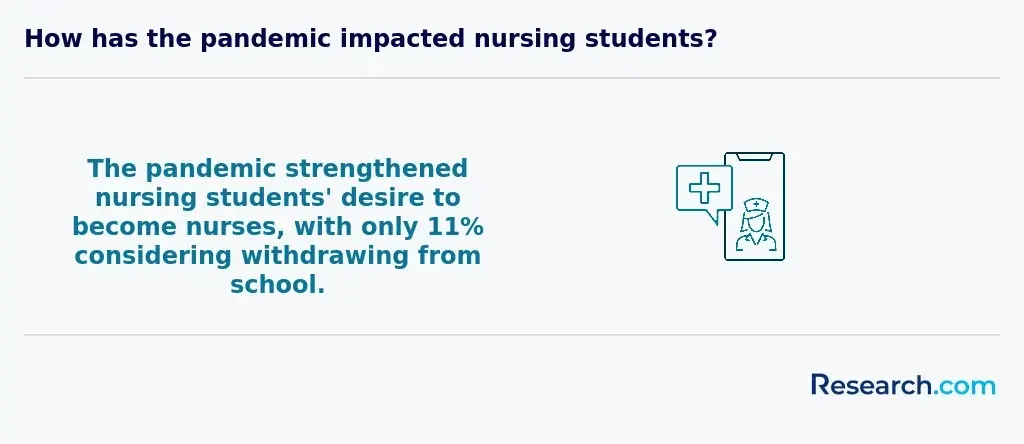
The graphic below shows that, because of the pandemic, interest in nursing increased among students across the U.S., not only in Iowa.
What are the licensing requirements for nurses in Iowa?
Iowa nursing licensure is handled by the Iowa Board of Nursing. Requirements vary by license type, but most applicants must document education, pass the appropriate NCLEX, complete a background check, and pay required fees.
- Education: RN applicants usually complete an ADN or BSN, while LPN applicants complete a practical nursing program. The program must meet Iowa’s approval or accreditation expectations.
- Examination: RN candidates take the NCLEX-RN, and LPN candidates take the NCLEX-PN. Passing the correct exam is required before full licensure.
- Application: Candidates submit an application to the Iowa Board of Nursing with proof of education, exam documentation, and required forms. The application fee is approximately $100.
- Background check: Iowa requires a criminal background review. Applicants submit fingerprints to the Iowa Division of Criminal Investigation. Fingerprinting costs can vary, but candidates should budget around $50.
- NCLEX-related costs: Candidates should also plan for NCLEX registration, which is around $200, along with review materials or preparation courses if needed.
- Program verification: The Board will review whether your education qualifies you for the license requested. This is especially important for online, out-of-state, and international programs.
| Cost or Requirement | Amount or Detail Stated | Why It Matters |
| Iowa licensure application | Approximately $100 | Required to start the licensing review |
| Fingerprinting/background check | Budget around $50 | Required for public protection and eligibility review |
| NCLEX exam fee | Around $200 | Required for RN or LPN licensure examination |
| Program completion | Approved or accredited nursing education | Determines whether the applicant can qualify for Iowa licensure |
Students should not wait until graduation to understand licensing requirements. The safest approach is to confirm program eligibility with the school and the Iowa Board of Nursing before enrolling.
What types of nursing licenses are available in Iowa?
The main nursing licenses in Iowa are the Registered Nurse license and Licensed Practical Nurse license. Advanced practice nurses have additional recognition and certification requirements, while CNAs follow a separate nurse aide certification process rather than a nursing license pathway.
- Registered Nurse license: RN applicants must graduate from an Iowa Board of Nursing-approved or otherwise qualifying nursing program, usually through an ADN or BSN route, and pass the NCLEX-RN. RNs perform a broad range of clinical duties, including medication administration, patient assessment, education, and care coordination.
- Licensed Practical Nurse license: LPN applicants usually complete a practical nursing program lasting about one year and pass the NCLEX-PN. LPNs provide essential nursing care under supervision. Many later use bridge programs to become RNs. Students comparing affordable advancement routes can review low-cost online LPN to RN programs.
Foreign-educated nurses may be eligible for Iowa licensure, but they often need credential evaluation and must meet exam and documentation requirements. Military service members may also receive recognition for relevant training and experience, depending on Iowa Board of Nursing rules and the license being pursued.
Students who are still comparing healthcare careers may also want to look at adjacent training options, such as affordable medical assistant programs, before committing to a nursing track.
The chart below compares NCLEX pass rates in the United States in 2022 for ADN and BSN degree holders.
Can a Compact nurse practice in Iowa?
Yes. Iowa participates in the Nurse Licensure Compact, which allows eligible nurses with a multistate license to practice in other compact states without applying for a separate single-state license in each one. This is especially useful for travel nurses, relocating nurses, telehealth roles, and employers that serve patients across state lines.
- Residency matters: A compact license is tied to a nurse’s primary state of legal residence. To hold a compact license, your primary residence must be in a compact state.
- Already licensed in another compact state: If you hold a valid multistate license from another compact state, you can generally practice in Iowa under compact privileges.
- Non-compact state residents: Nurses whose primary residence is in a non-compact state typically need an Iowa single-state license to practice in Iowa.
- Background checks: The enhanced Nurse Licensure Compact includes state and federal background check requirements for applicants.
- Continuing education still matters: Nurses must follow the renewal and education rules tied to their licensing status and state requirements.
Compact licensure can make Iowa more accessible for qualified nurses, but it does not remove professional accountability. Nurses still need to practice within Iowa laws, employer policies, and applicable scope-of-practice rules.
What financial assistance programs are available for nursing students in Iowa?
Nursing school can be expensive, but Iowa students should not judge affordability by tuition alone. Fees, books, uniforms, exams, background checks, transportation to clinical sites, and lost work hours can all affect the real cost. Financial aid can reduce the burden if students apply early and understand service commitments before accepting funds.
| Funding Option | How It Helps | What to Check Before Accepting |
| Iowa Nursing Education Loan Repayment Program | Helps eligible nurses repay loans when they work in high-demand or underserved areas | Worksite requirements, service commitment, and eligibility rules |
| Future Ready Iowa Last-Dollar Scholarship | Helps cover remaining tuition gaps for eligible high-demand programs, including nursing | Program eligibility, FAFSA requirements, and remaining balance rules |
| Federal grants | May provide need-based aid through programs such as the Pell Grant and FSEOG | FAFSA deadlines and annual eligibility |
| Hospital-sponsored tuition assistance | May reduce tuition in exchange for a work commitment after graduation | Required employment period, repayment clauses, and job placement terms |
| Iowa Workforce Development grants | May support students preparing for high-demand healthcare occupations | Availability, approved programs, and application timing |
| Employer tuition reimbursement | Can help working nurses pay for advanced degrees or certifications | Grade requirements, annual caps, and retention agreements |
Students pursuing advanced practice should ask each school’s financial aid office about scholarships, employer partnerships, and clinical placement expenses. Applicants comparing graduate options can also review nurse practitioner programs in Iowa while evaluating total cost and program fit.
Can you practice as a nurse without a license in Iowa?
No. Iowa does not allow someone to practice as a nurse without a valid nursing license or applicable legal authorization. Licensure exists to protect patients by verifying education, examination, background review, and professional accountability.
- Full practice requires licensure: RN and LPN candidates must complete an approved or qualifying program and pass the correct NCLEX exam before receiving full authority to practice.
- Temporary authorization may be limited: Iowa may allow temporary licensing for certain graduates during the licensing process, but such authorization is time-limited and tied to specific conditions.
- Unlicensed practice carries serious risk: Practicing without a license can lead to fines, legal consequences, employment barriers, and damage to your professional record.
- There are legal healthcare roles before licensure: Students can consider CNA, medical assistant, unit clerk, patient care technician, or other support roles while preparing for nursing licensure.
-
: "
Licensure is not just paperwork. It is the legal line between preparing for nursing practice and being authorized to provide nursing care independently within the role’s scope.
"
What is the state of nursing in Iowa?
Nursing in Iowa is shaped by workforce demand, rural healthcare needs, an aging population, and ongoing pressure on hospitals, long-term care facilities, home health agencies, and public health organizations. The Iowa Board of Nursing oversees licensing and professional regulation, while employers compete for qualified nurses across multiple care settings.
Demand for Nurses
Iowa has over 60,000 licensed nurses, including RNs, LPNs, and APRNs. Even with that workforce, shortages remain a concern in some communities, especially rural areas where healthcare access can be more limited. The projected need for over 10,000 additional nurses by 2030 makes nursing a strong option for students who are prepared for the academic, clinical, and emotional demands of the profession.
Cost of Living and Career Practicality
Iowa’s relatively low cost of living can make nursing wages go further than they might in higher-cost states. However, students should still compare loan amounts, expected starting pay, commute costs, and whether they may need to relocate for clinical placements or first jobs.
Major Employers and Work Settings
- Hospitals and health systems: RNs and LPNs work in emergency care, medical-surgical units, pediatrics, critical care, perioperative settings, and specialty departments.
- Long-term care facilities: Nursing homes and assisted living facilities need nurses to care for older adults and patients with ongoing medical needs.
- Home health services: Nurses provide care in patients’ homes, often supporting recovery, chronic disease management, and community-based care.
- Public health: Nurses support prevention, education, immunization, community outreach, and population health initiatives.
The strongest career strategy is to choose a license level that fits your short-term needs while keeping future advancement open. For example, an LPN route can be practical for quick entry, while a BSN can support broader advancement and graduate education.
How can bridging programs facilitate career advancement for nurses in Iowa?
Bridge programs help working nurses move from one credential level to the next without repeating unnecessary coursework. For example, an LPN may bridge to RN preparation, an RN with an ADN may complete a BSN, and an experienced RN may pursue graduate study for advanced practice.
These programs are most useful when they recognize prior nursing education, offer flexible scheduling, and provide clinical placements that meet state requirements. Nurses interested in moving from RN preparation toward advanced practice can compare ADN to MSN bridge programs to understand how bridge routes may shorten the path to graduate-level nursing.
| Bridge Route | Who It Serves | Why Nurses Choose It |
| LPN to RN | LPNs seeking broader scope and RN licensure | Higher responsibility, more settings, and stronger advancement potential |
| RN to BSN | RNs with an ADN or diploma | Leadership preparation, employer preference, and graduate school readiness |
| RN to MSN | RNs pursuing advanced clinical, education, or leadership roles | Graduate-level specialization without starting over |
| BSN to DNP | BSN-prepared nurses seeking doctoral practice training | Advanced practice depth and long-term professional mobility |
What are the nurse practitioner education requirements in Iowa?
Nurse practitioners in Iowa are advanced practice registered nurses. The path generally starts with RN licensure, followed by graduate nursing education, supervised clinical preparation, and national certification in a population focus or specialty area.
Before enrolling, applicants should confirm that the program is accredited, meets Iowa requirements, provides appropriate clinical experiences, and prepares graduates for the relevant certification exam. For a focused explanation of the process, see this guide to nurse practitioner education requirements in Iowa.
Which nurse practitioner specialty is the easiest to enter in Iowa?
No nurse practitioner specialty is “easy” in the sense of being academically simple or clinically low-stakes. However, some specialties may be more accessible depending on admission requirements, clinical placement availability, applicant background, and local employer demand.
When comparing specialties, ask whether the program requires prior specialty experience, how clinical placements are arranged, whether certification pass support is strong, and whether Iowa employers hire graduates in that focus area. Students exploring accessible NP options can review nurse practitioner specialties that may be easier to enter.
How can nurses enhance their careers through continuing education in Iowa?
Continuing education helps Iowa nurses maintain competence, meet renewal requirements, and prepare for new responsibilities. It can also help nurses move into specialties such as pediatrics, emergency care, long-term care leadership, informatics, public health, case management, and advanced practice.
- Use continuing education strategically: Choose courses that align with your next role, not just the easiest credits available.
- Document everything: Keep certificates and completion records in case of renewal review or employer audits.
- Add certifications carefully: Specialty credentials can strengthen a resume, but they require time, fees, and renewal obligations.
- Build adjacent skills: Nurses interested in administrative or revenue-cycle work may also explore related paths such as becoming a medical biller and coder in Iowa.
How can I become an LVN in Iowa?
Iowa commonly uses the term Licensed Practical Nurse rather than Licensed Vocational Nurse. If you are searching for LVN programs, make sure you are looking at Iowa-approved practical nursing pathways that lead to LPN eligibility in the state.
The typical process is to complete a qualifying practical nursing program, apply through the Iowa Board of Nursing, pass the NCLEX-PN, and meet background check requirements. For more detail on terminology and practical nursing routes, review how to become an LVN in Iowa.
How can online nursing education accelerate your career in Iowa?
Online nursing programs can help Iowa students and working nurses move forward without relocating or leaving employment. They are especially common for RN-to-BSN, MSN, DNP, and continuing education programs. Entry-level nursing programs may still require in-person labs, simulations, and clinical placements.
The key question is not whether a program is online. The key question is whether it is approved, accredited, clinically viable in Iowa, and respected by employers. Students comparing flexible options can explore online nursing programs in Iowa.
| Online Nursing Option | Potential Advantage | Risk to Check |
| Online RN-to-BSN | Flexible completion for working RNs | Transfer credit limits and employer tuition rules |
| Online MSN | Graduate advancement without leaving work | Clinical placement support and certification preparation |
| Online DNP | Advanced practice or leadership preparation | Project requirements, practicum expectations, and total cost |
| Hybrid entry-level nursing | Some coursework online with local clinical training | State approval and hands-on skill development |
What are the renewal and continuing education requirements for nurses in Iowa?
Iowa nurses must renew their licenses and complete continuing education according to state requirements. Renewal generally involves submitting the renewal application, paying applicable fees, and documenting required continuing education. Nurses should confirm current requirements directly with the Iowa Board of Nursing because rules can change.
For a deeper review of renewal, license maintenance, and eligibility expectations, use this guide to Iowa nursing license requirements.
How can professional networking and mentorship enhance nursing careers in Iowa?
Networking is not just for job searching. For nurses, it can lead to better clinical judgment, specialty exposure, leadership opportunities, and early awareness of policy or practice changes. Mentorship is especially valuable during transitions from student to nurse, LPN to RN, RN to charge nurse, or RN to advanced practice.
- Join professional groups: Local nursing associations and specialty organizations can provide education and career leads.
- Seek mentors in your target specialty: A critical care nurse, nurse practitioner, educator, or nurse manager can help you understand real day-to-day expectations.
- Use clinical rotations intentionally: Treat every placement as a chance to build references and learn workplace culture.
- Compare schools by support systems: Strong advising, alumni networks, and employer relationships can be as important as tuition. Students can start by reviewing nursing schools in Iowa.
How can I become a nurse midwife in Iowa?
Nurse midwives provide advanced care related to pregnancy, childbirth, reproductive health, and wellness across the lifespan. In Iowa, the route generally requires RN preparation, graduate-level nurse midwifery education, supervised clinical experience, certification, and compliance with state practice requirements.
Applicants should choose accredited midwifery programs with strong clinical placement support in maternity and women’s health settings. For a step-by-step explanation, review how to become a nurse midwife in Iowa.
What are some effective strategies for managing stress as a nurse in Iowa?
Nursing can be emotionally intense, physically demanding, and schedule-disruptive. Stress management is not a luxury; it is part of safe, sustainable practice. Iowa nurses working in hospitals, long-term care, rural settings, and home health may face different stressors, but many coping strategies apply across roles.
- Set firm work-life boundaries: Protect recovery time after shifts and avoid making constant overtime your default plan.
- Use brief reset techniques: Breathing exercises, short mindfulness practices, and grounding techniques can help during high-pressure shifts.
- Build peer support: Trusted colleagues can help process difficult cases and reduce isolation.
- Move regularly: Exercise, walking, stretching, or outdoor activity can reduce stress and improve sleep quality.
- Use employee assistance resources: Many healthcare employers offer counseling or employee assistance programs for staff.
- Prioritize sleep: Shift work can disrupt rest, so consistent sleep routines matter when schedules allow.
- Strengthen competence through education: Training can reduce anxiety by improving confidence in procedures, communication, and decision-making.
Avoid treating burnout as a personal failure. Chronic understaffing, repeated trauma exposure, and unsafe workload patterns require organizational solutions as well as individual coping strategies.
What are the best educational pathways for LPNs in Iowa?
LPNs in Iowa have several practical advancement options. The best route depends on whether the goal is higher pay, broader clinical responsibility, a BSN, graduate school, or a specialty area.
- Stay in LPN practice and specialize: Some LPNs build experience in long-term care, clinics, rehabilitation, or home health.
- Complete an LPN-to-RN program: This is a common route for practical nurses who want RN licensure without starting from the beginning.
- Earn a BSN after RN licensure: This can improve long-term mobility and support graduate school plans.
- Compare format and accreditation: Flexible formats are helpful, but state approval and clinical quality matter more.
Students comparing practical nursing options can review LPN programs in Iowa and evaluate program length, approval status, NCLEX support, cost, and clinical placement availability.
What is the job outlook for nursing in Iowa?
The nursing job outlook in Iowa is favorable, but opportunities vary by license level, geography, specialty, and employer. According to Iowa Workforce Development, employment for RNs is projected to grow by 10% from 2020 to 2030. The Bureau of Labor Statistics projection cited earlier indicates a 7% growth rate for registered nursing positions through 2029.
Registered nurses in Iowa earn an average annual salary of approximately $66,000, or about $31.73 per hour. Pay can differ substantially by city, experience, specialty, and work setting.
| Area or Setting | Average Salary Stated | What It Suggests |
| Des Moines | $70,000 annually | One of the stronger metro salary areas listed |
| Cedar Rapids | Around $68,000 per year | Competitive pay for RNs in the region |
| Davenport | Approximately $67,000 | Close to the statewide RN average |
| Outpatient care centers | Around $75,000 annually for RNs | Among the higher-paying settings listed |
| Specialty hospitals | Upwards of $72,000 per year | May reward specialty skills and experience |
| Home healthcare services | Around $68,000 | Strong option for nurses interested in community-based care |
Nurse anesthetists and nurse practitioners often earn the highest nursing salaries, frequently exceeding $100,000 annually. To compare advanced practice compensation more broadly, review nurse practitioner salaries by state.
LPNs earn lower average pay, around $48,000 per year. LPNs who want stronger earning potential may pursue RN licensure, a BSN, or eventually an MSN. Working nurses who need a faster graduate route can compare accelerated RN to MSN online programs.
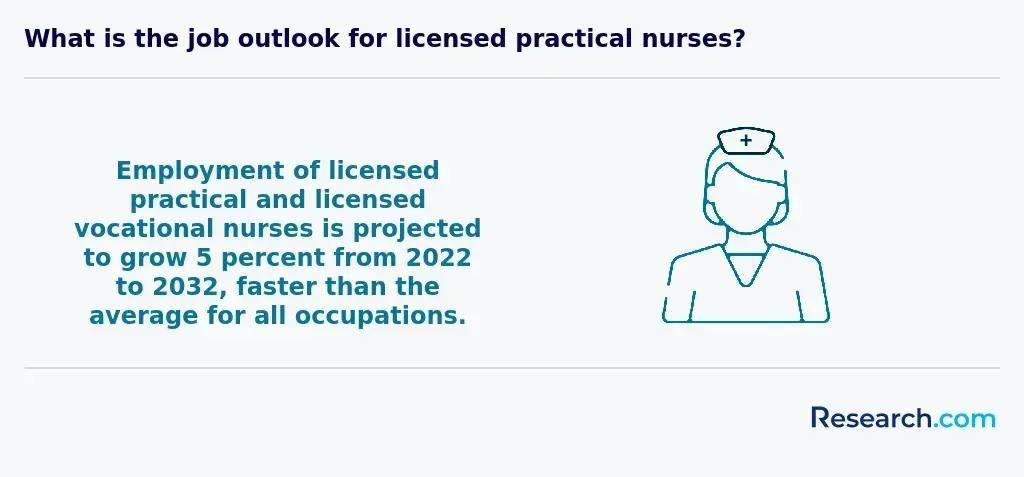
The graphic below shows the general national job outlook for LPNs.
What are the opportunities for diversifying a nursing career in Iowa?
Nursing does not have to mean staying in the same bedside role for an entire career. Iowa nurses can diversify through clinical specialization, leadership, education, informatics, care coordination, public health, advanced practice, or related healthcare professions.
| Career Direction | Good Fit For | Possible Preparation |
| Clinical specialization | Nurses who want deeper expertise in one patient population or care setting | Experience, specialty training, and certification |
| Nurse leadership | Nurses interested in staffing, quality, operations, or management | BSN, MSN, leadership training, and supervisory experience |
| Nursing education | Nurses who enjoy teaching students, patients, or staff | Advanced education and teaching experience |
| Public health | Nurses focused on prevention and community outcomes | Community health experience and population health training |
| Related healthcare profession | Nurses considering a major career shift | New prerequisites, professional school, and licensure planning |
Nurses considering a significant move outside nursing should compare training time, debt, licensing requirements, and opportunity cost. For example, those exploring a pharmacy pathway can review how to become a pharmacist in Iowa.
What do Iowa nurses say about the career path?
Individual experiences can be useful, but they should not replace careful research into licensure, program quality, salary, and working conditions. The comments below reflect common themes prospective nurses should investigate for themselves: mentorship, rural demand, continuing education, and workplace culture.
- Iowa’s nursing community felt accessible to me early in my career. My first employer offered mentorship, and that helped me move from student responsibilities to professional accountability. The average registered nurse salary of around $65,000 annually was also an important factor when I was comparing career options. Erica
- For me, nursing in Iowa offered stability and a manageable cost of living. Rural demand created opportunities, but it also required flexibility. New graduates should ask employers about staffing, orientation, shift expectations, and support before accepting a role. Jason
- Continuing education has been one of the biggest advantages of working here. Partnerships between hospitals and colleges made it easier for me to pursue pediatric training and build a stronger professional network. Cindy
Common mistakes to avoid when becoming a nurse in Iowa
| Mistake | Why It Can Hurt You | Better Approach |
| Choosing a program without checking approval or accreditation | You may not qualify for Iowa licensure | Verify eligibility before enrolling |
| Looking only at tuition | Fees, clinical travel, books, and exam costs can change affordability | Compare total cost of attendance |
| Assuming every online program works for Iowa | Clinical placement and state authorization issues can delay licensure | Ask the program and the Iowa Board of Nursing about eligibility |
| Ignoring NCLEX support | A weak preparation structure can delay employment | Ask about review resources, pass-rate support, and remediation |
| Waiting too long to apply for financial aid | Scholarships and grants may have early deadlines | Complete the FAFSA and school aid forms as early as possible |
| Assuming salaries are guaranteed | Pay varies by setting, shift, location, and experience | Compare local employer postings and benefits |
| Forgetting renewal requirements | An inactive or expired license can interrupt work | Track renewal dates and continuing education documentation |
Questions to ask before choosing an Iowa nursing program
- Is the program approved by the Iowa Board of Nursing or otherwise eligible for Iowa licensure?
- What exam does the program prepare graduates to take: NCLEX-PN or NCLEX-RN?
- Where are clinical placements located, and who arranges them?
- What are the total costs beyond tuition, including fees, supplies, background checks, and exams?
- What academic support is available if I struggle in science, pharmacology, or clinical courses?
- How does the program support NCLEX preparation?
- Can credits transfer into a BSN, MSN, or DNP later?
- What financial aid, scholarships, employer partnerships, or loan repayment options are available?
- What percentage of graduates find nursing jobs in Iowa healthcare settings?
- If the program is online or out of state, does it meet Iowa licensure requirements?
Related Articles for Nearby States
- 2027 How to Become a Nurse in Minnesota
- 2027 How to Become a Nurse in Wisconsin
- 2027 How to Become a Nurse in Illinois
- 2027 How to Become a Nurse in Nebraska
- 2027 How to Become a Nurse in South Dakota
- 2027 How to Become a Nurse in Missouri
- 2027 How to Become a Nurse in Kansas
- 2027 How to Become a Nurse in Indiana
- 2027 How to Become a Nurse in North Dakota
- 2027 How to Become a Nurse in Michigan
References:
- Iowa Department of Inspections, Appeals, & Licensing. Nursing & Professional Midwifery. dial.iowa.gov.
- NurseJournal. Become A Nurse In Iowa + Requirements & Licensing. nursejournal.org.
- Kathleen Gaines. Compact Nursing States List 2024. Nurse.org.
- Auerbach, D., Buerhaus, P., & Staiger, D. Implications Of The Rapid Growth Of The Nurse Practitioner Workforce In The US. Health Affairs.
Key Insights
- Iowa offers strong opportunity for nurses, with projections indicating a need for over 10,000 additional nurses by 2030.
- The fastest nursing path is usually practical nursing, but the RN route offers broader clinical responsibilities and more long-term mobility.
- Program approval and accreditation should be checked before enrollment, especially for online, out-of-state, and international programs.
- Iowa participates in the Nurse Licensure Compact, which can help eligible multistate nurses practice across compact states.
- Registered nurses in Iowa earn approximately $66,000 per year on average, but compensation varies by city, specialty, work setting, and experience.
- Bridge programs can help LPNs, ADN-prepared RNs, and BSN-prepared nurses advance without starting over academically.
- Financial aid can reduce nursing school costs, but students should read service obligations and repayment terms carefully.
- The best nursing path is the one that fits your target role, licensure eligibility, budget, learning format, and long-term career plan.
Other Things You Should Know About Becoming a Nurse in Iowa
In 2027, to become a nurse in Iowa, you need to complete an accredited nursing program such as an Associate or Bachelor of Science in Nursing (ASN/BSN). Afterward, pass the NCLEX-RN exam to obtain licensure from the Iowa Board of Nursing.
When considering a career in nursing in Iowa, many prospective students may wonder if an accelerated nursing program is a viable option. Accelerated nursing programs, typically designed for individuals who already hold a bachelor's degree in another field, allow students to earn a Bachelor of Science in Nursing in a condensed timeframe, often within 12 to 18 months.
Viability: Iowa has a growing demand for nurses, with the Iowa Workforce Development projecting a need for over 10,000 new registered nurses by 2028. This demand makes accelerated programs a practical choice for those looking to enter the workforce quickly. Additionally, many accredited institutions in Iowa offer accelerated programs, ensuring that graduates meet the necessary educational standards to sit for the NCLEX-RN exam.
Competency: Research indicates that BSN-prepared nurses tend to provide higher-quality patient care and have better patient outcomes compared to those with an associate degree. This is particularly relevant in Iowa, where healthcare facilities increasingly prefer or require BSN degrees for nursing positions.
Accelerated programs are rigorous and intensive, equipping students with essential clinical skills and theoretical knowledge in a shorter period. However, the fast-paced nature may not suit everyone, and students must be prepared for a demanding schedule.
Return on Investment: Graduates of accelerated nursing programs in Iowa can expect competitive salaries, with the average annual salary for registered nurses in the state around $65,000.
The investment in an accelerated program can yield a strong ROI, especially considering the potential for higher salaries and job stability in a growing field.
In conclusion, an accelerated nursing program can be advisable for those looking to practice as a nurse in Iowa, provided they are prepared for the challenges and demands of such a program. The combination of a strong job market, the emphasis on BSN education, and favorable salary prospects makes this pathway an attractive option for many aspiring nurses.
In 2027, starting a nursing career in Iowa involves completing a recognized nursing program, such as an associate or bachelor's degree in nursing. Graduates must then pass the NCLEX-RN exam and obtain licensure from the Iowa Board of Nursing. Staying updated with continuing education is crucial for career advancement.


