
2027 FNP-BC vs. FNP-C: Difference Between Nurse Practitioner Certifications

Co-Founder and Chief Data Scientist
Choosing between FNP-BC and FNP-C is not just a question of which initials look better after your name. Both credentials qualify eligible nurses for family nurse practitioner certification, but they are issued by different organizations, use different exam structures, and emphasize slightly different professional strengths. For students finishing an FNP program, RNs planning a graduate pathway, and working nurses comparing certification options, the right choice depends on your career goals, preferred practice setting, exam style, and long-term plans.
Family nurse practitioners remain the largest nurse practitioner specialization, representing 70.3% of the NP workforce in 2024. That popularity makes the FNP pathway attractive, but it also means candidates should be intentional about certification, program quality, clinical placements, costs, renewal rules, and job expectations. This guide explains how FNP-BC and FNP-C compare, what each exam includes, who each credential may fit best, how much certification costs, and how to prepare without wasting time or money.
Quick answer: FNP-BC vs. FNP-C
FNP-BC and FNP-C are both national certifications for family nurse practitioners. The FNP-BC is awarded by the American Nurses Credentialing Center and includes clinical content along with topics such as professional role, policy, and research. The FNP-C is awarded by the American Association of Nurse Practitioners Certification Board and is more strongly centered on clinical assessment, diagnosis, planning, and evaluation. Either credential can support FNP practice, but your state board, employer, and career direction should guide your final decision.
Key Things You Should Know About FNP Certifications
- FNP-BC and FNP-C are both respected FNP credentials, but the FNP-BC includes a broader professional-practice emphasis while the FNP-C is more clinically focused.
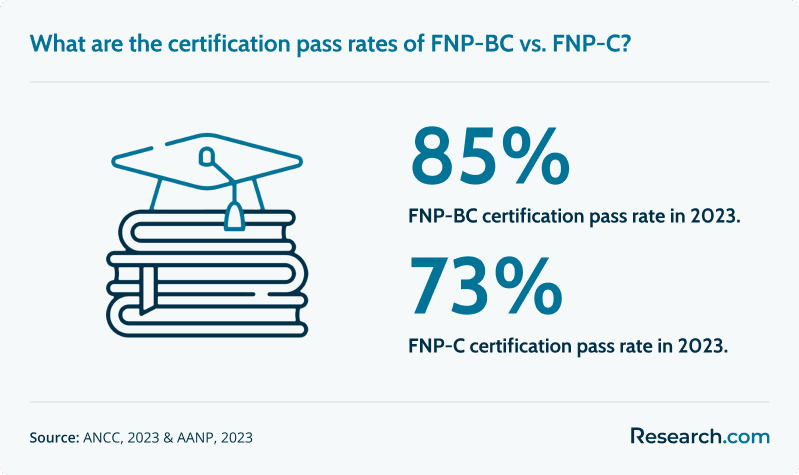
- The FNP-BC certification has a pass rate of 85%, while the FNP-C certification has a pass rate of 73%.
- Both certification paths require 500 faculty-supervised clinical hours.
- Exam fees range from $290 to $395 for FNP-BC candidates and from $240 to $365 for FNP-C candidates.
- Family nurse practitioners earn an average annual salary of $100,541, though actual pay depends on location, employer, experience, specialty, and role.
- What is an FNP certification?
- How do FNP-BC and FNP-C certifications differ?
- What are the requirements for FNP-BC and FNP-C certifications?
- What is the FNP-BC exam like?
- What is the FNP-C exam like?
- How much does it cost to take the FNP-BC or FNP-C exam?
- What types of clinical settings are best for FNP-BC vs. FNP-C preparation?
- What are common challenges students face with FNP-BC and FNP-C certifications?
- How should you choose between FNP-BC and FNP-C?
- Does FNP-BC or FNP-C certification affect salary?
- What are the best exam preparation strategies for FNP certifications?
- Can an RN to MSN bridge program support FNP certification readiness?
- How can you evaluate FNP program quality and affordability?
- What alternative educational pathways can strengthen an FNP certification plan?
- What is the fastest timeline to become a nurse practitioner?
- How can an RN transition into an FNP role?
- Can FNP certification lead to executive leadership roles?
- How do you maintain FNP-BC and FNP-C certifications?
- What career growth opportunities are available after FNP certification?
- What online FNP certification programs are available for post-graduate students?
- What are the benefits of online FNP programs for certification preparation?
- What trends are shaping FNP certification and nurse practitioner careers?
Here’s What Graduates Have to Say About Their Nurse Practitioner Certifications
“Preparing for the FNP-C helped me move into a stronger clinical role. The process deepened my assessment skills, improved my confidence with patients across the lifespan, and made primary care feel like the right long-term direction.” - Clara
“The FNP-BC pathway pushed me to think beyond individual patient visits. I gained advanced clinical knowledge, but I also developed a better understanding of leadership, community health, and how nursing decisions can shape care systems.” - Janus
“Becoming an FNP-C gave me more autonomy and a clearer professional identity. I now have the flexibility to provide patient-centered care while continuing to grow clinically.” - Nila
What is an FNP certification?
An FNP certification is a national credential showing that a registered nurse has completed graduate-level preparation as a family nurse practitioner and has met a certifying body’s examination and eligibility standards. Many candidates complete traditional FNP tracks, accelerated FNP programs, or a 12 month FNP program online, depending on their prior education, schedule, and program availability.
Family nurse practitioners are trained to provide care across the lifespan, which can include health promotion, disease prevention, diagnosis, medication management, chronic disease care, patient education, and referrals. FNP certification does not replace state licensure requirements, but it is commonly required for advanced practice recognition and employment as an NP.
To become certified, candidates usually complete a graduate nursing program, meet required clinical hours, and pass a national exam. Many candidates compare campus-based and online NP programs before deciding where to complete the academic and clinical preparation needed for certification eligibility.
The chart below demonstrates the popularity of FNP programs based on the most common specializations for nurse practitioners in 2024.
How do FNP-BC and FNP-C certifications differ?
The main difference is the certifying organization and exam emphasis. The FNP-BC is awarded by the American Nurses Credentialing Center, while the FNP-C is awarded by the American Association of Nurse Practitioners Certification Board. Both credentials assess whether a candidate is prepared for family nurse practitioner practice, but they do not test candidates in exactly the same way.
The FNP-BC exam includes clinical content along with areas tied to professional practice, such as evidence-based care, policy, leadership, and role responsibilities. This can make it a practical option for nurses who want to keep clinical doors open while also building toward education, administration, advocacy, or policy-oriented work.
The FNP-C exam is more concentrated on clinical decision-making. It focuses on assessment, diagnosis, planning, and evaluation across patient populations. Candidates who want to spend most of their careers in direct patient care often view the FNP-C as a strong match because its structure closely mirrors clinical practice tasks.
| Comparison point | FNP-BC | FNP-C |
| Certifying body | American Nurses Credentialing Center | American Association of Nurse Practitioners Certification Board |
| General exam emphasis | Clinical care plus professional role, policy, research, leadership, and education-related concepts | Clinical assessment, diagnosis, treatment planning, and care evaluation |
| Best fit | Nurses interested in clinical practice with possible movement into teaching, leadership, public health, or policy | Nurses focused primarily on hands-on patient care in primary care, urgent care, outpatient, or similar settings |
| Credential style | Board certification credential | Certification credential |
| Important decision factor | Useful if you value a broader professional-practice testing framework | Useful if you prefer a clinically concentrated examination model |
What are the requirements for FNP-BC and FNP-C certifications?
Before choosing an exam, confirm that your program, license, transcript, coursework, and clinical hours meet the certifying body’s rules. Requirements can be detailed, and missing documentation can delay approval to test.
For FNP-BC certification, candidates must generally satisfy the following requirements:
- Maintain an active RN license in a US state or territory, or hold an equivalent license in another country.
- Complete a master’s degree, postgraduate certificate, or DNP in family nurse practitioner practice from an accredited institution.
- Finish at least 500 faculty-supervised clinical hours through the FNP program.
- Complete three graduate-level APRN core courses: advanced physiology/pathophysiology, advanced health assessment, and advanced pharmacology.
- Show preparation in health promotion/maintenance and differential diagnosis/disease management.
For FNP-C certification, candidates must generally meet these criteria:
- Graduate from a nationally accredited graduate, postgraduate, or doctoral nurse practitioner program in Family, Adult-Gerontology Primary Care, or Psychiatric Mental Health.
- Meet nationally recognized competencies for the nurse practitioner role and population specialty.
- Complete APRN core coursework in advanced physical assessment, pharmacology, and pathophysiology.
- Document at least 500 faculty-supervised clinical practice hours.
- Hold a current, active professional nurse license in the US, a US territory, or a Canadian province or territory.
- Submit an academic transcript showing completion of the required coursework or degree.
What is the FNP-BC exam like?
The FNP-BC exam includes 175 questions. Of these, 150 are scored and 25 are pretest questions used for evaluation. Candidates must answer every question. The exam is organized around five major areas: assessment, diagnosis, planning, implementation, and evaluation.
- Assessment: This area measures whether you can gather a complete history, perform physical assessments, evaluate function, identify risk factors, and apply population health and evidence-based screening concepts.
- Diagnosis: This section tests your ability to understand disease processes, recognize clinical findings, choose appropriate diagnostic tests, and separate expected findings from abnormal changes.
- Planning: This domain covers prevention, age-appropriate guidance, evidence-based care recommendations, medication use, cultural considerations, and research interpretation. Students still comparing accessible degree options may also review programs from the easiest online college to get into, though FNP candidates should still verify nursing accreditation and certification eligibility carefully.
- Implementation: This portion focuses on ethical and legal practice, pharmacologic and nonpharmacologic interventions, regulatory compliance, APRN responsibilities, documentation, patient education, resource use, and professional communication.
- Evaluation: This section asks candidates to judge treatment outcomes, interpret test results, apply ethical and legal principles, and determine whether interventions are working.
The chart below lists the industries with the highest level of employment for nurse instructors, according to data published in 2024 by the BLS.
What is the FNP-C exam like?
The FNP-C exam contains 150 questions. Of those, 135 are scored and 15 are pretest questions used for statistical analysis. A candidate’s final score is based only on the 135 scored questions.
- Assessment: Candidates are tested on collecting patient data, completing physical examinations, and interpreting screening and diagnostic information.
- Diagnose: This domain evaluates whether you can combine subjective and objective findings, build differential diagnoses, and prioritize likely clinical problems.
- Plan: This section assesses your ability to create evidence-based care plans, refer or consult when needed, prescribe appropriate therapies, and educate patients.
- Evaluate: Candidates must show that they can monitor outcomes, judge whether a plan is effective, and adjust care when the patient’s status changes.
The exam blueprint includes multiple patient age groups, such as newborns, infants, toddlers, children, adolescents, young adults, middle adults, older adults, and prenatal patients. It also includes knowledge areas such as health assessment, pathophysiology, therapeutics, evidence-informed practice, therapeutic communication, pain management, and FNP-specific clinical skills.
How much does it cost to take the FNP-BC or FNP-C exam?
Certification exam costs vary by certifying body, application method, and membership status. Candidates should budget not only for the exam fee but also for transcripts, review materials, practice questions, travel if testing in person, and possible retesting costs.
| Exam | Candidate category or application type | Fee |
| FNP-BC | Non-member | $395 |
| FNP-BC | American Nurses Association members | $295 |
| FNP-BC | American Association of Nurse Practitioners member | $340 |
| FNP-BC | American Association of Nurse Practitioners student member | $290 |
| FNP-BC | Gerontological Advanced Practice Nurses Association members | $340 |
| FNP-C | Online application for certification examination, members | $240 |
| FNP-C | Online application for certification examination, non-members | $315 |
| FNP-C | Paper application for certification examination, members | $290 |
| FNP-C | Paper application for certification examination, non-members | $365 |
What types of clinical settings are best for FNP-BC vs. FNP-C preparation?
The best clinical setting is one that helps you meet your program’s requirements while exposing you to the patient populations and conditions tested on the exam. Because FNPs care for patients across the lifespan, candidates should avoid overly narrow placements when possible.
FNP-BC candidates may benefit from settings that combine direct care with broader professional responsibilities. Useful placements can include:
- Hospitals: These settings can expose students to diverse conditions, complex care coordination, and interprofessional teamwork.
- Academic medical centers: These environments may combine patient care with teaching, research, and quality improvement exposure.
- Public health clinics: These placements can strengthen experience in prevention, community health, health education, and population-focused care.
FNP-C candidates often look for placements that build repeated clinical decision-making skills. Strong options may include:
- Primary care clinics: These sites help students manage common acute and chronic conditions across age groups.
- Urgent care centers: These settings offer experience with immediate needs, triage, and time-sensitive clinical decisions.
- Private practices: These placements support continuity of care and development of long-term patient-provider relationships.
In practice, both FNP-BC and FNP-C candidates should seek varied clinical experiences. A broad placement mix can make exam preparation stronger and improve confidence before entering independent or semi-independent NP practice.
What are common challenges students face with FNP-BC and FNP-C certifications?
Most certification problems are predictable. Candidates often struggle not because they lack ability, but because they underestimate time demands, documentation rules, clinical placement competition, or the depth of exam content.
| Common challenge | Why it becomes a problem | Better approach |
| Working full time while studying | Long shifts can leave little energy for consistent review. | Build a weekly study schedule early and protect shorter, repeatable study blocks. |
| Underestimating exam breadth | Both exams cover many clinical and professional knowledge areas. | Use the official exam blueprint to guide study priorities. |
| Test anxiety | Pressure to pass can interfere with recall and pacing. | Practice timed question sets and simulate exam conditions before test day. |
| Certification and preparation costs | Exam fees, review courses, question banks, and time off work can add up. | Create a full certification budget before applying. |
| Clinical placement delays | Students may compete for limited preceptors and approved sites. | Ask programs directly how clinical placements are arranged before enrolling. |
| Incomplete eligibility documentation | Missing transcripts, clinical hour records, or course verification can slow approval. | Track requirements from the first semester of the FNP program. |
| Loss of motivation | Graduate coursework, clinicals, work, and family responsibilities can create burnout. | Use milestones, peer support, and realistic pacing instead of last-minute cramming. |
If the time, clinical, or financial demands of advanced nursing study do not fit your current situation, it may be worth comparing other degree options, including affordable accelerated online bachelor degree programs, before committing to an FNP pathway.
How to choose the certification that aligns with your career goals?
The best certification is the one that meets your licensing and employer requirements while matching how you want to practice. Neither credential should be chosen only because classmates are choosing it or because one exam appears less intimidating. Start with your state board rules, your target employers, and your preferred role.
| Choose FNP-BC if... | Choose FNP-C if... |
| You want a credential that includes clinical content plus professional role, policy, leadership, and evidence-based practice concepts. | You prefer an exam that is heavily centered on clinical assessment, diagnosis, planning, and evaluation. |
| You may pursue teaching, clinical education, policy, advocacy, administration, or public health later. | You expect to focus mainly on direct patient care in primary care, urgent care, outpatient clinics, hospitals, or private practice. |
| You are comfortable preparing for broader nursing practice and systems-based topics. | You want your exam preparation to mirror common clinical decision-making tasks. |
| Your employer or state accepts the ANCC credential for your intended role. | Your employer or state accepts the AANP credential for your intended role. |
Before registering, ask three practical questions: Which certification does my state board accept for FNP recognition? Which credential do my target employers list in job postings? Which exam blueprint better matches my strengths and long-term career plans?
If you are comparing credentials beyond nursing, a broader guide to certifications that pay well can help you understand how professional certification choices affect career mobility in healthcare and related fields.
Does having an FNP-BC or FNP-C certification affect salary?
Certification can influence employability because it is often tied to advanced practice eligibility, but salary is usually shaped more by role, setting, state, employer, specialty, experience, and scope of practice than by the letters FNP-BC or FNP-C alone. In 2024, Zippia reported that family nurse practitioners earn about $100,541 annually, with salaries ranging from $62,000 to $161,000 per year. Nurse educators earn an average of $67,983 yearly, with salaries ranging from $47,000 to $97,000 annually.
Because pay varies significantly by geography, candidates should compare local labor markets and review nurse practitioner salary by state before estimating return on investment. Nursing can be financially strong compared with many undergraduate paths, which is one reason it is often discussed among the highest paying 4 year degrees, but FNP compensation is not guaranteed.
FNP-BC-certified nurses who move into education, policy, or administrative roles may see a different pay structure than FNPs who remain in full-time clinical practice. FNP-C-certified nurses who stay in clinical roles may also experience wide variation based on patient volume, specialty area, practice authority, and employer type.
Students motivated primarily by earnings should also compare related NP specialties. Psychiatric mental health nurse practitioners often earn more than FNPs, and candidates interested in that route can review shortest PMHNP program options as part of a broader career comparison.
The chart below lists the industries with the highest employment levels for NPs, including FNPs, according to data published by the BLS in 2024.
What are the best exam preparation strategies for FNP certifications?
A strong study plan starts with the official exam blueprint, not random review materials. Candidates should map each tested domain, identify weak areas, and then schedule recurring review sessions for clinical assessment, pharmacology, pathophysiology, diagnostic reasoning, and evidence-based care.
- Begin with a diagnostic practice test: Use the result to determine whether you need broad review or targeted remediation.
- Study by domain: Align your weekly plan with the FNP-BC or FNP-C content outline instead of studying topics in a random order.
- Use timed question banks: This builds pacing and helps reduce anxiety before the actual exam.
- Review rationales carefully: Understanding why an answer is wrong can be as valuable as knowing why the correct answer is right.
- Protect pharmacology time: Medication questions require consistent repetition, not last-minute memorization.
- Join a focused study group: Peer discussion can help with difficult content, but the group should stay blueprint-driven.
- Schedule the exam strategically: Avoid testing immediately after exhausting clinical rotations, major work deadlines, or personal obligations if possible.
RNs still building the academic foundation for graduate nursing may consider whether an easiest RN to BSN online program can support the next step, while remembering that FNP certification ultimately requires graduate-level NP preparation.
Can an RN to MSN bridge program facilitate FNP certification readiness?
An RN to MSN bridge program can help qualified nurses move from registered nursing into graduate-level preparation without following a traditional separate BSN-to-MSN sequence. The value of this route depends on whether the program includes the required APRN core coursework, population-focused FNP preparation, and sufficient supervised clinical practice for certification eligibility.
Bridge programs can be useful for experienced RNs who already understand patient care but need advanced coursework in assessment, pharmacology, pathophysiology, diagnosis, and management. Candidates comparing this route can review the RN to MSN pathway to better understand how bridge options may fit into long-term FNP certification planning.
How can I evaluate the quality and affordability of FNP education programs?
Program choice matters because certification eligibility, clinical placement quality, student support, and total cost can affect whether you finish on time and qualify to sit for the exam. Do not evaluate an FNP program by tuition alone.
| What to check | Why it matters | Question to ask |
| Accreditation | Certification bodies generally require graduation from an accredited qualifying program. | Is the FNP program accredited in a way that supports FNP-BC or FNP-C eligibility? |
| Clinical placement support | Clinical delays can postpone graduation and certification. | Does the school secure placements, help identify preceptors, or leave placement fully to students? |
| Certification exam outcomes | Pass rates can indicate how well the curriculum prepares candidates. | What are recent FNP certification pass rates for graduates? |
| Total cost | Fees, books, travel, residencies, and lost work hours can change affordability. | What is the full estimated cost through graduation and certification? |
| Faculty experience | Experienced FNP faculty can improve clinical reasoning and exam preparation. | How many faculty members actively practice or have recent FNP experience? |
| State authorization and licensure alignment | Online programs may not meet requirements in every state. | Will this program meet requirements in the state where I plan to practice? |
Candidates looking for cost-conscious options can compare accredited online nurse practitioner programs, but affordability should always be weighed alongside accreditation, clinical support, and certification eligibility.
What alternative educational pathways can enhance my FNP certification journey?
The right pathway depends on your current credential. A nurse with an ADN, a nurse with a BSN, and a career changer with a non-nursing bachelor’s degree may need different steps before reaching FNP certification eligibility.
Some students first complete an accelerated bachelor of science in nursing online program to enter nursing more quickly, then gain RN experience before applying to graduate NP study. Others use bridge or post-master’s certificate routes. Whatever the pathway, verify accreditation, clinical placement procedures, state authorization, and whether graduates meet FNP certification requirements before enrolling.
What is the fastest timeline to become a nurse practitioner?
The quickest route to becoming a nurse practitioner depends on your starting point. A licensed RN with a BSN may be closer to graduate NP admission than someone who has not yet entered nursing. Accelerated programs and bridge pathways can reduce calendar time, but they do not remove the need for rigorous coursework, clinical training, certification eligibility, and licensure steps.
Candidates trying to shorten the process should compare admission requirements, transfer credit policies, course sequencing, clinical placement efficiency, and full-time versus part-time formats. For a broader planning overview, review the quickest path to an NP career.
How can I transition from an RN role to becoming an FNP?
The RN-to-FNP transition usually begins with confirming your highest nursing credential, identifying any missing prerequisites, and choosing a graduate pathway that leads to FNP certification eligibility. RNs without a BSN may need a bridge route, while BSN-prepared nurses may apply directly to MSN-FNP or DNP-FNP options if they meet admission criteria.
Working RNs should also plan for schedule changes. FNP programs require graduate coursework, clinical hours, and exam preparation, which can be difficult to manage alongside full-time shifts. Some nurses first complete flexible bachelor’s-level options, such as RN to BSN online programs no clinical, before moving into advanced practice study.
Can FNP certifications pave the way to executive leadership roles?
FNP certification can provide a strong clinical foundation for leadership, but it is usually not enough by itself for executive roles. Nurses who want to become clinical managers, directors, administrators, or executives often add experience in operations, finance, quality improvement, compliance, staffing, and healthcare strategy.
FNP-BC may appeal to nurses who already want a credential with broader professional-practice emphasis, but FNP-C-certified clinicians can also move into leadership with the right experience and additional education. Nurses exploring administrative advancement can review information on MSN in nurse executive leadership salary to understand how leadership-focused graduate study may shape career options.
How can I maintain my FNP-BC and FNP-C certifications?
Certification is not a one-time task. FNPs must meet renewal requirements, maintain appropriate licensure, and document continuing education or practice activity according to the certifying body’s rules.
For FNP-BC renewal, requirements include:
- Mandatory continuing education: Complete 75 continuing education hours in the specialty, including 25 hours in pharmacology.
- Professional development: Complete at least one approved professional development category, such as:
- Academic credits: Complete five semester credits or six quarter credits in the specialty.
- Presentations: Give one or more presentations totaling five clock hours in the specialty.
- Evidence-based practice or quality improvement: Complete an EBP/QI project, publish an article, or conduct specialty-related research.
- Preceptor hours: Complete at least 120 hours as a preceptor or clinical supervisor.
- Professional service: Volunteer for two or more consecutive years with a healthcare-related organization.
- Practice hours: Complete at least 1,000 practice hours in the specialty during the last five years.
For FNP-C renewal, candidates can use one of two options:
- Option 1: Clinical practice hours and continuing education:
- Complete at least 1,000 practice hours as a nurse practitioner in the specialty during the five-year certification period.
- Complete 100 advanced continuing education contact hours, including 25 hours in advanced practice pharmacology.
- Use precepting to replace up to 25 non-pharmacology CE credits if eligible, with 125 preceptor hours equal to 25 CE credits.
- Maintain current RN licensure throughout the certification period.
- Option 2: Recertification by examination:
- Pass the FNP National Certification Examination again.
- Maintain current RN licensure during the certification period.
What are the career growth opportunities for FNP-BC and FNP-C certified practitioners?
FNP certification can support several career directions. The best path depends on whether you want to deepen clinical practice, move into leadership, teach, specialize, or influence healthcare systems.
- Advanced clinical practice: FNP-BC and FNP-C practitioners may work in areas such as primary care, urgent care, women’s health, pediatrics, and chronic disease management.
- Leadership and administration: FNPs with management skills may move into roles such as clinical manager, nursing director, or healthcare administrator.
- Teaching and mentorship: FNPs who enjoy education may precept students, teach continuing education, or pursue academic roles.
- Policy and advocacy: Nurses interested in systems-level change may work with professional organizations, health systems, or public health groups.
- Specialization: Additional certifications or fellowships in areas such as diabetes management, cardiology, dermatology, or geriatrics can help FNPs build niche expertise.
Career advancement is strongest when certification is paired with strong clinical judgment, documented outcomes, communication skills, leadership experience, and continued professional learning.
What online FNP certification programs are available for post-graduate students?
Post-graduate FNP certificate programs can help nurses who already hold a graduate nursing degree add family nurse practitioner preparation. Some students compare flexible options such as 1 year post master's FNP online programs, but speed should not be the only selection factor.
Before enrolling, confirm that the certificate includes the required population-focused coursework, clinical hours, faculty supervision, and eligibility support for the certification exam you plan to take.
What are the benefits of choosing online FNP programs for certification preparation?
Online FNP programs can be a practical option for working nurses, especially those who cannot relocate or attend campus several days a week. However, online does not mean easier. FNP students still need graduate-level coursework, supervised clinical hours, and strong preparation for certification.
- Flexible scheduling: Online coursework can make it easier to balance school with work and family responsibilities.
- Potential cost savings: Some students reduce commuting or relocation costs, and options such as the cheapest FNP programs online may help budget-conscious candidates compare tuition.
- Broader program access: Online delivery can expand options beyond local colleges and universities.
- Accredited online choices: Many online FNP programs hold recognized accreditation, but students must verify this before applying.
- Expanded networking: Online cohorts may include nurses from different states, employers, and clinical backgrounds.
- Digital learning tools: Some programs use simulations, interactive modules, and online case-based learning to reinforce clinical reasoning.
- Self-directed pacing within course limits: Online formats may offer more control over study timing, although deadlines, clinical schedules, and exams still apply.
The biggest risk is assuming every online FNP program works in every state. Always confirm state authorization, clinical placement policies, and whether the program meets certification and licensure expectations where you plan to practice.
What are the current trends in FNP certifications and nurse practitioner careers?
FNP careers are being shaped by primary care access needs, telehealth, changing employer expectations, and the growing use of advanced credentials. These shifts make program choice and certification planning more important than ever.
- Primary care workforce needs: FNPs continue to play an important role in primary care access, particularly in rural and underserved communities.
- Telehealth expansion: More care is being delivered through digital platforms, which requires comfort with virtual assessment, documentation, privacy rules, and changing regulations.
- Preventive care emphasis: FNPs are central to screenings, health education, chronic disease prevention, and wellness counseling.
- Advanced education and specialization: Some FNPs pursue focused credentials or doctoral study, including affordable BSN to DNP programs online, to expand clinical or leadership options.
- Practice authority changes: In states with broader NP practice authority, FNPs may have more independence in diagnosis, treatment, and prescribing, but rules vary by state.
- Employer preference for readiness: Employers increasingly value candidates who can document strong clinical experience, certification success, EHR familiarity, communication skills, and adaptability.
Common mistakes to avoid when choosing an FNP certification or program
- Choosing a credential without checking state rules: Confirm that your state board accepts the certification for your intended FNP role.
- Assuming FNP-BC and FNP-C are identical: They are both valid FNP credentials, but the exams differ in structure and emphasis.
- Ignoring clinical placement support: A low-tuition program can become costly if clinical placement delays graduation.
- Looking only at pass rates: Pass rates matter, but also evaluate faculty, curriculum, support services, and student outcomes.
- Underbudgeting certification costs: Include exam fees, review materials, question banks, transcript fees, and possible lost work time.
- Waiting too long to study: Certification preparation is easier when review begins during the final terms of the FNP program.
- Assuming salary outcomes are guaranteed: Certification can support eligibility and employability, but pay depends on many labor-market factors.
Key Insights
- FNP-BC and FNP-C can both support family nurse practitioner practice, but they are not the same exam. FNP-BC has a broader professional-practice framework, while FNP-C is more clinically concentrated.
- Start with your state board and target employers. A credential is only useful if it is accepted for the role and location where you plan to practice.
- Both pathways require 500 faculty-supervised clinical hours, so program quality and clinical placement support matter as much as exam choice.
- Cost differences are real but relatively small compared with total FNP education expenses. FNP-BC fees range from $290 to $395, while FNP-C fees range from $240 to $365.
- Salary should be evaluated by role and market, not certification initials alone. FNPs earn an average annual salary of $100,541, but location, employer, specialty, and experience can significantly change earnings.
- Online and accelerated programs can be useful, but only if they are accredited, authorized for your state, clinically sound, and aligned with certification eligibility.
- The strongest candidates prepare early, use the official exam blueprint, complete varied clinical experiences, and keep renewal requirements in mind from the beginning of practice.
References:
- American Association of Nurse Practitioners (AANP). (2023). AANPCB 2023 Statistics. AANP certification statistics.
- American Association of Nurse Practitioners (AANP). (2024a). Family Nurse Practitioner. AANP FNP certification.
- American Association of Nurse Practitioners (AANP). (2024b). NP Fact Sheet. All About NPs. AANP NP fact sheet.
- American Association of Nurse Practitioners (AANP). (n.d.). Fees. AANP certification fees.
- American Association of Nurse Practitioners (AANP). (n.d.). Renewal Requirements. AANP renewal requirements.
- American Nurses Credentialing Center (ANCC). (2022a). Test Content Outline. Family Nurse Practitioner Board Certification Examination. ANCC FNP test content outline.
- American Nurses Credentialing Center (ANCC). (2022b). Certification Renewal Requirements. ANCC renewal requirements.
- American Nurses Credentialing Center (ANCC). (2023a). 2023 ANCC Certification Data. ANCC certification data.
- American Nurses Credentialing Center (ANCC). (2023b). Family Nurse Practitioner Certification (FNP-BC™). Our Certifications. ANCC FNP-BC certification.
- Bureau of Labor Statistics (BLS). (2024a). 25-1072 Nursing Instructors and Teachers, Postsecondary. Occupational Employment and Wages, May 2023. BLS nursing instructors data.
- Bureau of Labor Statistics (BLS). (2024b). 29-1171 Nurse Practitioners. Occupational Employment and Wages, May 2023. BLS nurse practitioner data.
- Zippia. (2024a). Family Nurse Practitioner Salary. Zippia FNP salary data.
- Zippia. (2024b). Family Nurse Practitioner Education Requirements. Zippia FNP education requirements.
- Zippia. (2024c). Nurse Educator Salary. Zippia nurse educator salary data.
Other Things You Should Know About FNP-BC vs. FNP-C Certifications
FNP-BC is offered by the ANCC and uses a 150-question exam, including 25 pretest items, with 3.5 hours to complete. FNP-C is offered by the AANPCB and uses a 150-question exam with 3 hours of testing time. Both assess family nurse practitioner practice.
In 2027, the FNP-BC certification is issued by the American Nurses Credentialing Center (ANCC), emphasizing holistic and research-based practices. The FNP-C certification is granted by the American Association of Nurse Practitioners Certification Board (AANPCB), focusing on clinical skills and practice-based competencies.





