
2027 How to Become a Nurse in Arizona

Co-Founder and Chief Data Scientist
Becoming a nurse in Arizona requires more than choosing a school and passing an exam. You need to understand which nursing role you want, whether your program qualifies you for licensure, how the Arizona State Board of Nursing evaluates applicants, and what kind of job market you are entering. This guide is for students, career changers, licensed practical nurses, registered nurses considering advancement, and out-of-state nurses who want to practice in Arizona.
You will learn the main nursing pathways in Arizona, the education and licensing steps, how compact licensure works, what to consider when comparing nursing programs, how online and bridge programs fit into the process, and which mistakes can delay licensure. The goal is to help you choose a realistic route into nursing without overlooking accreditation, clinical requirements, costs, or long-term career goals.
Quick answer: How do you become a nurse in Arizona?
To become a nurse in Arizona, you generally complete an approved nursing program, pass the appropriate NCLEX exam, submit an application to the Arizona State Board of Nursing, complete fingerprinting and a background check, pay the required fees, and wait for license approval. Registered nurses take the NCLEX-RN, while licensed practical nurses take the NCLEX-PN. Advanced practice registered nurses must complete graduate education and meet specialty certification requirements.
Key Things You Should Know About Becoming a Nurse in Arizona
- Arizona is currently experiencing a significant nursing shortage, with projections indicating a need for over 40,000 additional nurses by 2030. For students entering the field, this means demand may be strong, but job availability still depends on location, credentials, specialty, and employer needs.
- The average salary for registered nurses in Arizona is approximately $80,000 per year. Pay can differ by experience level, shift, specialty, employer type, and whether you work in a large metro area or a rural community.
- The employment outlook for nurses in Arizona is exceptionally promising, with the Bureau of Labor Statistics projecting a growth rate of 16% for registered nursing positions from 2020 to 2030. Aging populations, healthcare access needs, and hospital staffing pressures all contribute to demand.
- Arizona students can choose from Associate Degree in Nursing (ADN), Bachelor of Science in Nursing (BSN), bridge, accelerated, online, and hybrid options. The right program depends on your prior education, budget, schedule, and career goals.
- Nurses in Arizona work across major hospital systems, outpatient clinics, long-term care, home health, public health, rural facilities, and advanced practice settings. This range of workplaces gives nurses room to specialize, relocate, or advance over time.
- What are the steps to becoming a nurse in Arizona?
- What are the educational requirements for becoming a nurse in Arizona?
- What types of nurses can legally practice in Arizona?
- What are the licensing requirements for nurses in Arizona?
- What types of nursing licenses are available in Arizona?
- Can a Compact nurse practice in Arizona?
- Can you practice as a nurse without a license in Arizona?
- How does Arizona support nursing education and career advancement?
- What is the state of nursing in Arizona?
- What are the nurse practitioner education requirements in Arizona?
- What financial assistance options can support my nursing education in Arizona?
- What alternative healthcare roles can support my nursing career in Arizona?
- How can LVNs progress to higher nursing roles in Arizona?
- How can professional nursing organizations enhance my career in Arizona?
- What are the common pitfalls to avoid during the nursing licensure process in Arizona?
- What factors should I consider when selecting a nursing program in Arizona?
- What is the job outlook for nursing in Arizona?
- What online programs are available for aspiring nurses in Arizona?
- How Does Interdisciplinary Collaboration Enhance Healthcare Opportunities in Arizona?
- What is the fastest way to become a nurse in Arizona?
- How can advanced practice roles, such as nurse midwifery, expand your career opportunities in Arizona?
What are the steps to becoming a nurse in Arizona?
The standard route to becoming a licensed nurse in Arizona is straightforward, but timing matters. You should confirm program approval before enrolling, prepare early for the NCLEX, and avoid submitting an incomplete license application. The basic process differs slightly for RNs, LPNs, and APRNs, but most candidates follow the same sequence: education, exam, application, background review, and license approval.
Step-by-step path to nursing licensure in Arizona
- Choose the right nursing role. Decide whether you want to become an LPN, RN, APRN, nurse practitioner, nurse midwife, nurse anesthetist, or another nursing professional. Your choice determines the degree, exam, and license you need.
- Complete an approved nursing program. RN candidates usually complete an ADN, BSN, or diploma program. LPN candidates complete a practical nursing program. APRN candidates complete graduate-level nursing education.
- Finish required clinical training. Nursing education includes supervised patient-care experiences. Online and hybrid programs still require clinical components, so confirm how placements are arranged in Arizona.
- Apply for NCLEX authorization. RN candidates prepare for the NCLEX-RN. Practical nursing candidates prepare for the NCLEX-PN.
- Pass the licensure exam. Your exam result is a core requirement for license approval.
- Submit your Arizona nursing license application. The Arizona State Board of Nursing requires proof of education, exam results, identity verification, fees, and related documentation.
- Complete fingerprinting and the background check. Arizona requires a fingerprint clearance process before licensure can be finalized.
- Receive license approval before practicing. You may not work as a nurse in Arizona until you hold the appropriate valid license or qualifying compact privilege.
- Plan for continuing professional requirements. Once licensed, nurses should monitor renewal rules, employer requirements, specialty certifications, and continuing education expectations.
| Decision point | Why it matters | What to verify before moving forward |
| Program choice | Your program determines whether you can sit for the exam and apply for licensure. | Approval status, accreditation, NCLEX preparation, clinical placement support, and graduation requirements. |
| ADN versus BSN | An ADN may be faster, while a BSN may support broader hiring and advancement options. | Transfer options, RN-to-BSN pathways, employer preferences, cost, and timeline. |
| Online or campus format | Flexibility helps working students, but clinical training cannot be ignored. | Whether clinical placements are available in Arizona and whether the program meets state licensure expectations. |
| License application timing | Incomplete files can delay the start of employment. | Fingerprinting, fees, transcripts, NCLEX documentation, and Board instructions. |
Students comparing entry-level RN routes should also understand how an associate degree affects employment and pay expectations. Research.com’s guide to associate degree in nursing salary data can help you evaluate whether an ADN-first route fits your financial and career plan.
For official forms, current instructions, and license-specific rules, use the Arizona State Board of Nursing website as your primary source. If you are considering advanced practice, salary information for specialties such as psychiatric care can also help you plan; see Research.com’s overview of how much a psychiatric nurse practitioner makes.
What are the educational requirements for becoming a nurse in Arizona?
Arizona nursing education requirements depend on the level of practice you want. A practical nurse pathway is shorter than an RN pathway, and advanced practice roles require graduate preparation. Before enrolling, confirm that your program is approved for Arizona licensure and that it includes the clinical education needed for your intended credential.
| Education option | Typical purpose | Best fit | Key caution |
| Practical nursing program | Prepares students for LPN practice and the NCLEX-PN. | Students who want a shorter entry point into bedside care. | Scope of practice is more limited than RN practice. |
| Associate Degree in Nursing (ADN) | Prepares graduates for RN licensure and the NCLEX-RN. | Students seeking a relatively direct route into registered nursing. | Some employers may prefer or encourage a BSN. |
| Bachelor of Science in Nursing (BSN) | Combines RN preparation with broader coursework in leadership, research, public health, and evidence-based care. | Students who want stronger long-term flexibility, leadership preparation, or graduate school options. | Usually takes longer than an ADN and may cost more. |
| Master of Science in Nursing (MSN) | Supports advanced practice, education, administration, and specialty roles. | Licensed RNs with a BSN who want graduate-level responsibilities. | Admission, clinical hours, and certification requirements vary by track. |
| Doctor of Nursing Practice (DNP) | Focuses on advanced clinical practice, systems leadership, and high-level healthcare improvement. | Nurses aiming for top clinical practice or leadership roles. | Requires a major time and financial commitment beyond earlier nursing education. |
An ADN is commonly offered through community colleges and can prepare graduates for RN licensure after they meet all exam and Board requirements. A BSN provides broader preparation and may be preferred by some healthcare employers, especially for roles involving leadership, specialty units, public health, or later graduate study. An MSN generally adds about two years of study for BSN-prepared nurses, while a DNP commonly requires three to four years of study beyond the MSN.
Accelerated options may work for students who already hold a non-nursing bachelor’s degree. Some programs allow students to finish nursing preparation in as little as 12 to 18 months, but these tracks are intensive and typically require strong science preparation, open availability for clinical rotations, and careful financial planning.
Bridge programs can help working nurses move up without starting over. For example, LPN-to-RN and RN-to-BSN pathways may recognize prior coursework, licensure, and experience. If you are specifically exploring fast bridge routes, compare the requirements and limitations of 6 month LPN to RN program online options before assuming a program will meet Arizona licensure needs.
What types of nurses can legally practice in Arizona?
Arizona recognizes several nursing and nursing-support roles. Each role has a different scope of practice, education level, supervision requirement, and licensing or certification process. Understanding the differences helps you avoid choosing a pathway that does not match the work you actually want to do.
| Role | Common responsibilities | Required preparation | Practice level |
| Registered Nurse (RN) | Assesses patients, administers medications, coordinates care, educates patients, documents treatment, and works with physicians and other clinicians. | ADN, BSN, diploma program, NCLEX-RN, and Arizona licensure or compact privilege. | Broad direct-care nursing role. |
| Licensed Practical Nurse (LPN) | Provides basic nursing care, monitors patients, assists with daily care, and works under appropriate supervision. | State-approved practical nursing program, NCLEX-PN, and Arizona licensure or compact privilege. | Entry-level licensed nursing role with defined supervision and scope limits. |
| Advanced Practice Registered Nurse (APRN) | May diagnose, treat, prescribe, manage complex cases, deliver anesthesia care, provide midwifery services, or work in advanced specialty practice depending on certification. | Graduate nursing degree, specialty certification, and APRN approval. | Advanced clinical practice role. |
| Certified Nursing Assistant (CNA) | Assists with basic patient care, mobility, hygiene, feeding, and vital signs under nursing supervision. | State-approved training and competency testing. | Essential healthcare support role, but not the same as licensed nursing practice. |
APRNs include nurse practitioners, clinical nurse specialists, nurse anesthetists, and nurse midwives. These roles require more education and specialty preparation than RN practice. If long-term earnings and specialty mobility are part of your plan, comparing NP salaries by state can help you understand how location and role affect compensation.
What are the licensing requirements for nurses in Arizona?
Arizona nursing licensure is designed to verify that applicants have completed appropriate education, passed the required exam, and meet professional conduct and background standards. The details vary by license type, but the core process usually includes education verification, NCLEX results, fingerprinting, fees, and Board review.
To qualify for RN or LPN licensure, candidates generally must graduate from an approved nursing program and pass the NCLEX-RN or NCLEX-PN. Applicants then submit materials through the Arizona State Board of Nursing, including required documentation and fees.
- Application submission: Applicants complete the Board’s licensure process and provide proof of nursing education and exam eligibility or results.
- Fingerprinting and background review: Arizona requires fingerprinting and related clearance steps to evaluate applicant eligibility and support patient safety.
- Fees: The application fee for a registered nurse license is approximately $250, while the practical nurse application fee is around $150. Fingerprinting may add additional costs.
- License type selection: Candidates apply for the license that matches their education and intended scope of practice, such as RN, LPN, or APRN.
As of 2022, there are approximately 3,172,500 registered nurses (RNs) employed in the United States. The job growth projection for RNs from 2022 to 2032 is estimated at 6%, translating to an additional 177,400 jobs expected to be created in this period. These are shown in the graphic below.

National labor data helps show the size and stability of the nursing workforce, but applicants should not rely on national growth alone when choosing a program. Local demand, specialty, clinical experience, shift availability, and employer hiring practices all influence how quickly a new graduate may find the right role.
What types of nursing licenses are available in Arizona?
Arizona nursing licenses align with different levels of responsibility. Choosing the correct license pathway matters because each credential has its own education, exam, and practice requirements.
- Registered Nurse (RN): RNs provide broad patient care, assessment, medication administration, care coordination, and patient education in many healthcare settings.
- Licensed Practical Nurse (LPN): LPNs deliver basic nursing care and typically work under RN or provider supervision within the limits of Arizona law and employer policy.
- Advanced Practice Registered Nurse (APRN): APRN credentials apply to advanced roles such as nurse practitioners and clinical nurse specialists and require graduate education plus specialty preparation.
| License | Exam or certification path | Typical career direction |
| LPN | NCLEX-PN | Practical nursing, long-term care, clinics, skilled nursing, and supervised patient-care roles. |
| RN | NCLEX-RN | Hospital nursing, outpatient care, public health, home health, case management, and specialty units. |
| APRN | Graduate education and specialty certification requirements | Nurse practitioner, clinical nurse specialist, nurse anesthetist, nurse midwife, and other advanced roles. |
Nurses interested in doctoral-level practice often compare DNP routes with MSN-based advancement. Research.com’s guide to DNP salary details by state can help you evaluate how advanced education may connect to earning potential and role selection.
Can a Compact nurse practice in Arizona?
Yes. A nurse with a valid multistate license through the Nurse Licensure Compact may practice in Arizona if the nurse meets compact requirements and maintains the home-state license. The Nurse Licensure Compact allows eligible nurses to practice in participating states without applying for a separate single-state license in each one.
If you hold compact privileges, you may be able to:
- Practice in Arizona without first obtaining a separate Arizona nursing license.
- Use your home-state license as long as it remains active and in good standing.
- Accept qualifying travel, telehealth, or relocation-related work more efficiently than nurses who need a new license for every state.
However, compact practice is not automatic for everyone. Not all states participate, and nurses must meet the compact’s eligibility rules. If your legal residence changes, your licensing obligations may also change. Always confirm your status with the Arizona State Board of Nursing before accepting work.
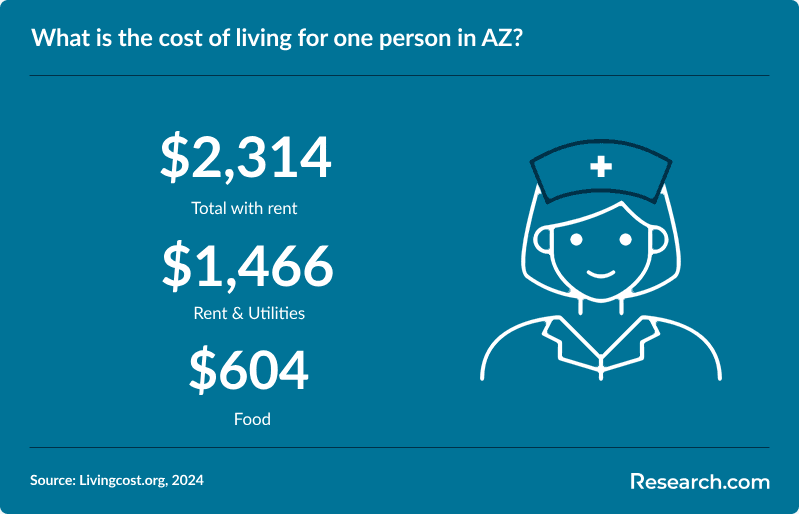
As shown in the graphic below, the cost of living in Arizona for a single person totals $2,314, which is approximately 6% higher than the national average. This figure includes $1,466 for rent and utilities and $604 for food. Arizona ranks as the 20th most expensive state and is considered the 8th best state to live in the U.S. The average salary after taxes in Arizona is $4,495, sufficient to cover living expenses for about 1.9 months. These statistics illustrate a balance between living costs and income, highlighting Arizona's appeal despite its higher expenses compared to other states.
Can you practice as a nurse without a license in Arizona?
No. You cannot legally practice as a nurse in Arizona without the proper license or compact privilege. Nursing is a regulated profession because patients rely on nurses for medication administration, assessment, documentation, clinical judgment, and safety-sensitive care. Practicing without authorization can put patients at risk and may create serious legal and professional consequences.
The state requires nurses to hold a valid credential that matches the work they perform. The World Health Organization has predicted a shortage of over 18 million healthcare professionals by 2030, but workforce need does not remove licensing requirements. Arizona still expects nurses to complete approved education, pass the required exam, and receive Board authorization before practicing.
Before you accept a nursing position, make sure you have completed the required steps:
- Graduate from an approved nursing program. Your education should match your intended license, whether LPN, RN, or APRN.
- Pass the required NCLEX exam. RN candidates take the NCLEX-RN, and practical nursing candidates take the NCLEX-PN.
- Apply through the Arizona State Board of Nursing. Submit proof of education, exam documentation, identity materials, fees, and background information as required.
- Wait for authorization. Do not assume graduation or an employer offer is enough to begin nursing practice.
- : "“I remember volunteering at a local clinic before I was licensed. It was exciting to help, but I also saw how clear the boundaries were. I could support the team, but I could not practice as a nurse. That experience made licensure feel less like paperwork and more like a patient-safety responsibility.”"
How does Arizona support nursing education and career advancement?
Arizona supports nursing career development through community college programs, BSN pathways, graduate nursing programs, online and hybrid study options, bridge programs, clinical partnerships, and employer-based advancement support. These pathways matter because the state’s nursing shortage cannot be addressed only by recruiting new students; it also requires helping current healthcare workers move into higher-scope roles.
Students can start with practical nursing, an ADN, or a BSN depending on their current education and career goals. Working nurses may use LPN-to-RN, RN-to-BSN, MSN, or DNP pathways to expand their responsibilities. Some Arizona institutions also offer online or hybrid coursework, which can help rural students and working adults stay enrolled while managing employment and family obligations.
Career advancement often depends on more than earning the next degree. Nurses should also look for employers that offer residency programs, tuition reimbursement, preceptor support, specialty training, clinical ladders, and leadership development. These supports can make the transition from student to practicing nurse safer and more sustainable.
For RNs considering advanced practice, comparing the best NP programs in Arizona can help identify programs aligned with specialty interests, clinical training needs, and graduate licensure goals.
What is the state of nursing in Arizona?
Arizona’s nursing workforce is under pressure. The state is projected to face the largest nursing shortage in the U.S. by 2025, with an estimated deficit of 28,100 registered nurses. Contributing factors include an aging workforce, burnout, growing healthcare demand, and educational capacity limits.
Major workforce challenges
- Demand exceeds supply in key areas: Hospitals, outpatient facilities, long-term care providers, rural clinics, and specialty services may compete for qualified nurses.
- Burnout affects retention: Staffing pressure can contribute to fatigue, turnover, and early retirement among experienced nurses.
- Education capacity is constrained: Nursing schools may face faculty shortages, limited clinical placements, and resource limits that prevent every qualified applicant from being admitted.
Efforts aimed at strengthening the nursing pipeline
- Nurse Education Investment Pilot Program: This initiative is intended to support nursing education through faculty hiring, facility expansion, and student services.
- Arizona Transition to Practice Program: This program helps new graduate nurses move into practice with additional mentorship and support.
- University of Arizona's Expansion: Enrollment growth and new program development are part of efforts to respond to workforce needs.
For students, the shortage creates opportunity, but it also raises an important question: will your program prepare you well enough to succeed in demanding clinical environments? Choose a school with strong student support, realistic clinical preparation, and transparent outcomes rather than relying only on broad job-demand headlines.
Nursing students who want to broaden their healthcare knowledge may also explore related fields such as nutrition, wellness, or patient education. Research.com’s guide to affordable online nutrition and dietetics degrees can help you compare adjacent healthcare education options.
What are the nurse practitioner education requirements in Arizona?
Nurse practitioners in Arizona need graduate-level nursing education, advanced clinical preparation, and specialty certification aligned with their population focus. NP education typically includes advanced assessment, pharmacology, pathophysiology, evidence-based practice, diagnosis, treatment planning, and supervised clinical experiences.
RNs who want to become NPs should first confirm whether they need an MSN, DNP, or post-graduate certificate for their intended specialty. They should also verify clinical placement expectations, certification exam eligibility, and Arizona Board requirements before enrolling. Research.com’s guide to nurse practitioner education requirements in Arizona explains the pathway in more detail.
What financial assistance options can support my nursing education in Arizona?
Nursing school can involve tuition, fees, books, uniforms, technology, transportation, exam costs, fingerprinting, and lost work time during clinical rotations. Financial planning should begin before admission because intensive nursing programs can make full-time employment difficult.
Funding options may include federal financial aid, scholarships, grants, employer tuition assistance, service-based aid, payment plans, and loan forgiveness programs tied to high-need areas. Students should compare total cost of attendance rather than tuition alone and ask whether financial aid applies to summer terms, clinical fees, online course fees, and repeated courses.
Career changers may also compare flexible programs designed for students without a nursing background. Research.com’s overview of online nursing programs for non nurses can help you understand how affordability and flexibility vary across pathways.
What alternative healthcare roles can support my nursing career in Arizona?
Not every healthcare career starts with nursing school. Some students first gain experience in support or administrative roles, then use that exposure to decide whether nursing is the right long-term path. Roles in patient care, health information, billing, coding, pharmacy support, emergency services, and allied health can build familiarity with healthcare workflows.
Medical billing and coding can be especially useful for understanding documentation, insurance processes, compliance, and the financial side of care delivery. While it is not a substitute for nursing licensure, it can strengthen healthcare literacy and provide an alternative route into the industry. To explore this option, see Research.com’s guide on how to become a medical biller and coder in Arizona.
How can LVNs progress to higher nursing roles in Arizona?
Arizona commonly uses the title LPN, while LVN is used in some other states. Licensed practical or vocational nurses who want more responsibility often pursue LPN-to-RN or LVN-to-RN bridge programs. These programs can help experienced practical nurses build on prior coursework and clinical experience while preparing for RN-level practice.
Before enrolling in a bridge program, verify admission requirements, prerequisites, clinical placement rules, transfer credit policies, NCLEX-RN preparation, and whether your practical nursing license must be active. A bridge program can save time, but only if your prior education is accepted and the program is approved for your licensure goal.
For a broader overview of vocational nursing pathways, review Research.com’s resource on how to become an LVN in Arizona.
How can professional nursing organizations enhance my career in Arizona?
Professional nursing organizations can help Arizona nurses stay connected, informed, and competitive. They may offer continuing education, conferences, mentoring, policy updates, specialty communities, leadership opportunities, job leads, and advocacy resources. These benefits are especially useful for new graduates, nurses changing specialties, and RNs preparing for graduate study.
Membership should be strategic. Join organizations that match your specialty, career stage, and goals rather than paying dues for groups you will not use. If your next step is further education, compare program quality and delivery format through resources such as Research.com’s guide to the best online nursing programs in Arizona.
What are the common pitfalls to avoid during the nursing licensure process in Arizona?
Many nursing licensure delays are avoidable. Applicants often run into problems because they assume the school handles everything, submit incomplete documents, misunderstand fingerprinting requirements, or accept employment before licensure is finalized.
| Common mistake | Why it can hurt you | Better approach |
| Choosing a program without checking approval or accreditation | You may complete coursework that does not support licensure or transfer as expected. | Verify approval, accreditation, and Board eligibility before enrolling. |
| Looking only at tuition | Fees, supplies, clinical travel, exam costs, and lost work hours can change the true cost. | Compare full cost of attendance and ask about every required expense. |
| Assuming online programs automatically qualify for Arizona licensure | Some programs may not meet state-specific clinical or approval expectations. | Confirm Arizona eligibility in writing before applying. |
| Waiting too long to prepare for fingerprinting | Background review can delay license approval. | Follow Board instructions early and keep copies of submissions. |
| Relying only on rankings | A highly visible school may not be the best fit for your schedule, clinical needs, or budget. | Use rankings as one input, then compare outcomes, support, cost, and clinical quality. |
| Assuming salary outcomes are guaranteed | Pay depends on role, employer, experience, location, shift, and specialty. | Use salary data as a planning tool, not a promise. |
For a more detailed licensing checklist, use Research.com’s guide to the requirements for nursing licensure in Arizona.
What factors should I consider when selecting a nursing program in Arizona?
The best nursing program is not always the most famous or the fastest. It is the program that prepares you for licensure, fits your life, supports your learning, and gives you access to meaningful clinical experience. Before applying, compare programs using objective criteria and ask direct questions.
| Factor | Questions to ask | Why it matters |
| Approval and accreditation | Is the program approved for Arizona licensure? Is it accredited by a recognized nursing accreditor? | Licensure eligibility, transfer options, and graduate school access may depend on it. |
| NCLEX preparation | How does the program prepare students for the NCLEX? What academic support is available? | Passing the NCLEX is required for RN or LPN licensure. |
| Clinical placements | Where do students complete clinical hours? Does the school arrange placements? | Strong clinical training builds confidence and employability. |
| Schedule and format | Are courses full-time, part-time, evening, hybrid, or online? | A program that conflicts with work or family obligations may be hard to finish. |
| Total cost | What are the full tuition, fees, supplies, exam, and transportation costs? | The cheapest advertised tuition may not be the cheapest total pathway. |
| Student support | Are tutoring, advising, simulation labs, mental health support, and career services available? | Nursing school is demanding, and support can affect persistence. |
| Career fit | Does the program support your target setting, such as hospital care, rural care, pediatrics, or advanced practice? | Clinical exposure and faculty expertise can shape your first job options. |
If you want a starting point for comparison, Research.com’s guide to the best nursing schools in Arizona can help you identify programs to evaluate more closely.
What is the job outlook for nursing in Arizona?
Arizona offers a strong nursing employment outlook, but the details depend on role, location, specialty, and education level. Registered nurses, nurse practitioners, nurse anesthetists, nurse midwives, LPNs, and nursing assistants do not all have the same salary range or job market.
The job outlook for nurses in Arizona is exceptionally bright, with the U.S. Bureau of Labor Statistics projecting a 9% growth in employment for registered nurses from 2020 to 2030. This growth is driven by an aging population and an increasing emphasis on healthcare services, particularly in rural areas where nursing shortages are more pronounced.
In terms of compensation, the average salary for registered nurses in Arizona is approximately $80,000 per year, which is competitive compared to national averages. However, earnings can differ across metropolitan areas and industries.
Top-Paying Metropolitan Areas
- Phoenix-Mesa-Scottsdale: Average salary around $82,000
- Tucson: Average salary approximately $76,000
- Flagstaff: Average salary nearing $78,000
Top-Paying Industries
- Specialty hospitals
- Outpatient care centers
- Home healthcare services
Advanced practice roles may offer higher pay. Nurse anesthetists and nurse practitioners typically command the highest salaries, often exceeding $120,000 annually. Licensed practical nurses tend to earn lower wages, averaging around $50,000 per year.
In more detail, the U.S. Bureau of Labor Statistics provides median annual wages for different types of nurses in 2022. Nurse anesthetists earn the highest median annual wage at $195,610, followed by nurse practitioners at $120,680 and nurse midwives at $112,830. Registered nurses have a median annual wage of $77,600, while licensed practical and licensed vocational nurses earn $48,070. In comparison, the median annual wage for all occupations is $45,760. These figures highlight the significant variation in earnings among different nursing roles and the relatively high compensation for advanced practice nurses compared to the overall workforce.
When evaluating the job market, look beyond statewide averages. Ask employers about new-graduate residency programs, shift differentials, specialty training, staffing ratios, tuition reimbursement, rural incentives, and advancement ladders. A lower starting wage with strong training may be more valuable than a higher wage in a role with limited support.
What online programs are available for aspiring nurses in Arizona?
Online nursing education can be useful for students who need flexibility, but nursing cannot be learned entirely through independent online study. Even online and hybrid programs require clinical training, labs, simulation, or in-person competencies. Before enrolling, confirm where and how clinical requirements are completed.
Arizona students may find online or hybrid options for RN-to-BSN programs, graduate nursing degrees, bridge programs, and selected practical or prelicensure coursework. However, prelicensure programs require extra scrutiny because state approval and clinical placements are essential. Students exploring practical nursing options can start by reviewing online LPN programs in Arizona.
| Program type | Online suitability | What to check |
| RN-to-BSN | Often well suited to online study because students are already licensed RNs. | Accreditation, transfer credit, employer tuition support, and practicum requirements. |
| MSN or DNP | Many programs offer online coursework with local clinical components. | Specialty certification eligibility, clinical placement support, and state authorization. |
| LPN-to-RN or ADN bridge | May include online theory courses, but clinical requirements remain in person. | Arizona approval, clinical sites, schedule intensity, and NCLEX-RN preparation. |
| Prelicensure RN or LPN | Requires the most caution because direct patient-care training is central. | Board approval, in-person skills labs, clinical placement arrangements, and exam eligibility. |
How Does Interdisciplinary Collaboration Enhance Healthcare Opportunities in Arizona?
Nurses rarely work alone. In Arizona hospitals, clinics, long-term care facilities, home health agencies, and community settings, nurses coordinate with physicians, pharmacists, therapists, social workers, case managers, dietitians, and administrative teams. Strong collaboration can improve communication, reduce care gaps, and help patients move through complex treatment plans more safely.
For nurses, interdisciplinary work can also reveal career options beyond bedside care. Exposure to pharmacy, population health, informatics, care coordination, and administration may help nurses choose specialties or graduate programs more intentionally. Professionals interested in another healthcare credential can explore how to become a pharmacist in Arizona to understand a related but distinct clinical pathway.
What is the fastest way to become a nurse in Arizona?
The fastest legitimate route depends on your starting point. If you are new to healthcare, a practical nursing program may get you into licensed nursing sooner than an RN pathway. If you already hold a practical nursing license, an LPN-to-RN bridge may be faster than starting a traditional ADN program from the beginning. If you already have a non-nursing bachelor’s degree, an accelerated BSN may reduce the time needed to qualify for RN licensure.
| Your starting point | Potential faster route | Trade-off |
| No college degree and no healthcare license | Practical nursing program or ADN pathway | Practical nursing may be quicker, but RN practice offers broader scope. |
| Current LPN or LVN | LPN-to-RN bridge program | Requires prerequisites, active licensure, and clinical availability. |
| Bachelor’s degree in another field | Accelerated BSN | Can be intense and may limit ability to work while enrolled. |
| Current RN with ADN | RN-to-BSN online or hybrid program | Does not create initial RN licensure, but can improve advancement options. |
Speed should not override quality or licensure eligibility. A short program is not a good value if it lacks approval, weakens NCLEX preparation, or leaves you without clinical readiness. For more route comparisons, review Research.com’s guide to the fastest way to become a nurse.
How can advanced practice roles, such as nurse midwifery, expand your career opportunities in Arizona?
Advanced practice nursing can move an RN into more specialized, autonomous, and leadership-oriented work. Nurse midwifery is one example. Nurse midwives focus on reproductive health, pregnancy, childbirth, postpartum care, and related patient education. This role can be especially meaningful for nurses who want long-term relationships with patients and a focused clinical specialty.
Advanced practice roles require careful planning. You must complete the right graduate program, meet clinical requirements, prepare for specialty certification, and satisfy Arizona practice rules. If this pathway interests you, review Research.com’s guide on how to become a nurse midwife in Arizona.
What do nurses say about becoming a nurse in Arizona?
Individual experiences can help you understand what the numbers do not show: the pace of the work, the diversity of patients, and the lifestyle trade-offs of nursing in Arizona. These accounts should not be treated as guaranteed outcomes, but they can offer useful perspective.
- “When I chose nursing, Arizona’s diverse patient population was one of the reasons I stayed. In Phoenix, I care for people with very different backgrounds, languages, and needs. That has made cultural awareness part of my everyday practice. The demand also matters; Arizona is projected to see a 20% increase in nursing jobs by 2028, which gives new nurses reasons to feel optimistic.” Liza
- “Nursing in Arizona lets me build a career while still enjoying the outdoors. My schedule has allowed me to spend time in the Sonoran Desert and hike near the Catalina Mountains. The work is demanding, but the support among nurses has helped me keep growing.” Cameron
- “My path into nursing changed my life. I started at a local community college, and the faculty support made a real difference. The nursing community felt close, and I found classmates who became lasting friends. Living near Flagstaff and the Grand Canyon made the experience even more memorable.” Leah
Related Articles for Nearby States
- 2027 How to Become a Nurse in New Mexico
- 2027 How to Become a Nurse in Nevada
- 2027 How to Become a Nurse in California
- 2027 How to Become a Nurse in Utah
- 2027 How to Become a Nurse in Colorado
- 2027 How to Become a Nurse in Texas
- 2027 How to Become a Nurse in Oklahoma
- 2027 How to Become a Nurse in Kansas
- 2027 How to Become a Nurse in Wyoming
- 2027 How to Become a Nurse in Idaho
Key Insights
- Arizona nursing licensure generally requires an approved education program, the correct NCLEX exam, a Board application, fees, fingerprinting, and background review.
- Do not enroll in a nursing program until you verify approval, accreditation, clinical placement support, and Arizona licensure eligibility.
- An ADN can be a direct route to RN practice, while a BSN may support broader hiring and advancement options. Bridge and accelerated programs can save time for qualified students.
- Compact nurses may practice in Arizona if they meet Nurse Licensure Compact rules, but they should confirm eligibility before accepting work.
- Practicing as a nurse without a valid license or compact privilege is not allowed in Arizona.
- Arizona’s nursing shortage creates opportunity, but students should still evaluate program quality, cost, NCLEX preparation, and clinical readiness carefully.
- Salary and job outlook figures are useful planning tools, not guarantees. Earnings vary by role, location, employer, specialty, experience, and shift.
- The smartest path is the one that matches your starting point, budget, schedule, and long-term goal while fully meeting Arizona Board requirements.
References:
- Alliant International University. (2024). Steps to become a registered nurse in Arizona. Alliant International University.
- LivingCost.org. (2024). Cost of living & prices in Arizona: 34 cities compared. LivingCost.org.
- Sciedu Press. (2022). Nursing education and workforce challenges in Arizona: A qualitative study. Journal of Nursing Education and Practice, 12(8).
- U.S. Bureau of Labor Statistics. (2023, December 27). Occupational outlook handbook - Registered nurses. U.S. Bureau of Labor Statistics.
Other Things You Should Know About Becoming a Nurse in Arizona
Arizona nursing applicants must complete a state and federal fingerprint-based background check through the Arizona Board of Nursing. The board reviews criminal history before issuing a license, and applicants may be asked for additional documentation if any record appears during the screening.
Non-native English speakers must demonstrate proficiency in English. Accepted tests include the TOEFL and IELTS. Minimum scores are 84 for TOEFL iBT and 6.5 for IELTS. Meeting these scores ensures effective communication in clinical settings in Arizona in 2027.


