2027 How to Become a Nurse in California

Co-Founder and Chief Data Scientist
Becoming a nurse in California is a strong career move for people who want stable healthcare work, meaningful patient contact, and access to one of the highest-paying nursing labor markets in the United States. The state employs more than 330,000 registered nurses, reports an average RN salary of $137,690 per year, and projects 12.9% job growth through 2032, with more than 23,000 openings expected each year. But California also has strict education, licensing, renewal, and scope-of-practice rules, so choosing the right path early matters. This guide explains how to become a nurse in California, how RN and LVN routes differ, what licenses and specialties are available, what out-of-state nurses need to know, and how to evaluate nursing school options before investing time and money.
Quick Answer: How Do You Become a Nurse in California?
To become a registered nurse in California, you must complete a California Board of Registered Nursing-approved or otherwise eligible nursing program, apply for licensure, complete fingerprinting and a background check, pass the NCLEX-RN, and maintain your license through renewal and continuing education. Most future RNs choose either an Associate Degree in Nursing (ADN), which usually takes 2 to 3 years, or a Bachelor of Science in Nursing (BSN), which typically takes 4 years. Licensed Vocational Nurses follow a shorter vocational nursing route and take the NCLEX-PN instead.
- California has strong demand for nurses: The state is projected to face a deficit of over 44,000 registered nurses by 2030, driven by healthcare demand, retirements, and an aging population.
- RN pay is high, but location matters: Registered nurses in California earn approximately $137,690 on average per year, though salaries vary by region, employer, specialty, schedule, and experience level.
- Job growth is favorable: Registered nursing employment in California is projected to grow 12.9% from 2020 to 2030, reflecting continued need across hospitals, clinics, long-term care, home health, and public health settings.
- Licensure is mandatory: Aspiring RNs must complete an accredited nursing program, pass the NCLEX-RN, satisfy background-check requirements, and receive approval from the California Board of Registered Nursing before practicing.
- There are multiple education pathways: Students can enter through community colleges, universities, accelerated programs for second-degree students, LVN-to-RN bridges, and graduate-level routes for advanced practice roles.
- What are the steps to becoming a nurse in California?
- What are the educational requirements for becoming a nurse in California?
- What types of nurses can legally practice in California?
- What are the licensing requirements for nurses in California?
- What types of nursing licenses are available in California?
- Can a Compact nurse practice in California?
- What are the top nursing specialties in California?
- Can you practice as a nurse without a license in California?
- Can nurses explore adjacent healthcare roles to diversify their careers in California?
- How can aesthetic and cosmetic nursing specialties boost career prospects in California?
- What are the nurse practitioner education requirements in California?
- How can advanced degree programs elevate nursing careers in California?
- Can expanding into medical billing and coding enhance my nursing career in California?
- What options are available for those interested in pursuing a career as a Licensed Vocational Nurse (LVN) in California?
- How is technology reshaping nursing practice in California?
- What are the ongoing renewal and compliance requirements for nursing licensure in California?
- What are the best nursing schools and educational programs available in California?
- Can specializing in nurse midwifery benefit nurses in California?
- How can LVNs advance their careers and enhance earning potential in California?
- What is the state of nursing in California?
- What is the job outlook for nursing in California?
What are the steps to becoming a nurse in California?
The path to nursing in California depends on whether you want to become an RN, LVN, or advanced practice nurse. For most first-time students pursuing registered nursing, the process starts with choosing an approved nursing program and ends with state licensure. Your decisions at the program-selection stage affect cost, timeline, clinical placement access, eligibility for the NCLEX, and future advancement options.
- Choose the nursing role you want. Decide whether your goal is to become a Registered Nurse, Licensed Vocational Nurse, Nurse Practitioner, Clinical Nurse Specialist, nurse midwife, or another advanced practice professional. RN and LVN routes have different timelines, exams, and scopes of practice.
- Complete the required education. Most RN candidates earn either a BSN or ADN. In California, 54% of nursing graduates from California institutions earned a BSN, while 39% completed an ADN program. These programs typically take 2 to 4 years and include classroom instruction, simulation, and supervised clinical experience.
- Apply for licensure through the correct state board. RN applicants work with the California Board of Registered Nursing. LVN applicants follow the state’s vocational nursing licensing process. Applications generally require education records, fees, fingerprinting, and background checks.
- Pass the required NCLEX exam. RN candidates take the NCLEX-RN. LVN candidates take the NCLEX-PN. Passing the exam does not, by itself, authorize practice until the state grants the license.
- Receive your California license before practicing. California does not allow people to perform nursing duties without an active license. Out-of-state nurses must also secure California authorization before working in the state.
- Maintain the license after approval. RNs renew every two years. The renewal fee is $190 for RNs and $150 for most advanced practice nurses. Public health and mental health nurses are exempt from renewal fees. The BreEZe portal is used for reminders, renewals, and tracking state requirements.
| Path | Typical time in school | Best for | Important trade-off |
| ADN to RN | 2 to 3 years | Students who want a faster, often lower-cost route to RN licensure | Some employers prefer or require a BSN for certain roles or advancement |
| BSN to RN | 4 years | Students seeking broader preparation, leadership options, and graduate-school readiness | Usually takes longer and may cost more upfront than an ADN |
| LVN | About one year | Students who want to enter bedside care sooner under RN or physician supervision | Scope of practice and advancement options are more limited than for RNs |
| LVN-to-RN or RN-to-BSN bridge | Varies by program | Licensed nurses who want to move into higher-level roles | Admission can be competitive and clinical placement requirements still matter |
| MSN, DNP, or PhD | Graduate-level study | RNs pursuing advanced practice, education, research, or leadership | Requires prior nursing preparation and careful review of certification requirements |
California’s nursing workforce is large: more than 332,000 RNs are employed statewide. The average annual RN salary is approximately $137,690, and projected job growth for RNs in the state is 11% from 2020 to 2030. Nurses considering advanced family practice roles should also understand how credentials differ; this comparison of FNP-BC and FNP-C certifications can help clarify certification choices.
What are the educational requirements for becoming a nurse in California?
California requires nursing candidates to complete an education pathway that matches the license they plan to pursue. The most common RN routes are the ADN and BSN, but the better choice depends on your budget, timeline, academic background, and career goals.
- Bachelor of Science in Nursing: A BSN is a four-year degree and was the most common credential among California nursing graduates from 2020 to 2022, representing 54% of graduates. BSN programs usually include nursing theory, health assessment, pharmacology, community health, leadership, research, and supervised clinical practice. Many hospitals and advanced practice programs value the broader preparation.
- Associate Degree in Nursing: An ADN usually takes two to three years and represented 39% of nursing graduates during the same period. ADN programs focus on core clinical nursing skills and prepare graduates to sit for the NCLEX-RN. This route can be attractive for students who want to enter the workforce sooner and later complete a BSN.
- Master of Science in Nursing: An MSN is designed for registered nurses moving into advanced practice, education, leadership, or specialized clinical roles such as nurse practitioner or clinical nurse specialist.
- Doctor of Nursing Practice or PhD in Nursing: A DNP is typically practice-focused, while a PhD is research-focused. These degrees support careers in advanced clinical leadership, academia, health systems, or nursing research.
The California Board of Registered Nursing approves approximately 140 pre-licensure programs and more than 50 advanced-practice programs. Students with prior college experience may also find accelerated, bridge, hybrid, or online options, though clinical requirements still require in-person practice. RNs who want a bachelor’s completion route can compare RN-to-BSN programs with no clinicals to see how completion programs differ from pre-licensure nursing degrees.
How to choose the right nursing education path
- Choose an ADN if cost and speed are your top priorities and you are comfortable completing a BSN later if needed.
- Choose a BSN if you want stronger preparation for hospital hiring, leadership, public health, military nursing, or graduate education.
- Choose an LVN program if you want a shorter route into practical nursing and may later bridge into RN education.
- Choose an MSN, DNP, or PhD if you already have RN preparation and want advanced practice, teaching, research, or executive leadership.
What types of nurses can legally practice in California?
California recognizes several nursing roles, each with a specific scope of practice, education requirement, and licensing process. The main distinction is the level of clinical judgment and independence the nurse is legally authorized to use.
| Nursing role | Typical preparation | Core responsibilities | Regulatory point to check |
| Registered Nurse | ADN or BSN plus NCLEX-RN | Assess patients, administer medications, coordinate care, educate patients, and implement care plans | RN licensure is overseen by the California Board of Registered Nursing |
| Licensed Vocational Nurse | State-approved vocational nursing program plus NCLEX-PN | Provide basic nursing care, monitor patients, assist with medications and daily care under supervision | LVNs must practice within vocational nursing scope and supervision rules |
| Nurse Practitioner | Graduate nursing degree plus national certification and state recognition | Diagnose, treat, prescribe when authorized, and manage patient care in primary or specialty settings | NPs must satisfy advanced practice and certification requirements |
| Clinical Nurse Specialist | Graduate nursing education and specialty preparation | Improve outcomes through expert consultation, evidence-based practice, education, and systems improvement | CNS practice requires advanced preparation and state recognition |
RNs are central to California’s healthcare system because they manage complex patient care across hospitals, clinics, community health settings, long-term care, schools, and home health. LVNs provide essential hands-on care but work under supervision and have a narrower legal scope. Advanced practice nurses, including NPs and CNSs, require graduate education and additional approval because they assume higher-level responsibilities.
In 2023, there were around 21,740 nurse practitioners (NPs) in the state. See the chart below for more information on the employment levels of select nursing occupations.
What are the licensing requirements for nurses in California?
California nursing licensure is not automatic after graduation. You must apply, document your education, complete fingerprinting and background checks, pay required fees, and pass the correct NCLEX exam. The process differs slightly for RN and LVN applicants, but the core purpose is the same: verifying that the applicant is prepared to practice safely.
- Approved education: RN applicants generally complete an ADN or BSN. LVN applicants usually complete a one-year vocational nursing program. ADN-prepared RNs who want a bachelor’s degree later can compare the best accelerated BSN programs if they want a faster route into BSN-level preparation.
- State application: Applicants submit proof of education, fingerprints, and required fees. As of 2023, the RN application fee is approximately $300, while the LVN application fee is around $150.
- Fingerprinting and background review: California requires applicants to submit fingerprints for review by the California Department of Justice and the Federal Bureau of Investigation.
- NCLEX exam: RN applicants must pass the NCLEX-RN. LVN applicants must pass the NCLEX-PN. The exam measures whether the applicant has the knowledge and judgment needed for safe entry-level practice.
- Disclosure and review of past issues: Prior convictions, license discipline, or other professional conduct concerns can trigger additional review. Applicants should answer questions accurately and follow board instructions carefully.
Licensure checklist before you apply
- Confirm that your nursing program meets California eligibility requirements.
- Request official transcripts early to avoid delays.
- Schedule fingerprinting according to state instructions.
- Budget for application, testing, transcript, and background-check costs.
- Do not accept a nursing role until your license or authorization is active.
What types of nursing licenses are available in California?
The two main entry-level nursing licenses in California are Registered Nurse and Licensed Vocational Nurse. They are both important, but they are not interchangeable. The RN license allows a broader and more independent scope of practice, while the LVN license supports practical nursing duties under supervision.
- Registered Nurse: RN candidates usually complete two to four years of college-level nursing education. Registered nurses can work in hospitals, ambulatory care, community health, schools, public health, long-term care, home health, and specialized clinical units. They assess patient conditions, create and carry out care plans, administer treatments, educate patients, and coordinate with physicians and interdisciplinary teams.
- Licensed Vocational Nurse: LVN candidates typically complete about one year of vocational nursing education. LVNs provide direct basic care, monitor patient status, assist with activities of daily living, and perform allowed medication and treatment tasks under supervision. This route can be a practical starting point for students who want to enter healthcare faster and later continue into RN education.
| License | Education length | Exam | Practice level | Best fit |
| RN | Two to four years | NCLEX-RN | Broader clinical judgment and care coordination | Students seeking hospital roles, specialty practice, leadership, or graduate nursing |
| LVN | About one year | NCLEX-PN | Basic nursing care under supervision | Students wanting a shorter entry path into direct patient care |
Students who are comparing nursing with other healthcare entry points may also review affordable medical assistant programs, but they should understand that medical assisting is not the same as licensed nursing and does not authorize RN or LVN practice.
The top-earning nurses in the state are specialist nurses, particularly nurse anesthetists with an average annual salary of $250,920 in 2023. See the chart below for more wage information.
Can a Compact nurse practice in California?
No. A nurse who holds a multistate license under the Nurse Licensure Compact cannot use that compact privilege to practice in California because California is not currently a member of the Nurse Licensure Compact. Nurses licensed in compact states must obtain California licensure before working as nurses in the state.
- A multistate compact license does not authorize nursing practice in California.
- Out-of-state nurses must apply through California’s process and satisfy state-specific licensure requirements.
- Applicants should prepare for education verification, background checks, fingerprinting, fees, and board review.
- The process can take longer than moving between compact states, so nurses should apply well before a planned relocation or job start date.
This rule matters for travel nurses, military spouses, telehealth nurses, and clinicians relocating from compact states. A California employer may be interested in your experience, but you still need the proper state license before performing nursing duties. Nurses planning long-term advancement may also consider an affordable RN-to-FNP degree online if their goal is to move into advanced practice after meeting RN and graduate-level requirements.
What are the top nursing specialties in California?
The best nursing specialty in California depends on your interests, tolerance for stress, preferred patient population, education level, and income goals. Some specialties require only RN experience and certification, while others require graduate education and advanced practice recognition.
- Nurse Practitioners: NPs often work in primary care, specialty clinics, community health, and underserved areas. Because the role requires graduate education and certification, students should compare program quality carefully. Reviewing the best NP programs in California can help prospective NPs evaluate options.
- Nurse Anesthetists: Nurse anesthesia is one of the highest-paying nursing paths in the state, with salaries often exceeding $200,000 annually. These nurses provide anesthesia-related care in hospitals, surgical centers, and procedural settings.
- Pediatric Nurses: Pediatric nurses care for infants, children, and adolescents in children’s hospitals, specialty clinics, primary care, and acute care units. The role suits nurses who communicate well with families and enjoy developmental care.
- Geriatric Nurses: California’s aging population creates demand in skilled nursing, home health, hospice, rehabilitation, and long-term care. Geriatric nurses need strong assessment skills and patience with complex chronic conditions.
- Emergency Room Nurses: ER nurses manage urgent and unpredictable cases. This specialty is a fit for nurses who work well under pressure, make rapid decisions, and communicate clearly during crises.
Questions to ask before choosing a nursing specialty
- Do I want predictable routines or high-acuity, fast-changing work?
- Am I willing to complete graduate school or specialty certification?
- Which patient populations do I work with best?
- Does this specialty have opportunities in the region of California where I want to live?
- Will the schedule, on-call expectations, and emotional demands fit my life?
Can you practice as a nurse without a license in California?
No. California prohibits nursing practice without a valid license or proper authorization. The rule protects patients by ensuring that people using the title or functions of a nurse have completed the required education, testing, background review, and state approval. Practicing without a license can lead to serious consequences, including fines, employment termination, and possible criminal charges.
To practice legally as an RN in California, a candidate must complete these steps:
- Graduate from an eligible nursing program: Most RN candidates complete an ADN or BSN. ADN-prepared nurses who plan to finish a bachelor’s degree later can compare accessible online RN-to-BSN programs designed for working nurses.
- Pass the licensing exam: RN candidates must pass the NCLEX-RN.
- Apply to the state board: Applicants submit required documentation, education proof, fees, and examination records to the California Board of Registered Nursing.
- Complete a background check: California reviews criminal history and other eligibility factors before granting licensure.
The stakes are high because nursing directly affects patient safety, medication administration, care coordination, and clinical decision-making. The United States spent $196.8 billion on nursing home care in 2020, underscoring how heavily healthcare systems rely on properly trained and licensed professionals.
- : "“Waiting for my NCLEX results was stressful because I knew how much my education and future depended on that license. Practicing without one was never an option. I wanted to know I had met the standard before taking responsibility for patients. When I finally saw that I passed, I felt relief, pride, and a real sense of responsibility.”"
Can nurses explore adjacent healthcare roles to diversify their careers in California?
Yes. California nurses can use their clinical background to move into related healthcare roles, especially if they want less bedside work, broader administrative responsibility, or a different type of patient interaction. Adjacent paths may include pharmaceutical services, care coordination, patient education, healthcare management, informatics, public health, medical sales, utilization review, or revenue cycle operations.
A move into pharmacy-related work, for example, may appeal to nurses who enjoy medication education and patient counseling. Nurses exploring that route can review this guide on how to become a pharmacist in California to understand prerequisites, education expectations, and licensing steps. The key is to verify whether the new role requires a separate degree or license rather than assuming nursing experience alone is enough.
How can aesthetic and cosmetic nursing specialties boost career prospects in California?
Aesthetic and cosmetic nursing can expand career options for California nurses who are interested in dermatology, injectables, laser procedures, plastic surgery support, med-spa services, and patient consultation. This field blends clinical judgment with customer-facing care, so nurses need strong assessment skills, patient education ability, and careful attention to safety protocols.
Compensation and opportunity can vary widely by employer, location, experience, and procedure mix. Nurses considering this niche should review scope-of-practice rules, supervision requirements, training quality, malpractice coverage, and employer reputation before investing in certification. For salary context, see this overview of how much aesthetic nurses make.
What are the nurse practitioner education requirements in California?
Nurse practitioners in California need advanced nursing preparation beyond RN licensure. The usual pathway is to earn a BSN, hold an RN license, complete an accredited master’s or doctoral nurse practitioner program, finish required clinical experiences, obtain national certification in a population focus, and satisfy California advanced practice requirements.
Prospective NPs should pay close attention to clinical placement support, population focus, certification pass preparation, and whether the program aligns with California practice expectations. A more detailed breakdown is available in this guide to nurse practitioner education requirements in California.
How can advanced degree programs elevate nursing careers in California?
Advanced nursing degrees can help California RNs move into roles with greater responsibility, including advanced clinical practice, education, executive leadership, quality improvement, informatics, public health, and policy. They can also strengthen a nurse’s ability to interpret evidence, lead teams, improve systems, and manage complex patient populations.
Before enrolling, nurses should compare cost, clinical requirements, accreditation, faculty expertise, schedule flexibility, and whether the degree is truly required for the role they want. For nurses interested in doctoral-level practice preparation, online DNP programs may offer a flexible format, but students should still confirm clinical and residency expectations.
Can expanding into medical billing and coding enhance my nursing career in California?
Medical billing and coding knowledge can be valuable for nurses who want to understand documentation, reimbursement, compliance, utilization review, case management, healthcare finance, or administrative leadership. It is not a replacement for nursing licensure, but it can complement nursing experience and create options outside traditional bedside roles.
This path may make sense for nurses who enjoy detail-oriented work, electronic health records, chart review, payer rules, and workflow improvement. Nurses interested in the administrative side of care can review how to become a medical biller and coder in California for education and career steps.
What options are available for those interested in pursuing a career as a Licensed Vocational Nurse (LVN) in California?
Future LVNs in California must complete an approved vocational nursing program and pass the NCLEX-PN. LVNs provide basic nursing care under the supervision of registered nurses and physicians, making this a practical option for students who want a shorter route into healthcare than an RN degree.
Program format matters. Some LVN programs offer hybrid or online coursework, but clinical training must prepare students for hands-on care. Prospective students should verify approval status, clinical placement arrangements, NCLEX-PN preparation, total program cost, and graduate outcomes. Students seeking flexible options can compare online LPN programs in California, keeping in mind that California uses the LVN title rather than LPN.
How is technology reshaping nursing practice in California?
Technology is changing how California nurses document care, monitor patients, communicate with teams, and deliver services across distance. Telehealth, electronic health records, remote patient monitoring, clinical decision support, medication safety systems, and data dashboards are now part of many nursing workflows.
This trend does not reduce the need for clinical judgment. Instead, it raises expectations for digital literacy, accurate documentation, privacy awareness, and the ability to interpret patient data. Students who want flexible nursing education can review the best online nursing programs in California, but they should confirm that any program includes compliant clinical training and prepares them for technology-enabled practice.
What are the ongoing renewal and compliance requirements for nursing licensure in California?
California nurses must keep their licenses active by meeting renewal requirements, paying applicable fees, completing required continuing education, and updating information as required by the state. Missing renewal deadlines can interrupt employment, so nurses should track requirements well before the expiration date.
Compliance also includes practicing within scope, maintaining accurate records, reporting required changes, and staying informed about board updates. Because requirements can change, nurses should regularly review the state’s current requirements for nursing licensure in California rather than relying only on employer reminders or outdated school materials.
What are the best nursing schools and educational programs available in California?
The best nursing school for you is not always the highest-ranked or most familiar name. A strong program should be properly approved or accredited, prepare students for licensure, provide reliable clinical placements, fit your schedule, and offer a total cost you can realistically manage.
| Factor to compare | Why it matters | Question to ask |
| Approval and accreditation | Determines licensure eligibility and transfer value | Is the program approved for California nursing licensure? |
| Clinical placements | Nursing cannot be learned fully online | Does the school arrange placements, or must students find their own? |
| NCLEX preparation | Passing the exam is required for licensure | How does the program support students who are preparing for the NCLEX? |
| Total cost | Fees, supplies, commuting, and lost work time can add up | What is the full estimated cost beyond tuition? |
| Schedule format | Working adults may need evening, weekend, hybrid, or part-time options | Can I complete required courses and clinicals with my current obligations? |
| Progression policies | Strict grade or repeat rules can affect completion | What happens if I fail or withdraw from a nursing course? |
Students comparing schools can use the best nursing schools in California as a starting point, but rankings should not replace checking licensure eligibility, clinical access, affordability, and personal fit.
Can specializing in nurse midwifery benefit nurses in California?
Nurse midwifery can be a strong specialization for nurses interested in pregnancy, childbirth, reproductive health, preventive care, and family-centered practice. It is an advanced role that requires focused graduate education, clinical training, certification, and compliance with California practice rules.
This path may appeal to RNs who want deeper involvement in maternal health and continuity of care. It is not a quick specialty switch, so nurses should evaluate program prerequisites, clinical opportunities, certification expectations, and local demand before enrolling. For a step-by-step overview, see how to become a nurse midwife in California.
How can LVNs advance their careers and enhance earning potential in California?
LVNs can strengthen their careers by building specialty experience, earning relevant certifications, moving into leadership within vocational nursing roles, or bridging to RN education. The most significant advancement path is often LVN-to-RN because registered nurses have a broader scope of practice and more opportunities in hospitals, specialty care, and graduate education.
LVNs should compare bridge programs carefully, especially admission prerequisites, waitlists, clinical schedules, cost, and transfer-credit policies. Continuing education in geriatrics, ambulatory care, rehabilitation, wound care, or long-term care can also improve flexibility. For a dedicated pathway, review how to become an LVN in California.
What is the state of nursing in California?
California’s nursing market offers high pay, broad career variety, and strong long-term demand, but it also comes with challenges. The state’s high cost of living, regional workforce shortages, competitive program admissions, and strict licensing rules mean that students should plan carefully before choosing a school or relocating for work.
Recent data indicate that more than 400,000 registered nurses are actively working across healthcare settings in California. Even with this large workforce, shortages remain in rural and underserved communities. Demand is shaped by an aging population, chronic disease management, preventive care, retirements, and the expansion of healthcare delivery beyond hospitals.
Cost of living is one of the biggest decision factors. Nurses in California often earn more than nurses in many other states, with an average salary for registered nurses around $120,000 annually in one cited estimate, but housing, transportation, taxes, and childcare can reduce the practical value of that income. Pay also differs by region, specialty, shift, union environment, and experience level.
Nurses in California work across several major employment settings:
- Hospitals: Acute care facilities employ large numbers of RNs in medical-surgical, emergency, intensive care, perioperative, labor and delivery, and specialty units.
- Long-term care and rehabilitation: Skilled nursing facilities, rehabilitation centers, and nursing homes need nurses for complex chronic care and recovery support.
- Home health: As more patients receive care at home, nurses are needed for monitoring, education, medication support, and care coordination.
- Public health: Public health nurses support prevention, immunization, community education, disease response, and care access initiatives.
- Education: Schools, colleges, and universities employ nurses in student health, nursing instruction, simulation labs, and clinical education support.
The California Board of Registered Nursing regulates RN education and practice standards. Nurses who want to add healthcare credentials without committing immediately to another degree may also compare quick medical certifications that can support career development, though these credentials do not replace nursing licensure.
California remains attractive because of its diverse patient population, advanced medical systems, specialty-care opportunities, and strong demand. Students who want to shorten their path should still be cautious: even the fastest online RN programs must meet clinical and licensure requirements to be useful for nursing practice.
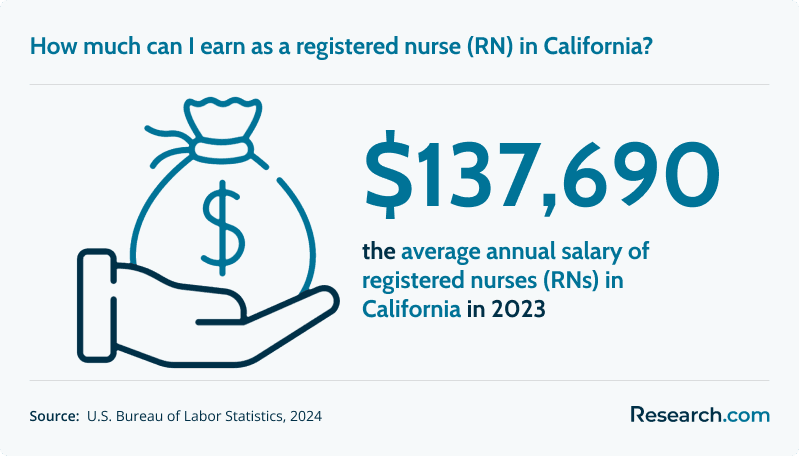
In 2023, registered nurses in California earn around $137,690 on average per year, significantly higher than the average annual salary of all occupations in the state at $76,960.
What is the job outlook for nursing in California?
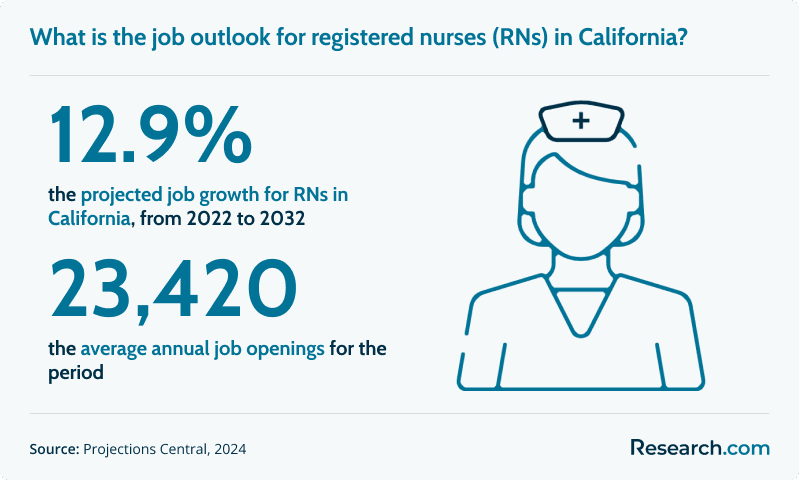
The job outlook for nursing in California is strong. According to Projections Central, registered nurse employment is projected to grow by approximately 12.9% from 2022 to 2032, which is faster than the average for all occupations. The same period is expected to produce around 23,420 job openings each year. Demand is linked to population aging, preventive care, expanded healthcare access, chronic disease needs, and ongoing workforce turnover.
What are the benefits of joining professional nursing organizations in California?
Professional nursing organizations can help California nurses stay informed, build networks, and advocate for better practice conditions. Membership is not required for licensure, but it can be useful for students, new graduates, and experienced nurses who want to grow beyond their current workplace.
- Networking: Organizations connect nurses with peers, mentors, educators, recruiters, and specialty leaders.
- Continuing education: Many groups offer conferences, webinars, workshops, and practice updates that support license renewal and professional growth.
- Advocacy: Members can follow and participate in policy discussions affecting staffing, scope of practice, patient safety, and healthcare access.
- Professional visibility: Active membership can signal commitment to the profession and may help nurses find leadership, committee, or speaking opportunities.
What do nurses say about becoming a nurse in California?
- California gave me room to explore different specialties before choosing the patient population I liked most. The pay helped me continue my education, but I also had to learn how much location and living costs affect financial planning. Fatima
- Continuing education pushed me to keep improving instead of relying only on what I learned in school. After earning a critical care certification, I became more confident and had access to roles I had not seriously considered before. David
- As an LVN, I found steady demand and a wide range of patients. Working in California strengthened my cultural competence and showed me how important licensed practical care is in the broader healthcare system. Aisha
Common mistakes to avoid when becoming a nurse in California
| Mistake | Why it can hurt you | Better approach |
| Choosing a program without checking approval or accreditation | You may risk licensure delays or ineligibility | Verify program status before applying or paying deposits |
| Looking only at tuition | Books, uniforms, exams, fees, transportation, and lost work hours can raise total cost | Ask for a full cost estimate and compare financial aid options |
| Assuming online means fully remote | Pre-licensure nursing requires in-person clinical training | Confirm where and how clinical placements are completed |
| Ignoring NCLEX preparation | Graduation alone does not make you licensed | Ask how the program supports exam readiness and remediation |
| Relying only on rankings | A highly ranked school may not fit your budget, schedule, or location | Use rankings as one factor, not the entire decision |
| Assuming salary outcomes are guaranteed | Pay varies by region, employer, specialty, shift, and experience | Research local job postings and talk to nurses in your target setting |
Key Insights
- California offers one of the strongest nursing markets in the country, but the path is highly regulated and requires approved education, testing, background checks, and active licensure.
- The ADN is often the faster RN route, while the BSN can provide broader preparation for hospital roles, leadership, and graduate study.
- LVN programs can help students enter patient care sooner, but LVNs have a narrower scope and may need bridge education to become RNs.
- California is not part of the Nurse Licensure Compact, so compact-state nurses must obtain California licensure before practicing there.
- Specialties such as nurse practitioner, nurse anesthesia, pediatrics, geriatrics, emergency nursing, aesthetics, and nurse midwifery can expand career options, but some require graduate education or certification.
- Program choice should be based on approval status, clinical placement quality, NCLEX preparation, total cost, schedule fit, and long-term career goals—not rankings alone.
- High average salaries are meaningful, but California’s cost of living makes local salary research and ROI planning essential before enrolling or relocating.
Related Articles for Nearby States
- 2027 How to Become a Nurse in Nevada
- 2027 How to Become a Nurse in Oregon
- 2027 How to Become a Nurse in Arizona
- 2027 How to Become a Nurse in Idaho
- 2027 How to Become a Nurse in Utah
- 2027 How to Become a Nurse in Washington
- 2027 How to Become a Nurse in New Mexico
- 2027 How to Become a Nurse in Colorado
- 2027 How to Become a Nurse in Montana
- 2027 How to Become a Nurse in Wyoming
References:
- nursejournal.org (14 Jun 2024). Become a Nurse in California: Requirements, Licensing, and Employment Outlook. nursejournal.org
- rn.ca.gov (10 Mar 2022). Welcome to the Board of Registered Nursing. rn.ca.gov
- nursecompact.com (n.d.). See additional implementation status information. nursecompact.com
- Grabowski, D., Chen, A., & Saliba, D. (2023). Paying for Nursing Home Quality: An Elusive But Important Goal. Journal of the American Geriatrics Society, 71, 342 - 348.
Other Things You Need to Know About Nursing in California
The California Board of Registered Nursing, or BRN, issues licenses for registered nurses and approves nursing education programs. Applicants must submit a licensure application, fingerprints for a background check, and pass the NCLEX-RN before the BRN grants an RN license.
To become a registered nurse in California in 2027, you typically need to complete an accredited nursing program, which can take 2-4 years, and pass the NCLEX-RN. An associate degree usually takes about 2-3 years, while a bachelor's degree takes around 4 years.
To enroll in nursing programs in California, prerequisites include courses in anatomy, physiology, microbiology, and chemistry. Students typically need to complete these courses with a minimum grade of C before starting a nursing program in 2027.