
2027 Can You Get Into a Speech Pathology Degree Master's Program with a Low GPA? Admission Chances & Workarounds

Co-Founder and Chief Data Scientist

Reviewed by Rhea Paul, PhD
SLP Education & Research Expert
A 2.7 undergraduate GPA makes admission to a speech pathology master's program difficult, but it does not make it impossible. The key question is whether you can show graduate programs that your transcript does not reflect your current ability to handle rigorous coursework, clinical training, client documentation, and supervised practice.
Speech-language pathology programs are selective because they prepare students for a profession that requires strong academic judgment, ethical decision-making, and precise clinical skills. With admission rates averaging around 33% nationally for these programs, applicants below the usual GPA range need a focused strategy rather than a generic application.
This guide explains how programs typically view a low GPA, what minimums matter, which factors can help offset weaker grades, and when options such as additional coursework, post-baccalaureate study, conditional admission, online programs, certifications, GRE scores, and work experience may improve your chances.
Key Things to Know About Getting Into a Speech Pathology Master's Program with a Low GPA
- Admissions committees assess applicants holistically, valuing strong letters of recommendation, relevant experience, and personal statements alongside GPA to gauge potential success.
- Completing prerequisite courses with high grades or pursuing a post-baccalaureate program can demonstrate academic improvement and commitment to the field.
- Gaining volunteer or work experience in speech pathology settings enhances practical skills and compensates for a low GPA by showing dedication and understanding of the profession.
What Is the Minimum GPA for Speech Pathology Master's Programs?
The most commonly cited minimum GPA for U.S. speech pathology master's programs is around 3.0 on a 4.0 scale. A stated minimum, however, is not the same as a competitive GPA. Many programs receive applications from students with GPAs well above the cutoff, often around 3.5 or higher, so meeting the minimum may only make an applicant eligible for review.
For applicants with a GPA below 3.0, the first step is to separate programs into three groups: programs that strictly screen by GPA, programs that allow exceptions, and programs that offer conditional or provisional pathways. A 2.7 GPA may be a firm barrier at some schools but only one concern among several at others.
When reviewing requirements, pay close attention to how each program calculates GPA. Some schools look at cumulative undergraduate GPA, while others may give more weight to the last 60 credits, major coursework, prerequisite grades, or post-baccalaureate performance. If your recent grades are stronger than your earlier record, programs that emphasize grade trends may be more realistic targets.
- If your GPA is below the stated minimum: Contact the program before applying and ask whether exceptions are ever considered.
- If your GPA is near 3.0: Strengthen the rest of the application with recent A-level coursework, clinical exposure, and strong recommendations.
- If your GPA is well below the class average: Consider post-baccalaureate coursework or prerequisite retakes before submitting applications.
Do not compare speech pathology admissions standards with unrelated program lists such as AI degrees online. Speech pathology programs usually evaluate applicants through the lens of clinical readiness, communication skills, prerequisite preparation, and eventual licensure alignment.
How Do Graduate Schools Evaluate a Low Undergraduate GPA?
Graduate schools use GPA as an early signal of academic readiness, but many speech pathology programs also review the context behind the number. A low GPA is most damaging when it appears recent, unexplained, and connected to prerequisite or major courses. It is less damaging when the applicant can show improvement, maturity, and strong preparation for graduate-level work.
Admissions committees often look for evidence that answers one question: if admitted, can this student succeed in intensive coursework and clinical training without needing excessive remediation?
- Academic performance trends: An upward grade pattern can show that earlier difficulties have been addressed. Strong grades in the final years of college or in recent post-baccalaureate classes can be especially helpful.
- Prerequisite performance: Grades in communication sciences, anatomy, linguistics, psychology, statistics, and related courses may matter more than unrelated electives.
- Professional experience: Work, observation, or volunteer experience in speech-language pathology, education, healthcare, disability services, or related settings can show commitment and realistic career understanding.
- Letters of recommendation: Strong letters should do more than praise personality. The best recommendations describe your academic discipline, clinical potential, communication skills, reliability, and growth.
- Standardized test scores: If a program considers the GRE, a strong score can support your case, although it usually cannot erase a weak academic record by itself.
- Personal statement: A persuasive statement explains the GPA briefly, accepts responsibility, and shows what has changed. It should not make excuses or over-focus on hardship.
A common mistake is applying broadly without adjusting the application for the GPA concern. Low-GPA applicants need each part of the application to reinforce the same message: the transcript shows past performance, but recent evidence shows readiness now. Resources about the easiest degree to get online may be useful for general academic planning, but they should not be treated as a shortcut into speech pathology graduate training.
Can Work Experience Compensate for a Low GPA in Speech Pathology Graduate Programs?
Relevant work experience can help compensate for a low GPA, especially when it shows sustained commitment to communication disorders, healthcare, education, or client-centered service. It is not a full substitute for academic readiness, but it can make an applicant more credible and memorable in a holistic review process. Research indicates that about 30% of candidates whose GPAs fell below usual thresholds were accepted because of significant relevant work history.
The strongest experience is not just any job. Admissions committees are more likely to value roles that involve observation, documentation, collaboration, communication support, or direct service with populations that speech-language pathologists commonly serve.
- Practical skills: Direct client or student interaction can show patience, professionalism, and the ability to apply communication strategies in real settings.
- Professional maturity: Consistent work history can demonstrate reliability, accountability, and readiness for supervised clinical training.
- Clinical exposure: Experience as a speech therapy aide, classroom aide, rehabilitation assistant, behavioral technician, caregiver, or healthcare support worker may help you discuss the field with specificity.
- Stronger recommendations: Supervisors who have seen your work with clients can provide concrete examples of empathy, problem-solving, cultural awareness, and communication skills.
- Clear motivation: A record of service in the field helps show that you understand the demands of the profession and are not applying casually.
To make experience count, describe outcomes and responsibilities clearly. Instead of simply saying you worked with children or patients, explain what you observed, how you collaborated with professionals, what communication barriers you encountered, and how the experience shaped your goals.
One recent graduate who entered the field after academic struggles described several years of work as a speech therapy aide as the turning point in his application. “I worried my GPA would close doors, but the experience gave me confidence and stories to share in my application,” he explained. His personal statement focused on real client challenges, lessons learned under supervision, and evidence that he had become a stronger student and future clinician. He credited supervisor recommendations and interview examples as important factors in changing how programs viewed his lower GPA.
Certifications can strengthen a low-GPA application when they are relevant, credible, and connected to speech pathology preparation. They show initiative and may help demonstrate that an applicant is actively building skills beyond the undergraduate transcript. Applicants holding relevant professional credentials may experience up to a 15-20% higher likelihood of passing the initial screening phase than those without such qualifications.
Certifications are most useful when they support a clear admissions narrative. For example, training related to child development, disability support, healthcare documentation, behavioral support, language development, or working with specific populations may help show readiness for clinical environments. Generic certificates with little connection to speech-language pathology are less persuasive.
- Use certifications as supporting evidence: They can show commitment, but they rarely replace the need for strong prerequisite grades.
- Choose quality over quantity: A few relevant credentials with practical application are better than a long list of unrelated online certificates.
- Connect them to your goals: In your application, explain how the certification changed your skills, not just that you completed it.
- Pair them with experience: Certifications carry more weight when you have used the training in a workplace, volunteer role, or observation setting.
Certifications should complement recent coursework, recommendations, and a focused personal statement. They are best viewed as proof of professional seriousness, not as a way to bypass academic standards. Similarly, broad resources on online business degree programs accredited institutions may help readers understand online learning formats, but speech pathology applicants should prioritize credentials that directly support clinical and graduate preparation.
Yes. Additional undergraduate coursework is one of the most practical ways to improve a low-GPA speech pathology application because it gives admissions committees recent evidence of academic ability. Research shows that about 60% of students who complete post-baccalaureate or extra coursework improve their GPAs by at least 0.3 points, which can be important for applicants close to a minimum requirement.
The goal is not simply to collect more credits. The goal is to prove that you can now earn strong grades in courses that resemble the academic demands of graduate study. For a low-GPA applicant, a recent transcript with A-level work in relevant subjects can be more persuasive than a general explanation of past academic difficulty.
- Retake weak prerequisite courses: If you earned low grades in key prerequisites, retaking them may directly address the biggest concern in your application.
- Check grade replacement rules: Some institutions apply grade replacement policies, meaning only the most recent grade for a retaken course counts. Others average both attempts.
- Prioritize upper-level coursework: Strong performance in advanced courses can better demonstrate graduate readiness than easy introductory classes.
- Choose relevant subjects: Courses in anatomy, linguistics, psychology, statistics, communication sciences, child development, and related areas may carry more admissions value.
- Build a recent academic record: Good grades earned after graduation can show that your current study habits and maturity differ from your earlier undergraduate performance.
Before enrolling, ask target programs which courses they recommend and whether non-degree, community college, online, or post-baccalaureate credits will be accepted. Applicants comparing broader graduate options may also review resources such as an online PhD in leadership, but speech pathology applicants should use extra coursework to meet specific admissions and prerequisite expectations.
Conditional admission is a provisional acceptance pathway for applicants who do not fully meet standard admissions requirements but appear capable of succeeding if they meet specific academic conditions. Around 30% of speech pathology graduate programs offer some version of provisional enrollment.
For low-GPA applicants, conditional admission can be valuable because it allows the program to take a measured risk while protecting academic standards. The student receives an opportunity to prove readiness, but continued enrollment depends on performance.
- Academic performance requirements: Students may need to earn a minimum GPA during the first term or first year to remain enrolled.
- Course completion conditions: A program may require foundational, prerequisite, or remedial coursework before full graduate standing is granted.
- Time limits: Conditions usually must be met within a defined period, such as one semester or a full academic year.
- Progress evaluation: Faculty may review grades, professionalism, clinical readiness, and advising reports before removing provisional status.
Applicants should read conditional admission terms carefully. Ask whether conditional students are eligible for financial aid, assistantships, clinical placements, and full progression through the program. Also ask what happens if the required GPA is not met. Conditional admission is an opportunity, but it is not a guarantee of completion.
Online speech pathology master's programs may appear more accessible, but they are not automatically easier to enter with a low GPA. Admissions standards depend on accreditation, clinical placement requirements, faculty capacity, applicant volume, and each school's review process. Acceptance rates for online health science programs, including speech pathology, average around 30%, while traditional on-campus programs have acceptance rates closer to 20%.
A higher average acceptance rate does not mean low-GPA applicants can rely on the online format alone. Accredited programs still need students who can complete demanding coursework and supervised clinical requirements. In some cases, online programs attract larger applicant pools because they appeal to working adults, career changers, and students who cannot relocate.
- Admission standards: Online programs may still require strong grades, prerequisite completion, recommendations, and evidence of academic readiness.
- Program selectivity: Competitive programs remain competitive regardless of delivery format.
- Applicant pool size: Online options may draw applicants from a wider geographic area, which can increase competition.
- Clinical requirements: Students must usually complete in-person clinical experiences, so placement support and local requirements matter.
- Experience value: Relevant work or volunteer experience can help a low-GPA applicant stand out in both online and campus-based admissions.
If flexibility and cost are central to your search, compare accredited options carefully and review resources on online masters in speech pathology while confirming that any program you consider supports your state, clinical placement needs, and long-term licensure goals.
One professional who entered an online speech pathology master's program with a low GPA said the process required persistence rather than shortcuts. She strengthened her application through additional certifications, targeted recommendations, and a personal statement focused on growth. “It wasn't easy, but persistence and focusing on my strengths beyond grades made a difference,” she said. Her experience reflects the main lesson for low-GPA applicants: online delivery may expand options, but the application still needs credible evidence of readiness.
A high GRE score can help a low-GPA applicant, but it usually cannot fully offset weak academic performance. The GRE is most useful when it supports a broader case for readiness: improved grades, strong prerequisites, relevant experience, and credible recommendations. Recent data shows that the average GRE score for admitted speech pathology master's students ranges from 306 to 310.
The GRE also matters only if the program requires, accepts, or considers it. Some programs place significant weight on scores, while others may be test-optional or less focused on standardized testing. Applicants should verify each program's policy before investing time and money in test preparation.
- Quantitative scores: Strong quantitative performance can support readiness for statistics, research methods, and evidence-based practice coursework.
- Verbal scores: High verbal reasoning scores may reinforce language comprehension, reading ability, and communication strengths relevant to the field.
- Analytical writing: A strong writing score can show that you can organize ideas, evaluate arguments, and communicate clearly in academic contexts.
- Balanced performance: A consistently strong score profile may reduce concerns about uneven academic preparation.
For low-GPA applicants, the GRE should be treated as one piece of evidence, not the main strategy. A strong score may help you get a closer review, but recent academic success in relevant coursework is usually more persuasive.
A post-baccalaureate program allows students who already hold a bachelor's degree to complete additional undergraduate-level coursework before applying to graduate school. For low-GPA speech pathology applicants, this route can serve two purposes: raising or strengthening the academic record and completing missing prerequisites.
Post-baccalaureate study is especially useful for career changers, applicants who did not major in communication sciences and disorders, and students whose early undergraduate grades no longer reflect their current abilities.
- Academic enhancement: Students can retake weak courses or complete more rigorous classes to show improved performance.
- Prerequisite completion: Many programs help students complete required background courses before applying to a speech pathology master's program.
- Research opportunities: Some options include faculty projects, labs, or applied academic experiences that can strengthen applications.
- Graduate preparation: Students may receive advising, study support, GRE preparation, or guidance on personal statements and applications.
Post-baccalaureate coursework is not always necessary. If your GPA is only slightly below a cutoff and your recent grades are strong, targeted prerequisite retakes may be enough. If your GPA is substantially below expectations or your academic background is unrelated, a structured post-baccalaureate path may provide a clearer record of readiness.
Applicants considering adjacent counseling or therapy fields may also compare options such as marriage and family therapy online programs, but speech pathology candidates should make sure any post-baccalaureate plan aligns with the prerequisites of their target master's programs.
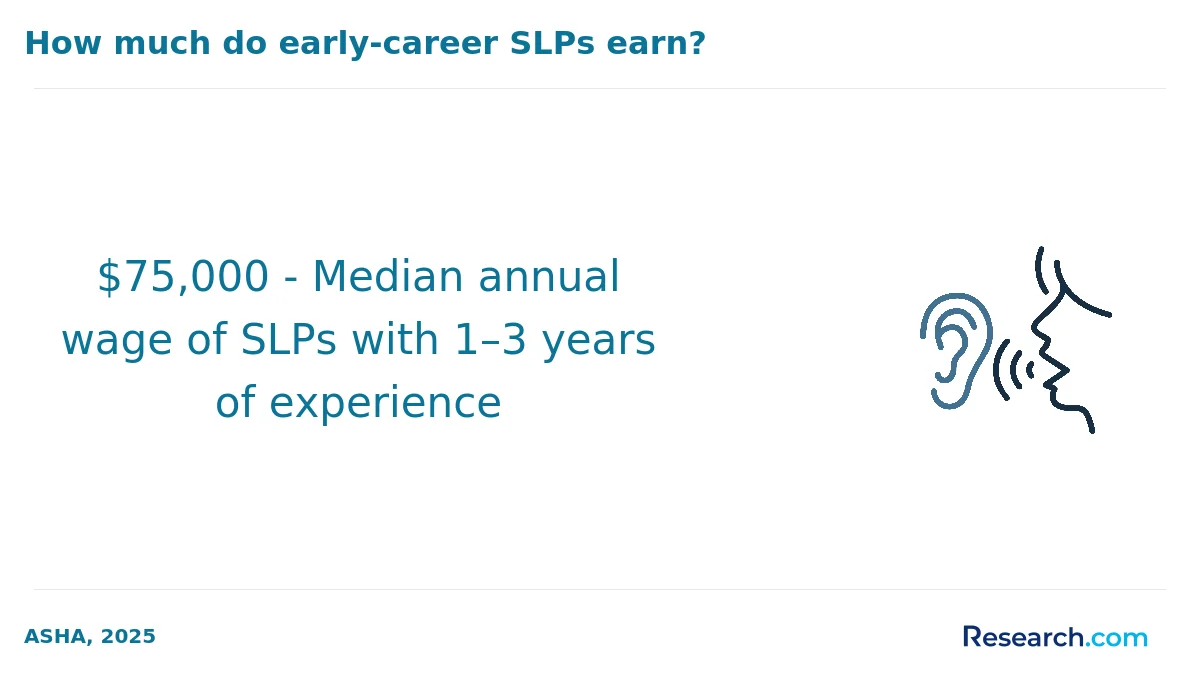
Undergraduate GPA generally has little direct effect on starting salary after completing a master's in speech pathology. Employers tend to focus more on graduate performance, clinical placements, licensure readiness, communication skills, and relevant experience. Research from the American Speech-Language-Hearing Association found starting salaries typically range between $55,000 and $70,000 annually, with GPA showing minimal influence on pay differences.
A low undergraduate GPA can affect whether you get into graduate school, but once you complete the degree and meet professional requirements, employers are more likely to evaluate what you can do as a clinician.
- Graduate-level performance: Strong grades and clinical evaluations during the master's program matter more than older undergraduate grades.
- Clinical experience: Internships, practicum placements, and supervised experience can influence hiring strength and setting options.
- Specialized preparation: Focus areas, clinical interests, and additional credentials may affect competitiveness for certain roles.
- Licensure and certification readiness: Employers often prioritize whether a graduate is prepared to meet required professional standards.
- Interview performance: Clear communication, professionalism, and case-based reasoning can outweigh transcript history in hiring decisions.
The practical takeaway is that a lower undergraduate GPA may be an admissions obstacle, not a permanent salary ceiling. Strong graduate performance and meaningful clinical experience can reset how employers view your qualifications.
What Graduates Say About Getting Into a Speech Pathology Degree Master's With a Low GPA
- : "Getting into a master's program in speech pathology with a low GPA felt daunting, but understanding the financial aspect really helped me plan better. The cost of the degree can be high, but scholarships and assistantships made it manageable. I'm now confident my career will flourish with this solid foundation. — Tiana"
- : "I underestimated how much my GPA would matter, and it was a tough hurdle for admission into speech pathology graduate programs. However, gaining experience and demonstrating genuine commitment made a huge difference. Reflecting on this, I realize the degree has been pivotal in shaping my professional path despite the initial setbacks. — Alexis"
- : "From a professional standpoint, the speech pathology master's degree elevated my expertise and opened doors I didn't think possible, especially given my lower GPA. It's been a rigorous but rewarding journey, and the investment has truly paid off in terms of career growth and personal satisfaction. — Trixie"
Other Things You Should Know About Speech Pathology Degrees
Yes, volunteering experiences relevant to speech pathology can enhance your application by showcasing practical skills and commitment to the field. Admissions committees often look for well-rounded candidates, and such experiences can help offset a lower GPA by demonstrating dedication and capability.
The personal statement is a critical component for applicants with a low GPA to voice their motivation, resilience, and commitment to the field of speech pathology. It allows candidates to explain any academic weaknesses and highlight relevant experiences or growth. A well-crafted statement can underscore determination and clarify readiness for the rigor of graduate coursework and clinical practice.
Some scholarships, like the ASHA Foundation's Minority Student Scholarship, may consider applicants with low GPAs if they demonstrate financial need or strong commitment to the field. Each scholarship has specific criteria, so it's essential to research and apply accordingly.
- U.S. Bureau of Labor Statistics - Speech-Language Pathologists https://www.bls.gov/ooh/healthcare/speech-language-pathologists.htm
- ASHA EdFind - Accredited Speech-Language Pathology Programs https://find.asha.org/ed/
- O*NET OnLine - Speech-Language Pathologists https://www.onetonline.org/link/summary/29-1127.00
- Nova Southeastern University - SLP Program - Master of Science in Speech-Language Pathology https://osteopathic.nova.edu/degrees/masters/speech-language-pathology/index.html
- Idaho State University - Master of Science in Speech-Language Pathology (Online/Distance Education) https://www.isu.edu/slp/programs-offered/slp-graduate-program/
- University of North Carolina at Greensboro - Speech-Language Pathology, M.A. (Online) https://csd.uncg.edu/graduate/masters-of-arts-online/
- Auburn University, Montgomery - Master of Science in Speech-Language Pathology https://www.aum.edu/degree/ms-speech-language-pathology/
- Ithaca College - Online Master of Science in Speech-Language Pathology https://slponline.ithaca.edu/programs/masters-speech-language-pathology-online





