
2027 States Offering Reciprocity For LPC Licensure For Mental Health Counselors

Co-Founder and Chief Data Scientist
In 2024, the Health Resources and Services Administration (HRSA) reported that over 122 million Americans live in designated mental health professional shortage areas. This stark figure underscores the urgent need for counselors to move freely and quickly to meet demand.
However, the complexity of LPC reciprocity (the traditional, opaque process of transferring a license) has historically prevented this. Instead of a seamless transfer, licensed professionals often faced months of delay and extensive, costly reviews, significantly limiting access to care across the country.
In this article, I will explain the differences among LPC reciprocity, licensure portability, and licensure by endorsement, as well as the key changes of the Counseling Compact. We will also review member states, license transfer requirements, and how a "privilege to practice" affects taxes and continuing education.
Key Things You Should Know About LPC Reciprocity
- LPC reciprocity is a rare, bilateral agreement between two states to mutually recognize equivalent licenses without rigorous individual review.
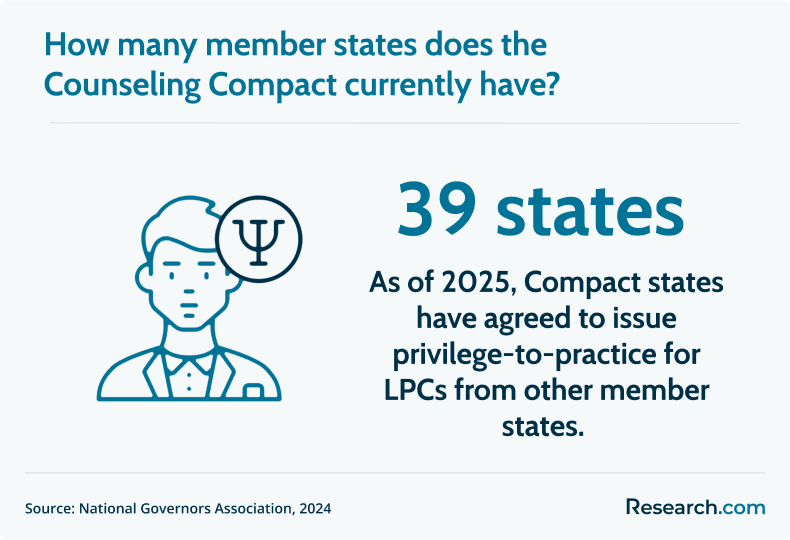
- The Counseling Compact is enacted in 39 states and jurisdictions as of 2025, exceeding the 10-state threshold to activate the agreement.
- The Counseling Compact grants a Privilege to Practice, a legal authorization equivalent to a license in a remote state, tied to an unencumbered home license.
- What is the difference between LPC reciprocity, licensure portability, and licensure by endorsement? LPC Reciprocity
- What is the current list of Counseling Compact member states for 2025? Counseling Compact
- Which states have existing LPC reciprocity agreements outside of the Counseling Compact? Which states have existing LPC reciprocity agreements outside of the Counseling Compact?
- What are the specific requirements to apply for a privilege to practice through the Counseling Compact? Privilege to Practice
- What are the LPC reciprocity requirements for out-of-state counselors by state? What are the LPC reciprocity requirements for out-of-state counselors by state?
- What are the essential documents and forms needed to apply for an LPC license by endorsement? What are the essential documents and forms needed to apply for an LPC license by endorsement?
- What are the total fees for LPC reciprocity and what do they cover? What are the total fees for LPC reciprocity and what do they cover?
- What strategies can optimize the LPC reciprocity application process? What strategies can optimize the LPC reciprocity application process?
- What are the estimated costs to transfer an LPC license to another state? Estimated Costs
- Do you have to complete continuing education (CE) requirements for every state you hold a license? Do you have to complete continuing education (CE) requirements for every state you hold a license?
- How much can a professional counselor expect to earn after obtaining a new license through LPC reciprocity? CE Requirements
LPC Reciprocity, Endorsement, and License Portability: A Practical Guide for Counselors Practicing Across State Lines
A professional counseling license is issued by a specific state board, which means an LPC, LPCC, LMHC, or similar license in one jurisdiction does not automatically give you permission to counsel clients in another. This becomes a real problem when counselors relocate, offer telehealth, join a multi-state employer, serve clients who move, or expand a private practice beyond one state.
This guide explains the major legal pathways counselors use to practice across state lines: LPC reciprocity, licensure by endorsement, general license portability, and the Counseling Compact Privilege to Practice. It is written for independently licensed counselors, associate-level clinicians planning ahead, graduate students comparing counseling programs, and practice owners who need to manage lawful services in more than one jurisdiction.
You will learn how each pathway works, which states have enacted the Counseling Compact, what requirements and documents to expect, how fees can add up, and how to avoid common mistakes that can delay approval or create disciplinary risk.
Quick answer: Does an LPC license transfer automatically to another state?
No. An LPC license typically does not transfer automatically. Most counselors who want to practice in a different state must either apply for licensure by endorsement or, when eligible, obtain a Counseling Compact Privilege to Practice in a participating state. True LPC reciprocity is limited because each state sets its own rules for graduate education, supervised experience, exams, ethics, scope of practice, and continuing education.
| Option | How it works | Best fit | Key drawback |
| LPC reciprocity | One state recognizes another state’s counseling license through a defined reciprocal arrangement. | Counselors moving between states that have a specific reciprocal process. | It is uncommon for LPCs because state licensing rules differ. |
| Licensure by endorsement | The destination state reviews your existing license, degree, exam record, supervised hours, and disciplinary history before issuing its own license. | Counselors relocating to a non-Compact state or needing a full license in another jurisdiction. | It may involve transcripts, supervision forms, state exams, coursework reviews, background checks, and multiple fees. |
| Licensure portability | A broad term for the ability to carry counseling practice rights across state lines through endorsement, reciprocity, or the Compact. | Counselors planning a move, telehealth expansion, regional employment, or multi-state private practice. | There is no single national LPC transfer application; the process depends on state law. |
| Privilege to Practice | A Counseling Compact authorization that lets an eligible counselor licensed in one Compact state practice in another Compact state. | Independently licensed counselors in Compact states who want a more streamlined way to practice in multiple member states. | It is not a separate full license and depends on maintaining an eligible, unencumbered home state license. |
LPC reciprocity vs. portability vs. endorsement vs. Privilege to Practice
Counselors often use these terms interchangeably, but they do not mean the same thing. Each one describes a different route to gaining legal authority to serve clients in a state where you were not originally licensed.
- LPC reciprocity: Reciprocity means two jurisdictions have agreed to recognize qualified counselors from each other under a defined process. For professional counselors, this is relatively rare because state boards must enforce their own education, supervision, examination, and ethics standards.
- Licensure by endorsement: Endorsement is the most common option when a counselor already licensed in one state applies for a license in another. The receiving board decides whether the applicant’s prior credentials are substantially equivalent to its current requirements. If coursework gaps appear, some counselors may need to consider additional academic preparation, while others exploring adjacent behavioral science routes may ask what an applied psychology degree can lead to.
- Licensure portability: Portability is the overall concept of moving counseling practice authority from one state to another. It can happen through endorsement, reciprocity, the Counseling Compact, or another state-approved mechanism.
- Privilege to Practice: A Privilege to Practice is created through the Counseling Compact. It permits an independently licensed counselor from a Compact home state to practice in another Compact state, as long as the counselor meets eligibility rules and maintains an unencumbered home state license.
The simplest way to separate the concepts is this: endorsement asks a second state to issue you another license after a credential review, while the Compact creates a standardized practice authorization for eligible counselors in member states.
How the Counseling Compact changes interstate LPC practice
The Counseling Compact is designed to reduce repeated licensing barriers for counselors who need to practice across state lines. Before the Compact, a counselor often had to rebuild a full credential file for every new state: official transcripts, national exam score reports, supervised experience verification, license history, disciplinary checks, fingerprints, and state-specific forms. That process could take months, especially if old supervisors were hard to reach or older coursework did not match current state rules.
Under the Compact framework, an eligible counselor does not apply for a traditional second license in every participating state. Instead, the counselor applies through the Compact Commission and pays the required fees to obtain a Privilege to Practice in a remote member state. Similar planning issues appear in other regulated health careers, where professionals may compare credentials such as specialty certifications for LPNs before choosing a practice area.
The Compact does not eliminate state authority. Counselors must still follow the laws, rules, professional standards, and scope of practice requirements in the state where the client is located. Some remote states may also require jurisprudence steps. The main benefit is that eligible counselors can avoid repeatedly reconstructing the same licensing file for every Compact state.
How to confirm that your LPC license is unencumbered
An unencumbered license is active and valid without current restrictions such as probation, suspension, revocation, practice limitations, or other adverse board actions. This status matters because both endorsement applications and Compact privileges depend heavily on the legal standing of your existing license.
Before you apply for an endorsement license or a Compact privilege, complete these checks:
- Use the official board lookup: Search your license in the public verification system maintained by your home state counseling board.
- Confirm good standing: Make sure the record shows active, current, or good-standing status and does not list unresolved restrictions.
- Review disciplinary information: Look for any current or past board actions, including probation, suspension, revocation, consent orders, or limitations on practice.
- Check the Compact lookback rule: For Counseling Compact eligibility, applicants must certify that no license or privilege to practice has been encumbered or restricted within the previous two years.
Credential review is common across licensed and technical professions. In other fields, students may need to understand how training and specialization affect mobility, such as when comparing the major subdisciplines of geoscience and the qualifications tied to each area.
States That Have Enacted the Counseling Compact
The Counseling Compact has expanded because it addresses a major workforce barrier in mental health care: obtaining legal authority to practice when the counselor and client are in different states. It is especially important for telehealth providers, military families, counselors who relocate, regional employers, and private practices serving clients across state borders.
The required data system was anticipated to be fully operational in the fall of 2025. Before providing services based on a Compact privilege, counselors should verify current application availability and implementation status directly with the Compact Commission.
The following jurisdictions have enacted the Counseling Compact:
- Alabama
- Arizona
- Arkansas
- Colorado
- Connecticut
- Delaware
- District of Columbia
- Florida
- Georgia
- Indiana
- Iowa
- Kansas
- Kentucky
- Louisiana
- Maine
- Maryland
- Minnesota
- Mississippi
- Missouri
- Montana
- Nebraska
- Nevada
- New Hampshire
- New Jersey
- North Carolina
- North Dakota
- Ohio
- Oklahoma
- Rhode Island
- South Carolina
- South Dakota
- Tennessee
- Utah
- Vermont
- Virginia
- Washington
- West Virginia
- Wisconsin
- Wyoming
Enactment alone does not mean every counselor can immediately practice there. You still need to confirm your home state status, unencumbered license standing, fees, jurisprudence requirements, and whether the remote state is accepting privilege applications.
LPC Reciprocity Options Outside the Counseling Compact
Outside the Counseling Compact, automatic LPC reciprocity remains limited. State boards generally do not accept another state’s license without review because they must apply their own statutes, regulations, supervision requirements, and consumer protection standards. When no Compact privilege or reciprocal process is available, licensure by endorsement is usually the route.
Examples of non-Compact reciprocity or expedited pathways include:
- Kentucky and Tennessee reciprocity: Kentucky and Tennessee have a bilateral arrangement involving the LPCC designation in Kentucky and the LPC/MHSP designation in Tennessee. Counselors must document five years of post-licensure clinical experience.
- North Carolina reciprocity application: North Carolina offers a specific reciprocity route for independently licensed professional counselors from South Carolina, Tennessee, and Kentucky. Even with the term reciprocity, applicants still complete forms, pay fees, and meet state-specific exam requirements.
- Endorsement as the usual alternative: If a counselor moves between non-Compact states without a defined reciprocal route, such as New York to California, the counselor generally applies by endorsement. If the destination board identifies education deficiencies, applicants may need to compare additional graduate options, including the best online applied psychology degree programs when considering broader behavioral science study.
The Counseling Compact has reduced the need for many one-off state agreements, but it has not replaced endorsement. Counselors should check the destination board’s current rules before moving, signing an employment agreement, advertising services, or accepting telehealth clients in that jurisdiction.
Counseling Compact Privilege to Practice Requirements
A Compact Privilege to Practice is meant to be more efficient than applying for a full second license, but it is not automatic. Your home state license is the basis for eligibility, and you remain responsible for complying with each remote state’s laws when serving clients located there.
| Requirement | What to confirm before applying |
| Home state license | You must have a valid, unencumbered independent counseling license in your home state, which is the state where you legally reside. |
| Disciplinary standing | You must certify that no license or privilege to practice has been encumbered or restricted within the previous two years. |
| Remote state compliance | You must meet any jurisprudence requirement required by the remote state where you plan to practice. |
| Fees | You must pay the Compact Commission administrative fee and the state fee connected to each requested Privilege to Practice. |
| Scope of practice | You must follow the counseling laws, ethical rules, and practice standards in the state where the client is physically located. |
This type of credential planning is useful in many regulated professions. Students comparing mobility across health and technical fields may also review career options with a biomedical engineering degree to see how education, licensing, and employer requirements can shape long-term flexibility.
The chart below presents CACREP-accredited program information by counseling specialization, including enrollment and graduate counts.
State Examples: LPC Reciprocity and Endorsement Requirements
If you cannot use the Counseling Compact or you need a full license in another state, the destination board’s requirements control the process. States may differ on degree accreditation, required graduate credits, practicum and internship content, supervised experience hours, national exams, background checks, and state-specific coursework or training.
The examples below show why counselors should review licensing rules before relocating, accepting a position, opening a practice, or providing telehealth across state lines.
Florida
- Education standard: Applicants must have a master’s degree with at least 60 semester hours. Beginning July 1, 2025, the program must be institutionally accredited by CACREP, MPCAC, or an equivalent body. Counselors comparing program recognition should understand how CACREP and MPCAC accreditation differ.
- Supervision and practice documentation: Florida requires proof of 100 hours of supervision completed in no less than 100 weeks and 1,500 hours of face-to-face psychotherapy.
- Course content review: Applicants must document at least 3 semester hours in 12 required content areas, including Diagnosis and Treatment of Psychopathology and Human Sexuality.
California
- Licensure by credential: California’s Path A applies to counselors who have held a comparable license in another U.S. jurisdiction for at least two years.
- Supervised experience: Applicants must satisfy California’s 3,000 hours of supervised professional experience requirement.
- California-specific exam: Out-of-state applicants must pass the California Law and Ethics Exam.
- Degree equivalency: The qualifying master’s or doctoral degree must include 60 semester units and address 13 required core content areas.
Texas
- No automatic reciprocity: Texas states that it does not offer reciprocity or temporary licensure, so out-of-state counselors must apply by endorsement and meet current Texas requirements.
- Jurisprudence exam: Applicants must pass the Texas LPC jurisprudence exam within six months of submitting the application.
- Experience threshold: Texas requires at least 3,000 hours of supervised experience, including at least 1,500 hours of direct counseling experience.
- Board forms: Practicum and supervised experience documentation must be sent to the board on the required forms.
New York
- Practice history requirement: Endorsement applicants must have practiced as a licensed counselor for at least five years during the ten-year period before application.
- Credential submission: Candidates submit credentials for state review through the TEACH Online Services system.
- Supervised practice: Applicants must verify at least 3,000 hours of supervised professional experience, including at least 1,500 hours of direct client contact.
- Required training: Applicants must complete child abuse identification and reporting training or coursework through a New York State-approved provider.
Virginia
- Graduate credit requirement: Virginia requires a 60-graduate-credit-hour counseling master’s degree that includes 13 specified core content areas.
- Residency documentation: Applicants must verify 3,400 hours of supervised post-master’s degree residency in an appropriate work setting.
- Renewal education: Virginia requires at least 20 contact hours of continuing education each year for renewal, including required hours in ethics and training standards for residents’ rights.
| State | Main issue for counselors licensed elsewhere | Requirement to review first |
| Florida | Accreditation language and detailed coursework review | 60 semester hours, 100 hours of supervision, 1,500 hours of face-to-face psychotherapy |
| California | Licensure by credential plus a California law exam | 3,000 hours of supervised professional experience and California Law and Ethics Exam |
| Texas | No reciprocity or temporary licensure | 3,000 supervised hours, including 1,500 direct counseling hours, plus jurisprudence exam |
| New York | Five-year practice requirement for endorsement | 3,000 supervised hours, including 1,500 direct client contact hours |
| Virginia | Residency verification and annual CE rules | 3,400 supervised post-master’s residency hours and 20 annual CE contact hours |
These examples show why LPC portability can be complex. A counselor may be fully qualified in one state but still face extra coursework review, supervised-hour verification, state exams, or training requirements elsewhere. Similar credential issues affect other advanced health professions, including clinicians exploring career options with a DNP in health systems leadership.
The chart below compares selected LPC licensing standards across states, including internship and supervised experience hour requirements.
Documents Commonly Required for LPC Licensure by Endorsement
Endorsement applications usually require primary-source verification. In practice, that means many records must be sent directly by your university, testing organization, former supervisor, or licensing board rather than uploaded by you. This protects the licensing process, but it also means missing or incorrectly sent documents can stall your application.
| Document type | Commonly requested records | Why the board needs it |
| License verification | Out-of-state license verification forms, current status reports, disciplinary records, and proof of years in active practice | The board must confirm that your existing license is valid and determine whether your record is unrestricted or has disciplinary history. |
| Education records | Official graduate transcripts and, when required, syllabi or course descriptions | The board compares your degree, credits, and coursework with the state’s academic requirements. |
| Exam results | Official results from the NCMHCE exam or National Counselor Examination (NCE) | Many states require proof that you passed an approved national counseling examination. |
| Supervised experience | Post-graduate supervised practice verification forms completed and signed by prior supervisors | The board reviews your hours, direct client contact, supervision frequency, supervisor qualifications, and work setting. |
| Background check | Fingerprinting, criminal history review, and state-approved vendor fees | Most states require a fresh background review even if another state already checked your history. |
The most common cause of delay is an incomplete file. Request records early, verify that each source used the correct form, and check the board portal until every required item is marked received.
Cost of LPC Reciprocity, Endorsement, and Compact Practice Authorization
Your total cost depends on whether you pursue a Counseling Compact Privilege to Practice or a full license by endorsement. Application fees are usually non-refundable, and the final cost can increase when a state requires fingerprints, jurisprudence exams, transcript orders, national exam score reports, license verifications, or additional coursework.
| Expense | Amount stated | When it applies | What the fee is for |
| Compact administrative fee | $30.00 | Privilege to Practice | Administrative fee paid to the Compact Commission for each privilege requested. |
| Compact state fee | $0 to over $264 | Privilege to Practice | Remote-state fee set by each participating member state. |
| Endorsement application fee | $100 to over $400 | Licensure by endorsement | Board review of the application and supporting credentials. |
| Virginia endorsement example | $175 | Licensure by endorsement | Virginia’s total endorsement application cost. |
| California application example | $400 plus an additional fingerprint fee | Licensure by endorsement | Initial application cost and required fingerprinting. |
| Florida initial licensure fee | $75 | Licensure after approval | Fee due after approval before the license is issued. |
| Texas jurisprudence example | $39 | State compliance requirement | Fee associated with the Texas jurisprudence exam. |
| Texas verification example | $50 | License verification | Fee for verifying a counselor’s license status for another jurisdiction. |
The Compact may reduce duplicate paperwork and repeated documentation costs, but it does not make multi-state practice free. Counselors planning to serve clients in several states should budget state by state and confirm whether each jurisdiction charges separate fees for jurisprudence exams, background checks, license verification, or other requirements.
For students still choosing a licensure pathway, program cost and accreditation can affect future portability. Research.com guides to online master’s programs in clinical mental health counseling and the most affordable online counseling degrees can help prospective counselors compare options before licensure barriers arise.
How to Make LPC Endorsement or Reciprocity Less Stressful
Treat license transfer like a professional project, not a quick form submission. Applications are commonly delayed because records are sent by the wrong source, supervised hours are described inconsistently, courses do not map clearly to state requirements, applicants miss jurisprudence steps, or background check instructions are not followed exactly.
- Begin with the destination board: Read the current endorsement, reciprocity, or out-of-state licensure instructions before ordering transcripts or contacting supervisors.
- Check Compact eligibility before applying for a full license: If both jurisdictions are Compact members, decide whether a Privilege to Practice is enough for your employment, telehealth, or private practice goals.
- Create a document checklist: Track every transcript, license verification, exam score report, supervision form, fingerprint requirement, fee, and due date.
- Reach out to former supervisors early: Supervision verification can become difficult when supervisors retire, move, close a practice, or change employers.
- Review coursework requirements line by line: If the destination state lists required content areas, gather syllabi or course descriptions before the board requests them.
- Prepare for state-specific exams: Even experienced counselors may need to complete a jurisprudence exam or legal-ethics requirement.
- Protect your home license: Keep renewal dates, continuing education deadlines, and fees current while your endorsement or Compact application is pending.
Common mistakes counselors should avoid
| Mistake | Why it creates risk | Smarter approach |
| Believing reciprocity is automatic | Most states require endorsement unless a Compact privilege or specific reciprocal process applies. | Confirm the exact authorization pathway with the destination board before practicing. |
| Providing telehealth before authorization is approved | The client’s physical location usually determines where you must be authorized to practice. | Verify your practice rights in the client’s state before the first session. |
| Budgeting only for the application fee | Total cost may include transcripts, score reports, fingerprints, verifications, exams, and extra coursework. | Estimate the full cost before you submit a non-refundable application. |
| Overlooking accreditation and course-content rules | A degree that satisfied one state may not meet another state’s current standards. | Compare credit hours, core content areas, CACREP or MPCAC language, and equivalency policies. |
| Allowing the home license to expire | Compact eligibility and endorsement credibility rely on an active license in good standing. | Renew on time and complete CE before the deadline. |
| Relying only on rankings or school marketing | A program’s reputation does not guarantee that it satisfies LPC requirements in every state. | Ask programs directly which state licensure requirements their curriculum is designed to meet. |
Estimated Total Cost to Move an LPC License to Another State
For endorsement, the final cost is usually more than the board’s application fee. You may also pay for records that prove your education, exam history, supervised experience, identity, and legal eligibility.
- Application and license issuance fees: Non-refundable application fees commonly range from $100 to $250. Some states also charge a separate initial license issuance fee, including Florida’s $75 fee.
- Records and verification charges: Licensing boards, universities, and testing agencies may charge for license verifications, official transcripts, and exam score reports. In some cases, license verification fees can range from $10 to $25.
- Compliance and remediation costs: Fingerprinting, background checks, and jurisprudence exams add to the total. Texas, for example, has a $39 jurisprudence exam fee. The most expensive scenario is a coursework deficiency that requires additional graduate-level classes.
The Counseling Compact can reduce repeated documentation expenses, but counselors using endorsement should plan for several layers of cost and possible processing delays.
Can multi-state counseling income create tax issues?
Yes. A Privilege to Practice authorizes counseling services in a remote state, but it does not remove tax responsibilities. Depending on state rules and income thresholds, earning income from clients located in another state may create a state filing obligation.
Counselors who practice across state lines should track revenue by client location, organize income by state when necessary, and consult a Certified Public Accountant. This is especially important for private practice owners who provide telehealth in multiple jurisdictions.
The chart below shows New York mental health counseling licensure growth by year, including new licenses issued from 2020 to 2024.
Continuing Education Rules for Counselors Licensed in Multiple States
In most cases, yes, counselors must meet continuing education requirements for every full state license they keep active. Requirements may differ by renewal cycle, total hours, ethics content, cultural competency topics, mandated training, and state-specific rules.
This is one of the administrative costs of holding multiple licenses. A counselor may need to monitor several renewal calendars and should not assume that a CE course accepted in one state will count in another.
How the Counseling Compact changes CE planning
The Counseling Compact simplifies continuing education for counselors practicing through a Privilege to Practice. Rather than meeting separate CE requirements in every remote Compact state, the counselor follows the continuing education rules of the home state.
- One primary CE standard: The counselor completes the CE required by the home state licensing board.
- No separate remote-state CE for the privilege: Remote Compact states waive their own CE requirement for counselors practicing under a Compact privilege.
- Less duplicate training: Counselors avoid purchasing overlapping ethics or renewal courses just to maintain several privileges.
- Simpler renewal tracking: The counselor manages one main renewal cycle instead of several unrelated systems.
Students still planning their education should separate licensure coursework from later CE requirements. A counseling psychology degree available online may support different academic or career goals than a clinical mental health counseling program built specifically for LPC eligibility.
Earning Potential After Gaining Practice Rights in Another State
Licensure portability can create financial opportunity, but it does not automatically increase income. The value comes from expanded access: you may be able to relocate, accept a job in another state, serve telehealth clients legally, or grow a private practice beyond one local market.
- Access to higher-paying locations: Moving from lower-paying regions such as Mississippi or Arkansas, averaging around $46,000–$47,000, to higher-demand states such as Washington or New Jersey, where salaries are often closer to $75,000–$89,221, may improve pay potential.
- Telehealth expansion for private practice: A Privilege to Practice can allow lawful telehealth services for clients in multiple member states, reducing reliance on one local market. Private practice settings are the most lucrative, with top earners exceeding $100,000 annually.
- Broader employment options: Multi-state authorization may help counselors move from lower-paying non-profit roles, with an average salary of $40,000–$55,000, into hospitals, government, or private practice roles, where the average range may be $65,000–$130,000+.
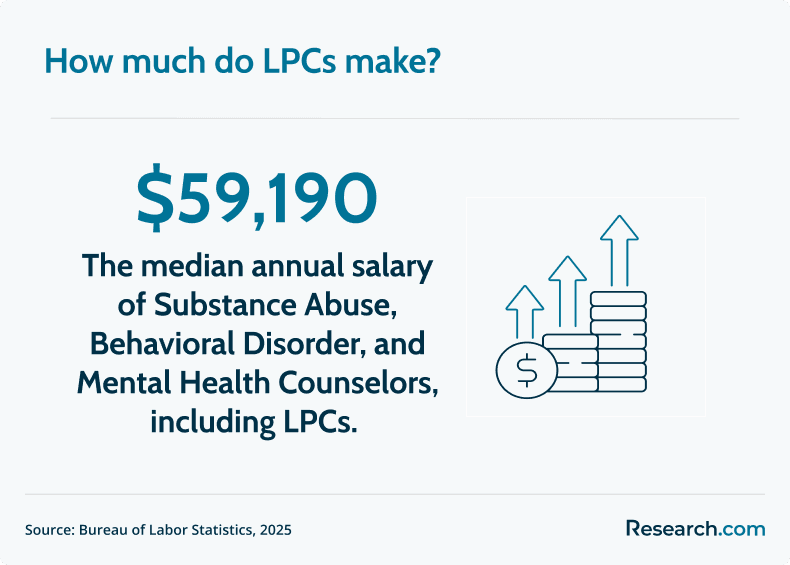
- National salary context: The national average salary for an LPC is approximately $71,915.
The practical point is that portability expands your options. It does not replace specialization, local demand research, payer contracting, business planning, or salary negotiation.
Questions to Ask Before Applying for LPC Reciprocity, Endorsement, or a Compact Privilege
- Are both my home state and the state where I want to practice members of the Counseling Compact?
- Do I need a full additional license, or is a Privilege to Practice enough for my work?
- Is my current license independent, active, valid, and unencumbered?
- Have I had any license restriction or encumbrance within the previous two years?
- Does the destination state require a jurisprudence exam, legal-ethics module, or state-specific training?
- Does my graduate degree meet the receiving state’s current credit-hour, accreditation, and coursework requirements?
- Can my former supervisors still complete the required supervised experience forms?
- What will the full cost be after application fees, fingerprints, verifications, transcripts, exam reports, and possible coursework?
- Will I need to satisfy continuing education rules in more than one state?
- If I use telehealth across state lines, how will I document client location, income by state, clinical records, and tax responsibilities?
References:
- American Counseling Association. (2025). ACA licensure portability model FAQ. https://www.counseling.org/docs/default-source/licensure/portability-faq.pdf?sfvrsn=c4124f2c_4
- American Counseling Association. (2025). Counseling Compact frequently asked questions. https://www.counseling.org/advocacy/counseling-compact/faqs
- Board of Behavioral Sciences. (2024). Application for LPCC licensure, Path A out-of-state. https://www.bbs.ca.gov/pdf/forms/lpc/lpc_app_oos_01012016.pdf
- Board of Clinical Social Work, Marriage & Family Therapy and Mental Health Counseling. (2025). Licensed mental health counselor. https://floridasmentalhealthprofessions.gov/licensed-mental-health-counselor/
- Bureau of Labor Statistics. (2024). Substance abuse, behavioral disorder, and mental health counselors. https://www.bls.gov/ooh/community-and-social-service/substance-abuse-behavioral-disorder-and-mental-health-counselors.htm
- Online Counseling Programs. (2024, April 9). Counseling certification requirements by state. https://onlinecounselingprograms.com/become-a-counselor/counseling-licensure/
- Counseling Compact. (2025). FAQ for counselors. https://counselingcompact.gov/faq/
- Counseling Compact. (2025). Rule on fees effective March 14, 2025. https://counselingcompact.gov/wp-content/uploads/2025/02/Chapter-7-Rule-on-Fees.pdf
- National Governors Association. (2024). Understanding behavioral health licensure compacts. https://www.nga.org/publications/understanding-behavioral-health-compacts/
- New York Mental Health Counselors Association. (2019). Mental health counseling FAQ. https://nymhca.org/page/resources-mhcfaq
- New York State Education Department. (2025). New York mental health counselor licensure requirements. https://www.mentalhealthcounselorlicense.com/license/mental-health-counselor-new-york/
- New York State Education Department. (2025). License statistics for mental health counselors. https://www.op.nysed.gov/professions/mental-health-counselors/license-statistics
- Texas Behavioral Health Executive Council. (2025). Licensed in another jurisdiction. https://bhec.texas.gov/texas-state-board-of-examiners-of-professional-counselors/applying-for-an-lpc-license/licensed-in-another-jurisdiction/
- Texas Behavioral Health Executive Council. (2025). Professional counselors applying for a license FAQs. https://bhec.texas.gov/professional-counselors-applying-for-a-license/
- Virginia Online CE Credits. (2025). Virginia licensed professional counselor requirements. https://onlinececredits.com/requirements/licensed-professional-counselor-virginia/
Key Insights
- LPC reciprocity is not automatic. Unless a specific reciprocal pathway or Counseling Compact privilege applies, most counselors must use licensure by endorsement.
- The Counseling Compact is the most streamlined option for eligible independently licensed counselors in member states, but it is a practice privilege, not a full second license.
- Your home license must stay active and unencumbered. Recent restrictions, probation, suspension, or other encumbrances can block Compact eligibility and complicate endorsement.
- State rules vary widely. Florida, California, Texas, New York, and Virginia show how requirements can differ by credit hours, accreditation, supervised experience, exams, CE, and state-specific training.
- Endorsement costs more than the advertised application fee. Budget for transcripts, license verifications, exam reports, fingerprints, jurisprudence exams, and possible graduate coursework.
- Multiple full licenses usually mean multiple CE obligations. A Compact privilege can simplify CE planning because the counselor follows the home state’s CE requirements.
- Portability can increase career and income options by opening new geographic and telehealth markets, but it does not guarantee higher pay.
- The safest first step is always verification. Check the destination board or Compact Commission before moving, advertising, accepting a job, or seeing clients across state lines.
Other Things You Should Know About LPC Reciprocity
Yes. Several states require a jurisprudence exam, especially for out-of-state LPC applicants seeking endorsement or reciprocity. The exam tests state counseling laws, ethics rules, and reporting duties. Boards such as Texas and Florida may require it before issuing a license by reciprocity.
In 2027, states like Texas, Georgia, and Virginia offer LPC licensure reciprocity. Basic requirements usually include an active and good-standing license in another state, passing a criminal background check, and meeting state-specific education and experience criteria. Each state may have unique additional prerequisites.





