2027 How to Become a Licensed Therapist (LPC) in Jacksonville, FL

Co-Founder and Chief Data Scientist
If you are searching for how to become an LPC in Jacksonville, the first thing to know is that Florida does not use the “Licensed Professional Counselor” title in the same way some other states do. In Florida, the comparable independent clinical counseling license is the Licensed Mental Health Counselor, or LMHC, regulated by the Florida Board of Clinical Social Work, Marriage & Family Therapy, and Mental Health Counseling.
This guide explains the Jacksonville path using the common “LPC” search term while focusing on Florida’s actual licensure process. You will learn what degree to choose, how supervised experience works, where Jacksonville students can train, what salaries commonly look like, which employers hire counselors, and how to avoid costly mistakes before you invest time and tuition.
Quick Answer: Becoming an LPC in Jacksonville, FL
- In Jacksonville, the LPC-equivalent license is Florida’s Licensed Mental Health Counselor credential. You generally need a qualifying graduate degree, supervised clinical experience, an approved exam, a background check, and Florida Board approval.
- Jacksonville’s counseling market is supported by hospitals, universities, behavioral health centers, rehabilitation providers, nonprofits, private practices, and community agencies serving a large and diverse population.
- The average LPC salary in Jacksonville is approximately $50,000 to $60,000 annually, with earnings shaped by licensure status, employer type, specialty, benefits, caseload, and private practice structure.
- Common employers include Baptist Health Jacksonville, UF Health Jacksonville, Brooks Rehabilitation Hospital, Jacksonville Behavioral Health Center, and university counseling services.
- What are the educational requirements to become an LPC in Jacksonville?
- How do you apply for licensure as a counselor in Jacksonville?
- Which schools in Jacksonville offer programs for aspiring LPCs?
- Are there internship or practicum opportunities for counseling students in Jacksonville?
- How much do LPCs make in Jacksonville?
- What are the supervision requirements for LPCs in Jacksonville?
- Is Jacksonville a good place to work as an LPC?
- How can LPCs expand their practice into substance abuse counseling?
- How can I expand my qualifications to include marriage and family therapy?
- Can LPCs diversify their career with teaching credentials in Jacksonville?
- How can I fast-track my LPC career in Jacksonville?
- What additional certifications can bolster your LPC career in Jacksonville?
- How competitive is the job market for LPCs in Jacksonville?
- Are there counseling associations in Jacksonville?
- Which are the most popular employers of LPCs in Jacksonville?
What are the educational requirements to become an LPC in Jacksonville?
To qualify for Florida’s counseling licensure pathway from Jacksonville, you should plan on graduate-level preparation in clinical mental health counseling or a closely related field. A bachelor’s degree can help you enter the human services field, but it is not enough for independent clinical counseling licensure.
The safest academic route is a master’s degree that is designed for mental health counseling licensure in Florida. Look for coursework in counseling theory, ethics, human growth and development, diagnosis, assessment, group counseling, career counseling, research, multicultural counseling, and clinical skills. Accreditation also matters because it can simplify review of your curriculum and make your preparation more portable if you later move to another state.
- Earn a master’s degree in counseling or a closely related discipline that includes the clinical coursework Florida expects for mental health counseling practice.
- Prioritize programs that clearly state they prepare graduates for Florida licensure as a mental health counselor.
- Review whether the program includes practicum and internship placements, not just classroom instruction.
- Confirm whether the school’s curriculum meets Florida Board requirements before enrolling, especially if the program is online or based outside Florida.
- Keep syllabi, course descriptions, practicum records, and supervisor documentation because these materials may be needed during licensure review.
| Education option | Best for | Licensure value in Jacksonville | Main caution |
| Master’s in Clinical Mental Health Counseling | Students who want the most direct path to Florida counseling licensure | Usually the clearest fit when the curriculum is built around counseling licensure requirements | Do not assume every counseling program automatically meets Florida requirements |
| Master’s in Counseling Psychology | Students interested in counseling practice with a psychology-oriented curriculum | May qualify if coursework and supervised training align with Florida standards | Program titles vary, so verify licensure alignment in writing |
| Master of Social Work | Students considering clinical social work, case management, policy, or agency leadership | Can lead to a different clinical license pathway rather than the LMHC pathway | Compare the difference between MSW vs MS in counseling before choosing |
| Addiction counseling or human services degree | Students who want entry-level behavioral health or substance use roles | Useful for career preparation, but typically not enough by itself for independent counseling licensure | Check whether additional graduate study will be required |
How do you apply for licensure as a counselor in Jacksonville?
Jacksonville applicants apply through the Florida Department of Health and the Florida Board of Clinical Social Work, Marriage & Family Therapy, and Mental Health Counseling. The process is statewide, so a counselor licensed through this route can practice in Jacksonville and elsewhere in Florida within the scope of the license.
The basic sequence is straightforward, but the documentation can be demanding. Candidates must show that their graduate education, supervised experience, examination results, background screening, and application materials satisfy Florida requirements. Because application rules can change, applicants should verify current instructions directly with the Board before submitting materials.
- Complete a qualifying graduate degree in counseling or a closely related mental health field.
- Register for and complete the required supervised post-graduate clinical experience under an approved supervisor.
- Pass the National Counselor Examination (NCE) or another exam accepted by the Florida Department of Health.
- Submit the Florida licensure application with transcripts, experience verification, exam documentation, required forms, and fees.
- Complete fingerprinting and the criminal background check.
- Respond quickly to any Board requests for missing or unclear information.
- After approval, complete continuing education to keep the license active and in good standing.
The original pathway information frequently cited for Jacksonville includes at least 2 years or 1,500 hours of clinical mental health counseling experience under a qualified Florida-licensed supervisor. Applicants may also encounter references to 2,000 supervised clinical practice hours, so it is important to confirm the exact current requirement for your application category before planning your timeline.
Licensure delays often happen because applicants choose a program before checking curriculum fit, start post-graduate work before confirming supervisor qualifications, or fail to keep complete records. If you are still comparing counseling careers, this related guide on how to become a counseling psychologist can help you understand how counseling psychology differs from mental health counseling.
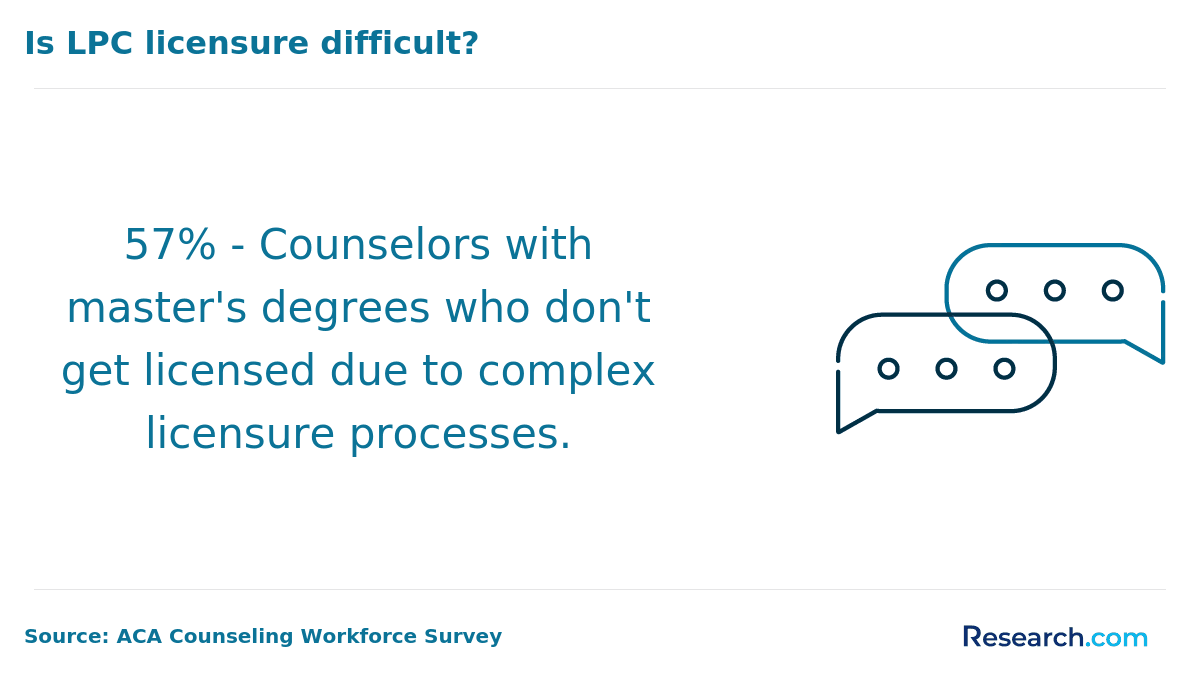
A recent ACA Counseling Workforce Survey found that 57 percent of counselors with master’s degrees never complete licensure because the process is simply too complex. That statistic is a reminder to treat licensure planning as part of your graduate school decision, not something to figure out after graduation.
Which schools in Jacksonville offer programs for aspiring LPCs?
Jacksonville students have local and regional options for graduate counseling preparation. Your goal is not simply to find a nearby program; it is to find a program that fits Florida licensure requirements, provides strong clinical placement support, and matches your schedule, budget, and specialty interests.
- The University of North Florida offers a Master of Science in Clinical Mental Health Counseling. The program is described as CACREP-accredited and includes counseling theory, ethics, assessment, and supervised clinical preparation for students pursuing licensure.
- Jacksonville University offers a Master of Arts in Counseling Psychology with a mental health counseling focus. The program is described as including supervised fieldwork and CACREP accreditation aligned with Florida LPC-equivalent preparation.
- The University of Florida in Gainesville offers a CACREP-accredited Clinical Mental Health Counseling program for students willing to consider a nearby regional option with broader university resources.
| Program factor | Why it matters | Question to ask before enrolling |
| Accreditation | Accreditation can affect licensure review, employer confidence, and portability | Is the counseling program CACREP-accredited or otherwise clearly accepted for Florida licensure? |
| Licensure alignment | Florida requires specific coursework and supervised experience documentation | Can the school provide a written licensure disclosure for Florida? |
| Practicum and internship support | Clinical placements are essential for skill development and graduation requirements | Does the program help secure Jacksonville-area placements, or must students find their own? |
| Format | Online, hybrid, evening, and campus formats affect working adults differently | Are any campus visits, synchronous classes, or local site requirements mandatory? |
| Total cost | Tuition is only one part of graduate school expense | What is the full cost including fees, books, commuting, insurance, and unpaid internship time? |
Nationwide, the pipeline of newly trained counselors is expanding. CACREP-accredited programs graduated more than 20,000 students in 2023 alone, up from about 18,000 just two years earlier. For students comparing specialties, this guide to master's in addiction counseling salary can help clarify how addiction counseling roles may differ from broader clinical counseling careers.
Are there internship or practicum opportunities for counseling students in Jacksonville?
Yes. Jacksonville offers practicum and internship settings across community agencies, healthcare organizations, school-related services, nonprofit programs, and specialty behavioral health providers. These placements are where students begin applying counseling skills with real clients under supervision.
A strong placement should do more than help you accumulate hours. It should expose you to ethical documentation, treatment planning, intake assessment, crisis protocols, referrals, cultural humility, boundaries, and collaboration with other professionals.
- Florida State College at Jacksonville Counseling Clinic: may provide experience with intake work, client counseling, case support, and individual or group counseling skills.
- Jacksonville Area Legal Aid: can expose counseling trainees to clients facing trauma, legal stressors, housing instability, family conflict, and crisis-related needs.
- Children’s Home Society of Florida: may be a good fit for students interested in child, adolescent, family, and community-based counseling work.
| Placement type | Skills you may build | Best fit for students interested in |
| Community mental health agency | Intake, diagnosis support, treatment planning, crisis response, case coordination | Serving high-need and underserved populations |
| Hospital or rehabilitation setting | Interdisciplinary care, adjustment counseling, trauma-informed support, discharge planning | Medical, rehabilitation, or integrated behavioral health |
| University counseling center | Short-term counseling, workshops, stress management, referral planning | College student mental health and prevention programming |
| Family or youth services agency | Parent consultation, child and adolescent counseling, family systems work | Child, teen, and family counseling |
| Substance use treatment provider | Relapse prevention, motivational interviewing, group counseling, co-occurring disorder support | Addiction counseling and recovery services |
When evaluating a placement, ask who will supervise you, how often supervision occurs, what client populations you will see, whether evening hours are available, how risk situations are handled, and whether the site has experience hosting counseling interns from your program.
- : "“Navigating the balance between emotional investment and professional boundaries was challenging but incredibly rewarding.”"
That reflection from a Jacksonville therapist captures why practicum matters. The training period is not only about hours; it is where students learn how to stay clinically present without losing professional judgment.
How much do LPCs make in Jacksonville?
LPC-equivalent counselors in Jacksonville commonly earn around $50,000 to $60,000 annually. Entry-level and pre-licensed roles may fall closer to the lower end, while experienced clinicians, supervisors, specialists, and private practitioners may earn more. Some counselors with several years of experience or specialized skills can earn upwards of $70,000 or more.
Salary depends heavily on work setting. A hospital or government role may offer steadier benefits, while private practice may offer higher upside but more business risk. Community mental health and nonprofit agencies may offer meaningful clinical experience but often operate within tighter funding limits. Pay can also change based on evening availability, insurance paneling, bilingual skills, trauma training, substance use expertise, and supervisory responsibilities.
| Work setting | Potential advantages | Potential trade-offs |
| Hospital or health system | Structured teams, benefits, referrals, interdisciplinary experience | Documentation demands, productivity expectations, complex cases |
| Community mental health agency | Broad clinical exposure and strong public-service mission | High caseloads and possible funding constraints |
| University counseling center | Defined population, prevention work, campus resources | Seasonal demand spikes and limited long-term therapy capacity |
| Private practice | More control over niche, schedule, and client mix | Income variability, marketing, billing, insurance, and overhead |
| Rehabilitation or specialty clinic | Focused expertise and collaborative care models | May require experience with specific populations or conditions |
When assessing income, compare total compensation rather than salary alone. Health insurance, retirement contributions, supervision support, paid continuing education, malpractice coverage, paid time off, and flexible scheduling can significantly change the value of a job offer.
What are the supervision requirements for LPCs in Jacksonville?
Supervised practice is the bridge between graduate training and independent counseling. In Jacksonville, this stage usually occurs after graduation and before full licensure. Candidates work under a qualified supervisor who reviews clinical work, supports ethical decision-making, and helps the counselor develop competence with real client concerns.
Jacksonville applicants should verify the current Florida Board requirements before beginning supervised work. Licensure guidance commonly references at least 2 years or 1,500 hours of post-graduate clinical mental health counseling, while other descriptions refer to at least 2,000 hours of supervised clinical practice. Because incorrect assumptions can delay licensure, confirm the requirement that applies to your pathway and document every hour carefully.
- Use a Florida-qualified supervisor approved for your license pathway.
- Confirm the supervision agreement before counting hours.
- Track direct client contact, supervision meetings, setting, dates, and supervisor signatures.
- Keep copies of evaluations, verification forms, and employment records.
- Discuss ethical issues, documentation, diagnosis, treatment planning, crisis procedures, and cultural considerations during supervision.
| Supervision issue | Why it matters | Better approach |
| Starting hours before confirming supervisor status | Hours may not count if the supervisor is not approved | Verify credentials and Board eligibility first |
| Poor hour tracking | Missing documentation can delay application review | Maintain a weekly log and back it up digitally |
| Choosing a site only for convenience | The experience may not build the skills you need | Prioritize supervision quality, client variety, and ethical training |
| Ignoring specialty goals | Your supervised experience can shape your first licensed role | Seek placements aligned with trauma, addiction, family, youth, or integrated care interests |
Is Jacksonville a good place to work as an LPC?
Jacksonville can be a strong market for LPC-equivalent counselors who want a mix of healthcare, nonprofit, school-adjacent, military-connected, rehabilitation, and private practice opportunities. The city’s size and diversity create many client needs, from anxiety, depression, trauma, and family stress to substance use, adjustment issues, and chronic health-related counseling.
It is not the perfect market for every counselor. Some roles involve high caseloads, lower nonprofit pay, complex insurance reimbursement, or limited resources for clients who need intensive support. Counselors who do well in Jacksonville often combine clinical skill with flexibility, community awareness, and a willingness to collaborate across systems.
- Why Jacksonville can be attractive: broad employer base, growing mental health awareness, diverse populations, healthcare infrastructure, and opportunities to build a specialty.
- Why it can be challenging: uneven access to care, reimbursement pressure, high-need caseloads, and competition for desirable hospital or university roles.
- Who may thrive: counselors interested in integrated care, trauma-informed practice, family services, addiction treatment, student mental health, rehabilitation, or community-based work.
- Who should compare other markets: clinicians seeking very high private-pay rates, a narrow specialty with limited local demand, or a lower administrative burden.
- : "“Navigating the balance between high community needs and limited funding has been both challenging and rewarding.”"
That local perspective reflects a practical truth: Jacksonville offers meaningful work, but building a sustainable counseling career requires careful choices about employer, specialty, supervision, and workload.
How can LPCs expand their practice into substance abuse counseling?
Substance abuse counseling is a logical specialization for many Jacksonville counselors because addiction, trauma, family stress, and mental health symptoms often overlap. LPC-equivalent clinicians who want to serve this population should pursue focused training in assessment, co-occurring disorders, motivational interviewing, relapse prevention, group counseling, ethics, and referral coordination.
Before adding this specialty, check whether your target employer or practice model expects a separate addiction credential, specific continuing education, or supervised substance use treatment experience. If you want a Jacksonville-specific roadmap, review how to become a drug counselor in Jacksonville.
How can I expand my qualifications to include marriage and family therapy?
Marriage and family therapy can broaden your clinical reach if you want to work more deeply with couples, parents, blended families, communication patterns, conflict, and family systems. This is not simply a marketing add-on; it may require separate education, supervised experience, and licensure steps depending on the services you want to provide and how you represent your credentials.
For counselors considering this route, compare the LMHC and marriage and family therapy pathways before committing to additional coursework. This guide to how to become a marriage and family therapist in Jacksonville explains the local pathway in more detail.
Can LPCs diversify their career with teaching credentials in Jacksonville?
Some counselors expand into education-related work, especially if they enjoy prevention programs, student support, psychoeducation, career readiness, or community training. Teaching credentials may support roles in schools, educational nonprofits, workforce programs, or community education, but they do not replace counseling licensure for clinical therapy.
If your goal is to combine mental health knowledge with classroom or school-based work, compare credential requirements, costs, and long-term career fit. Researching the cheapest way to become a teacher in Jacksonville can help you decide whether an education credential is worth the added investment.
How can I fast-track my LPC career in Jacksonville?
You cannot skip Florida licensure requirements, but you can make the process more efficient by planning early. The fastest path is usually the cleanest path: choose a licensure-aligned graduate program, secure appropriate practicum and internship placements, confirm supervisor qualifications before counting hours, pass the required exam promptly, and submit complete documentation.
- Choose a graduate program that publishes Florida licensure alignment clearly.
- Meet with an advisor before your first term to map required courses and clinical milestones.
- Use practicum and internship to build a specialty instead of accepting the first available site without review.
- Prepare for the NCE while coursework is still fresh.
- Network with supervisors, alumni, professional associations, and Jacksonville employers before graduation.
- Keep a licensure file with transcripts, syllabi, clinical logs, supervisor forms, exam results, and continuing education records.
For a broader career roadmap, review how to become a mental health counselor in Jacksonville.
What additional certifications can bolster your LPC career in Jacksonville?
Additional certifications can help when they match a real client need or employer demand. They are less useful when collected without a plan. Before paying for a credential, ask whether it improves your clinical competence, qualifies you for a specific role, supports insurance or employer requirements, or helps you serve a population you already work with.
| Credential or training area | May help with | Decision question |
| Substance use counseling training | Co-occurring disorders, recovery programs, group counseling | Do you want to work in addiction treatment or integrated behavioral health? |
| Trauma-focused training | Clients with trauma histories, crisis exposure, grief, violence, or abuse | Will your placement or employer provide supervised trauma experience? |
| Marriage and family therapy preparation | Couples, families, parenting issues, relational conflict | Do you need a separate license pathway for your long-term goals? |
| Behavior analysis credentialing | Autism services, behavioral intervention, structured behavior plans | Are you prepared for the coursework and supervised practice involved in BCBA certification requirements in Jacksonville? |
| Supervision training | Leadership, clinical oversight, future supervisor roles | Do you have enough licensed experience to move into supervision responsibly? |
How competitive is the job market for LPCs in Jacksonville?
The Jacksonville counseling job market is best described as opportunity-rich but credential-sensitive. Employers often prefer or require licensed clinicians because licensure affects scope of practice, insurance billing, risk management, and client care standards. Pre-licensed candidates can find roles, but they may face lower pay, narrower responsibilities, and closer supervision.
Demand is supported by community need, expanded awareness of mental health care, healthcare system growth, and the continuing need for clinicians in schools, clinics, private practices, hospitals, and nonprofit agencies. At the same time, the strongest roles may attract many applicants, especially positions with stable benefits, reasonable caseloads, strong supervision, or specialty training.
- Licensed clinicians generally compete better than applicants who have completed graduate school but not licensure.
- Specialized experience in trauma, addiction, child and family services, crisis care, or integrated healthcare can improve marketability.
- Bilingual and culturally responsive counseling skills may be valuable in diverse client settings.
- Private practice can offer autonomy, but it requires business skills and a referral strategy.
If you are still at the undergraduate stage, a lower-cost entry pathway may help you explore behavioral health before committing to a master’s degree. One option to research is the most affordable bachelors in substance abuse counseling online.
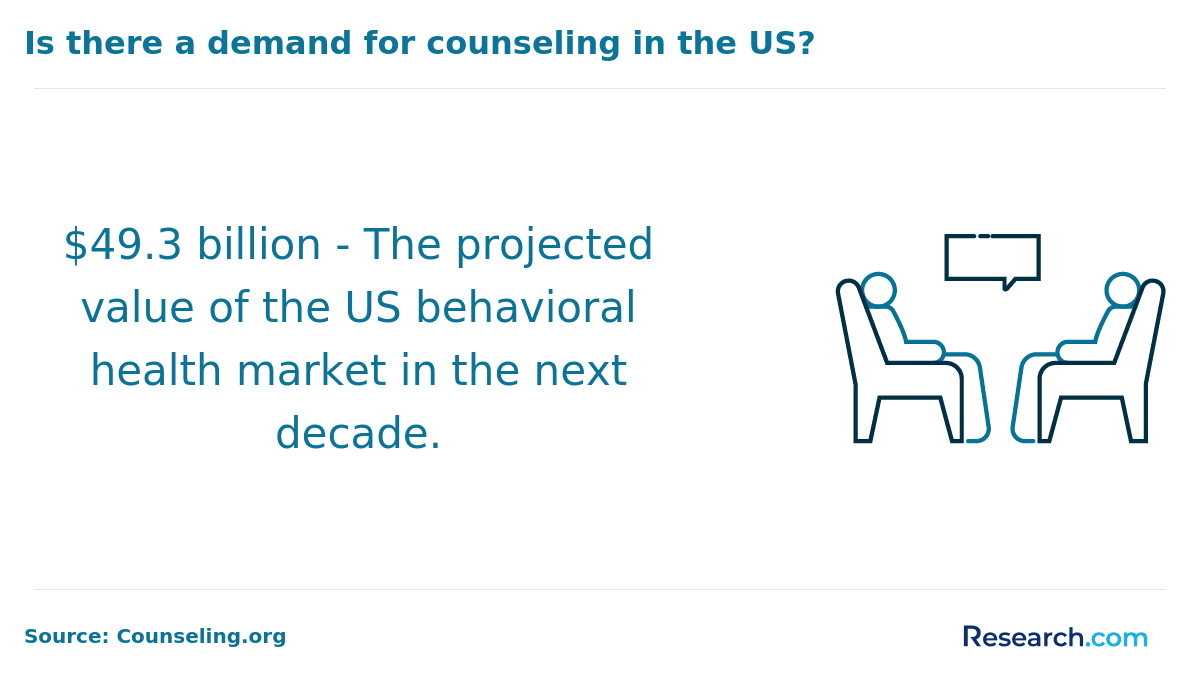
The image below reflects why local openings continue to matter: analysts project the U.S. behavioral-health market will swell to about $49 billion over the next decade. That broader demand does not guarantee any individual salary or job offer, but it does show why behavioral health remains a significant career field.
Are there counseling associations in Jacksonville?
Professional associations can help Jacksonville counseling students and licensed clinicians stay connected to continuing education, ethics updates, advocacy, referrals, and peer support. They are especially useful during graduate school and the post-graduate supervision period, when many candidates are trying to understand licensure expectations and employment options.
- Florida Mental Health Counselors Association: A key professional organization for mental health counselors in Florida, offering continuing education, licensure-related updates, advocacy, and networking.
- American Counseling Association: A national organization that provides ethics resources, publications, specialty divisions, professional development, and broader counseling field updates.
- Florida Association for Marriage and Family Therapy: A relevant association for clinicians focused on couples, families, relational therapy, and family systems practice.
Joining an association is not required to become licensed, but it can reduce professional isolation and help you learn from counselors who have already navigated the Jacksonville market. If you want to compare broader career options, this guide to jobs with counseling degree can help you see paths beyond traditional therapy practice.
Which are the most popular employers of LPCs in Jacksonville?
Jacksonville counselors work in many settings, but several employer categories stand out: healthcare systems, behavioral health centers, rehabilitation providers, universities, nonprofits, and private group practices. The right employer depends on whether you want intensive clinical work, predictable benefits, specialty training, academic-year rhythm, community outreach, or private practice growth.
- Baptist Health: Counselors may support assessment, treatment planning, individual therapy, group services, and collaboration with psychiatrists, physicians, nurses, and social workers.
- UF Health Jacksonville: As a major healthcare setting, UF Health Jacksonville can offer behavioral health opportunities connected to hospital, outpatient, crisis, or integrated care needs.
- Brooks Rehabilitation Hospital: Rehabilitation settings may need counselors who understand adjustment, disability, grief, trauma, caregiver stress, and interdisciplinary care.
- Jacksonville Behavioral Health Center: LPC-equivalent clinicians may work with depression, anxiety, trauma, substance use, crisis stabilization, group therapy, and community referrals.
- University of North Florida Counseling Services: Counselors working with college students may provide short-term therapy, workshops, wellness programming, crisis support, and referrals.
| Employer type | What to ask in the interview | Why it matters |
| Hospital or healthcare system | What are productivity expectations, documentation requirements, and crisis protocols? | These factors affect workload and burnout risk |
| Community agency | What supervision, training, and caseload support are available? | Strong support is crucial in high-need settings |
| University counseling center | How are urgent student needs handled during peak academic periods? | Demand often rises during exams and major campus stress points |
| Private group practice | How are referrals, billing, no-shows, insurance panels, and pay splits managed? | Your real income depends on more than the advertised rate |
| Rehabilitation provider | What populations and diagnoses will I see most often? | Specialized settings require specific clinical comfort and training |
What LPCs in Jacksonville Say About Their Careers
- My work as a counselor in Jacksonville has strengthened both my clinical identity and my relationship with the community. After graduating from the University of North Florida, I found meaningful opportunities in nonprofit clinics serving clients with very different life experiences. That variety keeps the work challenging and purposeful. Glen
- Jacksonville’s mix of cultures, neighborhoods, military-connected families, students, and coastal lifestyle creates a counseling environment that never feels one-dimensional. In a downtown multidisciplinary health center, I often use integrated approaches that help clients manage stressors tied to work, family, health, and place. Tony
- After more than a decade in counseling, I value Jacksonville’s combination of affordability, expanding mental health resources, and professional opportunity. I graduated from Florida State University and now supervise newer clinicians in an outpatient setting, which lets me contribute to the next generation of counselors. Aisha
Common mistakes to avoid when becoming an LPC in Jacksonville
- Assuming “LPC” is the official Florida title: Florida’s comparable license is the LMHC, so use the correct Board terminology when researching requirements.
- Choosing a graduate program based only on convenience: A nearby or flexible program is not enough if it does not meet Florida licensure standards.
- Ignoring accreditation and curriculum details: Course titles, clinical hours, and program accreditation can affect whether your application moves smoothly.
- Counting supervised hours too early: Hours may be questioned if your supervisor, setting, or documentation does not meet requirements.
- Looking only at tuition: Factor in fees, books, commuting, unpaid clinical hours, exam costs, background checks, and the opportunity cost of part-time work.
- Assuming online programs always qualify: Online counseling degrees can be legitimate, but you must verify Florida licensure alignment and local placement support.
- Waiting to network until after graduation: Jacksonville placements, supervisors, and association contacts can become future job leads.
- Expecting salary outcomes to be guaranteed: The $50,000 to $60,000 annual range is a useful benchmark, not a promise.
Key Insights
- In Jacksonville, “LPC” usually refers to Florida’s Licensed Mental Health Counselor pathway, so applicants should follow Florida Board requirements rather than relying on terminology from other states.
- The best first decision is choosing a licensure-aligned master’s program with strong clinical training, clear Florida disclosures, and practicum or internship support.
- Supervised experience is often the most confusing stage. Verify whether your pathway requires 2 years, 1,500 hours, 2,000 hours, or another current Board-defined standard before counting hours.
- Jacksonville offers counseling opportunities in hospitals, behavioral health centers, rehabilitation, universities, nonprofits, private practice, and community agencies, but pay and workload vary widely by setting.
- A typical LPC-equivalent salary in Jacksonville is approximately $50,000 to $60,000 annually, while experienced or specialized clinicians may earn upwards of $70,000 or more.
- Specializations such as substance abuse counseling, trauma work, marriage and family therapy, behavior analysis, and supervision can strengthen a career when they match real employer and client needs.
- The most avoidable licensure problems come from weak documentation, unverified supervisors, poorly matched degree programs, and assumptions about online or out-of-state coursework.
Related Articles for Nearby Cities
- 2027 How to Become a Licensed Therapist (LPC) in Orlando, FL: Counselor License Requirements
- 2027 How to Become a Licensed Therapist (LPC) in Tampa FL: Counselor License Requirements
- 2027 How to Become a Licensed Therapist (LPC) in St. Petersburg, FL
- 2027 How to Become a Licensed Therapist (LPC) in Port St. Lucie, FL
- 2027 How to Become a Licensed Therapist (LPC) in Atlanta, GA: Counselor License Requirements
- 2027 How to Become a Licensed Therapist (LPC) in Miami FL: Counselor License Requirements
- 2027 How to Become a Licensed Therapist (LPC) in Charlotte, NC
- 2027 How to Become a Licensed Therapist (LPC) in Winston-Salem, NC
- 2027 How to Become a Licensed Therapist (LPC) in Greensboro, NC
- 2027 How to Become a Licensed Therapist (PC) in Raleigh, NC: Counselor License Requirements
References:
- CounselingSchools.com. Florida counseling licensure, schools, and degree programs.
- Episcopal School of Jacksonville. College counseling information.
- Florida Board of Clinical Social Work, Marriage & Family Therapy and Mental Health Counseling. Licensed Mental Health Counselor licensing, renewals, and information.
- Florida Mental Health Licensure Services. Qualified supervisor training in Jacksonville.
- Jacksonville State University. Counselor education and professional counseling programs.
- Jacksonville University. Clinical mental health counseling program.
- Keiser University. Master’s in mental health counseling.
- Nova Southeastern University. M.S. in Counseling program.
- PayScale. Licensed Mental Health Counselor salary in Jacksonville, Florida in 2025.
- University of North Florida. Clinical Mental Health Counseling, MS.
Other Things You Need to Know About LPCs in Jacksonville
The Florida Board of Clinical Social Work, Marriage and Family Therapy, and Mental Health Counseling approves LPC licenses for Jacksonville applicants. It handles applications, licensing standards, exam requirements, and discipline for mental health counselors statewide. Local Jacksonville candidates follow the same state rules and apply through the Florida Department of Health.
In 2027, to become an LPC in Jacksonville, FL, you must hold a master's degree in counseling or a related field from an accredited institution. Accredited programs ensure you meet both coursework and practicum requirements essential for licensure.